The B1-B2 curse: why intermediate learners stall - and a 12-week reading path that breaks through
Between B1 and B2 growth can feel like glue. Why classic tools stall, the volume + scaffolding + interest formula, and a 12-week reading path - without another textbook loop.
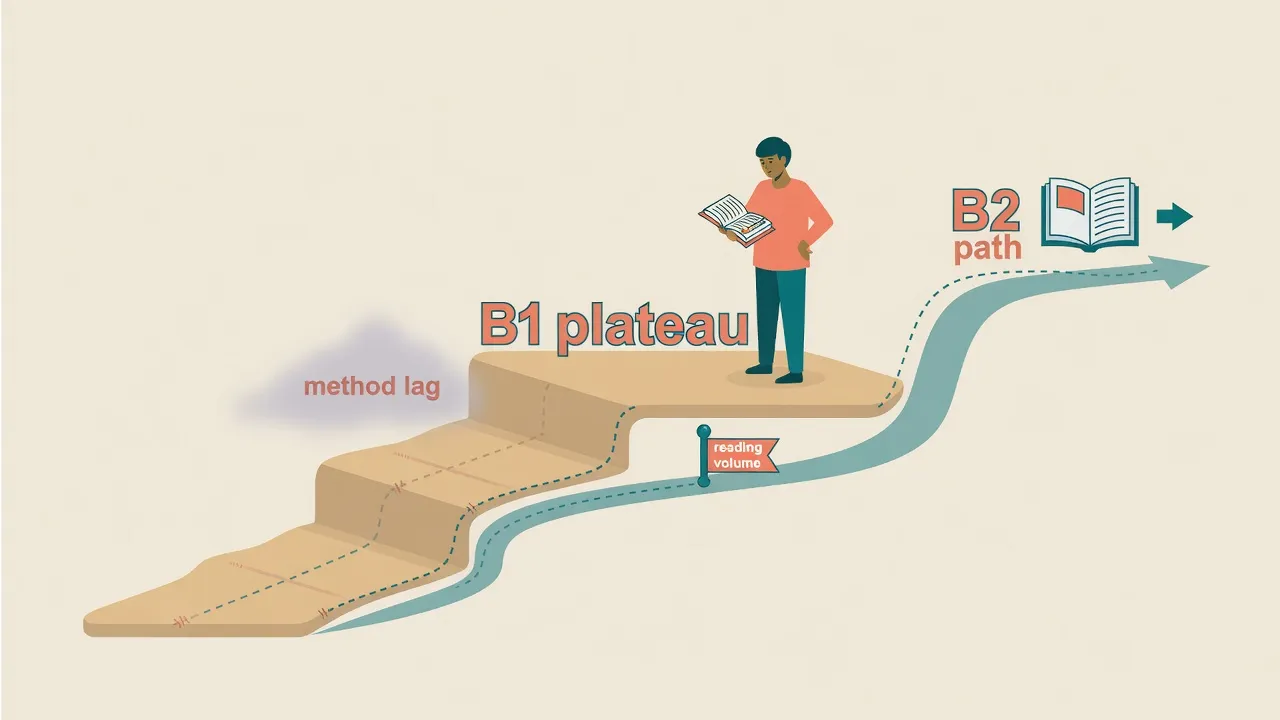
You can order food, survive small talk, and follow a show with subtitles. You passed B1. Then growth felt like glue.
New textbook units feel familiar. Apps recycle the same comfort vocabulary. A real novel still collapses after a few pages. Conversations die when natives speed up. You are not imagining it - the intermediate stall is one of the most common places adults get stuck.
Short answer: The B1-B2 plateau is usually method lag plus thin input - not missing talent. Beginner-style tools still feel productive, but you need far more mostly-comprehensible pages to move mid-frequency vocabulary. Breakthrough comes from volume of reading you can mostly follow, light scaffolding for real blockers, and topics you care about. A 12-week reading path builds stamina and denser passive vocab in your topics - not an exam certificate on day 90.
Below: three stall symptoms, why classic tools freeze you, the volume + scaffolding + interest formula, a full 12-week reading calendar, desert psychology, honest freemium limits, and FAQ.
Why the plateau hits at intermediate
Early gains are steep. The first high-frequency words unlock a large share of everyday chat. Ordering coffee, asking for directions, talking about your job - a few thousand frequent items carry a lot of that load. That is why A1 and A2 can feel almost magical. Progress is loud. Feedback is fast.
Moving from "survive" toward "comfortable with real text" is a different game. You need a long tail of less frequent vocabulary and patterns - the kind that show up in articles, books, podcasts, and unscripted talk, not only in unit 12 dialogues. Those mid-frequency items do not appear often enough in short app drills or one weekly class to stick on their own.
Paul Nation-style vocabulary research (and a lot of classroom practice) points the same way: to meet mid-frequency words often enough, you need large amounts of reading and listening in context. Flashcard bursts help at the margins. They rarely replace volume.
Stephen Krashen's i+1 idea is a useful difficulty filter: material mostly understandable, with a bit of stretch. Plateau learners usually fall into one of two traps:
- Stay too long on easy adapted content - no new fuel, comfort without growth.
- Jump into unsupported native text - too much pain, bounce back to safe apps.
Neither trap means you "started too late" or "lack talent." The stall is method lag + thin input. Your methods still look like beginner methods, but the language now requires much more contact to move the needle. For more on how big the B2 word stack can feel, see our notes on how many words for B2.
Three symptoms (check yourself)
This is a self-check board, not a medical diagnosis. If two or three hit, you are in normal intermediate territory - not proof you cannot learn.
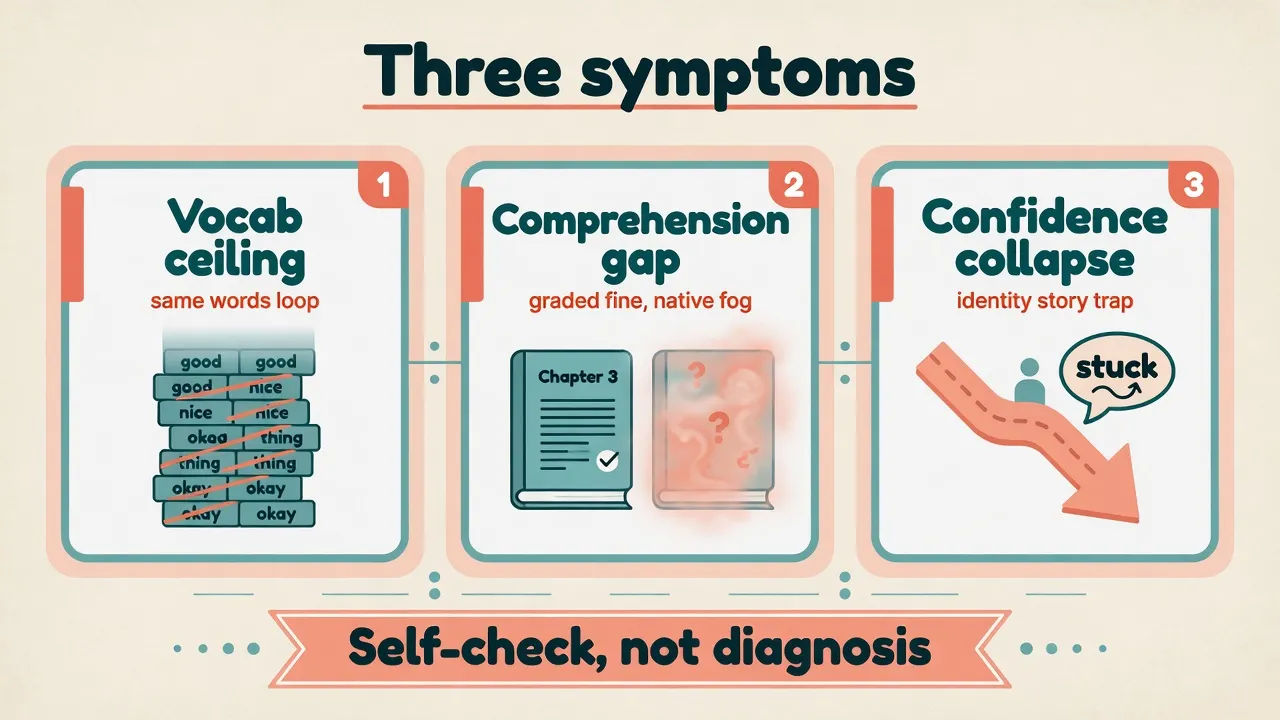
1. Vocabulary ceiling
You rotate the same few thousand words. New lists look productive on Monday and foggy by Friday. The items never reappear in stories you care about, so your brain has no reason to keep them.
Lists fail without context that matters. Mid-frequency words need reappearance in paragraphs, not only on a digital card. If every "new word" session feels like starting over, the ceiling is real - and the fix is pages, not a longer list.
2. Comprehension gap
Simplified text feels fine. Native-ish articles feel like roughly 60% fog. You get the topic, then lose the thread in the third paragraph. One more grammar PDF does not close that gap. The missing piece is hours of mostly-comprehensible input with a little stretch - not another rule sheet.
3. Confidence collapse
Stagnation stories turn into identity stories: "maybe I started too late," "maybe languages are not for me." That story is usually wrong - and it stops the only thing that works: consistent contact with slightly harder input. Perfectionism and fear of looking dumb make the same move: you shrink the challenge until nothing new enters. If that loop sounds familiar, our pieces on fear of mistakes and whether it is too late after 30 go deeper without the shame lecture.
Why classic tools stall here
You do not need to throw these tools away. You need a primary engine: lots of mostly-comprehensible authentic-ish input. Keep grammar, apps, and classes as support. Stop treating them as the whole plan.
| Tool | What it still does well | Why it plateaus you |
|---|---|---|
| Grammar books | Clarify a stuck pattern | You already "know" rules you cannot deploy fast |
| Vocab apps | Drill specific items | Weak context; weak transfer to paragraphs |
| 1-2 classes/week | Feedback, speaking | Not enough weekly word exposure alone |
| Only graded readers forever | Confidence, reading fluency | Eventually under-challenge B2-bound learners |
Flashcards and classes stay useful. They just cannot carry B1 to B2 alone. Grammar clarifies what you already half-noticed in text. Apps drill items you met in stories. Classes give feedback when you try to speak. None of that replaces hundreds of pages where mid-frequency language keeps showing up.
The breakthrough formula: volume + scaffolding + interest
One memorable triad. Remove one leg and volume dies or pain spikes.
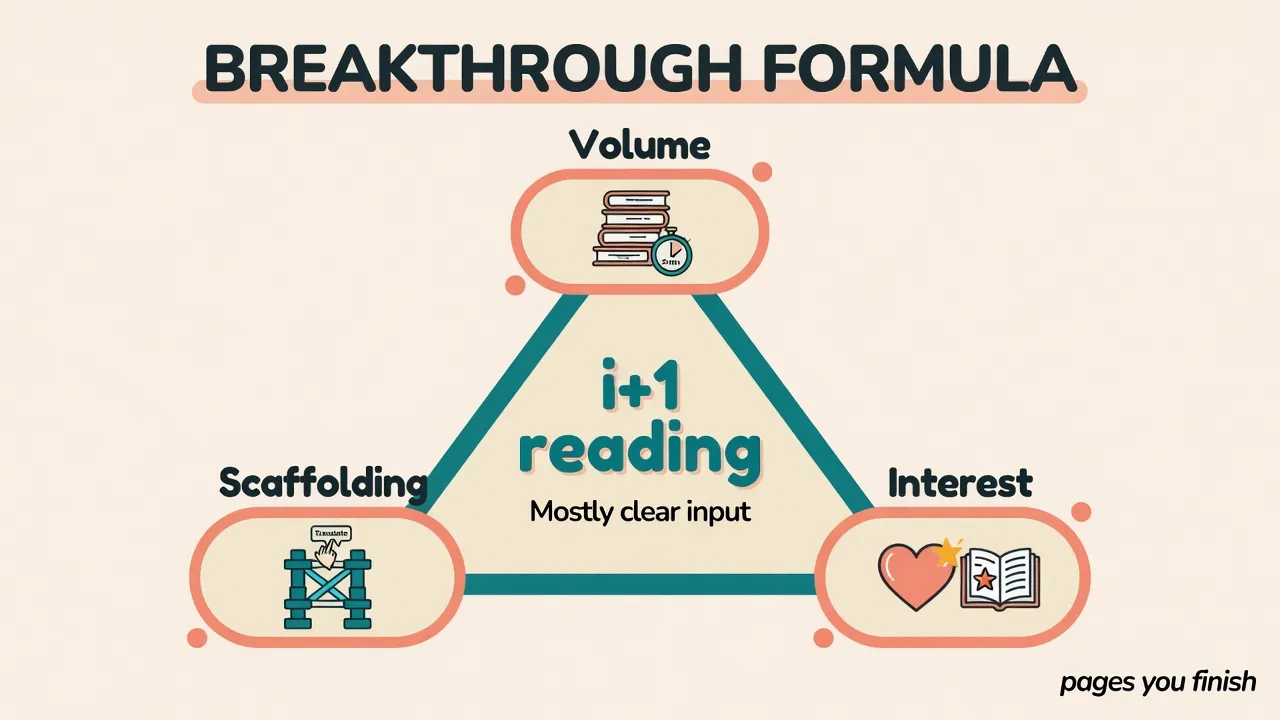
Volume
Extensive reading programs aim at large cumulative contact over months. You do not need a perfect research number to act. A practical proxy:
- 25-35 minutes most days
- Texts you finish (not endless abandoned starts)
- Weeks stacked into months
Rough intuition: an hour of reading exposes you to far more running words than an hour of slow conversation. Different benefit. Huge for vocabulary growth. No invented "X words per month" universal target here - languages, schedules, and starting points differ.
The useful habit is boring on purpose: show up, finish a page or a chapter, come back tomorrow.
Scaffolding
Native text without support can be the correct long-term target and still be the wrong Tuesday-night experience. Scaffolding means light help so you stay in the page:
- Guess first; click-to-translate real blockers only
- Easier parallel texts on hard days
- Audio after the page is somewhat clear - not instead of understanding
Scaffolding is not cheating. Quitting is worse. Constant full-sentence L1 freeze is costly (you never leave your first language). Spot help on hard words while you stay in the paragraph is reasonable. If every sentence needs a full rewrite into your L1, the text is too hard - step down.
Interest
If the book is virtuous but dead to you, you will not hit volume. Pick topics that pull: sports, crime, AI, business, hobbies, travel blogs, whatever actually keeps you turning pages. Dead-virtuous classics can wait until the engine is running.
Want five practical strategies and a 7-day kickstart first? That lives in our sister guide on the B1-B2 plateau. This page owns the full 12-week reading calendar below.
A 12-week B1→B2 reading plan
This is the spine of the method: a phased calendar, not seven tips. Expected honest outcome after twelve weeks of real contact: better reading stamina, denser passive vocabulary in your topics, less panic on native-ish pages. Not a guaranteed exam certificate on day 90.
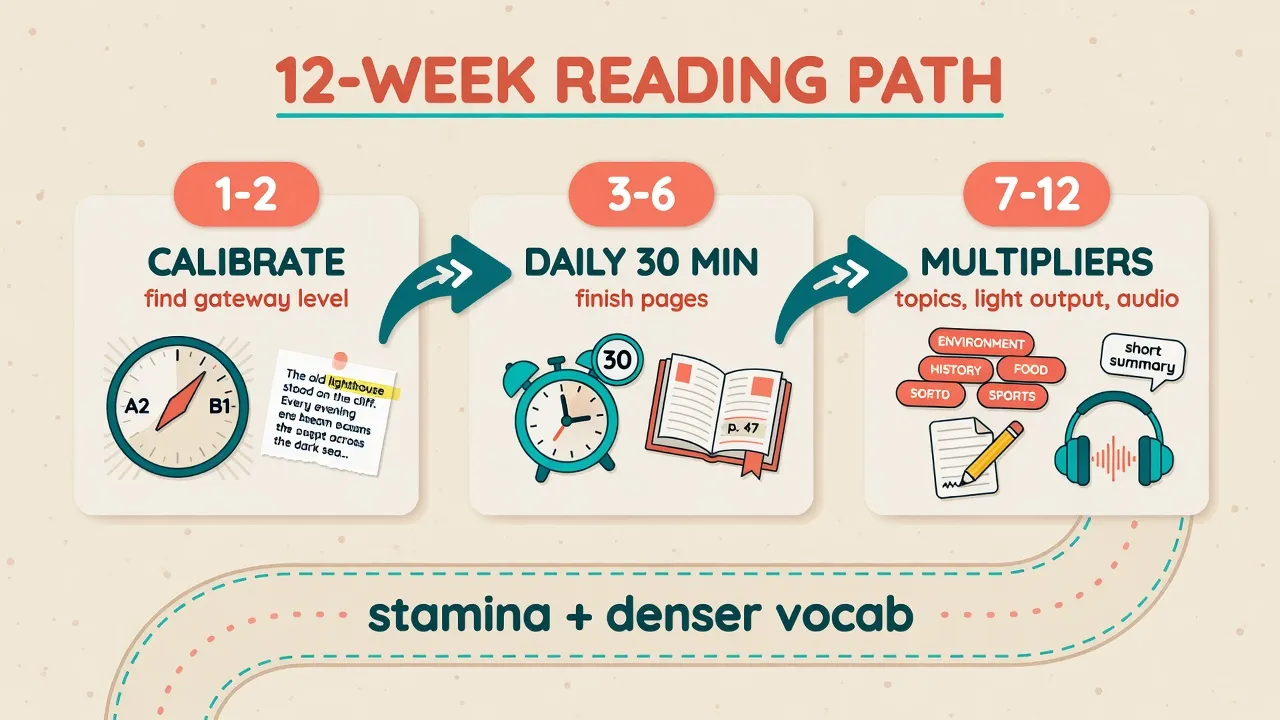
| Phase | Weeks | Focus | Success signal |
|---|---|---|---|
| Calibrate | 1-2 | Gateway level via free samples | Finish pages without total fog or zero stretch |
| Daily 30 | 3-6 | Volume habit + phrase harvest | Most days 25-35 min; texts finished |
| Multipliers | 7-12 | Topic clusters, light output, audio-after, harder genre | Fewer lookups on similar texts; faster gist |
Weeks 1-2: find the gateway level
Calibrate before you grind. Difficulty that is wrong makes either boredom or burnout look like "no talent."
Use free samples:
- English A2 sample as a warm-up if English is your target
- Spanish A2 sample if Spanish is your target
- Browse the free graded library filtered to your comfort band
Rule of thumb while reading a page: if blockers destroy the paragraph thread, step down. If you never click and never learn anything new, step up. Gateway level means you mostly follow the story, with a handful of real lookups - not zero stretch, not total fog.
If you are still building the reading habit from near zero, our guide on how to start reading is a gentler on-ramp. For this plan, assume you can already finish short simplified pages with help.
Weeks 3-6: daily ~30 minutes
This phase builds the engine. Same difficulty band most days. Finish what you start. Stack the minutes.
Practical session shape:
- Guess first from context.
- Verify real blockers only (not every unknown).
- Save 5-12 phrases per session - chunks you might reuse, not 50 isolated lemmas.
- Once a week, re-read an earlier page. Notice fewer lookups and faster gist. That is progress you can feel when exam scores are silent.
Soft product path (freemium-first) if you want scaffolding in one place:
- Free library reading with click-to-translate on blockers
- Upload an EPUB you own when you want a full book (how to use)
- Review harvested phrases via Phrases and trainers (demos: type training, phrase typing)
Honest limits (pricing):
- Freemium: about 20 word translations per day; free graded library within limits; listening often free-tier
- Reader (€1): unlimited translations for volume days
- Pro (€5/mo): full trainers when available
If freemium covers short sessions, stay free. If longer pages hit the cap, Reader is the reading step - not a requirement to start week 3. Pro is for people who want trainers after input, not a ticket to B2.
MovaReader does not host commercial novels by default and does not offer fictional "AI chapter summaries that replace reading" as a fluency path. Read the page. Reading builds recognition; speaking still needs separate practice.
Weeks 7-12: add multipliers
Once the daily habit is real, add force without inventing a new personality:
- Same-topic clusters for about two weeks (AI, sports, crime, business, cooking - your choice). Vocabulary recurs. Guessing gets smarter because the world of the text stays familiar.
- Light output: 3-5 written sentences after sessions, twice a week. Same ideas you just read. Not a novel. Not a perfection contest.
- Audio after text when available - not instead of understanding. Hearing what you already half-own locks sound to form.
- One harder genre once the first is comfortable. Stretch, then return to volume so you do not live only on hard mode.
Honest outcome recap: stamina, denser passive vocab in topics you chose, less panic on native-ish pages. Not "B2 certificate guaranteed." Not fluency by a fixed date. If your week is chaotic, protect the 25-35 minutes before you chase multipliers.
What not to do on the plateau
Guardrails, not a guilt list. Most of these feel productive while starving the input engine.
- Restart A2 grammar from zero "for foundations" for the fifth time.
- Collect 50 new Anki cards a day and skip reading.
- Jump to prestige literature as a personality project before you can finish easier pages.
- Wait to feel motivated before starting volume - motivation often follows finished pages, not the reverse.
- Believe a single app feature will skip the need for hours of contact.
If you catch yourself in one of these, step back to the formula: volume, scaffolding, interest. Restart the calendar from the phase you actually need, not from shame.
Psychology: desert, not wall
A plateau feels like a wall because beginner dopamine is gone. Early wins were loud: first conversation, first movie with subtitles, first unit completed. Mid-level progress is quieter. That quiet is not proof you stopped learning.
Think of it as a desert, not a wall. You are still moving. Feedback comes in smaller units:
- Fewer lookups on similar texts
- Faster gist of a paragraph
- Better guessing before you click
- Slightly less panic when a native page opens
Make progress visible so the desert does not rewrite your identity:
| Metric | How | Why it helps |
|---|---|---|
| Blockers per page | Same fixed sample article monthly | Compares like with like |
| Books / articles finished | Simple count | Volume made concrete |
| Same-prompt sample | One speaking or writing sample monthly on the same prompt | Shows denser language over time |
Optional orientation: the language map can give a rough visual sense of what you have marked - not a free full CEFR exam, and not a sales pitch. Use it as a dashboard, not a verdict.
The identity story ("too late," "not talented") thrives when nothing is measured. A monthly sample on a fixed prompt is boring and powerful. So is finishing three short articles in a week when last month you finished none.
How MovaReader fits (honest, soft)
MovaReader is a reading-first scaffold for intermediate volume: free graded texts, click-to-translate blockers, phrase harvest, optional trainers. It is not another textbook loop and not a certificate factory.
| Path | Truth |
|---|---|
| Freemium | About 20 word translations per day; free graded library within limits; listening often free-tier; own legal EPUB upload |
| Reader €1 | Unlimited translations for volume days |
| Pro €5/mo | Full trainers when available |
| Does | Scaffolded reading volume + phrase harvest |
| Does not | Guarantee B2 or fluency; replace speaking practice; host commercial novels by default; AI-summary-as-fluency path; free full CEFR exam |
Suggested path: all articles → samples (456, 1209) → how to use → phrases / trainers / demos → pricing.
Start free. Upgrade only if freemium limits cap the volume days you already chose to do.
FAQ
How long from solid B1 to solid B2?
Often many months of serious work - highly variable by hours per week, language distance, and whether you practice output (speaking and writing). Distrust any post that sells "B2 in 6 weeks guaranteed." A 12-week reading path can build stamina and denser passive vocabulary in your topics; it is not a universal exam certificate timeline. If someone invents one fixed hour count for every learner and every language, treat it as marketing, not science.
Are graded readers bad now? Should I stay on them forever?
No - graded readers are not bad. They are incomplete as an only diet. Use them for speed, confidence, and gateway calibration, then mix higher and more authentic texts so you do not under-challenge a B2-bound level forever. "Graded forever" is one of the classic stall patterns: comfort without new fuel.
Do I need conversation classes?
Helpful for speaking and feedback. Insufficient alone for the vocabulary wall between B1 and B2. Classes a few times a week rarely supply the weekly word exposure that extensive reading gives. Combine: input volume (pages you mostly understand) plus some live practice. Reading builds recognition; speaking still needs separate practice.
Should I stop grammar completely?
No. Use short, targeted grammar when a recurring pattern confuses you in real text. Do not restart entire A2 books "for foundations" for the fifth time, and do not let grammar study eat the reading hours that move mid-frequency vocabulary. Rules you cannot deploy at speed are not the missing piece - contact is.
Is dual-language or full translation bad?
Constant full-sentence translation can freeze you in L1 and kill flow. Spot translation of real blockers while staying in the text is reasonable scaffolding - not cheating. Prefer click-to-translate on hard words over dual-column freeze of every line. If every sentence needs a full L1 rewrite, the text is probably too hard; step down.
What if I hate reading? What can I do free in MovaReader?
The principle is massive meaningful input, not a purity test about paper novels. Try short articles on hobbies, comics or graphic novels if available, or listening-first with a transcript. In MovaReader freemium: free graded library, about 20 word translations per day, listening often on free tier, and you can upload an EPUB you own. We do not host commercial novels by default and do not sell "AI chapter summaries that replace reading" as a fluency path. Reader (€1) and Pro (€5 trainers) are optional when free limits cap volume - see pricing.
Final takeaway
The B1-B2 curse breaks with pages, not with another perfect plan document.
Today: read 20-30 minutes in a text at the right difficulty - start free at all articles - save a handful of phrases, and repeat tomorrow. The desert is crossed with steady walking gear, not with a motivational quote. No B2 certificate promise. Just contact, stacked into weeks, until the glue loosens.
Learn languages by reading!
Try MovaReader for just €1 — read texts with instant translation and interactive vocabulary training.
Free plan: 20 word translations/day and unlimited listening. Pro (€5/mo) unlocks full trainers.