Curated Resources
5 Business Spanish Books That Build Real Career Vocabulary
Five business Spanish books for corporate vocabulary: finance, startups, negotiation, leadership and economics, with levels, a reading method and a weekly plan.
You can order food, survive airport Spanish, and handle light conference small talk. Then a meeting hits flujo de caja, amortización, or contraoferta, and your confident Spanish freezes.
That freeze is a vocabulary and register problem, not proof that you "have no business Spanish talent." Business Spanish is a specialized dialect of clear Spanish: money, process, risk, people, and decisions. Apps rarely teach it deeply. Textbooks often teach it stiffly. Good books put the terms inside arguments and stories.
Plain answer. Five Spanish editions of well-known business books help ambitious B2-C1 readers build career vocabulary inside real arguments: money, product, deals, people, and macro talk. Start easier with Padre Rico, Padre Pobre, then climb denser titles when ready. This list does not promise pay outcomes. Better Spanish can support options in Spanish-speaking work; pay still depends on role, market, and results. Warm up on free graded texts if the first page feels heavy; read copies you own.
Business Spanish is domain register inside arguments - not a salary switch. Language practice from these books is not financial advice endorsement either. Mark the language. Judge the advice separately.
A note on MovaReader: it does not host full commercial business books by default. Free graded texts in the library, then upload a book file you own (for example EPUB). Plan limits are covered below.
In this guide:
- who the list fits (and who should wait)
- what business Spanish books actually train
- five titles with level, key Spanish, and a language method
- an 8-12 week plan that protects the habit
- a collocation-first method without dictionary hell
- how to use the free plan + FAQ
Who this list is for
Match the list to your level and goal, not to a title that sounds impressive on LinkedIn. Business nonfiction rewards readers who already handle basic nonfiction flow. If every page is a wall of unknowns, you will stop - and stopping kills the vocabulary gains.
| Your level / goal | Use this list if... | Skip or postpone if... |
|---|---|---|
| Strong B1 to low B2 | You already finish easier nonfiction and want light business terms | Everyday Spanish still collapses on simple articles |
| Solid B2 | You can read narrative Spanish and need domain language | You only want fiction for now |
| B2-C1 career push | You work with LATAM/Spain teams or want finance/product language | You need CEFR exam prep more than workplace register |
| C1 already | You want denser economics/strategy Spanish | You expected pure beginner business Spanish |
Quick baseline: if a random page of Padre Rico, Padre Pobre feels mostly clear, start there. If even that feels heavy, spend one or two weeks on free graded texts first: Spanish A2 sample, then All Articles. If you want a broader sense of level ranges, the language map can orient you.
If exam Spanish is your only goal this quarter, prioritize exam materials. If your pain is meetings, emails, and deals, these books sit closer to that register than another unit of sterile dialogues. For job-floor lines by role, see also Spanish for work phrases by job.
What "business Spanish books" actually train
Useful business reading trains:
- high-frequency money and company words (ingresos, costes/costos, margen, cliente, proveedor)
- decision language (priorizar, aplazar, negociar, validar)
- meeting and email register (clear, not theatrical)
- repeated collocations you can reuse in speech and writing
It does not automatically train:
- perfect accent in every region
- legal contract mastery
- industry jargon unique to one company
- "executive presence" by magic
Read for reusable phrases. Do not collect 400 isolated nouns and call it done. One finished book with weekly short output beats a spreadsheet of orphan lemmas.
Here is the ladder of the five titles - easier finance first, denser macro last:
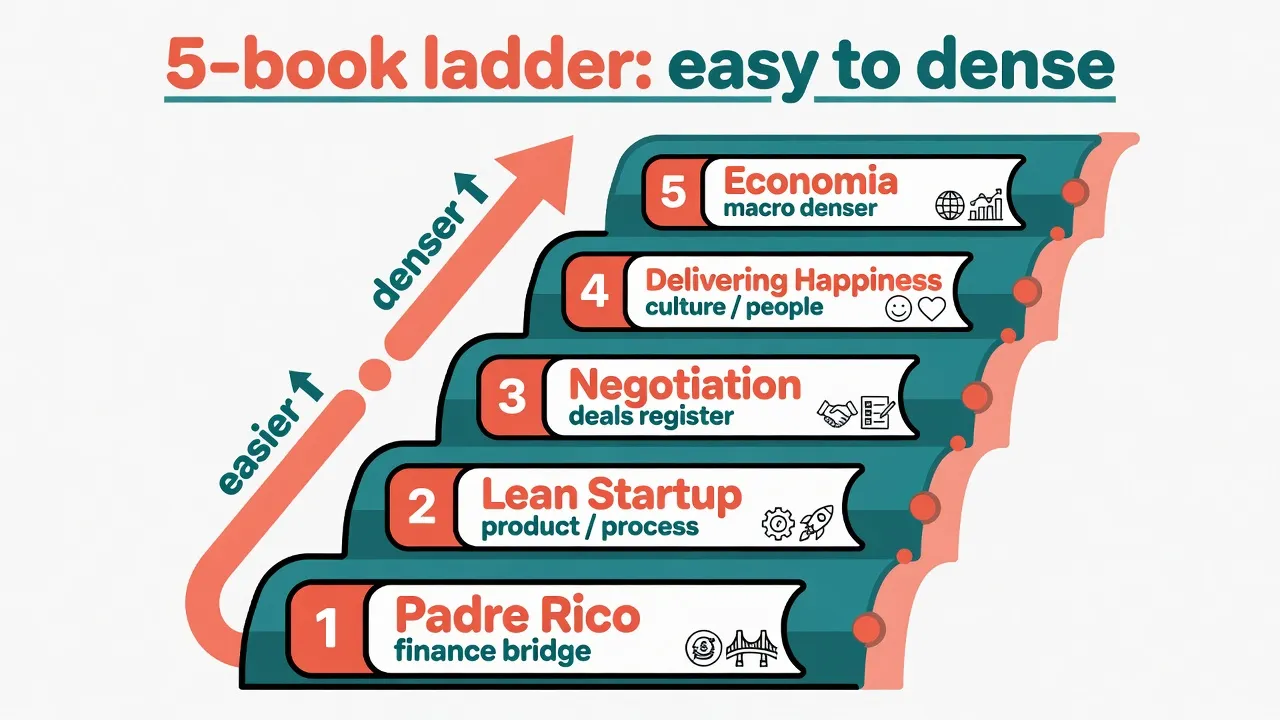
1. Padre Rico, Padre Pobre - Robert Kiyosaki (Spanish edition)
Realistic level: high B1 to solid B2
Best for: personal finance vocabulary foundation
Why it helps: Simple storytelling, repeated money concepts, low literary density.
Watch out for: The advice is debated. Use the book as language practice, not as financial advice.
Key Spanish you will meet often: activos, pasivos, flujo de caja, ingresos, gastos, estado financiero, libertad financiera.
How to use it for language:
- Read one short section.
- Save only terms that appear in your real work or goals.
- Write 3 sentences with flujo de caja / activos about a fictional small business.
- Move on. Do not build a 200-word finance dictionary on day one.
This is the best bridge book on the list when literary Spanish still feels hard but you want professional terms.
2. El método Lean Startup - Eric Ries (Spanish edition)
Realistic level: solid B2
Best for: product, startups, tech-adjacent roles
Why it helps: Dense with modern innovation vocabulary used in Spanish-speaking tech scenes.
Watch out for: Anglicisms and translation calques. Some teams say MVP, some say producto mínimo viable. Both matter.
Key Spanish and hybrid terms: producto mínimo viable, pivotar/pivotear, métricas accionables, iteración, aprendizaje validado, hipótesis, experimentos.
How to use it for language:
- Highlight process verbs, not only nouns: medir, validar, descartar, iterar.
- After each chapter, write a 4-line product update in Spanish using 5 saved phrases.
- If a chapter is abstract, skim examples and keep the core loop language.
Useful if your meetings already sound like product reviews and you want to stop translating every metric phrase in your head.
3. El arte de la negociación - Michael Wheeler (Spanish edition)
Realistic level: solid B2 to low C1
Best for: sales, partnerships, vendor deals, high-stakes talks
Why it helps: Negotiation is where missing phrases become expensive.
Watch out for: Concept clusters from English negotiation theory. Learn the Spanish forms and the common acronyms people still say in English.
Key language: contraoferta, punto de reserva, zona de posible acuerdo, alternativa, concesión, mesa de negociación, improvisar con preparación.
How to use it for language:
- Collect phrase frames, not single words: ¿Qué pasa si...?, desde nuestra perspectiva, no podemos aceptar X sin Y.
- Practice saying a calm "no" in Spanish in 3 variants.
- Role-play one email reply after each chapter: accept, reject, or counter.
If you only have time for one high-stakes register book, this category matters more than inspirational leadership memoirs.
4. Delivering Happiness - Tony Hsieh (Spanish edition)
Realistic level: solid B2
Best for: HR, team leads, customer experience, culture conversations
Why it helps: Soft-skills business Spanish that textbooks under-teach: culture, retention, brand, values.
Watch out for: U.S. company-story tone. Useful language; not a universal management system.
Key language: cultura empresarial, retención de talento, satisfacción del cliente, valores, marca, empleados, experiencia del cliente.
How to use it for language:
- Save idioms and evaluation phrases: las dos caras de la misma moneda, a largo plazo, en la práctica.
- Rewrite your team values in 6 short Spanish bullets after halfway through the book.
- Compare one customer-service paragraph with how your company actually speaks.
This book is easier than economics texts and denser with people-management vocabulary than pure finance books.
5. Economía en una lección - Henry Hazlitt (Spanish edition)
Realistic level: strong B2 to C1
Best for: policy, markets, trade, investor-adjacent reading
Why it helps: Clear macro vocabulary used in press, reports, and serious discussions.
Watch out for: Abstract argument style. Even clear economics prose can fatigue B2 readers.
Key language: inflación, subsidios, aranceles, balanza comercial, política fiscal, efectos a corto/largo plazo, incentivos.
How to use it for language:
- Read short sections, not marathon chapters.
- After each section, answer in Spanish: ¿Quién gana? ¿Quién paga? ¿Qué pasa después?
- Save contrast phrases: no solo... sino también..., a corto plazo / a largo plazo.
Put this last if your goal is workplace Spanish first. Put it earlier if you already read business news and need cleaner macro terms.
Suggested 8-12 week plan (realistic, not heroic)
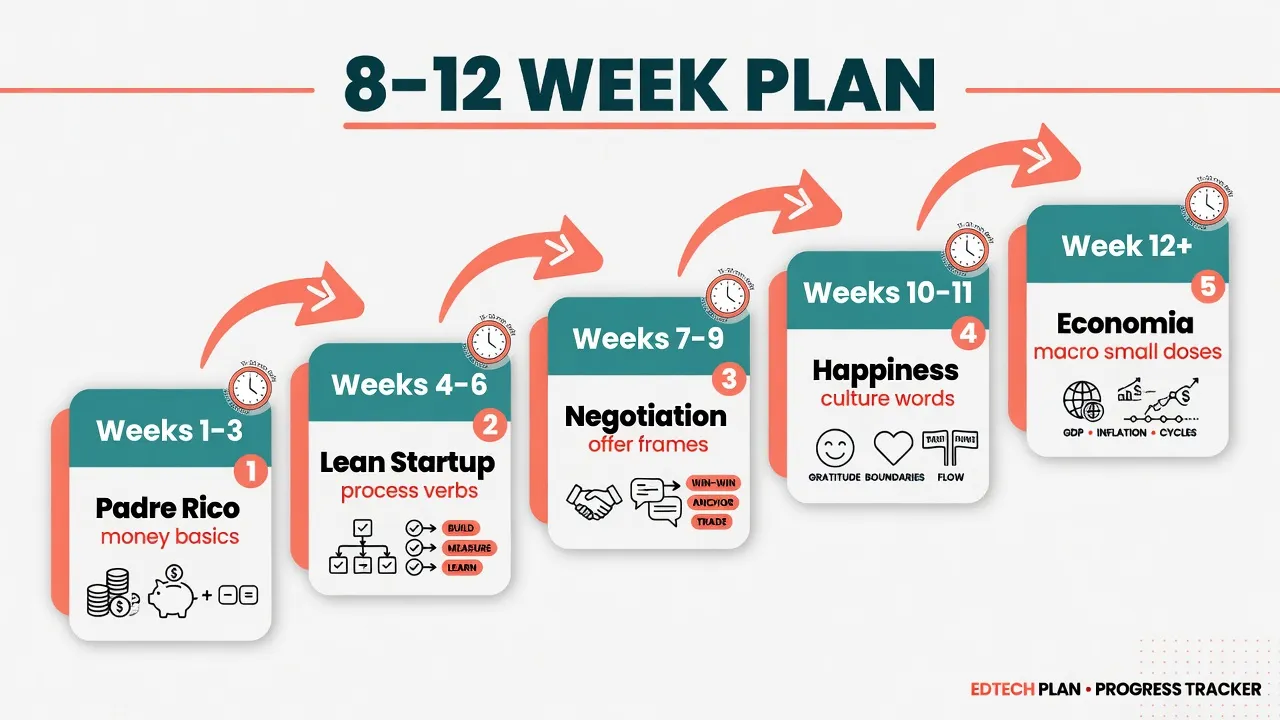
A ladder only helps if the calendar is kind. Here is a board that keeps sessions short and books finishable:

| Weeks | Book | Focus |
|---|---|---|
| 1-3 | Padre Rico, Padre Pobre | Money basics, confidence, short sessions |
| 4-6 | Lean Startup (ES) | Product/process verbs and metrics language |
| 7-9 | Negotiation book (ES) | Offer/counteroffer frames |
| 10-11 | Delivering Happiness (ES) | Culture and people vocabulary |
| 12+ | Economía en una lección | Macro register in small doses |
Rules that protect the plan:
- 15-25 minutes on weekdays beats weekend binge reading
- save 5-15 phrases per session max
- reuse phrases in one short writing or speaking task weekly
- if comprehension drops below ~70%, pause the book and do graded texts for several days
Skip a title that does not match your job this quarter. The order is a default ladder, not a law. Product-heavy roles can move Lean Startup earlier; deal-heavy roles can prioritize negotiation after a short finance bridge.
A method for business books that does not turn into dictionary hell
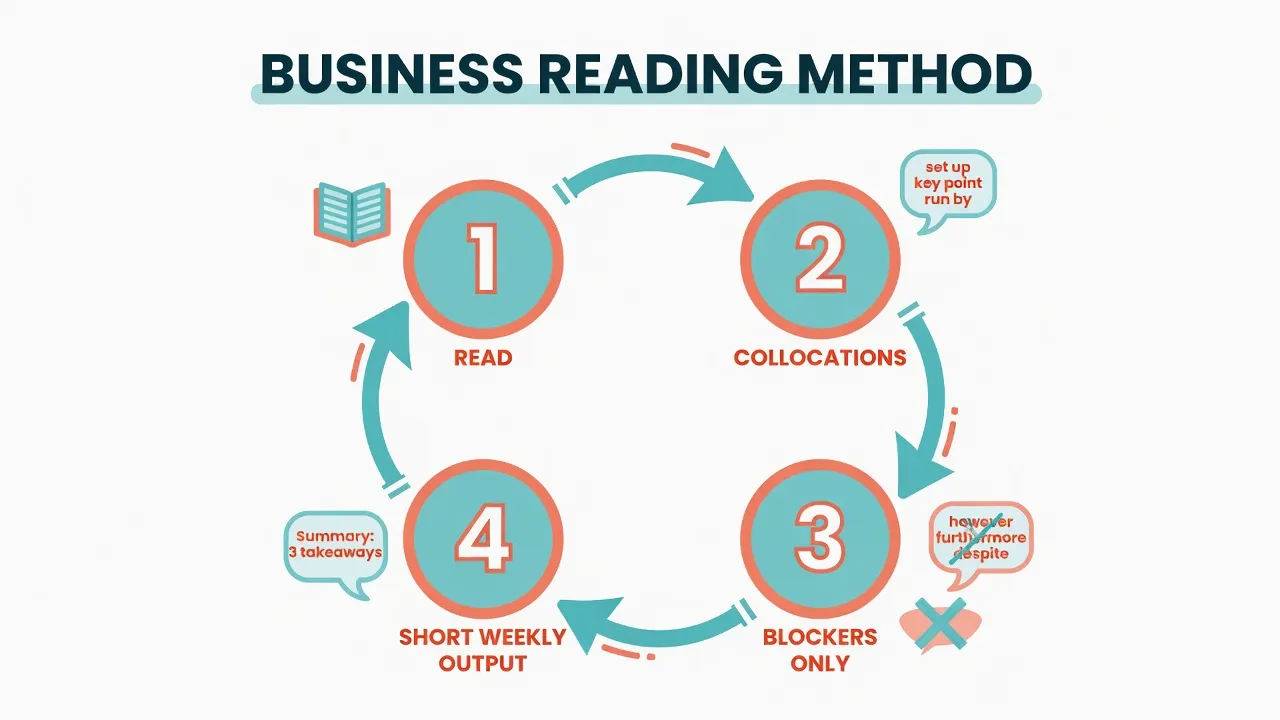
The goal is usable career Spanish, not a museum of highlighted nouns. Keep this loop in mind:
1) Separate language goals from life advice
You can learn excellent Spanish from a book whose business advice you only half trust. Mark language. Judge advice separately. Nothing on this list is a personal finance, legal, or management endorsement.
2) Prefer collocations over word lists
Better: generar ingresos, reducir costes, cerrar un acuerdo, validar una hipótesis
Worse: isolated ingreso, coste, acuerdo, hipótesis with no partner words
Collocations travel into emails and meetings. Lone nouns often stay on the page.
3) Look up blockers only
If you understand the decision and the numbers, keep reading. If one unknown term blocks the whole argument, tap it, save it, continue. Looking up every adjective kills flow and kills memory.
4) Produce a little output every week
After each book section, pick one:
- 5-sentence Spanish summary, or
- one mock Slack/email update, or
- 60 seconds of spoken summary on your phone
Input alone builds recognition. Tiny output builds usable career Spanish.
If you want more reading-stack context (apps, methods, graded vs original), see best apps to learn Spanish by reading.
How to use MovaReader for business reading
MovaReader helps with friction, not with fantasy automation. You still choose the book, save the phrases, and produce short Spanish output.
- Warm up on free graded articles in All Articles.
- Upload a book file you own when ready. See How to use.
- Tap only words/phrases that block meaning.
- Train a small set with the free Spanish vocabulary trainer and everyday Spanish phrases practice, then full trainers on paid plans.
- Know the plans: free tier includes listening and about 20 word translations/day. Reader (€1) unlocks unlimited reading translations for long files you own. Pro (€5/mo) unlocks full trainers. Details: Pricing.
What MovaReader does not do:
- host licensed commercial business titles by default (buy or borrow legally; upload files you own)
- replace industry mentors, contract lawyers, or live negotiation practice with humans
Free path today:
- Spanish A2 sample
- Word training demo
- Phrase training demo
- Upload one book you own and start with Padre Rico, Padre Pobre if the sample felt easy
FAQ: business Spanish reading
Will these books raise my pay?
No. Stronger business Spanish can improve your options in Spanish-speaking work contexts. Compensation still depends on market, role, and results.
What is the easiest business Spanish book here?
Usually Padre Rico, Padre Pobre (Spanish edition). Start there if you are unsure. It is the best bridge when literary Spanish still feels hard but you want professional money terms.
Are translated books worse than books written originally in Spanish?
For vocabulary building, good translations are still useful. You get standard professional Spanish and repeated domain terms. Later, add Spanish-language news and company documents from your field. The point is register inside arguments, not a literary purity contest.
B2 or C1 for this list?
Most readers should be solid B2 for comfort. Strong B1 can start with the easiest title and heavy support (graded warm-up, short sessions). C1 readers can move faster and add economics earlier.
Should I read finance books or negotiation books first?
- Product or startup pain: Lean Startup language first (after or instead of the finance bridge if money vocab is already fine).
- Meetings and deals pain: negotiation language first.
- Everything feels hard: personal-finance Spanish first for confidence (Padre Rico).
Default ladder if you are unsure: finance bridge → product → negotiation → culture → macro.
Can I only use flashcards instead?
Flashcards help after context, not instead of it. Business Spanish sticks better when terms appear inside arguments you care about, then get a short review. Prefer collocations (cerrar un acuerdo) over isolated nouns.
Coursebook (ELE manual) or real business book?
ELE manuals teach classroom business Spanish in a structured way. This list is different: popular nonfiction Spanish editions used as finishable domain reading with levels and a language method. Many learners need both at different times - manuals for structure, books for register in arguments.
Final takeaway
Career Spanish is not "more grammar drills with a suit on." It is repeated professional language inside real decisions: money, product, people, risk, and agreements.
Pick one book you can finish. Save fewer phrases. Reuse them in short output. Use MovaReader to reduce lookup friction on files you own and free graded texts - not as a rewrite of your compensation band.
If you want a clean start today, open a free Spanish sample, then begin the easiest title on this list with short daily sessions.
Keep reading with translations inside the text
With a free account, an unknown word translates with one tap, and the words you are learning wait for you in the trainer.
Free account: 7 days of Pro, then 20 word translations a day or a paid plan.