Reading Strategies
Contextual Guessing: How to Understand Words Without Opening Google Translate
Stop breaking every paragraph for a translate tab. Learn six context strategies, a verify-later habit, when guessing fails, and how in-page lookup should stay secondary to the story.

You are three pages into a Spanish thriller. The detective finds a clue in an abandoned bodega. Then you hit resquicio. Your thumb opens Google Translate. You type, read, switch back - and the plot thread is gone.
That reflex is normal. It is also expensive. Every app switch dumps working memory, cools the story, and trains a bad habit: unknown word equals leave the page.
Here is the short answer. You do not need every word to understand a page in a foreign language. Form a rough guess from the sentence, nearby words, tone, word parts, and story logic. Keep reading. Look up only blockers - words that break meaning, or that keep coming back. Contextual guessing protects flow. It is not "never use a dictionary." When the text is too hard or the context is empty, looking up is the smart move.
This guide gives you six field strategies, a compact clue-type cheat sheet, a guess-first workflow, the cases where context fails, and a light way to practice without wrecking the chapter.
Why the dictionary reflex slows real reading
Looking up every unknown item feels productive. Often it is decoding practice, not reading.
When you guess first, your brain does useful work:
- Scans nearby words and structure
- Activates related vocabulary
- Forms a hypothesis
- Tests it against the next clause
- Confirms or revises
A flat dictionary dump can skip that struggle. Struggle is not the enemy. Constant tab-switching is.
This does not mean "never look anything up." It means: look up blockers, not every decorative adjective. The same idea shows up in the mental habit of stopping word-by-word translation in your head: keep the language of the page long enough for meaning to land.
If you want a quick sense of how much you already know, open the language map before you force a prestige novel that will make every line a lookup.
Six context strategies that work in any language
These are field moves, not classroom labels. You can run several of them in 10-20 seconds mid-paragraph.
Here is the full board at a glance:
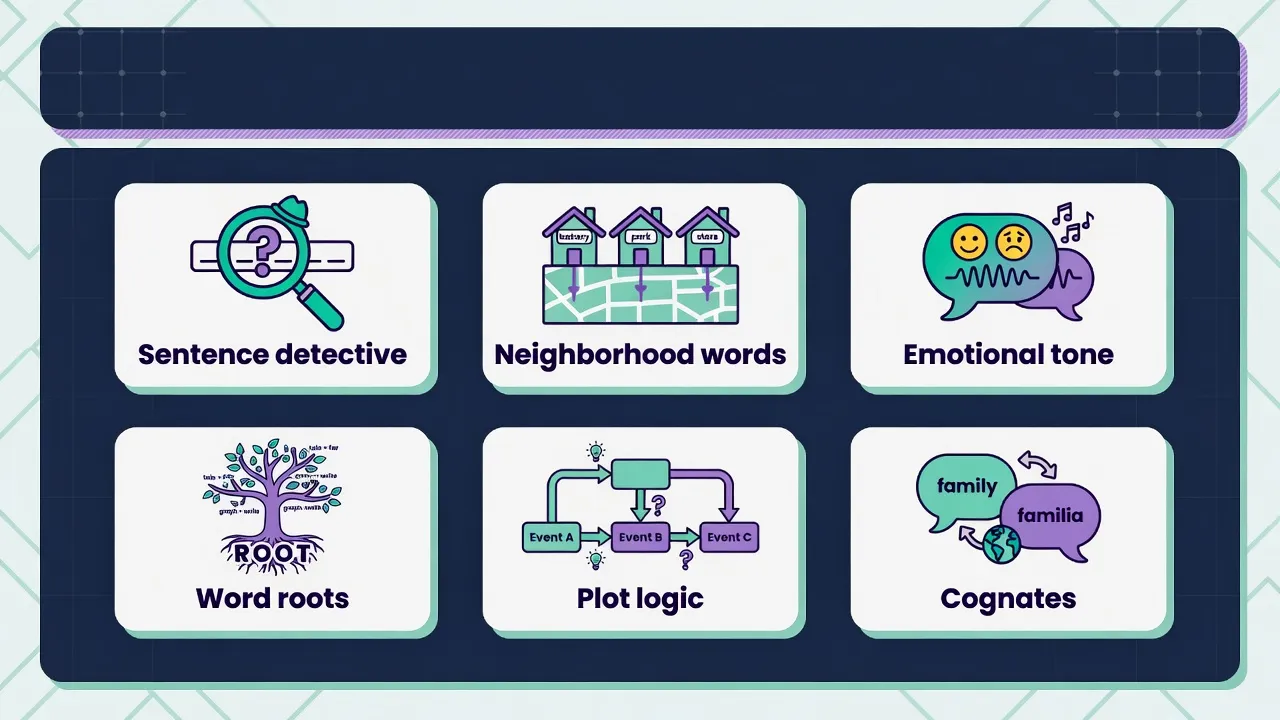
1. Sentence detective (syntax)
Even unknown words have a job in the sentence.
The old man walked with a peculiar gait, dragging his left foot slightly behind him.
After "a peculiar," you expect a noun. He is walking and dragging a foot. Gait is almost certainly a way of walking.
Spanish example:
El detective encontró un pequeño resquicio en la pared del sótano.
Small noun-thing in a wall: crack, gap, opening. Close enough to continue.
2. Neighborhood watch (nearby words)
The forest was eerily silent. Not a bird sang, not a leaf rustled. The stillness was suffocating.
Silent + no sound + oppressive atmosphere = stillness is complete quiet.
The paragraph is full of clues. One word rarely stands alone.
3. Emotional compass (tone)
She looked at the ruined painting with anguish, tears forming in the corners of her eyes.
Ruined + tears = strong negative feeling. You do not need a perfect dictionary gloss to keep reading. "Deep distress" is enough for the scene.
4. Root explorer (morphology)
Break the word:
- un + believe + able
- Spanish desconocido = des + conocido
- Ukrainian незрозумілий = не + зрозумілий
Affixes will not solve everything, but they shrink the search space fast - especially in English and Spanish.
5. Plot predictor (narrative logic)
Seeing no one, the thief quickly pocketed the diamond and slipped out the back door.
Thief + diamond + looking around + leaving = he put it away on his person. Even if pocketed as a verb is new, the plot carries you.
6. Cognate scanner
English-Spanish bridges are everywhere: hospital, impossible / imposible, transparent / transparente. Ask: does this look like something I already know?
Watch false friends later (actual, embarazada, sensible). First-pass guesses can still be useful enough to finish the paragraph.
Quick summary:
| # | Strategy | What you look at | Quick example |
|---|---|---|---|
| 1 | Sentence detective | Part of speech / job in the sentence | peculiar gait + dragging foot → way of walking |
| 2 | Neighborhood watch | Nearby words in the paragraph | silent, no bird, no leaf → stillness = quiet |
| 3 | Emotional compass | Tone, tears, joy, sarcasm | ruined painting + tears → anguish = deep distress |
| 4 | Root explorer | Prefixes, roots, affixes | un+believe+able; desconocido |
| 5 | Plot predictor | Who wants what next | thief + diamond + leaves → pocketed = put away |
| 6 | Cognate scanner | Looks like a known word | hospital, imposible / impossible |
A quick clue-type cheat sheet
Teachers often list "context clue types" (definition, synonym, contrast, and so on). Your six field strategies already use those signals. This table is a second lens - handy when you want a name for what you just did.
| Clue type | Signal | Reader move |
|---|---|---|
| Definition | means, is, which is | Take the gloss in the same sentence |
| Synonym / restatement | or, in other words, comma apposition | Swap in the simpler word |
| Contrast | but, unlike, however | Meaning is opposite of the other side |
| Example | such as, for example, lists | Infer the category from members |
| Inference | actions, consequences, scene | Build "good enough" meaning from plot |
| Morphology | roots and affixes | Shrink the search space (strategy 4) |
Example of contrast in the wild:
Unlike her gregarious brother, who talked to everyone at the party, Maria stood alone by the window.
Unlike + sociable brother + she stands alone → gregarious is roughly "outgoing / likes company."
Do not turn every page into a worksheet. Use the names only when they help you move faster.
Guess first, verify later: a workflow
The goal is a short loop you can run without leaving the page.
The loop looks like this:
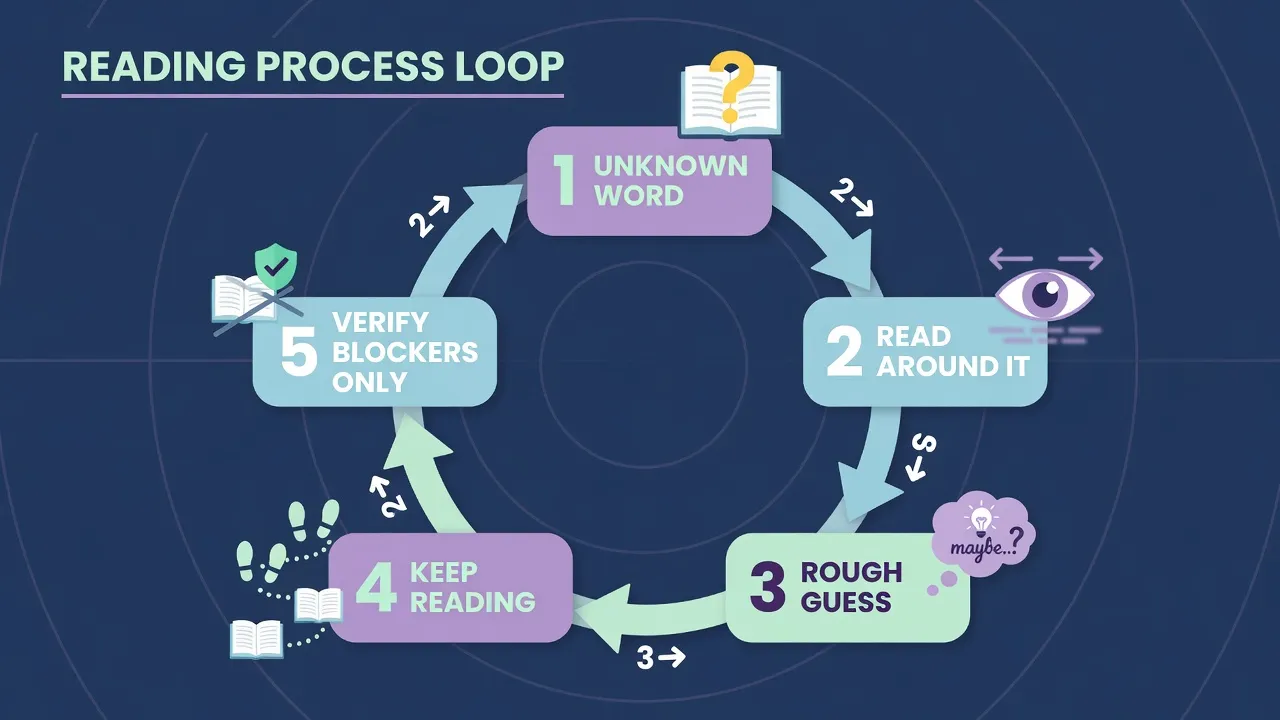
- Hit an unknown word. Do not open a new tab yet.
- Read the full sentence, plus the one before and after.
- Run the six strategies quickly (even 10-20 seconds).
- Form a rough hypothesis: "kind of building," "negative emotion," "way of walking."
- Keep reading.
- Verify only if the word is a meaning blocker, repeats, or still feels wrong after another paragraph.
Approximate is enough. You do not need "severe mental or physical pain" on first contact with anguish. "Deep distress" is fine.
Save precise verification for words that matter: the ones that keep the plot locked, or the ones that reappear three times and still block you. That is how you build vocabulary that actually serves reading instead of a random word list.
What "good enough" comprehension looks like
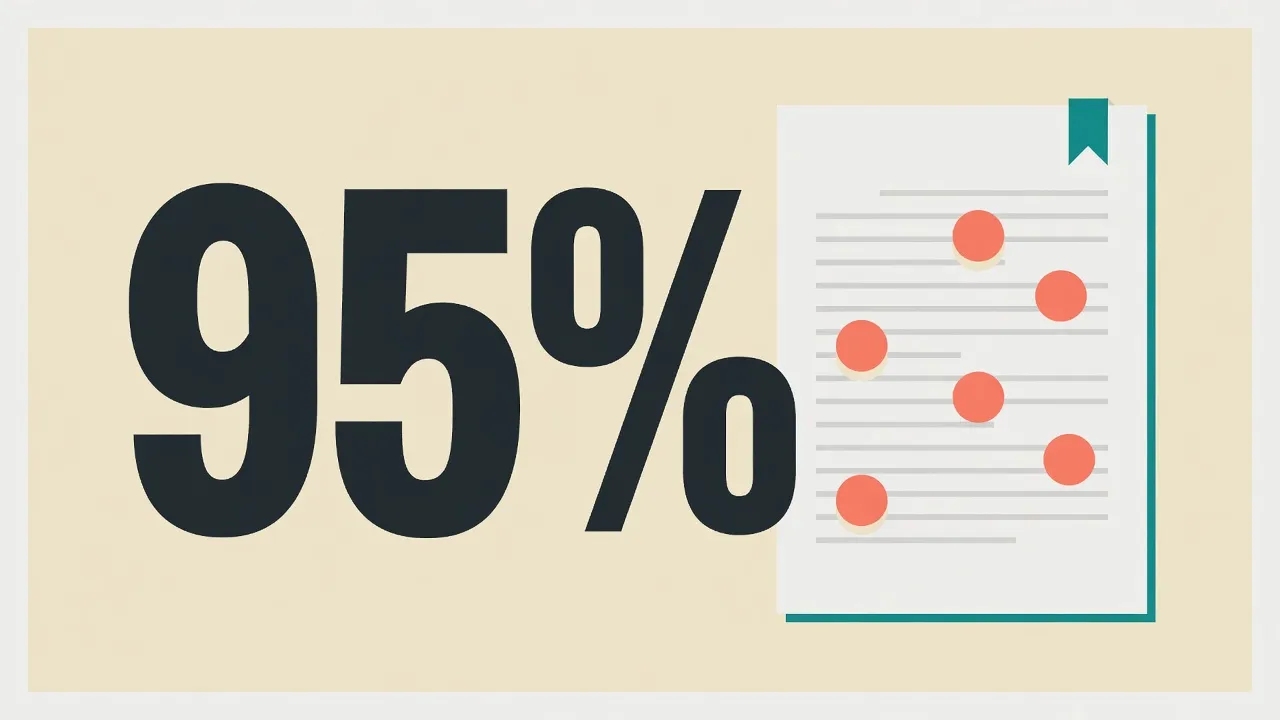
Contextual guessing only works when the page is not a wall of unknowns. Rough ranges:
| What you understand without help | How to treat the text |
|---|---|
| ~90%+ | Easy fluency practice; almost no lookups |
| ~80-90% | Ideal daily reading zone |
| ~70-80% | Stretch zone; guess more, look up fewer |
| below ~70% | Too hard for flow reading; step down a level |
The ladder in one picture:
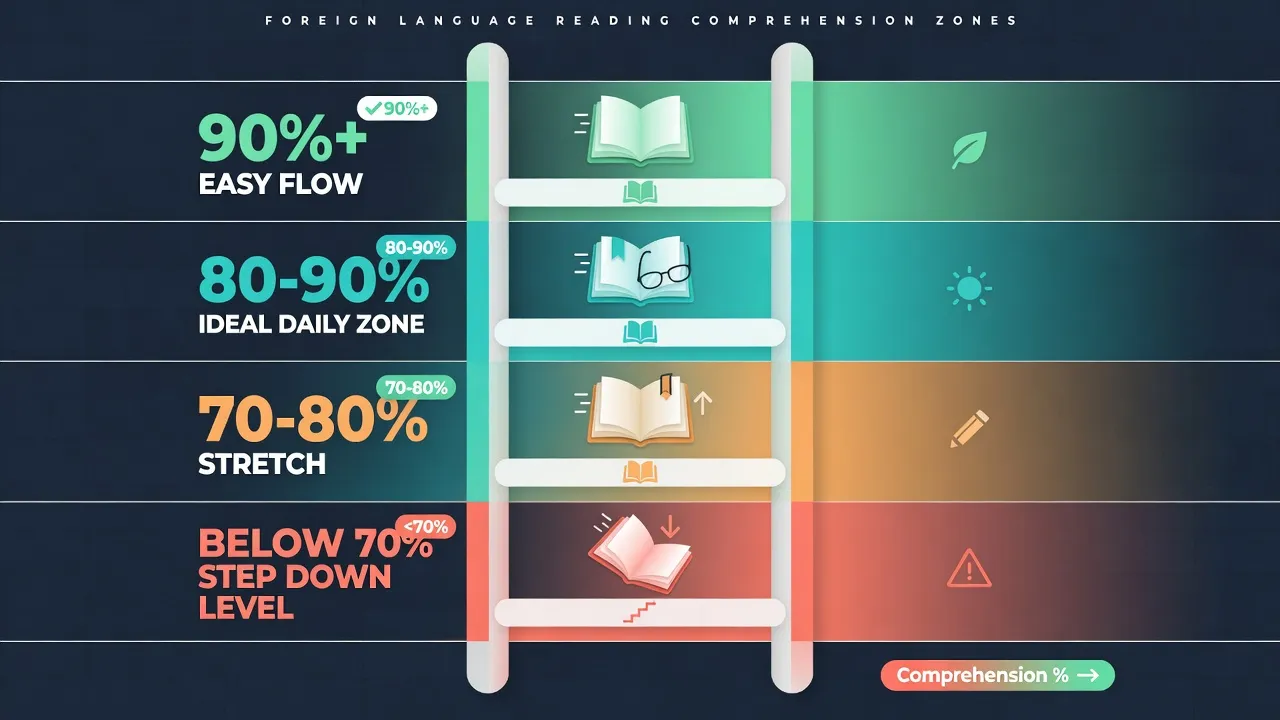
If every line needs a dictionary, you are not practicing contextual guessing. You are grinding decoding. Choose an easier text.
A practical check is the five-finger rule for book level: too many unknown words per page, and flow dies. For A2 readers, that often means adapted books first, not prestige originals.
Free warm-ups (no novel purchase needed):
If you are still building the habit from zero, start with how to start reading in English and keep pages short enough that you finish them.
When guessing fails
Context is powerful. It is not magic. Good readers know when to stop guessing.
1. Empty context. A technical term is dropped with no neighbors, no definition, no example. You are staring at a lone noun on a blank wall. Look it up or skip and mark it for later - do not invent a whole science from thin air.
2. Misleading context. Sarcasm, irony, or wrong prior knowledge can push a confident wrong gloss. The sentence "smiles" while the meaning is bitter. If the next paragraph fights your guess, revise or verify.
3. Too many unknowns. When density is high, every "guess" is noise. Five unknowns in one sentence is not a strategy problem; it is a level problem. Step down.
4. High-stakes precision. Legal wording, medical labels, exam answers that depend on the exact sense - guessing is the wrong tool. Use a dictionary or a specialist source.
The right response is simple: look up, or switch to an easier text. Pretending guessing always works is how people fossilize errors and then blame themselves for "not being good at languages."
Common mistakes
- Giving up in 2 seconds. Give the sentence a real pass first.
- Demanding perfect definitions mid-story. Reading needs functional meaning, not a dictionary entry.
- Ignoring repeat offenders. If a word appears three times and still blocks you, verify and save the phrase.
- Looking up everything "just in case." That rebuilds the dictionary crutch.
- Staying on prestige texts that destroy flow. A finished easier chapter beats an abandoned literary classic.
Practice drill (do this once)
Read and guess the bold words before checking yourself:
The old captain stood at the helm, squinting through the squall. The sails billowed dangerously, and the crew scrambled to batten down the hatches.
Reasonable guesses:
- helm - steering position
- squall - sudden hard weather
- billowed - filled and swelled with wind
- batten down - secure / fasten
Close counts. That is the skill.
Then try the same habit on a short graded page: one paragraph with zero clicks, one more with clicks only for blockers.
How MovaReader fits in
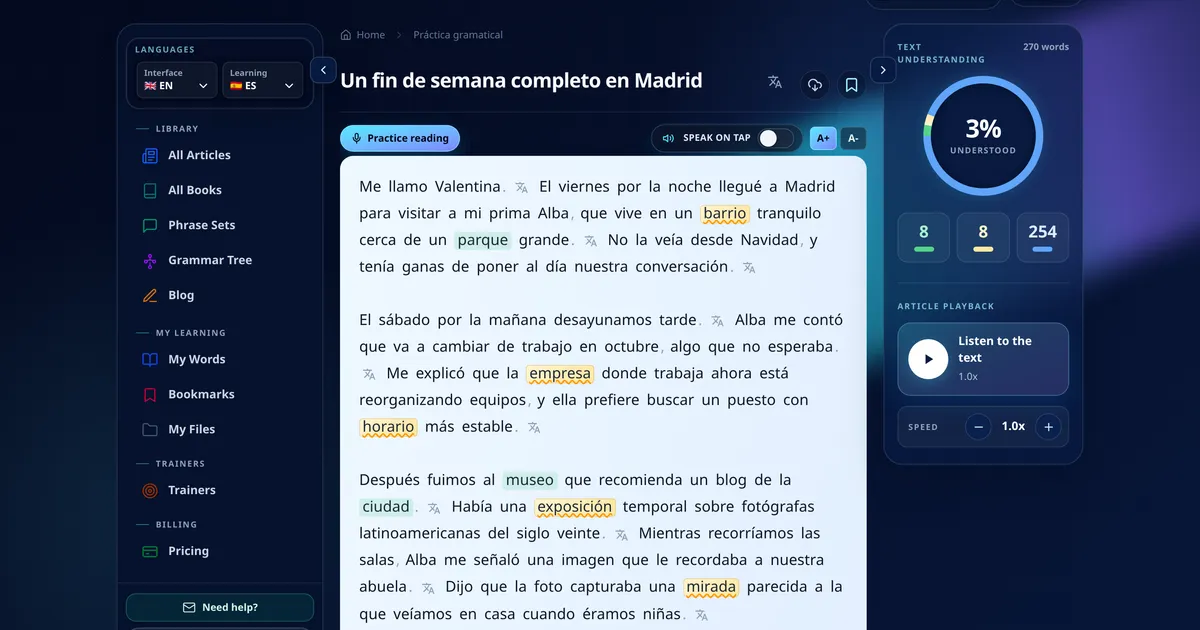
A reading tool helps when verification is fast and in-place, so you return to the paragraph immediately instead of losing the plot in a translate tab.
What MovaReader actually helps with here:
- Free graded library for level-appropriate practice: All articles
- Click-to-translate on words while you stay on the page
- Upload an EPUB or file you own when you want a longer book (How to use)
- Later, train a small set of saved phrases: demo type training, demo phrase typing, Trainers, Phrases
Plans and limits (Pricing):
| Need | Realistic plan |
|---|---|
| Test the habit without commitment | Free plan (~20 word translations/day; listening often unlimited) |
| Daily volume + dictionary without flow breaks | Reader €1/mo |
| Phrase / type trainers for saved chunks | Pro €5/mo |
Keep in mind:
- no tool is an always-perfect AI tutor for every word
- MovaReader does not host commercial novels by default
- guessing alone is not a complete fluency system
The free plan's 20 translations per day is not only a limit. It trains blocker discipline. You cannot productively click every adjective - and that is part of the lesson.
Suggested habit:
- Read a paragraph without clicking
- Click only blockers
- Save 3-10 useful phrases max
- Optionally drill them later on Pro or the free demos
A 15-minute daily routine
- 10 minutes reading at your level (graded text or your own file)
- Count roughly: guessed OK vs needed verify
- 5 minutes review of today's phrases (aloud or typing demo)
- Next week, if guesses feel easy, step difficulty up slightly
Track pages finished and lookup frequency - not XP. Momentum beats perfection.
FAQ
Is it bad to use a dictionary at all?
No. Blind refusal to verify can fossilize wrong guesses. Use dictionaries for blockers and high-value repeats. The problem is constant tab-switching, not looking things up.
Should beginners guess or look up more?
Beginners need more support and easier texts. Guessing grows as your known base grows. Prefer high-comprehension pages over heroic struggle on a literary classic.
What if my guess is wrong?
Useful. You built a hypothesis, then corrected it. That contrast often sticks better than a passive gloss you never tested.
Monolingual definitions or bilingual translations?
Both can work. Bilingual is fine at lower levels. As you advance, stay in the story longer before any gloss - bilingual or monolingual.
How many lookups per page is "too many"?
If lookups destroy your sense of the paragraph, the text is too hard or your threshold is too low. Aim to finish sections with momentum. Rough guide: if you are under ~70% known, step down rather than click every line.
Can I practice this on news as well as fiction?
Yes. News has discourse clues (cause, contrast, quote verbs). Fiction has plot and emotion. Use both. Graded short texts are ideal warm-ups.
Final takeaway
Contextual guessing is not anti-dictionary ideology. It is a reading skill: tolerate uncertainty, form a rough meaning, keep the thread, verify when it matters - and step down when context is empty or the page is too hard.
Start today on a page you can mostly understand - try a free A2 Spanish sample - and practice one rule only: guess the sentence before you click the word.
Keep reading with translations inside the text
With a free account, an unknown word translates with one tap, and the words you are learning wait for you in the trainer.
Free account: 7 days of Pro, then 20 word translations a day or a paid plan.