
The Dopamine Trap: Why Gamified Language Apps Fade - and Real Motivation
You had a huge streak. Then the confetti stopped landing. Here is why gamification fades, which metrics actually track skill, and a realistic 30-day shift toward pages you chose.
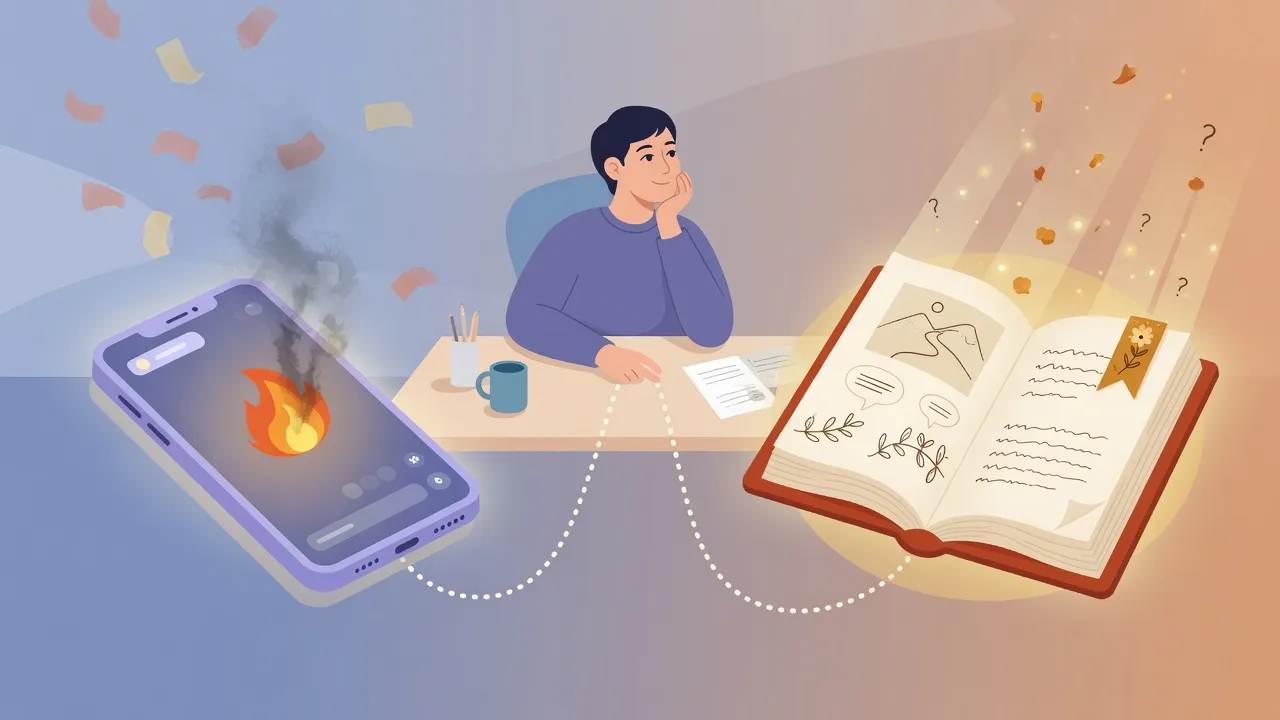
You had a 247-day streak. Thousands of XP. A league badge you half-remembered earning. Then one morning the app opened, the cartoon reminder popped up - and you felt nothing.
That is not a character flaw. It is often the dopamine trap of products built to maximize daily opens: rewards feel electric when they are new, then the pattern gets predictable, and the "lesson" quietly becomes a mini-game that happens to include vocabulary.
Millions of adults can complete units for months and still freeze on a real page without constant translation. Streaks prove you opened the app. They do not prove you can understand a page.
Short answer: long streaks and XP feel great early because novelty is high. Then hedonic adaptation kicks in, and many people keep "winning" lessons while stalling on real content. Engagement metrics are not skill metrics. Motivation that scales is competence on content you chose - reading with light help beats endless badge farming as a sole method. A 30-day detox can redirect the same discipline toward pages, not gems.
Apps as a supplement are fine. The trap is treating them as the whole method forever.
Dopamine is about anticipation, not trophies
Here is the simple version. Dopamine is less "I got the trophy" and more "I am chasing something that might pay off." It tracks prediction and pursuit, not only pleasure at the finish line.
Early app days feel great because rewards are new: sounds, streaks, gems, leagues. Your brain has not fully modeled the loop. Weeks later, the loop is familiar. Open app, micro-win, ding, close app. The same ding delivers less spark. Designers escalate - more leagues, fiercer notifications, guilt copy about broken streaks. You can end up optimizing the game while language progress stalls.
Hedonic adaptation is normal. Coffee, playlists, and confetti all fade if nothing changes underneath. The problem is when the product's success metric (daily streak) diverges from your success metric (understand a podcast, finish a chapter, write an email at work).
Think of two scoreboards:
- Their scoreboard: opens, streak length, time in app, lesson completion.
- Your scoreboard: can you follow a page you care about with manageable help?
When those two drift apart, discipline can stay high while skill feels stuck. That is the trap.
The reward loop looks simple once you sketch it:
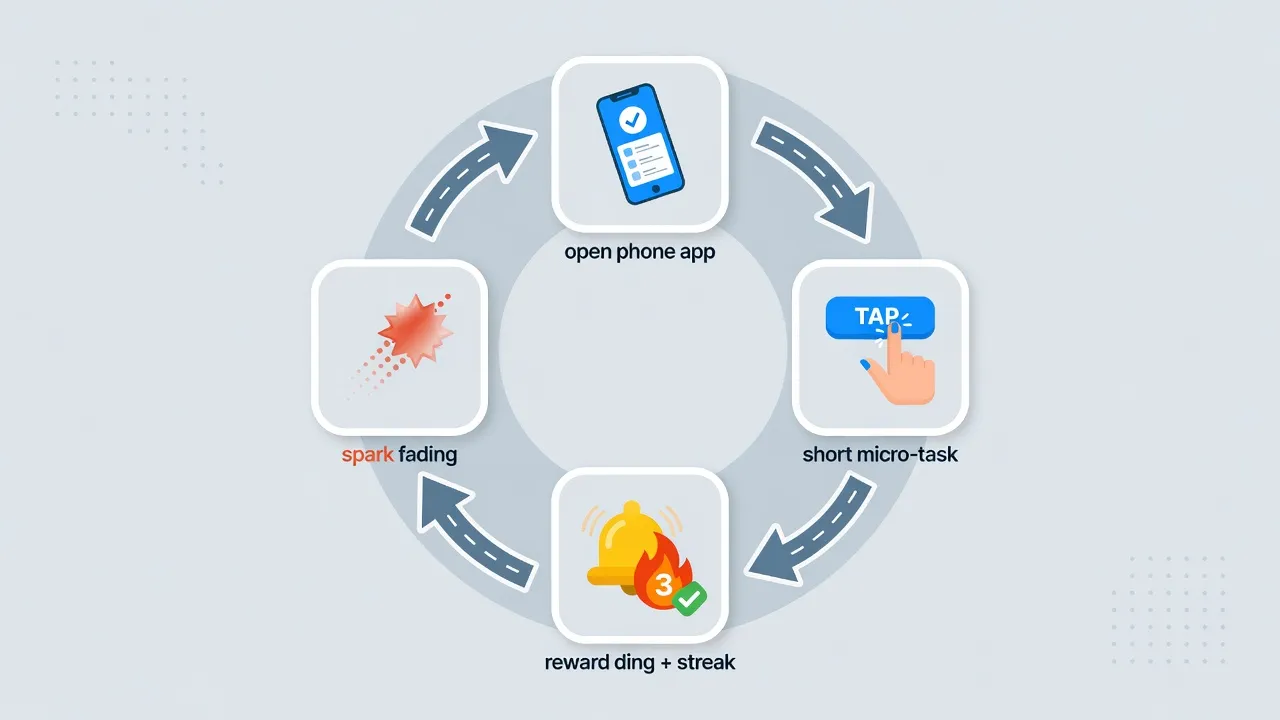
Novelty first. Predictability later. Escalation if the product needs your open rate more than your paragraph skills.
Five failure modes of cartoon-first learning
None of these mean "apps never work for anyone." They describe what happens when cartoon-first design becomes the only diet for adult learners who actually need real texts, messy speech, and honest feedback.
1. Illusion of competence
Multiple choice trains recognition under heavy scaffolding. You see the answer among options. Production - saying the phrase, writing the email, following a dense paragraph - is a different skill. Feeling correct on a quiz is not the same as retrieving language under pressure.
2. Decontextualized scraps
Five-word toy sentences rarely look like a news paragraph, a novel page, or a messy chat thread. Words stick better when they ride along with plot, argument, or emotion. Isolated scraps can pad a lesson and still leave you blank when the next sentence depends on the last.
3. Zero tolerance for ambiguity
Real language is incomplete, slangy, and rule-breaking. Sanitized app language can leave you brittle the first time a native text is messy. If every exercise has one clean answer, ambiguity feels like failure instead of normal life.
4. Streak guilt as fuel
Extrinsic pressure can work short-term. Over months, "I must not break the number" often replaces "I want to understand this." Self-determination research (Deci & Ryan and a large follow-on literature) keeps pointing at the same risk: controlling extrinsic motivators can crowd out intrinsic interest. Light version: shame is a weak long-term teacher.
5. No honest real-world feedback
An in-app score can rise while your ability to follow a newspaper paragraph does not. Adults need feedback loops tied to real tasks - pages finished, scenes followed, short summaries spoken or typed - not only league rank.
If burnout is part of your story, see also what to do when textbooks make you sick. Fear of imperfect production is a cousin problem: perfectionism and fear of mistakes.
What lasting motivation feels like
Call it competence signaling if you like jargon. In plain words: the quiet hit of I can do something today I could not do last month.
Examples that scale better than gems:
- finishing a graded article without panic
- recognizing a word you learned last week in a new article
- reading five pages of a book you chose
- understanding a scene in a show without English subtitles
These rewards change because the content changes. Story- and topic-driven reading resists boredom better than infinite isomorphic drills. You are not grinding the same confetti machine. You are following a thread you actually care about.
That does not mean every session feels magical. It means the payoff is tied to a real page, not a synthetic trophy.
Adult metrics that are not cartoon theater
If you want metrics, pick metrics that map to ability. Weak metrics are not "evil." They are just poor proxies for skill when they become the only score.
Here is the comparison board:
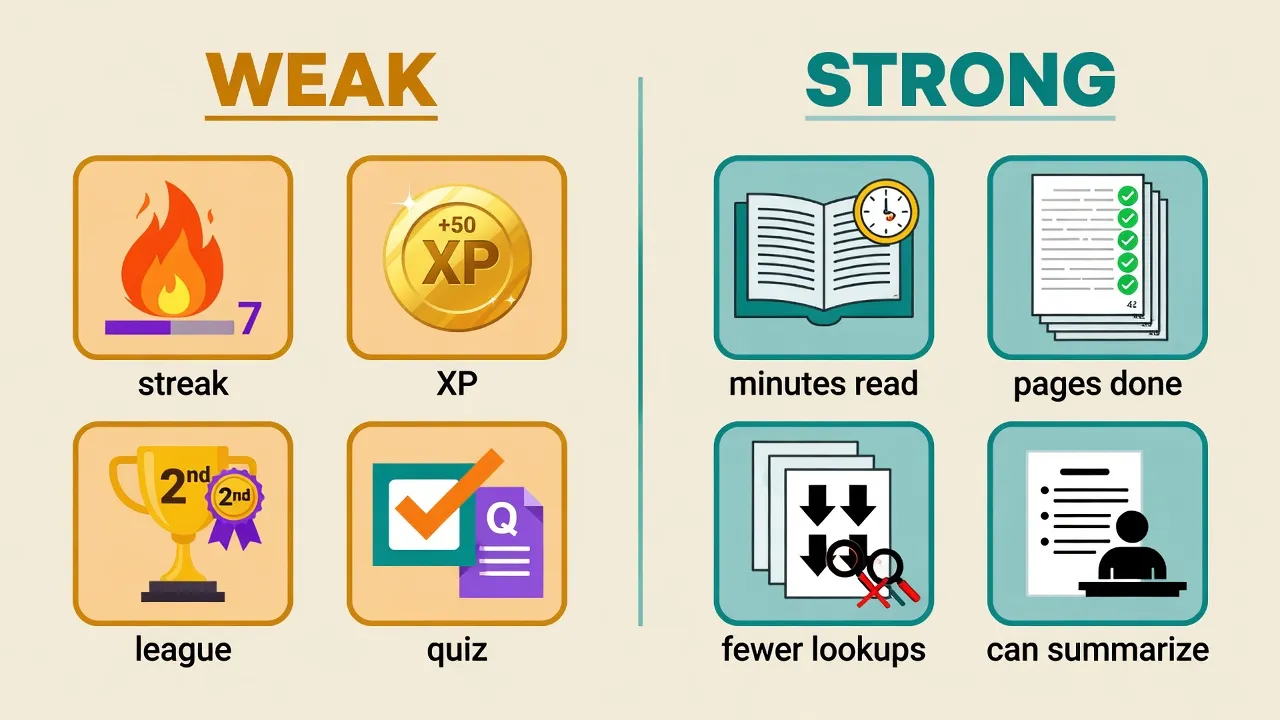
| Weak metric | Stronger metric |
|---|---|
| Day streak | Days you read 15+ minutes of real text |
| XP | Pages / articles finished |
| League rank | Lookups per page trending down on similar texts |
| Perfect lesson score | Can summarize a page in 3 sentences |
You do not need a fake "you understand 71% of this novel" oracle to start. A simple notebook line works: Book X, page 40, ~8 blockers today.
Want a rough vocabulary orientation later? The language map is a compass, not a free CEFR exam. Mark what you actually know. Do not treat a color fill as a diploma.
Why reading is a strong replacement habit
Reading (and listening to meaningful content) gives you:
- volume of patterns in context
- an emotional or intellectual reason to continue
- repeated vocabulary across chapters and topics
- a natural difficulty dial (choose easier or harder texts)
That is why a page you chose beats another isomorphic drill as a core habit for many adults. Apps can still warm you up, teach an alphabet, or drill a stubborn form. They just should not own the whole calendar forever.
Krashen's comprehensible input idea is a practical filter: stay mostly understanding, keep a bit of stretch. It is a guideline for choosing material, not a promise that "input alone always equals full fluency." Deeper background: Krashen and comprehensible input.
If English graded fiction is your next step, easy English books for A2-B1 can help you pick something finishable.
30-day detox protocol (realistic)
This is not a purity challenge. You are not "banned" from every app forever. You are redirecting discipline toward pages for one month and measuring something real.
The ladder in one glance:
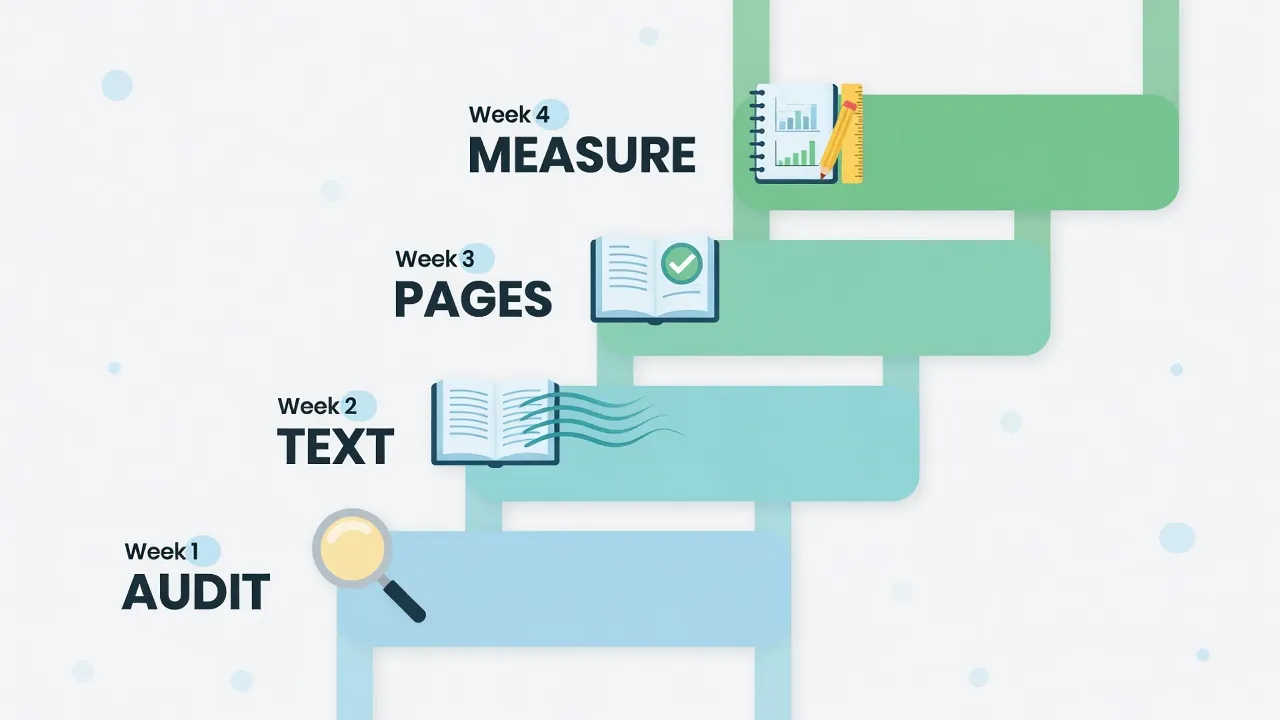
Week 1: audit without self-hate
Open your app stats. Ask one honest question: can you read a page of real content you care about with manageable help?
If the answer is no, the tool trained something else - usually quiz performance and habit loops. That is useful information, not a moral verdict.
Keep the app only if it still serves a narrow job (alphabet, absolute beginner phrases, a specific drill). Stop treating it as the whole method.
Done looks like: a clear yes/no on "can I handle a page I care about with light help?"
Week 2: pick one real text stream
Choose content you would read in your native language: tech blog, thriller, sports, psychology, travel. One stream beats five abandoned samples.
Paths that work in MovaReader:
- Free graded library: All articles
- Samples: ES A2, ES A1, EN A2
- Later: upload an EPUB you own (How to use)
Product honesty: MovaReader does not ship licensed commercial novels as built-in free library titles. You get free graded library texts plus your own legal files. Learning targets are English and Spanish.
You do not need our product to care about a text. You need a page you want to finish. If a paper book and a paper dictionary work for you this week, use them.
Done looks like: same topic or series for most sessions, not random shiny tabs.
Week 3: replace streaks with pages
New daily definition of done: I read N minutes / N pages of real text.
While reading:
- guess first
- click-to-translate only blockers
- save 5-10 phrases max (more is usually noise)
Freemium limit to know: about 20 word translations per day, with listening more open. When longer sessions need more volume, Reader is €1/mo. Full trainers are Pro at €5/mo. See Pricing. You can start the detox on free graded texts without buying anything.
Done looks like: a daily page or minute goal, not a gem count.
Week 4: measure something real
Re-read a page from day 1 of week 2. Note blockers. If the same class of text feels lighter, that is your dopamine - earned.
Add a tiny production step twice a week: speak or type a short summary of what you read. Demos if you want low-friction practice: type training, phrase typing. Full set: Trainers.
Optional orientation check on vocabulary you have actually marked: language map. Again, compass - not a free official exam.
Done looks like: fewer blockers on a familiar text type, plus two small summaries that week.
| Week | Focus | Done looks like |
|---|---|---|
| 1 | Audit without self-hate | Can I read a page I care about with manageable help? |
| 2 | One real text stream | Same topic/series; graded free library or own EPUB |
| 3 | Pages not streaks | Daily: N minutes / N pages; guess first; few phrase saves |
| 4 | Measure something real | Re-read week-2 page; fewer blockers; tiny summary 2×/week |
Motivation flywheel (the non-mystical version)
You do not need a motivational speech. You need a loop that feeds itself after the badge novelty dies.
- You choose interesting content → easier to show up
- You understand a bit more each week → competence signal
- Story or topic pulls you forward → more minutes
- Vocabulary recurs in context → less fragile memory
- You finish something real → identity shifts from "app user" to "reader of X language"
This still takes months. It is just less likely to collapse when the confetti stops sparkling.
If you miss a day, reopen the page. Do not reopen the shame counter.
FAQ
Are all language apps useless?
No. They can teach basics, build a tiny daily ritual, or drill specific forms. They fail when they become the only input forever and never meet real pages, chats, or speech.
Is gamification always bad?
No. Points on pages read or phrases reviewed from your books can help. Points on endless toy sentences - when that is the whole method - are the risky pattern.
What if I get bored of reading too?
Switch topics, shorten sessions, mix listening, or drop difficulty. Boredom often means wrong text or too hard, not "reading does not work."
Can I keep a streak for reading?
Yes - streak the habit of opening a text, not the app's gem count. Do not let the number become the goal. After a break, reopen the page, not the shame counter.
How hard should the book be?
If you need a dictionary every other sentence, step down. Daily reading should feel effortful but finishable: mostly understood, with a bit of stretch.
Does MovaReader "fix" motivation?
No tool fixes motivation. A tool can reduce friction - in-page translation, trainers built from phrases you met - so good intentions survive a tired Tuesday. Freemium is about 20 word translations per day; Reader is €1/mo for more volume; Pro is €5/mo for full trainers. Free graded library plus your own EPUB. English and Spanish learning targets only. No fluency guarantees.
Curious enough to try a free graded page? Register when you want saved progress; or start from all articles and see if fifteen minutes feels different from another league match.
Final takeaway
If your discipline was real but your Spanish or English still cannot survive a page, do not trash the discipline. Redirect it.
This week:
- Audit one app: is it teaching basics, or is it the whole method by accident?
- Open one free graded article (or a sample like EN A2 / ES A2).
- Read for 15 minutes. Save five phrases. Skip the guilt owl.
- Write one notebook line: text, page, rough blocker count.
Motivation that lasts usually looks like competence on content you chose - not another league promotion.
Learn languages by reading!
Try MovaReader for just €1 — read texts with instant translation and interactive vocabulary training.
Free plan: 20 word translations/day and unlimited listening. Pro (€5/mo) unlocks full trainers.