Vocabulary
The Ebbinghaus Forgetting Curve: How Spaced Review Helps Vocabulary Stick
You can nail a word list today and lose most of it within a day. What the forgetting curve really shows, and how spaced review plus reading keeps words usable.

You spent an hour on fifty new words. The quiz felt easy. Twenty-four hours later you remember a fraction. A week later, fewer still.
That pattern is not a personal moral failure. It is close to what Hermann Ebbinghaus measured in the 1880s: memory for new material drops fast at first, then more slowly. Language teachers call the idea the forgetting curve - a useful model of that steep early drop that flattens when you re-meet words, not a law that locks vocabulary in place.
Forgetting new words fast is normal biology, not proof you lack talent. Ebbinghaus measured that early drop with nonsense syllables - classic delay bands are a useful order-of-magnitude picture, not clinical gospel. Spaced review (retrieve soon, then stretch the gaps) works better with extensive reading as natural re-exposure and a small phrase list - not a dashboard that auto-manages every lemma. The goal is words that stay usable longer through repeated meaningful contact, not magic memory from one app streak.
Here is the path through this guide: what the curve really shows, spaced review in plain language, why pure flashcards burn out, reading as natural spacing, what to skip, a week of list-cram versus context, five rules, a short stop list, then a simple loop you can actually run.
What Ebbinghaus showed
Ebbinghaus memorized lists of meaningless syllables and tested himself after delays. His materials were artificial - not words inside a story, a chat, or a news line. Still, the shape he found is a solid mental model for learners: steep drop early, then slower fade.
Classic textbook summaries of Ebbinghaus-style delays look roughly like this - treat them as a picture of scale, not clinical precision:
| Delay | Approximate loss (order of magnitude from classic summaries) |
|---|---|
| ~20 minutes | large early drop |
| ~1 hour | more than half often gone |
| ~1 day | roughly two-thirds lost without review |
| weeks | remaining memory more stable, but not locked in place |
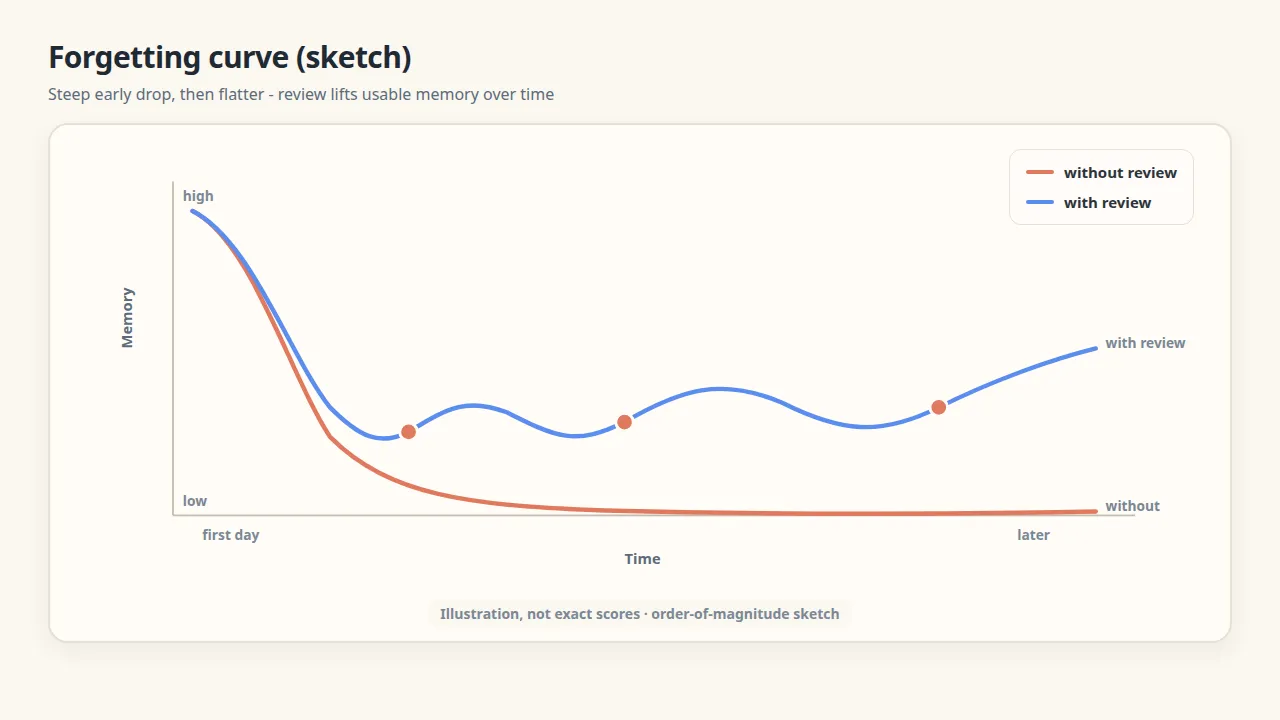
Exact percentages vary by material, person, and method. Do not treat a viral graphic as gospel. The durable lessons are simpler:
- New, poorly connected information fades fast.
- Each successful review slows the next fade.
- Spacing reviews beats massed cramming for long-term use.
- Relearning is cheaper than first learning - that savings is why spaced systems still help even when you blank between sessions.
For vocabulary, the implication is blunt: a list "learned" on Monday is not ownership. Ownership is surviving Tuesday, next week, and a conversation next month.
Spaced repetition in plain language
Spaced repetition (SRS) means you review an item soon after first learning it, then after longer gaps if you still recall it. Think of the schedule as a seatbelt, not a religion.
A learner-friendly ladder (not a sacred algorithm):
- Same day or next day
- ~2-3 days later
- ~1 week
- ~2-4 weeks
- Later only if the word still matters and feels weak
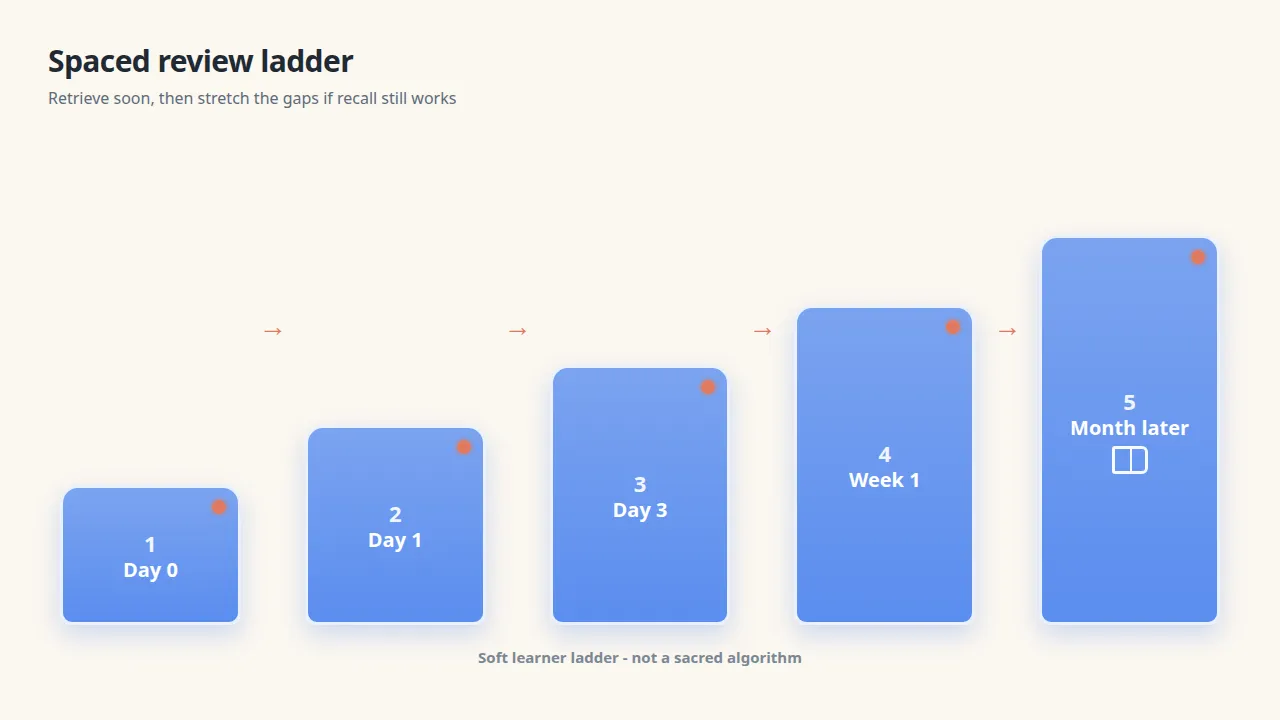
Why longer gaps help: retrieval after some forgetting is effortful, and effortful successful recall strengthens the memory more than easy, back-to-back cram. That idea sits next to the testing effect and decades of spacing research in cognitive psychology.
Meta-analyses support spacing for durable learning across many domains. That does not mean "200% better for everyone always," or vocabulary with zero work. It means: if you care about use weeks later, space reviews; do not only cram the night before a quiz.
The schedule is the seatbelt. Reading supplies much of the engine - next sections show why.
Why pure flashcard SRS still fails many learners
Apps like Anki implement spacing well. Many people still quit. The problem is rarely "the algorithm was wrong." More often it is how thin the encounters feel.
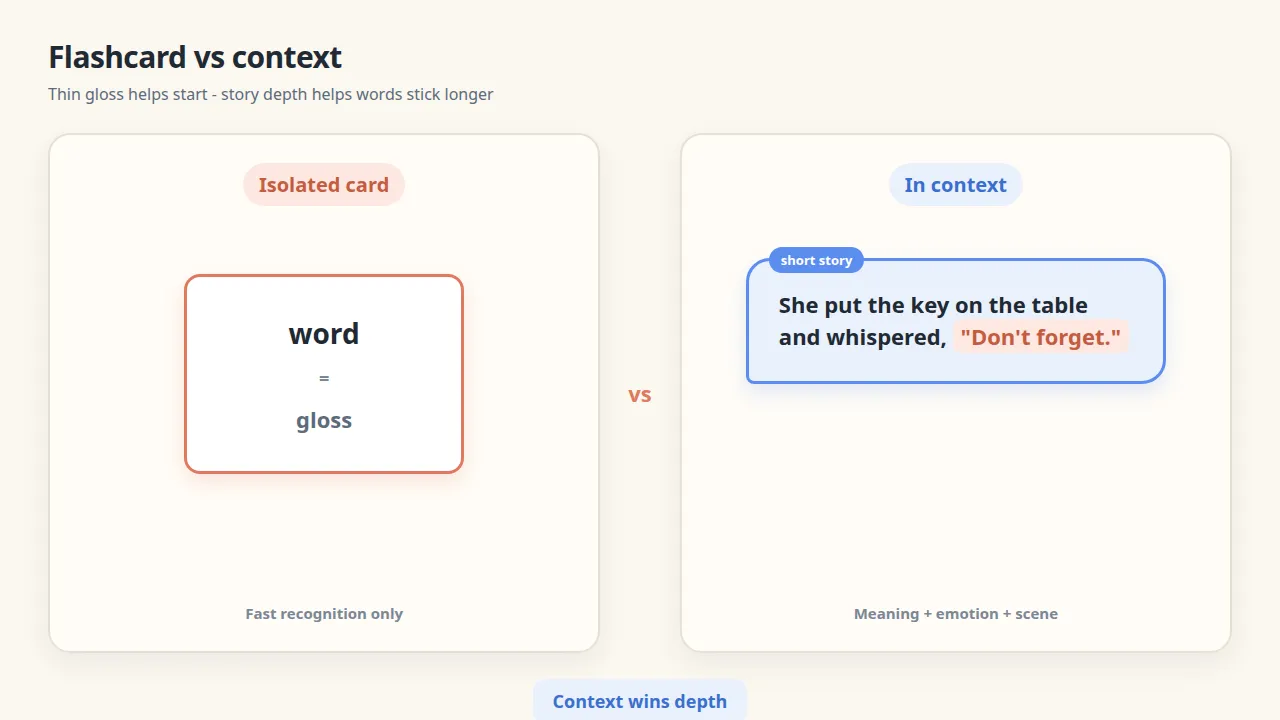
- Context stripped away - a bare gloss is thinner than the same word in a real scene.
- Review feels like unpaid work - motivation dies even when the schedule is correct.
- Backlog spiral - miss a few days, face 200 due cards, avoid the app.
- Recognition is not production - knowing a translation is not saying or writing the word when you need it.
Shallow flips (see word, flip card, mark Good) build weaker traces than deeper encounters - plot, emotion, paraphrase, your own sentence. So the goal is not "ban flashcards." Small phrase cards from reading still count. Aim for deeper encounters plus spaced retrieval, not only orphan lemma factories.
Reading as natural spaced exposure
Extensive reading creates accidental SRS for high-frequency words and structures. Everyday verbs, discourse frames, and topic vocabulary from genres you actually enjoy reappear across chapters and articles - in any target language you are working on.
Vocabulary research (Nation and others) often talks about the need for multiple meaningful encounters before a word moves toward solid knowledge - commonly discussed in a ~10+ ballpark, depending on the word and the learner. There is no single magic number. Plan for many meetings, not one heroic session.
Strengths of reading-based re-exposure:
- Varied contexts (richer meaning networks)
- Emotional and story glue
- You keep showing up because the activity is interesting
Limits of "just read":
- Rare words may appear once and vanish for months
- You may recognize a word in print and still fail to produce it
- Without any review habit, half-known items sit in an "I think I've seen this" fog
Reading is the engine. A small, deliberate review loop is the seatbelt. Together they beat pure list-cram and pure "hope the next chapter fixes it."
What you do not need: a dashboard that scores every word
Some marketing invents systems that score every lemma, glow when an item is about to expire, and auto-rewrite the next novel around your decay curve.
Treat that with friendly skepticism unless a product clearly ships it. You do not need it to learn.
What works instead:
- Notice blockers while reading - words or chunks that stop the sentence
- Save a tiny set - phrases preferred over naked lemmas
- Meet them again soon - tomorrow's reading, a short trainer, a spoken sentence
- Meet them later - next week in a different text or a quick self-test
- Drop junk - words you will never need do not deserve a twenty-year card
You can track this with a short phrase list in your reader or notes app, a paper mini-deck of about 20 cards max, or a weekly "can I use this in a sentence?" check.
The algorithm can be imperfect. Consistency and context matter more than perfect intervals.
A realistic week: list cramming vs contextual spacing
Same kind of word, two paths - list-only versus reading plus a tiny review.
| Day | List only | Reading path (contextual spacing) |
|---|---|---|
| Day 1 | Add isolated lemma; mark done. | Meet the word in a real line; save the whole chunk; say it once. |
| Day 3 | Flip card for a few seconds. | Re-meet the root in another text, type the saved phrase, or re-read aloud. |
| Day 7 | Backlog guilt; session skipped; decay. | More pleasure reading in the same language; 5-min review of this week's ~10 phrases. |
| Day 30 | Deck abandoned; word is a stranger. | A few texts or a tiny active list; some forgetting is normal; relearning is cheaper; high-value words show up more in speech. |
What that looks like in practice
List only on Day 1: add overwhelming as a bare gloss. Mark done. Feels productive for ten minutes.
Reading path on Day 1: meet the word in a real line - news about an overwhelming victory (or una victoria abrumadora if you are reading Spanish). Save the whole chunk. Say it once. Same effort, more glue.
By Day 3 the list path is a thin flip; the reading path is a second text, a typed phrase, or a re-read aloud. By Day 7 list decks often die of backlog guilt while the hybrid keeps light reading plus five minutes on ~10 phrases. By Day 30 the abandoned deck makes the word a stranger again; the hybrid still forgets some items - normal - but relearning is cheaper and high-value language is more likely to surface in speech.
No mystical AI required. Only repeated meaningful contact. Prefer phrases over orphan lemmas.
Five rules that respect the forgetting curve
Five habits that work with the curve instead of fighting it.
1. Daily contact beats weekend heroics
The steep part of forgetting is early. Fifteen minutes a day of reading or phrase review usually beats a two-hour Sunday guilt session. Small, often, soon after first contact.
2. Prefer phrases over orphan words
Save chunks and discourse frames - on the other hand, it turns out that, I was left speechless - not fifty isolated nouns you will never say. Phrases carry grammar and collocation for free.
3. Review "almost known" items first
The danger zone is familiar but slow. If meaning takes more than a couple of seconds, that item still needs a retrieval attempt this week. Easy wins can wait; almost-known items should not.
4. Add sound when it helps
Hearing a word while you see it adds another encoding path. Use built-in pronunciation or text-to-speech if you have it. Audio complements spacing; it does not replace it. Unlimited listening while you read is one of the easier extras to add without a complex system.
5. Accept forgetting as sorting
You will forget. Forgetting is how the brain prioritizes. The win condition is not "never forget." It is cheap relearning and gradual transfer into real use - conversation, writing, the next article.
If daily contact is the habit you want to lock in first, a short daily rule helps more than a heroic weekend plan: see our 15-minute rule for daily vocabulary.
What to stop doing
A few habits feed the curve more than they feed memory.
| Habit | Problem |
|---|---|
| 50 new words/day, zero review plan | Industrial-scale graveyard |
| Only recognition flashcards | Weak production |
| Saving every unknown word | Review system collapses |
| Waiting for a perfect AI scheduler | Procrastination in scientific clothing |
| Claiming permanence after one green streak | Overconfidence; schedule a later test |
If a method needs endless willpower and never touches real text, the curve usually wins.
How MovaReader can help
MovaReader is built around reading with support, then practicing what you saved.
What it offers is simpler:
- Free graded articles - regular, level-sensible input (All articles). Samples: ES A2.
- Click-to-translate while you read - the free plan includes about 20 word translations per day, unlimited listening. Reader (€1) when you want unlimited translations. Pricing.
- Upload EPUB and files you own - commercial novels are not hosted as free chapter buttons. How to use.
- Trainers for saved words and phrases - free demos first: type training, phrase typing. Full trainers on Pro (€5/mo).
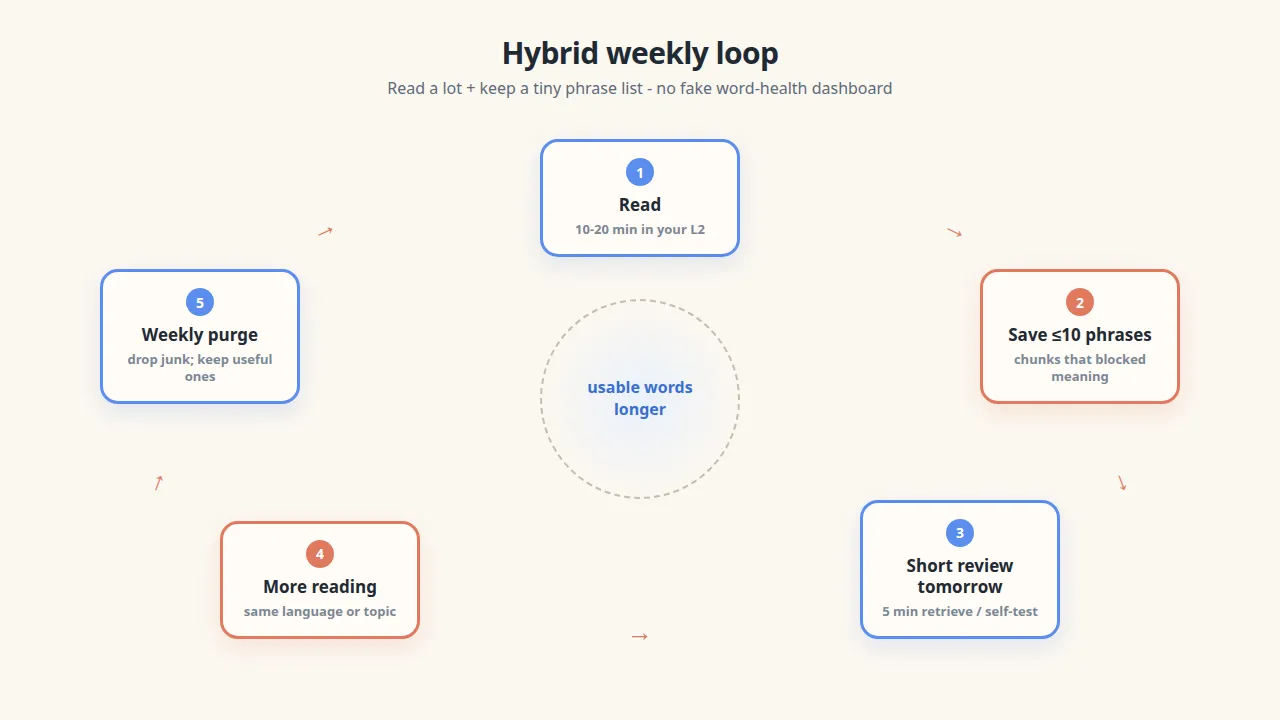
A spacing loop you can actually run:
| When | Do this |
|---|---|
| Today | Read 10-20 minutes; save ≤10 phrases |
| Tomorrow | 5 minutes trainer or self-test on yesterday's phrases |
| This week | More reading in the same language or topic |
| Next week | Purge dead words; keep useful ones |
That loop maps to spacing science: free plan with ~20 translations/day and unlimited listening, Reader ~€1, Pro ~€5/mo for trainers, free graded library, own EPUB for books you already own.
Spanish-focused learners who want Spanish chunks and a Spanish schedule may prefer the sibling guide: Ebbinghaus for Spanish vocabulary. This post stays general L2 - same curve, same hybrid stack.
FAQ
Is the forgetting curve "debunked"?
No, but popular charts oversimplify it. Modern research is richer (retrieval practice, desirable difficulties, interleaving). Core advice still stands: space reviews; do not only cram. Treat classic delay bands as an order-of-magnitude model, not a clinical law for every word.
How many encounters until I "know" a word?
No single magic number. Frequency, relevance, morphology, and recognition versus production all matter. Plan for many meaningful meetings, not one heroic session. The ~10+ ballpark is a discussion range, not a guarantee.
Anki or reading?
Hybrid for most independent learners: read a lot; SRS a small phrase list. Pure Anki without input often dies of boredom. Pure reading without review leaves rare words weak. Phrase cards from reading still count.
Should I review every word I look up?
No. Lookups include noise. Keep items you will meet again or need to say. Delete the rest. A short active list survives; a graveyard of every unknown word collapses.
Can any app make vocabulary permanent automatically?
No tool can. Apps schedule prompts; you still need retrieval and real use. Be wary of permanence marketing and "only scientific method" claims. Reading plus a small practice loop is enough to start.
How does this relate to grammar and structures?
Same spacing logic: many texts beat one worksheet week. Conditionals and discourse frames stick better when you re-meet them in stories, then retrieve after a gap. More: why grammar drills alone stall progress.
Final takeaway
Ebbinghaus did not invent a smartphone feature. He measured how fast unsupported memory decays - and how review changes the slope of that steep early drop.
Work with the curve:
- Meet words in context
- Retrieve them after gaps
- Keep the review list small
- Read often enough that high-value language returns on its own
You do not need a dashboard that scores every lemma in your life. You need repeated contact, a short active list, and patience with normal forgetting.
Concrete start today: open a free article, save five phrases that blocked meaning, test yourself on them tomorrow - then again in a week. The free library is enough to begin. No memory hacks required - only contact, spacing, and a list small enough to keep.
Keep reading with translations inside the text
With a free account, an unknown word translates with one tap, and the words you are learning wait for you in the trainer.
Free account: 7 days of Pro, then 20 word translations a day or a paid plan.