Reading Strategies
Flow state: enjoy long reading in your target language
You abandon long articles less because the language is impossible and more because the room is wrong. Fix challenge, feedback, and noise, then run a short timed session.

You know that feeling. You find a long piece you actually care about - climate policy in El País, a tech essay in German, a food feature in French. You click. Within ninety seconds you are drowning.
Not in the ideas. In the environment. Cookie banners. Pop-up ads. Autoplay video. Related-stories widgets. By the third overlay you have forgotten why you opened the tab.
So you quit. You tell yourself you will come back later. You rarely do.
This is not proof that you "lack talent" for languages. For many learners, long articles fail first because noise and level mismatch burn working memory before the grammar does. Fix the room, match the stretch to your skill, and long-form stops feeling like punishment.
Here is the plain answer. Flow (deep absorption) needs challenge near skill, enough sense-making as you go, and few interruptions. Clean text, low-friction lookup, material you care about at a level you mostly follow, then a short timed session. Extensive reading research often supports volume plus enjoyment for vocabulary growth. The rest is habit design.
This post is for any target language and long articles in general. If you want a CEFR ladder aimed at English news and magazines, see the sibling guide on flow state reading for English longreads.
What flow means for language reading
Psychologist Mihaly Csikszentmihalyi described flow as a state where attention locks onto a voluntary challenge and time softens. Athletes call it being in the zone. Readers hit a version of it when they forget they are decoding a foreign language and simply follow the story or argument.
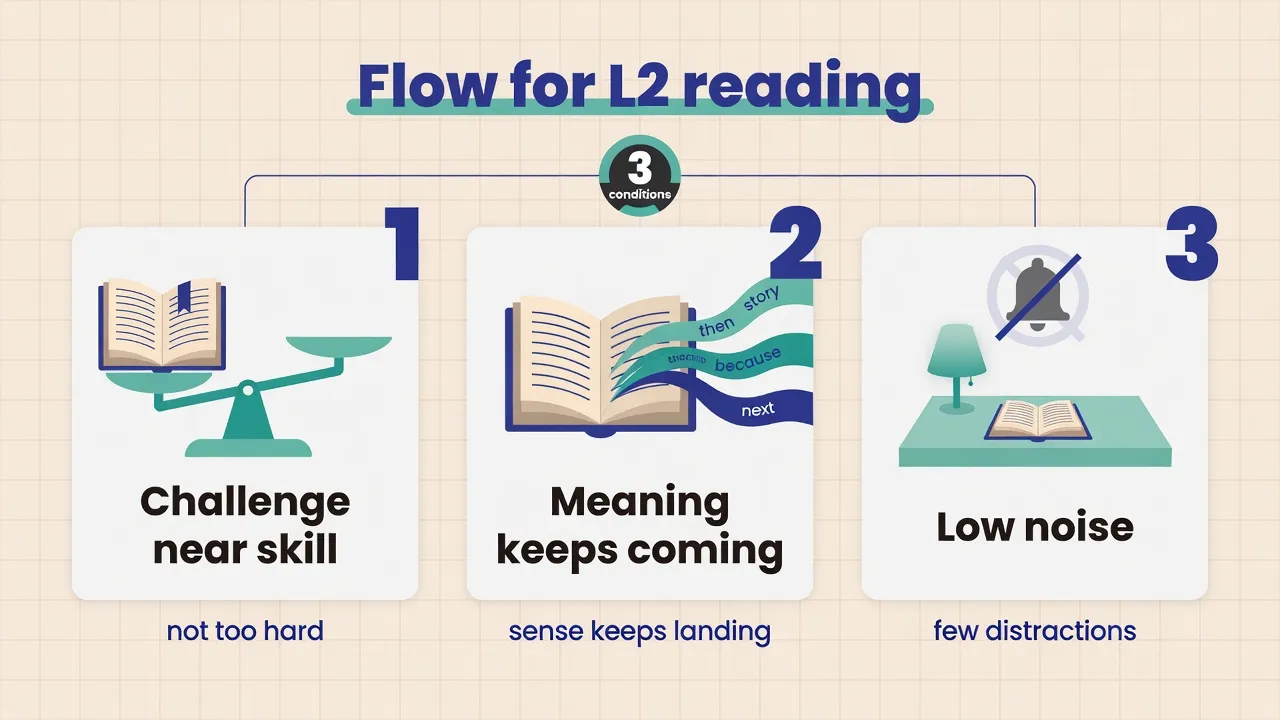
Three conditions usually need to line up:
| Condition | In plain words | If missing |
|---|---|---|
| Challenge near skill | Mostly understand; a little stretch | Boredom or freeze |
| Ongoing sense-making | Meaning arrives as you go (guess + light help) | Constant stop-start |
| Low distraction | Few popups, tabs, sidebars | Working memory full of noise |
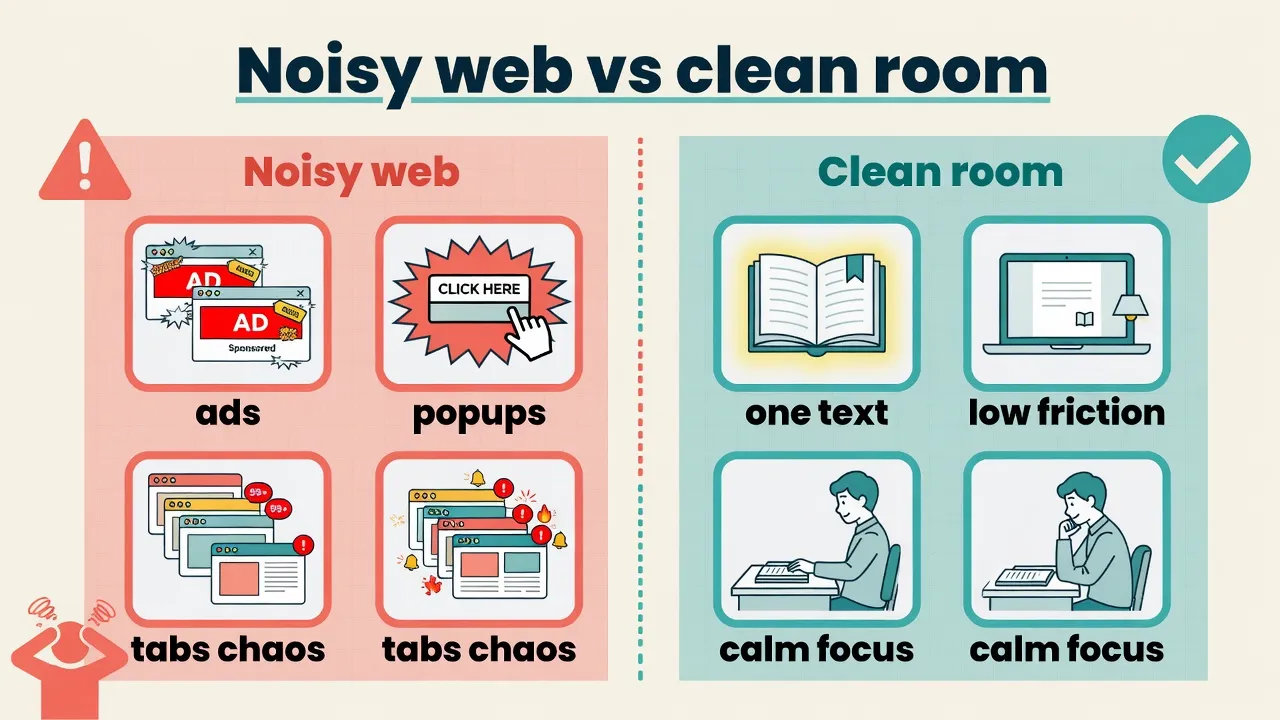
Traditional web reading fails all three. Random pages have no difficulty fit. A separate dictionary tab kills the feedback loop. Modern layouts are built to pull eyes sideways.
When the three conditions do line up, something quieter happens. You stop translating every clause. You start processing meaning. Words you have met several times start to stick without a flashcard session. You are not "studying" in the school sense - you are reading. That feeling is worth designing for. It is not inevitable, and it is not a high you chase every night. It is a workable target for a calm session.
Here is the same idea as a simple triangle:
Why longer stretches beat 30-second clips
Language internet culture loves short clips, flashcard sprints, and five-minute podcasts. Those tools have a place. They warm vocabulary. They fill a commute.
They rarely give your brain a runway. A short clip ends before context can do the heavy lifting. A 15-25 minute article (or chapter) gives repeated exposures inside one topic. Unknown words sit next to known ones. Syntax patterns reappear. You get a chance to infer instead of look up everything.
Research on extensive reading often finds that volume of enjoyable input supports vocabulary growth better than isolated word lists alone. Treat that as a direction of evidence, not a fixed multiplier. The practical point is simpler: short snacks train recognition; longer stretches train staying with meaning.
You do not need a 3,000-word marathon on day one. You need enough continuous time that the first minutes of warm-up can turn into actual engagement.
Four flow killers
Before tools, diagnose the crash.
| Killer | What it does | Cleaner move |
|---|---|---|
| Dictionary tab-switch | Breaks immersion for each unknown word | In-page or one-tap lookup; skip words you can guess |
| Visual noise | Ads, autoplay, widgets tax attention | Reader mode or clean app text |
| Hostile typography | Tiny type, low contrast, scan layout | Larger type, calm line length |
| No recovery plan | Lose the thread, then quit | One-line checkpoint (who / where / what changed), then continue |
1. Dictionary tab-switch
You meet an unknown word. New tab. Search. Three senses. Pick one. Switch back. Re-read the paragraph. Immersion is gone.
Some interruptions leave attention residue: part of your mind stays with the other task for a while. You do not need a fixed "23 minutes always" number to notice the effect. Five heavy lookups in a messy layout can erase any hope of flow. Prefer quick in-page help, or skip words that do not block the idea.
2. Visual noise
Sidebars, related links, social widgets, comment previews - each is a small tax. Native readers absorb it. Second-language readers already spend working memory on form and meaning. Noise competes for the same budget.
3. Hostile typography
Many news sites optimize for scanning: narrow columns, small type, low contrast. Fine for skimming headlines. Harder when every sentence needs careful processing.
4. No recovery plan
You realize three paragraphs ago that the thread slipped. Restarting from the top is exhausting. Closing the tab is common. A one-line checkpoint is kinder: who, where, what just changed - then continue from the next clear sentence.
Cluttered page versus a calm reading room:
Build a cleaner reading room
You do not need a perfect app on day one. You need fewer enemies of attention.
1. Strip everything that is not the text
Reader mode in the browser, a distraction-free reader, or a graded page without banners. Same idea: one column of prose, calm type, no autoplay.
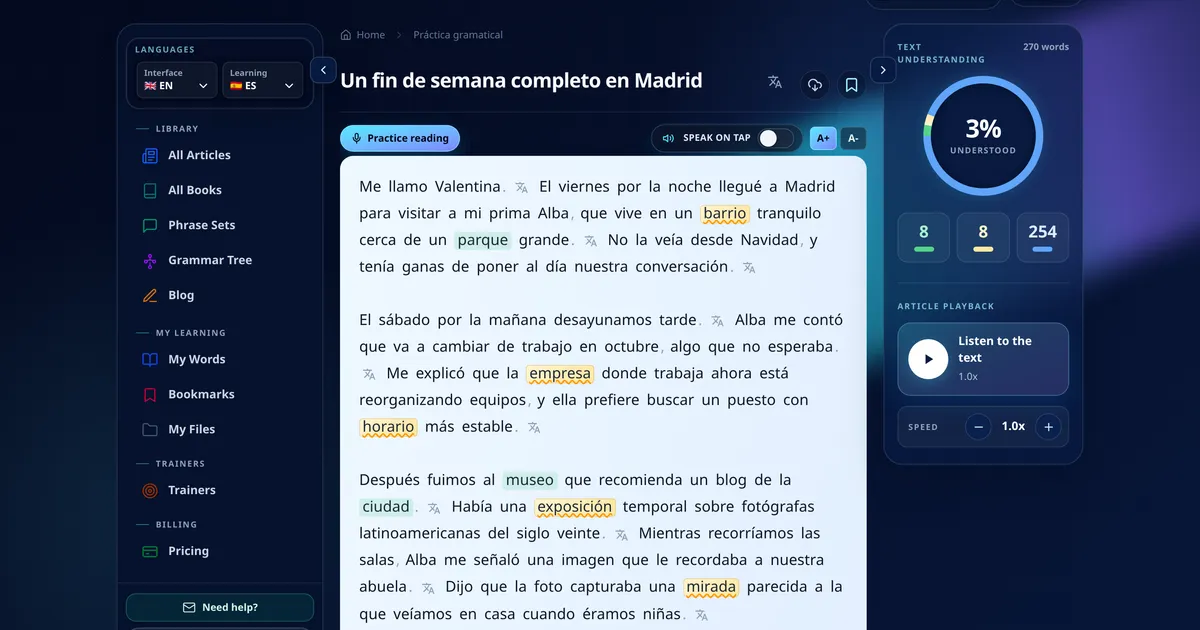
MovaReader is built as a calm reading room for graded articles and files you bring. Free graded library, click-to-translate, 20 word translations per day on the free plan. Reader is €1/month when you need more daily reading volume. Pro is €5/month for the full set of current trainers. Upload EPUB or files you own when your plan allows. We do not host licensed commercial novels by default. URL import can pull web text into a cleaner view when the feature is available on your plan - do not expect every site to paste perfectly.
2. Lower the cost of unknown words
During a flow session, deep dictionary work is the wrong tool. Save deep study for a separate block. While reading, prefer one-tap or in-page help for words that truly block meaning. Skip the rest and trust context when you can.
Click-translate helps flow. It is not a perfect context oracle for every edge sense of a word. If a sense looks odd, glance at the sentence again or mark the phrase for later. Save phrases you choose, rather than assuming everything is auto-logged for you.
3. Match challenge to skill
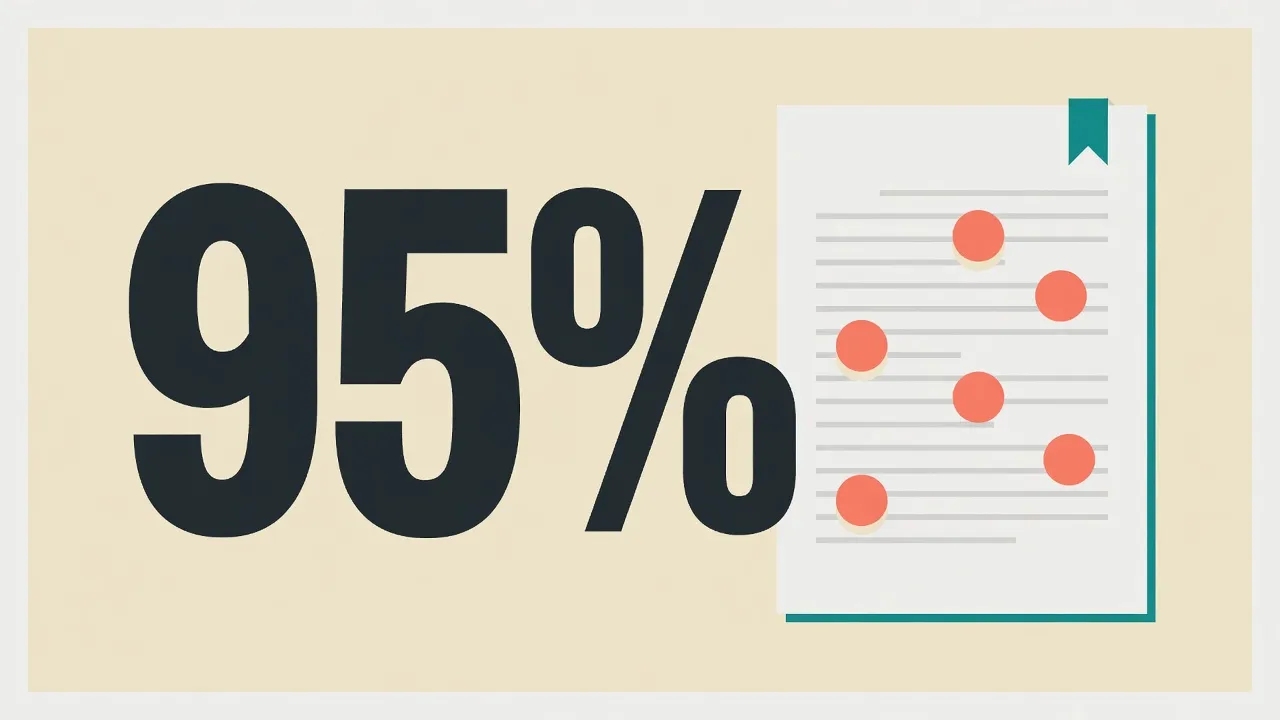
Too easy and you skim without stretch. Too hard and every line is a wall. Many extensive-reading guides aim for roughly most words known (often cited around 95-98% for pleasure reading). Treat that as a feel, not a law: if you stop every line, step down; if you never meet a new word, step up. Familiar topics act as a scaffold - same idea, new labels.
Browse levels in the free article library, or sample Spanish A2. The language map helps you see which bands already feel solid.
4. Keep a tiny recovery ritual
One sentence on paper or in notes: who is acting, where we are, what changed. Then keep going. Momentum matters more than pride.
A 20-minute long-form protocol
Use this as a default loop. Adjust length when energy is high.
- Pick text you care about. Intrinsic interest is half the battle. News is optional. Tech, sports, food, travel, fiction samples all work.
- Open clean text. Graded article, calm import, or a quiet EPUB you own.
- Rough level check. Every sentence a wall? Step down. Zero unknowns? Step up.
- Timer 15-25 minutes. Aim for engagement, not "finish the internet."
- Read forward. Look up only words that block the idea.
- If lost: one-line checkpoint. Do not restart from zero.
- After (optional): 2-5 minutes to save or review a few phrases while context is warm.
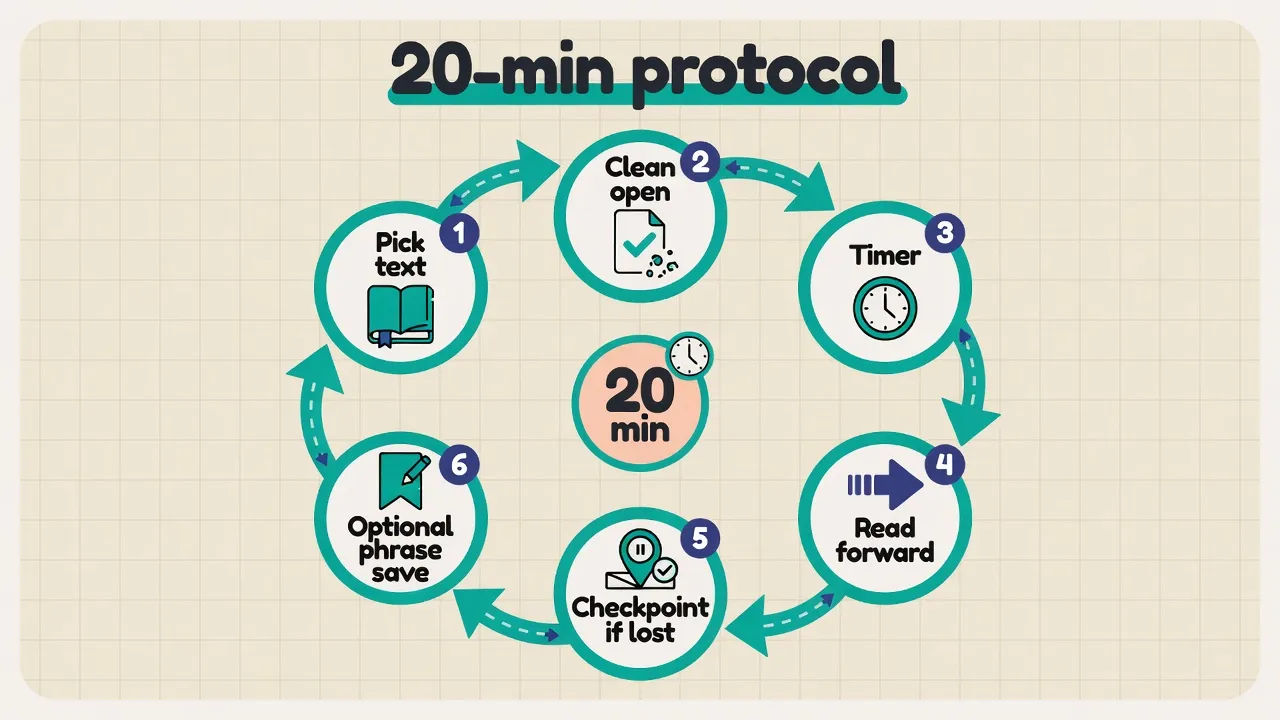
Twenty minutes is a practical threshold for many people, not a sacred law. Consistency beats heroic weekends.
What it feels like
The first minutes are often a warm-up. You still notice that this is "foreign." You tap a word or two. That is normal.
Somewhere later, if conditions are decent, individual words recede and ideas take the foreground. A paragraph about housing or football stops being a decoding exercise and becomes something you agree with, doubt, or enjoy. You are thinking in the language more than about the language.
When the timer ends, you may want another page. That is a good signal. It is not proof you will be fluent next month. It is proof the session was designed well enough that your brain wanted more input.
From articles to books
Articles are a gentle on-ramp: finite length, clear structure, easy to abandon without guilt. Books need the same room and the same level match, only longer.
Start with topics you already know in your first language. If you follow tech news in L1, try tech pieces in the target language. Subject knowledge becomes a scaffold so you learn labels for concepts you already hold.
On MovaReader you can work through graded pieces first, then bring files you own into the same clean interface when your plan supports it. Reinforce sticky phrases in phrase tools after a session if you want a short deliberate block. For how the product fits day to day, see how to use.
FAQ
Do I need perfect understanding to feel flow?
No. Flow needs enough meaning to stay with the story or argument. Unknown words are fine when they are rare enough that the thread still holds.
How hard should the text be?
Hard enough to stretch, easy enough that you are not decoding every third word. If you dread opening the tab, step down a level or pick a familiar topic. The 95-98% "known words" range is a guideline from extensive-reading practice, not a stopwatch law.
Is a paper dictionary always wrong?
No. It is slow for flow sessions. Use deep dictionary work in a separate study block. During long reading, prefer quick in-page help or skippable guesses.
How long should a session be?
Start with 15-25 focused minutes most days. Longer is great when it feels good. Consistency beats heroic weekends.
What if I hate news?
Read what you already love in your first language: tech, sports, food, fiction samples. Topic knowledge is a scaffold. News is optional. Long-form is the format; journalism is only one genre.
How does MovaReader fit?
Free graded library with click-to-translate, 20 word translations per day on the free plan, plus listening where available. Reader €1/month for more reading volume. Pro €5/month for full current trainers. Upload files you own; we do not host licensed commercial novels by default. URL import depends on plan and feature support. Save phrases you care about. Think of it as a cleaner room for long reading. Details on pricing. Demos: type training and phrase typing.
Next steps
Most learners spend more time researching methods than sitting with a real page. The quieter path is ordinary: pick something you care about, remove noise, match difficulty, set a short timer, read forward.
Flow is not automatic, and twenty minutes will not produce B2. But environment and level design make long reading feel possible more often - and that is how volume actually happens.
Start here:
Fix the room. Match the stretch. Keep the timer honest. Then let the next paragraph earn another five minutes.
Keep reading with translations inside the text
With a free account, an unknown word translates with one tap, and the words you are learning wait for you in the trainer.
Free account: 7 days of Pro, then 20 word translations a day or a paid plan.