Tips & Methods
How to Learn Spanish with TV Shows (30-Day Plan)
Active beats passive. Spanish audio, Spanish subs when you need them, 5-10 phrases per episode and a clear 30-day plan you can follow week by week.
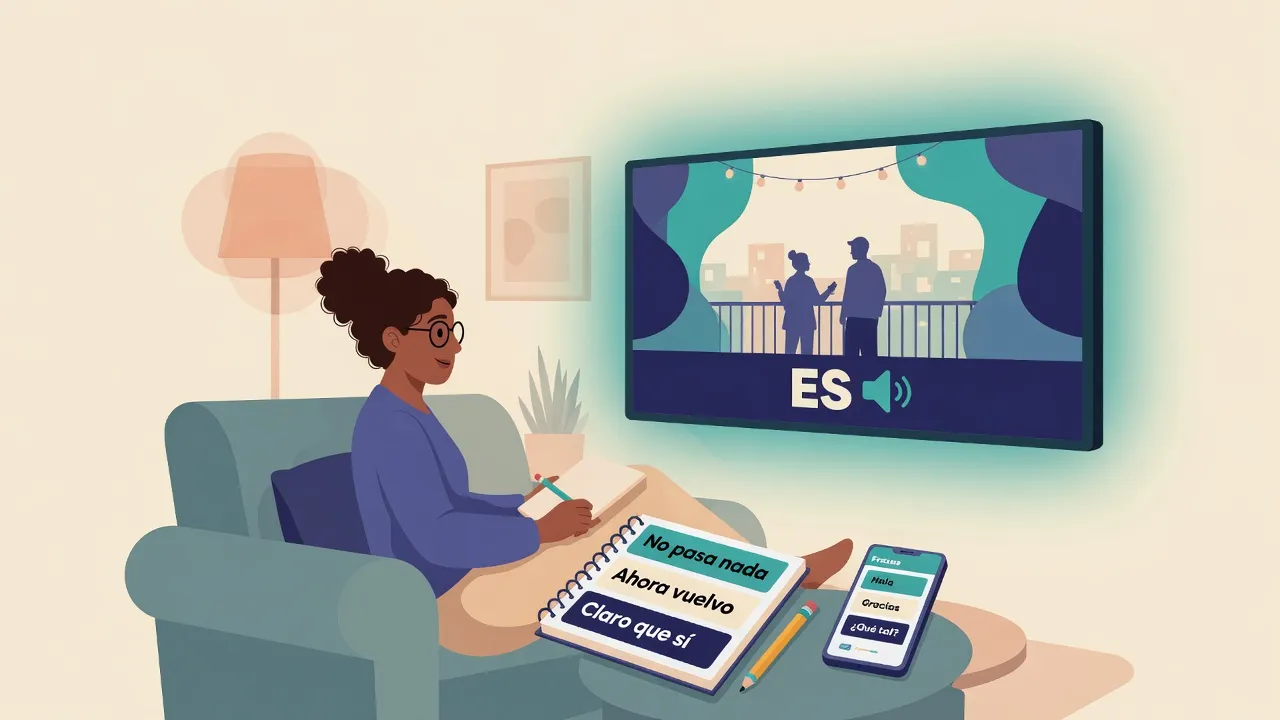
You finished three episodes last night. This morning you still cannot say "I was late because..." out loud without freezing.
That is the couch problem. Spanish was on. Your brain was on plot mode. Almost nothing landed as usable language.
Can you learn Spanish by watching TV?
Yes - if you watch actively. Spanish audio. A show near your level. Spanish subtitles when you need them. And 5-10 useful phrases per scene that you actually review the next day.
Passive binge with English subtitles mostly builds sound familiarity, not usable Spanish. TV alone will not make you fluent. It feeds listening and some vocab. You still need speaking practice and a review loop. Reading helps those phrases stick.
Here is a one-screen protocol, a CEFR setup, and a real week-by-week 30-day plan.
The 5-step active protocol
One closed loop beats three hours of "background Spanish."
| Step | Do | Time box |
|---|---|---|
| 1 | Pick a level-fit show | 2 min setup |
| 2 | Spanish audio on; subtitles by CEFR ladder (not always English) | - |
| 3 | Watch one short scene for meaning first | 8-20 min |
| 4 | Mine 5-10 phrases; soft-shadow 2-3 lines out loud | 5-10 min |
| 5 | Save + review next day | 5-10 min next day |
Soft shadowing means you repeat a short line after the actor (near-simultaneous or with a short lag). Goal is rhythm and mouth memory, not perfect acting.
When you pick phrases, prefer reusable chunks: "I was late because...", "What do you mean?", "I'm not sure." Skip rare slang you will never say.
What setup fits your level?
Match the setup to what you can process in a short scene - not to a show's prestige.
| Level | Audio | Subtitles default | Per-episode goal | When to step up |
|---|---|---|---|---|
| A1 | Spanish | Spanish if you can follow ~50%+; English OK for first contact only | 1 short scene (8-15 min); 3-5 phrases | Drop English subs after 1-2 weeks of daily short sessions |
| A2 | Spanish | Spanish | 1 short episode or 2 scenes; 5 phrases; gist of main plot | Less freeze-pause; can retell 2-3 lines of what happened |
| B1 | Spanish | Spanish main; none for rewatch of known scenes | Full short episode active pass; 5-8 phrases; soft shadow 2-3 lines | Comfortable ES+ES on easy sitcom or doc; start no-subs rewatch |
| B2+ | Spanish | Spanish first pass, then none on rewatch | 1 episode with mining; 7-10 high-value phrases; one no-subs rewatch/week | Regional accent pick; denser drama in short scenes only |
Energy-day exception: Tired evening? Keep Spanish audio + Spanish subs. Do not punish yourself with no-subs when your brain is empty. A short active scene still counts.
Comprehension check: With Spanish subs on, if every other line is a wall, the show is too hard for main practice. Simplify the content, or rewatch a known scene first.
A1-A2: audio, subs, episode goals
At A1-A2, Spanish audio is non-negotiable. Your job is not "finish the season." Your job is one short scene you can almost follow.
English subs are a temporary bridge for early A1 panic. The target is Spanish audio + Spanish subs as soon as the main idea is visible. Three to five phrases you could reuse tomorrow beat twenty words you dump and forget.
B1-B2+: when to drop subs
From B1, Spanish + Spanish is your main learning pass. Use no-subs on rewatch of scenes you already know - not on every first watch of dense new material.
B2+ can stretch into regional accents and denser drama, still in short active scenes. On low-energy days, put Spanish subs back on. That is strategy, not failure.
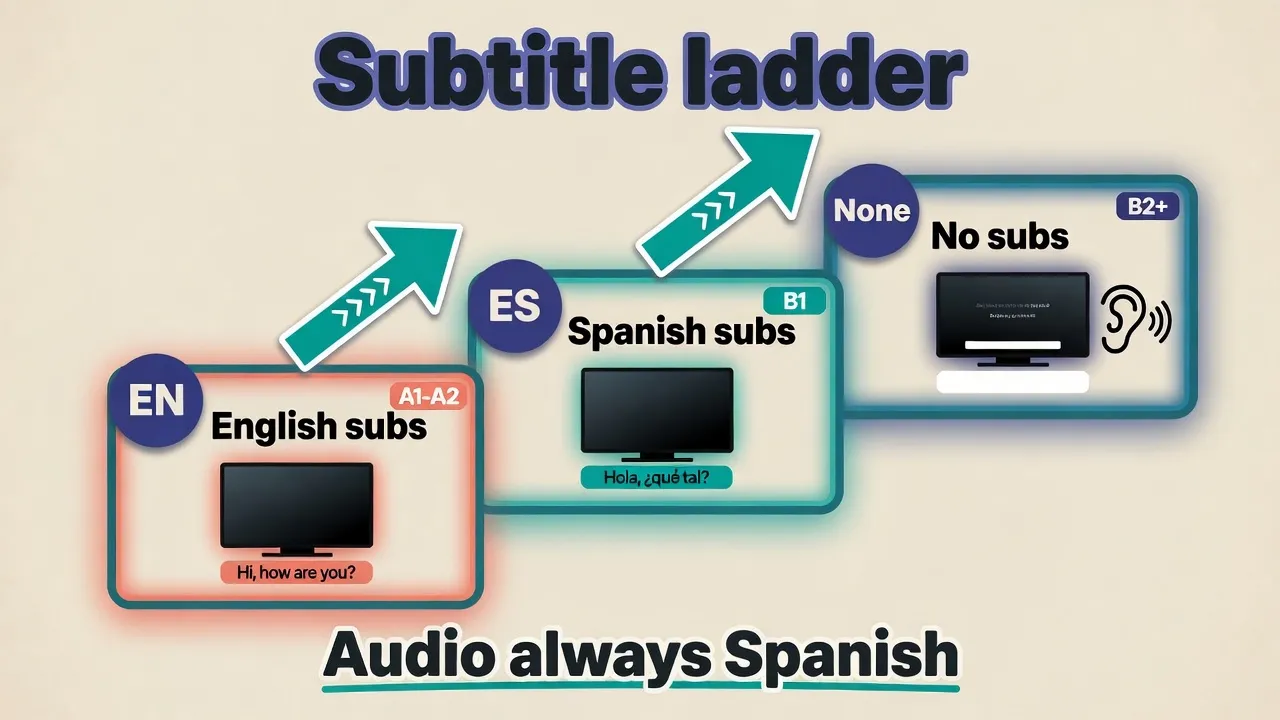
Subtitle ladder: English → Spanish → none
English subs are a stage for true beginners, not a permanent home.
| Stage | Setup | Best when | Risk if stuck here |
|---|---|---|---|
| 0 | ES audio + English subs | Early A1, first week of a hard show | Plot only; weak Spanish form memory |
| 1 | ES audio + Spanish subs | Main learning pass for A2-B2 | Reading faster than listening - still useful |
| 2 | ES audio + none | Known scenes, rewatch days, B1+ peaks | Frustration if the scene is brand-new and dense |
Default target for this method: live in stage 1. Visit stage 2 on rewatch. Use stage 0 sparingly.
Here is the ladder at a glance - Spanish audio stays on at every step:
When should beginners use English vs Spanish subtitles?
Early A1: English is OK for a short first pass so the plot does not crush you. Goal is still Spanish audio + Spanish subtitles as soon as you can follow the main idea.
Staying on English for months freezes you in "I understood the story, not Spanish."
Spanish audio + Spanish subs - when it works
ES + ES trains reading and listening together. That is the best default learning setup. You may read a beat faster than you hear - that is fine. The written form still anchors the sound.
English subs win the plot and lose the forms. No-subs wins confidence on known material. Use both as tools, not as identity.
The active loop
Think of one closed loop, not a tips pile:
- Pick a scene (not always a full episode)
- Meaning pass - plot first
- Mine 5-10 phrases in context
- Soft shadow 2-3 lines
- Save them somewhere you will reopen
- Review next day (and later: day 3 / week)
The loop, drawn as a simple cycle:
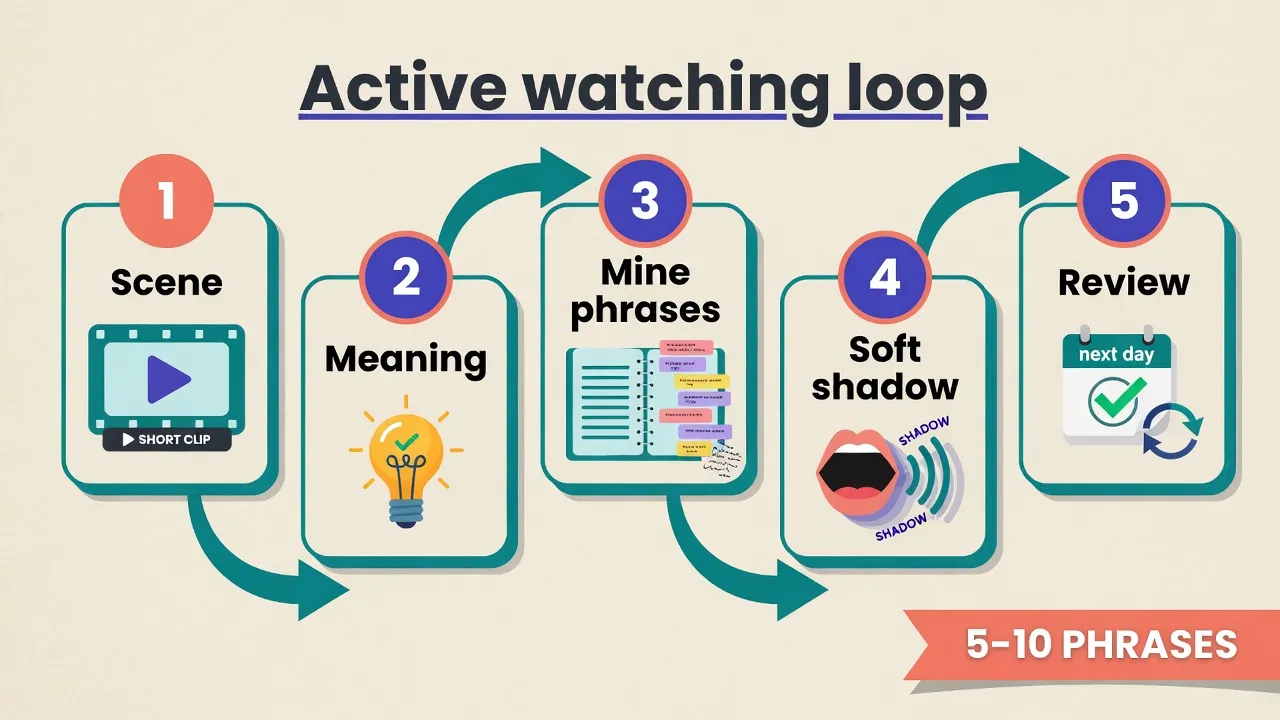
Without the review step, mining is just collecting souvenirs. With it, the same chunks show up again in your ear, mouth, and (later) on the page.
30-day plan (week by week)
Four weeks of short, active sessions - not a fluency certificate and not a binge calendar.
The roadmap in four cards:
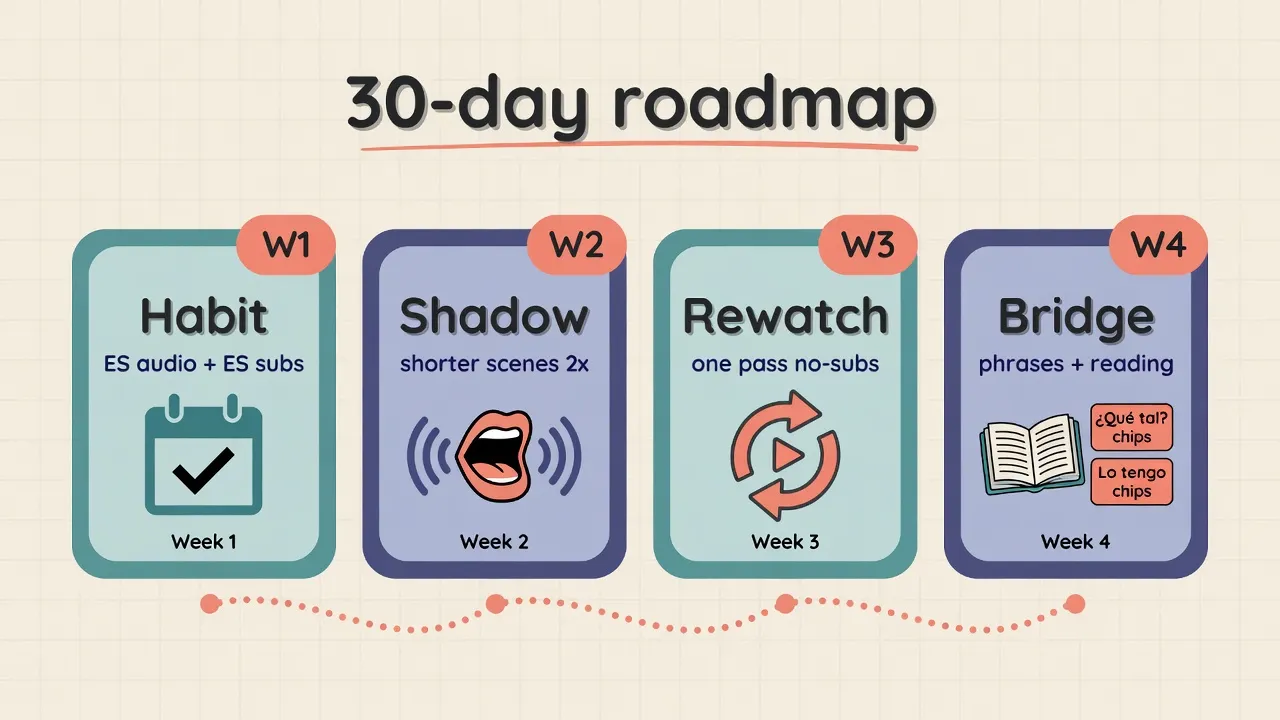
| Week | Focus | Session shape | Phrases | Subtitles goal | End-of-week check |
|---|---|---|---|---|---|
| 1 - Habit | ES audio + ES subs; build the loop | 15-20 min, most days | 5/day | Stay on ES subs; English only if A1 panic | Can you open the same show without hunting for a "better" one? |
| 2 - Active | Shorter scenes 2x; start soft shadow | 15-25 min; one scene twice beats one full episode once | 5-7/day | Drop English fully | Shadow 2-3 lines without freezing every word |
| 3 - Stretch | One no-subs rewatch of a known scene; optional regional focus | 20-30 min peak days OK | 7-10 peak, not every day | ES first; none on rewatch | Gist without subs on a scene you already know |
| 4 - Bridge | Mix new + rewatch; reading bridge days | 3-4 TV days + 2-3 read/review days | Review old bank + few new | ES or none by energy | Self-check: gist % on a familiar scene; phrases you still recognize next day |
Week 1 - Habit + ES audio + ES subs
Time box: 15-20 minutes, most days.
Pick one show and stick with it. Spanish audio always. Spanish subs as default. English only if you are true A1 and the plot would otherwise collapse.
Mine five phrases a day. Save them. Open the same show tomorrow without shopping for something "better." Habit first.
Week 2 - Shorter scenes twice; start shadowing
Time box: 15-25 minutes.
Watch one scene twice rather than one full episode once. Drop English fully if you still have it. Soft-shadow two or three lines out loud after the actor.
By the end of the week you should be able to shadow a short line without freezing on every word. Still 5-7 phrases per active day - quality over dump size.
Week 3 - One rewatch with no subs; regional focus
Time box: 20-30 minutes on peak days is fine.
Pick a scene you already know and rewatch it with no subtitles. Optional: commit to one regional flavor for a month (Spain or LatAm - pick, do not hop every episode).
Peak mining can hit 7-10 high-value phrases on good days. Not every day needs a peak.
Week 4 - Mix new + rewatch; reading bridge; self-check
Mix new scenes with rewatch. Add 2-3 reading or review days so TV language meets text. Review your old phrase bank; add only a few new ones.
Self-check at the end of the month:
- Rough gist percent on a familiar scene (a rough guess is fine)
- How many saved phrases you still recognize the next day
- Whether ES + ES feels normal on your main show
Realistic time: 15-25 minutes active most days beats a 3-hour weekend binge. Miss a day? Restart the next day. No punishment marathons.
Week outcomes:
- W1: Habit + Spanish audio as default
- W2: Mining + soft shadow as normal
- W3: At least one successful no-subs rewatch of known material
- W4: Phrases reviewed; one reading day linked to TV language
What to watch by level
Genre type + one example flavor only. Full named lists live in our sister post: top 10 Spanish series for learning.
| Level | Prefer (type) | Example flavor | Avoid as main practice |
|---|---|---|---|
| A1-A2 | Kids / slow slice-of-life, cooking, clear school sitcoms, learning-oriented shorts | Clear daily-life sitcom or kids adventure with visual support | Fast multi-speaker crime openers, heavy slang teen drama |
| B1 | Sitcoms with short lines, narrator-led docs, lighter drama | Workplace or family comedy with clear diction | Pure background binge of densest thriller season |
| B2+ | Drama, news-style docs, series with regional accents | One regional pick you care about (Spain or LatAm - commit for a month) | Jumping accents every episode "for variety" |
Telenovelas: Good for emotion and repetition - everyday conflict language shows up again and again. Accent and register vary by country. Still run the same 5-step loop. They are not a special shortcut format.
Streaming catalogs change. Pick by level fit and clarity, not by a permanent fixed Netflix list.
Reading bridge: how TV phrases stick
TV feeds your ear. Phrases stick better when you re-meet them in text and review them on purpose.
Mined lines → Phrases → Trainers
After a scene, move your 5-10 chunks into a phrase bank you will reopen - for example Phrases. Review the next day. Later, practice them with trainers or free typing demos if full trainers are gated for you.
Same chunks. Ears, mouth, then eyes again.
One short Spanish article day
On bridge days in week 4 (or any week once the loop is stable), read one short Spanish text - graded article or transcript-style piece. Start from Articles. Forms stick when you re-meet them outside the show.
If you want a full reading method next, see how to learn Spanish by reading when that guide fits your pace.
Language Map for rough level orientation
Unsure if a show is A2 or B1 for you? Use the Language Map as a rough compass for your vocabulary band.
Limits of TV + what MovaReader is (and is not)
TV is for ears and scenes. It will not replace speaking practice, and it will not hand you fluency from the couch.
MovaReader is the reading and phrases side of this method - not a dual-subtitle Netflix player or browser extension for video. Dual-sub video apps exist; they solve a different job. We help after the scene: save phrases, short Spanish reading, trainers for review.
How the plans work:
- Free: 20 translations a day, unlimited listening - enough to try the phrase and reading bridge lightly
- Reader (€1): when 20/day blocks real reading volume
- Pro (€5): full trainers and structured review if you want more than light demos
Details: pricing. Use the product as the review bridge inside the 30-day plan.
FAQ
Can you learn Spanish just by watching TV?
You can improve listening and pick up useful phrases if you watch actively: Spanish audio, level-fit show, Spanish subs when needed, 5-10 phrases reviewed. Passive binge with English subtitles mostly trains sound familiarity. TV alone will not make you fluent - you still need speaking practice, review, and usually some reading or structured study.
Should beginners use English or Spanish subtitles?
Early A1: English subs are OK for a short first pass so the plot does not crush you. Goal is still Spanish audio + Spanish subtitles as soon as you can follow the main idea. Staying on English for months freezes you in "I understood the story, not Spanish."
How many words or phrases should I save per episode?
5-10 high-value phrases per active session is enough. Forty random words becomes a dictionary dump you never review. Prefer chunks you could reuse tomorrow.
Spanish audio + Spanish subtitles vs English subtitles - what works?
ES audio + ES subs trains reading and listening together - best default learning setup. ES audio + English subs is easier for plot and weaker for Spanish form memory. Use English briefly if needed, then step up. No-subs is for rewatch of known scenes, not for every first watch at A1.
How long until Spanish TV gets easier?
Usually weeks of short consistent sessions, not three days. After 2-4 weeks of active watching, many people notice: familiar phrases catch easier by ear, fewer total freezes, and rewatch without English feels possible. "Easier" is not the same as fluent.
Are telenovelas good for learning Spanish?
Yes for emotion and repetition - everyday conflict language shows up again and again. Accents and register vary by country and production, so pick one lane for a month and run the same active protocol. Telenovelas are not a shortcut past mining and review.
Next steps
- Run the 5-step loop on one short scene today (Spanish audio; Spanish subs if you can follow the gist).
- Pick shows by level from the short table above, then open the full named list: top 10 Spanish series for learning.
- Save phrases in Phrases, add a reading day from Articles, and check pricing only when free limits get in the way.
Active beats passive. Short sessions beat weekend guilt marathons. The 30-day plan is a calendar for habits - not a promise of fluency. Start with one scene.
Keep reading with translations inside the text
With a free account, an unknown word translates with one tap, and the words you are learning wait for you in the trainer.
Free account: 7 days of Pro, then 20 word translations a day or a paid plan.