
Introvert language barrier: 3 solo ways without club stress
If café language exchanges make your stomach drop, you are not broken. Build a solo runway first: deep reading, private shadowing, and low-stress phrase recall - then try real talk with a fuller tank.

You know the feeling. Someone suggests a "fun" language exchange, and your stomach drops. Ten strangers around a café table, everyone talking over each other, and you - with a decent sentence forming - watching it dissolve before you can say it out loud.
For introverts, that night often gets mislabeled as a personality failure. It is usually not. The real problem is stacking two hard jobs at once: processing a foreign language and performing in a social group. That double load drains the tank before you get real practice.
Here is the plain answer. You do not have to force yourself into the café first. Build a solo runway: deep reading to stock natural patterns, private shadowing to train the mouth and ear, and low-stress phrase recall so words show up when you need them. Real conversation still matters later - but with fuel, not on empty.
Clubs optional at first. Input and private mouth practice first. Live talk when a few phrases are ready.
Why speaking clubs drain introverts (and it is not your fault)
Speaking clubs rest on a simple idea: more talking equals faster progress. For some people that works. For many introverts it backfires, not because they "cannot learn," but because the room is expensive in mental energy.
Double load. You are decoding words, building a sentence, and managing eye contact, noise, and status at the same time. That is a lot for a brain that already prefers depth over rapid social bouncing.
One bad night sticks. After freezing once, avoidance feels rational. Skipping the group is not laziness. It is your system protecting limited energy - and it can block practice for months if that is your only plan.
Shallow loops. Group tables often stay on "Where are you from?" and "What do you do?" Useful for warm-up, thin for depth. You leave knowing how to order coffee and still blank when you want to talk about a book, your job, or a real opinion.
A useful frame (not gospel): Stephen Krashen's idea of comprehensible input says we acquire a lot of language by understanding messages. Speaking tends to get easier after you have absorbed patterns, not only after you force output under pressure. Output still helps later. The order and the stress level matter.
If English is your only focus and you want a parachute-style day plan, see our sibling note on speaking English without the social stress. This piece stays language-general: Spanish, English, or whatever you are building - same solo ladder.
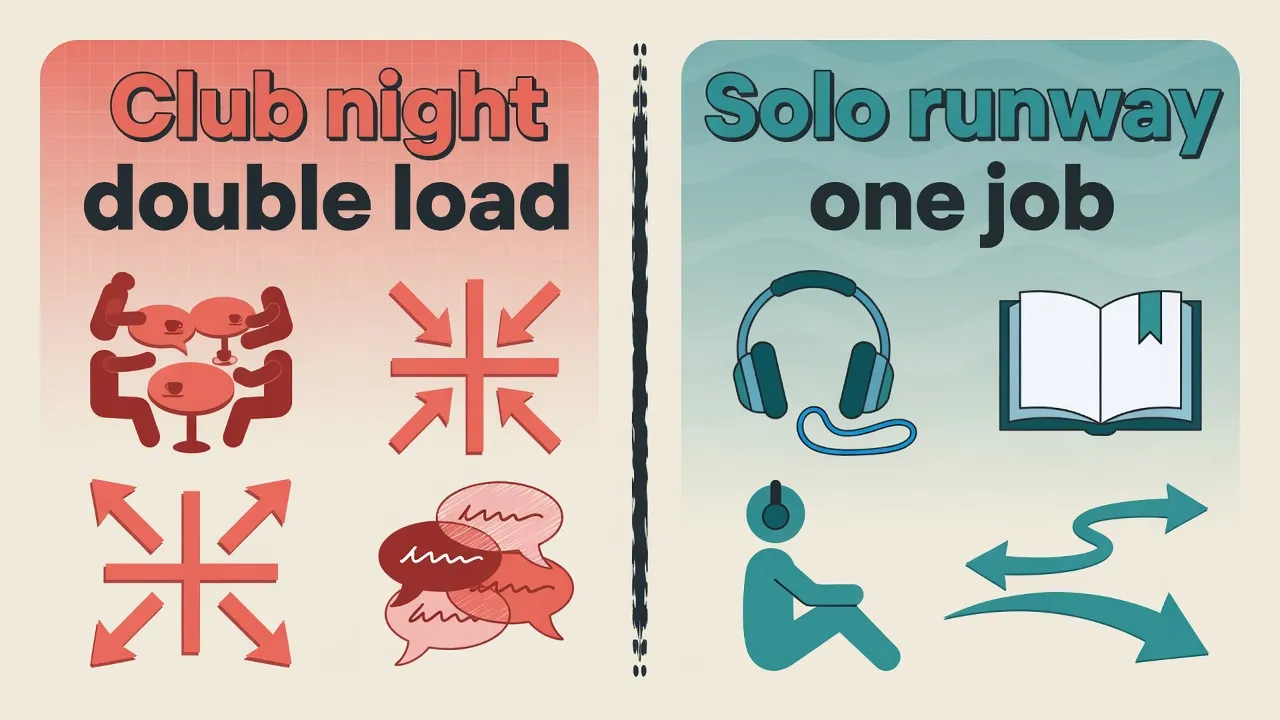
Here is the simple picture of club night versus a solo runway:
| Club night | Solo runway |
|---|---|
| Language + social performance at once | One job at a time |
| Shallow small-talk loops | Deep input from stories you care about |
| Public mistakes feel expensive | Mistakes stay private |
| Energy often spent on anxiety | Energy spent on patterns and phrases |
| Useful later, with a full tank | Useful first, builds readiness |
Club stress is not the only path. The solo runway builds fuel first, then you choose how much human talk you want.
The solo runway (three steps, in order)
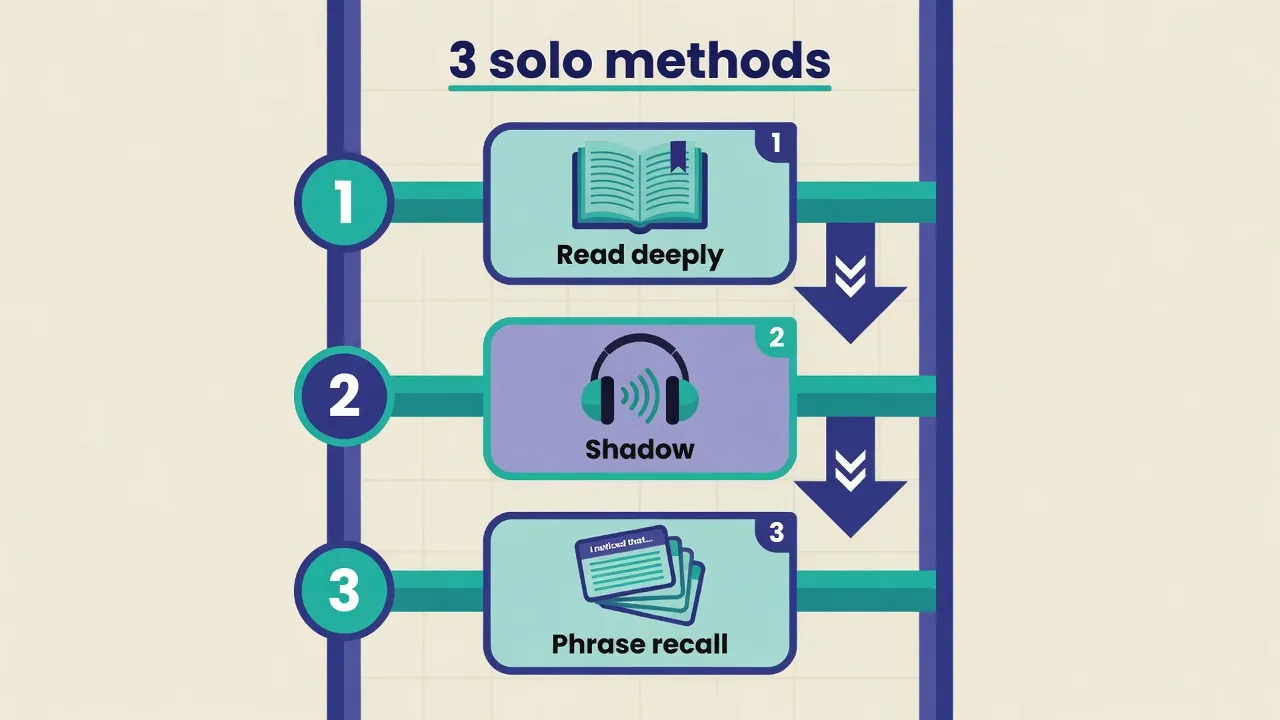
Think of speaking readiness as a short ladder, not a personality test.
- Deep reading - stock patterns, collocations, and a "feel" for how sentences work.
- Private shadowing - train mouth muscles, rhythm, and stress without an audience.
- Phrase active recall - pull useful lines on demand so passive knowledge becomes active.
Order matters. Reading without mouth practice leaves you full of words that never leave the throat. Shadowing without saved phrases leaves you sounding good on random lines you cannot retrieve later. Recall without rich input trains empty cards.
The three methods stack: read for fuel, shadow for the mouth, then recall phrases until they come when you need them.
Way 1: Build speaking fuel with deep reading
Here is the counterintuitive part many polyglots quietly live by: a lot of speaking readiness is built when your mouth is closed. Reading wires your brain with authentic grammar, natural phrasing, and collocations - the chunks people actually say.
Take a line like this (any target language will do the same job):
"She hadn't meant to eavesdrop, but the conversation drifted through the thin walls like smoke."
In one sentence you meet past perfect in a real feeling, the verb "eavesdrop" attached to a scene, and a small image ("like smoke") that sticks better than a dictionary row. You did not open a grammar table. You understood a moment. Your brain filed patterns for later use.
That is fuel. When you speak later, you are not inventing every structure from scratch. You are reusing what stories already taught you.
In practice: pick material a little above pure comfort - interesting enough that you want the next page, clear enough that you are not guessing every third word. Graded articles work. Books you care about work even better when the friction of unknown words is low enough to stay in the story.
How a reading app helps without the sales pitch
Unknown words kill flow. That is the honest friction of foreign-language reading. A tool like MovaReader is built for that private loop: free graded articles, tap a word for a translation, keep going. Freemium gives you 20 word translations per day plus listening - enough to try the habit. Reader is €1/month when you need more reading volume day after day. Pro is €5/month when you want the full current trainers.
You can upload EPUBs you already own. We do not host licensed commercial novels by default. Start with free samples if you want zero setup: Spanish A2 or English A2. For a rough map of levels and vocabulary ranges, the language map is a compass, not a free CEFR exam.
The introvert win here is simple: deep focus, no performance, no small talk required. Just you and a story that is quietly stocking the tank.
Way 2: Shadow pronunciation in private
Reading alone does not train the mouth. You still need to hear the language and move your tongue. You do not need a café audience for that.
Shadowing is a classic interpreter drill:
- Listen to a sentence (native audio or solid TTS).
- Repeat almost immediately - match rhythm, stress, and melody, not only single sounds.
- Loop the hard line until your version feels closer.
You are not memorizing the plot. You are teaching your ear and mouth the music of the language. Because nobody is watching, anxiety stays lower while the physical skill builds.
A private studio, not a perfect tutor
Text-to-speech on sentences you are already reading is a practical aid: slow a line, loop it, shadow it in pajamas at 11 p.m. TTS is not a perfect human partner and not a substitute for all future conversation. It is a calm practice aid for rhythm and confidence.
A simple session looks like this: read a short stretch, play 8-12 sentences, shadow each once or twice, mark two lines that felt sticky. Tomorrow, those sticky lines get another pass. Small, private, repeatable.
Way 3: Close the passive-to-active gap with phrase recall
Many introverts know the frustrating version of progress: "I understand so much... and nothing comes out." That is often the passive-to-active gap. The words live somewhere. Retrieval under pressure fails.
More noisy club nights are not always the first fix. Low-stress active recall is: see a meaning, produce the phrase; hear a line, type or say it back; review until retrieval gets cheaper.
Save from real text, then produce under calm pressure
As you read, save short lines that feel useful or true to how you speak - not random textbook lists if you can avoid them. Then review them later.
Concrete Spanish example:
- You save from a story: "No me fío de nadie en esta ciudad" ("I don't trust anyone in this city").
- Two days later a trainer shows the English (or your native gloss) and you type or say the Spanish from memory.
- Weeks later, in a real chat about neighborhoods, a piece of that line shows up without a full freeze.
That is not magic. That is repeated retrieval attached to a story you already lived on the page.
In MovaReader, phrases can live in Phrases and get trained with typing or recall flows. Try the demos if you want the feel first: phrase typing and type training. Pro unlocks the fuller trainer set; freemium and Reader stay useful for reading volume first.
Your strengths as an introvert (soft take)
You do not need a superiority story about introverts beating extroverts. Personality research and language blogs both overclaim that sometimes.
What is fair: many introverts already like deep reading, careful listening, and reflective practice. Those habits match a solo runway well. That is a fit, not proof that you learn "deeper by nature."
The industry often centers classrooms, oral exams, and exchange tables. Those tools help some learners. They are not the only honest path to readiness. If your energy is limited, spend it where learning density is high for you - then add human talk in small doses when you choose.
A 30-day solo practice blueprint
No fluency guarantee. No exact phrase count. Outcomes depend on your level, the difficulty of what you read, and how often you show up. Use this as a loop, not a certificate.
| Days | Focus | Concrete habit |
|---|---|---|
| 1-14 | Input base | 20-30 min reading most days; save roughly 5-10 phrases per session |
| 15-30 | Mouth + recall | Shadow about 10 sentences per session; review saved phrases daily or near-daily |
| After 30 | Light human talk | Prefer short 1:1 or calm chats if you want; mega-clubs still optional |
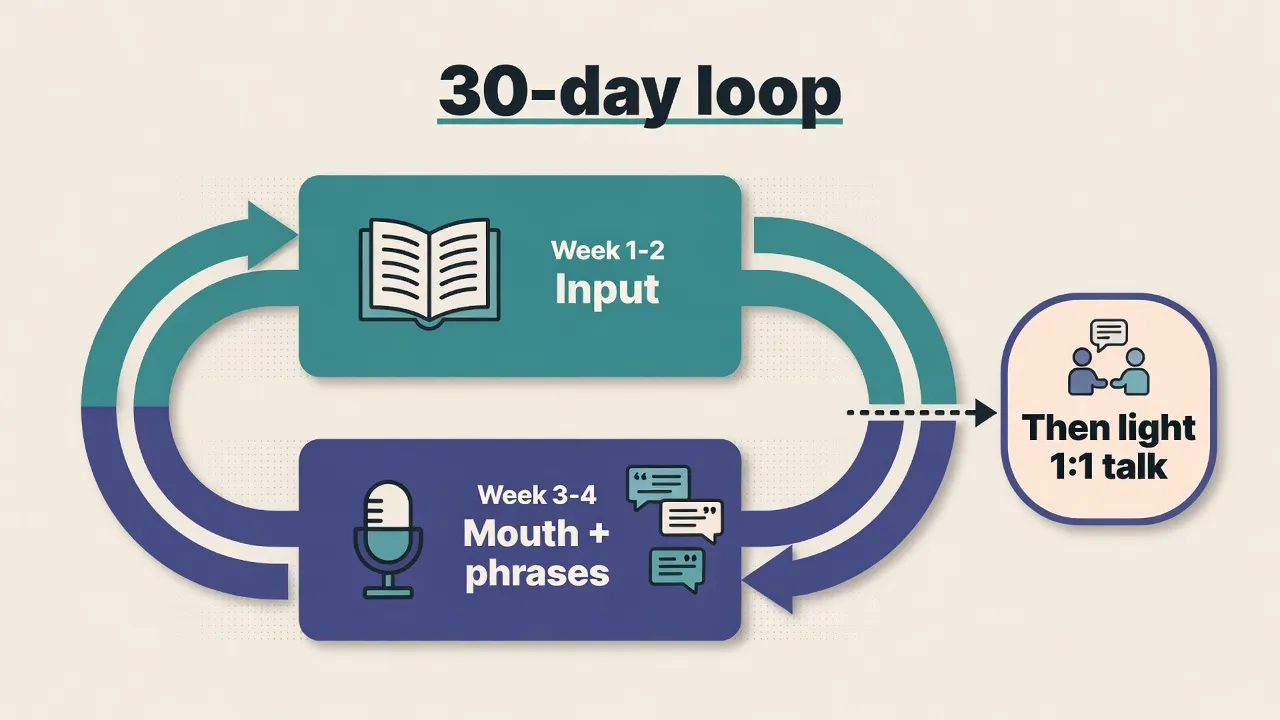
Weeks 1-2. Choose material you care about. Stay in the story. Save phrases that sound like things you might say, not only pretty literary lines.
Weeks 3-4. Keep reading. Add shadowing on a handful of sentences each session. Run phrase recall so saved lines get pulled, not only recognized.
After day 30. If understanding is up, shadowing feels less alien, and a few personal phrases come under quiet recall, try a small human step: a tutor, a patient friend, a short voice note. You are not required to jump straight to a ten-person café.
A four-week loop: input first, then mouth practice and phrase recall, then optional light conversation.
FAQ
Can introverts learn to speak well without conversation clubs?
Yes, you can build a lot of speaking readiness alone: listening, reading, shadowing, and retrieving phrases under low stress. Clubs are optional early on. At some point, short real conversations (ideally 1:1) still help turn readiness into flexible talk. You do not need a noisy exchange table to start.
Is reading enough to speak?
Reading is powerful fuel, not a full speaking course. It stocks patterns and vocabulary so you have something to say. Shadowing trains the mouth. Active recall trains retrieval. Speaking with people later stress-tests everything. Treat reading as the foundation, not the whole house.
What is shadowing and why does it help anxiety?
Shadowing means you listen to a sentence and repeat it almost immediately, matching rhythm and stress. It is a solo drill used by interpreters. You get mouth practice without an audience, so anxiety stays lower while your ear and tongue learn the music of the language.
When should I start real conversations?
When a few conditions feel true: you understand simple stories, you can shadow short sentences without freezing, and a handful of personal phrases come out under quiet recall. Start small - a tutor, a calm friend, a 15-minute chat - not a ten-stranger café if that drains you.
How does MovaReader fit a solo plan?
MovaReader is a reading-first path: free graded articles with click-to-translate, freemium 20 word translations per day, Reader €1/month for more reading volume, Pro €5/month for full current trainers. Upload your own EPUB files; we do not host licensed commercial novels by default. TTS helps you shadow sentences; phrase trainers help active recall. It is a runway tool, not a magic fluency switch.
Next steps
If the café still makes your stomach drop, start smaller and private.
- Open a free article and read for 20 minutes: all articles.
- Try one sample at a comfortable level: Spanish A2 or English A2.
- Save a few phrases, shadow a few sentences, and review them tomorrow via phrases or the demos.
- Check pricing when free limits feel tight: freemium 20 translations/day, Reader €1, Pro €5.
Stop apologizing for needing quiet practice. Your barrier is often thin ready phrases plus social load - not a permanent label. Build the runway. Talk when the tank is fuller. That is a calm plan, not a guarantee - and for many introverts, it is the plan that actually lasts.
Learn languages by reading!
Try MovaReader for just €1 — read texts with instant translation and interactive vocabulary training.
Free plan: 20 word translations/day and unlimited listening. Pro (€5/mo) unlocks full trainers.