Curated Content
Which García Márquez Book Should You Read First in Spanish?
Most B1-B2 learners should open Crónica de una muerte anunciada first - not the famous family saga. A clear first-book pick, when to choose Coronel or stories instead, a realistic ladder, and a 15-25 min routine.
You open Cien años de soledad because everyone says it is the masterpiece. Three pages later the dictionary has eaten the story. Names repeat. Time slides. Magic shows up like weather. You are still a solid B1 or B2 reader - the problem is not "you are bad at Spanish." The problem is prestige order. Famous is not the same as first.
Friends, lists, and school shelves push the Everest book first. For learning Spanish as a second language, you need something else: momentum and length. A book short enough to finish, with a thread strong enough to pull you back tomorrow.
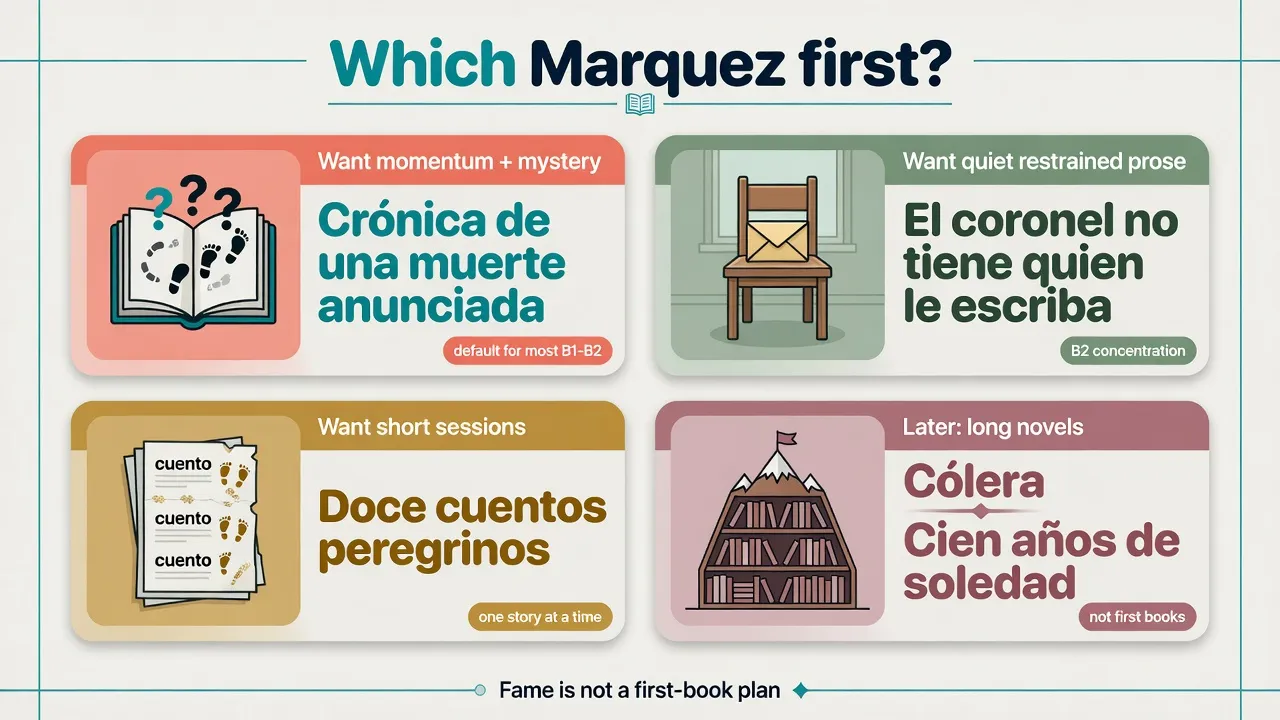
Quick answer: start with Crónica de una muerte anunciada
For most upper-intermediate learners, Crónica de una muerte anunciada is the best first García Márquez book to read in Spanish. It is relatively short, the central event is clear from the beginning, and the story gives you a strong reason to keep turning pages. It is still literary Spanish, not a graded reader - expect to pause for regional vocabulary and imagery. The goal is to follow the story and keep reading, not to understand every word.
If you want a different experience:
| If you want | Start with | Practical band |
|---|---|---|
| A compelling first novella (default) | Crónica de una muerte anunciada | B1-B2 |
| Quieter, restrained prose | El coronel no tiene quien le escriba | B2 |
| Short sessions, one story at a time | Doce cuentos peregrinos | B2-C1 |
| Lyrical longer prose (later) | El amor en los tiempos del cólera | C1 |
| Family saga / Everest (last) | Cien años de soledad | C1+ |
These bands are practical recommendations for learners, not official CEFR exam labels for novels. Edition, habits, and support change how hard a book feels.
Keep scrolling for why Crónica works as a first full novella, when another title fits better, a realistic learner order, a two-page level check, a 15-25 minute session loop, and a warm-up path if literary Spanish still feels heavy. For a softer short-session path through the full difficulty ladder, see where to start García Márquez in the original. This page answers one question: which book first.
Why Crónica de una muerte anunciada is the safest first choice
Think of Crónica as the best first full novella with pull - not the only soft entry on earth, and not "easy Spanish."
The plot spine is simple enough to hold in your head: a narrator pieces together the events around the killing of Santiago Nasar. The death is announced early. You spend less energy on "what is happening?" and more energy on "how is this told?" - who knew what, when, and what they did with that knowledge.
That design is kind to second-language readers. When a sentence breaks, you still have a clear thread to return to. You are not rebuilding a multigenerational family tree on page four.
Choose Crónica first if you can usually:
- follow the main plot of a contemporary novel with occasional help
- read dialogue and narration without translating every sentence
- tolerate a few unknown words without losing the paragraph
- enjoy connecting details and perspectives across scenes
Do not pick it because you expect simplified Spanish. Literary Colombian Spanish still lives on the page: imagery, local texture, careful rhythm. Pick it because it balances three things learners actually need: literary value, manageable length, and narrative momentum.
If you want short independent stories or a quieter novella before any full mystery pull, the sister post on the original-Spanish path covers that softer ladder. Here we keep the default first full novella as Crónica.
When another García Márquez book is a better first pick
The default is not a law. Match the book to how you like to read.
Choose El coronel no tiene quien le escriba if you prefer restraint
This novella follows a retired colonel waiting for a pension that never quite arrives. Surface prose is often more direct than in the longer novels. That does not make every page easy. Much of the meaning sits in silences, repetition, and ordinary details that refuse to go away.
Pick it if you are a solid B2 reader who wants quiet concentration more than mystery momentum. It is short enough to finish in a stretch of short sessions, yet rich enough to reward a slow reread. If loud plot energy tires you, El coronel may feel more like "your" first Márquez than Crónica.
Choose Doce cuentos peregrinos if you learn best in short sessions
A collection of independent stories helps when you do not want to carry one complex novel in your head for weeks. Finish one story. Review a few phrases. Start another when life allows.
Difficulty is uneven across the book. Do not treat the whole collection as one level. Sample a story, notice whether you are reading or decoding, and change course if every page becomes homework. For a fuller soft-entry ladder built around short sessions, use the where-to-start original path.
Save El amor en los tiempos del cólera for later
This novel rewards patience: longer descriptions, slower pacing, voice and emotional vocabulary that bloom over time. Those rewards fade if you stop every line for a dictionary.
For many learners it works better after one shorter García Márquez book - not as the first L2 encounter with his Spanish. Come back when long literary prose already feels enjoyable rather than exhausting.
Do not start with Cien años de soledad just because it is famous
One Hundred Years of Solitude is extraordinary. Fame still does not make it the best first step for a learner. The Buendía family spans generations. Names repeat. The timeline shifts. Magical events arrive in a matter-of-fact voice that assumes you can keep walking.
Read it first only if you already enjoy literary Spanish and can keep moving when a sentence does not fully open. Otherwise, finish one or two shorter works first. You will have more fun, retain more language, and arrive at the Everest book with better legs.
A realistic reading order for Spanish learners
English prestige lists and "greatest hits" shelves are not learner order. Here is a route that works for many B1-B2 readers who want real Márquez without quitting on page ten:
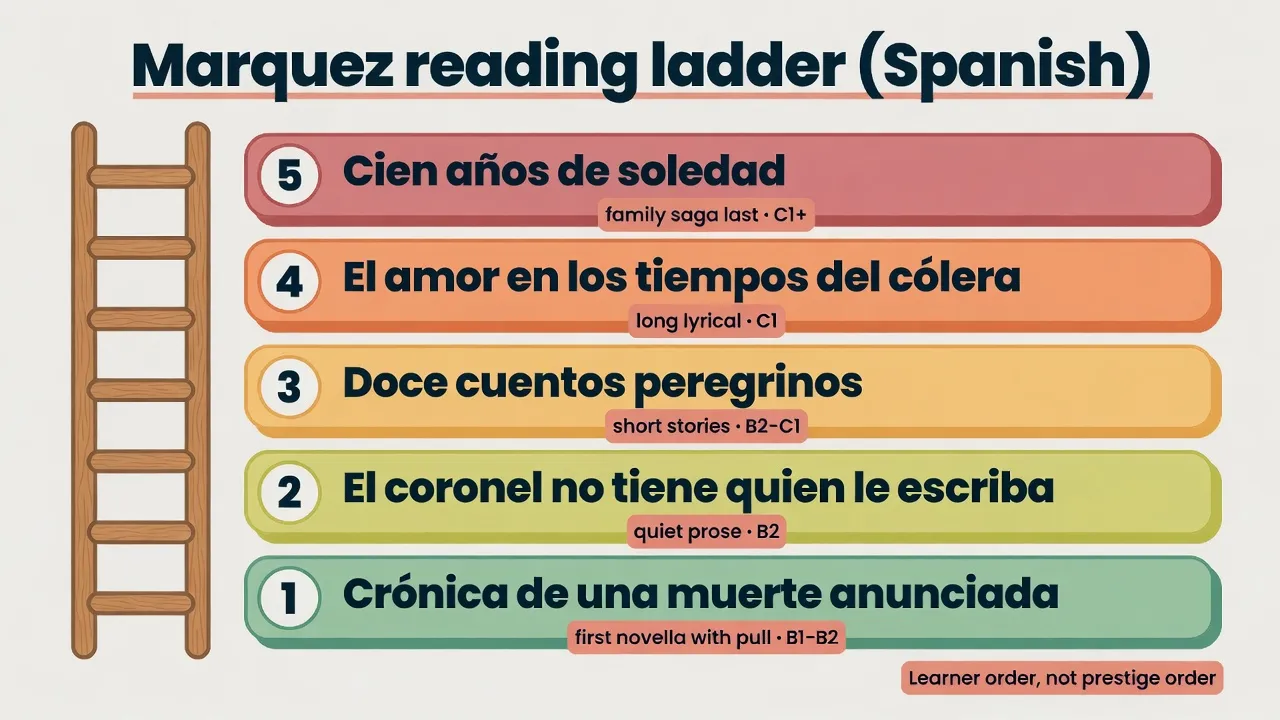
- Crónica de una muerte anunciada - narrative momentum and a manageable first full challenge.
- El coronel no tiene quien le escriba - concise prose and subtext.
- Stories from Doce cuentos peregrinos - practice adapting to different voices (or earlier if you are a short-session learner; that is an alternate path, not the lead answer on this page).
- El amor en los tiempos del cólera - when longer literary prose feels enjoyable.
- Cien años de soledad - the full multigenerational, magical-realist challenge.
You may skip steps. You may reverse Coronel and a couple of stories if quiet prose or short sessions fit you better. Permission is part of the method: finishing a book you enjoy beats forcing a prestigious one you have stopped understanding.
For broader B1 Spanish reading outside Márquez, see Spanish books at B1: what to read. For the gap between graded text and originals, see adapted vs original books.
How to know whether the book is above your level
Before you commit, read two or three pages. Then ask yourself, in plain language:
- Can I explain the basic situation in my own words?
- Who is speaking, and what do they want?
- Are unknown words occasional obstacles, or is every sentence a puzzle?
- Do I still want the next page?
Productive level: you can follow the scene even if you miss detail.
Too hard right now: you lose the basic action. Switch to a shorter work, add more support, or warm up on graded Spanish first.
A useful rule for literary Spanish: do not stop for every unknown word. Mark only the words or phrases that block the scene. Look up a small selection after you finish the page or scene. Keep a short list of expressions worth revisiting. That preserves story rhythm and gives new vocabulary a real context instead of a flashcard vacuum.
If you like a quick finger-test for "is this book too hard?", the 5-finger rule for choosing book level pairs well with the questions above. Method transfer from first long books in another language also lives in how to read your first book in English - the habit ideas carry over even when the novel is Spanish.
Read García Márquez without turning the book into homework
Literature teaches more than isolated words. You learn how ideas, images, dialogue, and rhythm work together. That benefit dies when every page becomes a translation drill.
Try this simple session loop:
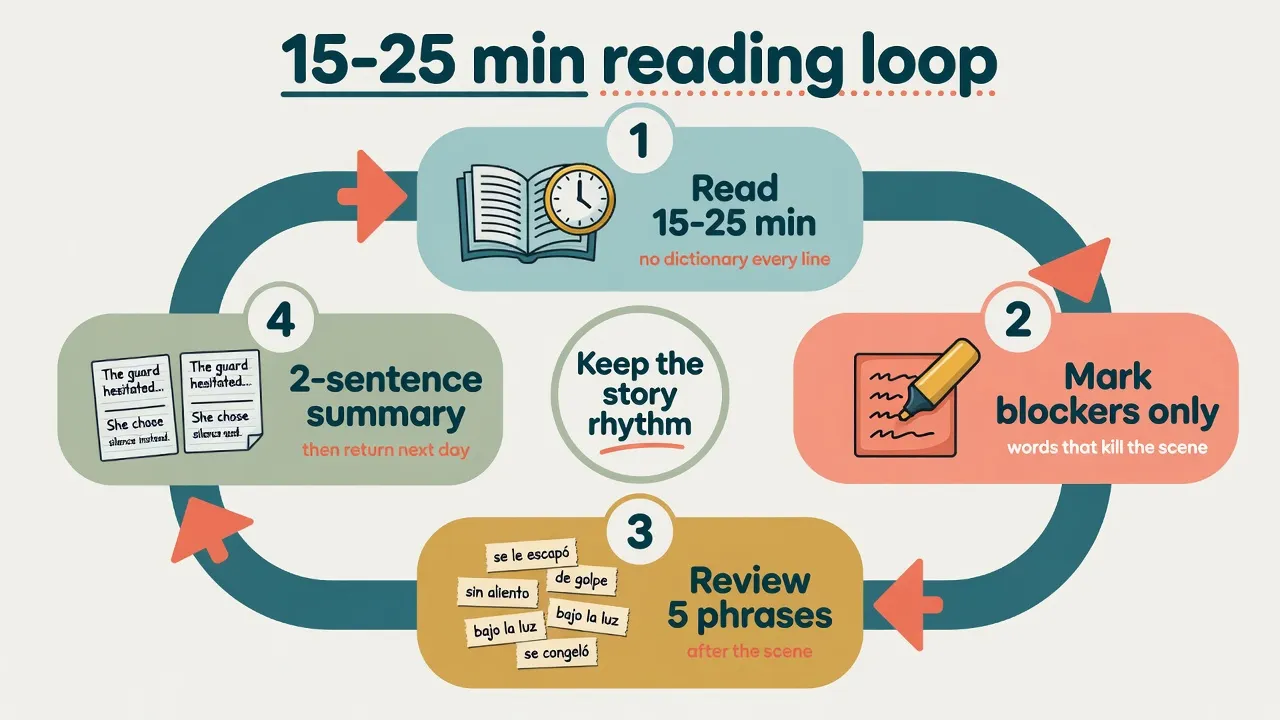
- Read for 15-25 minutes without opening a dictionary at every line.
- Mark only words or phrases that prevent you from following the scene.
- After reading, review up to five useful expressions - not every unfamiliar word.
- Write a two-sentence summary in Spanish or English before the next session.
- Return the next day while the plot is still fresh.
If you use a reading tool, choose one that lets you check blockers in context and return to the text fast. That is the job: understand what stops you, save a little useful language, keep the story alive.
If Crónica still feels too hard
That is normal at the edge of B1. You are not failing literature. You may need a warmer runway.
- Spend a stretch on free graded Spanish so plot-following feels automatic again.
- Retry two pages of Crónica with the 15-25 minute loop.
- Or take the quieter / short-session route: El coronel or a story from Doce, with more detail on the original path ladder.
- When you are ready for full novella support in an app, use a legal EPUB you own (bought or borrowed where allowed).
A calm tool path
Value first was the book pick. Tool second.
If the plot keeps collapsing, warm up on free graded Spanish articles, then return to García Márquez. MovaReader is built for click-translate on text you are actually reading. Freemium gives about 20 word translations per day. Reader is €1/month when you need more translation volume. Pro is €5/month when you want the full practice trainers.
Use the free graded library to rebuild momentum:
For novels, upload a legal EPUB or file you own. We do not host licensed commercial Márquez novels free in the app library by default. Magical realism titles usually need legal purchase or borrow, then your own file if upload is supported.
Pricing and limits in one place: freemium · Reader €1 · Pro €5. Optional practice loops: Spanish typing practice · Spanish phrases practice.
The real win is finishing pages you care about, with support that does not kill the story.
FAQ
What is the easiest García Márquez book to read in Spanish?
For most learners, Crónica de una muerte anunciada is the best first choice: a clear central story plus manageable length. El coronel no tiene quien le escriba is also short, but its emotional subtext can demand more than the surface prose suggests. "Easiest" here means best first full novella with pull, not simplified Spanish.
Can a B1 learner read García Márquez in Spanish?
A strong B1 can try Crónica de una muerte anunciada with support and patience. If you regularly lose the plot, warm up with graded Spanish or simpler native texts first, then return to García Márquez. Treat B1-B2 as a practical band, not an exam stamp on the novel: habits and tools matter as much as a certificate score.
Is Cien años de soledad too difficult for Spanish learners?
Not for every learner, but it is rarely the easiest first García Márquez book. It asks you to manage repeated names, a long timeline, dense imagery, and a large load of unfamiliar vocabulary at once. Fame is not a reason to open it first at B1-B2. Read one or two shorter works first unless you already move comfortably through literary Spanish.
Should I use a dictionary while reading García Márquez?
Yes, selectively. Look up words and phrases that stop you from following the scene. Skip interruptions for words that do not kill the main meaning. Mark blockers, finish the page or scene, then review a small set (about five expressions per session).
Which García Márquez book should I read after Crónica de una muerte anunciada?
Try El coronel no tiene quien le escriba if you want shorter, more restrained prose. Choose stories from Doce cuentos peregrinos if you prefer short sessions and shifting voices. Save El amor en los tiempos del cólera and Cien años de soledad for later, when longer literary Spanish feels enjoyable rather than exhausting.
Is there a softer start than Crónica?
Yes. Doce cuentos peregrinos or El coronel no tiene quien le escriba can fit better if you want short sessions or quiet prose first. For the full original-Spanish path and difficulty ladder, see where to start García Márquez in the original. This page keeps Crónica as the default first full novella with pull for most B1-B2 readers. If even that feels heavy, start with free graded Spanish, then come back.
Open the book that matches your Spanish, not the shelf label
Default pick for most B1-B2 learners: open Crónica de una muerte anunciada. If the decision table pointed you to quiet prose or short stories, start with El coronel or a story from Doce instead. Run the two-page level check. Keep the 15-25 minute loop. Warm up on free graded text when the plot keeps slipping. Climb to Cólera and Cien años when you actually want the longer challenge - not because a list said you must.
Next steps:
- Open Crónica (or Coronel / Doce if that row matched you)
- Two-page level check + 15-25 min loop
- Warm up: free articles · Spanish A2 sample
- Softer ladder: where to start Márquez in the original
- Tools: pricing · type training · phrase typing
Keep reading with translations inside the text
With a free account, an unknown word translates with one tap, and the words you are learning wait for you in the trainer.
Free account: 7 days of Pro, then 20 word translations a day or a paid plan.