Vocabulary Tips
Learn Spanish Idioms from the News (Method + Core List)
You open a Spanish headline, look up every word, and still miss the point. Here is how to treat idioms as phrase units, with a core news list and a calm reading habit.
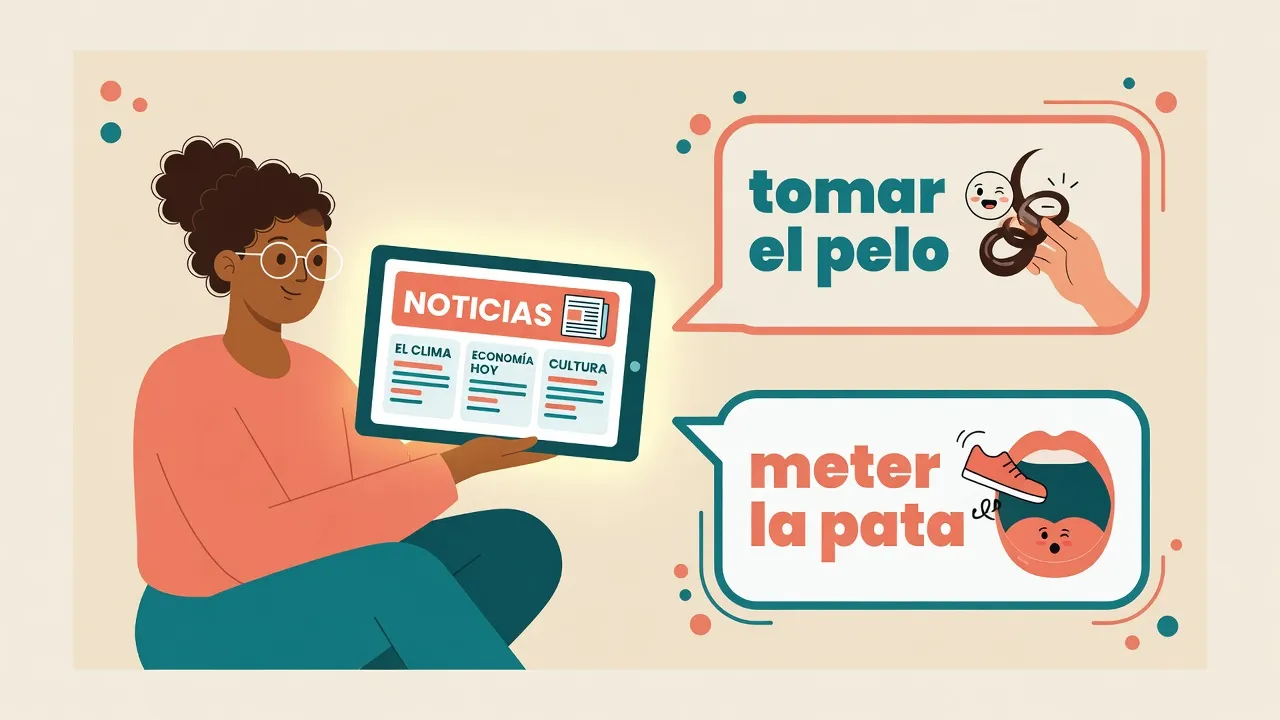
You're reading a Spanish news piece about a political scandal. The journalist writes that the minister le tomó el pelo al público. You open the dictionary. Tomar: to take. Pelo: hair. He took the hair of the public? That cannot be right - and yet every word looked familiar.
Welcome to Spanish idioms in the wild. The words are ordinary. The meaning is not the sum of those words. When you split the phrase, the sense evaporates.
Short answer
Spanish idioms break word-by-word dictionaries. Treat the whole phrase as one meaning unit, learn it from news context (tone plus situation), keep a short high-frequency news list (about 10-15, here fourteen), and run a simple decode loop when you read. Start with graded Spanish news if raw press still feels dense.
Dictionaries translate words. Idioms are meaning units. News is a useful classroom because the same journalistic register shows up again across outlets.
Why dictionaries fail on idioms
Open a bilingual dictionary on meter la pata. You get something like: meter = to put; pata = paw or leg. Put together: "to put the paw." Nonsense. The real meaning is to put your foot in it - to make an embarrassing mistake.
That is the core problem: dictionaries translate words, not meaning. An idiom is one semantic unit dressed up as a string of normal words. Break it apart and the idea disappears.
Here is what the trap looks like on a few common phrases:
| Idiom | Word-by-word (trap) | Real meaning |
|---|---|---|
| meter la pata | put the paw/leg | make an embarrassing mistake; put your foot in it |
| estar en las nubes | be in the clouds | daydream; be absent-minded |
| no tener pelos en la lengua | not have hairs on the tongue | be blunt; speak one's mind |
| dar en el clavo | hit/give on the nail | hit the nail on the head |
You already met the same pattern with tomar el pelo: "take the hair" on paper, pull someone's leg / tease or deceive in real speech and columns.
Traditional dictionaries were built for lemmas. Idioms do not live there. Side by side, the difference is simple: a word pile vs one phrase unit.
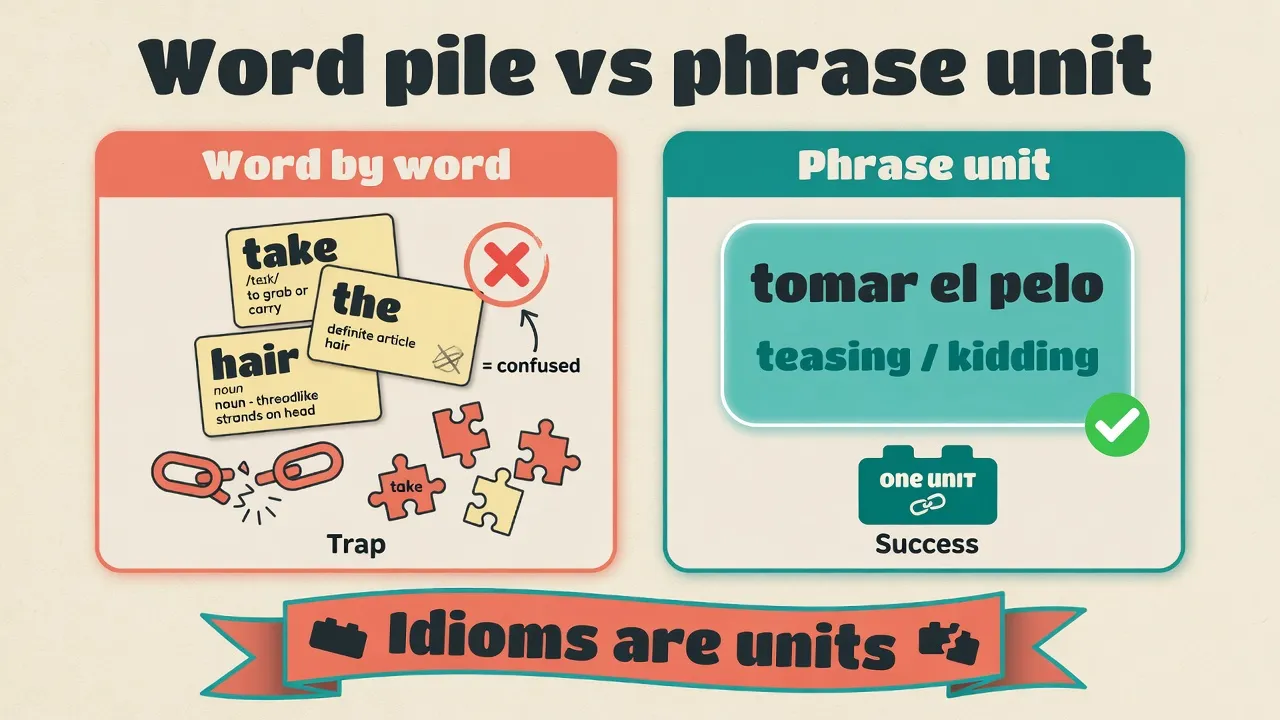
What the dictionary trap does to your reading
Almost every Spanish learner has lived this loop:
- You hit an unknown phrase.
- You look up each word.
- The literal gloss makes no sense.
- You get annoyed and skip the sentence.
- You miss the author's actual point.
It is not only slow. It trains the wrong habit. You teach your brain to treat Spanish as isolated vocabulary items instead of living phrase patterns. The more you lemma-walk idioms, the longer it takes to spot them as units next time.
Why news works better than textbooks or pure novel dumps
Textbooks often sanitize language. Full novels can drift literary or old-fashioned. News sits in a useful middle for idiom exposure:
- Current language - idioms people and columnists use now, not only textbook fossils
- Varied domains - politics, sports, culture, economics each recycle their own stock phrases
- Emotional intensity - headlines and opinion pieces want a reaction; idioms stick to drama
- Repetition across outlets - the same story, many papers, so the same expression meets you again
Here is a classic headline-style line:
El presidente echó leña al fuego con sus declaraciones sobre la reforma.
Literal: "The president threw firewood on the fire with his statements about the reform."
Real meaning: The president added fuel to the fire with his statements about the reform.
See that phrase three times in one week - different outlets, same controversy - and you stop needing a gloss. The meaning sits on a real political scene, complete with tone. That is the classroom news gives you for free.
If raw national press still feels dense, that is normal at A2-B1. Warm up on graded Spanish articles first (for example a Spanish A2 sample), then step toward harder outlets. You do not need El País on day one.
The news decode loop
When a stretch of Spanish stops making literal sense, do not lemma-walk every token. Run this loop instead.
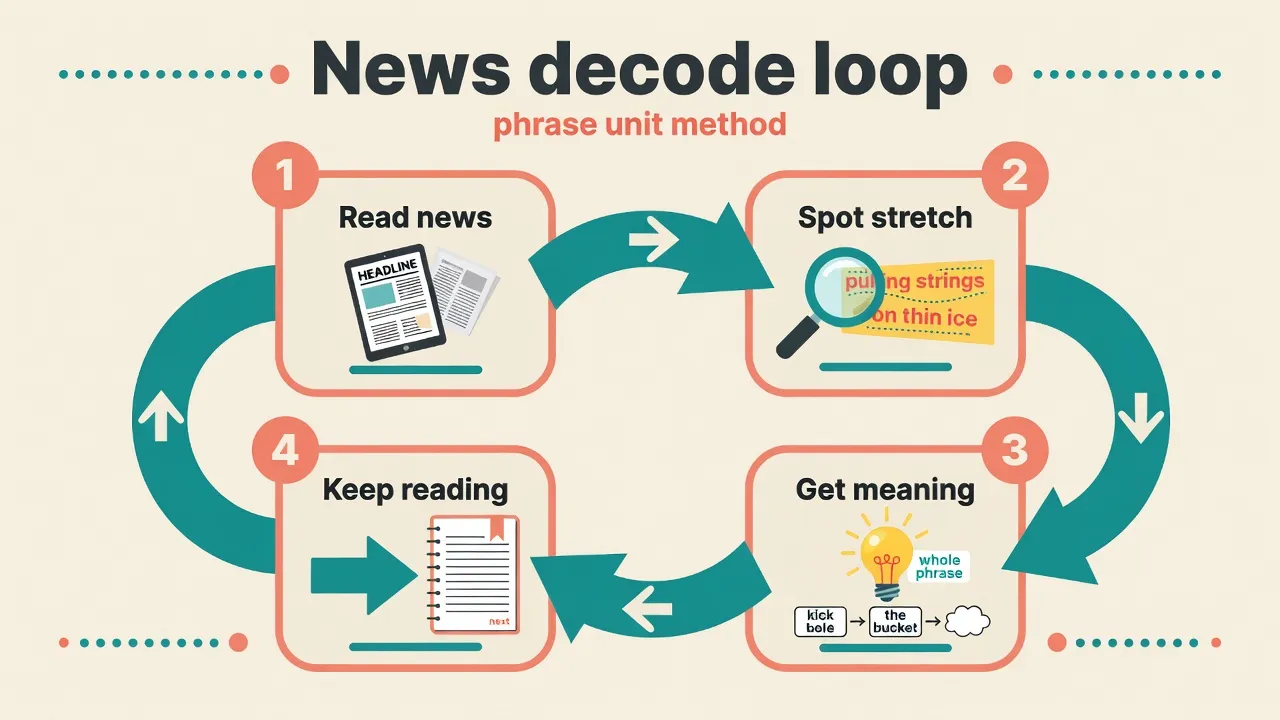
1. Spot the non-literal stretch
If the words are common but the sentence feels wrong, you may be on an idiom. "He took the hair of the public" is a loud signal. Odd combinations of ordinary words are your radar.
2. Treat it as a phrase unit
One meaning - not the sum of lemmas. Look up or tap the whole stretch when your tool allows it. Tomar el pelo is one idea. So is echar leña al fuego. Splitting them is how you invent nonsense translations.
3. Read tone and situation
Is the journalist joking, blaming, praising, or describing a crisis? Sarcasm, scandal, and sports drama narrow the meaning fast. Tomó el pelo in a playful interview is not the same emotional load as tomó el pelo in a corruption column - the core idea (tease / deceive) holds, but register shifts.
4. Log the whole phrase; meet it again
Write down or save the unit, not three separate words. Next week, notice it in another outlet. Meeting the same phrase in a second real context is stronger glue than a perfect dictionary definition you never see again.
The loop feels slow the first few times. After a handful of logged phrases, your eye starts catching "unit shapes" before you open a dictionary.
A good reading tool should support that loop: surface the whole phrase when it can, keep tone or register cues, and let you keep reading. That is support for the method. If you want the product workflow once, skim how to use MovaReader.
Core list: hard Spanish idioms you meet in the news
This is a core news-register list, not "the 100 hardest Spanish idioms" and not a complete catalogue. Journalism, politics, sports, and business columns recycle these. Learn them as units. The sample sentences are news-style, not textbook chit-chat.
| # | Idiom | Literal | Meaning | Sample news-style sentence |
|---|---|---|---|---|
| 1 | tirar la casa por la ventana | throw the house out the window | spare no expense; go all out | El gobierno tiró la casa por la ventana con el nuevo plan de infraestructuras. |
| 2 | dar gato por liebre | give cat for hare | deceive; rip someone off; bait and switch | Los consumidores acusan a la empresa de dar gato por liebre con sus productos orgánicos. |
| 3 | estar entre la espada y la pared | be between the sword and the wall | between a rock and a hard place | El ministro está entre la espada y la pared: dimitir o enfrentar el juicio político. |
| 4 | poner el dedo en la llaga | put the finger in the wound | touch a nerve; raise a sensitive issue | La periodista puso el dedo en la llaga al preguntar por los fondos desaparecidos. |
| 5 | hacer la vista gorda | make the fat eye | turn a blind eye | Las autoridades hicieron la vista gorda durante años con la contaminación industrial. |
| 6 | llover sobre mojado | rain on the wet | add insult to injury; bad news on top of bad | La crisis energética llueve sobre mojado para una economía ya debilitada. |
| 7 | nadar contra la corriente | swim against the current | go against the grain; fight the prevailing trend | El candidato independiente nada contra la corriente en un sistema bipartidista. |
| 8 | ponerse las pilas | put in one's batteries | get one's act together; step up | Los analistas piden que el sector tecnológico se ponga las pilas ante la competencia asiática. |
| 9 | costar un ojo de la cara | cost an eye from the face | cost an arm and a leg | La vivienda en Madrid cuesta un ojo de la cara, según el último informe inmobiliario. |
| 10 | dar la vuelta a la tortilla | flip the tortilla | turn the tables; reverse the situation | El equipo visitante dio la vuelta a la tortilla en los últimos diez minutos del partido. |
| 11 | echar leña al fuego | throw firewood on the fire | add fuel to the fire | El presidente echó leña al fuego con sus declaraciones sobre la reforma. |
| 12 | tomar el pelo | take the hair | pull someone's leg; tease or deceive | La oposición asegura que el ministro le tomó el pelo al público con las cifras de empleo. |
| 13 | meter la pata | put the paw | put one's foot in it; blunder | El portavoz metió la pata en la rueda de prensa y tuvo que rectificar. |
| 14 | poner en jaque | put in check (chess) | put at risk; put on the back foot | La huelga pone en jaque el plan de movilidad del ayuntamiento. |
Fourteen is enough to train your radar. When you want more sets (animals, slang, fixed phrases), use deliberate drill after reading. Soft handoff: the phrases hub is for review of units you actually met, not instead of reading.
Weekly habit ladder
Pick a rung you can keep for weeks, not a 30-day "mastery" sprint that collapses on day twelve.
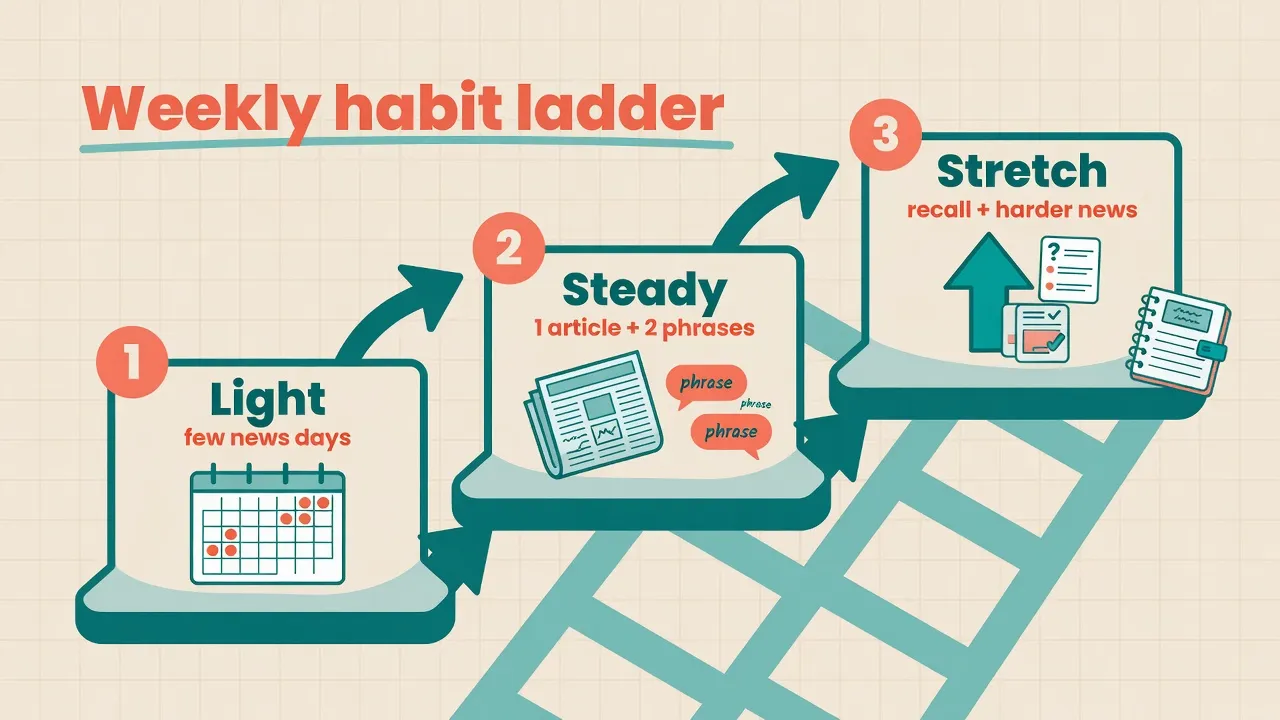
| Rung | Cadence | Focus |
|---|---|---|
| Light | 1 short article every few days | Notice 1-2 non-literal phrases; do not force a deck |
| Steady | ~1 article/day (15-20 min) | Log 2-3 whole phrases; politics/opinion when ready |
| Stretch | Steady + short recall | Restate 3 phrase meanings from memory; mix domains; graded → harder outlets |
Light fits the free plan: short graded pieces, a couple of lookups, no guilt.
Steady is where most intermediate readers live. One article, two or three logged units, done. Quality beats fifty half-noticed dictionary hits.
Stretch adds a tiny recall step: can you restate three phrase meanings without looking? Then mix sports with politics so the same units show up in new costumes.
The goal is fewer freezes on real headlines, not "fluency in a month." If the free plan hits about 20 word translations per day mid-session, that is a product limit signal, not moral failure. Browse all articles for density you can finish; keep a Spanish A2 sample bookmarked as a warm-up when hard news overwhelms you.
How a reading tool helps
MovaReader is built for learning by reading: click meaning in context, treat multiword idioms as units when the tool can, save what you actually met, and review without turning every headline into a guilt deck. For Spanish idioms, the useful path is graded or real news → phrase unit → optional deliberate drill.
What a good reader tool should do, in plain terms:
- Surface the whole phrase when possible (not "take" + "hair")
- Keep register or tone cues when they matter
- Let you keep reading after one tap
- Make it easy to save the unit for later review
It is support for the decode loop.
Plans (when volume becomes the bottleneck)
| Need | Realistic plan |
|---|---|
| Try the loop on short graded news | Freemium (~20 word translations/day) |
| Daily press volume without stopping mid-article | Reader from €1/mo |
| Heavier phrase/type trainers and review depth | Pro €5/mo |
The free plan is enough to learn the habit: free graded library, about twenty translations a day, upload files you already own. We do not host licensed commercial novels by default. Real daily news volume usually wants Reader. Full trainer depth sits on Pro. Details live on pricing.
About the language map
The public language map is orientation for vocabulary coverage - not a CEFR certificate. Personal fill appears after you sign in, pick English or Spanish as a learning language, and mark words and phrases you actually know. Empty personal percent for guests is by design.
Learning targets on MovaReader are English and Spanish. The UI can be Ukrainian; that does not add a Ukrainian learning path.
FAQ
Can I learn Spanish idioms from flashcard lists alone?
Lists help you recognize a phrase once. They rarely teach tone, register, or when a journalist is joking vs accusing. Use a short list as a radar (the core table above), then meet the same units in real or graded news. Flashcards alone usually stall on "I know it on a card, freeze in a headline."
Is Spanish news too hard if I am A2-B1?
Often yes - density, names, and idioms stack up in raw national press. Start with graded Spanish articles and shorter pieces, then step toward harder outlets. You do not need El País on day one. Browse all articles and try a Spanish A2 sample before you force raw headlines.
How many idioms should I learn per week?
Fewer than your ego wants. A calm target is 2-5 whole phrases you can restate from memory after real encounters - not 50 half-noticed dictionary hits. Quality beats a long checklist. Log the unit, notice it again next week, then add another.
Do Spain and Latin America use the same news idioms?
Many journalistic idioms travel well (echar leña al fuego, estar entre la espada y la pared). Others skew regional or informal. When in doubt, trust the local outlet's context over a generic list. Treat this core table as high-frequency news Spanish, not a dialect atlas.
Should I look up every unknown word in a headline?
No. Look up blockers and whole odd phrases. Word-by-word walks on idioms train the dictionary trap. If the words make no sense together, switch to the decode loop: treat as unit → tone → log. Leave rare names and one-off jargon alone until the main claim is clear.
Where do I practice the phrase after I see it once?
Meet it again in another article when you can; that is the strongest glue. For deliberate review, use the phrases hub after reading, not instead of reading. Graded ES samples keep density manageable. The language map gives a rough view of vocabulary coverage.
Next steps
- Warm up on graded Spanish: all articles and a Spanish A2 sample.
- When an idiom breaks literal sense, run the decode loop; log the whole phrase.
- Review collected units on phrases - after reading, not instead of it.
- Check rough vocabulary orientation on the language map if you want a sense of your level.
- Skim how to use once so click-translate and saves are clear.
- Stay on the free plan while testing; move to Reader from €1 on pricing when the daily limit blocks real pages. Add Pro (€5) only if trainers and review volume are the bottleneck.
The hard Spanish news idioms are in today's headlines. Read a little, treat phrases as units, meet them again. Tools help; they do not replace the habit.
Keep reading with translations inside the text
With a free account, an unknown word translates with one tap, and the words you are learning wait for you in the trainer.
Free account: 7 days of Pro, then 20 word translations a day or a paid plan.