Curated Content
Modern Spanish Bestsellers for B2 Readers (Skip the Boring Classics)
Skip archaic classics for daily practice. Five modern Spanish bestsellers for B2 learners with realistic level notes, a quick-pick table and a reading order.
Someone hands you a "must-read Spanish list," and it opens with Don Quixote, a dense magic-realism classic, or a prestige title your teacher loved twenty years ago. You are around B2. You want living Spanish. What you get is habit death on page 30.
You do not need another prestige shelf. You need modern Spanish you can finish: short chapters, current dialogue, and vocabulary that shows up in series, podcasts, and real conversation.
Plain answer. At B2, modern Spanish bestsellers usually beat 19th-century classics for daily habit: living vocabulary, natural dialogue, and plot pull that keeps you turning pages. They are not always easy. Slang, length, and culture still cost lookups. Use the quick-pick table, then open a random page - stay when you understand about 80-90%. Safer Path A: Mentira → La chica de nieve → Reina Roja → El silencio de la ciudad blanca → later Patria. Crime-TV Path B can jump to Castillo or Gómez-Jurado sooner.
In one line: The best modern Spanish book for B2 is the one you can finish this month.
Warm up on free graded texts in the app. Commercial novels are copies you own or borrow - MovaReader does not host full commercial bestsellers by default. Product details come later, after the books and a short method.
In this guide:
- Quick picks by difficulty and the 80% page test
- What "modern" actually helps with at B2
- Five book cards (level, watch-outs, skip-if)
- Books people push too early
- Path A / Path B order
- A short finish-first method + how to use MovaReader
Who this is for: upper-intermediate learners who want Spanish that transfers to series, podcasts, and conversation - not prestige lists that start with Don Quixote as daily practice.
Still fragile at A2-B1? Start with easiest Spanish books you can finish. Solid B1 but not ready for full thrillers? See Spanish books for B1. Same idea for English? Modern English bestsellers for B2.
Quick picks by difficulty
Match your situation first. Then open a random page and run the 80% test - blurbs lie; pages do not.
| Your situation now | Start with | Why |
|---|---|---|
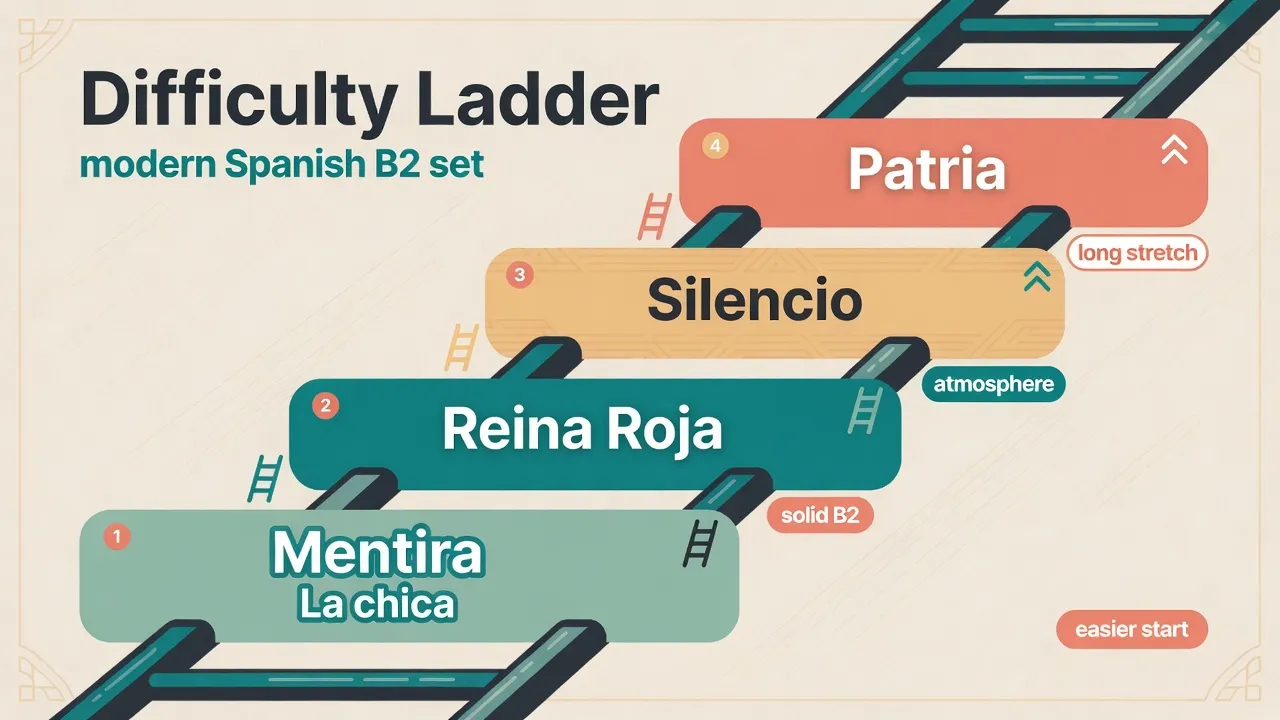
| Low B2, first modern novel | Mentira or La chica de nieve | Shorter chapters, clearer prose, strong plot pull |
| Solid B2, likes thrillers | Reina Roja | Modern police dialogue, short scenes, high pace |
| Solid B2, likes atmosphere | El silencio de la ciudad blanca | Contemporary style + place vocabulary |
| Strong B2 / low C1 stretch | Patria | Accessible sentences, but long and emotionally heavy |
| Not ideal as first "fun B2" book | Dense classics, multi-generation sagas | Great literature, weaker daily-habit fit |
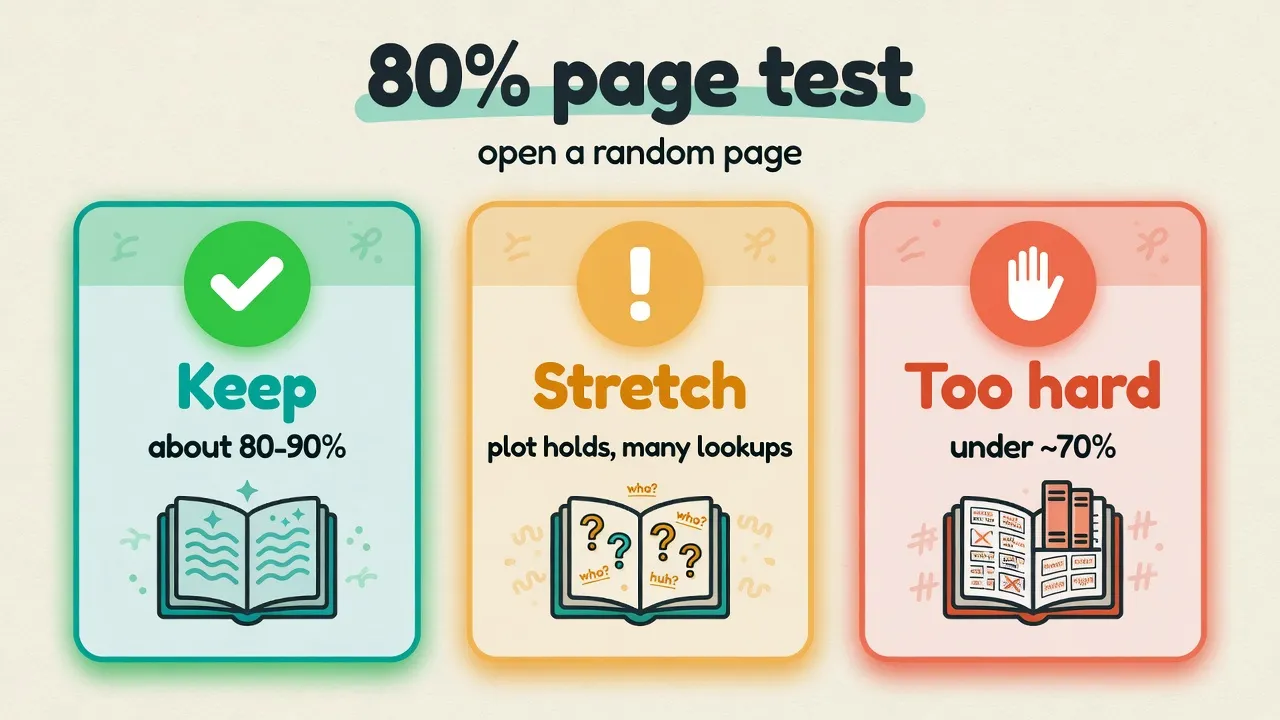
The only rule that matters: open a random page. If you understand about 80-90% without help, keep going. Under ~70% = stretch project, not your main daily reader.
Traffic-light version of the same idea:
- Green: you can retell the scene in simple Spanish
- Yellow: plot holds; some lookups
- Red: you decode almost every sentence - step down
Calibrate without buying a novel first:
- Spanish A2 sample: Aprendiendo a reciclar en casa
- optional Spanish A1 warm-up: Mi día en el parque
- browse free articles
If A2 free text feels automatic and a B2 novel page still feels mostly clear, you are in the right zone for this list. If graded B1 still feels hard, drop to the A2-B1 easiest list for a few weeks - no shame, just good habit design.
Here is the rough difficulty ladder of the five titles (softest entry to stretch):
What "modern" helps with at B2
Modern bestsellers usually give you:
- current vocabulary (devices, social media, workplaces, cities)
- dialogue that sounds closer to speech than to school Spanish
- shorter chapters in many commercial thrillers
- motivation to finish because the plot pulls hard
Modern does not automatically mean easy:
- slang and cultural references still cost lookups
- crime novels pile up procedure and place names
- long social novels can exhaust you even with simple sentences
- YA can be easy linguistically and still dense emotionally
Many "B2 reading lists" mix prestige titles with true comfort books. That confuses people and causes early quitting.
Quick compare for daily habit (not literary merit):
| Criterion | Prestige classics (e.g. Quixote, dense magic realism) | Modern list here |
|---|---|---|
| Vocabulary freshness | archaic / literary density | living Spanish (devices, cities, workplaces) |
| Dialogue | more literary | closer to speech and series/podcasts |
| Chapter shape | often long or dense | many commercial thrillers: short scenes |
| Typical B2 risk | style overload, habit kill | slang, length, culture, emotion |
| Transfer to daily talk | lower for modern life | higher for current Spanish |
| Finishability this month | often poor as first daily book | higher if level band matches |
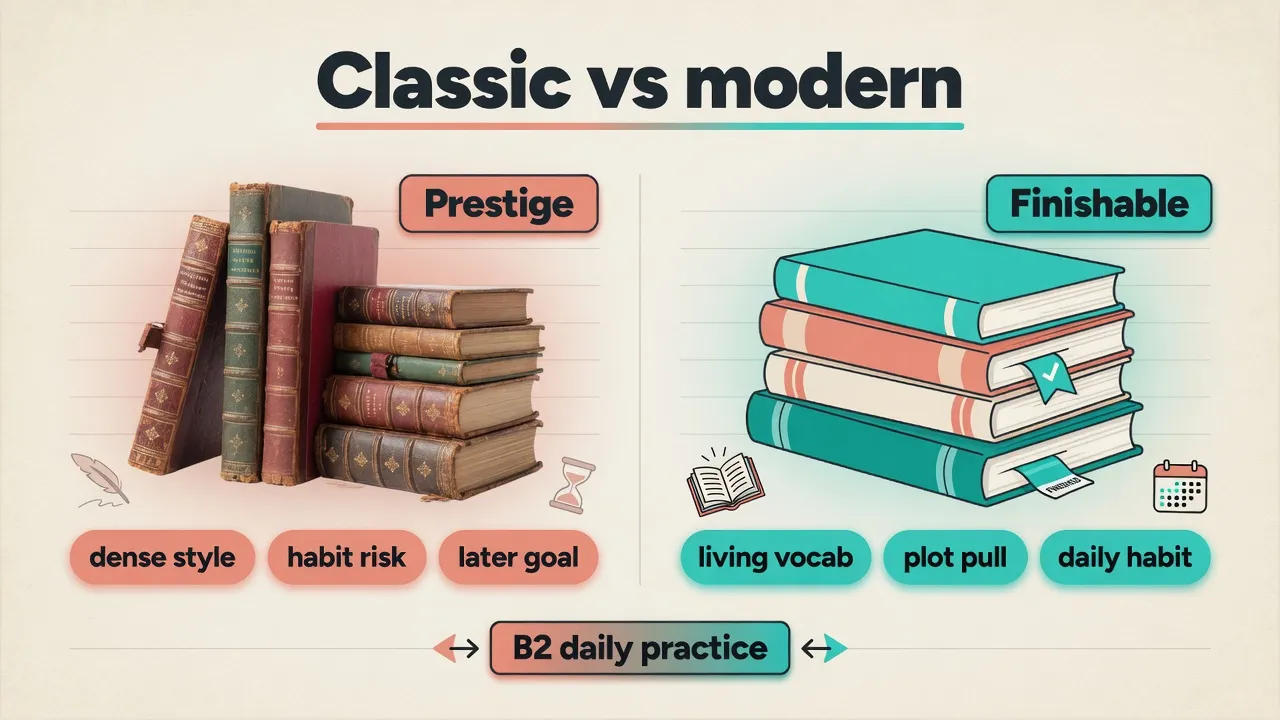
Modern usually means more transferable for daily habit. It does not auto-mean A2.
1. Mentira - Care Santos
Realistic level: high B1 - solid B2
Why it helps: YA thriller tone, simple sentence shapes, lots of everyday digital Spanish. You get contemporary language without the police-file density of adult crime novels. For many learners this is the gentlest entry on the list - a finishable modern novel that still feels like a story, not a textbook.
Watch out for: Internet culture references and quick scene jumps. Skip a joke or meme you do not care about and keep the plot. YA voice is a feature if you want short scenes; a bug if you need adult crime stakes from page one.
How to start: Read 5-8 pages. If you can follow who is lying to whom, continue. If every chat-style line needs a dictionary, step down to free graded texts for a week (all articles), then retry.
Useful language: reflexive reactions, hedging phrases, school/social life vocabulary, short narrative past.
Skip if: you hate YA voice or need adult crime stakes from page one.
2. La chica de nieve - Javier Castillo
Realistic level: solid B2
Why it helps: Fast thriller pacing, short chapters, journalistic and everyday modern Spanish. Castillo writes for momentum, not literary ornament. That is good for language learners: you practice reusable modern Spanish while the story keeps you turning pages.
Watch out for: Multiple timelines and media-investigation vocabulary. Keep a simple character list if names blur. The media register (reporting, devices, city movement) is gold for series and podcasts - and also the thing that slows readers who try to look up every byline-style phrase.
How to start: One short chapter a day is enough. Stop mid-chapter if needed; consistency beats hero sessions. If multi-timeline crime confuses you more than it pulls you, park this and finish Mentira first.
Useful language: reporting, devices, city movement, shock reactions, cause-and-effect narration.
Skip if: multi-timeline crime confuses you more than it pulls you.
3. Reina Roja - Juan Gómez-Jurado
Realistic level: solid B2 (slang makes some pages harder)
Why it helps: Short, punchy scenes; contemporary Spain setting; dialogue-heavy thriller style. This book is popular because it feels current. That is also why a paper dictionary alone frustrates people: informal Spanish is not always in textbook lists.
Watch out for: Colloquial and rude speech, police/procedure terms, Madrid cultural references. Tap blockers, not every colorful insult. Partial understanding is fine when the chase still holds.
Flavor note: short aggressive dialogue, setup language, city landmarks used as shortcuts in speech.
How to start: If the first interrogation or chase scene feels mostly clear, you are fine. If slang blocks every third line, keep Mentira as your main book and use Reina Roja as a twice-weekly stretch.
Useful language: informal commands, suspicion language, workplace tension, modern crime-TV register.
Skip if: heavy slang walls kill flow and you refuse partial lookup.
4. El silencio de la ciudad blanca - Eva García Sáenz de Urturi
Realistic level: solid B2
Why it helps: Clear contemporary prose, strong sense of place (Vitoria-Gasteiz), and a plot structure that rewards daily reading. This is a good "next novel" after a shorter thriller. You still get modern Spanish, but with more atmosphere and setting vocabulary - city, architecture, investigation framing - without antique grammar.
Watch out for: Local geography, investigation terms, and descriptive passages that slow speed-readers. Atmosphere is the point for some readers and the drag for others. If you only want ultra-short chapters and zero description, you may bounce.
How to start: Read one scene, then retell in 2-3 simple Spanish sentences (even ugly ones). If the action retell works, comprehension is ok. If you cannot name who did what where, the page is still red - step down or slow the session.
Useful language: city and architecture words, investigation framing, social media reactions, contemporary emotional dialogue.
Skip if: you want only ultra-short chapters or zero descriptive atmosphere.
5. Patria - Fernando Aramburu
Realistic level: strong B2 - low C1 for comfortable independent reading
Why it helps: Everyday domestic Spanish, powerful dialogue, modern historical context told through families rather than textbooks. The prose is often more accessible than people expect. The challenge is volume and context, not antique grammar.
Watch out for: Length, emotional intensity, many characters, Basque names and local references. Do not use Patria as your first proof that "B2 reading works." Use it after you finish one shorter modern book.
How to start: Treat it as a project novel: fixed daily page target, not a weekend binge. Map the two families early. If grief and anger scenes wipe you out, shorter sessions still count - finishing is the goal, not heroics.
Useful language: family conflict language, memory narration, neighborhood talk, grief and anger phrasing.
Skip if: this is your first "proof B2 works" book, or you have finished zero shorter modern novels yet.
Popular books people push too early at B2
These are excellent later. They are simply weaker first targets if your goal is "finish modern Spanish this month."
| Book type | Why harder than blogs admit |
|---|---|
| Dense magic-realism classics | Long sentences, shifting time, heavy metaphor |
| Multi-generation political sagas | Timeline load + historical vocabulary |
| Poetry collections | Short pages, high figurative density |
| 500+ page gothic mysteries | Motivation helps; daily lookup load still high |
Keep prestige titles as goals. Build habit on finishable modern books first. If you are still climbing through adapted classics and wondering whether originals are "allowed," read our take in adapted vs original books - then come back here when modern commercial Spanish feels like the next step, not a punishment.
Suggested order if you feel lost - Path A / Path B
Think ladder, not prestige shelf. Order protects finish rate more than any "best novel" debate.
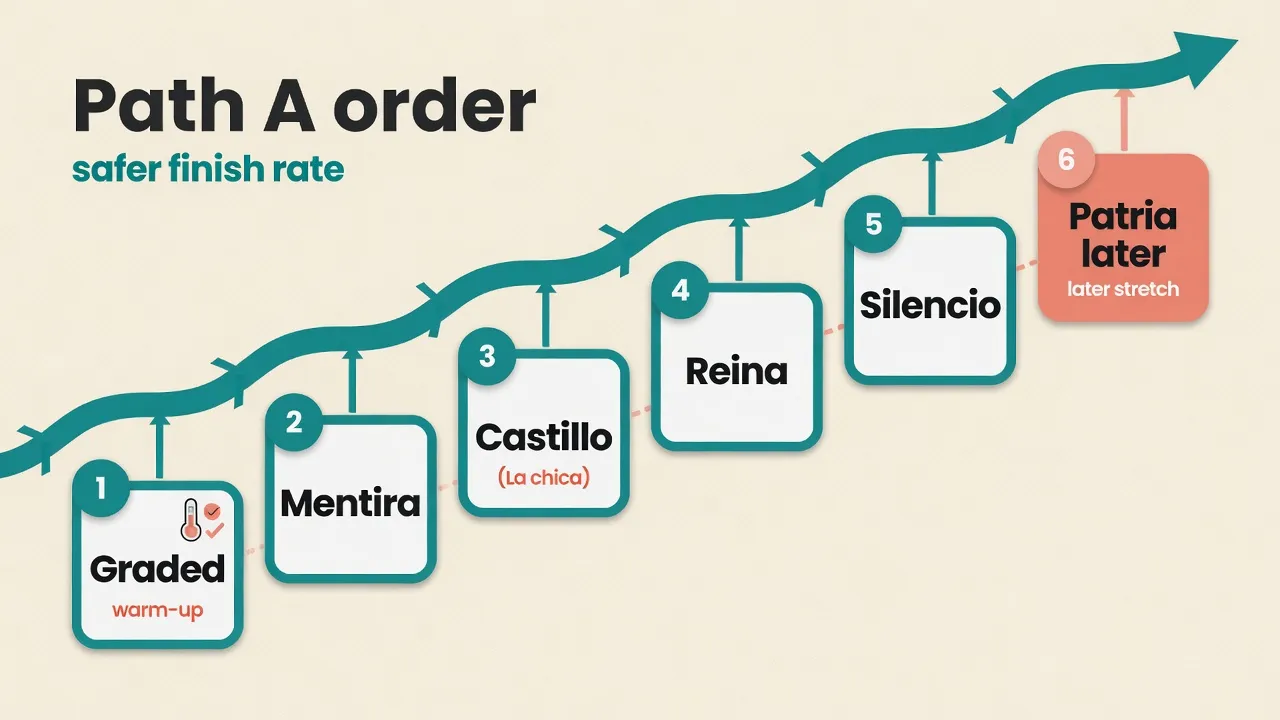
Path A (safer finish rate):
- Free A2-B1 articles in MovaReader (all articles)
- Mentira
- La chica de nieve
- Reina Roja
- Later: El silencio de la ciudad blanca
- Much later: Patria
Path B (if you already love crime TV in Spanish):
- Free A2 sample + one longer graded text
- La chica de nieve or Reina Roja
- El silencio de la ciudad blanca
- Stretch Patria only after path books 2-3 feel manageable
Difficulty ladder in one line: graded free texts → Mentira → La chica de nieve → Reina Roja → El silencio de la ciudad blanca → Patria (stretch).
If Path A book 2 still feels red after a week of honest sessions, you are not "bad at Spanish." You are early. Stay on graded speed days longer, or park on the B1 Spanish reading list until lookups drop.
A reading method that does not burn you out
Keep this short. Full walkthrough: how to learn Spanish by reading (complete method).
- Pick for comprehension, not status. Constant translation = decoding. Step down a week.
- Look up less, finish more. Read a paragraph without stopping → mark only sentence-blockers → check → reread → save 3-10 phrases max (not 40 isolated words).
- Short daily sessions. 15-25 minutes. Stop mid-chapter if needed.
- Mix free graded + one real book. 3-4 days graded / 2-3 days modern book / 1 day review phrases.
- Audio only when it helps. After the written page is mostly clear - audio on an opaque page usually adds noise, not magic.
Samples for warm-up and mix days:
- Spanish A1 sample
- Spanish A2 sample
- stretch graded option: El misterio de la zona abisal
- browse free articles
Want a sense of whether novel coverage is realistic for your vocab size? See vocabulary size to read Spanish novels and the free language map for progress orientation.
How to use MovaReader
MovaReader is useful for this exact problem: reading with support, then turning unknown words into practice. It is not a free warehouse of commercial bestsellers.
- Warm up on free graded articles in All Articles so you learn the click-to-translate flow.
- Upload a book file you own (for example EPUB) when you are ready for a longer title. See How to use.
- Tap only blockers, not every unknown adjective or insult.
- Train a small set of phrases in the Spanish phrases practice, Spanish typing practice, or full trainers after you save them.
- Respect freemium limits: free use includes listening unlimited and about 20 word translations per day. Unlimited translation is on Reader (€1). Full trainers are on Pro (€5). Details: Pricing.
Free path today:
- Read a Spanish A2 sample
- Try the word training demo
- Try the phrase training demo
- Only then upload a book you own and start with Mentira or La chica de nieve
Own the file (or paper). Use the app for lookup discipline and practice - not as a pirate shelf. For legal free EPUBs and public-domain options (not commercial hits by default), see free legal EPUB libraries (English and Spanish).
FAQ: modern Spanish books for B2
Are modern bestsellers always easier than classics?
Usually for vocabulary and sentence rhythm, yes. Not always for length, slang, or cultural density. The useful formula is modern + short + high plot pull - not "modern = automatic A2."
What is the easiest book on this list?
For many learners, Mentira or La chica de nieve. Reina Roja is more current and fun, but slang can slow you down. Always run the 80% page test on a real page, not a blurb.
Should B2 learners still use graded readers?
Yes. Graded texts build speed and confidence. Real books add motivation and natural style. A stable mix: free graded texts most days and one real book in short sessions.
How many pages should I read per day?
Start with 4-8 pages or 15-25 minutes. Increase only when lookup frequency drops. Consistency beats a two-hour weekend guilt session. Stop mid-chapter if needed.
Can I read Patria at B2?
Some motivated B2 readers manage it with support. Most enjoy it more after finishing shorter modern novels first. If your goal is "finish books," choose a shorter win first. Patria is strong B2 to low C1 for comfortable independent reading - length and emotional load matter more than antique grammar.
Do I need AI to read modern Spanish?
No. You need the right book level, a lookup habit that does not destroy flow, and consistent minutes. Tools reduce friction; they do not replace judgment about difficulty.
Is Reina Roja or El silencio de la ciudad blanca ok for low B2?
Often a stretch if slang or atmosphere blocks every third line. Prefer Path A order (Mentira or La chica de nieve first). Let the 80% page test decide - not social media hype.
Where do I get these books?
Buy or borrow a legal copy. Upload your own EPUB into the app if you want tap-to-translate support. Free graded articles in MovaReader are warm-ups - they are not the commercial novels on this list. The app does not host full commercial bestsellers by default. Public-domain and free legal sources: free legal EPUB libraries.
Final takeaway
The best modern Spanish book for B2 is the one you can finish this month.
Choose for comprehension, protect your daily habit, and use tools to reduce friction - not to pretend a long social novel is a light weekend read. Prestige can wait. Finishable modern Spanish builds the habit that makes harder books possible later.
Clean start today:
- Open a free Spanish A2 text or browse all articles
- Run a 10-minute 80% page test on Mentira or La chica de nieve
- Load your legal EPUB only if you want reader support (how to use, pricing)
- Keep graded days in the mix; stretch to Reina Roja, El silencio, then Patria only when green/yellow holds
Related reading: how to learn Spanish by reading, vocabulary size for Spanish novels, Spanish books for B1, easiest Spanish books A2-B1, modern English bestsellers for B2.
Keep reading with translations inside the text
With a free account, an unknown word translates with one tap, and the words you are learning wait for you in the trainer.
Free account: 7 days of Pro, then 20 word translations a day or a paid plan.