Language Learning Psychology
"I Have No Talent for Languages": Why That Myth Stalls Progress
I'm just not a language person. That story often hides a bad method, wrong difficulty, or too little contact. Here is the talent myth, realistic 6-month ranges, and reading that builds comprehension.

Have you ever said - or quietly believed - "I just have no talent for languages"? Maybe years of school Spanish or French ended with a barely passed exam, and you decided your brain was not built for this.
You are not alone. Plenty of adults quit and blame aptitude. That story feels true because traditional classes reward a narrow skill set: rule drills, perfect tests, fast oral output under pressure. If that system did not fit you, it is easy to invent a permanent identity: language person vs not a language person.
"I have no talent for languages" is usually a story about method, difficulty, contact hours, or fear - not a genetic off switch. People differ in working memory, phonology, prior languages, and free time; that changes speed and comfort, not can or cannot. Six months is a useful planning window with realistic ranges, not a fluency certificate for every adult. Reading you can mostly understand (about 80-90%) is one of the strongest scalable habits for busy adults - not magic, and not the only skill you will ever need.
Here is the practical spine: four levers that actually move progress, five boring reasons adults stall, a realistic six-month plan with minute ranges, and a reading path you can start today.
The "language gene" is a weak explanation
Is there a genetic component to language learning? Research on individual differences exists. It is still a poor excuse for quitting.
What shows up again and again is more boring and more useful than a talent switch:
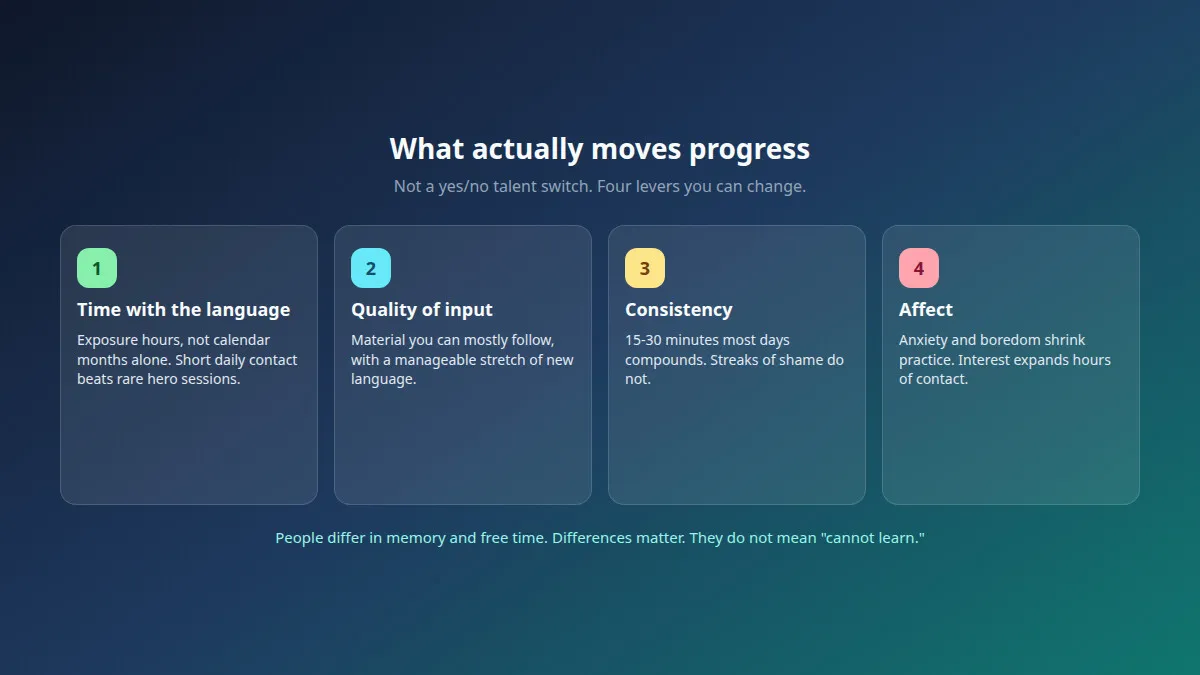
- Time with the language - exposure hours, not calendar months alone
- Quality of input - material you can mostly follow, with manageable novelty
- Consistency - short daily contact beats rare hero sessions
- Affect - anxiety, shame, and boredom shrink practice; interest expands it
Notice what is missing from that working list: "natural talent" as a yes/no switch. People differ in working memory, phonological sensitivity, prior languages, and free time. Those differences matter. They change how fast and how comfortable the climb feels. They do not mean "cannot learn."
Here is a simple board of the four levers that usually matter more than a talent label:
Stephen Krashen's line is still a useful orientation (even if you treat no theory as a cult):
There is no such thing as a person who cannot learn a second language. There are only people who have not found the right approach yet.
The talent myth survives because school often gives everyone the same textbook, the same pace, and the same tests. When you fall behind, the system labels you. A better diagnosis is usually wrong difficulty, too little input, or a method that kills motivation.
Fixed mindset vs growth mindset
Carol Dweck's mindset research is often oversold in marketing. The practical point is solid. If every struggle "proves" you are not a language person, you stop experimenting. If struggle is feedback about method and load, you adjust.
Three assumptions keep the language talent myth alive:
- "I should understand everything immediately." Productive reading often means roughly 80-95% understanding with a little stretch. Full clarity on day one is not the bar.
- "Other people learn faster than me." You often compare week 1 to their year 3, or to someone who already lived abroad or grew up with related languages.
- "I tried before and failed." Methods fail more often than brains do. Apps, pure grammar books, and random video do not automatically equal a coherent input plan.
None of that requires genius. It requires changing inputs and habits.
Why reading is a strong lever (not the only one)
If talent is not the main lever, what is? One robust answer from vocabulary and extensive-reading research (Nation, input-based approaches, graded reading practice) is comprehensible input: language you can mostly understand, with just enough stretch.
Reading is not the only route. Listening, conversation, writing, and deliberate study still help. For busy adults, reading is often the most scalable lever:
- Self-paced - pause and re-read without social panic
- Context-rich - words sit in sentences and stories, not only on white cards
- Huge supply - articles, graded texts, news, books for every interest
- Low social risk - a page does not judge slow decoding
The catch is difficulty. Too easy and you coast. Too hard and you "prove" the talent myth again.
The 80-90% rule
Open a random page. Use this rough compass:
| Understanding without help | What to do |
|---|---|
| About 80-90% | Keep going |
| Under ~70% | Step down or switch to shorter graded material |
| Always ~98%+ and bored | Stretch difficulty a little |
Try free samples before you rewrite your identity:
- Spanish A1: Mi día en el parque
- Spanish A2: Aprendiendo a reciclar en casa
- Browse the free graded library
If the page feels like a brick wall, that is input design, not proof you lack a language gene.
What actually stalls adults (the five boring reasons)
If talent is mostly a myth, why do so many people stall? Usually for five ordinary reasons - none of them a genetic off switch.
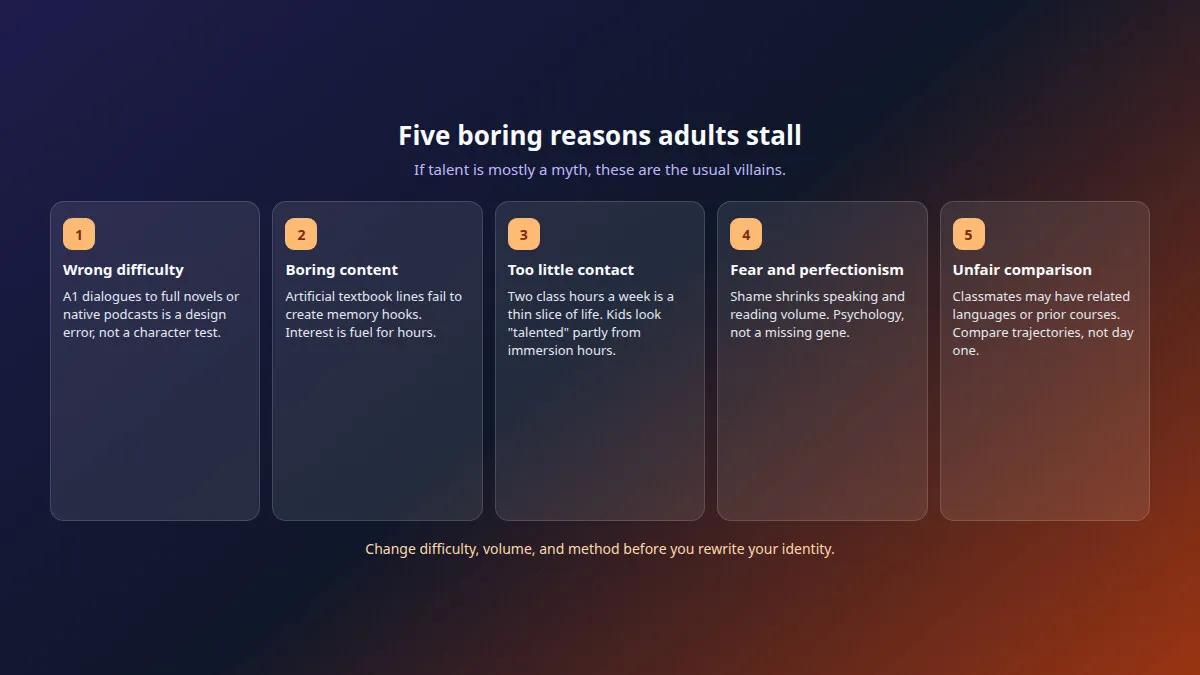
Five stalls that look like "no talent" until you name them:
1. Wrong difficulty
Jumping from A1 dialogues to raw literature, unfiltered news, or native podcasts at full speed is not a character test. It is an input design error. Brains need a ladder, not a cliff.
2. Boring, artificial content
Textbook lines about cats on tables do not create strong memory hooks. Interest is not a luxury. It is fuel for the hours of contact that look like "talent" from the outside.
3. Too little contact time
Two class hours a week is a thin slice of life. Children look "talented" partly because they live inside the language many hours a day. Adults need realistic weekly volume, not shame.
4. Fear of mistakes and perfectionism
Shame cuts speaking and reading volume. That is psychology, not a missing gene. If perfectionism is the main drag, dig deeper in fear of mistakes and perfectionism. When progress freezes later, the B1-B2 plateau post is a useful next read.
5. Comparison without context
The classmate who "gets everything" may already have related languages, daily media habits, or prior courses. Compare trajectories, not day-one performance.
For a Spanish-specific path (ser/estar, ES ladder, speak-in-six-months framing), see our sibling post on the Spanish talent myth and realistic progress. This article stays general: any second language, same four levers.
A realistic 6-month plan (ranges, not a guarantee)
Six months is a useful planning window. It is not a universal fluency certificate.
What "progress" can mean after about half a year of serious work varies by:
- starting level (A0 vs A2)
- hours per week (3 vs 10+)
- languages already known
- reading and listening volume vs grammar-only study
- how you define "fluent" (travel chat is not workplace meetings, and neither is novels without help)
Here is an illustrative reading-heavy plan. Treat the minutes as targets to adjust, not promises.
A simple six-month planning board (ranges to adapt):
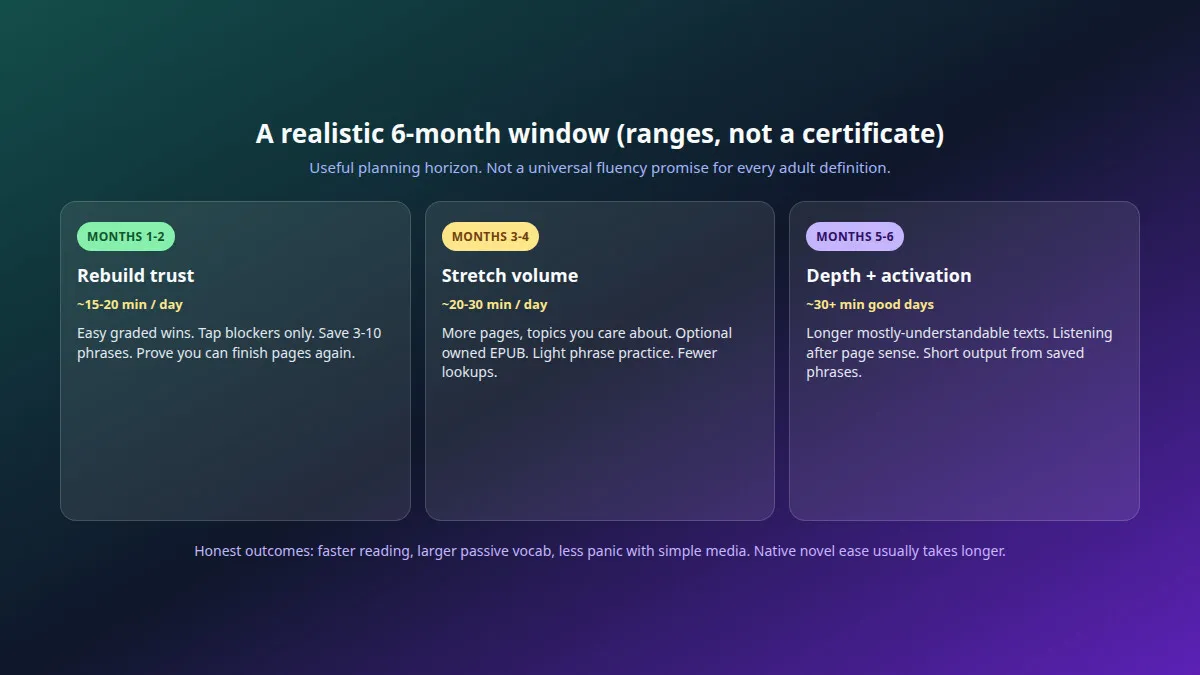
Months 1-2: Rebuild trust with easy wins (~15-20 min/day)
- Short graded texts or very easy stories at your real level
- Tap only words that block meaning, not every adjective
- Save 3-10 useful phrases per session, not 40 isolated lemmas
- Goal: rebuild the habit and finish pages
Months 3-4: Stretch volume (~20-30 min/day)
- Mix the free graded library with slightly harder topics you care about
- Optional: an EPUB you own when graded texts feel too short
- Light phrase practice so some passive items become usable
- Goal: fewer lookups per page; more pages per week
Months 5-6: Depth and activation (~30+ min on good days)
- Longer texts that are still mostly understandable
- More listening after the written page is clear
- Short speaking or writing from saved phrases
- Goal: comfortable extensive reading at your new ceiling - not "native podcasts at full speed for everyone"
Realistic outcomes after six months of daily practice often look like: stronger reading speed, larger passive vocabulary, less panic with simple media, better class confidence. Full professional fluency, accent perfection, and novel-native ease usually take longer - sometimes much longer - and that does not mean you lack talent.
"But I tried everything and nothing worked"
If Duolingo streaks, textbooks, tutors, flashcards, and language exchanges all felt useless, that still does not prove a missing talent gene. It often means none of those pieces gave you enough understandable input at a stable difficulty with a habit you could keep.
Common tool limits (not moral failures):
| Tool | Limit |
|---|---|
| Gamified apps | Short isolated sentences, weak narrative |
| Grammar books alone | Rules without enough usage in real context |
| One tutor hour a week | Valuable feedback, limited exposure volume |
| Flashcards alone | Pair recognition without rich context (fine as a side tool, weak as the whole system) |
Reading real-ish texts with support is one way to raise volume without a conversation partner every day. It is not magic. It is logistics: more messages understood per week.
How to use MovaReader
MovaReader is a supported reading foundation. It is not a talent replacement and not a speaking replacement.
What it does:
- Free graded article library with click-to-translate while you read
- Upload files you own (for example EPUB) when you want longer material you already have rights to read
- Trainers for words and phrases you saved (full trainers on Pro; demos available)
- Listening on freemium (useful after the page is mostly clear)
What it does not do:
- Host licensed commercial novels by default (no free Harry Potter chapter buttons)
- Replace choosing the right difficulty
- Replace live speaking
If daily volume is the bottleneck, plans stay simple (see Pricing for current periods):
| Plan | When it fits |
|---|---|
| Freemium | Explore the library, listening, about 20 word translations/day |
| Reader €1 | Unlimited translations for serious reading volume |
| Pro €5/mo | Full trainers when practice after reading is the bottleneck |
Suggested free path today:
- Open All Articles
- Read a sample at your level (ES A2; step down to ES A1 if needed)
- Try the word training demo and phrase typing demo
- Only then bring a file you own if you want longer reading (How to use)
- Move up the plan table when ~20 translations/day or missing trainers block real pages - not before
FAQ
Does "no talent for languages" mean I should quit?
No. It usually means the previous method, difficulty, or contact hours did not fit. Change those before you rewrite your identity as "not a language person." Individual differences change speed and comfort, not can or cannot.
Can anyone become fluent in 6 months?
No teacher should promise full professional fluency in six months for every adult definition of "fluent." Some motivated learners make large jumps in half a year; many need longer. Track weekly hours and comprehension, not calendar myths. Travel chat, workplace meetings, and novels without help are different targets.
Is reading enough to learn a language?
Reading is a high-leverage input source for vocabulary and comfort. Most people still want listening and some speaking or writing for balanced skills. Use reading to grow the foundation; add output when you can. It is not a speaking replacement.
How do I know if a text is the right level?
Use the about 80-90% understanding rule. Open a random page. If you mostly follow without help, keep going. If every line needs a dictionary (under ~70%), step down to shorter graded material. Frustration is data about difficulty, not destiny.
What if I am over 30 or 40?
Adult brains still learn. You may need more explicit help with form and more deliberate practice than a child, but you also bring strategy, vocabulary from related languages, and domain knowledge. Age is not a talent test. Consistency and right-level input still matter more than a "language gene" story.
Should I drop grammar completely?
No. Drop grammar-only plans that never give you messages to understand. Light grammar notes after you have seen forms in context often stick better than abstract tables alone. Rules without enough usage in real text are a common stall, not proof of missing talent.
Final takeaway
The talent myth is useful as a quit story and terrible as a plan.
You do not need a special gene to improve. You need contact hours, material you can mostly understand, a difficulty ladder, and tools that reduce friction. Start with one page today - preferably something interesting - and judge yourself by whether you return tomorrow, not by whether you woke up "fluent" in week two.
Keep reading with translations inside the text
With a free account, an unknown word translates with one tap, and the words you are learning wait for you in the trainer.
Free account: 7 days of Pro, then 20 word translations a day or a paid plan.