Vocabulary Tips
Passive vs Active Vocabulary: How to Force Words You "Kind of Know" into Real Speech
You can follow a book and still freeze when someone asks a simple question. Here is the passive vs active gap, the "kind of know" trap, and a short listen-repeat protocol that gives words a path into real speech.
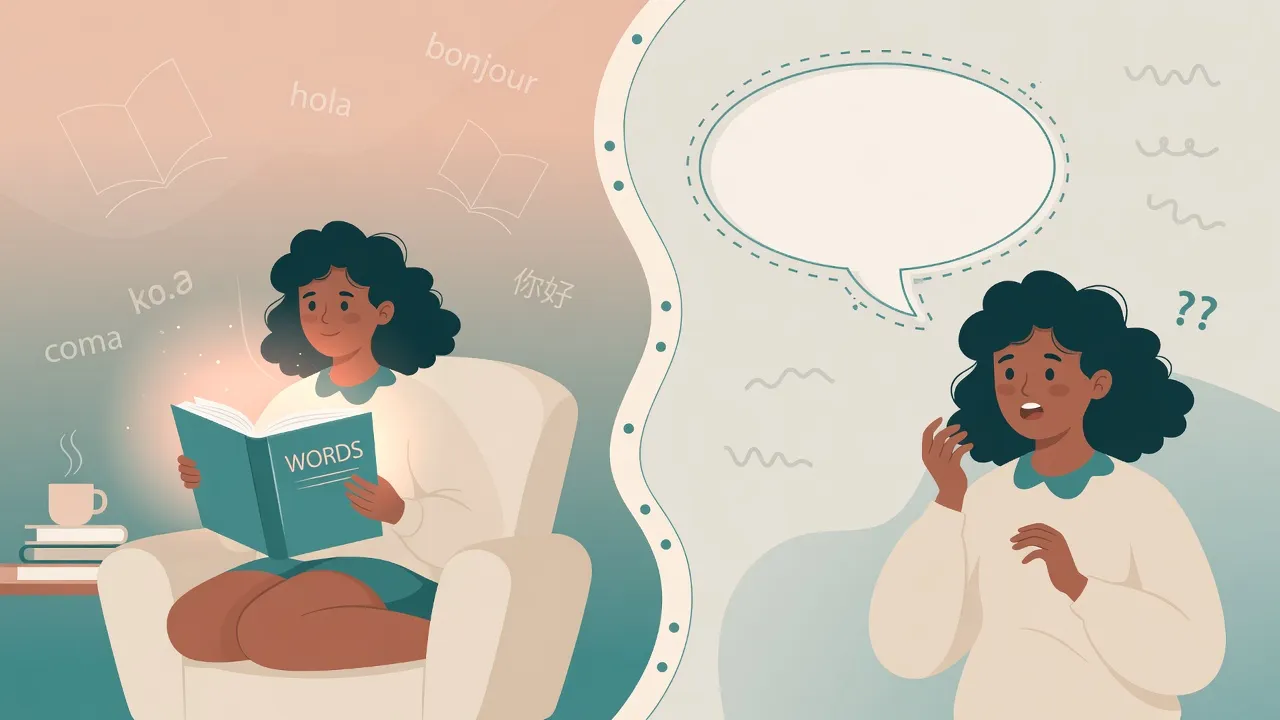
You're reading a book in the language you're learning. The plot makes sense. The jokes land. You even feel the nuance in a quiet sentence. Then a friend asks you something simple in that language, and your mind goes blank.
The words you know do not show up.
That is usually not "zero knowledge." It is the gap between passive and active vocabulary. Recognition is easier than retrieval plus pronunciation under time pressure. The fix is not a bigger word list. It is a small, repeatable loop: meet the word in a real sentence, hear the full sentence, say it aloud, say it again from memory, then give a few targets a tiny real job later (voice note, journal line, conversation). Do a handful per session. Consistency beats heroic word-count promises.
Why you understand books but freeze when asked a question
Reading and listening ask your brain to match what arrives. Speaking asks it to find a form, shape the grammar, and move your mouth - often while someone is waiting.
So you can feel fluent with a page and clumsy with a reply. That mismatch is common for people who learn a lot through input. Input is valuable. It just does not automatically train production.
If this freeze has a name in your head - "I understand everything but I can't speak" - you are not broken. You have a large recognition store and a thinner retrieval habit. The useful response is not shame. It is a method that puts your mouth (and sometimes your fingers) on the words you already half-own.
For a broader look at the freeze itself and a short menu of soft activation exercises, see our guide on passive to active vocabulary and the language barrier. This article goes deeper on the kind-of-know zone, a sentence-level listen-repeat protocol, and a transfer ritual into real talk.
Passive vs active (plain definitions) + the "kind of know" trap
Here's the simple version:
- Passive vocabulary: words you recognize when you read or hear them. You get the meaning in context. You might even spell them if you saw them on a page.
- Active vocabulary: words you can pull out under time pressure - pronounce, place in a sentence, and use without a long mental search.
Both stores matter. Passive vocabulary is how you follow media and books. Active vocabulary is how you join the conversation. Treating passive growth as "not real progress" is unfair. Treating it as finished speaking skill is also wrong.
Between the two sits a messy middle: the kind-of-know zone.
You've seen the word many times. You "feel" it in your head. In conversation it just. does not. come out. That zone creates false progress. Silent reading feels smooth, so you assume you are ready. Then real time pressure proves otherwise, and frustration hits hard.
Common signs you're stuck there:
- You recycle the same safe words in every conversation
- Native input feels clear; your replies stay short and simple
- You sense the word is there, but too slow for live talk
- You dodge topics because retrieval feels risky
If that list feels personal, good. You now have a target. You do not need to "know more words" first. You need a few words you already recognize to survive a retrieval drill.
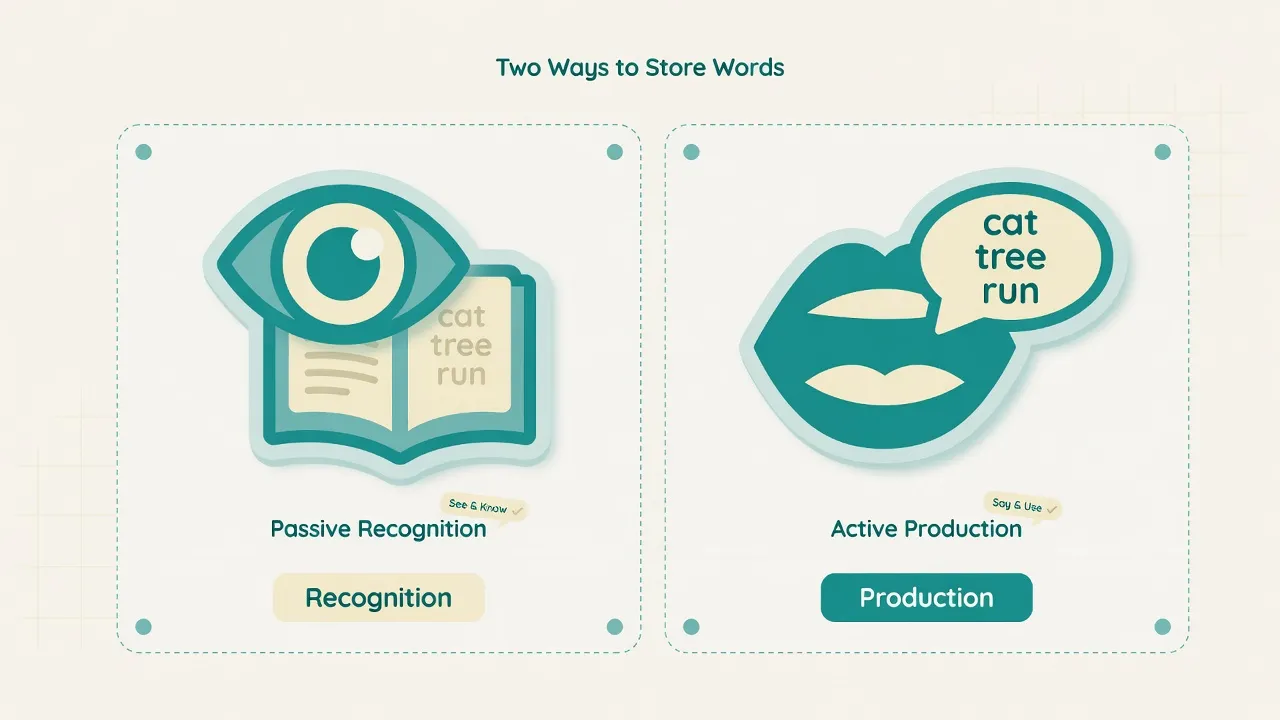
Two stores, one learner: passive recognition on one side, active production on the other - with the kind-of-know zone in between.
Recognition is not retrieval
When you read a word, your brain does recognition. It matches input against patterns it has seen before. That can feel almost automatic after enough exposure.
When you speak, your brain does retrieval. It has to search, select a form, attach enough grammar, and send motor commands to the mouth. That is slower and more fragile - especially if you have only ever met the word through silent reading.
You do not need a lab paper or a hard-sounding brain map to act on this. The practical takeaway is enough: comprehension circuits and production habits are not the same workout. Watching piano tutorials does not train your hands. Hearing a word a hundred times does not guarantee you can say it on cue.
So "I understood it in the book" is real progress for reading. It is not proof that the word will appear in a café reply. Activation is a separate habit: mouth rehearsal plus a later micro-use in something that feels like real language.
The listen-repeat protocol (4 steps, sentence-level)
The core drill is almost boring. That is a feature. Linguists often talk about shadowing or listen-and-repeat. For vocabulary activation, keep it at sentence level, not isolated dictionary syllables.
1. Meet the word in context.
Pick a sentence from reading you care about - a story, a graded article, a page you chose. Context gives memory hooks: plot, emotion, neighboring words. Isolated list items give you fewer.
2. Hear the full sentence.
Not only the target word. The whole line. Rhythm, stress, and connected speech matter. A word alone rarely sounds like it does in living speech.
3. Say the full sentence aloud.
Mimic pace and intonation as best you can. Your mouth needs to feel the word in motion. This is motor rehearsal, not a perfection contest.
4. Look away and say it again.
True recall. No peeking. If you stumble, glance once, then try from memory again. One clean pass from memory is enough for a first session.
Time budget: often about 30-60 seconds per sentence when you stay focused. Target roughly 5-15 sentences per reading session when energy allows. Quality beats volume. Three careful sentences beat thirty mumbled list items.
Optional Spanish micro-example while you read:
La inquietud lo invadió como una ola inesperada.
You may already "kind of know" inquietud. Hear the full line. Say it looking. Say it from memory. That is the loop. One word did not become fluency. One word got a path toward use.
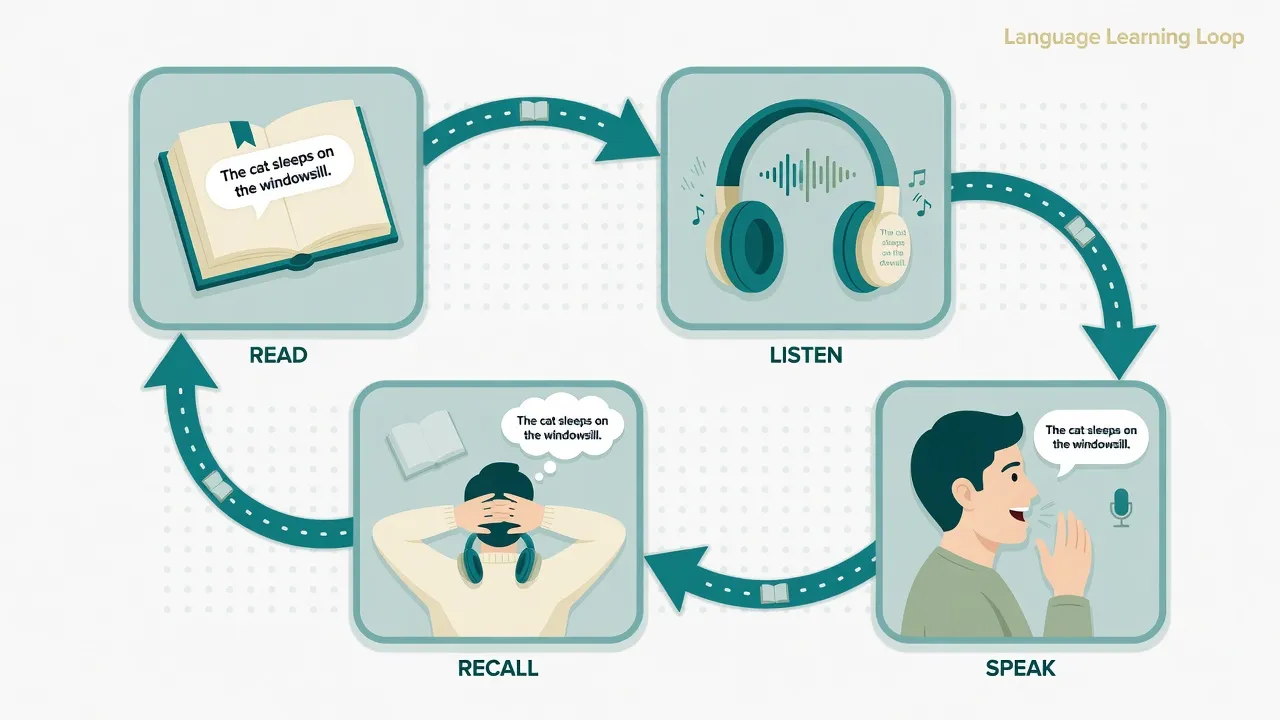
The listen-repeat loop: context → hear → say → recall. Small, repeatable, finishable.
A few notes to keep the protocol useful:
- Prefer phrases and full sentences you might actually say later.
- Skip heroic daily counts. A few high-value lines finished well will beat a spreadsheet of unfinished targets.
- Shadowing trains mouth and retrieval for those lines. It is a bridge, not a finish line for conversation skill.
If you want reading time that fits a busy day, the 15-minute vocabulary rule pairs well with this drill. For context guessing before you even open a gloss, see guessing English words from context.
Push words into conversations (transfer ritual)
Listen-repeat moves a word closer to the tongue. Transfer gives it a job in something that feels real.
Same day or next day, pick 3-5 targets from what you practiced - not fifty. Then run one small move:
| Move | How | Why |
|---|---|---|
| Voice note | 60-90 seconds summarizing your day or the page, forcing those 3 words in | Low social risk, real recall |
| Journal line | One short paragraph that includes the targets | Production without an audience |
| Swap overused words | Replace "very good / interesting / nice" with one better chunk you practiced | Precision you already "knew" |
| Buddy or class turn | Use one target phrase on purpose | Real time pressure, small dose |
You are not staging a TED talk. You are parking words in a situation where retrieval has to fire. Voice notes and journals are underrated because they feel private. That privacy is useful when public speaking still freezes you.
After a week, notice what changed: which words still need another oral pass, which ones showed up unprompted. That quiet feedback loop is enough. Skip fantasy yearly word-count spreadsheets. A few targets done well will beat a giant unfinished list.
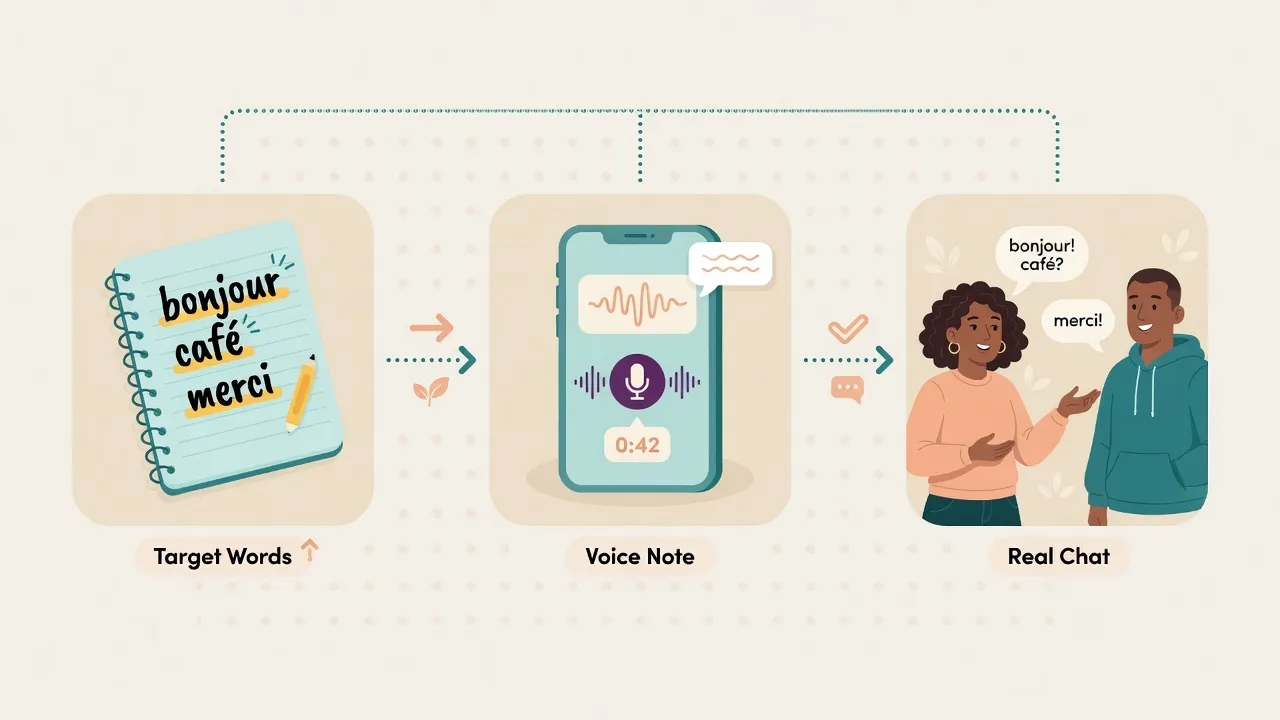
Transfer path: an activated line leaves the page and gets a micro-use - voice note, journal, or real chat.
Extra levers: chunks, overused safe words, optional typing path
Beyond the core four steps, a few levers speed activation without turning study into a second job.
Work in chunks, not lone words.
Your brain likes reusable pieces: "couldn't help but," "a sense of," "on the other hand." When you practice a full sentence, you train neighbors of the target too. Later, those neighbors help new sentences assemble faster. If you like structured phrase work, the Phrase Trainer is built for short, repeatable lines.
Hunt overused safe words.
Many learners can understand rich language but reply with the same thin toolkit. That is the kind-of-know trap talking. Keep a tiny "swap list": three safe words you always say, and three slightly sharper chunks you already recognize from reading. In your next voice note, force one swap. Small, specific, finishable.
Optional typing path.
Speaking alone can feel awkward at first. Typing the full sentence slowly is another motor channel: spelling, structure, working memory. Try one careful typed pass, then still do one oral pass when you are ready. The phrase typing demo is a low-pressure way to feel that loop. Typing is a complement, not a permanent substitute for mouth practice if speaking is your goal.
Warm up aloud for a few minutes.
Before the protocol, read a short stretch of the book out loud. Think of it as stretching. Your articulatory system wakes up; retrieval feels less sudden when the "real" targets appear.
Avoid paper-notebook guilt traps.
Huge handwritten lists often die in a drawer. If notebooks have burned you before, our take on why paper vocabulary notebooks kill motivation may sound familiar. Keep targets short enough that you still want tomorrow's session.
For longer reading flow without constant dictionary stops, flow-state reading for English longreads pairs with activation: stay in the story first, then pull a few sentences for the mouth drill.
Where MovaReader fits
You need two things for this method: sentences you care about, and a low-friction way to hear and revisit them. App-hopping (reader + dictionary + separate audio tool) kills the habit.
MovaReader is built around reading first: graded free texts, legal EPUB/FB2/text you own, click-to-translate when stuck, and listening for lines so you can run the protocol without leaving the page. Optional trainers come later for phrases and typing - not as nightly punishment homework.
Plans and limits:
| Fact | Detail |
|---|---|
| Free start | Graded library at all articles |
| Freemium translations | About 20 word translations per day |
| Listening | Often unlimited on free - do not wait for a paid plan just to hear lines |
| Reader | About €1/month for higher translation volume when you read a lot |
| Pro | About €5/month for full trainers (phrases, typing, and more) |
| Uploads | Legal EPUB/FB2/text you own |
How a session can look in practice:
- Open a graded piece or your own legal book (how to use if you are new).
- Mark or notice a sentence with a kind-of-know word.
- Listen to the full line. Say it. Say it from memory.
- Park 3 targets for a voice note or journal line later.
- Optionally save a phrase for a short trainer pass when you want spaced mouth practice.
For rough orientation by level, the language map helps you see research-style ranges. Sample graded reads to try the loop on real text: article 1209, article 1127.
Tools lower friction. You still supply the 30 seconds of mouth work and the later micro-use.
Old friction path vs activation path
| Old friction path | Activation path |
|---|---|
| Word → dictionary → forgotten flashcard → still can't say it | Sentence → hear → say → recall → micro-use later |
| Many apps, high friction | Help stays near the text (click, listen) |
| Huge weekly list | Small daily targets you can actually mouth |
FAQ
Is a big passive vocabulary useless?
No. Passive vocabulary is how you understand media and books. It is real progress. It is just not the same skill as speaking under pressure.
How many words should I activate per day?
Start with 3-10 high-value sentences, not 50 new list items. Finishable beats impressive. A few words per session, done consistently, is a realistic pace.
Does shadowing alone make me conversational?
It trains mouth and retrieval for specific lines. Real conversations still need real interaction. Shadowing is a bridge, not a finish line.
Can I activate words only by reading silently?
Silent reading mainly grows recognition. Some people subvocalize, but deliberate speak or write practice is more reliable for active use.
Should I learn isolated word lists?
Lists can help review. Activation works better with phrases and full sentences you might actually say.
Is listening in MovaReader only on paid plans?
Listening is often unlimited on freemium. Paid plans help with translation volume (Reader) and full trainers (Pro). Check current pricing.
Will this make me fluent?
No tool can promise that. This method improves the odds that known words show up when you need them - with practice and real talk over time.
Start today (5-minute first session)
Open a page in a language you are learning - free graded text, a legal upload, or a sample article above.
- Find 5 sentences with words you understand but have never said out loud.
- For each: hear the full sentence if you can, say it looking, say it from memory.
- Pick 3 targets. Record a 60-second voice note or write four lines that force those words in.
- Stop. Do not "make up" a giant list for the week.
Tomorrow, five new sentences. Same loop. You are not trying to empty the ocean. You are teaching a few known words that they have a job in your mouth.
The words are already half-yours. Recognition built the store. Activation is the short, slightly awkward, very human next step: hear, say, use, repeat.
Keep reading with translations inside the text
With a free account, an unknown word translates with one tap, and the words you are learning wait for you in the trainer.
Free account: 7 days of Pro, then 20 word translations a day or a paid plan.