Contextual Vocabulary Learning That Actually Helps
Polyglots rarely live inside naked word lists. They meet language in real messages. Here is a practical contextual method - no fabricated multi-x studies, no empty fluency promises.
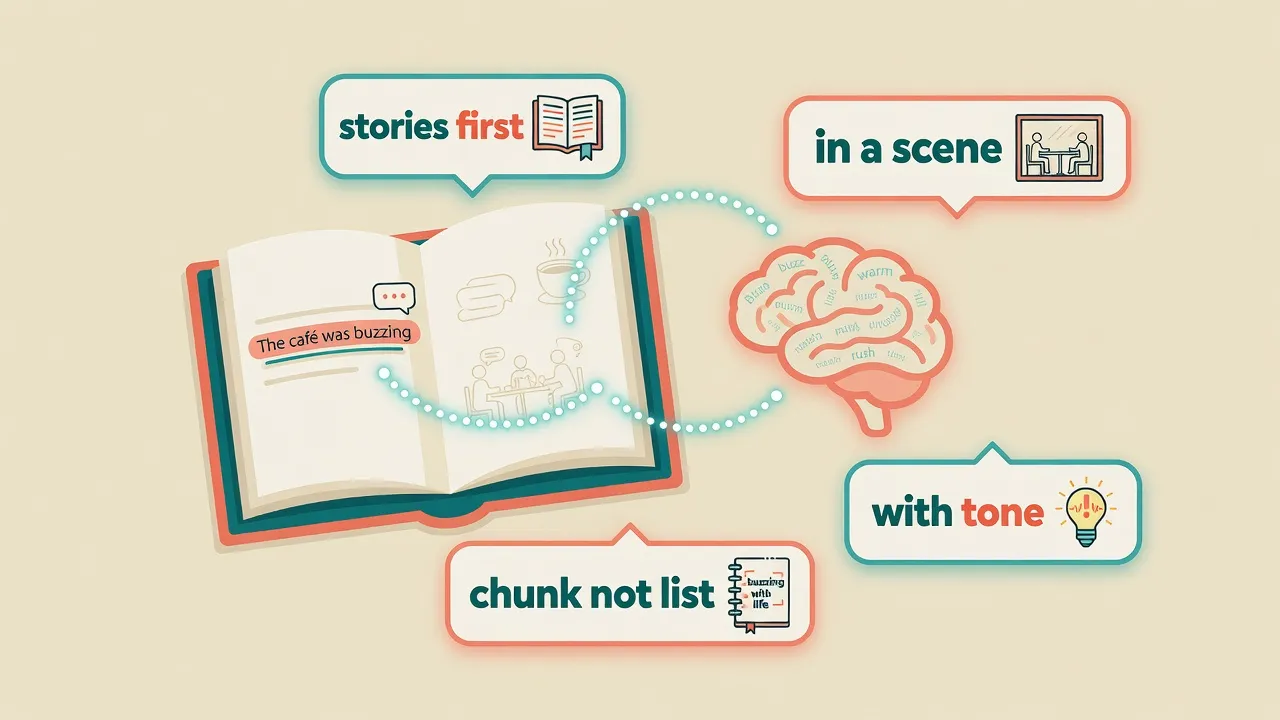
You can conjugate ir in every tense and still freeze when someone says "Anda, no me digas." That is often not a pure grammar gap. It is a context gap: you studied forms in isolation, then met living language with tone, idiom, and speed.
Many people freeze on living speech not only from grammar, but from that same gap. Forms came alone; language arrives with tone and speed. A simple polyglot loop fixes the practical problem without miracle math: interesting input near your level, understand the message, notice useful chunks, meet them again, reuse a few. Lists can help for high-frequency glue; they underperform as the whole system. Skip blog theater that invents fixed multi-x speed for everyone.
The durable habit is a reading loop near your level - not a secret percentage.
Below: what contextual learning actually means, why naked lists often stall, four layers worth noticing, honest research notes (no fake study shopping), page-difficulty bands, a daily protocol you can keep, when lists still help, and a clean path inside MovaReader if friction while reading is your bottleneck.
What "contextual learning" actually means
Contextual learning here means meeting language inside real messages - not a ban on every flashcard.
In practice:
- you meet a word inside a sentence, scene, or dialogue
- you also get collocations (make a decision, not only decision)
- tone matters (sarcasm, politeness, anger)
- you see the word again across days and texts
It does not mean:
- never use a flashcard again (spaced review of phrases from your reading can still help)
- dictionaries are evil
- one thrilling novel equals fluency
- any AI translation makes you a polyglot automatically
Many successful multilingual learners (the people blogs call "polyglots") do something simple and repeatable: they get a lot of words and phrases inside real messages - reading, listening, and later reusing chunks - instead of treating vocabulary as a naked list.
That method is useful. The internet version often is not: "contextual learning is several times faster for everyone," "a tidy lab trial proved a fixed multi-x retention gap," "90 days rewires your brain forever." Those exact figures are marketing theater more often than careful science writing. This guide keeps the useful method and drops the fake precision.
Why naked word lists often underperform
Lists are not useless. They are incomplete.
Common failure modes:
- Weak memory hooks - a line on a list has little story, emotion, or image.
- One sense only - English run, Spanish llevar, Ukrainian йти all split into many uses. One gloss hides that.
- No grammar neighbors - you "know" a noun but not the verb or preposition that usually travels with it.
- Recognition without retrieval - you understand the word when you see it later, but cannot pull it out when speaking.
Polyglot-style practice attacks those gaps by keeping the phrase + situation attached to the item. When you save language, prefer a full chunk you actually met (nothing says summer quite like..., me parece que...) over an orphan lemma with a single gloss.
Four layers of context worth noticing
You do not need a mystical system. When you meet a new item, ask four quick questions.
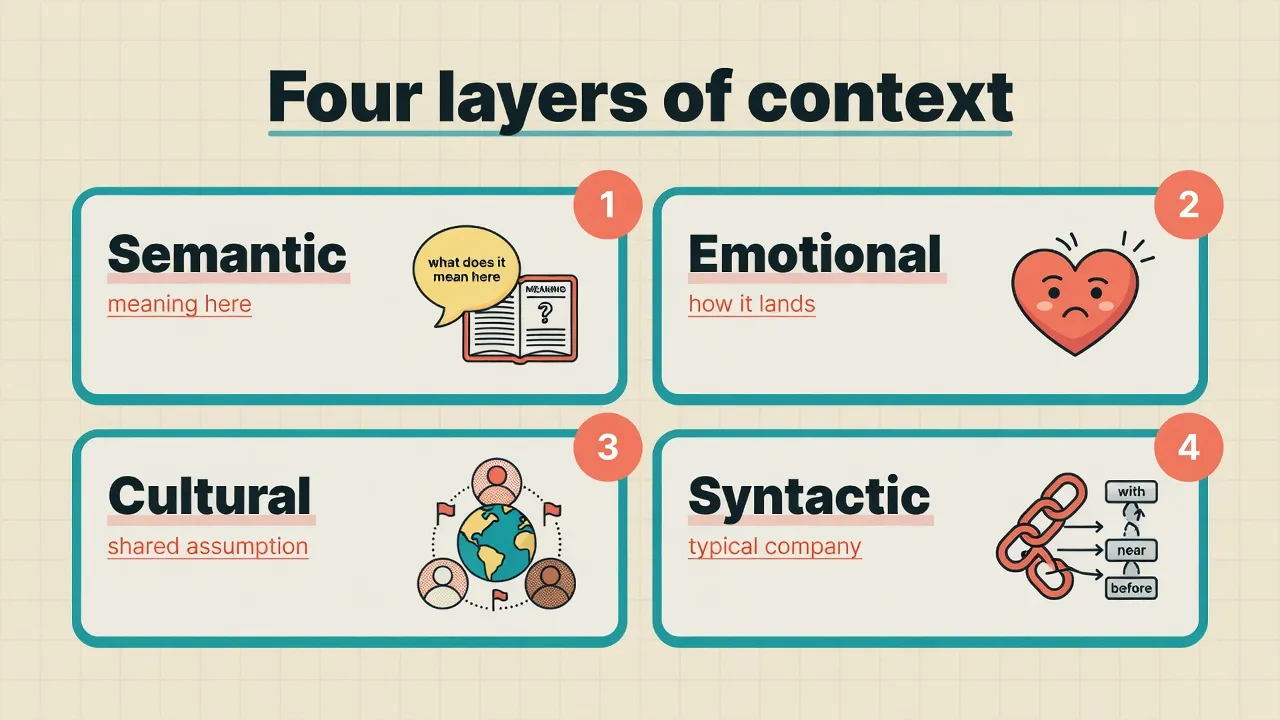
Semantic: what does it mean here?
English run:
- She runs a company (manages)
- The colors ran (bled)
- He went for a run (jog)
- A run of bad luck (streak)
Context chooses the sense. Your job is not to memorize every sense on day one. Your job is to understand this occurrence, then collect more later.
Emotional / pragmatic: how does it land?
Spanish "¡Qué fuerte!" is often reaction language (shock, intensity), not a gym compliment. English "Oh, great." can be sincere or pure sarcasm. Lists miss the face the speaker would make.
Cultural: what assumption sits under it?
Some phrases pack local habits, humor, or politeness rules. Reading native material slowly teaches those better than a pure translation table. You will not "download culture" from a gloss list alone.
Syntactic: what company does it keep?
After enough examples, patterns feel expected: verb + preposition pairs, article habits, typical tense choices in stories. This is close to what many teachers mean by "acquired feel," whether or not you follow Krashen word for word. You do not need a personality cult; you need repeated good examples.
What research roughly supports (without fake study shopping)
Honest field notes only - treat big round percentages in blogs as red flags unless you can read the paper and methods.
- Incidental vocabulary learning from reading is real: you can pick up words while focused on meaning, especially with repeated meetings.
- Involvement and elaboration help: when you notice a word, connect it to meaning, and meet it again, retention improves compared with shallow one-glance exposure.
- Decontextualized lists can still work for some high-frequency items, especially with good spacing - but they transfer better when later tied to use.
- Exact multipliers like "always several times faster for everyone" are not a safe universal constant. Study designs differ (age, hours, tests, languages, word difficulty).
Useful names and traditions (as fields, not as fake footnotes): Paul Nation on vocabulary size and learning from input; work on extensive reading; research on incidental vs intentional vocabulary learning; practical polyglot educators who emphasize massive input plus review (for example Steve Kaufmann-style listening and reading volume). Verify claims; do not worship personalities.
If a post invents a tidy "named university trial, Group B retained a precise multi-x advantage, 74% vs 12%" package with no real citation path, assume it is content filler until proven otherwise.
The hard constraint: context only helps if you understand enough
If a page is about 40% unknown, you are not absorbing rich context. You are drowning.
Here is a simple way to feel difficulty on the page, before you invent a hero plan:
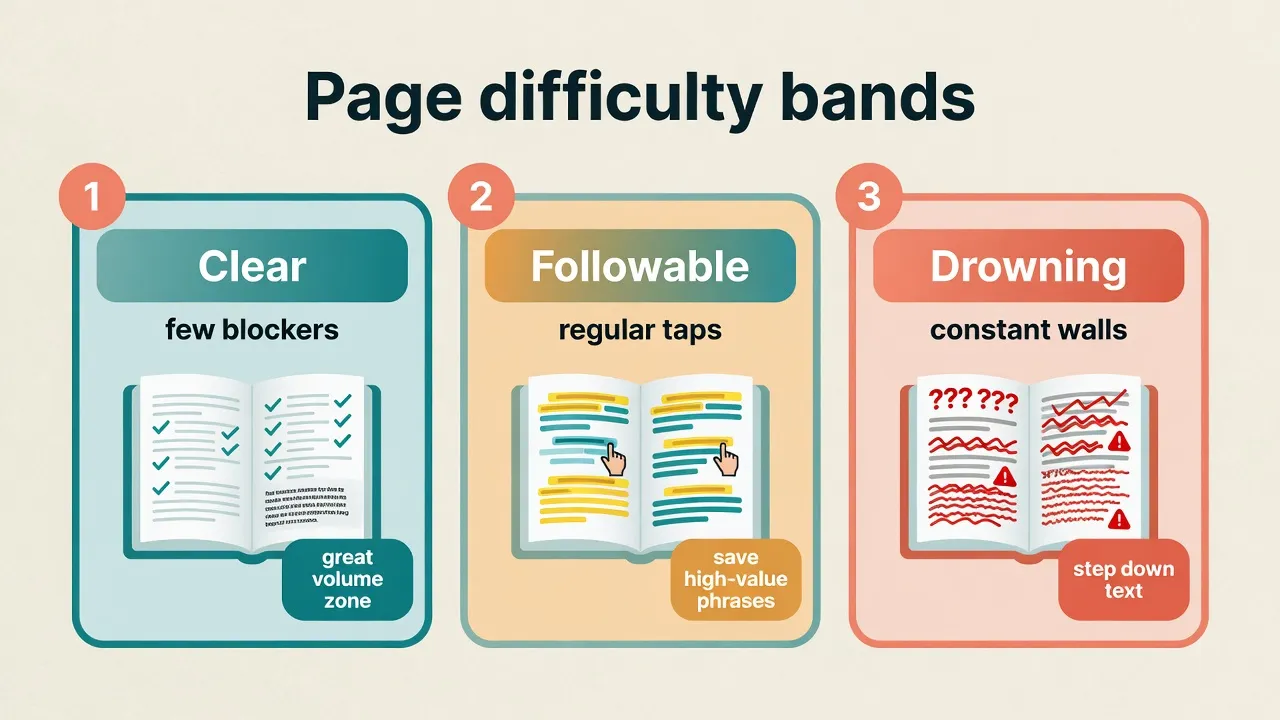
| Feel on a page | What to do |
|---|---|
| Mostly clear, few blockers | Great extensive reading zone |
| Followable with regular taps | OK with support; save only high-value phrases |
| Constant walls | Too hard for daily volume; step down or switch text |
Also watch tool traps:
- Paper dictionary every line - kills flow
- Blind machine translate of whole page - trains you to read your L1, not the target text
- Parallel text as a permanent crutch - can help early, but if you never look left, you are not building target-language parsing
- Flashcards of random app words you never met in life - low motivation, weak hooks
Stuck on "how do I learn in context if I know nothing?" Start with graded samples near your level, not pure immersion sermons. Try a Spanish A2 sample or an English A2 sample, then more free texts in All Articles. If you like a sister check for book level, the 5-finger rule for choosing book level pairs well with these bands.
A practical polyglot-style protocol (no miracle week)
No miracle week. A repeatable loop beats heroics.
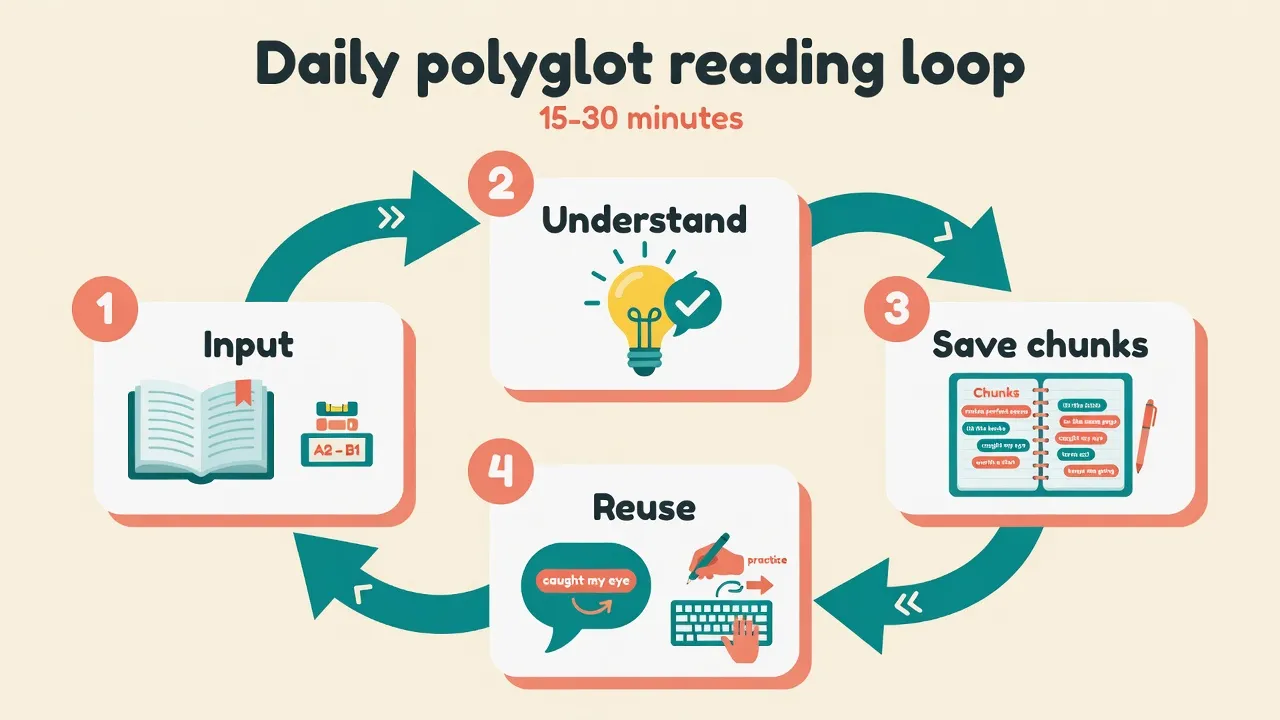
Daily core (15-30 minutes)
- Choose material you partly care about (graded article, news you follow, a book file you own).
- Read for meaning first.
- Tap or check only blockers.
- Save 3-10 phrases max: full chunks, not naked lemmas when possible.
- Stop while you still could continue. Habit beats heroics.
If your days are short and messy, the same spirit shows up in the 15-minute rule for daily vocabulary: protect a small block you can actually keep.
Two or three times a week: light retrieval
- Type or say the saved phrases.
- Write 3-5 new sentences that reuse them.
- Optional: spaced review of those phrases only - not a huge fantasy list of words you never met in life.
For a structured reuse pass, try the phrase typing demo or browse phrases when you want multiword practice without inventing a second curriculum.
Weekly difficulty check
If lookups drop and pages finish easier, stretch slightly. If dread rises, drop difficulty for a few days. Polyglots are often ruthless about finishing input, not about looking hardcore.
Sample starter path inside free materials
- Spanish A2 sample or English A2 sample
- More free texts in All Articles
- Phrase typing demo for reuse practice
- Later: upload an EPUB you own via How to use
When you want a rough progress compass (not a free CEFR exam certificate), open the language map after you have started marking words and phrases you actually know.
Context vs lists: use both on purpose
The enemy is not review. The enemy is review disconnected from life.
| Situation | Better default |
|---|---|
| Building reading fluency and phrase feel | Context-first reading |
| High-frequency glue words you keep missing | Short focused review + more input |
| Exam tomorrow on a fixed list | Intentional study of that list, then example sentences |
| Idioms and sarcasm | Context + note the whole chunk |
| Speaking prep | Retrieve phrases aloud, not only reread |
Polyglots who "hate lists" often still review chunks from content they chose. Lists for glue; context for life. Intensive and extensive reading can both sit in the same week - different jobs, not a religion. If that split is fuzzy, see intensive vs extensive reading.
How MovaReader helps without the marketing fog
MovaReader is useful when your bottleneck is friction while reading: free graded library, click-to-translate, upload files you own, listening when available, later practice of saved language in trainers.
Honest limits:
- freemium: 20 word translations/day, unlimited listening
- Reader (€1): unlimited translations when volume is real
- Pro (€5/mo): full trainers
- details: Pricing
MovaReader does not:
- host commercial novels by default as if they were free public domain for every title
- promise a fixed multi-x acquisition speed
- replace speaking practice with natives or tutors if that is your goal
- auto-detect every sarcastic nuance perfectly forever (context help is an aid; your judgment still matters)
- offer a free full CEFR exam on the language map
A good session looks like: read a page, understand the scene, check two blockers, save one phrase like "nothing says X quite like Y" if it is useful, keep going.
A bad session looks like: open a prestige novel far above your level, tap every adjective, save 60 orphan words, feel productive, remember little next week.
Practical path if you want the tool under the method:
- Open a free graded piece from All Articles.
- Read for meaning; tap only blockers (freemium 20/day is enough to test the habit).
- Save 3-10 phrases as chunks, not orphan lemmas.
- Reuse in the phrase typing demo (or trainers when ready).
- When translation volume is the bottleneck, Reader €1 on Pricing.
- When deliberate practice is the bottleneck, Pro €5/mo for full trainers.
- Orient progress (not a free CEFR exam) on the language map.
- Upload a legal EPUB you own via How to use when you want your own books.
FAQ
Do polyglots really never use flashcards?
Some do, some do not. Many successful learners mix heavy input with selective review. The stereotype "zero flashcards forever" is branding. If you review, prefer phrases you met in reading, not a random orphan list.
Is reading enough to speak well?
Reading strongly helps comprehension, vocabulary, and written patterns. Speaking still needs retrieval under time pressure. Add low-stakes output: say or type saved phrases, short new sentences, a demo trainer when you want structure.
How many new words or phrases should I save per day?
Fewer than you think. 3-10 useful phrases you will reuse beats a giant graveyard of highlights. Quality and re-meeting win over volume theater.
Should I learn word lists of the top 1000 words?
A high-frequency base helps. Just do not stop there, and try to meet those words in real sentences soon. Lists for glue; context for life.
What about grammar books?
Use them as reference when a pattern blocks meaning. Do not let them replace hours of understandable messages. Paper conjugations without scenes still leave a context gap.
Can AI translation create fake confidence?
Yes. If you tap everything and never reread, you may feel smooth while building little independence. Tap blockers, then reread without help when possible. Whole-page blind machine translate trains your L1, not the target text.
Final takeaway
The durable polyglot habit is not a secret percentage. It is this loop:
interesting input near your level -> understand the message -> notice useful chunks -> meet them again -> reuse a few.
Drop the fabricated speed multipliers. Keep the method. If you want a clean start today, open a free article, read for meaning, save a handful of phrases, and reuse them in a demo trainer. When you want a rough compass for what you already mark as known, glance at the language map - orientation, not a certificate.
Learn languages by reading!
Try MovaReader for just €1 — read texts with instant translation and interactive vocabulary training.
Free plan: 20 word translations/day and unlimited listening. Pro (€5/mo) unlocks full trainers.