Language Learning Psychology
Why Strong Learners Read Massively (and Still Use Grammar Lightly)
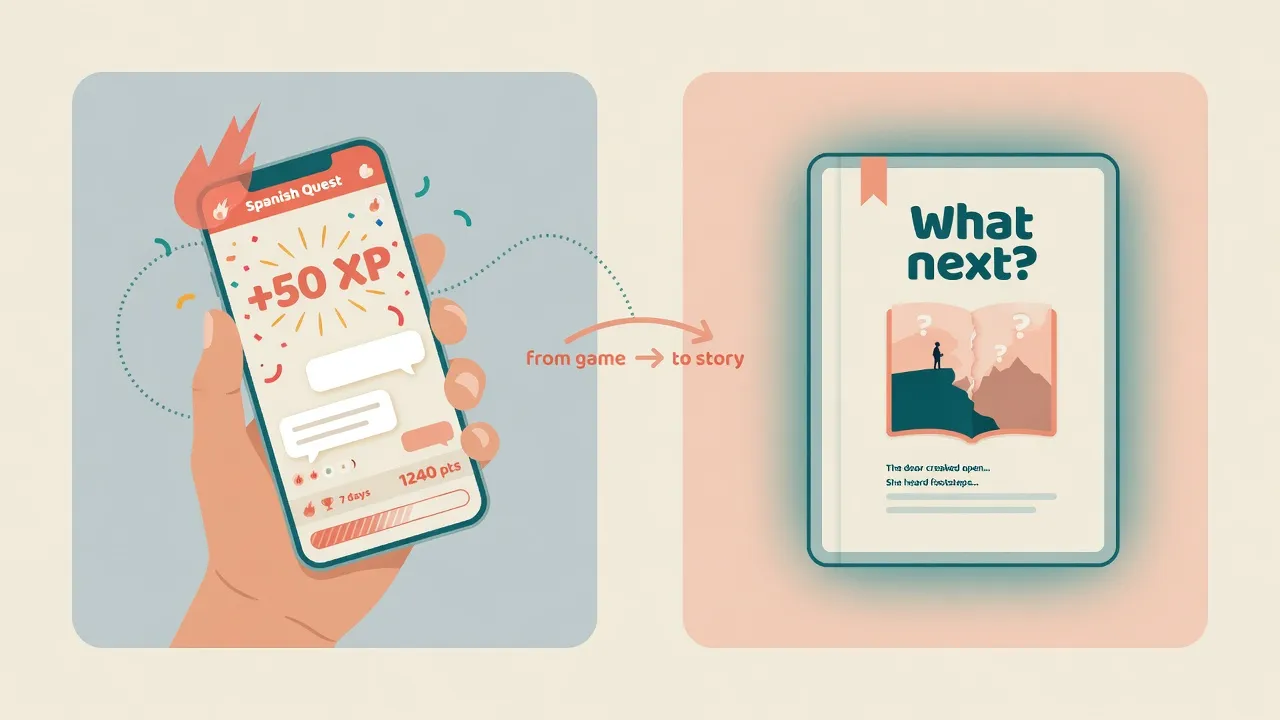
Grammar books are not evil. They are a weak primary diet. Here is a practical massive-reading protocol: interesting input at scale, light grammar as a scalpel, and tools that keep you on the page.

Viral polyglot videos invite a predictable question: How many grammar books did you finish?
Often the real answer is: not many as a main method. Strong multi-language learners still peek at grammar when stuck. They build the language with huge amounts of meaningful input, especially reading and listening they actually care about.
This is not a personality cult. It is a volume problem. Languages are too big to assemble only from charts. Charts describe patterns; input makes patterns automatic.
Strong multi-language learners do not "hate grammar." They refuse grammar-as-main-meal. They build the language with huge amounts of interesting reading (and listening) they mostly understand, and use short grammar checks when a pattern confuses them - after exposure, for exams, or to fix a stuck error. That is a volume-and-timing method, not a promise of fluency from reading alone.
Below: what polyglots optimize for, why grammar-first stalls after the basics, a practical massive reading protocol (with a page-test), why people quit "just read," a light research compass, an 8-week starter plan, and what the free plan includes.
What do polyglots actually optimize for?
People like Steve Kaufmann emphasize interesting content over worksheet stacks. The useful core of that message:
- The brain acquires a lot from messages you understand
- Grammar rules are a map, not the territory
- Interest keeps you in contact long enough for repetition to work
- You tolerate incomplete understanding instead of freezing on every unknown item
You will also hear names like Kató Lomb or Luca Lampariello in the same conversation. Details differ; the shared habit is boringly consistent: lots of reading and listening in material they care about.
Treat that as a practice design hint, not a promise that you will "speak 20 languages." Massive reading language learning is a volume-and-interest habit. It is not a membership badge.
Why does grammar-first often stall after the basics?
Grammar study is not useless. It is frequently mis-scheduled.
Common failure modes:
- Rules without examples in motion. You can recite present perfect and still not notice it in a paragraph.
- Translation dependency. Every sentence is built as L1 → rule → L2, which is slow under time pressure.
- Diminishing returns. After core word order, high-frequency morphology, and major tense/aspect contrasts, more charts rarely match the gains from more input.
When grammar still helps
Keep grammar in the week - just not as the whole diet:
- a pattern never clicks from exposure alone
- you need exam accuracy or test-format practice
- a fossilized error needs a targeted fix
Stephen Krashen's comprehensible input / i+1 idea is a useful compass for text choice: pick material you mostly understand, with a little stretch. It is not a vow that "only one theory works forever."
Timing is the debate - not "grammar is evil." Here is how the two roles split when you treat grammar as a scalpel and massive reading as the main meal:
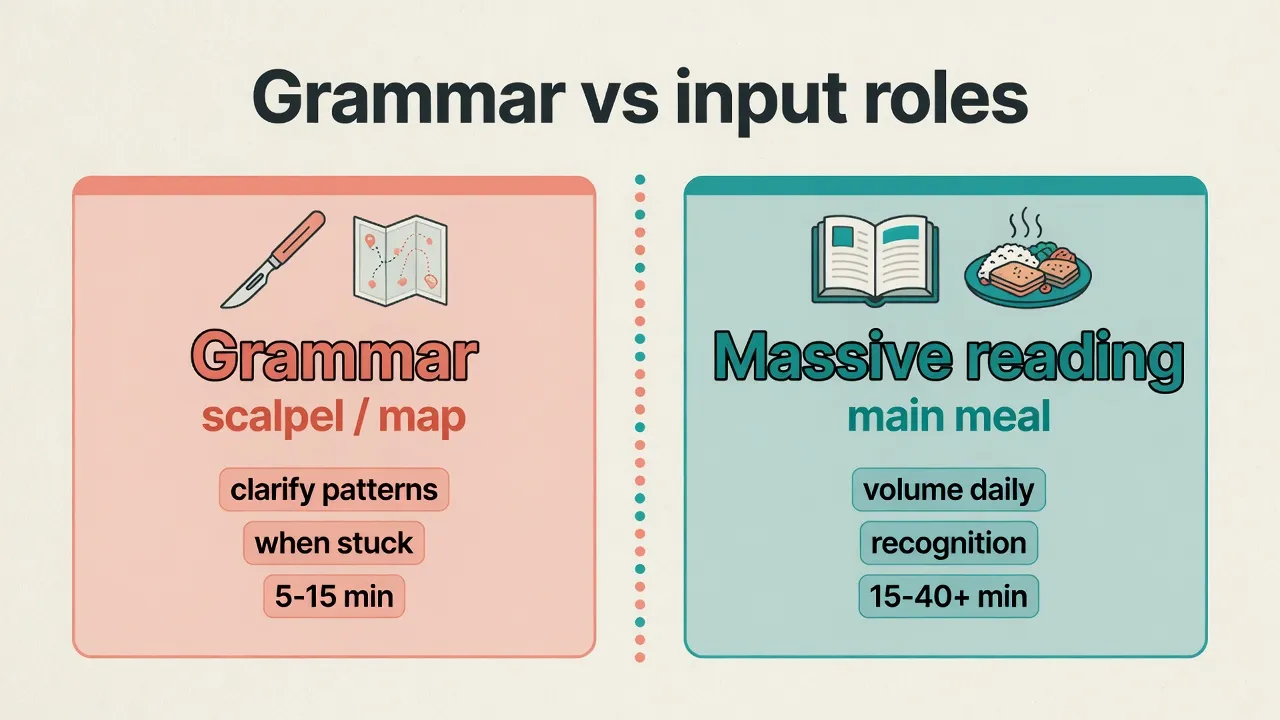
| Dimension | Grammar (scalpel / reference) | Input / massive reading (main meal) |
|---|---|---|
| Primary job | Label and clarify patterns you already half-know | Build automatic recognition + vocab through volume |
| Best timing | After many examples; when stuck; for exams | Daily bulk of study time |
| Failure mode | Charts without motion; endless drills before texts | Native novels too hard; lookup death spiral |
| Session shape | 5-15 min focused check | 15-40+ min flow reading |
| Output link | Targeted production fix | Recognition foundation (speaking still needs practice) |
Grammar is a tool. Reading is the bulk diet. The fight is when each sits in the week.
What is the massive reading protocol (practical version)?
Not "suffer through unreadable novels." Maximize understandable contact. Extensive reading language learning works when you finish pages you mostly follow - not when you decode one hard paragraph for an hour.
1. Volume over perfection
Do not stop for every unknown word. Keep enough flow to finish pages. Goal: patterns and vocabulary through repeated contact, not 100% glossing.
2. Interest first
A detective novel you finish beats a "serious" book you abandon. Interest is not childish; it is adherence. Genre and topic you open tomorrow beat prestige titles you never touch.
3. Progressive difficulty + page-test
One short paragraph tells you if the book is daily fuel or daily combat.
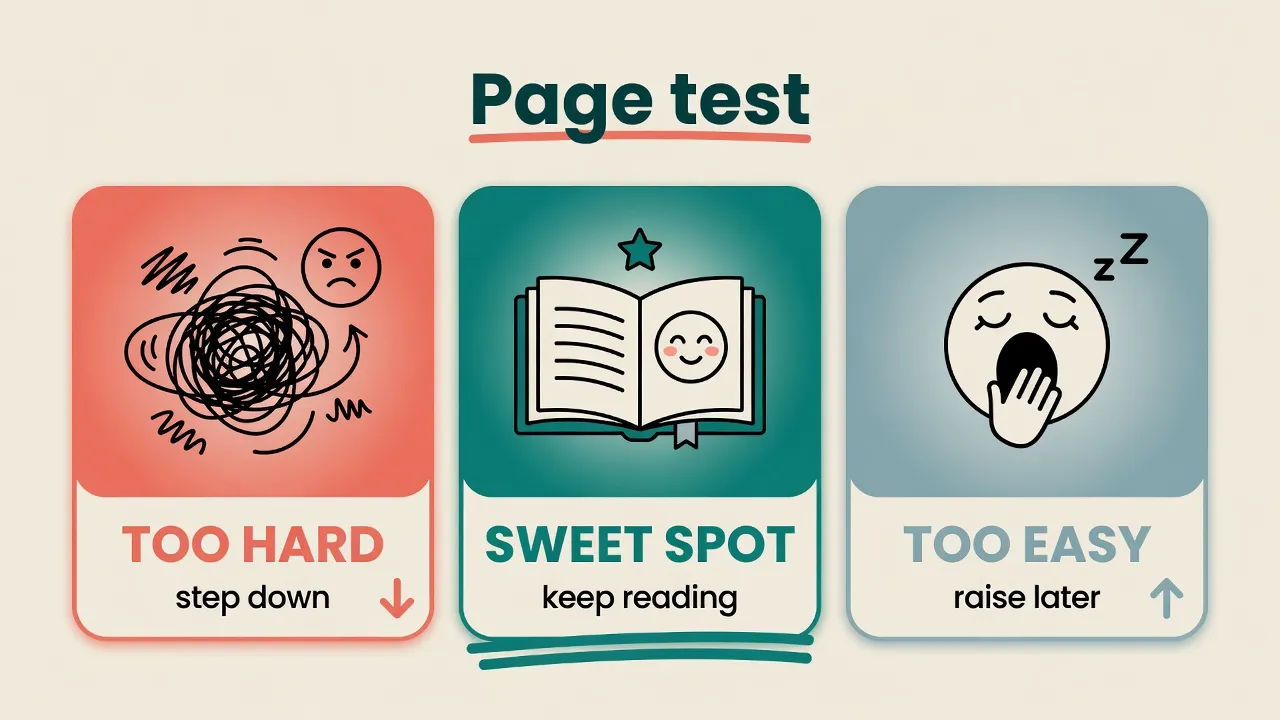
| Signal on a short paragraph | Meaning | Action |
|---|---|---|
| More than ~5 unknown words that block meaning | Too hard for daily flow | Step down level / graded text |
| Some unknowns, story still follows | Sweet spot (growth + flow) | Keep reading; click blockers only |
| Almost no unknowns | Too easy for growth | Fine for speed/stamina days; raise difficulty later |
Thresholds are practical guides, not physics laws. Interest still rules: abandon dead material.
Free calibration texts:
4. Repetition over one-shot memorization
Important words reappear. Trust recurrence for many items. Save only high-value phrases you want active. Rereading beats stuffing a mega-deck of orphans.
5. Light capture, heavy reading
Per session, keep 5-15 phrases, not 60 orphan words. Then return to the story. For deeper phrase mining and contextual layers, see the contextual polyglot vocabulary method.
A simple 20-minute loop looks like this:
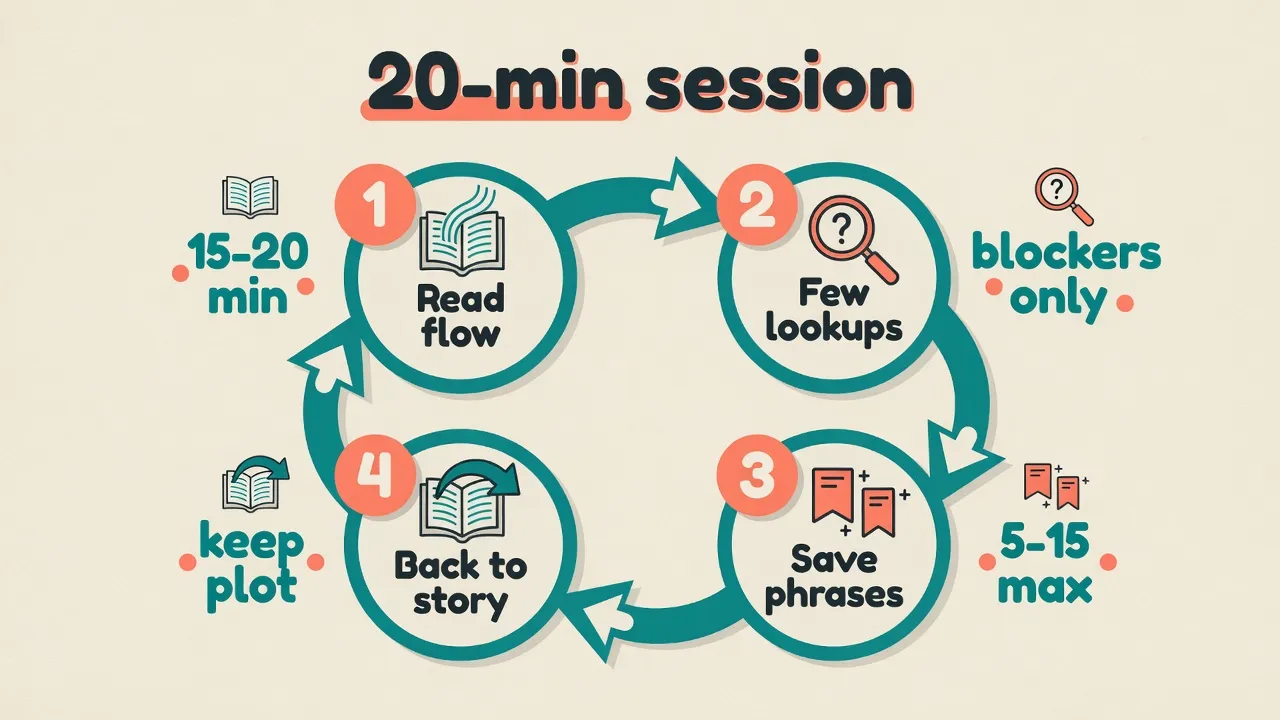
read (flow)
  → click blockers only
  → save 5-15 phrases
  → return to the story
That is the polyglot reading method in everyday clothes: volume first, capture light, grammar as a scalpel later if a pattern still confuses you.
Why do people abandon "just read"?
Opening a native-level novel at B1 without support is often miserable: lookup, lose place, lose plot, quit.
Polyglots who "just read" usually had:
- better level matching than they admit on stage
- dictionaries, pop-up tools, or bilingual crutches at hard edges
- years of accumulated reading stamina
So the method is not "suffer without tools." The method is maximize understandable contact while removing friction that kills the habit. Tools and level match are part of the method, not cheating.
Path out of the quit spiral: start on graded or easy text, protect flow, then climb. A free Spanish A2 sample or the graded library is a calmer door than a hard novel on day one.
What does research-shaped practice suggest?
Across extensive reading research and classroom "book flood" style programs, a recurring pattern appears:
- more easy/interesting reading tends to help vocabulary and reading fluency
- decontextualized drills alone transfer poorly to messy real text
- consistency beats heroic weekend marathons
Modern ER reviews often report small-to-medium positive effects across domains. Treat that as direction, not a multiplier. You do not need study names to use the conclusion: read a lot at the right difficulty. For theory depth on i+1, the Krashen / comprehensible input guide goes further.
An 8-week starter blueprint
Habit and finished pages - not "fluent in 8 weeks."
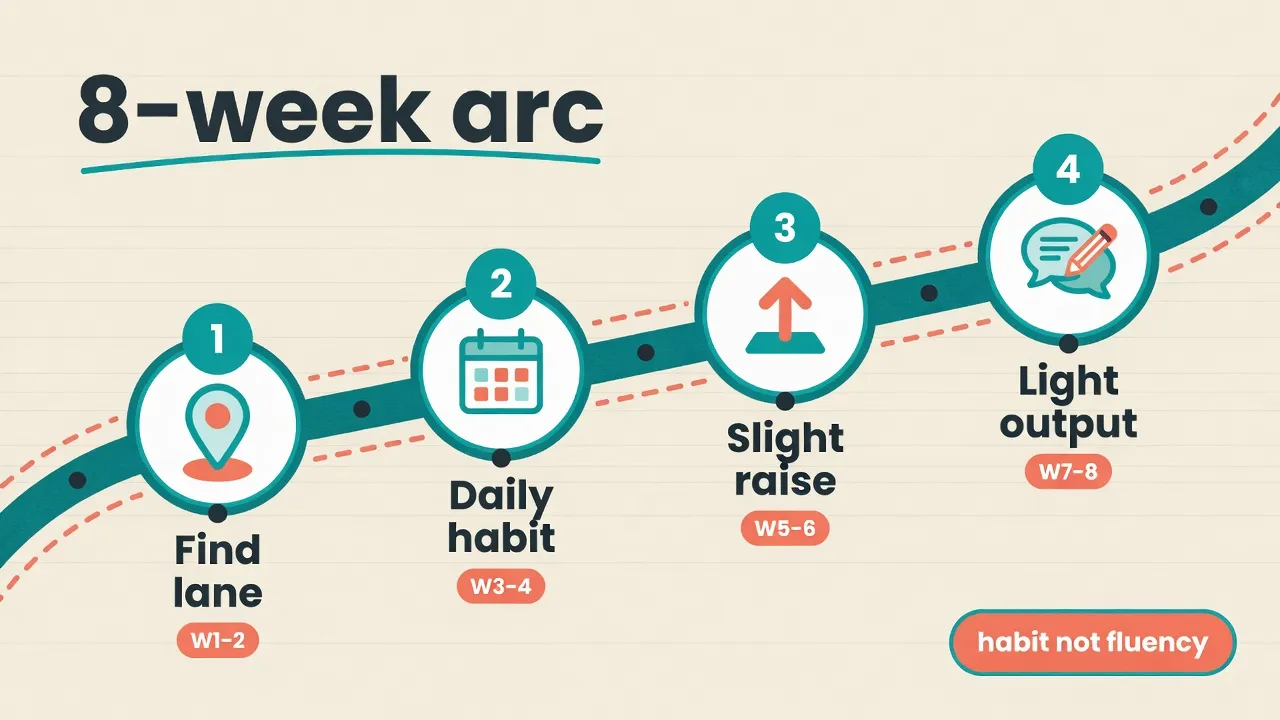
| Weeks | Focus | Concrete actions |
|---|---|---|
| 1-2 | Find your lane | Alternate free graded texts with one easy interesting book/file; if every page is combat, step down |
| 3-4 | Lock 20 minutes daily | Short daily sessions beat Sunday guilt; track finished pages |
| 5-6 | Raise difficulty slightly | Same topics, slightly harder sources - or longer chapters at same level |
| 7-8 | Light production edge | After reading: write 5 sentences or 60-sec spoken summary; optional weekly 5-min grammar check on a pattern you keep noticing |
Weeks build contact time and level match. They do not mint a polyglot. If you want free warm-ups while you find your lane, open Spanish A1, Spanish A2.
The grammar paradox (the useful version)
People who read massively often end up using grammar more naturally than people who only study grammar. That is not because rules are evil. It is because they have seen thousands of correct examples.
You may still want explicit grammar when:
- a pattern never "clicks" from exposure
- you need exam accuracy
- fossilized errors need a targeted fix
If exams and accuracy drills are your main pain, our article on grammar tests vs reading digs into that tradeoff. Here the close is simple: use grammar as a scalpel. Use reading as the main meal.
Where MovaReader fits
Interesting input is the method; tools only lower friction. Massive reading dies when every third word sends you to another tab.
MovaReader is a reading environment for learners. What it offers:
- Free graded article library with click-to-translate
- Upload EPUB/files you own for longer reading
- Listening support (the free plan is generous on listening)
- Phrase/trainers path after you save language from texts
Plans (Pricing):
- Free plan: free library, listening, 20 word translations/day
- Reader (€1): unlimited word translations
- Pro (€5/mo): full trainers
Workflow that matches the volume idea:
- Warm up on All articles
- Read 20 minutes; click only blockers
- Save a small phrase set (5-15)
- Drill later via demo type training, demo phrase typing, or Trainers on Pro
- When ready, upload a book file you own (How to use)
Start with one graded text today - volume first, grammar as a scalpel when stuck. Speaking still needs practice. Reading alone is not a fluency machine.
FAQ
Do polyglots really hate grammar books?
Many dislike grammar-as-only-method. Few never check a reference. The slogan is marketing; the habit is input volume plus light grammar when stuck, after exposure, or for exams. The real refusal is grammar-as-main-meal.
Can beginners do massive reading?
Yes - with graded or very easy content. "Massive" means lots of understandable pages, not forcing a hard novel at A2. Start with free level-matched samples (Spanish A1, Spanish A2), then climb. If every paragraph is combat, step down, not harder.
How many books per month?
Whatever you finish. One easy book finished beats three hard ones abandoned. There is no magic quota that "makes you a polyglot." Track pages and days of contact, not vanity book counts.
Is listening enough without reading?
Listening is powerful for sound, rhythm, and meaning. Reading often gives clearer access to form - you can re-see a sentence. Best stack uses both when you can. Listening-only can work as a season; pure silence on the page is optional, not a purity test.
Should I stop Anki completely?
Not required. A small deck of phrases mined from reading is fine. The trap is a huge orphan-word deck that replaces pages. Prefer 5-15 phrases per session from real text over 60 disconnected cards. For deeper phrase method, see the contextual vocabulary approach.
Will this make me fluent by itself?
No. Massive reading builds a large part of comprehension and vocabulary. Speaking fluency still needs speaking practice. Reading is foundation, not a complete magic system.
Final takeaway
The useful habit is not secret: interesting input at scale, light grammar when needed, and tools that keep you inside the page.
Start with 20 minutes today on a text you can mostly understand - free Spanish A2 sample - and protect flow more than you protect perfect lookup hygiene. Climb when the story still holds. Use grammar as a scalpel. Keep reading as the main meal.
Keep reading with translations inside the text
With a free account, an unknown word translates with one tap, and the words you are learning wait for you in the trainer.
Free account: 7 days of Pro, then 20 word translations a day or a paid plan.