Grammar in Context
Por vs Para in Spanish: A Clear Guide With Real Context
Stop treating por and para as two English "for"s. Use a simple mental model, check the hard cases, and build intuition through reading you can actually finish.
You are reading Spanish and hit Lo hice por ti. That feels like "I did it for you." Two paragraphs later: Es para ti. Also "for you." English has one word. Spanish splits the job. Your hand freezes mid-sentence while your brain scrolls a chart you once memorized and already forgot.
That freeze is normal. English for (and often by, through, to) collapses jobs that Spanish keeps separate. Charts help a little. They rarely create a reading reflex.
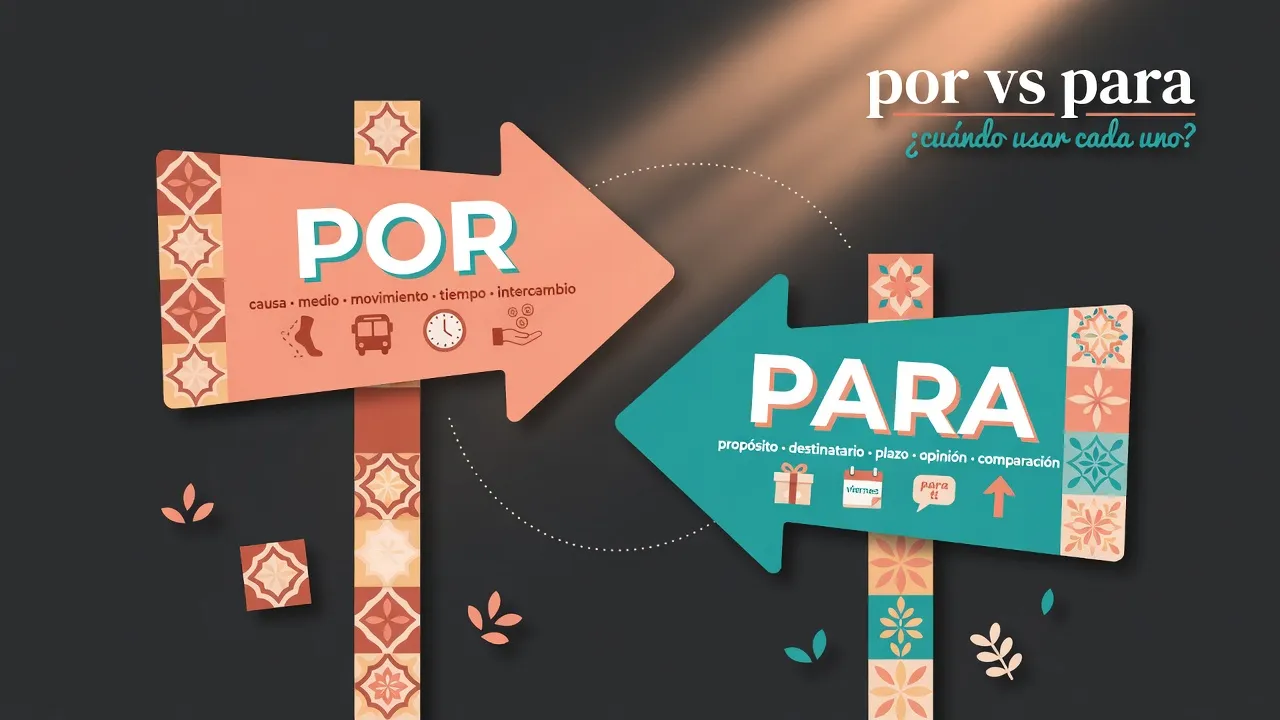
Por vs para both often map to English "for," so one translation rule fails. Think direction: por looks back or through (cause, path, exchange, means, duration); para looks forward (goal, destination, recipient, deadline, standard). Charts list categories; they rarely become a reflex. Drill the conflict cases, collect fixed phrases as chunks, then notice both words in Spanish you mostly understand.
Cause vs purpose alone is incomplete. Path, price, para mí, passive por, and fixed phrases still need the same direction feeling (or plain chunk memory).
Next: why charts fail as reflexes, a compact uses map, seven battlegrounds, fixed phrases, a mini quiz, and a 7-day reading loop.
Why textbook charts feel true and still fail
Most books offer something like:
- Por: cause, duration, exchange, movement through, means
- Para: purpose, destination, deadline, recipient, opinion
Useful as a map. Weak as a speaking or reading reflex. Real sentences do not announce "this is category 3." You meet por and para inside stories, messages, and news, with no label attached.
If you came from app mnemonics (DREAM, PERFECT, and friends), those labels can hang on the same hooks later. Mnemonics store names. They do not decide a live sentence for you. Secondary tool, not the spine.
What you need first is a direction feeling, then a short list of conflict zones where English "for" lies to you.
Core model: looking back vs looking forward
A model that covers a large share of cases:
| Lens | Direction | Typical jobs |
|---|---|---|
| Por | back / through | cause, reason, path, exchange, means, duration, passive agent |
| Para | forward | goal, destination, recipient, deadline, standard / opinion |
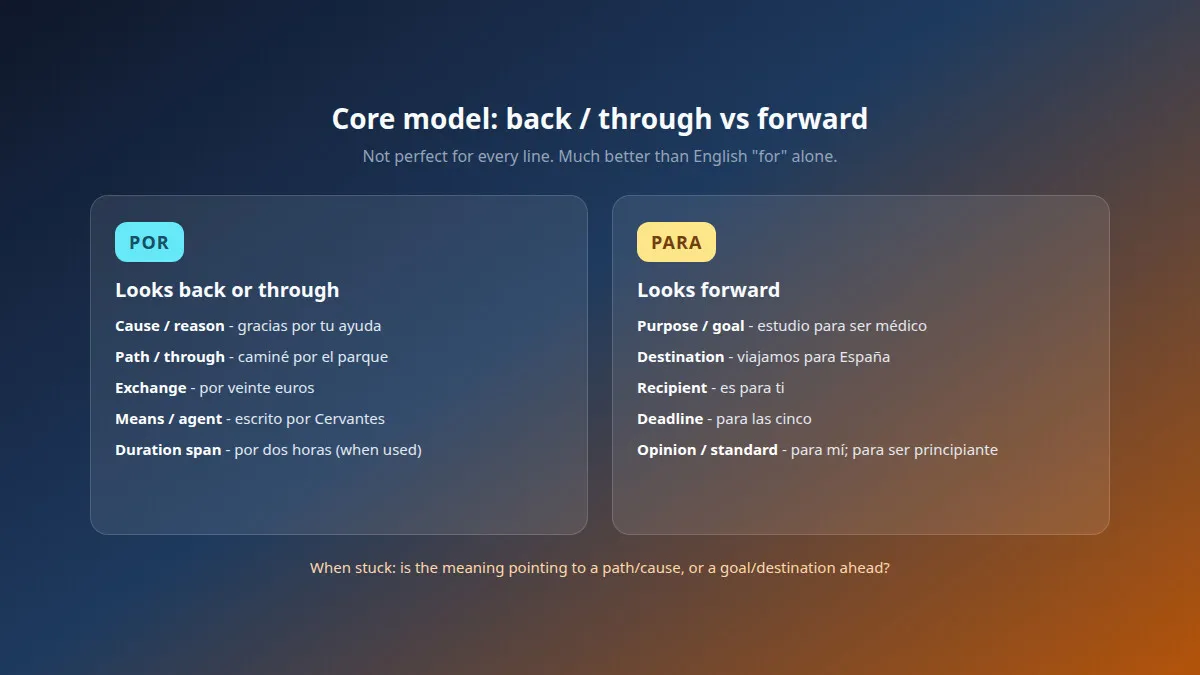
In short: por looks back or through the scene; para looks forward toward a target. When you are unsure, name the direction before you open a grammar wall.
Por examples
Viajamos por toda España.
We traveled through Spain. Path already in focus.
Gracias por tu ayuda.
Thanks because of your help. Reason.
Lo compré por veinte euros.
I bought it for / in exchange for twenty euros. Price swap.
Para examples
Viajamos para España.
We are traveling to Spain. Destination ahead.
Es para tu cumpleaños.
It is for your birthday. Intended use.
Estudio para ser médico.
I study in order to be a doctor. Goal.
This model is not perfect. It is much better than memorizing columns without examples. Por = back/through. Para = forward. Same English "for," two Spanish directions.
Here is the same idea as a picture: por looks back or through; para looks forward.
Quick comparison table
Same model, scannable form. Hang categories on the direction feeling - do not treat this table as a second brain.
| Situation | Prefer por | Prefer para |
|---|---|---|
| Motive / cause | por amor (because of love) | - |
| Purpose / goal | - | para demostrar… (in order to show) |
| Path / through | por el parque | - |
| Destination / toward | - | para el parque / para Madrid |
| Duration (span) | por dos horas | - |
| Deadline (point ahead) | - | para las cinco / para el viernes |
| Exchange / price | por veinte euros | - |
| Recipient | - | para ti |
| Opinion / standard | - | para mí; para ser principiante |
| Passive agent | escrito por Cervantes | - |
| Fixed chunks | por supuesto, por si acaso… | para siempre, para que… |
Fixed phrases often ignore clever rules - collect them as chunks (list below). Want more minimal pairs and a fuller uses map? See our por vs para prepositions guide. This post stays on battlegrounds, the quiz, and the reading loop.
Seven battleground cases
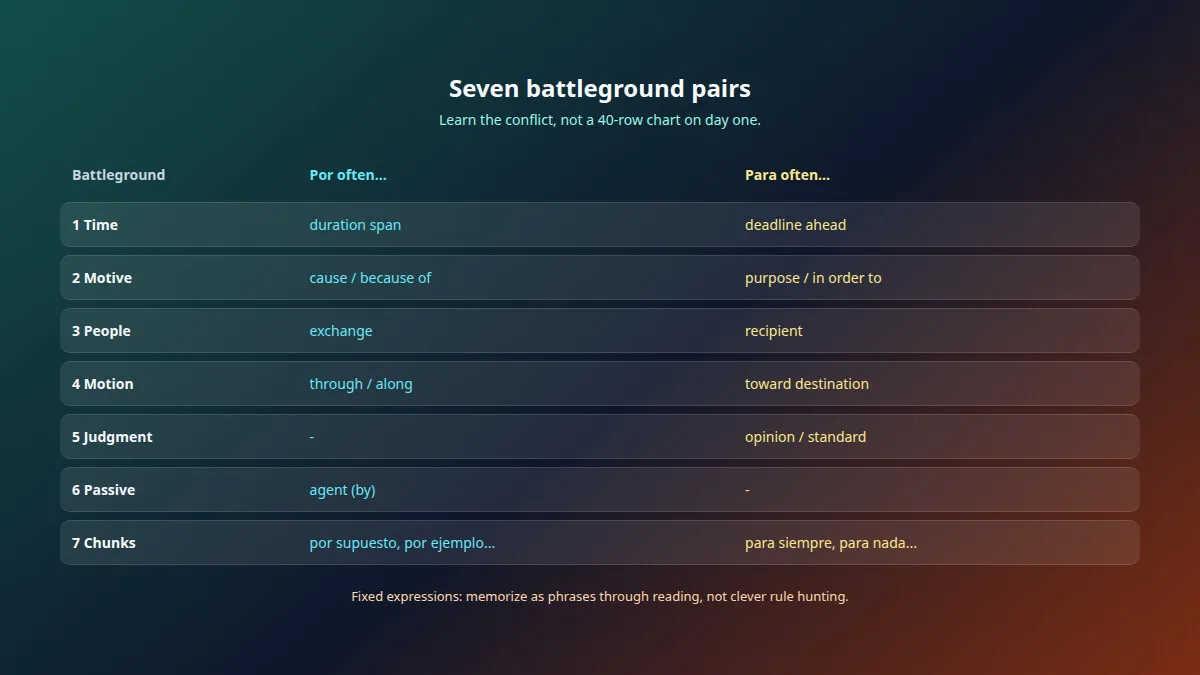
These are the conflict zones where English for (or a flat chart) fails. One concrete pair per battle is enough. Own these until they feel less like coin flips.
Seven conflict zones on one board:
1. Duration vs deadline
Esperé por dos horas. - duration (time spent, through a span)
Necesito el informe para las cinco. - deadline (point ahead)
In everyday Spanish you will also hear bare time phrases without por (esperé dos horas). Still, when por appears with duration, think "through a stretch of time." Deadlines lean para: a target moment ahead.
2. Cause vs purpose
Lo hago por amor. - because of love (motive)
Lo hago para demostrar mi amor. - in order to show love (goal)
Classic English "for" trap. Motive looks back. Goal looks forward. Cause vs purpose is only one battleground, not the whole system.
3. Recipient vs exchange
Este regalo es para ti. - recipient
Te cambio mi libro por el tuyo. - exchange / swap
And the freeze pair that opened this article:
Lo hice por ti. - for your sake / because of you (cause)
Es para ti. - for you as the recipient
Both gloss as "for you." They do not mean the same thing.
4. Through vs toward
Caminé por el parque. - through / along the park
Caminé para el parque. - toward the park
Path already in focus (por) vs destination ahead (para). Same park, two jobs.
5. Opinions and standards (usually para)
Para mí, el español es más difícil que el francés.
Para ser principiante, hablas muy bien.
Opinion and comparison standards almost always take para. Think "from this standpoint / relative to this bar," looking toward a frame of judgment.
6. Agent in passives (por)
El libro fue escrito por Cervantes.
English by in passives usually becomes por. Not a "for" problem - still a high-frequency freeze if your chart only listed cause and purpose.
7. Fixed expressions (no clever rule)
Some lines are chunks. You do not invent a clever rule under pressure. You meet them in context until they feel automatic. Battle 7 expands into the next section.
Fixed phrases: collect chunks, do not invent rules
Rules will not save you here. Save whole phrases from texts you finish - do not only drill orphan lists. Emotion and story glue a phrase better than fifty flashcards of bare por favor.
With por
por favor, por supuesto, por lo menos, por fin, por cierto, por ejemplo, por si acaso, por qué (cause why - pair with para qué in the FAQ), por eso, por otro lado
| Phrase | Rough sense |
|---|---|
| por favor | please |
| por supuesto | of course |
| por lo menos | at least |
| por fin | finally |
| por cierto | by the way |
| por ejemplo | for example |
| por si acaso | just in case |
| por eso | that is why / therefore |
| por otro lado | on the other hand |
With para
para siempre, para nada, para colmo, para que (+ subjunctive as a chunk), para mí, para variar, para empezar
| Phrase | Rough sense |
|---|---|
| para siempre | forever |
| para nada | not at all |
| para colmo | to top it off |
| para que | so that (usually + subjunctive) |
| para mí | in my opinion / for me |
| para variar | for a change |
| para empezar | to begin with |
Reader rule: save whole phrases; cap about five saved phrases a day. You can stash them in a phrase bank and reinforce later with everyday Spanish phrases practice if you want a light drill without killing the reading habit.
Literature / graded feel
Same direction in slightly richer lines:
"... cada vez que alguien pasa sus ojos por sus páginas..."
por = through its pages (path)
"Clara escribía en sus cuadernos para que algún día se supiera la verdad."
para que = so that (forward purpose; often subjunctive)
You do not need Cien años de soledad first. The same prepositions appear in graded stories and modern short texts. Start where comprehension is high.
Mini quiz: por or para?
Choose por or para. Misses are information, not a personality flaw. Eight items.
- Salimos ______ Madrid mañana a las seis.
- Compré estas flores ______ mi madre.
- Caminamos ______ la playa durante una hora.
- Estudia mucho ______ aprobar el examen.
- El cuadro fue pintado ______ Picasso.
- ______ un niño de cinco años, lee muy bien.
- Pagué cien dólares ______ estos zapatos.
- Necesito terminar esto ______ el viernes.
Optional hard cases (if you want them):
- ¿______ qué estudias español? (Por qué = cause why; Para qué = purpose what-for - both possible depending on intent)
- Lo hice ______ ti. (for their sake / because of them → por; contrast para ti = recipient)
Answers:
- para - destination
- para - recipient (unless context is exchange)
- por - movement through / along
- para - purpose
- por - passive agent
- Para - standard / comparison
- por - exchange
- para - deadline
If you missed several, you need more meetings with both words in context. That is the job of the loop below, not a longer chart.
How to practice without drill fatigue
A chapter of easy narrative can contain many instances of both prepositions. That volume matters more than one perfect worksheet.
- Short Spanish at a level you mostly understand.
- On each por/para: back/through or forward?
- If unclear: quick check, then keep reading.
- Save fixed expressions as whole phrases (cap about five per day).
- Day 7: retake the quiz cold (or from your own saved sentences).
Noticing walkthroughs (graded-text shape)
Pause → name the direction → continue:
- María camina por el centro todas las mañanas. → por = path / through the center. Continue.
- Compra pan para la cena. → para = for dinner as purpose / intended use. Continue.
- Pasamos por Sevilla para llegar a Cádiz. → via (por) vs goal of arriving (para). Continue.
Prefer free samples you can finish: Spanish A1, Spanish A2, or browse graded Spanish articles. For how noticing works inside the reader, see how to use MovaReader.
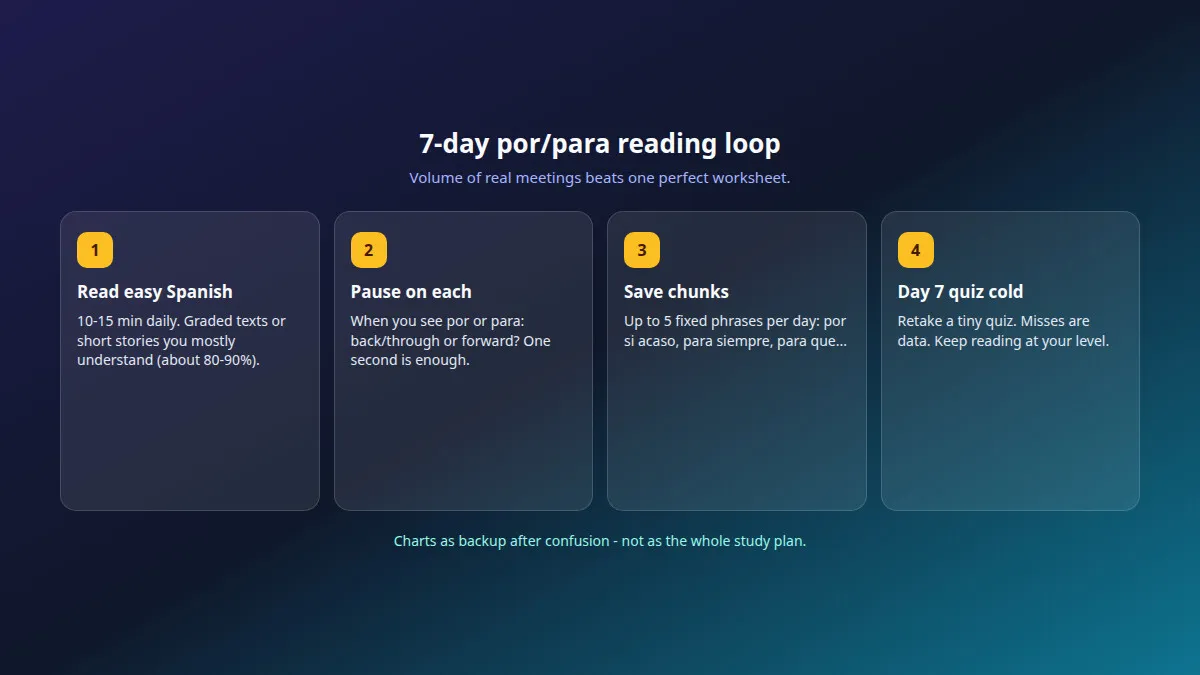
7-day reading loop
Ten to fifteen minutes of live context beats a perfect table you forget by Thursday. No heroics.
The loop looks like this: read → notice por/para → back/through or forward? → save a chunk → continue.
| Day | Action | Time |
|---|---|---|
| 1-6 | Easy Spanish daily; pause one second on each por/para; apply the model | 10-15 min |
| 1-6 | Save up to about five fixed phrases total per day (not fifty) | included |
| 7 | Retake the mini quiz cold; skim saved phrases | about 10 min |
Same week, soft product loop if you use MovaReader:
- Open graded Spanish you mostly understand.
- Pause on each por/para and name the direction.
- Translate blockers only when needed (freemium 20 word translations/day; Reader if you want unlimited).
- Save chunks to phrases; Pro trainers only if you want full drill loops.
- Day 7: quiz cold.
How MovaReader fits
MovaReader is for the reading loop. It does not replace your attention. You still decide por or para. The app keeps you inside Spanish you can finish.
What it does:
- free graded Spanish articles + click-to-translate
- upload EPUB/files you own (legally)
- unlimited listening on freemium
- 20 word translations/day free; Reader €1 unlimited translations; Pro €5/mo full trainers
Useful paths:
- samples: Spanish A1, Spanish A2
- library: all articles
- freemium, Reader, and Pro: pricing
- practice path: how to use
- trainers, phrases
- demos: free Spanish vocabulary trainer, phrase typing
More meetings with finished text beat another dense chart. Missed quiz items mean you need more context, not a personality rewrite.
FAQ
Is there one rule that always works?
No. The back/through vs forward model covers a lot, then fixed expressions and a few special cases remain. There is no single dictionary gloss that wins every time.
Should I stop using charts completely?
No. Use charts as a checklist after a sentence confuses you. Do not start every decision by reciting the whole chart. Hang categories on the two directions; do not treat the table as the only tool.
Can I learn por/para only from conversation?
Yes, if you get enough input and correction. Reading simply multiplies examples per minute, so noticing por and para is faster.
Is para que always subjunctive?
In standard modern Spanish, para que typically takes the subjunctive because the purpose is not treated as a plain fact. Learn it as a chunk: para que + subjunctive. For mood in context, see Spanish subjuntivo through dialogues.
Which should I study first, por/para or ser/estar?
Both matter. Por/para shows up constantly in motion, purpose, and fixed phrases. If one confuses you more in real reading, start there. Related conflict: ser vs estar.
Por qué vs para qué - what's the difference?
Por qué often asks cause (why / because of what). Para qué asks purpose / what for. Same family as the other battlegrounds: look back vs look forward.
Bottom line
Por and para stop being a permanent pain when you stop hunting for a single English translation. Use a direction model, walk the seven battlegrounds lightly, collect fixed phrases as chunks, and meet both words in texts you can finish.
One action today: open one easy article, pause on each por/para, save one phrase. More reading at the right level beats another dense chart you will forget by Thursday.
Keep reading with translations inside the text
With a free account, an unknown word translates with one tap, and the words you are learning wait for you in the trainer.
Free account: 7 days of Pro, then 20 word translations a day or a paid plan.