Grammar in Context
Ser vs estar: identity vs condition (a frame for real Spanish)
You know the chart until es aburrida and está aburrida show up in the same chat. Here is a clearer frame: identity vs condition, with edge cases and a practice plan built on reading.
You memorized the acronyms. You passed the worksheet. Then someone says both Ella es aburrida and Ella está aburrida in the same chat, and the chart collapses.
That moment is not proof you are bad at Spanish. It is proof that ser vs estar is not only a grammar pair. It is a choice about how the speaker frames reality: what something is versus how it is right now.
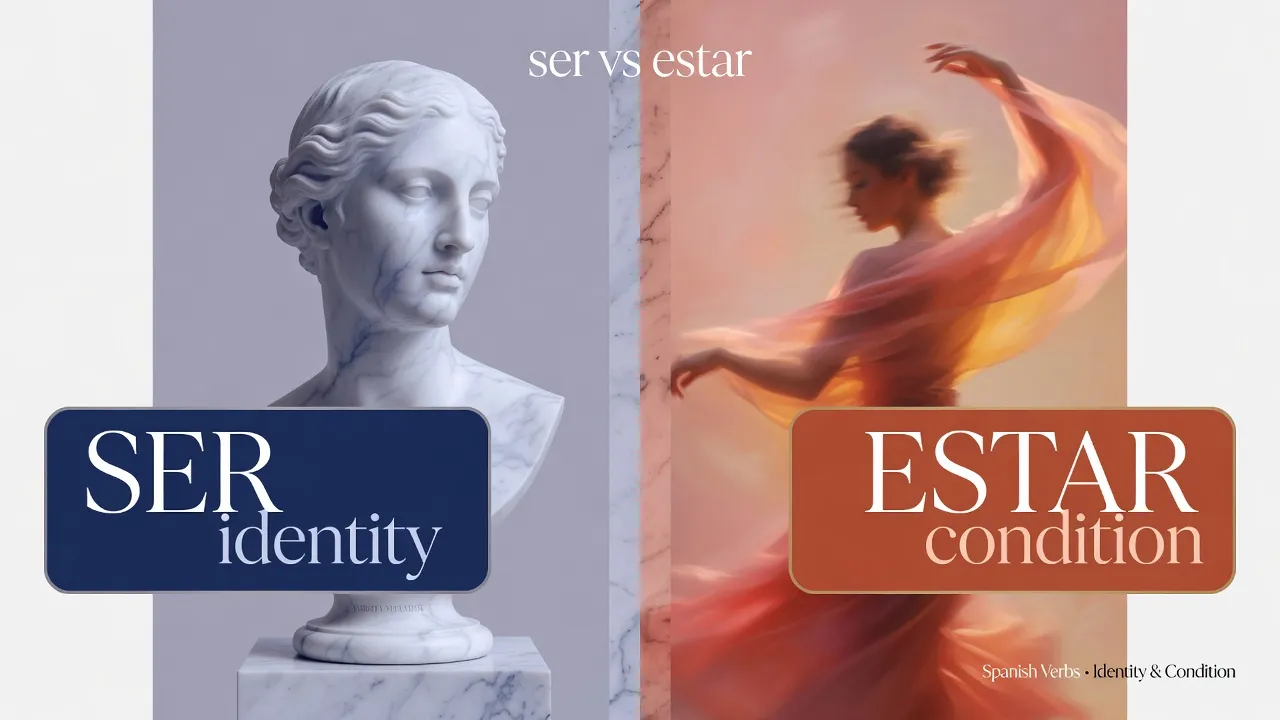
Here is the short version. Ser paints a portrait (who or what something is). Estar takes a snapshot (how or where it is right now). Permanent versus temporary is a rough starter, and it fails on death, event location, and many adjectives. No article, hack, or app removes every future slip. A better frame plus lots of noticed examples does most of the real work.
The permanent/temporary shortcut (and why it misleads)
Most courses open with:
- Ser = permanent
- Estar = temporary
Useful for day one. Incomplete after that, and sometimes wrong.
Death is permanent, yet Spanish normally uses estar:
Mi abuela está muerta.
Not because death is temporary. Death is framed as a state someone is in, not a defining label like profession or nationality.
Or a narrative line:
La ciudad era un lugar próspero.
Era (ser) can define the city's identity in the story even if prosperity later ends. The verb choice is about framing, not a promise of eternal stability.
So if your only rule is "long-lasting vs short-lived," real Spanish will keep surprising you. Keep the shortcut as a first map. Do not treat it as the whole territory.
Better frame: portrait (ser) vs snapshot (estar)
Ask two plain questions:
- Ser - What is it? Who is it? What defines it?
- Estar - How is it right now? Where is it? What condition is it in?
Ser draws a portrait. Estar takes a snapshot.
Picture the two frames side by side before you lean on another acronym list:
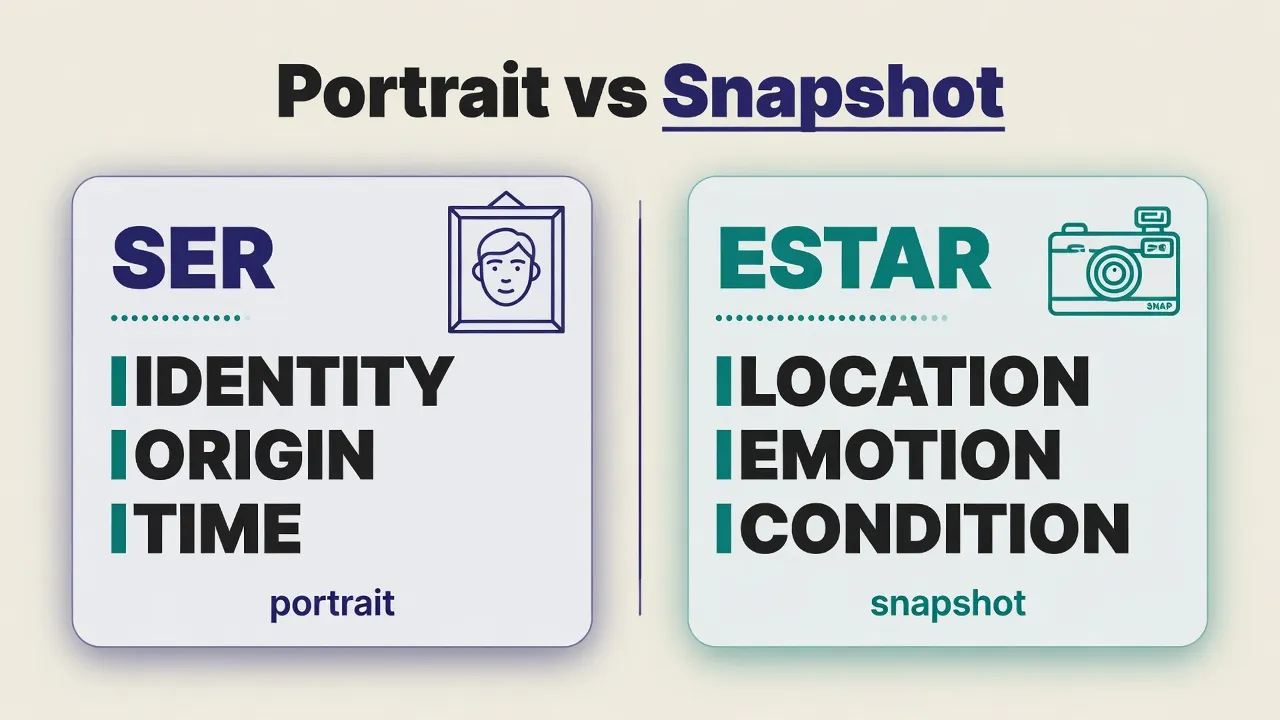
Examples that stick:
- Es guapo - he is a handsome person (identity)
- Está guapo - he looks good right now (current appearance)
- Es aburrido - he is a boring person
- Está aburrido - he is bored now
- Barcelona era un espejismo de bruma y tiniebla. - narrative identity of the city
- Las calles estaban vacías. - condition of the streets at that moment
This lens does not erase every exception. It survives contact with real usage much better than permanent/temporary alone. When you hesitate, name the frame first: portrait or snapshot. Then pick the verb.
Starter maps: DOCTOR and PLACE (use, then outgrow)
Textbooks love two memory hooks. They are fine as training wheels.
| DOCTOR (ser) | PLACE (estar) |
|---|---|
| Description, Occupation, Characteristic, Time, Origin, Relationships | Position, Location, Action (-ndo), Condition, Emotion |
Use them when you need a quick checklist. Then upgrade.
DOCTOR does not explain está muerto. PLACE does not fully explain why a party es en mi casa. Identity vs condition still does more work once adjectives start shifting meaning and stories get richer.
One short progressive note: estar + gerund (está lloviendo, estamos comiendo) is the snapshot of an action in progress. That is PLACE's "Action" slot, and it fits the same idea: not who you are, but what is happening now.
When the acronym list and the portrait/snapshot question disagree, trust framing plus context. The acronyms are training wheels. Outgrow them on purpose.
Adjectives that shift meaning
Some adjectives change meaning with the verb. These are not random traps. They still follow identity vs condition.
| Adjective | With ser | With estar |
|---|---|---|
| listo | clever | ready |
| aburrido | boring | bored |
| malo | bad / evil | sick |
| bueno | good (character) | tasty / looks good (context) |
| verde | green (color) | unripe |
| vivo | lively / sharp (person) | alive |
| rico | wealthy | delicious |
| seguro | safe (inherently) | sure / certain |
| orgulloso | arrogant (trait) | proud (of something) |
| atento | considerate | attentive right now |
Juan es listo. - clever
Juan está listo. - ready
La manzana es verde. - green color
La manzana está verde. - unripe
A tiny board of the pairs people share most often:
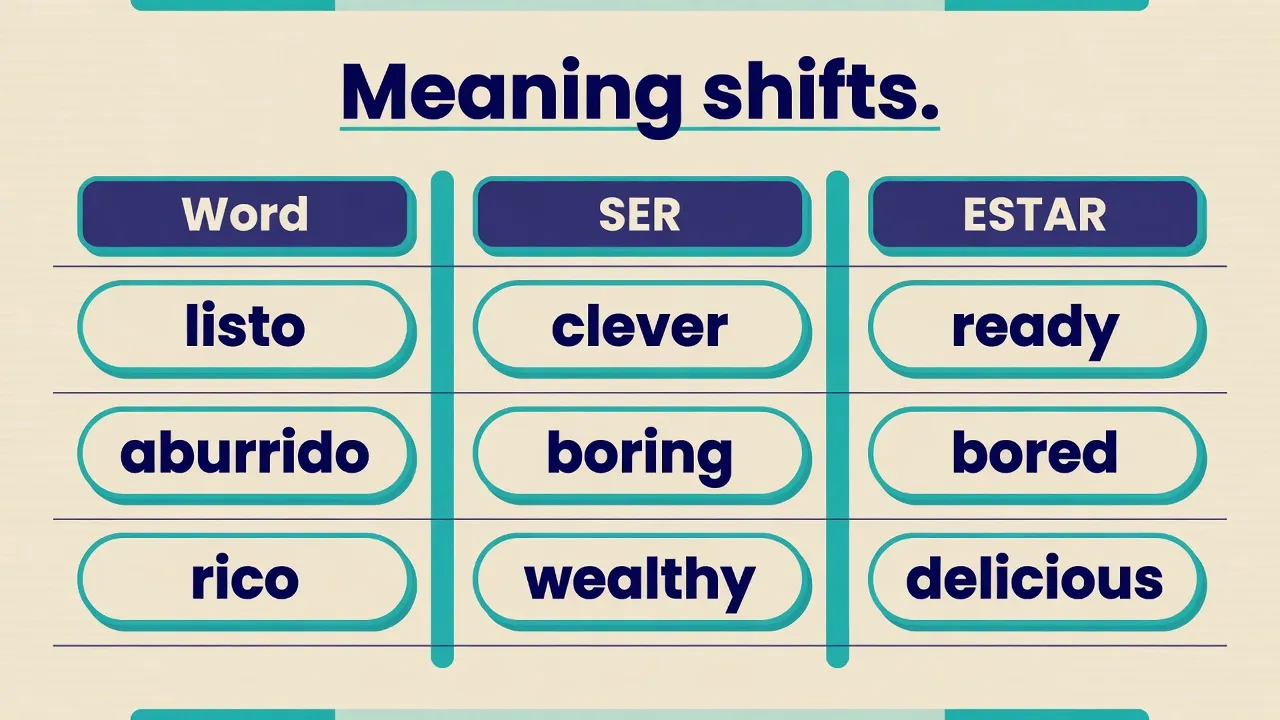
When reading, pause on these pairs for one second. Ask: portrait or snapshot? That beat beats re-reading a whole acronym list.
Edge cases that still trip people
1. Location: usually estar (things and people)
El libro está en la mesa.
Event location often uses ser:
La fiesta es en mi casa.
The event is defined by where it takes place. Objects and people at a place usually take estar. Events often take ser.
2. Profession and roles: ser
Ella es doctora.
3. Time and dates: ser
Son las tres.
Es lunes.
4. Passive action vs resulting state
La puerta fue abierta por el viento. - action (ser + past participle)
La puerta está abierta. - resulting state (estar)
5. Emotions: usually estar
Estoy feliz. / Están tristes.
Character description can still use ser:
Es una persona feliz.
6. Death: estar
Está muerto.
Again: state, not a profession-style label. Permanent/temporary does not decide the verb. Framing does.
Keep this list short on purpose. You do not need fifty edge cases. You need the few that break the first chart, then lots of real examples.
A simple practice plan
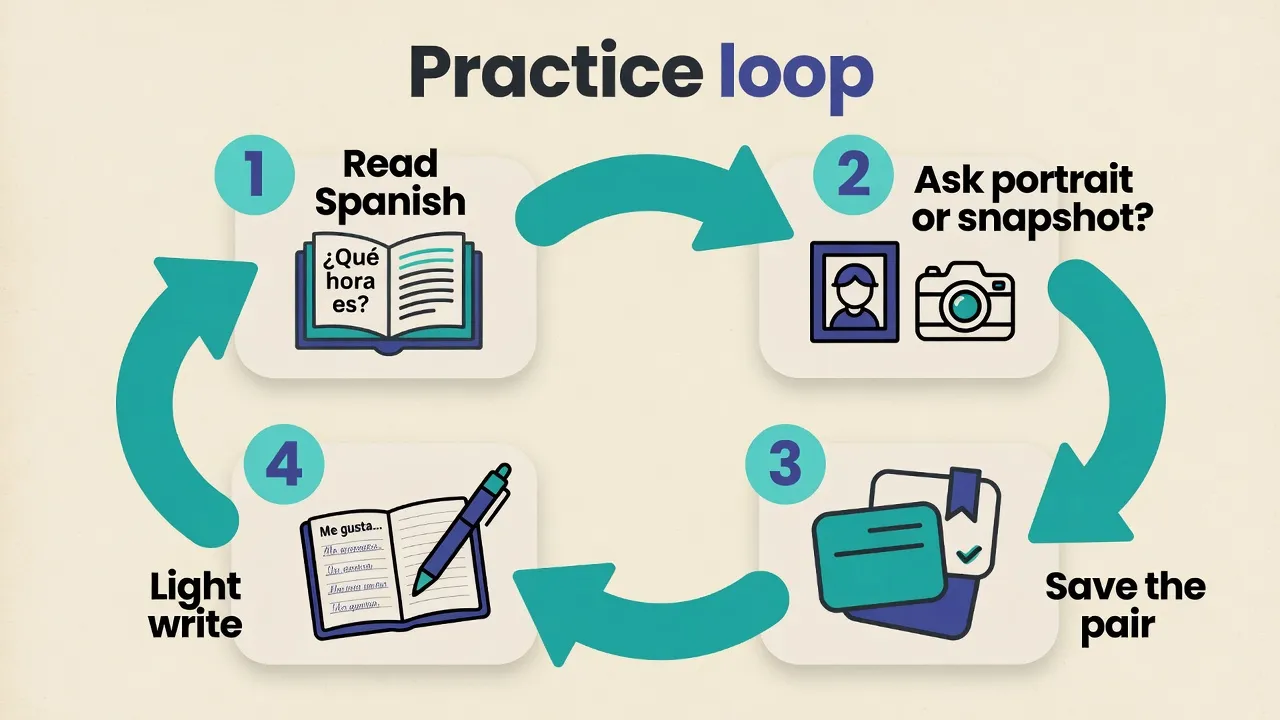
No schedule turns ser/estar into magic. A small loop turns it into a habit.
Phase A: notice while reading (1-2 weeks)
- Choose Spanish texts you mostly understand.
- When you see ser or estar, ask: identity or condition? Portrait or snapshot?
- For meaning-shift adjectives, check the context before you assume the worksheet meaning.
- Save 3-8 useful sentences per day, not every verb form you meet.
Phase B: produce a little (ongoing)
Write short daily notes with parallel pairs:
- Soy ingeniero. vs Estoy cansado.
- Mi piso es pequeño. vs Mi piso está desordenado.
- El café es bueno. vs El café está bueno. (character of the product vs current taste or state)
Say them aloud. If a pair still feels fake, collect more examples from reading before forcing production.
Mini-checklist (use after each short session)
- Did I name the frame (portrait / snapshot) before guessing?
- Did I save at least one real sentence, not only a bare conjugation?
- Did I write or say one parallel pair of my own?
- Will I reopen a saved line in two days?
What progress looks like
After regular exposure, many learners stop translating the acronyms and start feeling which frame fits. Mistakes still happen under speed or stress. That is normal. Track progress by fewer repeated errors in writing and easier choices in easy conversation, not by a promise of perfection.
The notice loop in one picture:
Why reading beats another worksheet
A quiz can prove you know the rule for ten minutes. Automatic choice needs many correct examples in meaningful context.
That is why reading helps more than another worksheet farm. You meet ser and estar constantly in descriptions, dialogue, and narration. You see está aburrido next to a person who was fun five pages ago. You see es en el parque when a meeting is defined by place. The frame stops being abstract and starts being something you have felt a hundred times.
Worksheets still have a job: first contact, quick review, meaning-shift pairs. They are weak at building the reflex under real language. Input volume, plus light production, does that.
Related reading if you want the bigger picture: why grammar tests alone stall progress and intensive vs extensive reading.
How MovaReader fits
MovaReader is a reading-first tool: graded articles, click-to-translate, saved phrases, and light trainers later. It helps you meet ser and estar in real sentences. It does not auto-label every ser/estar decision with a philosophy lecture on each tap.
What it does:
- free graded library and click-to-translate
- upload EPUB or files you own
- unlimited listening on freemium
- 20 word translations per day free
- Reader €1/month for more reading volume (unlimited translations at that plan)
- Pro €5/month for full trainers
- samples: Spanish A1, Spanish A2
- demos: free Spanish vocabulary trainer, everyday Spanish phrases practice
- paths: /en/all-articles, /en/pricing, /en/how-to-use, /en/trainers, /en/phrases, /en/language-map
What it does not do:
- host commercial novels by default without your own file
Practical start:
- Read a free A2 Spanish sample.
- Mark a few ser/estar sentences that feel interesting.
- Write three parallel pairs of your own.
- Revisit them two days later.
FAQ
Is permanent vs temporary always wrong?
No. It is a rough first map. It fails on death (estar), event location (ser), and many meaning-shift adjectives. Upgrade to identity (ser) vs condition (estar).
Why do speakers say está muerto?
Death is framed as a state someone is in, not a defining label like profession. Permanent versus temporary does not pick the verb. Framing does.
Why both es rico and está rico?
Different meanings. With ser, often wealthy or a quality identity. With estar, often delicious (food) or a current evaluation. Context chooses.
Why is the party es en mi casa if locations use estar?
Event locations often use ser (the event is defined by where it happens). Objects and people at a place usually use estar.
Can flashcards fix ser vs estar?
They help for meaning-shift pairs and sticky examples. They work best when cards come from sentences you actually met while reading, not only from isolated drills.
How long until it feels automatic?
Often weeks to months of regular reading and light production. Speed under pressure comes last. One article does not remove every future error.
Bottom line
Drop the fantasy of a secret rule that ends every slip. Keep a framework that matches how Spanish frames reality: ser for identity, estar for condition, plus a short edge-case list.
Then do the boring powerful thing: read texts you understand, notice the choice, save a few pairs, produce a little, repeat. That is how the chart becomes a feeling.
Next steps: open a free Spanish A2 sample, try the portrait/snapshot question on the first page you read today, and skim all articles or pricing if you want more volume without guessing what the app is for.
Keep reading with translations inside the text
With a free account, an unknown word translates with one tap, and the words you are learning wait for you in the trainer.
Free account: 7 days of Pro, then 20 word translations a day or a paid plan.