Grammar in Context
Spanish Si Clauses: Feel Types 0-3 as Distance from Reality
Stop memorizing only the chart. Learn Spanish conditionals as distance from reality, then hunt *si* in Spanish texts you can actually finish.
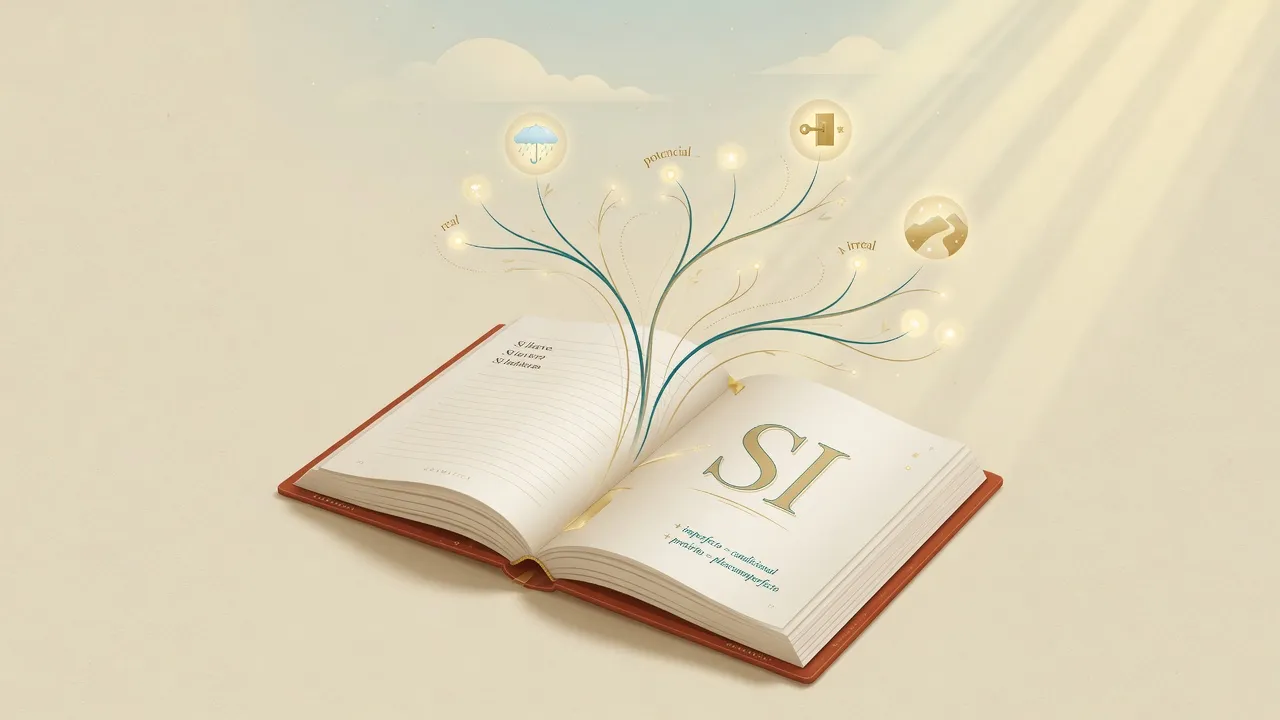
You open the textbook and hit a chart: Types 0, 1, 2, 3. Four rows. Four formulas. Zero emotional connection. Normal - charts strip the feel.
Native speakers do not think "Type 2." They think this is not true right now. That is longing wearing grammar clothes. Si yo pudiera... is not only a conjugation drill. It is someone opening a door that reality keeps closed.
Spanish si clauses (conditionals) are if-then structures that encode how far a situation is from reality, not four dry chart rows. Type 0 is carved-stone fact or habit. Type 1 is real hope or a possible plan. Type 2 is longing or an unlikely present. Type 3 is past regret you cannot undo. Mixed bends those time frames. Numbers are labels - feel is the map - while formulas still matter (presente, imperfecto de subjuntivo, pluscuamperfecto de subjuntivo, plus the matching result tenses).
In this guide you get clear formulas, spot tips, and short literary-style example sentences. Then a reading loop: hunt si, name the distance, save the full sentence, transform the type.
In MovaReader you notice si, name the distance, and use click-to-translate when a word blocks you.
Why textbook conditional charts fail
Traditional charts look clean:
- Type 0: Si + presente, presente
- Type 1: Si + presente, futuro
- Type 2: Si + imperfecto de subjuntivo, condicional
- Type 3: Si + pluscuamperfecto de subjuntivo, condicional compuesto
Useful under exam pressure. Incomplete for meaning. They never say: speakers choose a type by emotional distance from reality. Type 0 sits on solid ground. Type 1 treats the condition as possible. Type 2 steps away from what is true now. Type 3 looks at a past that never happened.
Picture a ladder, not a spreadsheet:
| Type | Feel | Distance from reality |
|---|---|---|
| 0 | always true / habit | none - carved-stone fact |
| 1 | real hope / plan | close - treated as possible |
| 2 | longing / unlikely now | far - contrary to present reality |
| 3 | past regret | locked - alternative past that never happened |
| Mixed | time bends | past condition + present result (or reverse) |
Here is that ladder as a diagram - always true at the base, past regret at the top:
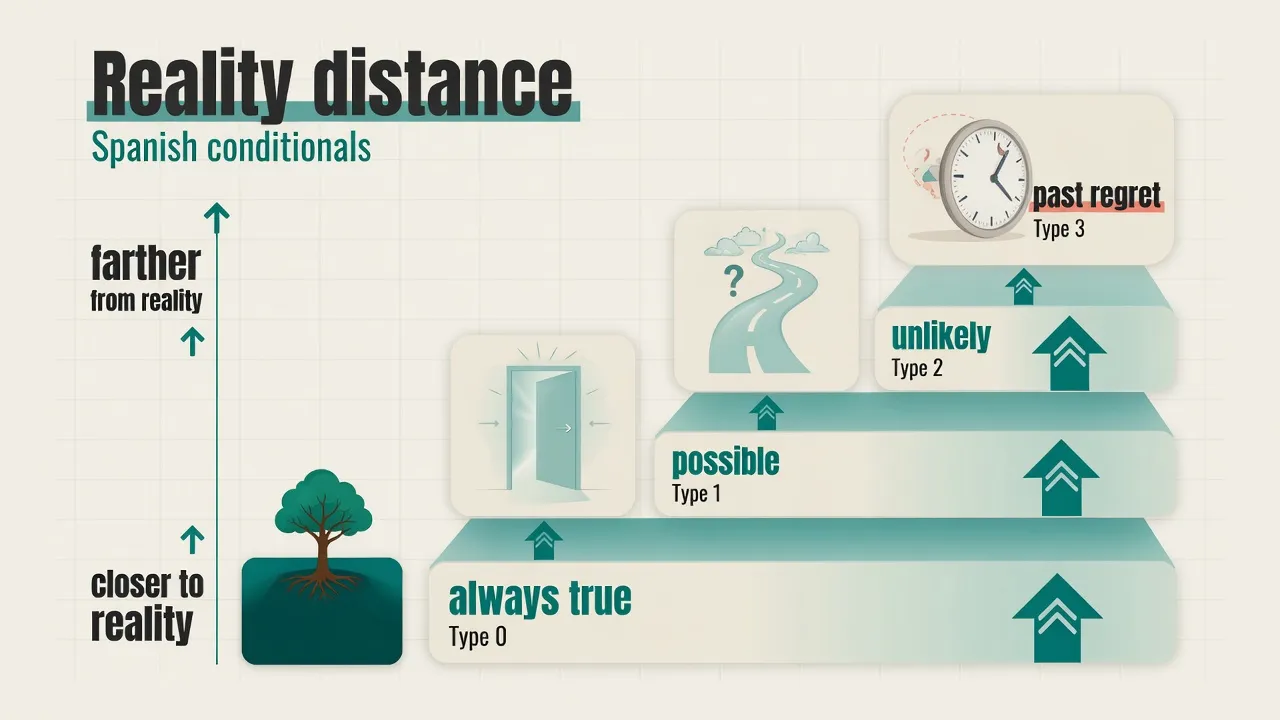
Formulas stay. We still write them out. Feel + form together beat either alone.
Type 0: universal truths and habits (carved-stone fact)
Formula: Si + presente de indicativo → presente de indicativo
Feel: permanent rule or habit. No dream. No regret. Proverb voice.
Spot tip: both verbs present; the line sounds like a general rule.
The literary-style lines below are example sentences written in the tone of magical realism, thriller, or memoir prose.
- Si un hombre miente una vez, miente siempre.
If a man lies once, he always lies. - Si llueve en la sierra, el río crece antes del amanecer.
If it rains in the mountains, the river rises before dawn. - Si lees todos los días, tu vocabulario crece sin esfuerzo.
If you read every day, your vocabulary grows without effort.
You will meet this pattern in character philosophies and proverb-like narration - the grammatical equivalent of carved stone.
Type 1: real possibilities (actionable hope)
Formula: Si + presente de indicativo → futuro simple
Feel: plan, threat, invitation. The speaker treats the condition as possible.
Spot tip: present in the si clause; future in the result.
Literary-style examples:
- Si encuentras el manuscrito antes que ellos, cambiarás la historia.
If you find the manuscript before they do, you will change history. - Si vienes conmigo, te mostraré la verdad.
If you come with me, I will show you the truth. - Si no llegas antes del anochecer, cerraremos la puerta.
If you do not arrive before nightfall, we will close the door.
You will also meet an imperative result in everyday Spanish: Si tienes tiempo, llámame. Same Type 1 spirit - real condition, real next step - just a command instead of a future.
Type 1 is the grammar of plot engines: characters make plans, set conditions, and push the story forward.
Type 2: longing and unlikely present (grammar of dreams)
Formula: Si + imperfecto de subjuntivo → condicional simple
Feel: daydream, soft advice (Si yo fuera tú...), impossible wish. Contrary to what is true now.
Spot tip: imperfect subjunctive in the si clause; never put the conditional (iría, haría) inside the si clause for this type.
Literary-style examples:
- Si yo tuviera una segunda vida, la pasaría leyendo todos los libros que no pude abrir en esta.
If I had a second life, I would spend it reading all the books I could not open in this one. - Si pudieras ver esta ciudad como yo la veo, entenderías por qué nunca me fui.
If you could see this city the way I see it, you would understand why I never left. - Si viviera cerca del mar, nadaría cada mañana.
If I lived near the sea, I would swim every morning.
Emotional spectrum inside Type 2:
| Shade | Example |
|---|---|
| Longing | Si viviera cerca del mar, nadaría cada mañana. |
| Advice | Si yo fuera tú, leería ese libro en español. |
| Impossible wish | Si el tiempo se detuviera, nos quedaríamos aquí para siempre. |
A quick formation note: imperfecto de subjuntivo often builds from the pretérito third-person stem + -ra (tuvo → tuviera; also -se variant tuviese). Enough to recognize forms on the page. For deeper mood work, see Spanish subjunctive through emotional dialogues - Type 2 is one door into that world, not the whole house.
Type 3: rewriting the past (architecture of regret)
Formula: Si + pluscuamperfecto de subjuntivo → condicional compuesto
Feel: irreversible past. Flashback, confession, "what would have been."
Spot tip: hubiera/hubiese + past participle in the si clause; habría + past participle in the result.
Literary-style examples:
- Si hubiera tomado el otro camino, habría llegado a una vida completamente diferente.
If I had taken the other path, I would have arrived at a completely different life. - Si hubiera estudiado español antes, habría entendido esa conversación.
If I had studied Spanish earlier, I would have understood that conversation. - Si ella no hubiera abierto esa carta, nada de esto habría sucedido.
If she had not opened that letter, none of this would have happened.
Together, hubiera + participle and habría + participle build a life that never existed. That is why Type 3 feels heavy in fiction: deathbed confessions, detective reveals, the sentence that trails off after Si hubiéramos sabido la verdad...
A regional note: some speakers use hubiera in the result as well. Standard classroom pair stays hubiera (condition) + habría (result). Learn that pair first; treat other variants as recognition later.
Type map at a glance
Feel first, formula second - but keep both.
| Type | Feel | Si-clause | Result clause | Spot tip |
|---|---|---|---|---|
| 0 | carved-stone fact / habit | si + presente de indicativo | presente de indicativo | both verbs present; proverb / rule voice |
| 1 | real hope / plan | si + presente de indicativo | futuro simple (or light imperative) | present condition; future (or command) result |
| 2 | longing / unlikely now | si + imperfecto de subjuntivo | condicional simple | imperfect subjunctive in si; never conditional inside the si clause |
| 3 | past regret | si + pluscuamperfecto de subjuntivo | condicional compuesto | hubiera/hubiese + participle; habría + participle in result |
| Mixed | time bends | past unreal + present result, or present unreal + past result | mixed tense pair | learn pure 0-3 first; mixed = recognition skill |
Here is the same map as a visual: formulas plus emotion tags (truth / possible / longing / regret).
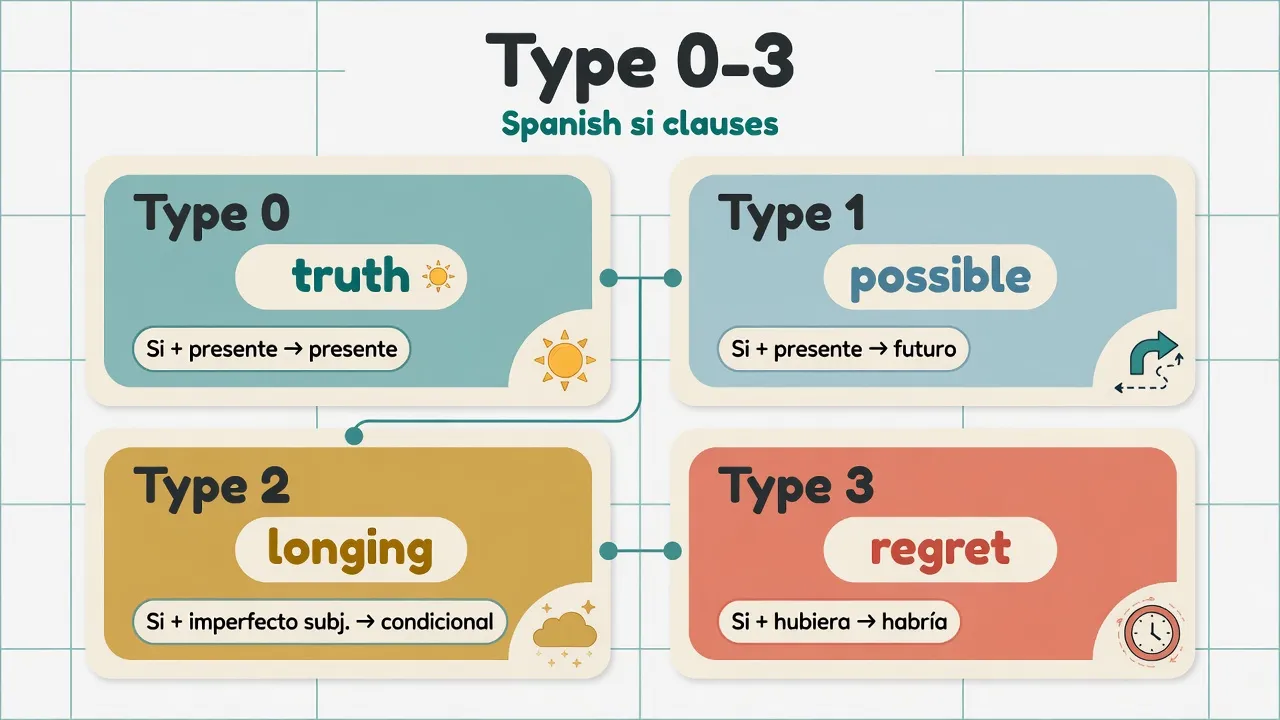
Feel is the map. Numbers are labels you pin on after you sense the distance.
Mixed conditionals: when time bends
Clean types live in one time frame. Mixed conditionals bend time: a past condition with a present result, or a present trait with a past result. Learn pure Types 0-3 first. Mixed is mainly a recognition skill when a story explains who someone is now - or why they failed then.
Past condition → present result (3+2)
- Si no hubiera leído ese libro de niño, no sería la persona que soy hoy.
If I had not read that book as a child, I would not be the person I am today.
Past unreal condition (hubiera leído) + present-unreal style result (sería). Memoirs and coming-of-age narration love this shape.
Present trait → past result (2+3)
- Si fuera más valiente, habría dicho la verdad ayer.
If I were braver, I would have told the truth yesterday.
Present character trait (fuera) + past missed action (habría dicho). Self-awareness grammar: who I am now explains what I failed to do then.
Two patterns are enough for this guide. When you spot a mix, name both distances: past locked plus present still open - or the reverse.
Mini traps (fast)
A few classic stumbles before you practice:
| Trap | Wrong feel | Fix |
|---|---|---|
| si vs sí | accent panic | si = if; sí = yes / emphasis |
| si tenga | present subjunctive after si in standard conditionals | Types 0/1 use present indicative (si tengo) |
| Conditional in the si clause (Types 2/3) | si iría... | use imperfect / pluperfect subjunctive in the si clause |
| hubiera vs había | mix mood | hubiera = unreal past condition helper; había = real past narrative (imperfect indicative) |
More on each in the FAQ below.
How to practice si clauses without flashcards
Charts help exams. Feel sticks when si appears inside a story you can finish. Forget conjugation marathons alone. Use a short reading protocol.
- Choose level-matched Spanish. Graded articles first. Commercial novels only if you legally own the file.
- Hunt si + verb. Pause. Name the type by emotional distance (fact / hope / longing / regret), not only the number.
- Save the full sentence. Not a naked hubiera tomado. Keep character, setting, and feel.
- Transform across types. Rewrite a Type 2 as Type 1 (make it real) or Type 3 (push it into irreversible past).
Here is the loop as a diagram:
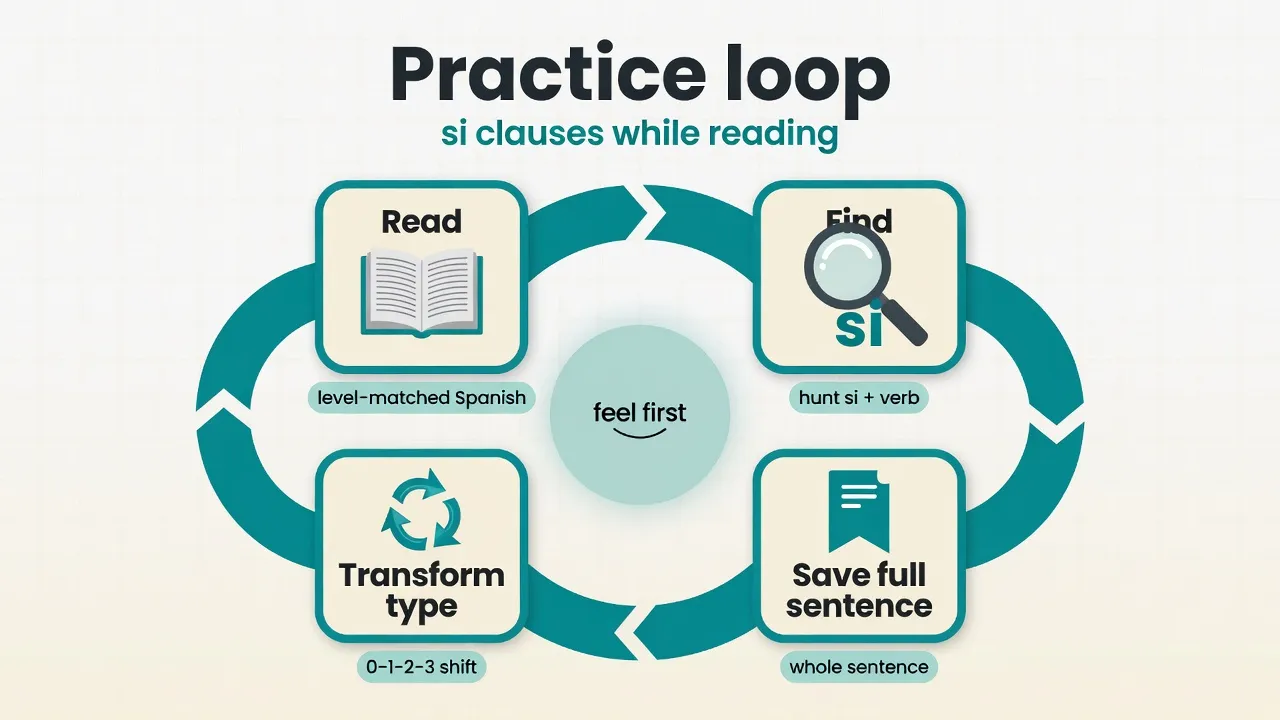
Start light: Spanish A2 sample, then browse free graded Spanish articles. Magical realism and thrillers are rich in "what if" language; for harder prose, upload a legal EPUB you own. Soft genre path if you are choosing a first Márquez-style read: which Márquez book to try first in Spanish.
When you save lines, prefer full sentences in phrases over isolated verbs. A template with a face and a room beats a naked conjugation forever.
Structural templates for production
The leap from recognizing conditionals to using them needs frames you can fill. Templates from saved full sentences beat isolated drills.
| Use | Template | Type |
|---|---|---|
| Real plan | Si [presente], [futuro]. → Si tengo tiempo, te llamaré. | 1 |
| Personal wish | Si yo [pudiera / tuviera / supiera], [haría / iría / diría]. | 2 |
| Advice voice | Si yo fuera tú, [condicional]. | 2 |
| Past regret | Si [alguien] hubiera [participio], [algo] habría [participio]. | 3 |
| Mixed (optional) | Si no hubiera [participio] entonces, no sería [ahora]. | mixed 3+2 |
When a structure arrives inside a story, it comes pre-loaded with emotion. Your brain files a moment, not only a rule: the door not taken, the invitation still open, the habit that never breaks.
How MovaReader helps
MovaReader is for the reading loop: free graded Spanish, click-to-translate (about 20 word translations a day on the free plan, plus listening), and your own legal EPUB when you want harder prose. Reader is €1/mo for more translations; Pro is €5/mo for full trainers. When Si hubiera sabido... appears, you still decide: regret, hope, or fact - the app keeps you inside Spanish you can finish.
What exists:
- free graded library + click-to-translate
- about 20 word translations a day on the free plan
- listening
- upload EPUB/files you legally own
- phrases for full si sentences
- trainers on Pro (phrase / typing practice)
- demos: free Spanish vocabulary trainer · everyday Spanish phrases practice
Soft next steps if tools help you keep reading: how to use MovaReader, pricing: freemium · Reader €1 · Pro €5, and more graded text at all articles.
FAQ
Si vs sí - what's the difference?
si (no accent) means if. sí (with accent) means yes, or emphatic "himself/herself" in some patterns. Spelling trap, not a tense issue. If the clause sets a condition, you almost always want si without the accent.
Can I use present subjunctive after si (si tenga)?
For standard Types 0 and 1, no. Use present indicative in the si clause: si tengo, not si tenga. Si tenga is a classic learner error. Rare advanced patterns exist outside this guide's spine - stay with indicative for everyday conditionals until pure Types 0-3 feel stable.
Type 2 vs Type 3 - how do I choose?
Ask one question: is the condition about now / future unreal (longing), or locked in the past (regret)?
- Type 2: imperfect subjunctive + simple conditional → Si tuviera tiempo, leería más. (I do not really have time now.)
- Type 3: hubiera + participle and habría + participle → Si hubiera tenido tiempo, habría leído más. (The window already closed.)
If the door is still imaginable in the present, Type 2. If the door already closed yesterday, Type 3.
What are Spanish mixed conditionals?
They bend time frames instead of staying in one clean type.
- Past condition → present result (3+2): Si no hubiera leído ese libro de niño, no sería quien soy.
- Present trait → past result (2+3): Si fuera más valiente, habría dicho la verdad ayer.
Learn pure Types 0-3 first. Mixed is mainly a recognition skill when past cause explains a present self (or reverse).
How do I practice si clauses by reading?
Both drills and reading help; they do different jobs. Drills fix the chart under exam pressure. Reading attaches feel: fact vs hope vs longing vs regret inside a full sentence.
A simple protocol: level-matched text → hunt si → name distance → save the full sentence → transform types. Start with graded Spanish (A2 sample, then all articles). Commercial books only if you own them legally.
Does MovaReader auto-explain every conditional for me?
No. There is no automated grammar explainer and no auto-highlight of every si clause. The free plan covers the graded library, click-to-translate (~20 word translations/day), listening, uploads of your own legal EPUB and phrase saving; Reader is €1 and Pro with trainers is €5. You name the type. Details: pricing and how to use.
Next step
Si clauses are distance from reality first and type numbers second. Keep the formulas for Types 0-3, add mixed only after pure types stabilize, and treat the literary-style examples as teaching sentences.
This week: open a text you can actually finish, hunt three si lines, and name each one fact, hope, longing, or regret. Optional tools above if they cut lookup friction. Same emotional-distance idea for English if-clauses lives in a separate guide: English conditionals 0-3. Stop memorizing only the chart. Start noticing si in Spanish you can finish.
Keep reading with translations inside the text
With a free account, an unknown word translates with one tap, and the words you are learning wait for you in the trainer.
Free account: 7 days of Pro, then 20 word translations a day or a paid plan.