Grammar in Context
Spanish Subjunctive Without Tears: Feel the Mood Through Dialogue
Subjunctive marks desire, emotion, doubt, judgment, and unrealized possibility - not the calendar. Five zones, Marta and Carlos, imperfect light, and a small daily noticing loop.

You freeze when viene becomes venga in a fight line or a love line. One letter shifts, and your brain stalls mid-sentence. That freeze is normal. The world event did not change. The frame did.
WEIRDO charts and trigger walls are fine as reference. They are weak as the only method. When speech gets emotional, you need something you can feel, not a third conjugation wall.
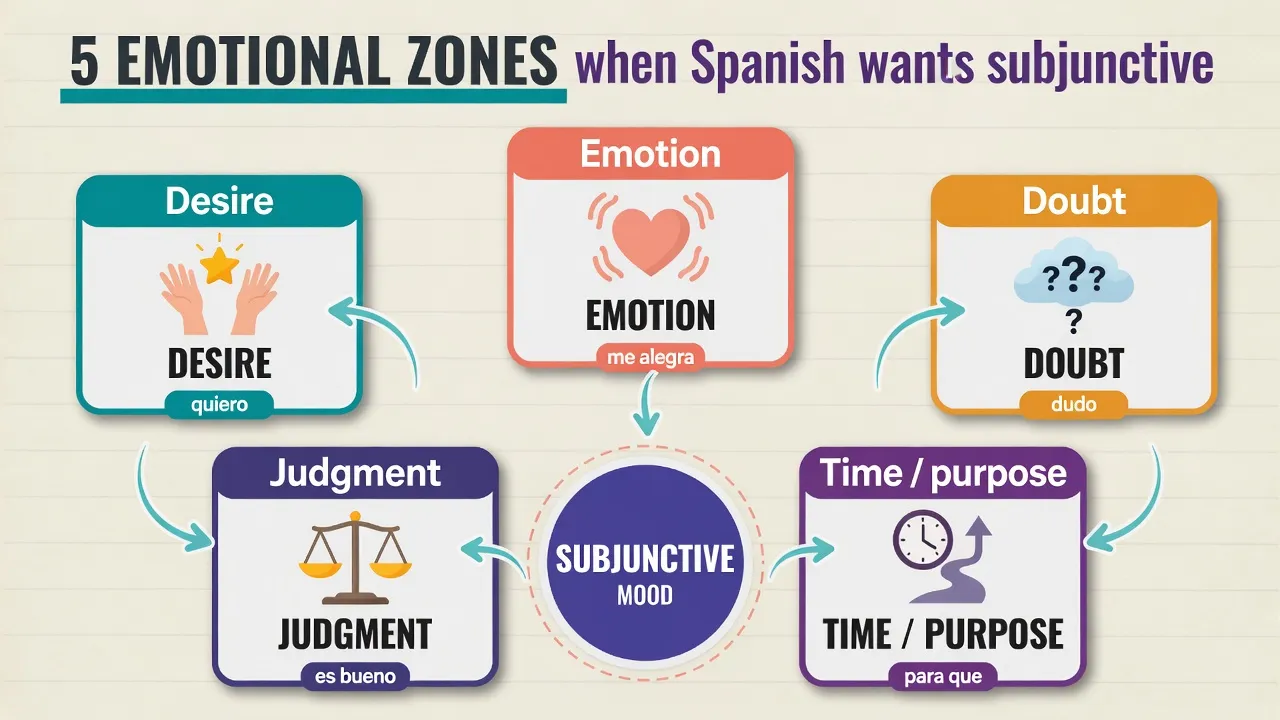
Spanish subjunctive marks how the speaker filters reality - desire, emotion, doubt, judgment, or something still unrealized - not the calendar. Indicative treats content as asserted fact; subjunctive often appears when attitude sits between you and the clause (often after a trigger and que, two subjects). Learn when to use Spanish subjunctive with five recognition zones and one emotional dialogue you reread for mood, not with charts alone. You still need forms; meaning makes forms stick.
MovaReader does not auto-highlight every subjunctive; it helps you read and notice. Free plan details later.
Below: indicative vs subjunctive pairs, five zone cards with skip-if, one Marta/Carlos dialogue plus a mood map, imperfect light, why reading beats worksheets, a 2-week plan, how MovaReader helps, book ideas, and FAQ.
Indicative vs subjunctive in one page
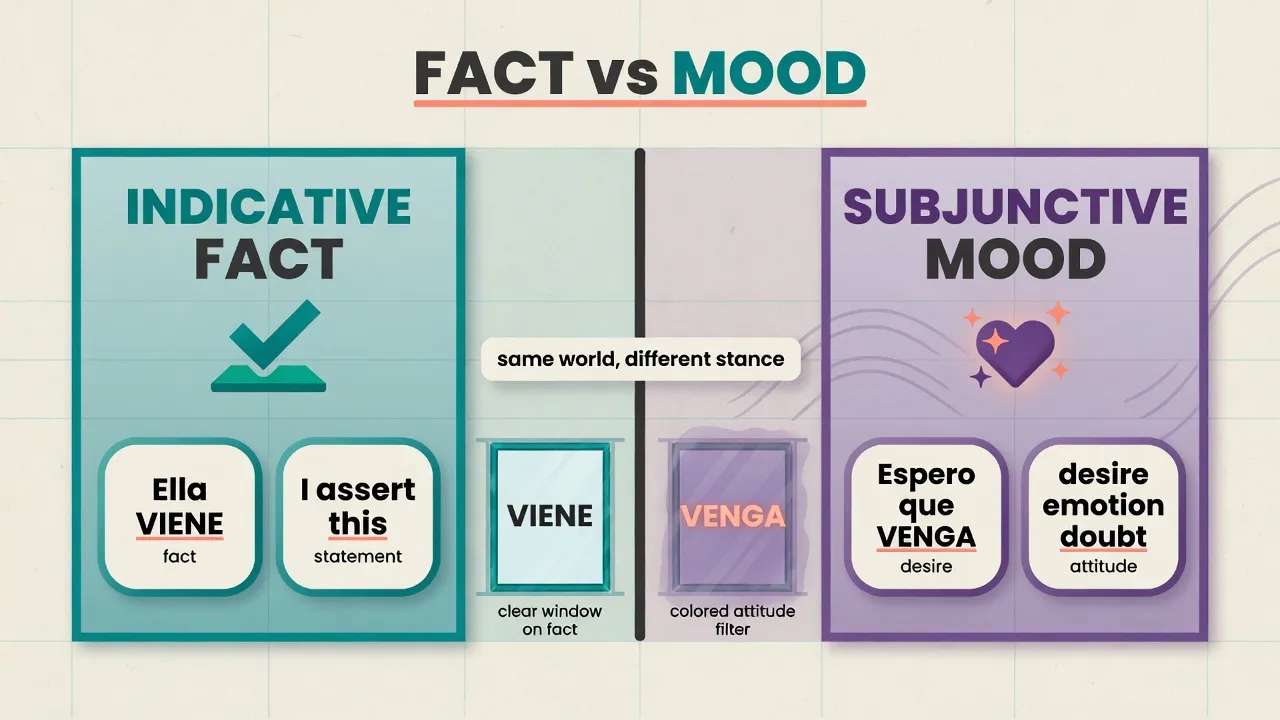
Same world event. Different speaker filter. Fact frame or attitude frame?
| Lens | What it marks | Mini example | Gloss |
|---|---|---|---|
| Indicative | Treated as factual / asserted | Ella viene mañana. | She is coming tomorrow. |
| Indicative | Knowledge as given | Sé que habla español. | I know he/she speaks Spanish. |
| Subjunctive | Desire / hope | Espero que ella venga mañana. | I hope she comes tomorrow. |
| Subjunctive | Doubt | Dudo que hable español. | I doubt he/she speaks Spanish. |
The shift is not random decoration. It marks how the speaker relates to the content.
A line with multiple subjunctive pressures:
No quiero que te vayas sin que sepas lo que siento.
| Pressure | Form | Stance |
|---|---|---|
| Desire (quiero que) | vayas | Non-asserted departure |
| Unrealized condition (sin que) | sepas | Still not realized |
In a real scene, you feel the urgency before you count triggers. That is the habit this article builds.
Five emotional zones (better than only WEIRDO)
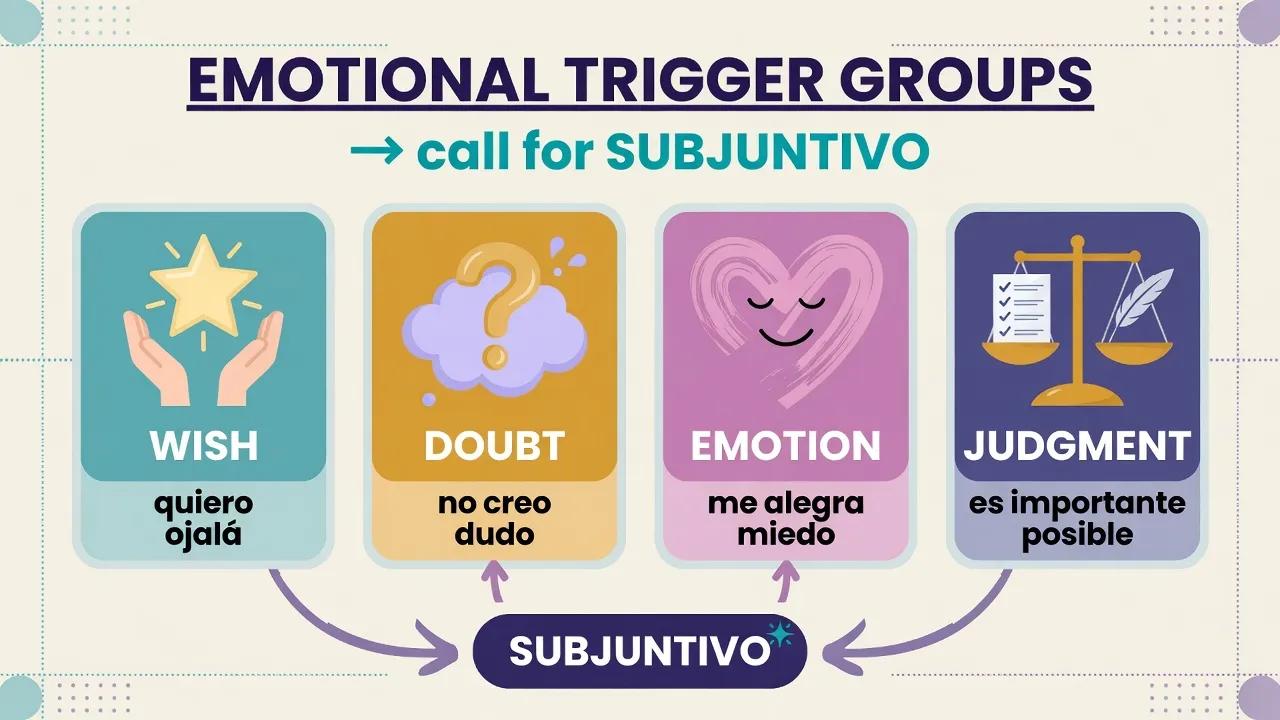
WEIRDO can stay as a memory aid. Zones help you recognize why a form appears - and when to skip subjunctive. Each card below has frames, one mini example, and a skip-if so you do not force the mood where Spanish does not want it.
Zone 1: Desire and will
Someone wants another person to do something (or not do it).
Frames: quiero que, necesito que, prefiero que, te pido que, exijo que, ruego que
Mini example: Te pido que me escuches. - I ask you to listen to me.
Skip-if: Same subject often takes the infinitive. Quiero ir, not Quiero que yo vaya. Different subject → Quiero que tú vayas.
Zone 2: Emotion
A reaction sits in front of the clause: fear, joy, irritation, delight.
Frames: me da miedo que, me alegra que, me molesta que, es triste que, me encanta que, tengo miedo de que
Mini example: Me da miedo que no vuelvas. - I'm scared you won't come back.
Skip-if: Pure fact report without an emotional filter. If you only assert a fact with no reaction frame, you are not in this zone.
Zone 3: Doubt and denial
The speaker withholds full commitment to the clause as fact.
Frames: dudo que, no creo que, no pienso que, no es verdad que
Mini example: No creo que esto funcione. - I don't think this will work.
Must-keep contrast:
- Creo que funciona (assertive → indicative)
- No creo que funcione (doubt → subjunctive)
Skip-if: Affirmative belief when the speaker asserts: creo que, sé que → usually indicative.
Zone 4: Unrealized time / purpose
The event is still ahead, still conditional, or still a purpose - not yet treated as a closed fact.
Frames: cuando (future/unrealized), antes de que, para que, sin que, a menos que, en cuanto (when unrealized), aunque (meaning-dependent)
Mini example: Cuando llegues a Buenos Aires, llámame. - When you get to Buenos Aires, call me.
Contrast past fact: Cuando llegó, me llamó. - When he/she arrived, he/she called me. (indicative)
Skip-if: Past or habitual factual cuando: Cuando tengo tiempo, leo.
Zone 5: Impersonal judgments / possibility
The speaker judges what should be, or names a possibility without asserting it as fact.
Frames: es necesario que, es importante que, es mejor que, es posible que, es probable que, basta que
Mini example: Es necesario que todos participen. - Everyone needs to take part.
Skip-if: es cierto que / es obvio que / es verdad que often take indicative (asserted fact frame).
These zones overlap. Language is not a clean spreadsheet. That is fine. If two labels fit, pick the one that matches the speaker's pressure in the scene.
Optional: hang WEIRDO on the zones
If tests need letters, hang them on zones - do not treat WEIRDO as the only brain.
| Letter | Maps roughly to | Example |
|---|---|---|
| W wishes | Zone 1 | Quiero que vengas |
| E emotions | Zone 2 | Me alegra que estés |
| I impersonal | Zone 5 | Es posible que nieve |
| R requests | Zone 1 | Te pido que digas la verdad |
| D doubt | Zone 3 | No creo que sea |
| O ojalá | Desire / hope | Ojalá pudiera |
Note: WEIRDO is incomplete. Time and purpose frames like para que and future cuando sit outside tidy letters. Zones plus noticing beat pure acronym drills.
Practice dialogue: count the moods, then feel them
One scene, stacked moods. Read twice: once for plot, once only watching mood shifts.
Marta: Necesito que me digas la verdad. No quiero que me mientas otra vez.
Carlos: No te miento. Pero dudo que entiendas lo que pasó.
Marta: Es posible que no lo entienda. Pero prefiero que me lo expliques tú, antes de que alguien más me lo cuente.
Carlos: Ojalá pudiera explicarte todo. Pero tengo miedo de que no me creas.
Marta: Cuando estés listo, estaré aquí. Aunque no sea fácil.
Subjunctive forms here: digas, mientas, entiendas, entienda, expliques, cuente, pudiera, creas, estés, sea. Every one sits inside need, doubt, fear, hope, or unrealized time.
Mood map (optional labels)
Optional map if you want labels; the scene still works if you only feel the pressure.
| Speaker | Form | Zone (approx.) | Frame cue |
|---|---|---|---|
| Marta | digas / mientas | Desire | necesito que / no quiero que |
| Carlos | entiendas | Doubt | dudo que |
| Marta | entienda | Possibility | es posible que |
| Marta | expliques | Desire | prefiero que |
| Marta | cuente | Unrealized time | antes de que |
| Carlos | pudiera | Hope (imperfect) | ojalá |
| Carlos | creas | Emotion / fear | tengo miedo de que |
| Marta | estés | Unrealized time | cuando (not yet) |
| Marta | sea | Concessive judgment | aunque |
When a form blocks meaning, save the full frame, not a bare verb. No creo que esto funcione is reusable. funcione alone is not.
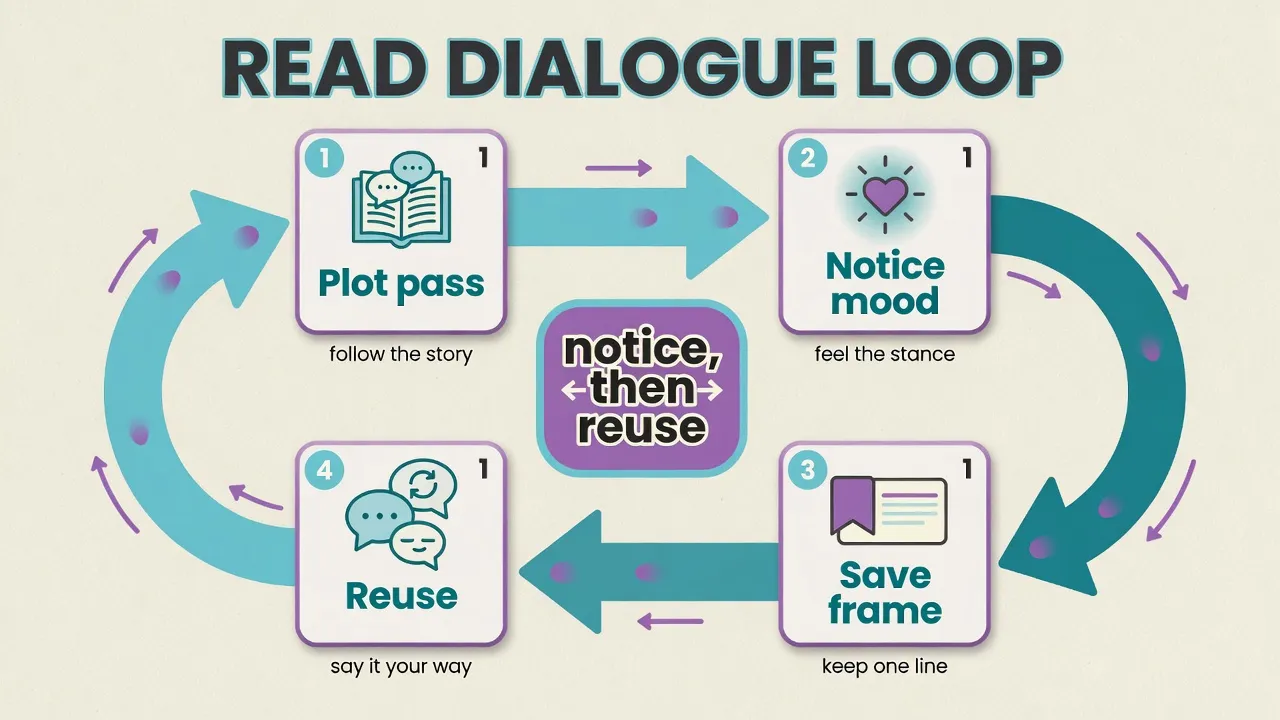
Notice loop:
- Read for plot (finishable text)
- Re-read for mood shifts
- Label zone (1 of 5)
- Save the full frame
Imperfect subjunctive: past wishes and unreal ideas
Stabilize present recognition first. Then past wishes and unreal ideas. This is a light layer, not a full tense course.
| Spanish | Gloss | Note |
|---|---|---|
| Si tuvieras más tiempo, ¿qué harías? | If you had more time, what would you do? | Hypothetical si |
| Me gustaría que estuvieras aquí. | I'd like you to be here. | Soft desire / politeness |
| Ojalá pudiera... | If only I could... | Open wish (also in the dialogue) |
This is the zone of hypotheticals, politeness, and "what if." Pull imperfect forms from dialogue you already understand. Ojalá and si are useful noticing cues. You do not need a full si-clause encyclopedia on day one.
Why reading dialogue beats only worksheets
Worksheets prove you can apply a trigger list under no time pressure. Dialogue shows the mess of real speech.
| Worksheets give you | Dialogue shows you |
|---|---|
| Trigger → form under no pressure | Emotion before the verb |
| Isolated sentences | creo flip under doubt |
| One clause at a time | Stacked clauses in one outburst |
| Correct / incorrect | Repeated patterns across a story |
You do not need the densest classics first. Graded stories and modern easy novels already hold espero que, cuando + subjunctive, and para que.
A level check: if every line needs lookup, you study decoding, not mood. Drop a level. Finishable Spanish beats heroic failure on a page you cannot hold in working memory.
If you care about the wider method, intensive vs extensive reading and how to learn Spanish by reading go deeper without replacing the zone work here. For level and vocab growth as a habit, the language map is a useful hub.
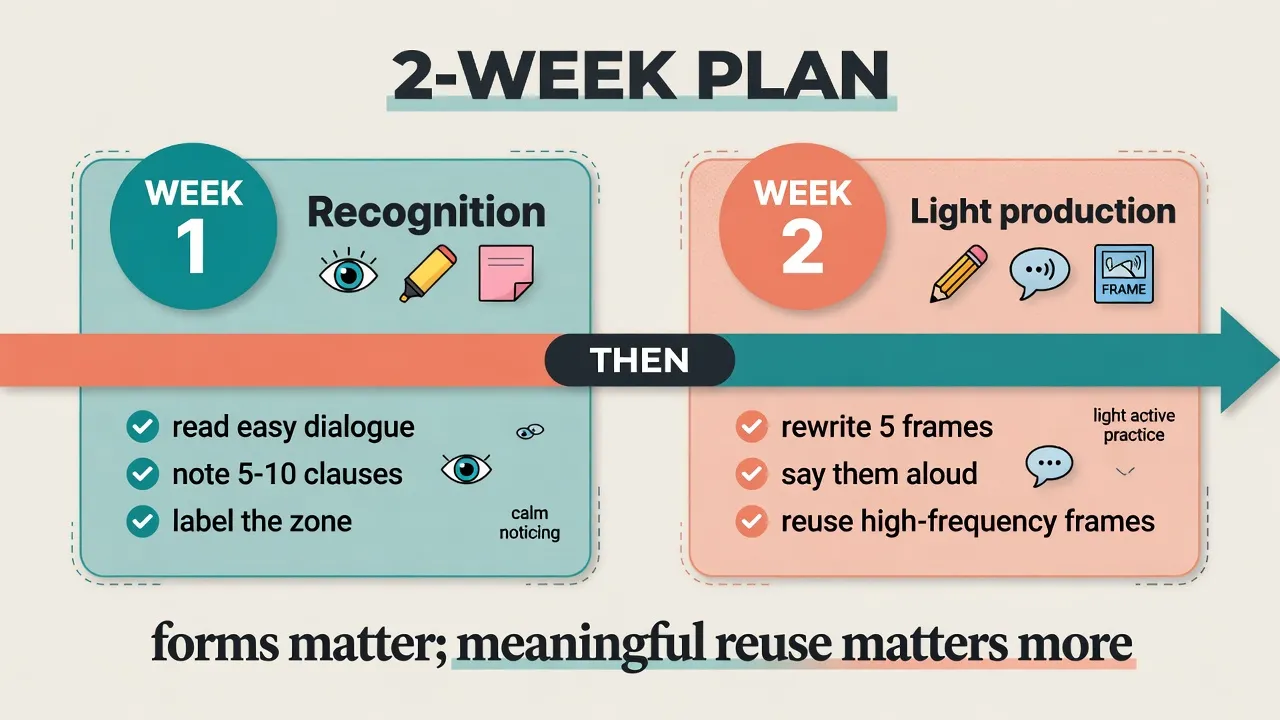
A two-week acquisition plan
No 50-row conjugation ritual every night. Forms matter; meaningful reuse matters more.
Week 1: recognition
| Day habit | Detail |
|---|---|
| Time | ~15 minutes daily easy Spanish (dialogue density if possible) |
| Cap | Note subjunctive clauses - max 5-10 per day |
| Label | Zone: desire / emotion / doubt / time / judgment |
Warm up on free graded text: Spanish A1 sample, Spanish A2 sample, or browse graded Spanish articles.
Week 2: light production
| Habit | Detail |
|---|---|
| Rewrite | 5 saved sentences with your own details |
| Speak | Say them aloud |
| Frames | Tiny personal high-frequency list (below) |
High-frequency frames worth owning:
| Frame | Use for |
|---|---|
| Quiero que... | Desire / will |
| No creo que... | Doubt / denial |
| Es importante que... | Impersonal judgment |
| Cuando + subjunctive (future) | Unrealized time |
| Para que... | Purpose (unrealized) |
Save high-value frames as phrases when you want them reusable later. Practice a few in trainers or the free Spanish vocabulary trainer and everyday Spanish phrases practice after noticing - not instead of reading.
How MovaReader helps (and what it does not do)
The zones and dialogue still matter if you never open an app.
MovaReader is for the notice loop, not a subjunctive highlighter. Free graded Spanish, click-to-translate (20 word translations a day on the free plan; unlimited listening), and your own legal EPUB when you want harder prose. Reader is €1 for unlimited translations; Pro is €5/mo for full trainers. When venga or sea appears, you still decide: fact frame or attitude frame. The app keeps you inside Spanish you can finish.
What it does not do
- Auto-highlight every subjunctive verb
- Lecture "emotional architecture" on each tap
Plans in brief
- free graded library + click-to-translate
- upload EPUB / files you legally own
- unlimited listening on the free plan
- 20 word translations/day free
- Reader €1 unlimited translations
- Pro €5/mo full trainers
- samples: Spanish A1, Spanish A2
- paths: all articles, pricing, how to use, trainers, phrases, language map
Suggested path
- Warm up on free A1-A2 Spanish articles
- When a subjunctive clause blocks meaning, tap unknown words and re-read the whole clause
- Save high-value frames as phrases
- Practice a few in trainers or demos later
See free plan, Reader, and Pro pricing when you outgrow the free translation cap, and how to use MovaReader for reading if you want the notice loop in-product.
Book ideas (realistic expectations)
Dialogue density first, then difficulty.
- Shorter love/family dramas and YA in Spanish - high dialogue density; often the best first ladder
- Como agua para chocolate - desire language; still a stretch for many B1 readers
- Dense magical-realism classics - later goals, not day-one subjunctive textbooks in novel form
Upload only files you own. MovaReader does not replace buying or borrowing commercial books. Use the free graded library for daily noticing; bring your own legal EPUB when rights allow.
Related reading
This post owns five zone cards, one Marta/Carlos mood map, and a 2-week plan. If you want extra short scenes and a mistakes framing under subjuntivo branding, see the subjuntivo dialogues guide once.
Also useful nearby:
- por vs para (grammar cluster)
- intensive vs extensive reading
- how to learn Spanish by reading
FAQ
Do I need to memorize WEIRDO?
Optional scaffolding. If five zones make more sense for recognition, use zones. If WEIRDO helps on tests, keep it. Neither replaces meeting real dialogue frames in text you mostly understand.
Why does creo que take indicative but no creo que often take subjunctive?
Affirmation and doubt frame the clause differently. Grammar follows speaker stance, not only the verb lemma.
- Creo que funciona → assertive → indicative
- No creo que funcione → doubt → subjunctive
Same verb family; different filter.
Is every cuando subjunctive?
No.
- Past or habitual factual cuando often indicative: Cuando llegó, me llamó. / Cuando tengo tiempo, leo.
- Future / unrealized cuando often subjunctive: Cuando llegues, llámame.
One contrast pair is enough for daily noticing. You do not need a full adverbial-clause course on day one.
How long until subjunctive feels natural?
Many meaningful encounters, not one chapter of drills. Expect partial control first: recognition before clean production under pressure. No universal timeline and no fluency guarantees.
Should I pause reading every time I see subjunctive?
No. Pause when meaning breaks or during a short noticing session (for example 5-10 clauses in Week 1). Full-time grammar hunting kills reading.
Mood vs tense - quick check?
Subjunctive is a mood (stance: how the speaker filters the content). Tenses live inside moods (present subjunctive, imperfect subjunctive, and so on). Calling the whole thing a "subjunctive tense" confuses the calendar with attitude.
Does any app auto-highlight every subjunctive for me?
MovaReader does not. You notice by reading; tap words when stuck. Click-to-translate and phrase practice help; mood judgment stays yours.
Same subject after quiero?
Same subject often takes infinitive: Quiero ir.
Different subject → que + subjunctive: Quiero que tú vayas.
Bottom line
The subjunctive is less a punishment and more a mood marker for non-facts, wishes, emotions, and judgments - not the calendar.
- Learn five zones with skip-if; collect real dialogue frames
- One extended scene (Marta and Carlos) beats twenty isolated drills for feel
- Recognition before clean production under pressure
- Small daily loop: read, notice a few clauses, reuse them
- Spreadsheet becomes instinct through encounters, not shame
Skip the myth of an auto-highlighter that does the mood work for you. Keep the small loop. That is how venga stops feeling like a trap and starts feeling like stance.
Keep reading with translations inside the text
With a free account, an unknown word translates with one tap, and the words you are learning wait for you in the trainer.
Free account: 7 days of Pro, then 20 word translations a day or a paid plan.