Grammar in Context
Spanish word order: stop building phrases with English templates
Textbook Spanish often follows English blueprints: correct, stiff, easy to spot. Spanish treats word order as flexible emphasis, not a cage. Three principles, five patterns and a reading method.
You open the textbook. It says: Subject + Verb + Object. You build Yo quiero una cerveza. Correct. Clear. A little stiff. The moment real Spanish rearranges the pieces for emphasis, your English blueprint freezes.
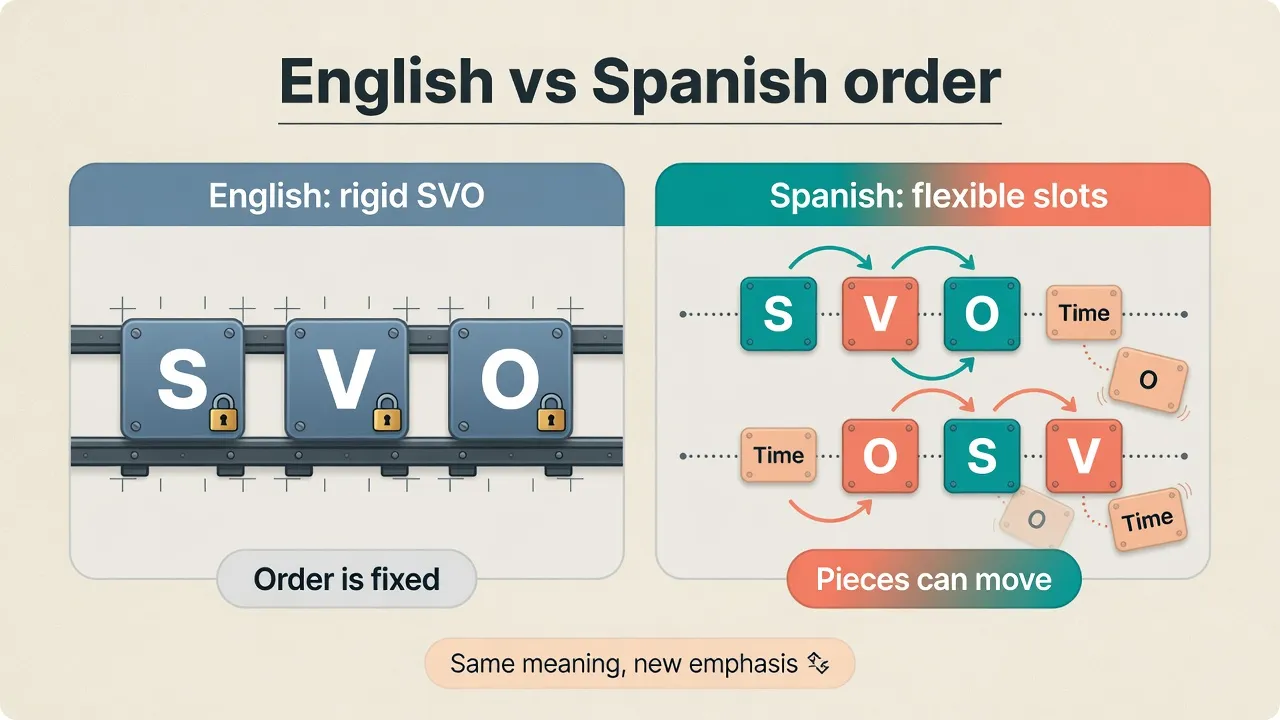
English treats word order almost like a cage. Spanish treats it more like movable furniture: the same idea can sit in more than one legal shape. That is the core of Spanish word order (and Spanish sentence structure) for English speakers: freer defaults, not chaos.
Spanish word order is freer than the English templates most learners paste onto every sentence. Default Spanish is still roughly Subject-Verb-Object, but speakers move time, objects, and subjects to mark what is known vs new, drop subject pronouns when the verb already shows who, and place adjectives before or after the noun for meaning - not decoration. You do not need 40 memorized rules: learn a few reusable patterns, then train them by reading graded Spanish you mostly understand.
Below: why English scaffolding makes Frankenstein Spanish, three principles that actually govern order, a B2+ literary stretch, five patterns you can reuse, why drills alone stall, a 4-week reading plan, what MovaReader does, and FAQ.
Why English speakers build "Frankenstein" Spanish
English is an SVO language: Subject, Verb, Object. Shuffle that stack and you often sound like Yoda. The order feels sacred.
Spanish is also SVO as a default. The trap is treating the default as law. Speakers reshuffle for topic, focus, and style - and the sentence stays natural when context supports it.
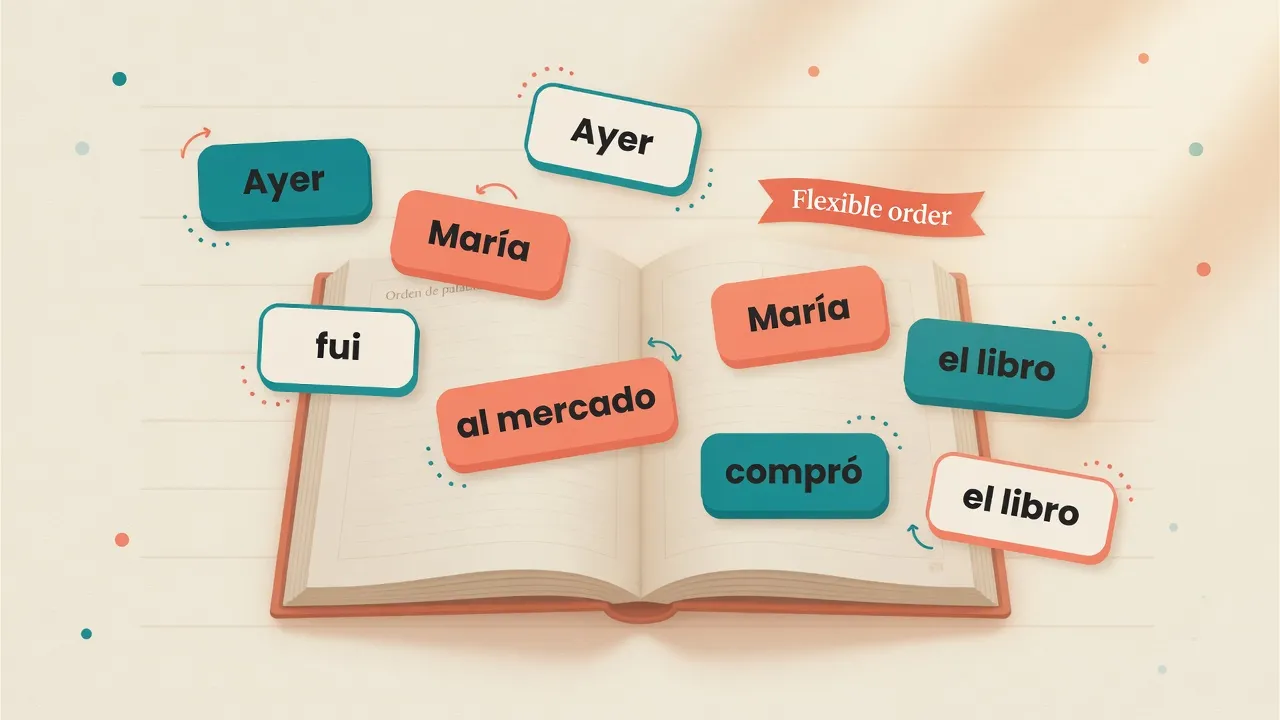
Here is one proposition in four legal Spanish shapes:
| Spanish | Rough English gloss | Emphasis feel |
|---|---|---|
| María compró el libro. | María bought the book. | Neutral default |
| El libro lo compró María. | The book, María bought it. | Object / topic front |
| Compró María el libro. | Bought María the book. | Verb-first / narrative |
| Compró el libro María. | Bought the book María. | Delayed subject |
English often freezes one safe order. Spanish can reshuffle the same idea for focus:
| English-like (rigid template feel) | Spanish freer options | What moved |
|---|---|---|
| María bought the book. (SVO only feels neutral) | María compró el libro. | Neutral default SVO |
| "The book, María bought it" (odd/cleft in EN) | El libro lo compró María. | Object / topic front + clitic |
| Verb-first storytelling (rare in EN speech) | Compró María el libro. | Verb-first / narrative feel |
| Delayed subject (awkward in EN) | Compró el libro María. | Subject late for weight |
Same proposition. Four legal Spanish orders. One English default. Native speakers hear English scaffolding even when every word is "correct."
Three principles that actually govern Spanish word order
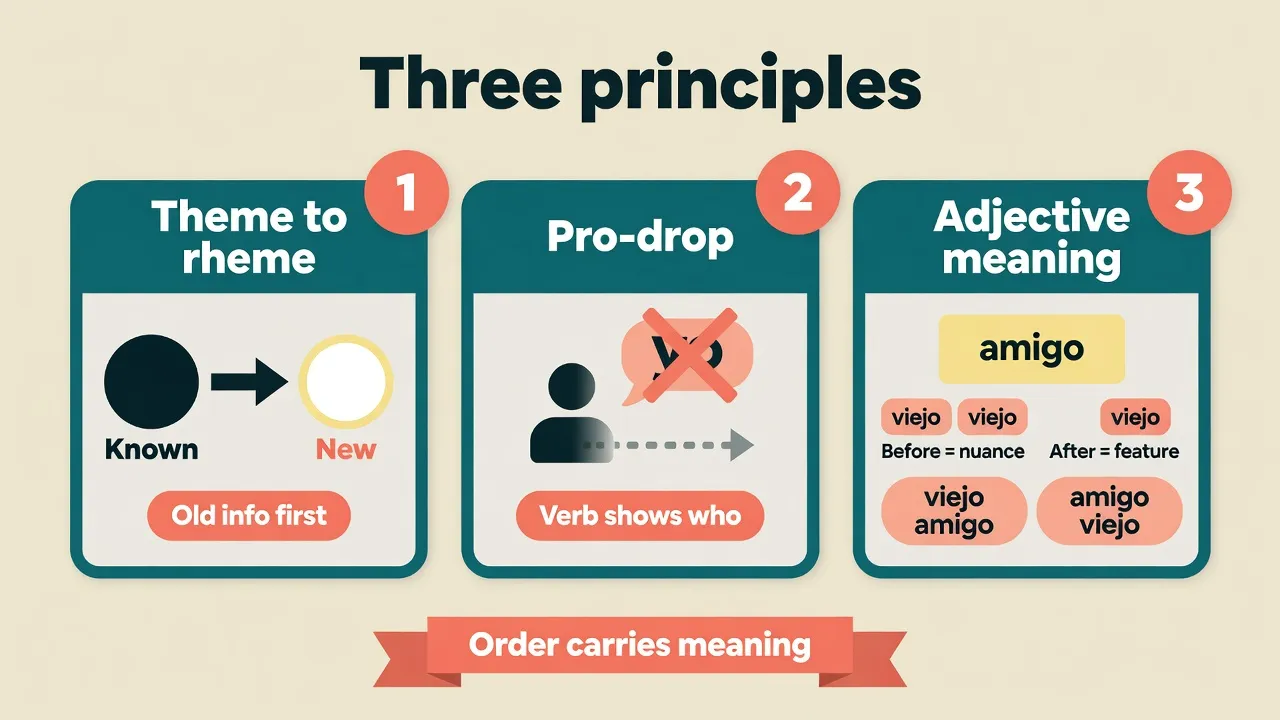
Word order is not chaos. Three habits explain most of what English speakers miss.
1. Old information first, new information last (theme-rheme)
Spanish often puts what you already share early, and the surprise or focus late. Linguists call this theme-rheme: theme = what we already share; rheme = what is new.
A mi madre le regaló un libro mi papá.
Focus lands on mi papá (the agent comes late). English often needs stress or a cleft ("It was my dad who..."). Spanish can simply move the piece.
2. Subject pronouns drop (pro-drop) - and when they return
Spanish verb endings already mark person: hablo, hablas, habla. So the subject pronoun is optional most of the time.
| Form | When | Feel |
|---|---|---|
| Hablo español. | Default | Neutral; the ending shows yo |
| Yo hablo español. | Contrast, emphasis, or rare clarity | "I (not you / believe it or not)" |
English speakers over-include yo, tú, él. In Spanish that often sounds heavy and textbook-ish. Drop by default; keep the pronoun when you mean contrast.
3. Adjective placement changes meaning
In English, "old friend" is almost one slot. In Spanish, before vs after the noun is a meaning choice - not decoration.
| Phrase | Meaning |
|---|---|
| un amigo viejo | friend who is elderly |
| un viejo amigo | long-time friend |
| un hombre pobre | man without money |
| un pobre hombre | pitiful man |
When unsure, put the adjective after the noun. That is the safe learner default (it also ties to pattern 5 below). More pairs exist (gran/grande, antiguo...), but one table is enough for now.
Stretch example: real Spanish that rearranges pieces
Flexibility shows up every day - not only in Nobel prose. Start with a B1-ish news feel:
- Anunció la reforma el presidente. (Subject after the verb for news weight.)
- Ayer, en Madrid, se reunieron los ministros. (Time and place first, then the action.)
B2+ literary stretch (not A2 homework)
If you want a famous long opener as a stretch, not daily drill, look at this line from Cien años de soledad (as an illustration):
Muchos años después, frente al pelotón de fusilamiento, el coronel Aureliano Buendía había de recordar aquella tarde remota en que su padre lo llevó a conocer el hielo.
Structural moves, in plain language:
- Temporal adverb first (Muchos años después)
- Scene prepositional phrase (frente al pelotón...)
- Delayed subject (el coronel Aureliano Buendía)
- Verb phrase (había de recordar)
- Nested temporal clause (en que su padre lo llevó...)
Label this B2+. Failing to parse a 47-word opener is not failure at A2 or B1. Meet such sentences later in books you own legally, school excerpts, or short public quotes - not as "start here at A2."
Five Spanish word-order patterns English speakers underuse
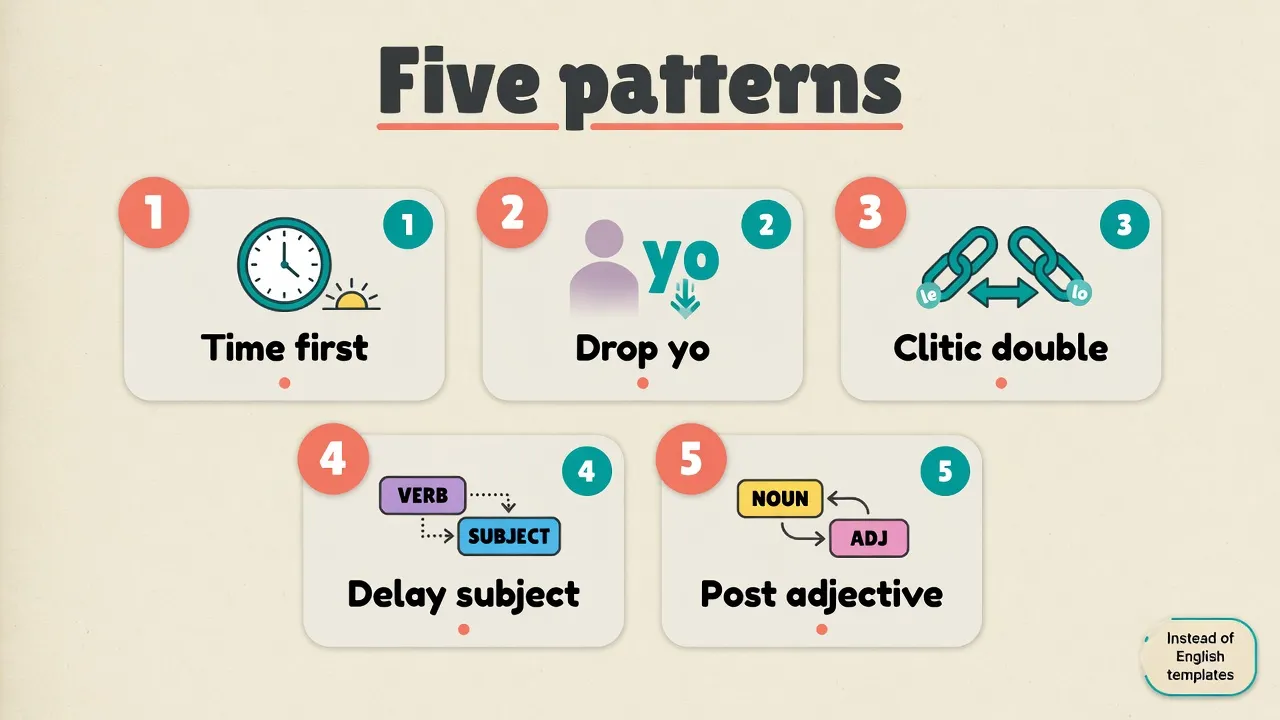
Reading builds long-term feel. These five are production shortcuts you can start noticing and reusing. The goal: freer, more natural Spanish.
| # | Pattern | Instead of (English-like) | Prefer (more natural ES) | Note |
|---|---|---|---|---|
| 1 | Front-load time/place | Yo fui al supermercado ayer. | Ayer fui al supermercado. | Scene before action |
| 2 | Drop subject pronoun most of the time | Yo creo que yo puedo hacerlo. | Creo que puedo hacerlo. | Keep yo for contrast |
| 3 | Clitic doubling when IO is fronted | Dije a mi hermano la verdad. | A mi hermano le dije la verdad. | Redundant le is expected |
| 4 | Delay subject for weight (news/formal) | El presidente anunció la reforma. | Anunció la reforma el presidente. | Common in journalism |
| 5 | Post-nominal adjective as default | Es una interesante historia. | Es una historia interesante. | Pre-nominal often shifts meaning |
Pattern 1: Time and place first
Ayer, mañana, en ese momento, allí set the scene before the action. English often parks time at the end; Spanish loves the front row.
Pattern 2: Drop yo (and friends)
The verb already marks person. Keep the pronoun when you mean "me vs you," not on every line.
Pattern 3: Clitic doubling with a fronted indirect object
When the IO moves forward, Spanish often wants the little pronoun again: A mi hermano le dije la verdad. Object-pronoun order lives here - not in a second 40-rule stack.
Pattern 4: Delayed subject for weight
News and storytelling do this constantly. It is not "books only." Context and style matter; it is a tool, not a party trick for every line.
Pattern 5: Adjective after the noun by default
Safe when you are unsure. Pre-nominal placement is a meaning move (viejo amigo vs amigo viejo), not random decoration.
Why grammar drills alone do not fix word order
Here is the familiar loop: you learn a rule, you do five blanks, you get them right, then a wild sentence freezes you.
The gap is exposure, not only knowledge. Natives feel order; they do not run a checklist while they speak. Children pick up structure from messages they understand - the idea behind Krashen's comprehensible input.
Drills can name a pattern so you know what you noticed. Volume of readable Spanish installs it. That is also why polyglots often prefer massive reading over endless isolated grammar pages: the patterns show up in living context.
How to train Spanish word order by reading (4-week plan)
A practice ladder you can actually finish.
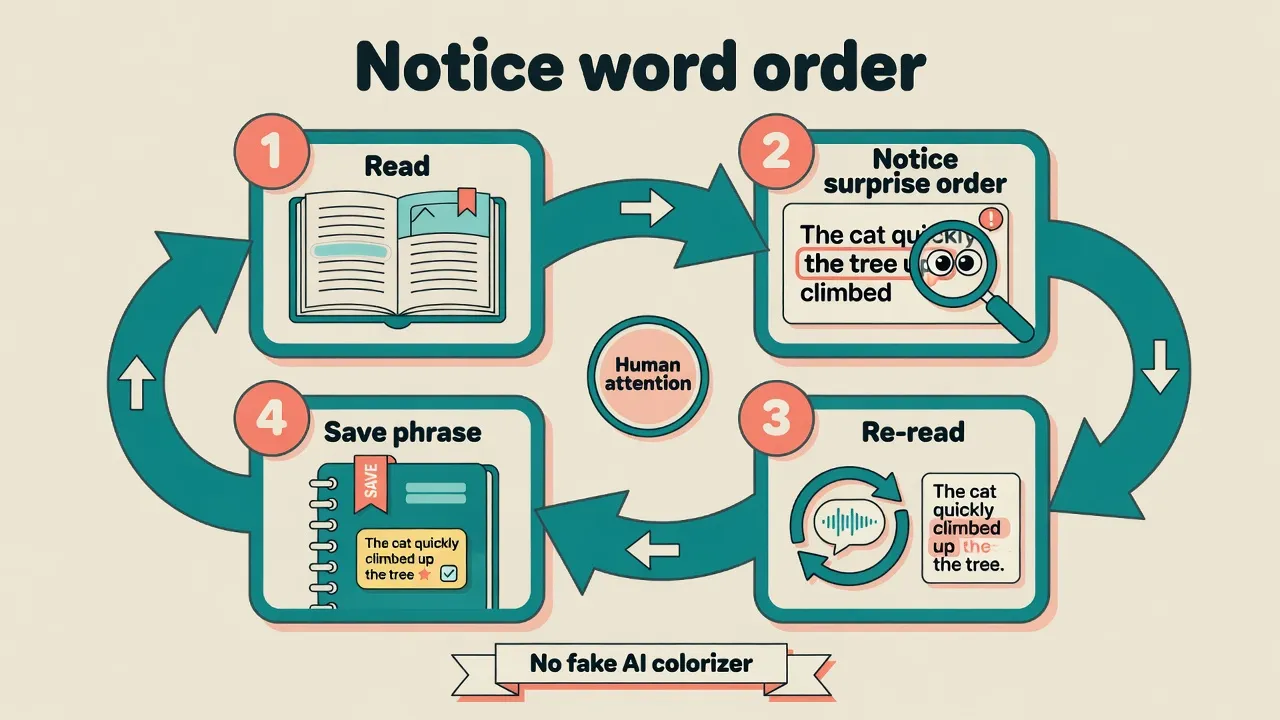
The loop (your attention does the noticing; tools only remove friction):
- Notice a surprising order in a text you mostly understand
- Mark or save the sentence yourself (notes or highlights you make)
- Re-read aloud or rebuild the line (voice, notebook, or a phrase trainer)
- More graded input at the right level
The practice ladder:
| Weeks | Focus | Level | Practice |
|---|---|---|---|
| 1-2 | Short graded stories / A2-B1 articles | Comfort + light stretch (mostly known vocab) | Collect ~5 surprising-order sentences per session when possible |
| 3 | Longer chapter, opinion column, magazine | B1-B2 if ready; do not force Gabo | Count how often subject follows verb in news-ish Spanish |
| 4 | Rebuild collected lines | Stay at the same level | Rebuild aloud or in a trainer; compare to your English default |
For weeks 1-2, short Spanish stories for day one and stories by CEFR level keep the difficulty right. After weeks of noticing, freer order should start to feel less alien - that is progress, not a guarantee.
What MovaReader actually does
MovaReader is a reading app with lookup friction removed. You meet Spanish word order inside graded texts and books you own. You notice surprising order with your own attention.
What exists today:
- A free graded Spanish article library with click-to-translate
- About 20 word translations per day on freemium
- Upload your own legal EPUB/files when you outgrow the library
- We do not host licensed commercial novels by default
- Reader €1/month for unlimited translations
- Pro €5/month for type and phrase trainers so you can rebuild sentences you collected
Simple path for this topic:
- Open graded Spanish you mostly understand - try a sample Spanish A2 article or browse the free library.
- When order surprises you, mark or save the line yourself.
- Translate only blockers (freemium ~20/day; Reader if you want unlimited lookups - see pricing).
- Rebuild collected lines with everyday Spanish phrases practice or free Spanish vocabulary trainer (full trainer set on Pro - trainers hub, phrase bank).
- Read more at the same CEFR band. Grammar grows in context.
If you want the full method stack, read how to learn Spanish by reading. Stop pasting English blueprints; read Spanish with flexible order intact. For how lookup works in the app, see how to use MovaReader.
FAQ
Is Spanish word order free, or still basically SVO?
Default Spanish is still roughly Subject-Verb-Object. It is freer than English when speakers mark topic, focus, or style - not a random free-word salad. Learn the default, then the legal moves.
When should I include yo / tú / él if the verb already shows the subject?
Drop the subject pronoun by default: Hablo español. Keep yo / tú / él for contrast, emphasis, or rare clarity needs (Yo hablo español as "I, not you"). English speakers overuse them; Spanish hears that as heavy.
Why does un amigo viejo mean something different from un viejo amigo?
Placement changes meaning, not decoration. Un amigo viejo leans "elderly friend"; un viejo amigo leans "long-time friend." Same family as pobre (broke vs pitiful). When unsure, put the adjective after the noun.
Can I put the subject after the verb in normal conversation, or only in books?
Not books only. Delayed subjects show up in journalism, storytelling, and speech when context supports them (Anunció la reforma el presidente). Context and style matter; it is a tool, not a party trick for every line.
How do I practice Spanish word order without memorizing 40 rules?
Learn a few named patterns (time first, drop yo, clitic doubling, delay subject, adjective after noun). Notice them in graded Spanish you mostly understand. Mark surprising lines yourself and rebuild a handful - aloud or in a phrase trainer. Object-pronoun order ties to pattern 3 (clitic doubling), not a second rule encyclopedia.
Will reading graded Spanish actually help syntax, or do I need drills only?
Comprehensible reading builds the feel of natural order. Light drills can label a pattern so you know what you noticed. Best loop: name a pattern, meet it in text, rebuild a few real sentences, read more.
Keep the patterns, keep reading
You do not need a new English cage for Spanish. Keep SVO as the default, practice the five moves, and meet freer order in texts you can mostly follow. That is enough to start sounding less like a template and more like a person.
If English rigidity still feels sticky, our post on English word order shows why those templates glue so hard. For another grammar-in-context habit, see por vs para in real sentences. Then open free graded Spanish and notice one rearranged line today.
Keep reading with translations inside the text
With a free account, an unknown word translates with one tap, and the words you are learning wait for you in the trainer.
Free account: 7 days of Pro, then 20 word translations a day or a paid plan.