Reading Strategies
Speed Reading in a Foreign Language: 3 Techniques to Stop Stumbling
Long sentences kill L2 reading speed more often than single hard words. Speed here means fewer stalls per page, not skimming. Three trainables: chunk the skeleton, widen fixation, freeze idioms without spiral lookups.
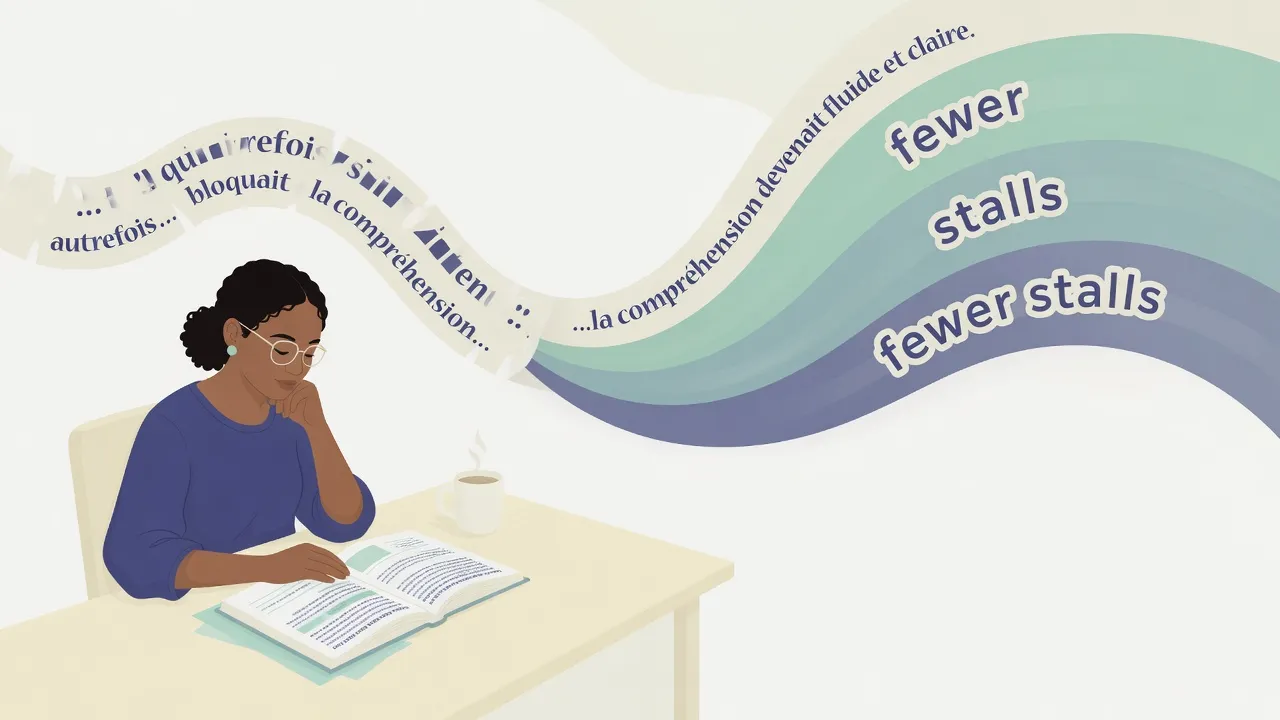
You are deep in a Spanish page (or an English one that still feels foreign), then a long sentence freezes you. You reread it once, twice, three times. By the fourth pass, the chapter mood is gone. You close the tab and tell yourself you are "bad at reading." That story is almost never true.
Here is the plain version. Speed reading in a foreign language is not skimming and not an RSVP gadget race. It means fewer stalls per page while you still understand the story - usually by cutting syntax load and idiom freezes, not only by adding more dictionary words. Train three habits: syntactic chunking (read blocks, find the skeleton), wider fixation (see more per glance on easy text), and an idiom freeze protocol (flag, read past, confirm after the paragraph). Tools can reduce lookup friction.
Below: why L2 pages slow down even when words look easy, three drills you can do by hand, a 30-day path, myths that waste time, tools that help versus tools that only hype, where MovaReader fits if you want graded pages, and FAQ.
Why does L2 reading slow down (even when words look easy)?
The bottleneck is often not raw vocabulary size. It is syntax load: nested clauses, stacked prepositional phrases, and idioms that look like plain words until they do not. You can know almost every item on the line and still need multiple passes because your working memory is hunting the main action.
Consider a famous opening (mostly B1-ish words, heavy structure):
Muchos años después, frente al pelotón de fusilamiento, el coronel Aureliano Buendía había de recordar aquella tarde remota en que su padre lo llevó a conocer el hielo.
Many intermediate readers recognize most of those words and still freeze. The cost is finding the skeleton fast enough: who did what, with which time frame, with which nested clause. Until that job list is clear, the line feels like a wall.
That is what Technique 1 trains. (If you want a deeper walkthrough of long English clauses only - main clause first, strategic slow-down - we keep a separate post for that later in FAQ. This article stays on the full three-technique package.)
Technique 1: Syntactic chunking (read blocks, not atoms)
Native readers group words into phrases without thinking. Learners often crawl word by word. Chunking is the conscious version of that native grouping: you force the line into jobs instead of a bag of tokens.
Break the Márquez sentence into blocks
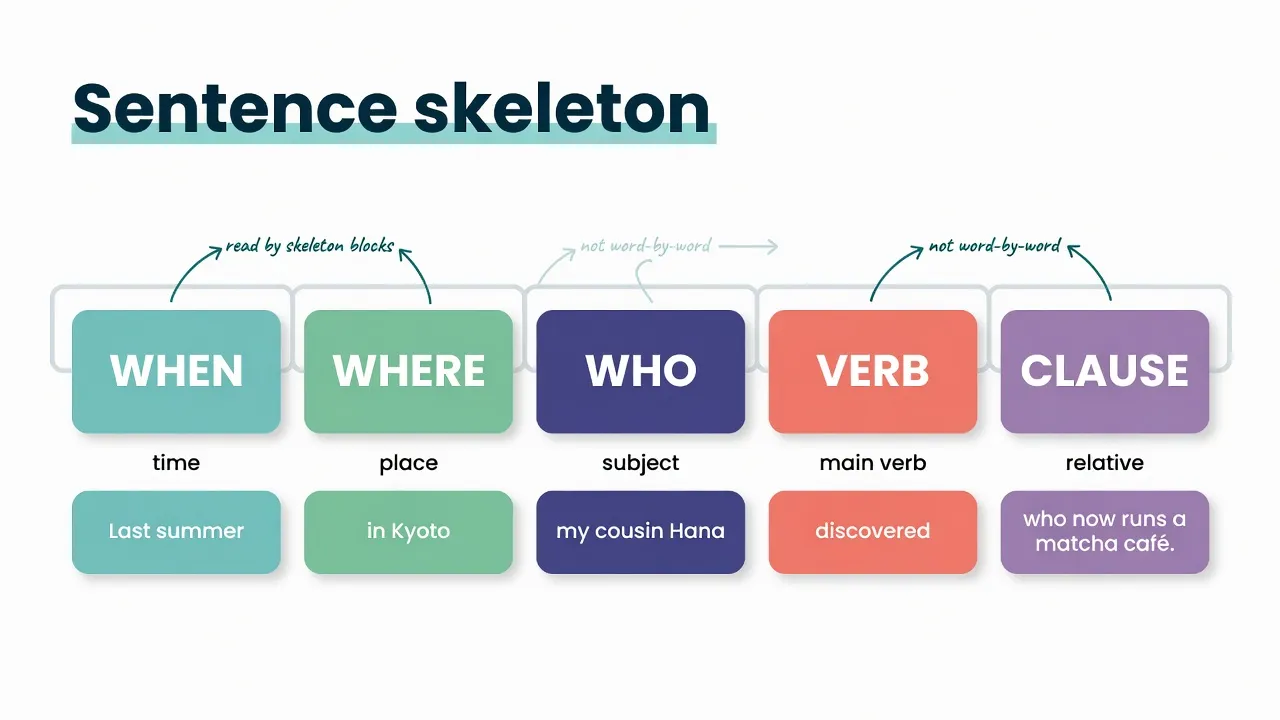
- [Muchos años después] - time frame
- [frente al pelotón de fusilamiento] - place / situation
- [el coronel Aureliano Buendía] - subject
- [había de recordar] - main verb idea
- [aquella tarde remota] - object of memory
- [en que su padre lo llevó a conocer el hielo] - relative clause
A wall of text becomes a short list of jobs: when, where, who, did what, about what, extra detail. Once you see those jobs, rereading drops because you already know what the sentence is doing.
Here is the same idea as a skeleton board - long line broken into labeled blocks:
If that opening made you curious about which Márquez book to try first later, we have a separate ladder post - but for speed training, any right-level page with long sentences works better than prestige novels you cannot finish.
3-step chunking drill
- Find the main conjugated verb (or verb chain). Everything else orbits it.
- Bracket prepositional phrases (de, en, con, por, para, frente a... and the English cousins in, on, with, for, despite...).
- Isolate relative or subordinate clauses (que, quien, donde, cuando, aunque... / that, who, where, when, although...).
Do this on 5-10 hard sentences a day for about two weeks. At first it is slow on purpose. The goal is a mental habit, not a stopwatch score. After a while, the brackets become quieter; you start "seeing" the skeleton without drawing it every time.
Paper version works fine
You do not need special UI. In a notebook:
- Copy one long sentence.
- Draw slashes between chunks.
- Underline subject + main verb.
- Only then translate blockers.
Mental notes first. If you use a reader app later, tap only the words that still break the clause - not every decorative adjective. Chunking is structure work; translation is support, not the whole method.
Technique 2: Wider fixation (see more per glance)
Slow L2 readers often fixate on one or two words at a time. Each eye jump costs time and attention. Widening what you take in per glance can reduce those jumps - on text that is already near your level.
This is eye and attention training, not a promise of "double speed in 7 days." If the page is full of unknown words, wider fixation only makes you miss more. Fix level first, then train span.
Pyramid / center-line drill
- Open a page at your level (not your hardest novel).
- Soft-focus near the center of a short line.
- Try to absorb the line with fewer left-right jumps.
- Start with short lines; widen only when comprehension stays acceptable.
Think of it as gently expanding the window you trust, not forcing your eyes to sprint. If meaning collapses, narrow again. That is training, not failure.
Digital layout helps training
On paper, line width is fixed. In a digital reader, you can temporarily use a narrower measure so each line holds fewer words, then widen as comfort grows.
Use that as a temporary drill mode. Do not force ultra-wide lines while you still need heavy lookup on every line. Layout supports the habit; it does not replace chunking when syntax is dense.
Technique 3: Idiom freeze protocol
You know every word in tomar el pelo and the literal sense is nonsense. Or you hit break the ice and your brain starts assembling furniture. Speed collapses while you force a word-by-word parse of a multi-word unit that never meant the sum of its parts.
There is no tool that "decodes every idiom for you." What you can train is a calm protocol so freezes do not eat the whole chapter.
Here are all three techniques on one board before we go deep on the protocol:
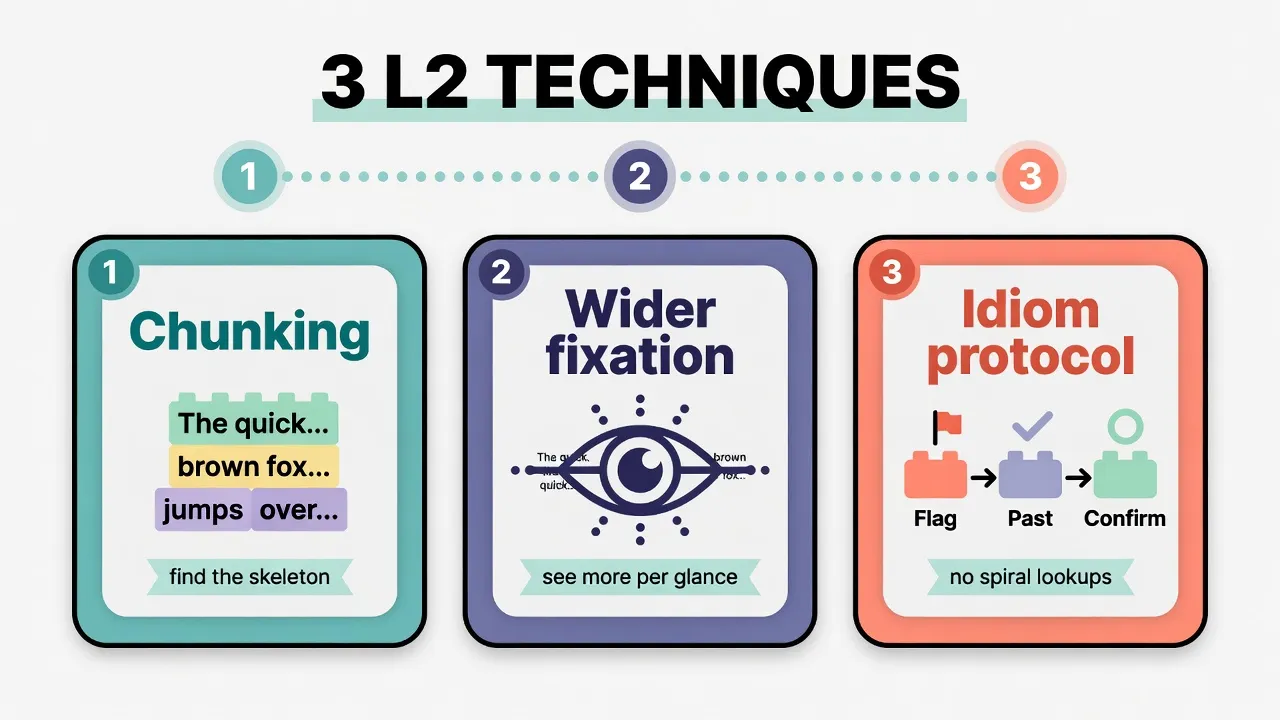
Three-step protocol
- Flag the freeze. Sudden stall + known words + weird literal meaning = possible idiom or collocation.
- Read past it for 1-2 more clauses. Guess function from plot or emotion (joke? insult? delay? softener?).
- Confirm after the paragraph. Look up the whole phrase once, save it if high-value, move on.
This is faster than a sixty-second spiral on every opaque phrase, and better for memory than never checking. Context first, clean lookup second.
What not to do
- Do not build a huge idiom flashcard mountain before reading.
- Do not stop the whole chapter for every figurative phrase.
- Do not trust literal machine translation of multi-word expressions without context.
If you save phrases at all, keep a tiny high-value list - about 5-10 multi-word items a week max - and reuse them. Exposure plus reuse beats panic lists.
A 30-day practice plan
One skill layer at a time. Smoother pages beat marketing percentages. Pick text near your comfort band (the five-finger rule is a rough compass if you need a quick level check). Prestige novels far above your level make a terrible gym for these drills.
| Phase | Days | Focus | Session shape | Realistic goal |
|---|---|---|---|---|
| Chunking base | 1-10 | Slash-chunk long stalls | ~15 min at ~80-90% comfort | Fewer full-sentence restarts |
| Add fixation | 11-20 | Center-line on easy text | 5 min drill + 10-15 min reading | Slightly fewer eye jumps; comprehension holds |
| Idiom protocol | 21-30 | Flag → past → confirm | Contemporary prose / news-like text | Less panic spiral; tiny phrase list 5-10/week max |
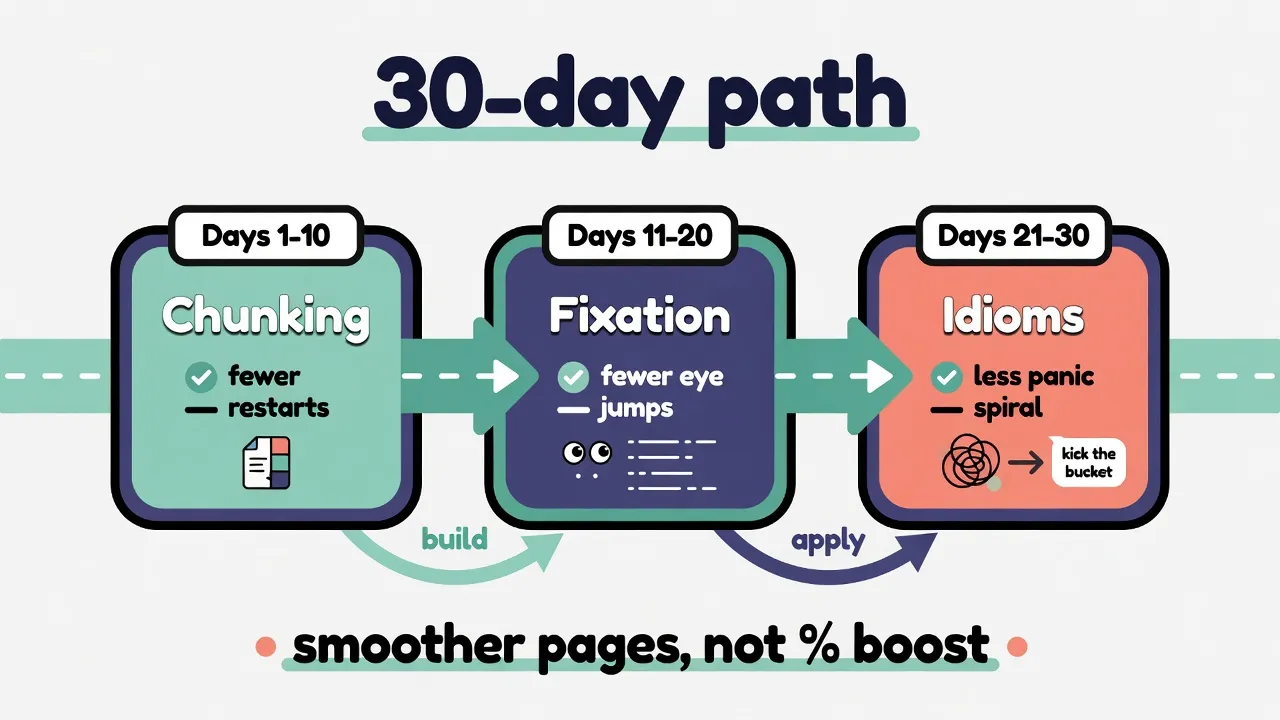
Days 1-10, in practice: Read about fifteen minutes at a level where you already understand most of the page. When a sentence longer than about 15-18 words confuses you, slash-chunk it. Do not chase a claimed percent boost. Chase fewer full restarts.
Days 11-20: Add five minutes of center-line practice on easy text, then normal reading with chunking as needed. Widen line length only if comprehension still holds.
Days 21-30: Prefer contemporary prose or news-like text with more collocations. Use flag → skip briefly → confirm later. Keep that tiny multi-word list small and reusable.
Expected result if you stay consistent: smoother pages, less panic on long syntax, better confidence. Exact "faster by X%" claims are marketing noise unless you time your texts yourself. Some days will still feel sticky. That is normal.
Myths that waste L2 readers' time
L1 speed-contest tips often hurt language learners. Flip these three before you waste a month on the wrong target.
Myth 1: "Kill subvocalization"
For native-language speed contests, people debate inner speech. For language learning, quiet inner voice often helps map print to sound. Do not suppress it aggressively. If audio exists for a text, listen after you can follow the written page - support, not a replacement for seeing structure.
Myth 2: "Understand every word"
For extensive reading, aim for high overall comprehension. Unknowns are normal. Look up blockers (words that break the clause), not every decorative adjective. If you want the intensive/extensive split in more detail for Spanish, we have a separate post on intensive vs extensive reading. Here, the rule of thumb is simple: blocker lookups only while you train flow.
Myth 3: "Speed reading = skimming"
Skimming samples. Speed skill means reading the line with better grouping and fewer stalls. If you skip half the meaning, you are not training reading; you are sampling. Keep comprehension as the floor. Efficiency sits on top of that floor - it does not replace it.
Tools: what helps vs what is hype
Tools matter when they cut friction. They fail when they replace structure work.
| Approach | Helps when | Fails when |
|---|---|---|
| Paper dictionary | Deep study of a few words | Every lookup kills flow |
| Full-sentence machine translate | Emergency gist | You never see L2 structure |
| Flashcards only | Isolated words | Syntax and idioms stay weak |
| Manual chunking + selective lookup | Real pages at the right level | Text is far above your level |
| Reader app with tap translate | Fast blockers, keep context | You tap every word and never reassemble |
If tap-translate keeps you in the page, good - still do the skeleton work by hand when a sentence freezes you. The tool is for friction. The habit is still yours.
How MovaReader fits
MovaReader is a reading product with translation support and trainers. It helps you keep flow on graded pages: click-to-translate blockers, optional listening, and later phrase/type trainers for saved chunks.
What it offers:
- Free graded library + click-to-translate
- Upload EPUB / files you own
- Freemium: about ~20 word translations/day; listening often free
- Reader (€1) - unlimited translations for real page volume
- Pro (€5/mo) - full trainers
| Need | Realistic plan |
|---|---|
| Test habit + blocker discipline | Freemium (~20 word translations/day; listening often free) |
| Daily page volume without constant flow breaks | Reader €1 |
| Phrase / type trainers for saved chunks | Pro €5/mo |
Free graded texts are the natural start. Longer books you own can be uploaded.
First 15-minute session (step by step)
Make tomorrow small enough that you return.
- Choose easy-interest text, not your prestige white whale. Try a Spanish A2 sample or a Spanish A1 sample. Browse more in All articles.
- Note start position and set a 15-minute timer.
- Read for meaning first.
- On each freeze: main verb → brackets → continue.
- Lookup budget: blockers only (tap if you use the app; notebook if you prefer paper).
- End: write one sentence about what happened + list 3 chunks or phrases that mattered.
- Tomorrow: same length, slightly fewer restarts if the level is right. If not, drop difficulty.
Train a few saved phrases later if you like: type demo, phrase demo. Details live on Pricing and How to use.
Do the work on the page. Use tools for friction, not fantasy autopilot.
FAQ
Can beginners speed-read in a foreign language?
They can train efficiency - less thrashing on easy pages. True high speed needs enough vocabulary and pattern knowledge. Start with graded texts near your level, not prestige novels. Chunk short sentences first; save fixation drills for text you already mostly understand. If you are still choosing first reading steps, how to start reading in English is a gentle companion path.
Should I time WPM every day?
Optional. A weekly check (pages finished in a fixed time, or minutes for a known stretch) is enough. Obsessive daily WPM tracking often kills enjoyment and pushes skimming. Prefer fewer restarts and smoother mood as the main signal.
Is chunking the same as translation?
No. Chunking is structure grouping - who did what, with which modifiers. Translation is meaning support for blockers. Do structure first (main verb, brackets, subordinates), then look up only what still breaks the clause.
What about German or French long sentences?
Same skeleton habit transfers: find the main verb early, bracket modifiers, isolate subordinates. Languages differ; the "find the skeleton" drill still helps. Practice examples on this site stay Spanish and English as L2. For a deeper English complex-clause walkthrough (main-clause first and long clause patterns), see complex sentence reading techniques.
Do I need special fonts or RSVP apps?
Not required. Level-matched text + syntactic chunking + selective lookup beats gadget hopping. Wider fixation is a simple attention drill on ordinary lines - temporary narrow layout can help training, but fonts and RSVP apps are optional toys, not the method.
How do idioms ever stop being freezes?
Exposure + phrase saving + reuse. One clean lookup after you have paragraph context beats ten panicked literal parses. Keep a tiny high-value list (about 5-10 multi-word items a week max), not a mountain of idioms before you read.
Final takeaway
Long L2 sentences feel like walls until you treat them as jobs in order: main verb, chunks, then details. Wider fixation reduces eye thrash on easy text. A simple idiom protocol stops literal-translation death spirals.
Tools cut friction. They do not replace the habit. Start with one free graded article, slash-chunk five hard sentences, and keep tomorrow's session short enough that you actually return. The win is not a fantasy speed number. The win is a page that still feels like a story.
Keep reading with translations inside the text
With a free account, an unknown word translates with one tap, and the words you are learning wait for you in the trainer.
Free account: 7 days of Pro, then 20 word translations a day or a paid plan.