Vocabulary Tips
How to Stop Translating in Your Head and Start Thinking in Your Target Language
Translation is a beginner scaffold, not a life sentence. Use four stages, five exercises, extensive reading, and a 30-day plan so your first language steps in less often.

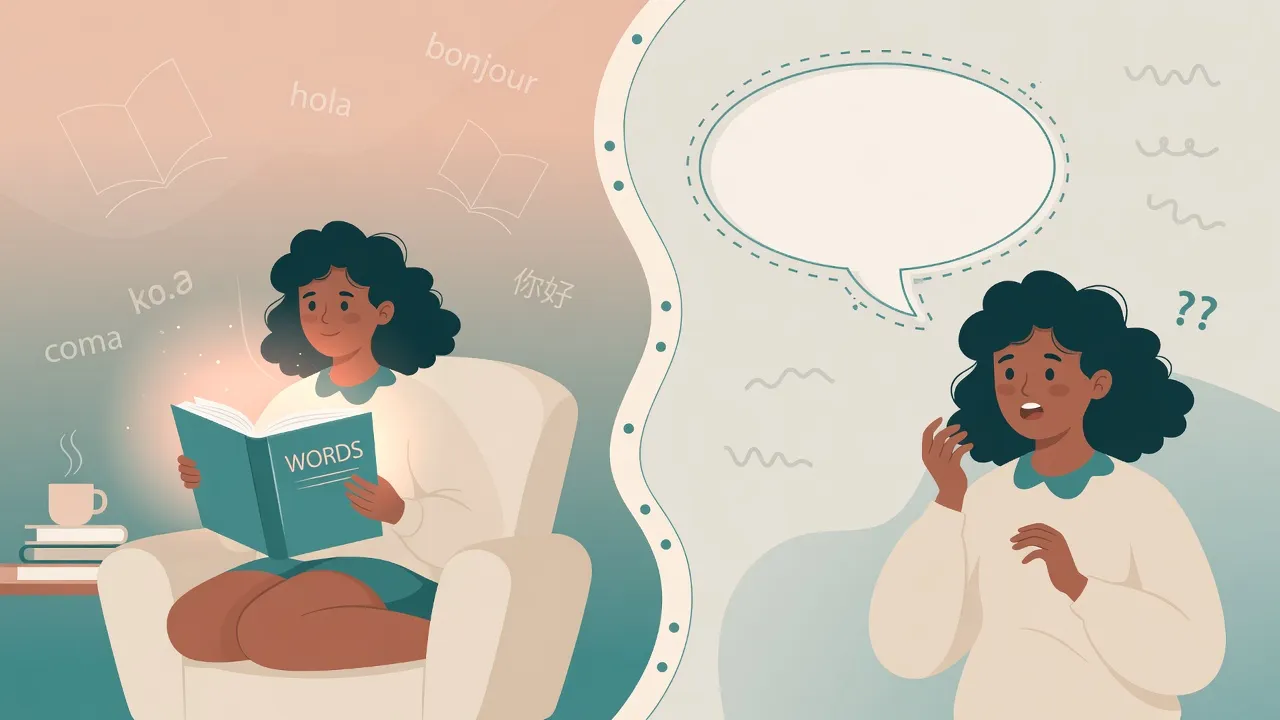
You read Spanish and hit madrugada. Your brain routes: madrugada → "early morning / dawn" → meaning → continue. Every sentence pays a toll in English.
That loop is normal early on. Later it becomes a bottleneck: slow reading, tired conversations, and the sense that the language never quite becomes yours.
Here is the plain answer. Mental translation is a beginner scaffold, not a life sentence. You will not flip a pure-L2 switch overnight. You can train more direct links between situations and target-language words so your first language shows up less often and with less authority. The path is stages (not shame), five small exercises, easy reading that multiplies concept↔L2 encounters, and a 30-day plan with a soft success metric: L1 interrupts less during reading and simple self-talk.
If conversation lag is your main pain (hear → rebuild in L1 → answer late), the companion guide how to stop translating in your head walks five practical steps for speech. This article is the stages path: how thinking in L2 grows over time, what to practice, and how reading rewires the loop.
Why brains default to translation
At the start, your first language is the only reliable meaning system you have. Research in the bilingual-memory tradition (including work associated with Kroll and colleagues on linked L1/L2 lexicons) describes a gradual shift: beginners lean on L1 mediation; with more contact, stronger direct concept↔L2 links grow. No miracle percentages required - the useful idea is simple.
Beginner path: L2 form → L1 word → meaning
More advanced path: L2 form → meaning (L1 optional, not mandatory)
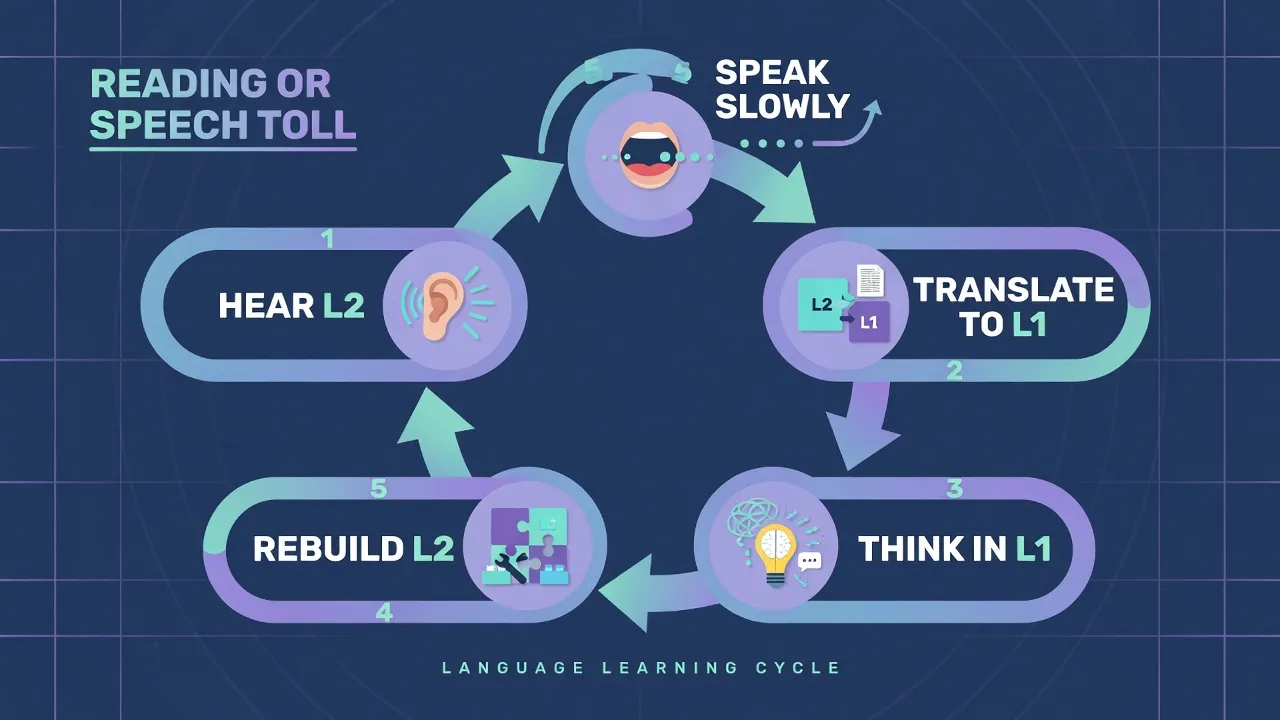
In conversation, double processing often feels like this:
- Hear L2
- Translate to English (or your L1)
- Think the answer in L1
- Translate back to L2
- Speak
Fluent speakers compress that chain. Your job is not to demolish the toll booth on day one. It is to visit it less as the L2 network grows.
Here is the double-processing loop that keeps the English (or L1) toll booth busy:
Reading has a quieter version of the same tax. You decode each word, park meaning in L1, then rebuild the scene. It works. It also burns attention you could spend on the story.
L1 path vs more direct path
Two routes to the same meaning. One is slower and safer early on. The other feels "native-ish" in domains you practice.
| Path | What happens | Cost | When useful |
|---|---|---|---|
| L1-mediated | L2 form → L1 word → meaning → (optional) rebuild L2 | Slow; lag in talk and reading | A1-A2; rare jargon; emergency rescue |
| More direct | L2 form / situation → meaning or ready phrase | Faster; freer in practiced topics | After enough easy input and phrases |
Side by side, the bridge and the direct path look like this:
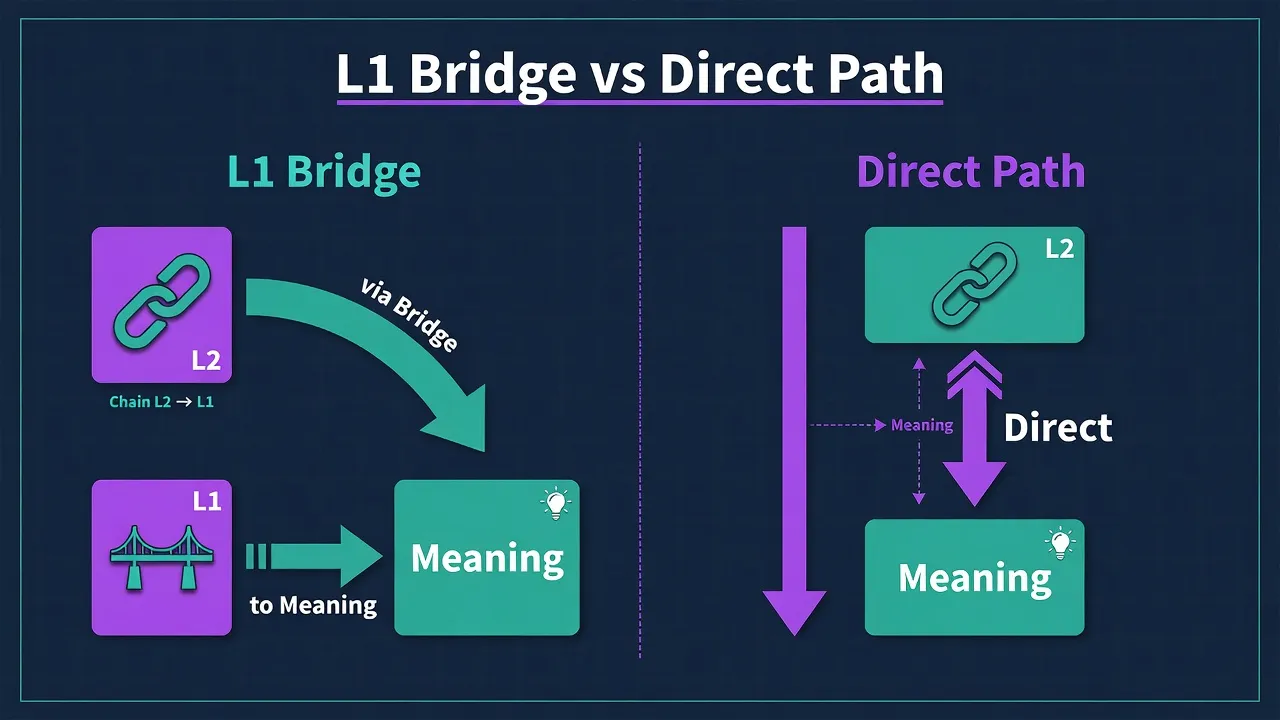
Neither path is a moral grade. The L1 bridge is a tool. The problem starts when it stays the only road for months after you have enough easy input to build another one.
Monolingual habits beat pure bilingual flashcards (with nuance)
Every time you only ever see:
madrugada = dawn
you strengthen the translation highway. Sometimes that is fine - especially at A1-A2, when monolingual definitions are still noise.
A stronger long-term habit:
madrugada → las primeras horas del día, antes de que salga el sol
or a personal L2 paraphrase: muy temprano, casi de noche todavía.
Nuance: forced monolingual dictionaries harder than the text can backfire. Use simple L2 paraphrases, example sentences, pictures, or situation memory - not a second impossible text. The goal is another route to meaning, not purity theatre.
Four stages (expect overlap)
Think of stages as overlapping skill bands, not a ladder of shame. You can feel Stage 3 in reading and Stage 1 under stress when speaking. That is normal.
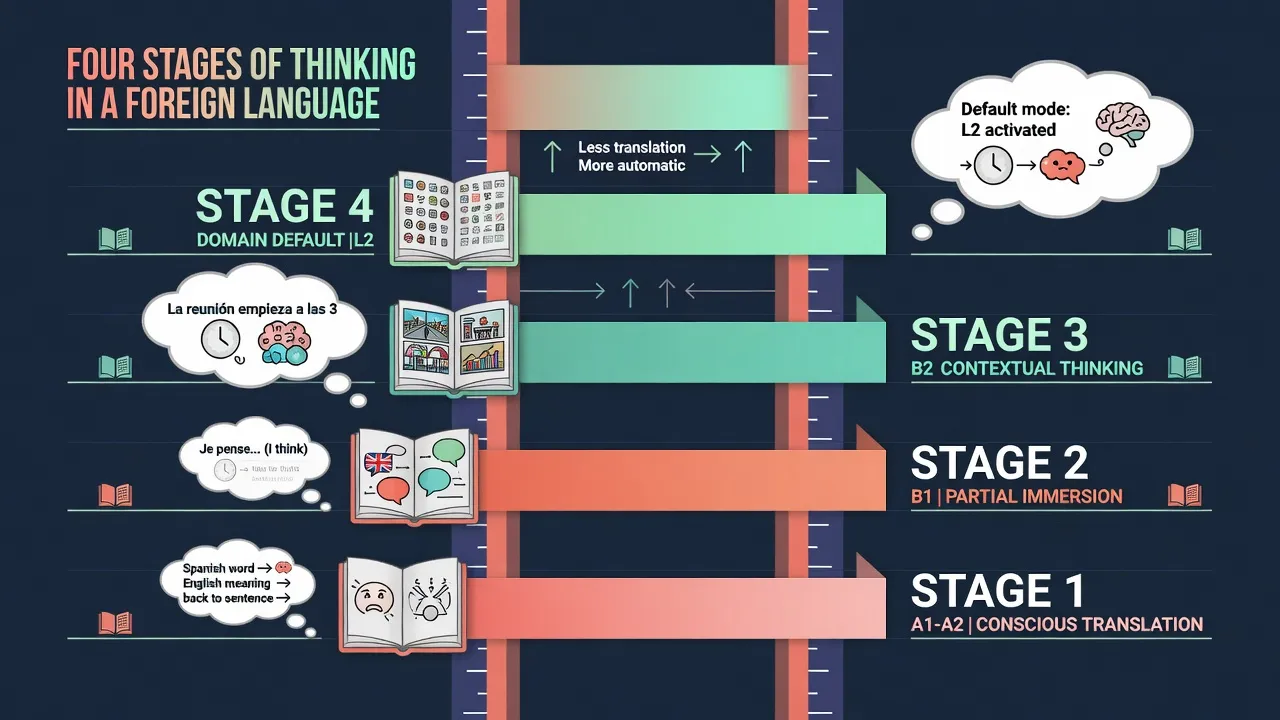
Stage 1: Conscious translation (A1-A2)
You translate a lot. Normal.
Do: easy extensive input; when you look something up, skim any simple L2 example if it is available; start labeling objects: puerta, ventana, agua.
Stage 2: Partial immersion (B1)
Common words feel direct; complex ones still detour through L1.
Do: longer reading sessions; guess from context before lookup; narrate easy routines in L2 (Now I make coffee).
Stage 3: Contextual thinking (B2)
Reading and listening often stay in L2; stress or live speech pulls you back to L1.
Do: inner monologue timers; short journal entries; talk about the text you just read without drafting an English script first.
Stage 4: Default in domain (C1-ish in topics you live in)
L2 is default for many everyday and professional topics you practice. Translation still appears for rare jargon - that is fine.
Do: keep volume high in the domains you care about; stop treating residual translation as failure.
Stage numbers are a compass, not a verdict. A language map can help you see which bands and domains you already touch.
Five exercises that move the needle
These are small on purpose. Daily micro-practice beats a heroic weekend of "think only in Spanish forever."
1. Label your world
Name what you see in L2. If you lack a word, describe around it: la cosa para escribir before you learn bolígrafo. Description practice is thinking practice.
2. Five-minute monologue switch
Timer on. Thoughts in L2 only. When stuck, stay in L2 with simpler words. Do not pause to build a perfect L1 sentence first if you can help it.
3. Guess-first reading
Read a full sentence before any dictionary. Form a rough meaning. Verify only blockers. That trains tolerance for uncertainty - required for direct thinking. For the full field guide, see contextual guessing.
Free practice:
4. Tiny L2 journal
Three to eight sentences about your day. Ugly grammar allowed. Goal: stay in the language long enough to form a chain of thoughts, not a polished essay.
5. Shadow or read aloud short chunks
After you understand a paragraph, say it. Sound and meaning together reduce the need to park everything in L1 first. If audio exists for a text, use it after the page is somewhat clear.
Pick two exercises this week. Run them on easy material. Hard texts plus hard exercises is how people quit.
How reading rewires the loop faster than phrasebook drills
Extensive reading multiplies concept↔L2 encounters in a way isolated cards rarely match:
- same word in new situations
- grammar patterns as feeling, not only rules
- less time spent building each sentence from L1 Legos
Comprehensible input (easy enough that you mostly understand) is a difficulty rule of thumb here. Pages you finish beat pages you translate into a parallel English novel in your head.
The rewire is not magic. It is frequency. When madrugada shows up in three different scenes, your brain stops needing the English layover every time. For level fit, the 5-finger rule keeps books readable. For building usable words from pages, see vocabulary for reading comprehension and how to start reading in English.
Where MovaReader helps
Useful behaviors the product supports:
- Stay on the page with click-to-translate instead of app-hopping (app-hopping almost always yanks you into an L1 UI)
- Practice on free graded texts before harder books
- Upload an EPUB you own for longer immersion (How to use)
- Turn saved phrases into active drills on Trainers and Phrases
Demos: type training, phrase typing.
Plans (Pricing):
- Free plan: free graded library + listening, about 20 word translations per day
- Reader (€1): unlimited word translations
- Pro (€5/mo): full trainers
MovaReader does not host commercial novels in the app.
Practical monolingual-leaning workflow in-app:
- Read the sentence
- Guess
- If needed, tap the blocker
- Re-read the sentence in L2 immediately
- Save the phrase, not only the bare word
- Later, type or speak the phrase without looking at L1 first
If a translation appears in your first language, treat it as a quick checkpoint, then return your eyes to the L2 sentence for a full re-read. That re-read is the training rep many people skip. Reading builds direct links. It does not replace live speaking when you need speech skill.
Common mistakes that keep the L1 toll booth open
- Only bilingual cards, forever. Mine phrases from reading instead of infinite isolated pairs.
- Narrating grammar rules in L1 mid-sentence. Notice patterns in text; check a short reference later.
- Instant lookup every time. Steal 10-20 seconds for context first.
- Only easy texts forever - or only prestige texts forever. Comfort is good for flow days; growth needs some unresolved edges. Prestige books alone can stall flow.
- All input, zero output. Direct thinking strengthens when you must produce under a timer.
None of these make you a bad learner. They just keep the booth collecting tolls longer than it needs to.
30-day challenge (minimum viable)
A month will not install pure L2 thought. It can make the scaffold quieter if you show up on most days.
| Week | Focus |
|---|---|
| 1 | 15 min/day reading; guess-first; label 15 objects/day |
| 2 | Add 5 min monologue; 3 journal sentences 4 days/week |
| 3 | Phone UI in L2 if tolerable; type 10 saved phrases (demo) |
| 4 | One 30-60 min block of "L2 first" during chores + reading; note when L1 still hijacks |
Success metric is not silence of your first language forever. Success is: L1 interrupts less during reading and simple self-talk.
Track one observation each week: "During today's pages, did I reach for English less often on common words?" That is enough data. No need for a spreadsheet of purity scores.
FAQ
Is mental translation always bad?
No. It is a scaffold. It becomes a problem when it is the only path and never weakens.
Can beginners avoid translation completely?
Usually not, and forcing it can stall comprehension. Reduce it gradually with easy input and labeling.
Do I need a full immersion country?
No. Immersion helps, but deliberate L2 reading, self-talk, and media can move the same mechanisms more slowly.
Should I ban my native language in the app?
Not as a purity test. Use L1 glosses as brief checks, then re-process in L2. The re-read matters.
How long until I "think" in L2?
Topic-dependent. You may think in L2 about coffee and the calendar long before philosophy or legal nuance. That is expected.
Does speaking with natives fix this automatically?
It helps a lot under pressure. Combined with massive reading, it works better than either alone for many learners.
Final takeaway
Stopping translation is less about willpower and more about representation: enough rich L2 contact that meaning does not need an L1 layover every time.
Shrink the toll booth. Do not try to demolish it in a week.
Start with one page today - try a free graded article - and run a single rule: finish the sentence, guess, verify only if needed, re-read in the target language. Repeat until English (or your L1) becomes a backup generator, not the main power grid.
Keep reading with translations inside the text
With a free account, an unknown word translates with one tap, and the words you are learning wait for you in the trainer.
Free account: 7 days of Pro, then 20 word translations a day or a paid plan.