Vocabulary Tips
The Vocabulary Blind Spot: Check Your Real Level (Not Your Vibes)
You can feel advanced while still missing the words that carry precision. Here is how a vocabulary blind spot forms, a 60-second self-audit on real prose, and a calm plan to make gaps visible.
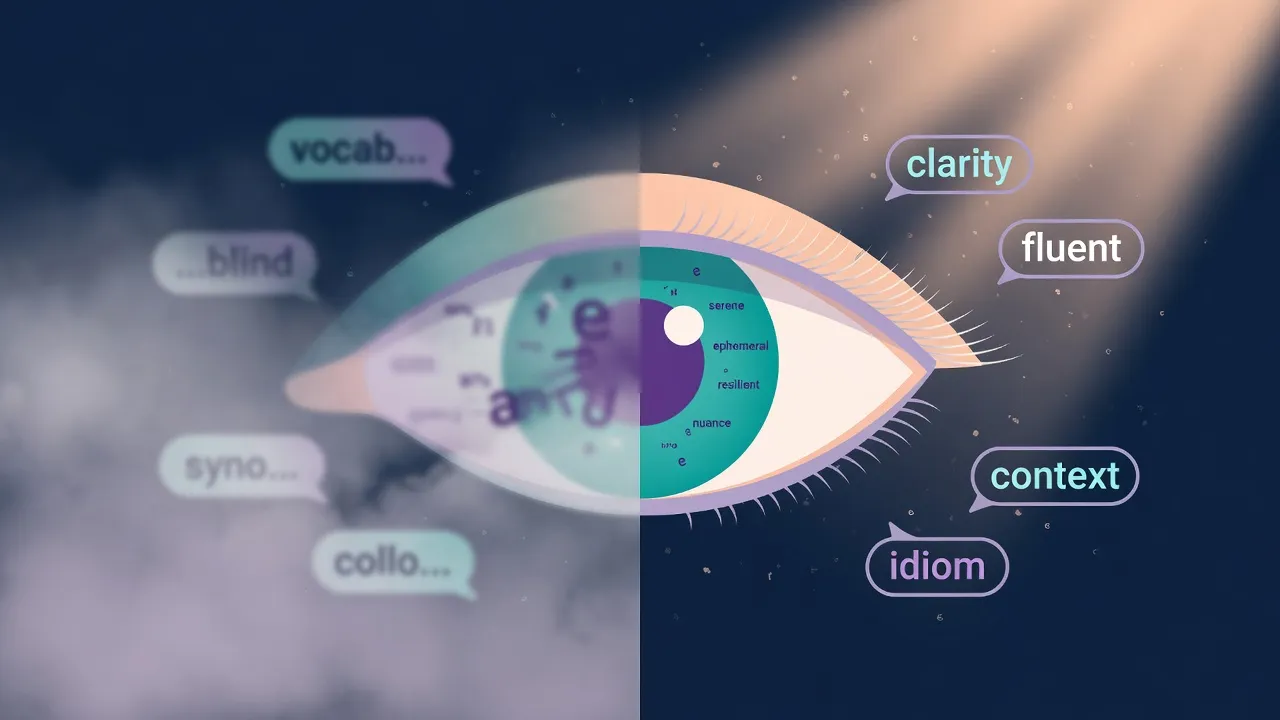
You have been studying for months, maybe years. Apps feel friendly. Everyday chat kind of works. Then you open a real news piece, a work email, or a novel chapter, and precision falls apart. You still catch the story. You just cannot swear you knew the words that carried it.
That gap is a vocabulary blind spot. Context and confidence fill holes so well that unknown words stay quiet. You feel advanced; the page still has fog.
Here is the simple fix. Stop trusting vibes. Ruthlessly count unknowns on authentic prose. Compare a soft frequent-lemma orientation band (same idea as the free language map). Grow the mid-frequency stretch through reading you actually finish. A 60-second check is a self-audit, not an official level test.
This post is about perception, measurement, and a plan. Pure word-count deep-dives live next door: How many words for B2? and How many words for CEFR?. Examples below use Spanish legal and news lines because they show precision gaps clearly. The method works for English (and other targets) the same way: swap the paragraph for your language.
Why you misread your vocabulary
At beginner level, unknown words scream. You pause. You look them up. You feel the friction.
After roughly B1 comfort, something quieter happens. Your brain gets good at gist. You nod along. You finish the paragraph. You tell yourself "I understood that." Often you did understand the plot. You did not always process every precise word.
That is the illusion. Gist is useful. Gist also hides the inventory problem. If the sentence still makes sense, the missing pieces never light up as missing.
You do not need a lab study to trust this pattern. You only need one simple experiment: take a paragraph you "understood," then mark every word you would not defend next week. Most intermediate readers find more fog than their vibes suggested.
Here is a Spanish legal-style line that exposes the trap:
"El abogado presentó una demanda ante el tribunal por incumplimiento del contrato, alegando que la cláusula de rescisión había sido vulnerada."
If you are around solid B1, you may catch abogado, contrato, maybe tribunal. What about incumplimiento (breach), rescisión (termination), vulnerada (violated)? Those are not tourist words. They are the ones that decide whether you understood a claim or only the shape of a claim.
The problem is not intelligence. It is visibility. You cannot improve what never becomes a mark on the page.
How perceived fluency and real unknown density can split:
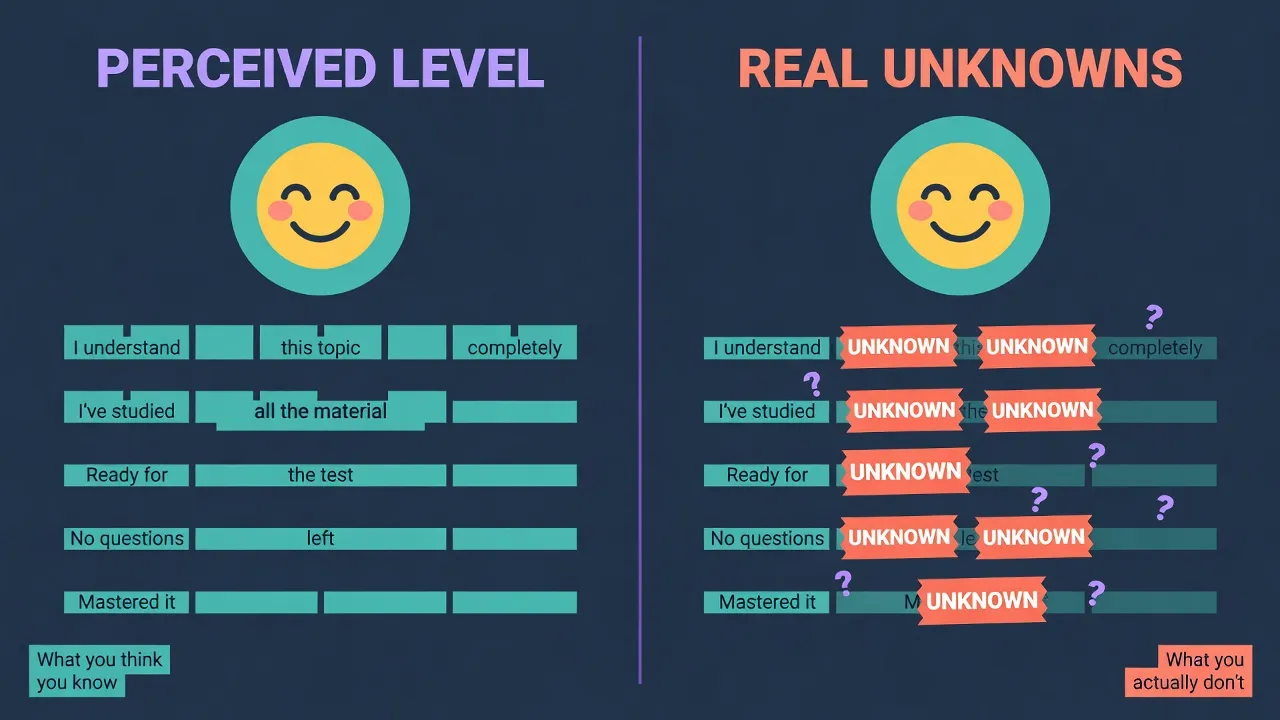
Same paragraph, two stories: the vibe vs the marks.
Receptive vs productive (both matter, they are not equal)
Recognition and production are different muscles. Confusing them is how list scores feel "B2" while speaking still stalls.
| Kind | What it means | Typical risk |
|---|---|---|
| Receptive | You recognize the word in text or speech | Overconfidence from lists and multiple choice |
| Productive | You can retrieve it when speaking or writing | Smaller set; lags under pressure |
Receptive vocabulary is usually larger. That is normal. It becomes a problem when you treat recognition as proof of full control. Map marks can overstate speaking ability if you only mark passive "I've seen this."
A short split diagram:
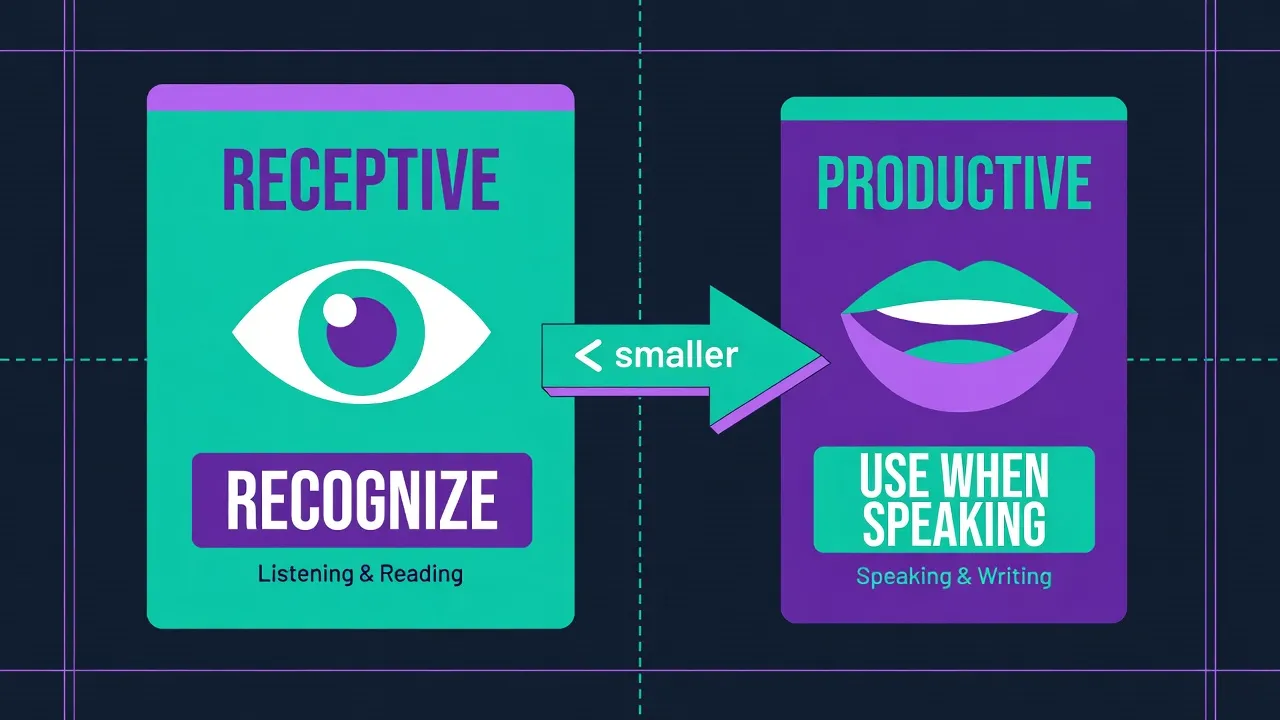
You can know a word on a page and still fail to find it in a meeting.
For reading goals, strong recognition is already huge progress. For full B2 "can-do" claims (listen, speak, write, interact), you still need more than a green list. More on reading coverage: Vocabulary for reading comprehension.
A soft CEFR ladder (map-aligned, not law)
CEFR does not publish an official word quota. Still, learners need a compass. Research-informed tools and MovaReader's public language map use a frequent-lemma orientation scale. Treat the bands as road signs for common headwords, not as certificates.
| Level | Orientation (frequent lemmas) | Rough feel |
|---|---|---|
| A1 | up to ~1,500 | Short graded; heavy support |
| A2 | ~1,500-2,500 | Simple stories, menus, routine |
| B1 | ~2,500-3,250 | Independent short texts on familiar topics |
| B2 | ~3,250-3,750 | Many modern non-literary texts; novels still vary |
| C1 | ~3,750-4,500 | Wide authentic range; style friction left |
| C2 | ~4,500-5,000+ | Late band; no magic "done" |
Caveats in plain language:
- Lemma is not the same as word form or word family. Unit wars explain why blogs disagree.
- Productive stock is usually below receptive stock.
- Hitting a band on a list is not the same as multi-skill exam performance.
Full ladder and how units are counted: How many words for CEFR?. B2 deep-dive: How many words for B2?. Myth check on late totals: Does 5,000 words mean C2?.
The ladder as a simple visual:
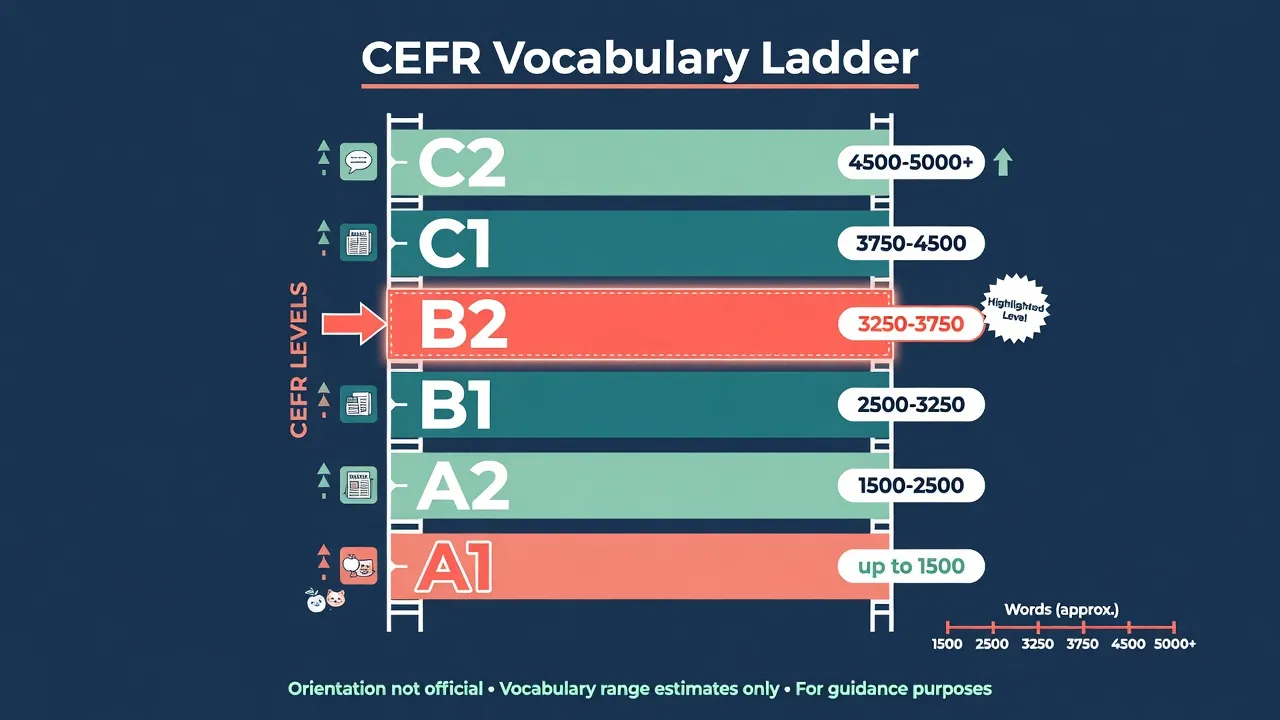
Orientation bands, same spine as the free language map.
The 60-second vocabulary reality check
This is a ruthless self-audit on one text type. It is not an official level test.
How:
- Pick a short authentic paragraph in your target language (news, work blog, book page).
- Read once for gist. Do not look anything up yet.
- Read again and mark every word you are even slightly unsure about.
- Count the marks. Be mean to yourself on purpose.
Here is a Spanish news-style sample (keep it if Spanish is your target; otherwise paste your own English paragraph from a paper you care about):
"La economía española experimentó un crecimiento del 2,3% durante el último trimestre, impulsada por la recuperación del sector turístico y el aumento de las exportaciones. Sin embargo, los analistas advierten que la inflación subyacente podría erosionar las ganancias a medio plazo, especialmente si el Banco Central Europeo mantiene su política de tipos de interés restrictiva. Los sindicatos, por su parte, reclaman una subida salarial que compense la pérdida de poder adquisitivo acumulada desde 2022."
Rough scoring for this kind of prose only:
| Unknown count (ruthless) | Rough reading feel |
|---|---|
| 0-2 | Strong on this domain and text type |
| 3-5 | Upper-intermediate stretch; close on familiar topics |
| 6-10 | Solid intermediate; gist OK, precision leaks |
| 10+ | Step difficulty down or add more support |
What this is not:
- Not a B2 pass/fail badge
- Not a full vocabulary-size estimate
- Not proof across listening, speaking, and writing
- Not transferable from one domain to every domain (legal vs sports vs fiction differ)
If you want a calmer English-focused check protocol, see How to check your English vocabulary size for B2. If a page feels too hard, the 5-finger rule helps pick level. Guess-first before you click: Contextual guessing.
Why the mid-frequency stretch is hard
High-frequency words build everyday comfort fast. That is why early progress feels steep. Then you hit the stretch that lives in news, work writing, and novels: mid-frequency precision words. They appear less often in apps. They matter more for nuance.
In English you can chat without mitigate, stakeholder, or pursuant. Try a serious article without them.
Spanish has the same cliff. One more news-shaped line:
"El gobierno implementó medidas para amortiguar el impacto de la crisis, incluyendo subvenciones a pequeñas empresas y prórrogas fiscales."
Amortiguar (cushion/buffer), subvenciones (subsidies), prórrogas (extensions) rarely show up in tourist dialogues. They decide whether you understood policy or only "government did something about a crisis."
Flashcard apps often redrill the high-frequency mass you already own. Authentic reading is where the stretch surfaces. That is why B1 can feel "fine" in chat and still stall on El País, a product blog, or a novel with denser style.
Related plateau talk (skills, not only lists): B1-B2 language plateau. If shame shows up when numbers look "low," remember perception goes both ways: Imposter syndrome in languages.
Why reading beats isolated cards for this stretch
For the mid-frequency zone, isolated cards are a weak main meal. They can support review. They rarely create the network that sticks.
Reading helps because:
- Incidental meeting - you meet the word while chasing a story you chose, not a sterile list.
- Natural re-meet - the same domain reuses presupuesto, inflación, sindicato across articles.
- Links - presupuesto arrives next to gastos, ingresos, déficit, not as a lonely row.
- Motivation - people finish chapters more often than they finish 400 pure review cards.
You still need some deliberate work: save a phrase, type it later, say it once. The spine is still pages finished with attention, not prestige abandonment of a book that was too hard.
Practical reading workflow ideas live in Vocabulary for reading comprehension. For support without breaking flow, click blockers on the page, then return to the sentence.
A practical 4-week plan
Four weeks can grow a meaningful mid-frequency set if you read almost daily. Four weeks usually will not guarantee an official B1 to B2 jump. Treat this as exposure with a feedback loop.
| Weeks | Focus |
|---|---|
| 1-2 | Daily short news or articles you care about. Guess first. Click only blockers. Save 3-10 phrases, not 80. |
| 2-3 | Longer graded text or slightly hard fiction. Pages finished beat "impressive" books you abandon. |
| 3-4 | Activate a few saved phrases (type or speak). Re-read the same domain. Repeat the 60-second check on a similar paragraph. |
Success metric: fewer unknowns on similar text types, plus phrases you can actually use. Failure metric to ignore: "I am officially B2 now because a week-4 score looked pretty."
Start easier if fog is thick:
- Free library browse: all articles
- Samples: Spanish A2 · another graded sample
- How the product flow works: How to use
Make the gaps visible with a map
Shame is a bad coach. A compass is better.
The free language map shows orientation ranges for A1-C2 on a frequent-lemma spine (the same bands in the table above). Anyone can open those research-style ranges. Your personal fill only grows when you mark what you actually know while reading. That is slower than a viral quiz. It is also closer to truth.
What the map is:
- A compass for common vocabulary
- A way to see empty zones
- A bridge between "I felt advanced" and "these mid-frequency cells are still pale"
What the map is not:
- An official CEFR exam
- A guarantee that marked words are productive under pressure
- Instant personal progress for guests who never read or mark
More map context: Language map explained.
FAQ
Is the 60-second check an official level test?
No. It is a ruthless self-audit on one text type. CEFR exams test multi-skill performance under exam conditions.
Why do other sites say B2 needs 5,000 or 8,000 words?
Different units (forms, families, lemmas) and different corpora. We use frequent-lemma orientation aligned with the language map. Deep comparison: How many words for CEFR?.
Can I go from B1 to B2 vocabulary in four weeks?
Usually not as a guaranteed jump. Four weeks can still grow a real mid-frequency set if you read daily and re-check similar texts. Exposure plan, not a certificate calendar.
Is this only for Spanish?
Examples use Spanish prose because precision gaps show up clearly in legal and news Spanish. The blind-spot method works for English too. Paste a paragraph from your target language and run the same ruthless count.
Is recognizing words enough for B2?
Recognition helps reading a lot. Full B2 "can-do" still needs listening, speaking, writing, and interaction. Map marks can overstate speaking if you only mark passive recognition.
How does the language map help?
Free orientation ranges for A1-C2. Personal fill needs marks from real reading (and enough reading volume over time).
Tools that help, then the takeaway
If you want software that keeps you on the page instead of bouncing to five dictionary tabs, MovaReader is built for that path.
What actually helps make gaps visible:
- Free graded library - practice at a level you mostly understand
- Click-to-translate on the page for blockers (stay in flow)
- Own EPUB upload for longer books you already have rights to read
- Language map - free orientation ranges; personal marks from real reading
- Save phrases; optional type/phrase trainers on Pro, with free demos to try the idea
Plans (pricing):
| Need | Plan |
|---|---|
| Start + discipline | Free plan (~20 word translations/day; listening is often unlimited) |
| Volume reading + more lookups | Reader €1/mo |
| Full phrase/type trainers | Pro €5/mo |
We do not host unlimited commercial novels by default, and nothing here certifies your level from one paragraph. Demos if you want to feel the trainers: type training · phrase typing · trainers · phrases.
Final takeaway
Your vocabulary has a blind spot when context does the work and unknown words never get a mark. Fix it with visibility: count unknowns on real prose, use soft map bands as a compass, and grow the mid-frequency stretch by reading you finish. Vibes are optional. Marks on a page are not.
Next step in five minutes: run the 60-second self-audit on one article you care about, open the language map, and pick tomorrow's page from the free library.
Keep reading with translations inside the text
With a free account, an unknown word translates with one tap, and the words you are learning wait for you in the trainer.
Free account: 7 days of Pro, then 20 word translations a day or a paid plan.