Vocabulary
Why Writing Every Unknown Word Mid-Reading Kills Motivation
You open a chapter, hit an unknown word, open the notebook, write, then the next unknown. By page three the story is gone. Why mid-reading write-and-forget stalls you, when paper still helps, and a selective mark-and-review loop.
You open a chapter you actually want to finish. Two pages in, an unknown word. Pen out. Notebook open. Translation on the right. Back to the page. Another unknown. Another line of handwriting. By page three the plot is a blur, the pen is warm, and you have a neat list you will not look at tomorrow.
If that stop-start pattern feels familiar, you are not lazy. You are running a mid-reading habit that turns a novel into office work.
Writing down every unknown word while you read often kills the story more than it builds your vocabulary. You break flow, spend the session on note-taking, and end up with a list you never review. Paper still helps for slow deliberate study and exam lists. For extensive reading, a better loop: mark only a few high-value words, keep the sentence, and do a short review later.
Here is why write-and-forget feels productive, three frictions that stall the book, when handwriting still helps, and a selective mark-and-review loop you can try without buying anything.
Should you write down every unknown word while reading?
Usually no, if the goal is pleasure reading or extensive input. The decision is not "notebook bad." It is "every unknown, mid-chapter, full copy."
Picture one evening: a short chapter, a dozen unknowns, and a rule that each one needs a dictionary line and a notebook line. The book becomes homework. You leave the session knowing the plot less well than when you started, and the words rarely stick either.
A lighter first move often works better. Guess from the sentence when the meaning still holds. Mark the few items that truly block the story or keep repeating. Skip the wall of ink for one-off names, rare ornaments, and jargon outside your goals.
The real failure mode is not handwriting itself. It is write-and-forget: capture without a return plan, mid-story, at full volume.
The write-and-forget illusion
The notebook page looks serious. Clean columns. Translations. Maybe a little phonetic note. You feel productive. Then the same word returns in chapter four, and your mind is blank.
Copying can prime attention once. That is real, and limited. Priming is not ownership. Ownership needs reuse in context and some kind of intentional recall later, not only a neat first write.
Another quiet leak is the context strip. A bare first-language gloss ("serendipity - happy accident") without the sentence that carried the word is hard to reuse in speech or writing. The story that made the word vivid is gone. Copying mid-page often strips that anchor because you are rushing to get back to the plot.
So what feels productive (full lists mid-chapter) and what often sticks (reuse in context plus a short review later) are not the same job. If you want the deeper gap between "I saw it" and "I can use it," see passive to active vocabulary.
Three named frictions explain the stall better than a blanket "apps beat paper" claim.
Three frictions that drain mid-reading motivation
The problem is often when and how many you copy, not that notebooks exist.
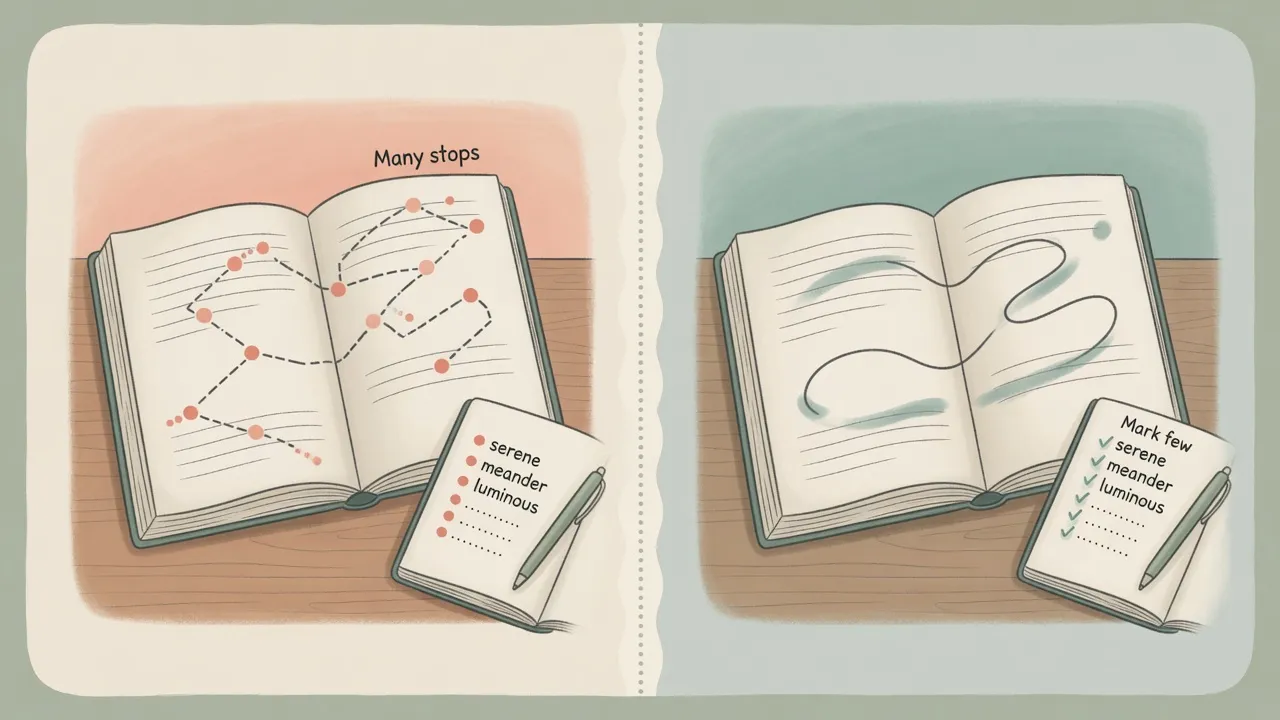
Here is the stop-start picture in one view: story flow interrupted by lookup-and-copy stops.
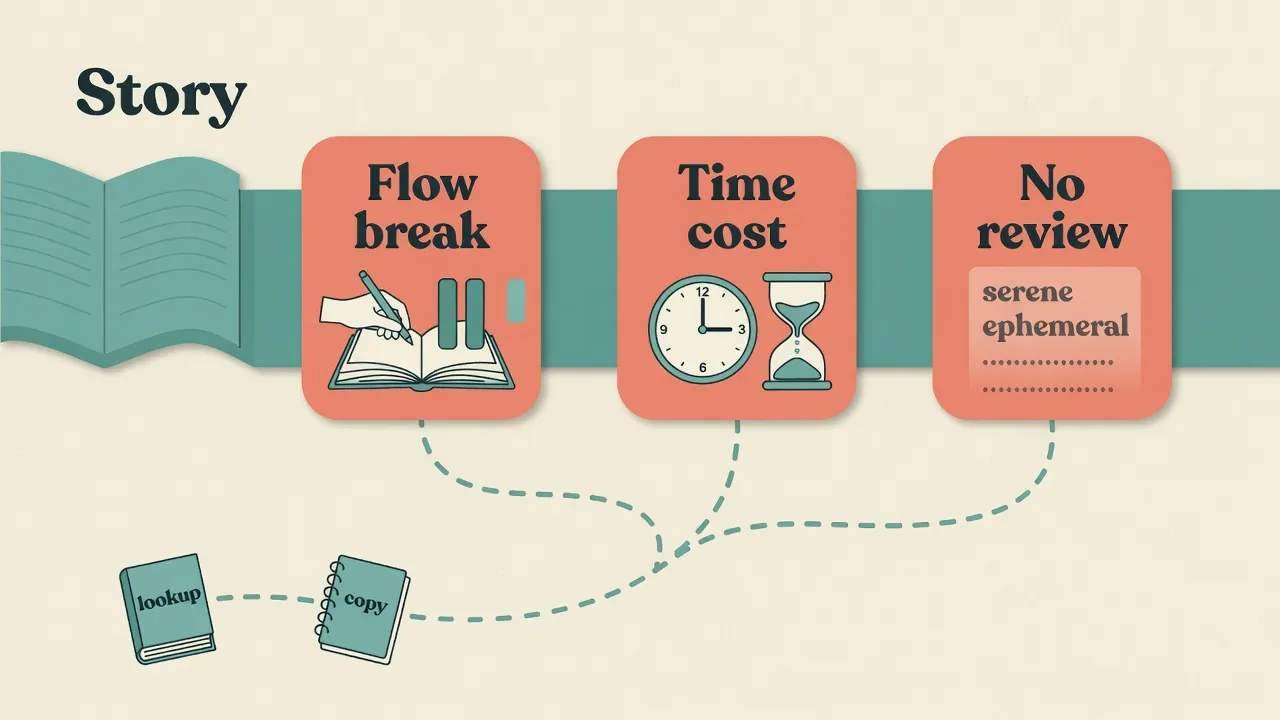
1. Flow break (the story dies first)
Each unknown becomes a mini ritual: stop, look up, write, re-enter the sentence. The emotional pay-off of the scene cools while you do admin. For self-learners, that pay-off is the reward that opens the next page. When stop-start reading turns the novel into a desk job, motivation drops even if the handwriting looks perfect.
2. Time cost of an every-unknown policy
One lookup-plus-copy can eat a real chunk of a short session. Twenty unknowns can eat the evening. Many learners finish the night with a full page and an unfinished chapter. The policy scales badly. More curiosity on the page means more friction, which quietly punishes harder books.
3. Archive without review
Mid-reading lists rarely get a scheduled return. Write-and-forget becomes the default. Neat pages without a plan are storage, not practice. Forgetting without re-meeting is normal, not a personal flaw. The Ebbinghaus forgetting curve is the plain version of that story.
Contrast helps: reading itself re-exposes frequent words. Rare words need intentional review later, not more ink mid-page.
| # | Friction | What happens | Why motivation drops |
|---|---|---|---|
| 1 | Flow break | Story stops for lookup and copy | Story reward cools |
| 2 | Time cost | Many write-outs in one evening | Night spent on admin |
| 3 | Archive, no schedule | No "recall this tomorrow" | Write-and-forget by default |
If all three feel familiar, you did not "fail notebook method." You asked the notebook for the wrong job: main tool for extensive reading instead of a deliberate study block.
When does writing words by hand still help?
Paper is not the villain. Mid-reading full-copy is the habit that stalls the book.
Handwriting still helps when:
- You are in a slow deliberate study block, not mid-chapter.
- You have an exam or course list you will actually re-test on paper.
- You simply prefer pen for encoding when the task is word study (fair preference; not proof that full-copy mid-novel works).
- After reading, you pick five to ten marked words and rewrite them carefully with real sentences.
- You want an offline focus evening or a screen break for pure study.
Rule of thumb: study block = pen OK; extensive reading = selective mark, review later.
The fork looks like this:
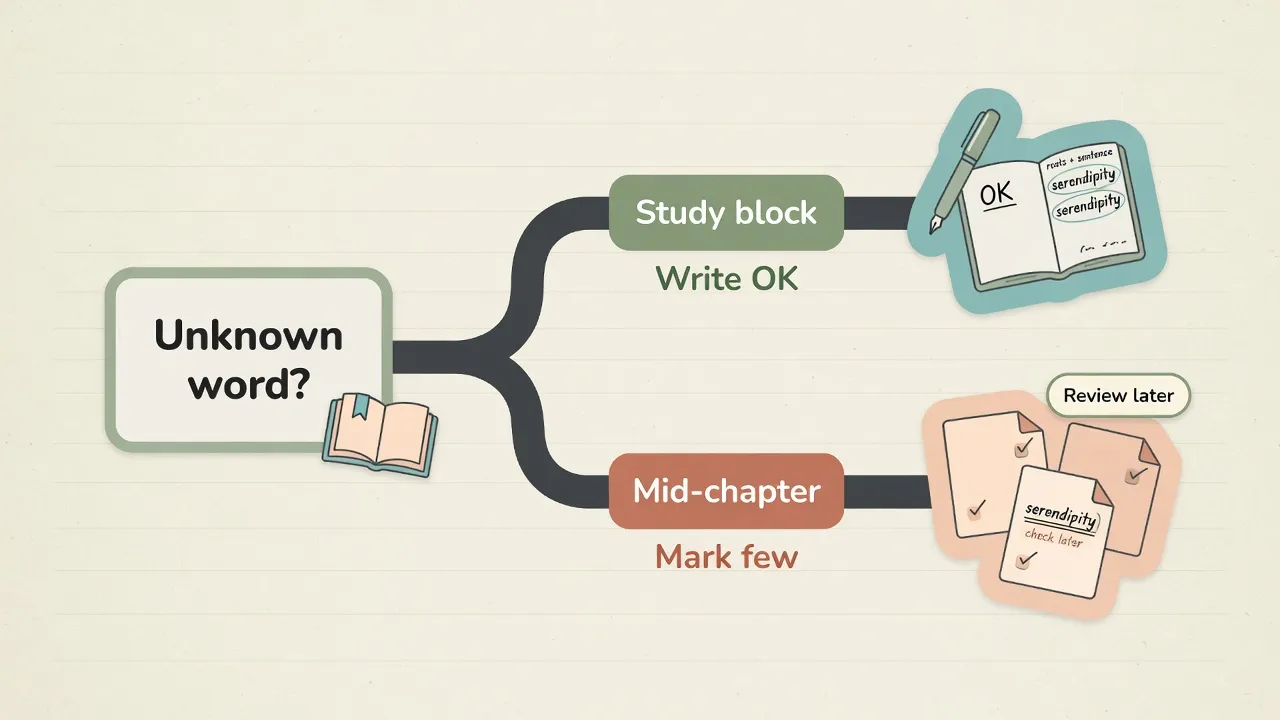
Hybrid is normal. Use paper where it earns its keep. Use lighter capture while the story is running. For the broader fair map of paper vs flashcards vs reading-plus-capture, see why paper vocabulary notebooks kill motivation.
The better loop: read, mark few, keep context, short review
You do not need new gadgets to fix this. You need a different mid-reading policy.
Same notebook, two jobs:
| Mid-reading every-unknown copy | Selective capture |
|---|---|
| Many stops; story stalls | Few marks; story moves |
| List without schedule | Review later on purpose |
| Bare gloss risk | Sentence kept |
You do not have to abandon paper forever. You need fewer stops, context kept, and review on purpose.
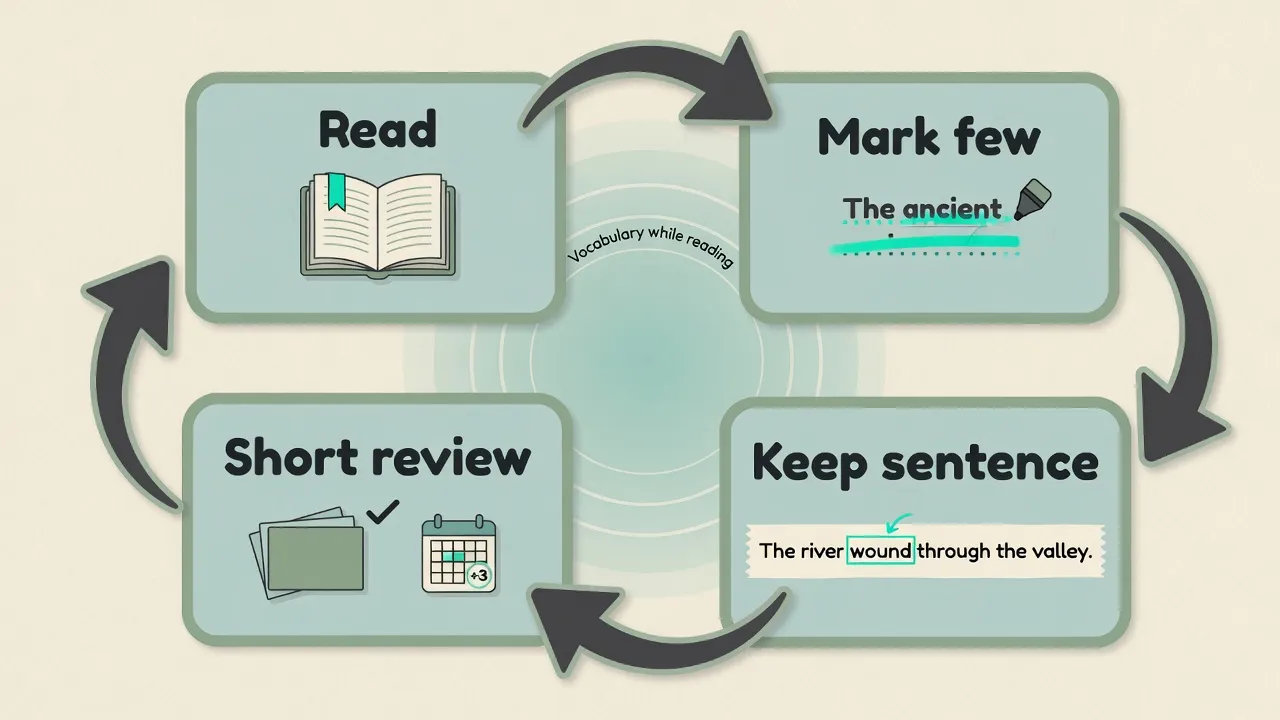
The loop in four steps:
- Read interesting text near your level. Finish the page more often than not.
- Mark few high-value words or phrases, not every unknown.
- Keep context (source sentence or phrase), not bare first-language pairs only.
- Short review later: SRS, phrase practice, or re-read your marks. Not "someday."
Here is that ladder as a simple process:
How many words should you mark while reading?
A handful per session beats a wall of ink. Prefer words that block meaning or keep repeating. Skip proper names once recognized, one-off jargon outside your goals, and rare ornaments you will not meet again soon. If the review pile grows every day, cut new marks for a week and re-read what you already captured.
How do you look up words without breaking flow?
Guess first when the sentence still makes sense. Mark now; batch full sense later if you need a cleaner gloss. Keep the source sentence when you capture. Avoid opening a full notebook and rewriting every gloss mid-page.
In-reader click-translate is one way to mark without leaving the page. Details and limits are in the next section. You can also practice the habit on free graded pieces in the library, for example a Spanish A2 sample. A short orientation of the capture flow is in how to use.
If you want the loop in one place
MovaReader is an optional tool for this loop. Open graded text (or your own legal file), click-translate a few words while you read so you stay on the page, keep sentence context, listen when you want sound, and optionally run short phrase trainers.
How the plans fit the habit:
| Plan | Fit for this loop |
|---|---|
| Free plan | Learn the habit; short sessions; about 20 word translations per day; listening included |
| Reader €1 | Unlimited translations for real daily volume; free graded library continues; own legal EPUB |
| Pro €5 | Phrase trainers |
Upload files you have rights to use.
If daily limits block real pages, skim pricing. If you want account progress, register. For rough vocabulary orientation, the language map is optional background.
FAQ
Should I write down every unknown word while reading?
Usually no for pleasure or extensive reading. That mid-story every-unknown habit often stalls the book and builds a list you never review. Mark a few high-value words or phrases that block meaning or keep repeating. Guess first when the sentence still makes sense. Keep sentence context when you can.
Does writing words by hand help memory for language learning?
It can help in deliberate study blocks, when the task is word work. It is not a free pass if you never recall the item later, and it does not prove full-copy mid-novel works. Medium matters less than selection plus a short review schedule.
Is a vocabulary notebook worth it if I mainly read for pleasure?
Yes for study blocks and exam lists you will actually re-test. Weak as your only mid-reading tool: stop-and-copy every unknown turns the novel into admin. Keep the notebook for the study evening; keep selective marks for the story.
How many words should I mark per reading session?
A handful of high-value items beats a wall of ink. Prefer quality and context over "every unknown." If the review pile grows every day, cut new marks for a week and re-read what you already marked.
How do I look up words while reading without breaking flow?
Mark now, keep the sentence, batch sense later if needed. Guess first when safe. Avoid rewriting every gloss mid-page. In-reader click-translate (if you use an app) is one way to capture without leaving the page. Still select few items, not every unknown.
Do I need a paid plan to try a read-mark-review loop?
No. The free plan is enough to test the habit: free graded library, about 20 word translations per day, and listening. Move to Reader €1 when daily limits block real volume. Pro €5 only if phrase trainers are the bottleneck.
Next steps
- Next reading session: mark only a small set of unknowns, not every word.
- If a word matters, keep the sentence; schedule five to ten minutes of review later.
- Use paper for deliberate study blocks, not every mid-page stop.
- Try a free graded piece in the library if you want low-friction practice text.
- Optional: click-translate on the free plan (about 20/day); Reader if daily limits bite; Pro only if trainers are the bottleneck.
- Want depth on forgetting and ownership? Revisit Ebbinghaus and passive to active.
Motivation stays when the book stays enjoyable. Copy less mid-story. Review a few words on purpose. Paper can still help deliberate study. Capture plus short review keeps reading alive, with or without a paid plan.
Keep reading with translations inside the text
With a free account, an unknown word translates with one tap, and the words you are learning wait for you in the trainer.
Free account: 7 days of Pro, then 20 word translations a day or a paid plan.