Gramática en contexto
La voz pasiva en español de negocios: cómo leerla sin atascarte
El español de negocios esconde al agente a propósito. Aquí tienes un mapa de tres construcciones, un párrafo de estilo Expansión para practicar y un método de lectura en tres pases.
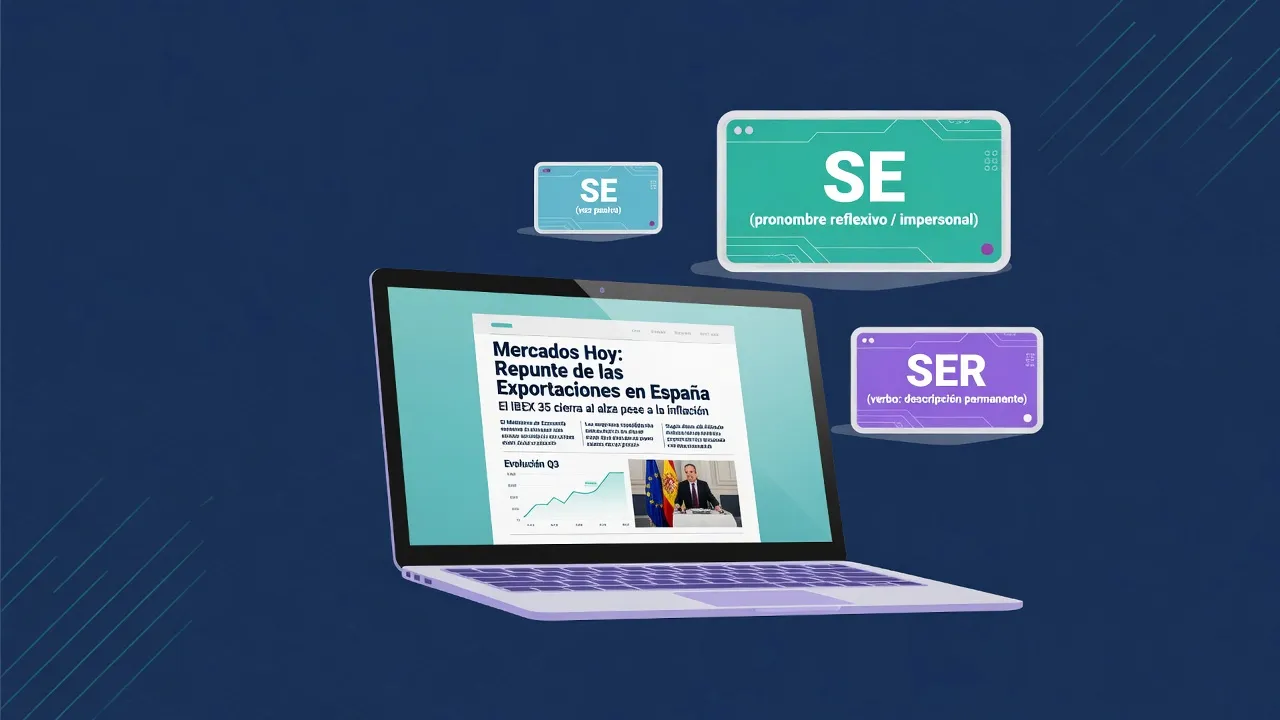
Abres un artículo de economía y lees: "Se espera que la inversión sea aprobada por los reguladores antes de que el informe sea presentado." Lo lees dos veces. ¿Quién espera? ¿Quién aprueba? ¿Quién presenta?
No es (solo) que "te falle el español". Es la voz pasiva y las construcciones con se haciendo su trabajo habitual en el lenguaje formal: bajar el protagonismo del agente, subir la acción y sonar institucionales.
Respuesta en corto
En el español formal y de negocios conviven tres herramientas que a menudo se mezclan bajo la etiqueta "pasiva":
- Pasiva con ser + participio (fue firmado por...)
- Se pasivo (el verbo concuerda con el paciente: se publicaron los resultados)
- Se impersonal (suele quedarse en 3.ª singular: se habla de una fusión)
El hábito útil es simple: localiza la forma, busca por + agente si existe, y reescribe mentalmente en activa para comprobar que entendiste. Es una habilidad de lectura que se entrena con semanas de exposición, no un truco de fin de semana para "decodificar al instante" cualquier Forbes.
En una línea: tres construcciones, un hábito: encontrar agente (si hay), recuperar la acción, seguir leyendo.
Si también lees informes en inglés, la lógica de "resultado primero" se parece, pero las formas no: hay una guía hermana de voz pasiva en Business English.
Por qué el español de negocios ama la pasiva (y el se)
En la conversación cotidiana, la pasiva con ser es poco frecuente. Casi nadie dice "La cena fue preparada por mí"; dice "Preparé la cena" o "Hice la cena".
En textos de empresa y periodismo económico cambia el estilo:
- Objetividad aparente: "Los resultados fueron analizados" suena más "neutro" que "El equipo analizó los resultados."
- Tono institucional: la forma impersonal da peso de "lo establecido".
- Ambigüedad útil: "Se cometieron errores" no es lo mismo que "Nosotros cometimos errores."
Si quieres leer español real (no solo el del manual), necesitas reconocer estas formas con rapidez. El vocabulario de sector ayuda, pero el orden y la voz también: conviene no forzar plantillas del inglés al leer español; hay más sobre eso en orden de palabras en español.
Tres caras de la "pasiva" en español
A diferencia del inglés, donde was written cubre casi todo, en español conviene separar tres mecanismos. Mezclarlos es el error más común en B1-B2.
Antes de bajar al detalle, mira el mapa de las tres caras:
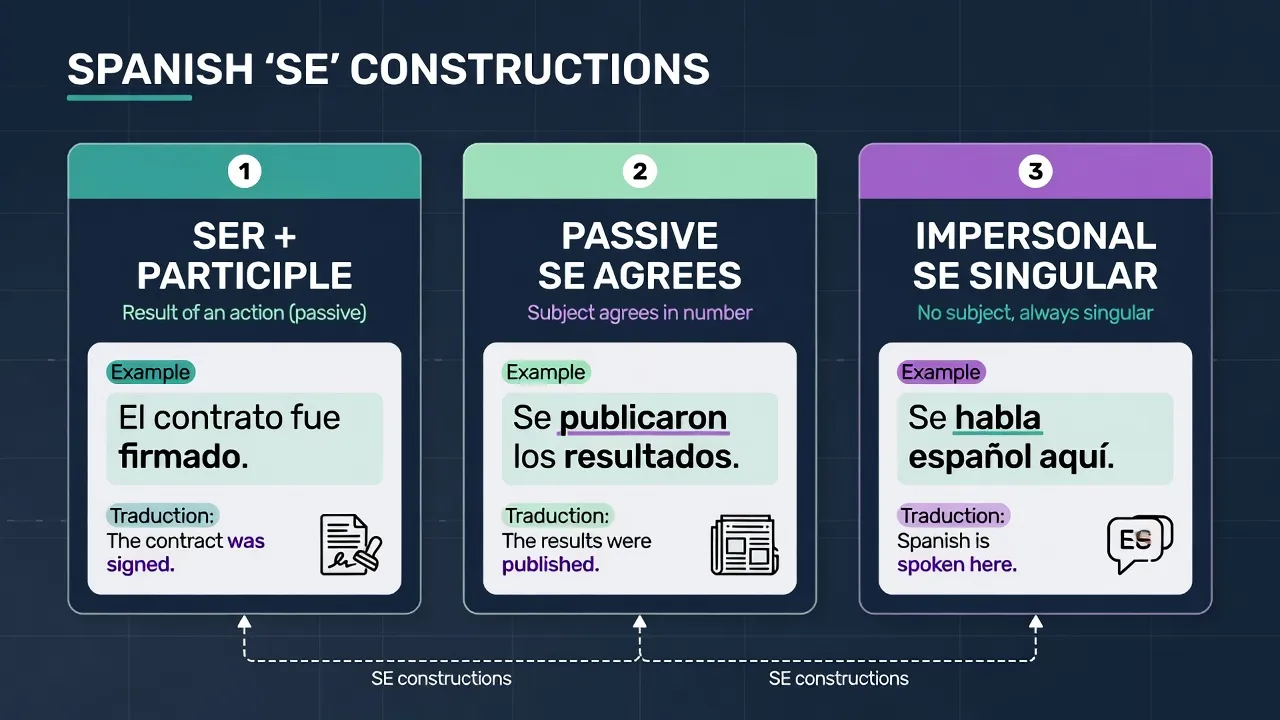
1. Voz pasiva perifrástica (ser + participio)
"El acuerdo fue firmado por ambas partes."
Estructura: sujeto paciente + ser conjugado + participio (+ por + agente, opcional)
Dónde abunda:
- contratos y textos legales
- academia
- crónicas históricas
- comunicados oficiales
Truco de lectura: localiza el participio (firmado, aprobado, presentado). Pregunta: ¿quién hizo la acción? Si hay por, ahí está el agente. Si no hay por, el autor lo omitió a propósito.
Ejemplo de estilo periodístico:
"La adquisición fue valorada en 3.200 millones de dólares por los analistas."
Lectura activa equivalente: Los analistas valoraron la adquisición en 3.200 millones de dólares.
No necesitas un resaltador mágico: reescribe mentalmente en activa cuando la frase se te nuble. El participio es el ancla; el resto es marco.
2. Se pasivo (pasiva refleja)
"Se publicaron los resultados del primer trimestre."
Estructura: se + verbo que concuerda con el sujeto paciente + sujeto
- "Se vendió la empresa." (singular)
- "Se vendieron las acciones." (plural)
Es muy frecuente en noticias porque suena natural en español y mantiene un tono "objetivo". En un solo artículo de economía puedes encontrarla muchas veces. Si el verbo va en plural, suele estar "mirando" al paciente plural: esa es tu pista de lectura.
3. Se impersonal
"Se habla de una posible fusión."
Estructura: se + verbo en 3.ª persona singular (+ complemento, a menudo con preposición)
El verbo no se pluraliza aunque lo que sigue sea "plural" en sentido amplio:
- Se pasivo: "Se firmaron los contratos." (el verbo mira a contratos)
- Se impersonal: "Se habla de los contratos." (el verbo se queda en singular)
También: "Se espera que...", "Se estima que...", "Se prevé que..." - marcos típicos de previsión y rumor de mercado. Aquí el agente no es un sujeto gramatical claro: es "el mercado", "la gente" o nadie en concreto.
| Tipo | Patrón | Ejemplo | Movimiento de lectura |
|---|---|---|---|
| Pasiva con ser | ser + participio (+ por) | El acuerdo fue firmado por ambas partes. | Busca el participio; el agente va tras por si existe |
| Se pasivo | se + verbo que concuerda | Se publicaron los resultados. | El verbo sigue al paciente en número |
| Se impersonal | se + 3.ª singular | Se habla de una fusión. | El verbo se queda en singular; lee "se dice / se comenta" |
Reto: un párrafo de estilo Forbes / Expansión
Practica con este bloque (inventado, pero realista):
"Se espera que la nueva regulación sea aprobada por el Congreso antes de fin de año. Los cambios fueron propuestos por el ministerio de economía, y se prevé que las reformas se implementen de manera gradual. Se habla de un período de transición de dieciocho meses, aunque no se ha confirmado la fecha exacta."
Desglose:
Se espera que... sea aprobada por...
- Se espera: marco impersonal
- sea aprobada por el Congreso: pasiva con ser + agente dentro de la subordinada
- Idea: La gente / el mercado espera que el Congreso apruebe la regulación...
Los cambios fueron propuestos por el ministerio...
- Pasiva con ser + agente claro
- Activa: El ministerio propuso los cambios...
se prevé que las reformas se implementen...
- se prevé: impersonal
- se implementen: se pasivo (reformas = paciente; subjuntivo por la subordinada)
Se habla de...
- Impersonal: hay conversación / rumor sobre el plazo
no se ha confirmado la fecha exacta
- Se pasivo (o lectura pasiva con se): la fecha no está confirmada; agente oculto
Cinco oraciones, varias capas. Eso es español de negocios normal, no un examen caprichoso. Cuando el subjuntivo se mete dentro (se espera que sea aprobada), no intentes resolver las dos capas a la vez el primer día: primero el marco, luego la pasiva interna.
Si quieres material de lectura de negocios más largo (libros y rutas), mira libros de Business Spanish.
Cinco patrones que verás casi a diario
| Patrón | Ejemplo | Lectura útil |
|---|---|---|
| Se espera que... | Se espera que la inflación baje. | Expectativa genérica; el agente no importa |
| Fue + participio + por | La decisión fue tomada por la junta. | Agente = la junta |
| Se + verbo en plural | Se registraron pérdidas récord. | Hecho presentado sin autor explícito |
| Se ha + participio | Se ha anunciado una reestructuración. | Anuncio hecho; ¿quién? a veces no se dice |
| Se prevé / se estima que | Se estima que el mercado crecerá un 4%. | Cifra u opinión de "el mercado / analistas" |
Con estos cinco marcos lees gran parte de la pasiva periodística sin memorizar tablas eternas. Cuando una frase te frene, no es que "no sepas español": a menudo es uno de estos marcos en cadena.
Se pasivo vs se impersonal: el contraste que más confunde
Esta es la frontera donde más gente se atasca. La idea no es memorizar un término de manual; es oír la diferencia al leer.
Aquí el contraste en una sola imagen:
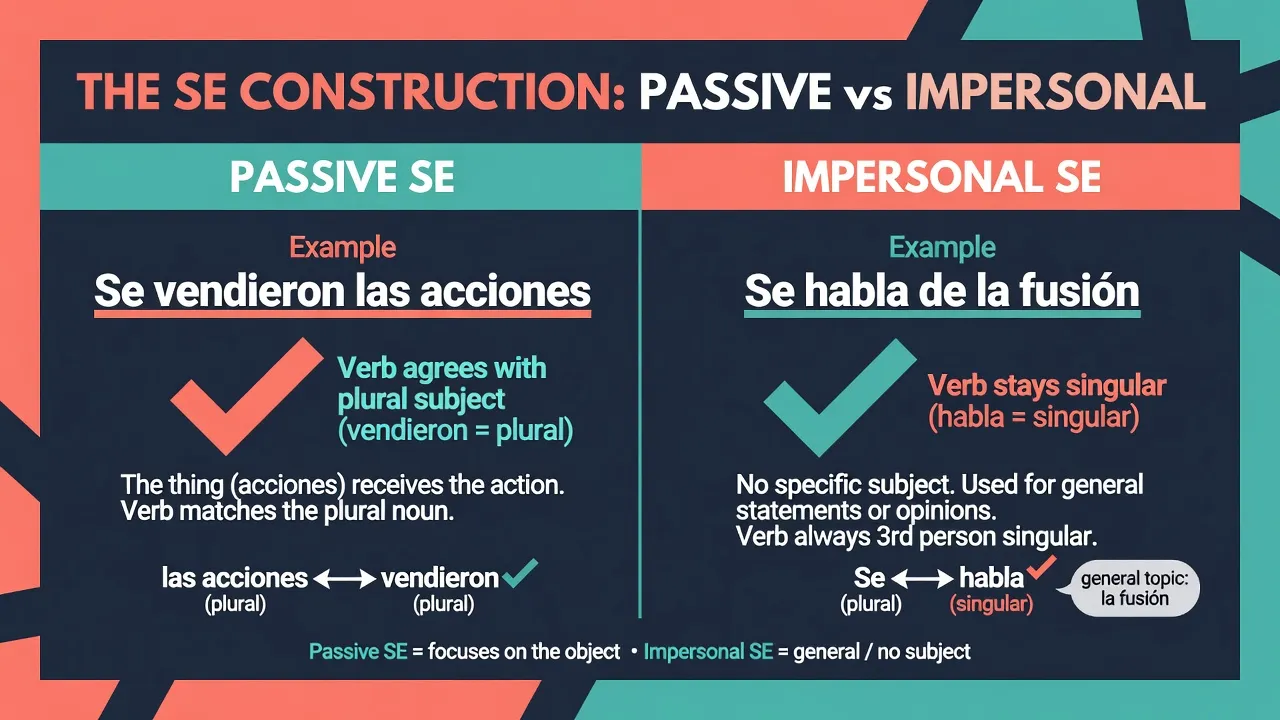
Pista rápida:
- Si el verbo cambia de número con lo que "recibe" la acción (se vendió / se vendieron), piensa en se pasivo.
- Si el verbo se queda en singular aunque el tema sea amplio (se habla de los mercados), piensa en se impersonal.
- Si ves por + persona o institución tras un participio (fue aprobado por el Congreso), es pasiva con ser, no un se.
No hace falta pelearte con el matiz de lingüista en cada titular. Te basta con recuperar el sentido: ¿hay un hecho sin autor, un rumor de mercado o un agente explícito?
Método de lectura: tres pases
Puedes hacerlo con un artículo de Expansión, Bloomberg Línea, El Economista o un texto de la biblioteca de artículos:
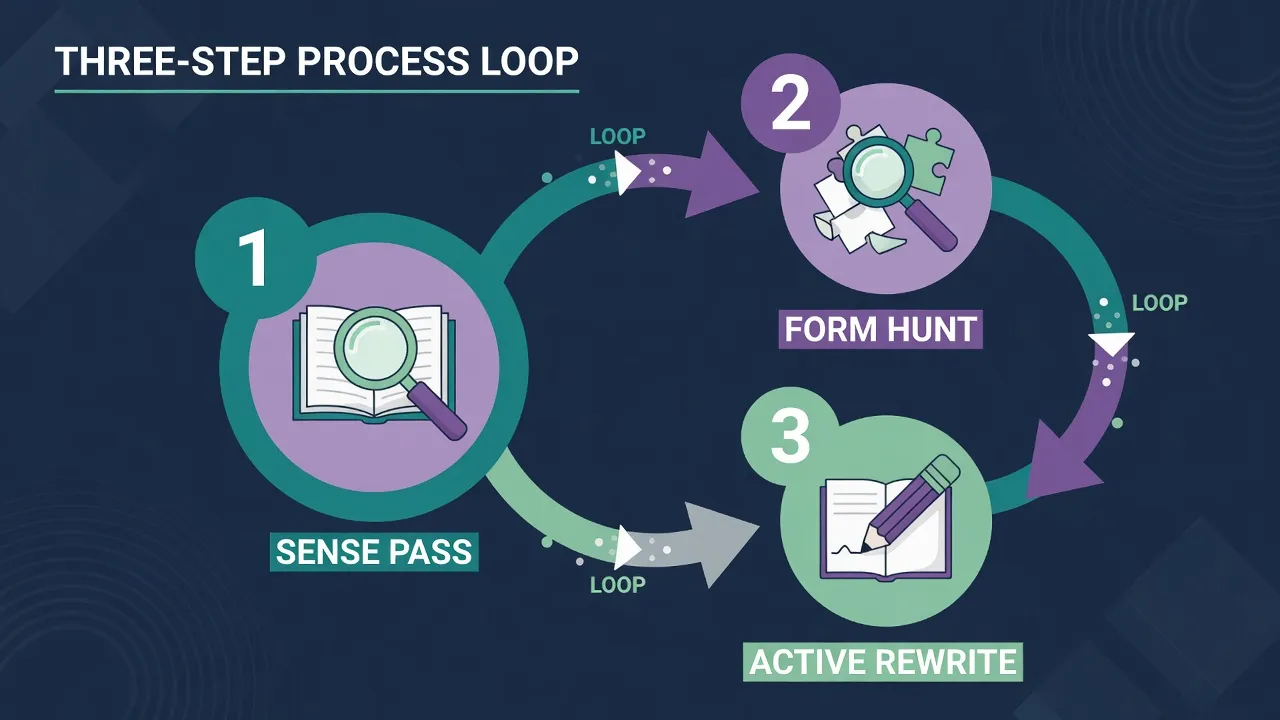
Primer pase (sentido general)
Lee el párrafo sin parar. No analices. Quédate con el tema: ¿regulación, fusión, resultados, inflación?Segundo pase (cazador de formas)
Marca solo:- ser + participio
- se + verbo
Pregunta en cada caso: ¿hay agente (por)? ¿el verbo concuerda en plural?
Tercer pase (versión activa mental)
Reescribe en voz alta o en una nota una versión activa o "alguien + verbo".
Ejemplo: Se publicaron los resultados → Publicaron / La empresa publicó los resultados (aunque no sepas el sujeto exacto, recuperas la acción).
Regla de oro: no traduzcas palabra por palabra. Traduce la relación: paciente, acción, agente (si existe).
Este método no "desbloquea Forbes en cinco minutos". Te da un camino repetible. La velocidad llega con volumen de lectura, no con un interruptor.
Mini-ejercicio (5 minutos)
Toma tres titulares o frases y clasifícalas: A) ser + participio, B) se pasivo, C) se impersonal.
- Se vendieron más de un millón de unidades.
- El informe fue elaborado por un comité externo.
- Se habla de recortes en el segundo semestre.
Respuestas: 1-B, 2-A, 3-C.
Si quieres, añade dos frases más de un artículo real y repite el mismo etiquetado. Cinco minutos bastan; la clave es hacerlo varias veces a la semana, no una sola vez "perfecto".
De reconocer a producir
Si escribes informes o correos formales en español, la pasiva y el se te sirven. El camino realista es más lento que un embudo de marketing:
- Reconocimiento - las ves al leer
- Comprensión rápida - ya no te frenan
- Imitación - copias marcos útiles (Se adjunta..., Los datos fueron revisados por...)
- Uso flexible - eliges pasiva o activa según el tono
Un puente útil de la lectura a la producción: copiar a mano o teclear 5-10 frases reales que te hayan servido, luego cambiar solo el contenido (empresa, cifra, fecha). Eso es práctica deliberada, no un milagro de app.
La misma idea vale para otros contrastes del español formal: no se "arreglan" con un eslogan. Si te confunde el marco de ser y estar en descripciones de empresa o de resultados, hay una guía de ser vs estar. Y si al reescribir en activa te pelean los tiempos del pasado, pretérito e imperfecto te da un mapa paralelo.
Por qué los huecos del manual no bastan
El ejercicio "La carta _____ (escribir) por el director" entrena conjugación. Casi no entrena:
- cuándo prefieres se pasivo frente a se impersonal
- por qué el autor oculta el agente
- cómo recuperar el sentido bajo presión de lectura
Eso se entrena con exposición a textos auténticos o semi-auténticos y con el hábito de reescritura mental. Los ejercicios sirven como mapa corto; no como dieta completa.
En la práctica: un manual te da la etiqueta; un párrafo de Expansión te da la presión real (vocabulario, subordinadas, dos capas a la vez). Necesitas ambos, en ese orden o intercalados, pero no solo el primero.
Dónde más domina este estilo (además de negocios)
- Ciencia: Se observó una correlación...
- Derecho: El demandado será notificado...
- Política: Se han tomado medidas...
- Tecnología: La actualización fue diseñada para...
- ONG / informes: Se estima que... fueron afectadas...
Los tres mecanismos se repiten; cambia el vocabulario del dominio. Si entrenas el hábito en economía, lo reutilizas en un informe de impacto o en un paper, sin aprender "otra gramática".
Cómo encaja MovaReader
MovaReader no es un motor de "radiografía gramatical" automática. Es un lector con biblioteca graduada, traducción al tocar y entrenadores. La gramática de esta guía la aplicas tú; la app quita fricción de vocabulario.
Lo útil de verdad:
- Lee textos graduados o importa un archivo que poseas (por ejemplo EPUB). La app no sustituye comprar o prestar libros comerciales con botones de "Capítulo 1" de bestsellers.
- Usa traducción al tocar solo en bloqueadores (palabras que tumba la frase). En freemium hay 20 traducciones de palabra al día y escucha ilimitada. Reader (€1) quita el tope de traducciones. Pro (€5/mes) abre los entrenadores completos. Ver Precios.
- Guarda frases con pasiva / se, no solo lemas sueltos. Practica con demos: entrenamiento de palabras, tipeo de frases. Más contexto en Cómo usar y en los entrenadores.
- Explora la biblioteca: Todos los artículos. Si ya guardas chunks, revisa también frases.
Flujo recomendado (15 minutos):
- Un párrafo de economía o un artículo graduado
- Tres pases del método de arriba
- Guardar 3 frases modelo
- Teclearlas una vez al día siguiente
Ese ciclo es aburrido en el mejor sentido: repetible y medible.
FAQ
¿Es incorrecto usar mucho la pasiva con ser al hablar?
No es "incorrecto", pero suena formal o traducido del inglés si abunda en conversación informal. En informes, actas y prensa, es normal.
¿Se venden casas es pasiva o impersonal?
En la práctica didáctica suele analizarse como pasiva refleja (se + verbo que concuerda). El matiz fino interesa a lingüistas; a ti te basta: hay casas en venta / se realiza la venta de casas, sin agente explícito.
¿Debo traducir siempre a voz activa?
Como técnica de comprensión, sí ayuda. Como estilo de escritura, no: a veces quieres el tono impersonal.
¿El subjuntivo dentro de se espera que... es otra trampa?
Sí, aparece mucho: se espera que sea aprobada. Primero recupera el marco (se espera que); luego mira la pasiva interna. No intentes resolver las dos capas a la vez el primer día.
¿Cuánto tarda en volverse automático?
Depende de cuánto leas. Con lectura frecuente de prensa o informes, muchas personas notan menos fricción en varias semanas, no en un fin de semana.
¿Sirve solo para el español de España o también de Latinoamérica?
Los tres mecanismos son panhispánicos. Cambia el léxico y a veces la preferencia de registro, no la lógica básica.
¿MovaReader etiqueta cada pasiva por mí?
No. Te ayuda a leer con traducción al tocar y a practicar lo que guardas. Tú sigues siendo quien nota el patrón.
Cierre
La voz pasiva y el se no son un muro. Son un código de estilo del español formal: a veces esconden al agente, a veces solo suenan profesionales.
Aprende a:
- separar ser + participio / se pasivo / se impersonal
- buscar el agente solo cuando existe
- reescribir en activa para comprobar que entendiste
Hazlo sobre textos que te importen. Usa herramientas para quitar fricción de vocabulario, no para externalizar el pensamiento gramatical.
Si quieres empezar hoy: abre un artículo de la biblioteca, marca tres se o pasivas, y escribe al lado la versión activa en una línea. Ese hábito vale más que cualquier promesa de "decodificación instantánea". Si además lees inglés de empresa, cruza con la guía de passive voice en Business English y nota qué es compartido (resultado primero) y qué es solo del español (las tres caras del se).
¿Aprendes español?
La versión en español de MovaReader enseña inglés y ucraniano. Para leer en español con traducción de cada palabra, abre el lector en inglés o en ucraniano:
Spanish booksThis article in EnglishКниги іспанськоюЦя стаття українською