Curated Resources
Fantasy Book Difficulty Ranking for Language Learners (Harry Potter to Dune)
Fantasy series are not equally hard in English. This ladder ranks popular books by friction and finishability so you pick a challenge you can complete.
You finished Harry Potter. Arrakis and Kaer Morhen look tempting. That is a great impulse. It is also where many English learners pick the wrong next book.
Here is the plain answer. Fantasy series are not equally hard in English. Clean YA dialogue and dense political monologue are different sports. This ranking is for people who want a book they can finish, not a prestige badge. You get realistic CEFR comfort bands, friction notes, a Dune vs Witcher callout, and a method for invented names. Rough rule: if you understand about 80-90% of ordinary pages, keep going. Under about 70%, step down one level. For a rough vocab/CEFR orientation compass, open the language map.
MovaReader does not host full commercial fantasy novels by default. Warm up on free graded texts in the library, or upload a book file you own (for example EPUB). Links below go to real product pages and free samples.
What you will get if you keep scrolling: a quick ladder table, why fantasy is a special case, Levels 1-4 (Percy to Tolkien, with Mistborn), Dune vs Witcher, a safer path, an 800-page method, how to use MovaReader, and FAQ.
Quick ranking table
Not every popular fantasy series is equally readable in English. Treat this as a finishability map, not a shelf of trophies.
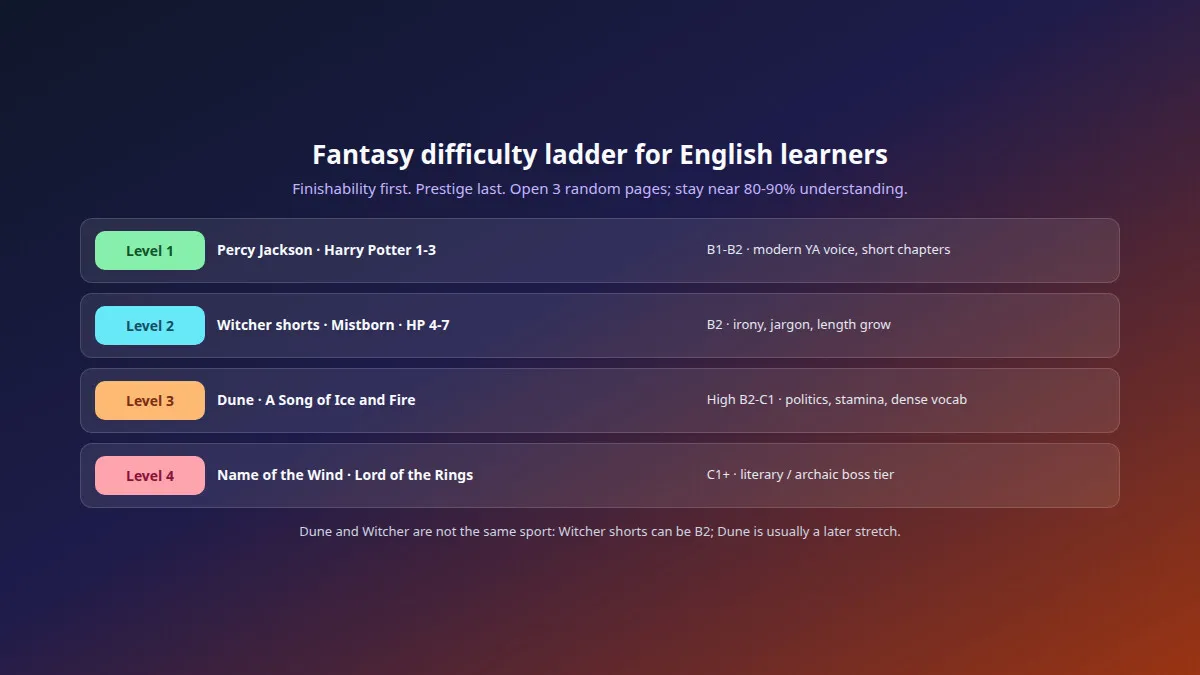
| Series | Realistic range for comfortable reading | Main friction |
|---|---|---|
| Percy Jackson | solid B1 to low B2 | modern YA slang, mythology names |
| Harry Potter (1-3) | B1-B2 | gradual growth later |
| Harry Potter (4-7) | B2 to low C1 | length, politics, denser chapters |
| The Witcher (English) | B2 | cultural irony, folklore layers |
| Mistborn | B2 | magic-system jargon early |
| Dune | high B2 to C1 | invented + technical + political vocab |
| A Song of Ice and Fire | high B2 to C1 | archaic/medieval register, length, many POVs |
| The Name of the Wind | C1 | literary prose, unusual word choice |
| The Lord of the Rings | C1-C2 | archaic style, songs, dense description |
Rough rule: open three random ordinary narrative pages (not a song, not a prophecy page). If you understand about 80-90% without help, the book can be a daily reader. If you are under about 70%, step down one level on this ladder.
Try a free graded sample first: English A2 article. If that feels easy, you are closer to Level 1 below. Prefer numeric 1-5 scores or slightly different CEFR floors? This page owns the Dune vs Witcher finishability path and the safer ladder. Prefer numeric 1-5 scores or a slightly different framing? See the sister post: fantasy books English difficulty rating.
Why fantasy is a special case for learners
Fantasy adds friction that crime or contemporary fiction usually does not. Plot pull is high. Lookup friction can be higher still.
- Invented names and terms: melange, Igni, mithril, Allomancy. Some are pure fiction. Some are real English (prescience, hegemony).
- Genre vocabulary: armor, courts, magic systems, military ranks.
- Style range: YA dialogue next to biblical cadence and Victorian landscape prose.
- Length: many series reward stamina more than single clever sentences.
In practice:
- Do not look up every capitalised weird word on page one.
- Keep a short name list (characters, places, factions) instead of a giant vocab dump.
- Learn real English words that block meaning. Skip pure lore tags until the plot forces them.
After you upload a file you own, click-to-translate helps on meaning blockers. Your filter still matters.
Level 1: Approachable entry (about B1-B2)
Percy Jackson - Rick Riordan
Realistic level: solid B1 to low B2
Why it works: modern first-person voice, short chapters, explanations built into the story.
Watch out for: US teen idioms (freak out, no big deal) and Greek names.
Good confidence series before longer adult fantasy. Dialogue trains useful informal English more than "literary" English. If you want something even lighter than YA fantasy first, try free graded texts or easiest English books for A2-B1. If you have never finished any English book, start with how to read your first book in English before Dune or Tolkien.
Harry Potter - J.K. Rowling
Realistic level: books 1-3 around B1-B2; books 4-7 often B2 to low C1
Why it works: clear plot pull, familiar story for many readers, gradual difficulty rise.
Watch out for: later political vocabulary, long chapters, and emotional nuance that is easy in your first language but slower in English.
Treat Book 1 as a gateway, not as proof that Book 7 will feel the same. Spell names are mostly skippable for language progress. Dialogue and narration are the real training.
Level 2: Solid independent reading (about B2)
The Witcher saga (English translation) - Andrzej Sapkowski
Realistic level: B2
Why it works: short stories (The Last Wish, Sword of Destiny) are a better start than diving into the long novels. Dialogue is often sharp and modern.
Watch out for: Slavic folklore, irony, and political subtext. A literal sentence is not always enough to catch the joke.
Invented-term load is moderate (Signs, monster names, potions). Focus on conversational English and moral arguments between characters. Note: English Witcher is a translation into English, not original English style. Friction is culture, irony, and names more than "archaic grammar."
Mistborn - Brandon Sanderson
Realistic level: B2
Why it works: clear, systematic prose. Magic is explained. Plot threads are usually readable without decorative fog.
Watch out for: early jargon dump (Pushing, Pulling, metals) and long novel length (often 600+ pages).
Once the magic system clicks, terms repeat. That repetition helps learners. This is a strong Level 2 bridge when Witcher irony still feels sticky but you want adult fantasy stamina.
Level 3: Heavy stretch (high B2 to C1)
Dune - Frank Herbert
Realistic level: high B2 to C1 for comfortable reading
Why it is hard: ecology, religion, politics, and a dense mix of invented and advanced real vocabulary (prescience, subterfuge, hegemony). Internal monologue is long and abstract. First chapters are especially dense.
Why people still try it: short memorable lines, strong world pull, and the payoff of finishing something hard.
Do not start here to "test if reading English works." Start here when you already finish clearer B2 narrative books with less lookup. A glossary helps natives too. That should tell you something.
A Song of Ice and Fire - George R.R. Martin
Realistic level: high B2 to C1
Why it is hard: length, many POVs, medieval-flavored vocabulary (liege, tourney, sigil), and shifting registers (court, battlefield, street).
Why it can still train useful English: diplomacy, negotiation, formal speech, and narrative stamina.
Stamina is the real boss fight here. If you quit books after 30 pages, this is a poor first original-language project.
Level 4: Literary boss tier (C1+)
The Lord of the Rings - J.R.R. Tolkien
Realistic level: C1-C2 for comfort
Why it is hard: archaic diction (smote, ere, hither, nigh), songs and poems, long landscape description, and invented languages.
When to try it: after you can finish modern adult fantasy without constant dictionary loops.
Magnificent book. Bad first original if your goal is "build a daily reading habit this month."
The Name of the Wind - Patrick Rothfuss
Realistic level: C1
Why it is hard: carefully polished prose, unusual metaphors, story-within-story structure, and words used in non-default senses.
Best for: literature-oriented learners who already like slow, dense prose in their first language.
Dune vs Witcher: which hard book first?
Both names sit in the slug for a reason. They are popular stretch targets after Harry Potter. They are not the same kind of hard. Pick by friction type and finishability, not by fandom prestige.
| Axis | The Witcher (EN) | Dune |
|---|---|---|
| Comfort band | often B2 dialogue-forward | high B2-C1 |
| Start path | short stories first | only after clearer B2 narratives finish |
| Main friction | folklore, irony, Slavic names, medieval/plant vocab | invented + advanced real vocab, politics/ecology, abstract monologue |
| Translation note | Polish → English; culture layers survive | original EN SF-fantasy; dense native prose |
| Pick when… | you want sharp dialogue + adult irony at solid B2 | you already finish B2 books and want a heavy stretch |
Witcher short stories can be a Level 2 daily reader. Dune is a Level 3 project, not a first test of "does reading English work?" If you are B2 and craving adult fantasy with spoken edge, start with The Last Wish. If you already finish Mistborn or later Harry Potter without hating the dictionary, then Dune becomes a fair stretch.
Suggested order if you feel lost
If the ladder feels noisy, follow finishability order, not shelf prestige.
Here is a safer path as a simple flow:
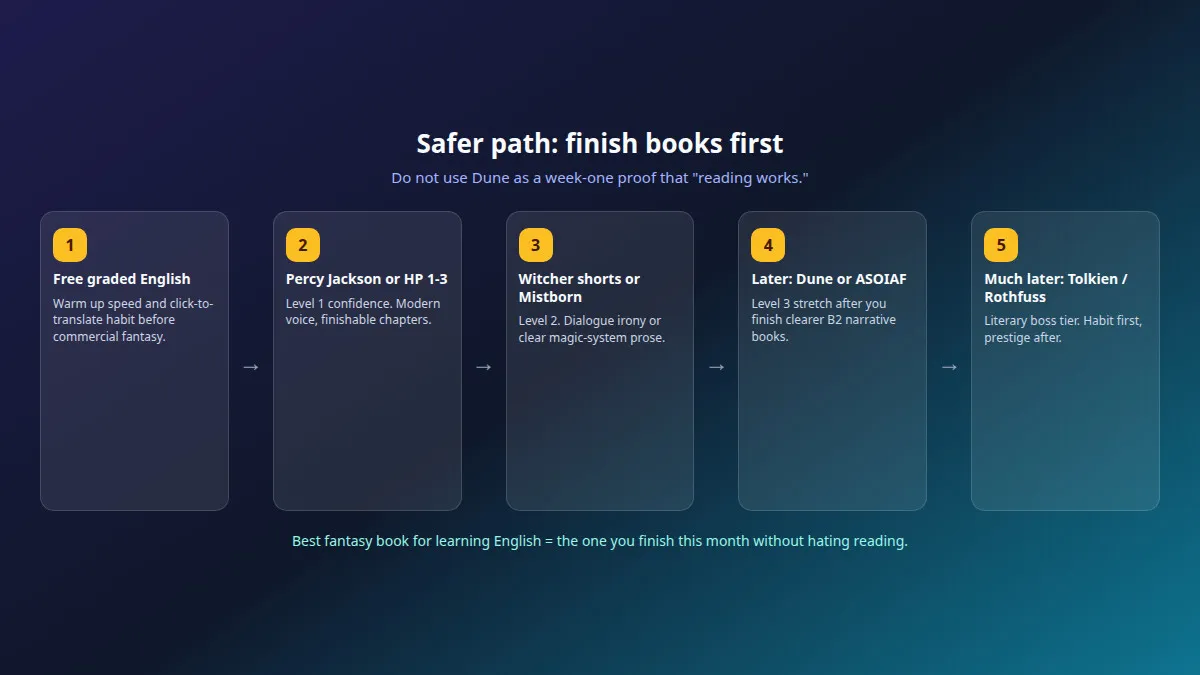
Safer path (finish books first):
- Free graded English texts in MovaReader
- Percy Jackson or Harry Potter 1-3
- Witcher short stories or Mistborn
- Later: Dune or ASOIAF
- Much later: Tolkien / Rothfuss
If you already know the stories from film or translation:
- Free A2-B1 English samples
- The series you know best at Level 1
- One Level 2 title
- Only then Level 3
Warm-up link: All Articles. Want a criteria scoreboard instead of this finishability ladder? The sibling framing lives at fantasy books English difficulty rating.
A reading method that survives 800 pages
Finishing fantasy is half language and half habit design. Use this method so Level 2 and careful Level 3 do not turn into pure decoding sessions.
Rank by finishability, not prestige
If every page is decoding, you are not reading fantasy. You are doing hard decoding practice. Short hard bursts can help. They are a bad daily habit as your only diet.
Separate lore tags from real English
When a name clearly marks a person, place, or spell, mark it once and move on. When a real word blocks the sentence (feint, allegiance, wroth), look it up and keep going.
This split is the whole game for fantasy:
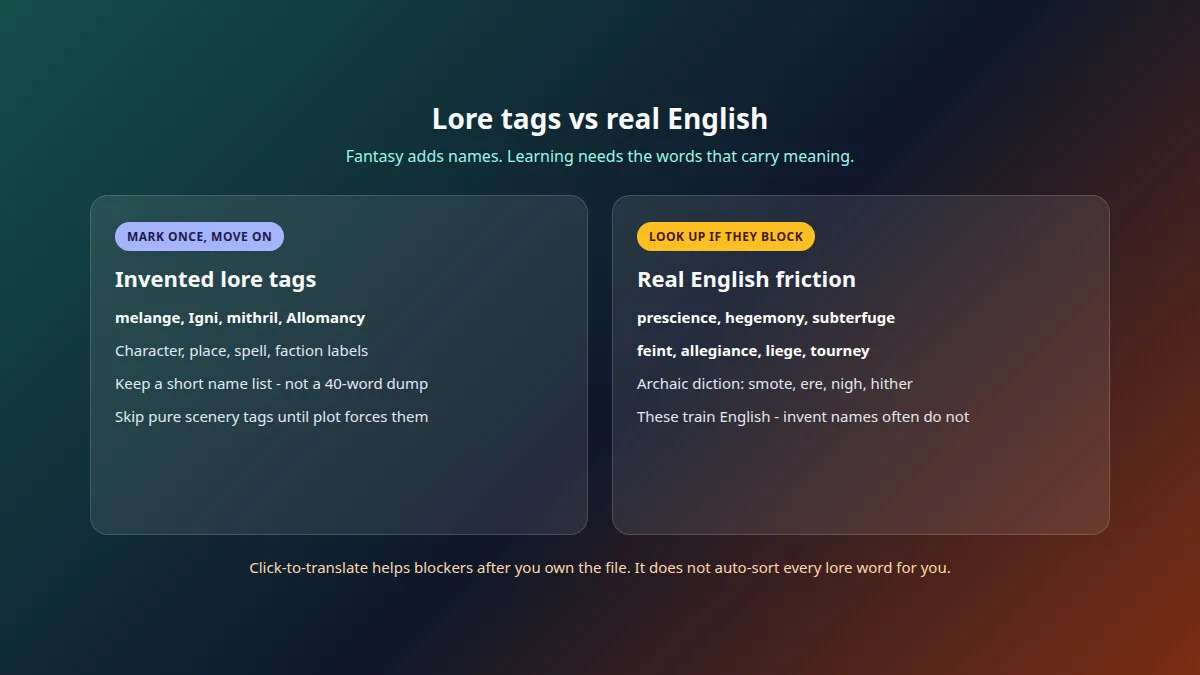
Look up blockers, not decoration
- Read a paragraph once without stopping.
- Mark only words that block whole-sentence meaning.
- Check those words.
- Reread the paragraph.
- Save 3-10 useful phrases per session, not 40 isolated words.
Use short daily sessions
15-25 minutes daily beats a weekend guilt marathon. Stop mid-chapter if needed. Streaks of "I opened the book" beat heroic abandoned weekends.
Mix graded text with one real book
- 3-4 days: free graded texts
- 2-3 days: your fantasy EPUB or paper book
- 1 day: review saved phrases
Free samples to mix in: browse free articles.
How to use MovaReader
MovaReader is a reader with click translation on meaning blockers, free graded samples, listening on the free tier, and upload of your legal EPUB or file. The point for this article is finishability on Level 1-2 (and careful Level 3), without turning invented lore into your whole vocabulary curriculum.
- Warm up on free graded articles in All Articles.
- Read a free English A2 sample.
- Upload a fantasy file you own when ready. See How to use.
- Tap only meaning blockers, not every invented name.
- Train a small phrase set in the word training demo and phrase typing demo. Full trainers help when phrase review is the bottleneck.
- Free plan: listening is free; about 20 word translations/day are free; unlimited reading translations are on Reader €1; full trainers are on Pro €5. Details: Pricing.
| Need | Realistic plan |
|---|---|
| Free graded warm-up + light lookup | Free plan (~20 word translations/day + unlimited listening) |
| Real reading volume with click translation | Reader €1/mo |
| Phrase trainers beyond reading | Pro €5/mo |
| Commercial Dune / Witcher / HP you own | Your legal EPUB/file (not an unlimited hosted catalog) |
Suggested free path today:
- Word training demo
- Phrase training demo
- Only then upload a Level 1 or Level 2 title you own legally
FAQ
What is the easiest popular fantasy series for English learners?
For many B1-B2 readers: Percy Jackson or early Harry Potter (books 1-3). They are not a childish waste for language practice. They are efficient confidence builders before adult density, irony, and invented-term fog.
Is The Witcher harder than Harry Potter?
Usually yes in English, mainly because of cultural layering, adult irony, and folklore, not only a longer vocabulary list. Start with the short stories (The Last Wish, Sword of Destiny) before the long saga novels. Treat it as solid B2 dialogue-forward reading, not early B1 comfort.
Can a B2 learner read Dune?
Some motivated B2 readers manage with heavy support and a glossary habit. Most enjoy it more at high B2/C1 after finishing clearer narrative books (Mistborn, Witcher shorts, later Harry Potter). If your goal is finishing books, do not make Dune your first original-language test.
Should I look up every invented word?
No. Track person, place, and spell names lightly (mark once, move on). Prioritize real English words that change plot or argument meaning (prescience, allegiance, subterfuge). Pure lore tags are scenery until the story forces them.
Are translations easier than English originals?
For non-English source series like The Witcher, you are already reading a translation into English. Difficulty still depends on English prose quality plus culture and irony. It is not "game difficulty," and it is not automatic "easy because it is a translation." Dune is original dense English SF-fantasy: a different friction type.
Graded readers or real fantasy first?
Both. Graded texts build speed and daily wins. Real fantasy builds motivation and genre vocabulary. Use free graded texts most days if original pages still feel sticky: All Articles. Mix 3-4 graded days with 2-3 fantasy days and one phrase-review day.
Final takeaway
The best fantasy book for learning English is the one you can finish this month without hating reading.
Choose for comprehension and finishability over prestige. Treat invented lore as scenery, not as your whole vocabulary curriculum. Tools reduce friction. They do not pretend C1 prose is beginner material.
If you want a clean start today, open a free English sample, then pick one Level 1 or Level 2 title you can actually obtain and upload legally. When the free 20 translations/day stop real pages, Pricing explains Reader (€1) and Pro (€5). Climb the ladder one rung you can finish.
Learning English?
The English version of MovaReader teaches Spanish and Ukrainian. To read English with a translation for every word, open the reader in Ukrainian or Spanish:
Книги англійськоюЦя стаття українськоюLibros en inglésEste artículo en español