Beyond the 5-Finger Rule: Choose a Book That Matches Your Level
Five unknown words on page one should not decide your next three weeks of motivation. Here is a calmer, multi-page way to choose books you can actually finish in English or Spanish.

You open a novel in English or Spanish. Page one. Five unknown words. Five fingers. You close the book and feel a little stupid.
That is the classic 5-finger rule doing its worst job: turning book choice into a mini failure test before you have even met the story.
The rule is not useless. Packed unknowns really do kill enjoyment. The problem is the theater around it. One page is a tiny sample. Not every unknown word is equal. And for adult second-language readers, five fingers on page one is a red light, not a final exam.
Here is the better path this guide walks through:
- What the 5-finger rule actually is
- Why one page lies to you
- A coverage target that matches real reading research (~95-98% comfortable feel)
- A 10-minute multi-page green/yellow/red method
- A worked example (YA vs literary vs classic)
- What frequency lists can and cannot do for you at the bookshelf
- Graded texts vs authentic books, plus a weekly plan that protects the habit
- An honest product note (no fake exact book percentage)
If you only want the short version: sample three places, score whether you can follow who is doing what, aim for a comfortable coverage feel, and protect daily reading over prestige. For the classic classroom bands as a rough compass only, see our sibling note on the 5-finger rule for choosing book level. This post goes beyond fingers.
What the 5-finger rule actually is
The common classroom version is simple:
- Open a page.
- Raise one finger for each unknown word.
- If you reach five fingers, the book is "too hard."
Useful core idea: if a page is packed with unknowns, you will not enjoy reading it.
Limits that matter for adult learners:
- It was built mainly for children reading in their native language
- It often uses one page (frequently the first)
- It treats every unknown as equal
- It ignores repeated words, cognates, and context clues
- It says nothing about whether you can finish the next 200 pages
Treat it as a rough red-light check. Keep the instinct. Drop the theater.
Why one page lies to you
One page is not a novel. Five reasons the single-page finger test misleads L2 readers:
1) First pages are special
Openings can be unusually simple (to hook you) or unusually dense (weather, exposition, world-building). Neither is the average chapter.
2) Unknown words are not equal
Miss a rare sword-hilt word once, and you shrug. Miss a high-frequency connector (although, however, unless) or a key plot verb, and whole paragraphs collapse.
3) Context solves some unknowns
Skilled readers infer a lot. The finger rule counts every blank the same, even when the sentence meaning is still clear.
4) Sample size is tiny
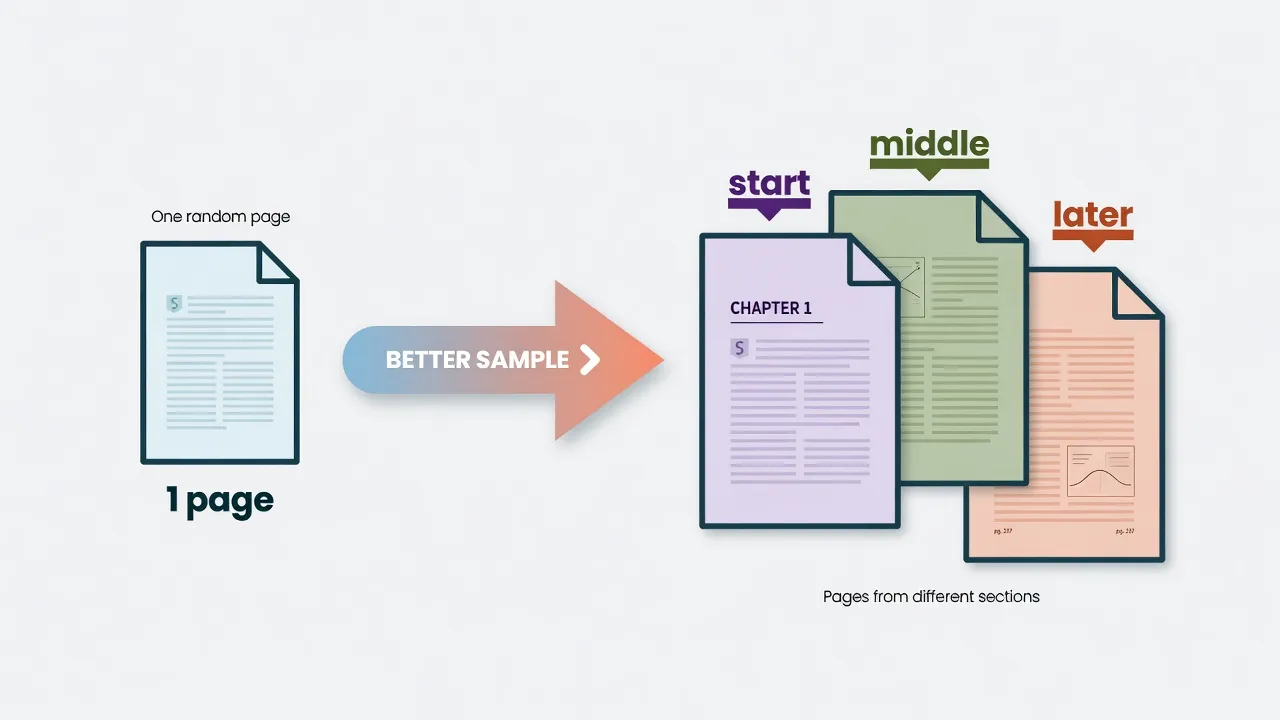
One page of roughly 250 words in an 80,000-word book is a thin slice. Three pages from different places is already much more honest.
5) It can demotivate
Finger-counting turns pleasure reading into a test. You feel graded before the story has a chance to pull you in.
Here's the idea in one picture: one page versus a small multi-page sample.
The better target: coverage, not finger theater
Vocabulary researchers (especially work popularized by Paul Nation and colleagues) keep pointing at a practical idea: for comfortable extensive reading, you usually want to understand roughly 95-98% of running words. Below that, dictionary load rises fast and "reading" becomes decoding practice.
You do not need a lab. You need an honest sample and a habit of estimating. No tool needs a fake exact book percentage tattooed on the cover.
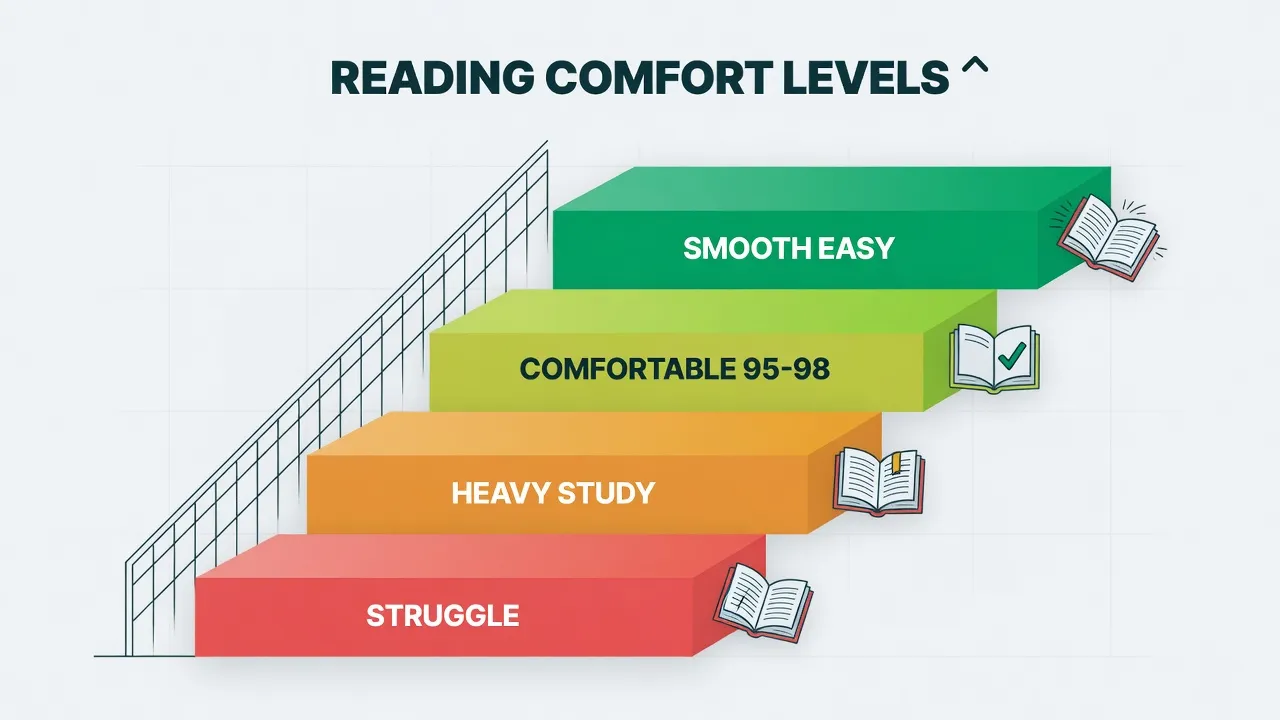
Use this ladder as a feel guide, not a scoreboard:
| Rough comprehension on a normal page | Reading experience | What to do |
|---|---|---|
| Under ~70% | Constant stop-start | Step down a level or use graded texts |
| ~70-85% | Heavy study mode | Short intensive sessions only, not daily pleasure reading |
| ~85-95% | Workable with support | Possible if the plot is strong and sessions stay short |
| ~95-98% | Comfortable extensive reading | Best daily-reader zone for many learners |
| 98%+ | Smooth / easy | Great for speed and confidence; fewer new words |
The middle of that ladder is where most adults quit or thrive. Aim for the green zone when the goal is habit.
A 10-minute method that beats five fingers
This is the method. Ten minutes. No mythical full-book math UI required.
Step 1: Sample three places, not one
Open:
- a page near the beginning (not only page 1 if it is pure prologue fog)
- a page near the middle
- a page near the end of an early chapter
Read each for 1-2 minutes.
Step 2: Score each page with a simple rubric
For each sample, ask:
- Can I follow who is doing what?
- Do I get the main feeling of the scene?
- How often do I hit a word that blocks the whole sentence?
Then mark the page:
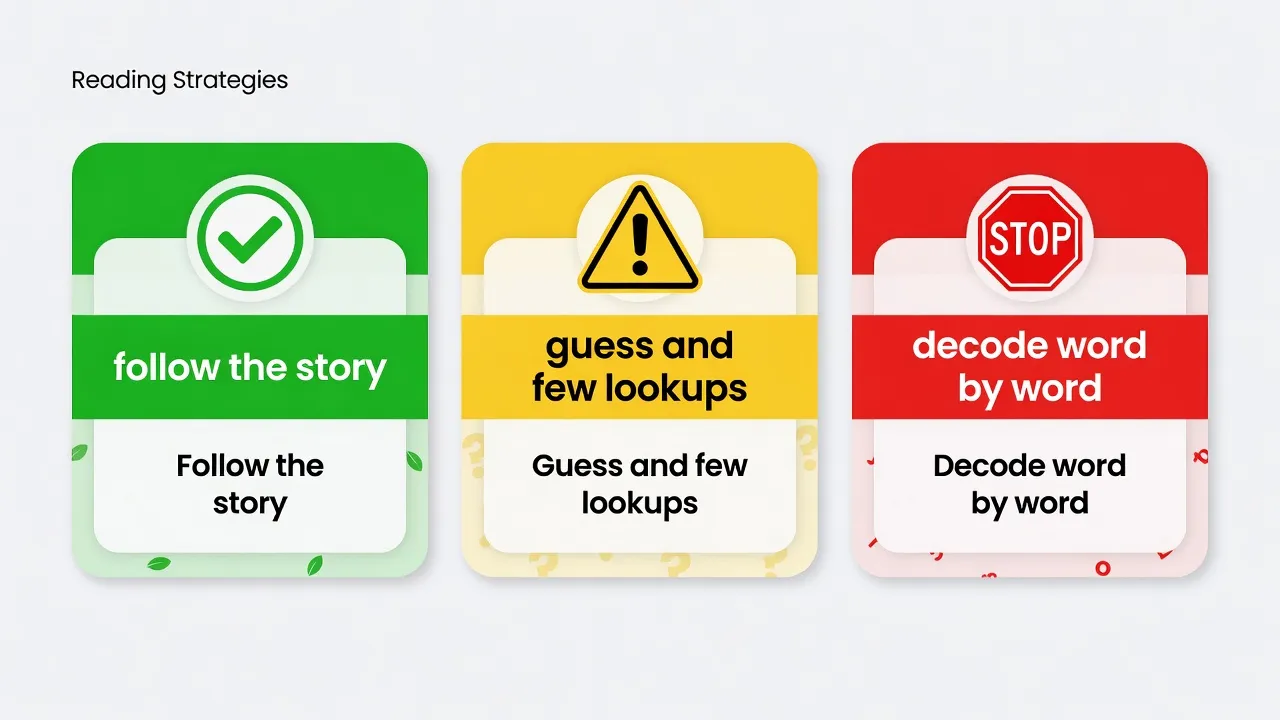
- Green: I can retell the scene in my own words with little help
- Yellow: I get the plot with some guessing and a few lookups
- Red: I am decoding word by word and losing the story
Step 3: Decide by majority and by your goal
- 3 greens: strong daily reader candidate
- 2 green + 1 yellow: good if you like the genre
- Mostly yellow: stretch project; short sessions only
- Any solid red in normal narrative: probably too hard right now
If your goal is confidence and habit, prefer green. If your goal is intensive challenge, yellow can work for 15 minutes, not for two-hour guilt sessions.
Step 4: Weight blockers, not every unknown
Only count words that stop meaning. Do not panic over:
- proper names
- one-off technical props
- words you can guess from context and still follow the plot
Do pay attention to repeated connectors, tense markers, and key verbs you cannot resolve.
Step 5: Run a "first chapter survival" check
If the three-page test looks yellow-green, read one full short chapter or 8-10 minutes of continuous text. Ask:
- Did I want to continue?
- Did lookups stay occasional?
- Could I summarize the chapter in 3-5 sentences?
If yes, keep the book. If no, switch down without drama. Switching is not failure; it is level hygiene.
Worked example (honest, not fake precision)
Suppose you are roughly B1-B2 and comparing three books:
- a diary-style YA novel
- a literary modern novel with dense description
- a classic with archaic style
You sample three pages of each.
- YA diary: green / green / yellow → daily reader
- literary modern: yellow / yellow / red → weekend stretch or later
- archaic classic: red / red / yellow → not your habit book yet
That decision is more reliable than five fingers on page one. You still did not invent a mythical full-book percentage. You used judgment on real pages.
What about frequency lists and "math"?
Frequency lists and coverage math are real tools in applied linguistics. They help:
- textbook writers
- graded-reader designers
- researchers estimating difficulty by word families
They are less magical for you at the bookshelf if you do not have a clean personal vocabulary inventory and a lemmatized book corpus. "About 95% feels comfortable" is already enough to guide behavior. Exact book tattoos like "you know 94.3% of this novel" are not required, and we will not pretend any free app has that as a reliable everyday fact for every EPUB.
Keep two layers:
- Practical layer (daily): multi-page green/yellow/red test above
- Concept layer (why it works): aim for high coverage so your brain can guess and enjoy, not drown
Graded readers vs authentic books
Both have a place. The mistake is making prestige the only plan.
| Option | Strength | Weakness |
|---|---|---|
| Graded / adapted texts | controlled load, confidence, speed | less natural style at higher levels |
| Easy authentic (YA, simple contemporary) | motivation, real phrasing | uneven difficulty spikes |
| Dense literary / archaic | prestige, rich style | high quit rate if too early |
A stable progression for many learners:
- A1-A2: mostly graded or very short authentic pieces
- B1: easy authentic + graded mix
- B2+: authentic novels you actually want to finish
Free graded practice (no novel purchase required):
Related strategy posts if you want more depth:
- Graded readers vs original texts
- How to read your first book without quitting
- Vocabulary for reading comprehension
MovaReader currently supports English and Spanish as learning languages. The sampling method works for both.
A weekly plan that protects the habit
Protect the habit first. Prestige second.
- 4 days: free graded texts (speed and low frustration)
- 2 days: one chosen authentic book in short sessions
- 1 day: review 10-20 saved phrases max
On authentic-book days:
- Read a paragraph once without stopping
- Look up only blockers
- Reread
- Save phrases, not endless single words
- Stop while you still want to continue tomorrow
If two authentic days feel heavy, flip the mix for a week. Consistency beats hero sessions.
How MovaReader fits (truthfully)
MovaReader helps when you want reading support without tab-hopping dictionaries all night. Judgment and the multi-page test come first. Tools reduce friction after you choose well.
- Warm up on free graded articles in All Articles.
- Upload a book file you own when ready (How to use).
- Tap words that block meaning; skip names and fluff.
- Practice a small set in the word training demo or phrase typing demo.
- Full trainer workflows live under Trainers.
- Optional orientation on ranges: Language map.
Freemium truth:
- Free: listening + limited word translations (about 20/day) + free graded library
- Reader (€1): unlimited translations
- Pro (€5/mo): full trainers
Details: Pricing.
What this article does not claim:
- MovaReader does not replace your judgment with a guaranteed perfect "94.3% coverage" score for every book
- It does not host commercial novels as free chapter buttons by default
- It does not make a C1 novel feel like A2
- English and Spanish only as study targets here; upload your own EPUB when you own the rights to the file
Suggested start today:
- Open a free A2 sample
- Try the typing demo
- Run the 10-minute multi-page test on one real book you already own
- Only then upload that file if you want in-app support
FAQ
Is the 5-finger rule completely wrong?
No. It is a fast warning light. It is just a weak final verdict for adult second-language readers.
What percentage of unknown words is too many?
For relaxed extensive reading, many learners do better near the high-90s comprehension zone. If you need a lookup every line, treat the book as study text, not a flow book. Use ranges and feel, not lab tattoos.
Should I always avoid hard books?
No. Hard books are fine as short intensive practice. They are a bad only daily habit if they kill consistency.
Is poetry a good level test?
Usually no. Poetry compresses meaning. Use narrative prose pages for level checks.
Do I need AI to choose a book?
No. Three sample pages and a green/yellow/red call already beat one-page finger counting.
Can I use the same method for Spanish and English?
Yes. The sampling logic is language-agnostic. Only the free sample links and library titles change.
Final takeaway
Do not let five fingers on page one decide your next three weeks of motivation.
Sample more than one page. Judge whether you can follow the story. Aim for a comfortable coverage feel (often near 95-98% for extensive reading). Mix graded texts with authentic books so the habit survives hard weeks. Tools can reduce friction after you choose well. They cannot turn a bad level match into an easy novel.
Start simple: read a free graded sample, then run the 10-minute test on one book you actually want to finish.
Learn languages by reading!
Try MovaReader for just €1 — read texts with instant translation and interactive vocabulary training.
Free plan: 20 word translations/day and unlimited listening. Pro (€5/mo) unlocks full trainers.