Reading Strategies
Graded Readers vs Original Books at A2: The Comfort Trap
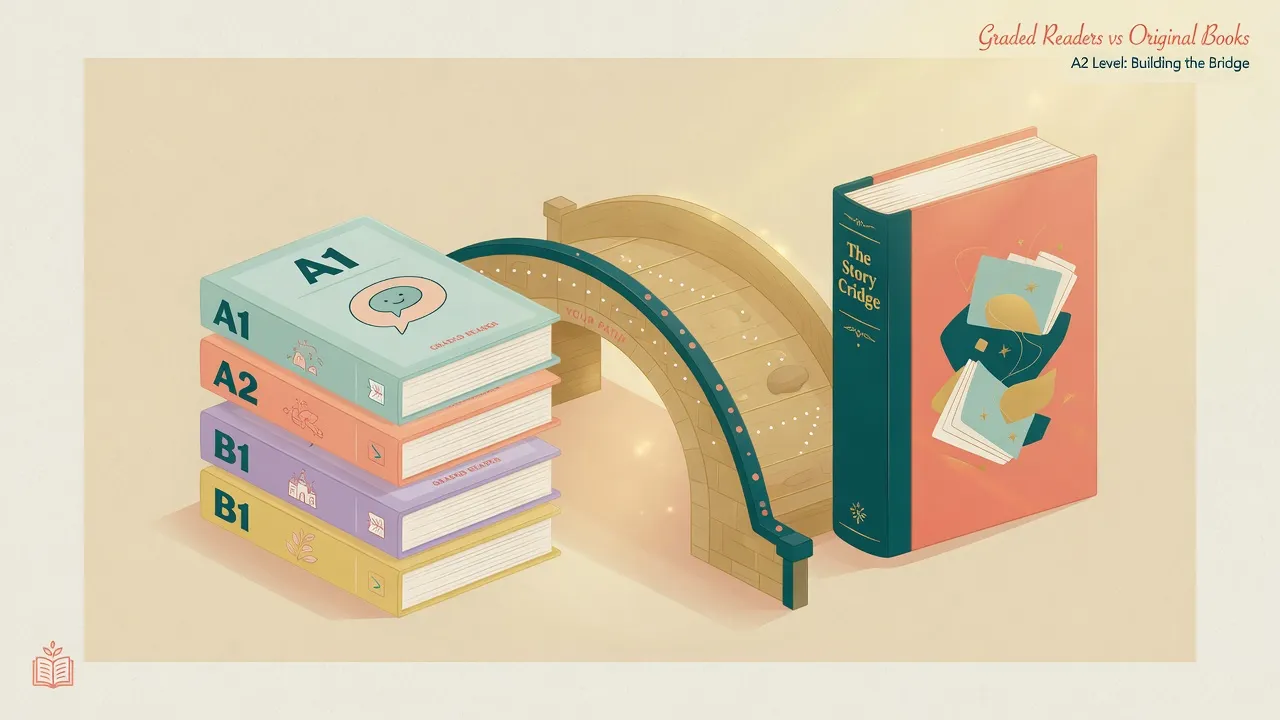
Adapted books are not "bad." After early A2 they can become a comfort trap. See what graded texts cut, why cold originals + dictionary break flow, and how to bridge with five finishable first books.
You buy another Pre-Intermediate graded reader. Friendly cover. Short sentences. You understand almost everything. It feels like progress.
Then you open a random post on X (Twitter), a news blurb, or page one of a cold novel - and the plot dies. Real English looks foggy again.
That is not a talent problem. It is the comfort trap: graded readers (adapted books) keep working as a safe room after early A2, while authentic English stays outside.
Here's the simple version. Graded readers help at early A2 - you build flow and confidence. The trap starts when you stay on Pre-Intermediate comfort for years while posts, news, and unadapted fiction still feel opaque. Cold original plus a paper or phone dictionary often breaks the story. A better bridge is a finishable first original with in-context help, not a purity war. This week: pick one easy original from the list below, read short sessions, and look up only sentence-breakers.
Below: what the trap looks like, what adaptations cut, why cold originals fail, three reading paths, five first books, a 30-day soft bridge, and an FAQ.
What is the graded-reader comfort trap?
Graded readers are not bad. Early A2 needs short sentences, limited vocabulary, and wins you can finish. Many people rebuild reading confidence there - and that is real.
The trap is different. It is years on the same band (Pre-Intermediate forever) while you avoid denser, living English. Full comprehension of a simplified page is not the same as readiness for authentic text.
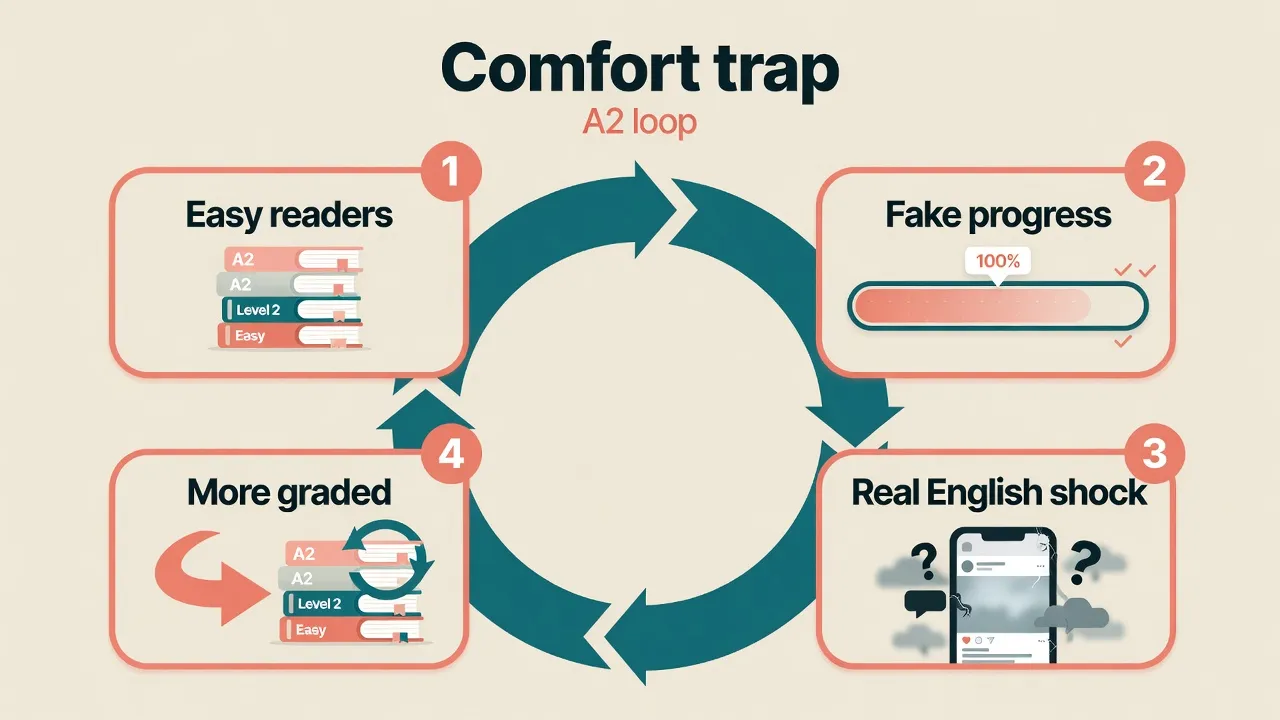
You may recognize the loop:
- Graded ease feels good
- You feel progress (100% of a simplified text)
- You avoid denser real English
- You buy another graded title
- Real posts and pages stay opaque - back to step 1
Soft rule of thumb: if graded is effortless and real posts or simple articles still foggy, you are in the trap - not "failed." Plenty of learners share the same pain: boring plots, stuck, "I should move but..." That hesitation is common. The fix is a soft bridge, not shame.
If you are asking when to stop graded readers (or stop relying on them alone), that is the decision this piece is for. Some people keep light graded text as a warm-up forever. That is fine. The problem is only graded for years.
What do adaptations cut from the original?
When editors grade a text for A2-B1, they often remove the living parts of the language. Same plot idea; different learning fuel. If you care about vocabulary for reading comprehension, this list is why density matters.
- Idioms and metaphors - "The news hit her like a ton of bricks" becomes "She was very surprised."
- Complex grammar combinations - inversions, dense conditionals, stacked passives (you do not need a grammar lecture; just notice denser lines disappear).
- Author voice - irony, understatement, rhythm.
- Culture, jokes, allusions - the jokes that make native writing feel native.
A concrete Orwell-style pair:
| Flavor | Text |
|---|---|
| Original-ish | He was a lonely ghost uttering a truth that nobody would ever hear. |
| Graded flatten | He felt alone. Nobody listened to him. |
Technically the idea is similar. The first line feeds ghost, uttering, truth in a metaphor. The second recycles alone and listen if you already know them. Graded text is still useful early. After early A2, it often underfeeds the language you meet online and in unadapted fiction.
Why does cold original + dictionary fail?
You decide: "Fine. I will open a real book." Then the classic quit loop:
- Page 1 - many unknowns; you open an external dictionary; you lose your place.
- Page 3 - the plot thread is gone; every sentence feels like homework.
- Page 5 - the book closes "for later."
The problem is often tooling plus a level jump, not "no talent." External dictionary means leave the text, search, return, forget the clause. The brain flips from story mode to drill mode.
Some learners do cold originals fine - known plot, very short texts, high tolerance for fog. Many A2s do not. That is normal. Jumping from Pre-Intermediate graded comfort straight into a dense prestige novel is a big cliff. You need a softer landing, not a purity badge.
Three paths: graded, cold original, supported original
You do not have to choose only "safe graded forever" or "heroic cold novel." Three paths exist. Pick by where you are, not by purity.
| Path | What it is | Strength | Limit after early A2 |
|---|---|---|---|
| Adapted / graded | Controlled vocab and length | Safety, confidence, early flow | Growth caps if you never leave |
| Cold original + external dictionary | Unadapted book + phone/paper lookup | Authentic input when it works | Flow break; quit risk |
| Supported original | Original text + in-context sentence help (optional EN-to-EN) | Real language without full jump shock | Still work; not instant B2; tool limits apply |
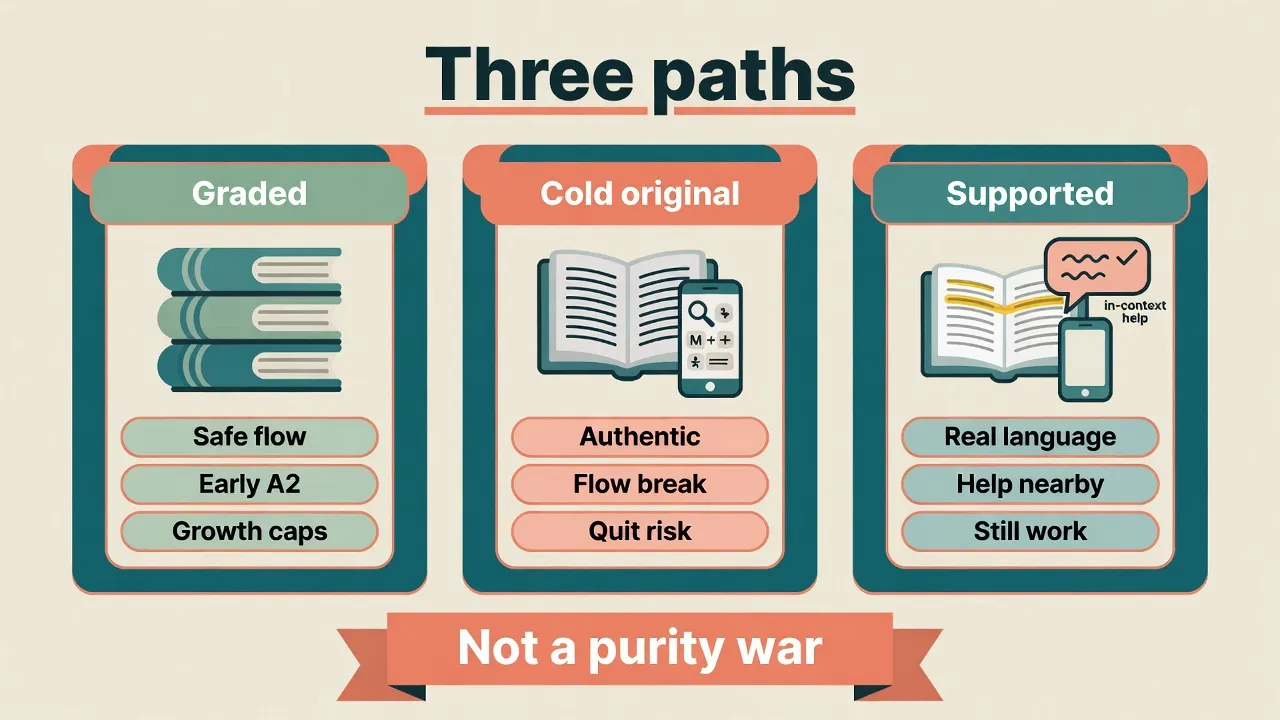
This is not a purity war. Stay on graded briefly if you still need early A2 stability. Bridge when graded feels effortless and real posts stay foggy. Do not treat "stay on graded readers until B2" as the only rule - that advice helps some classroom tracks and stalls many self-learners. For more on how reading grows usable words, see how to build B1 vocabulary by reading.
In-context help vs external dictionary
| Mode | What happens | Effect on story |
|---|---|---|
| External dictionary | Leave text → search → return → forget clause | Often kills flow |
| In-context help | Tap / sentence help stays near the line | Keeps you in the book |
| Optional EN-to-EN gloss | Simpler English near the word or phrase | Less L1 relay; still optional |
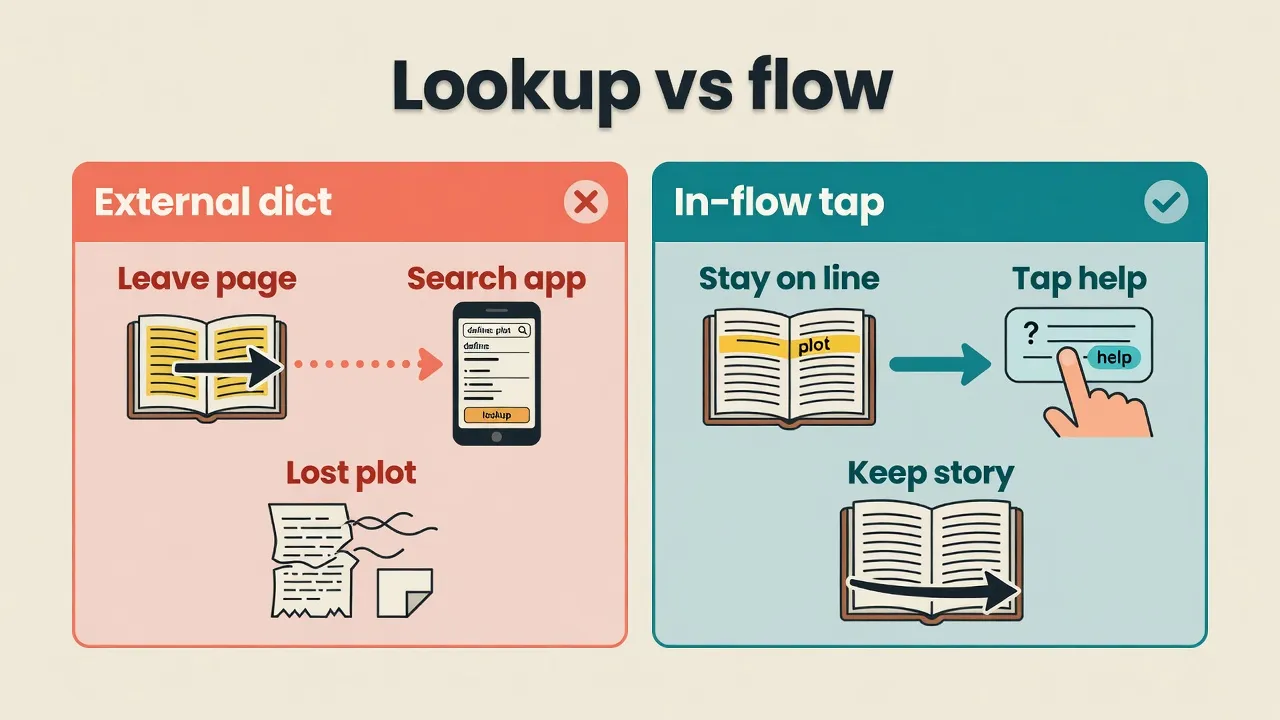
In-context help is a tool class, not magic. You still choose books you can finish, short sessions, and lookups that protect the story. Plans and free plan limits come later if you want software for that path.
Which 5 first original books work after graded readers?
Think finishable transition ladder, not prestige. These five work well for many A2-B1 English learners moving off graded comfort. Prefer a known plot or the shortest first.
| # | Book | Author | Why first-able | Watch-out |
|---|---|---|---|---|
| 1 | The Old Man and the Sea | Hemingway | Short sentences, short book | Sea words; "simple style" still literary |
| 2 | Wonder | R.J. Palacio | Child voice, short chapters, plot pull | Longer total length; themes can hit hard |
| 3 | The Curious Incident of the Dog in the Night-Time | Mark Haddon | Clear narrator logic, detective frame | Math digressions / lists change rhythm |
| 4 | Animal Farm | Orwell | Surface story simple | Allegory needs a tiny history cheat sheet |
| 5 | Charlotte's Web | E.B. White | Clean, elegant prose | Farm animal lexis; emotional density |
1. The Old Man and the Sea (Hemingway)
Short book, spare sentences. A strong first finish for many learners. Sea vocabulary can snag you, and "simple style" is still literary. Start tip: try 5-8 pages. If the plot dies under lookups, stop the session - do not punish yourself into page 50.
2. Wonder (R.J. Palacio)
Child point of view, short chapters, strong pull to keep reading. Total length is longer than Hemingway, and some themes hit hard. Start tip: one chapter a day is enough.
3. The Curious Incident of the Dog in the Night-Time (Mark Haddon)
Clear narrator logic plus a detective frame. Math digressions and lists change the rhythm. Start tip: skip a digression once if you must; protect the detective thread and return later.
4. Animal Farm (George Orwell)
Surface story is simple animals. The allegory needs a tiny history cheat sheet if you want the second layer. Start tip: read for plot first; allegory second.
5. Charlotte's Web (E.B. White)
Clean, elegant prose that still feels like real English. Farm animal words and emotional density can surprise you. Start tip: 15-20 minutes, sentence-breakers only.
Harry Potter caveat: high-motivation later stretch for many people. It is often too long and dense as the default week-1 A2 first finish. Save the saga for when short wins already feel normal.
Want a longer ladder after these five? See the 10 easiest English books for A2-B1. When you are ready, you can upload a legal copy of one title into a reader app - or warm up on free graded samples first.
How do you move from graded to original in 30 days?
This is a soft bridge, not "B2 in a month." Success means more finished chapters and less fog - not a certificate.
Weeks 1-2: known-plot or easiest first original
- Pick from the five. Prefer known story or shortest: Old Man, Charlotte's Web, or Wonder.
- Read 15-20 minutes almost daily.
- Look up sentence-breakers only. Do not harvest every unknown.
- Goal: finish sessions and keep the plot, not perfect vocab scores.
Weeks 3-4: new story in your genre
- Mystery, light YA, or a short classic in your interest zone.
- Notice fewer lookups if sessions were regular.
- On hard days, mix optional free graded samples (for example from free articles). That is not a shame step - it is pacing.
What "success" looks like
- You finish chapters more often.
- Graded Pre-Intermediate starts to feel flat (good sign).
- Social posts and simple articles feel a bit less foggy.
- Not: a guaranteed +500-1000 words, fluency, or a CEFR jump on a calendar.
If vocabulary growth is your main focus after the bridge habit sticks, building B1 vocabulary by reading goes deeper without turning every page into a drill.
Reading originals with help (soft product path)
Once the method is clear, software is optional friction reduction. MovaReader is a reader with click translation and sentence help, a free graded library path, and upload of your EPUB or file. Optional EN-to-EN glosses keep you near English when that helps. The point for this article: finish a first original without the classic external-dictionary quit loop.
Practical path:
- Warm up with free samples on /en/all-articles if you need an easy day.
- Upload a legal copy of one of the five when ready (how to use).
- Tap blockers only; optional EN-to-EN gloss.
- Optional trainers when phrases stick (type training demo, phrase typing demo).
- Track visible vocab on the language map if you use marks.
- Plans and limits: /en/pricing.
| Need | Realistic plan |
|---|---|
| Try the loop / free graded path | Freemium (~20 word translations/day; listening often unlimited) |
| Real reading volume with AI translation | Reader €1/mo |
| Trainers beyond reading | Pro €5/mo |
| Commercial novel you own | Your legal EPUB/file - not unlimited hosted catalog |
What it does not do: host a free warehouse of full commercial bestsellers by default or replace speaking practice. The free plan is enough to test the habit. Reader-level volume is what many people need for real pages. Supported original reading is still work - a bridge, not instant B2.
FAQ
When should I stop graded readers?
When early A2 stability is there and graded feels too easy while real posts and pages stay hard - start a soft bridge, not a shame quit. Some people keep light graded as warm-up forever. The trap is only graded for years. That is the practical answer to when to stop graded readers as your main diet.
Is A2 ready for original books?
Yes for easy first originals with support and short sessions - not for dense unadapted prestige cold. Readiness depends more on book choice than the label "A2." Prefer finishable titles from the five above (or known plots).
Dictionary app vs in-context help - does it matter?
Yes for flow. External lookup often kills the story: leave text, search, return, forget the clause. In-context help keeps you near the sentence. Still look up less, finish more. Optional EN-to-EN gloss reduces L1 relay when it helps.
Which first original book should I pick?
Prefer known plot or shortest from the five: often The Old Man and the Sea, Charlotte's Web, or Wonder. Avoid defaulting to long YA sagas as "easy A2." Harry Potter can be high-motivation later; it is rarely the best week-1 first finish. For more titles, use the easiest English books A2-B1 list.
Should I stay on graded readers until B2?
Some ELT advice says wait; many self-learners stall that way. Our take: a soft A2-B1 bridge with finishable books plus support beats a purity timeline. Stay on graded briefly if you still need early stability. Do not treat "until B2 only" as law.
What are the free plan limits if I try supported reading?
Free path: graded library plus roughly 20 word translations/day; listening is often freer. Reader ~€1/mo for more AI translation volume; Pro ~€5/mo for trainers. Upload your own legal EPUB for commercial titles - we do not host unlimited bestsellers by default. Details: /en/pricing. Bridge, not instant B2.
Next steps
Graded books helped you start. They are not a life sentence. Cold original without support is optional heroics, not the only adult path.
This week:
- Pick one finishable original from the five (or a free graded warm-up on a hard day from /en/all-articles).
- Read short sessions. Look up only sentence-breakers. Protect the story.
- If you want in-context help, upload a legal file and stay on the free plan while you test; move to Reader €1 on /en/pricing when translation limits stop real pages.
- Optional: mark progress on the language map; expand the ladder with more easy books.
The tool reduces friction. The pages still come from you.
Learning English?
The English version of MovaReader teaches Spanish and Ukrainian. To read English with a translation for every word, open the reader in Ukrainian or Spanish:
Книги англійськоюЦя стаття українськоюLibros en inglésEste artículo en español