Vocabulary
How Large a Vocabulary for Reading Comprehension?
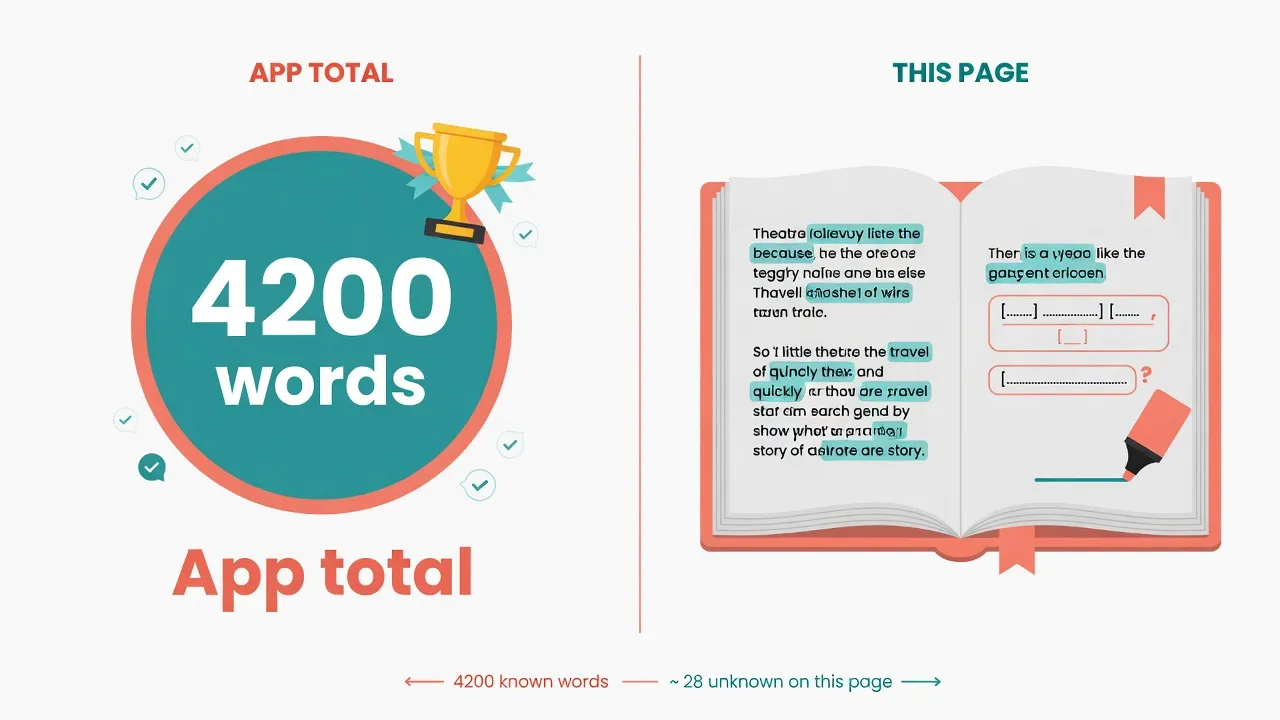
Reading comprehension is not "I know 4,200 words in an app." It is how many words on this page you already recognize. Here is how 95% and 98% work - and what to do next.
You have seen this: "I know 4,200 words" - and you still drown on page one of a news story or novel. That is not hypocrisy. Those are different questions.
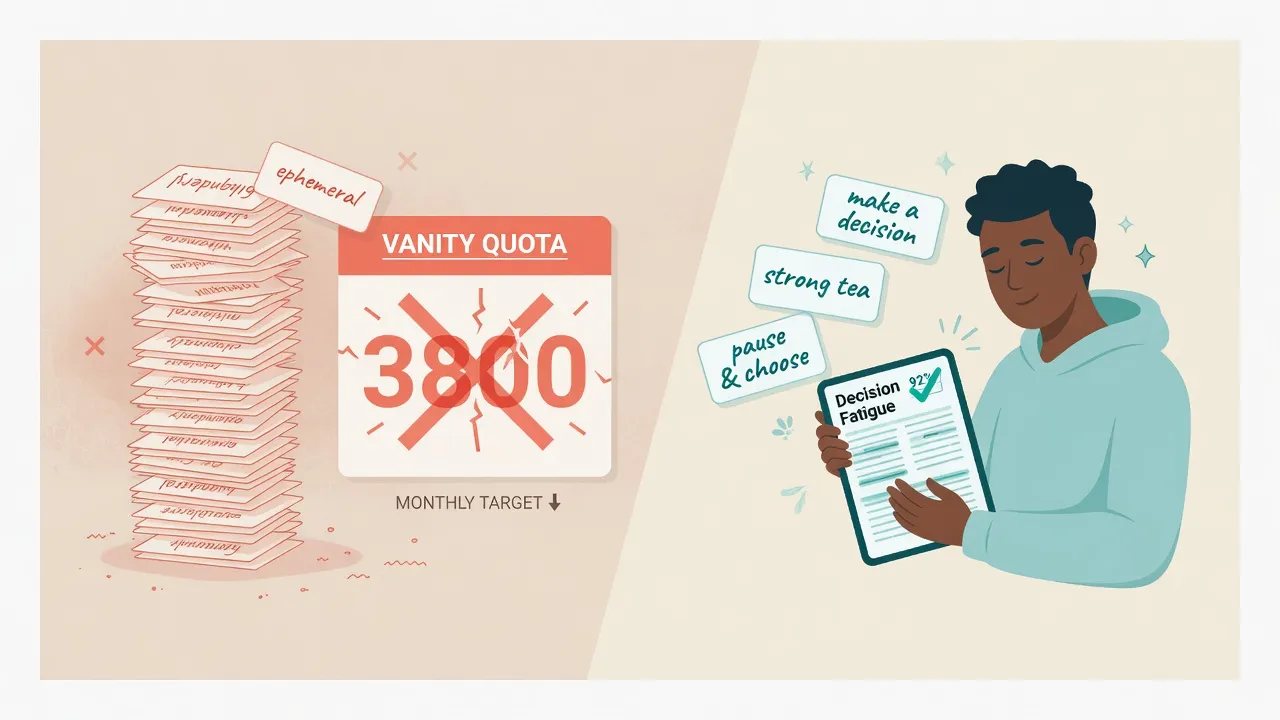
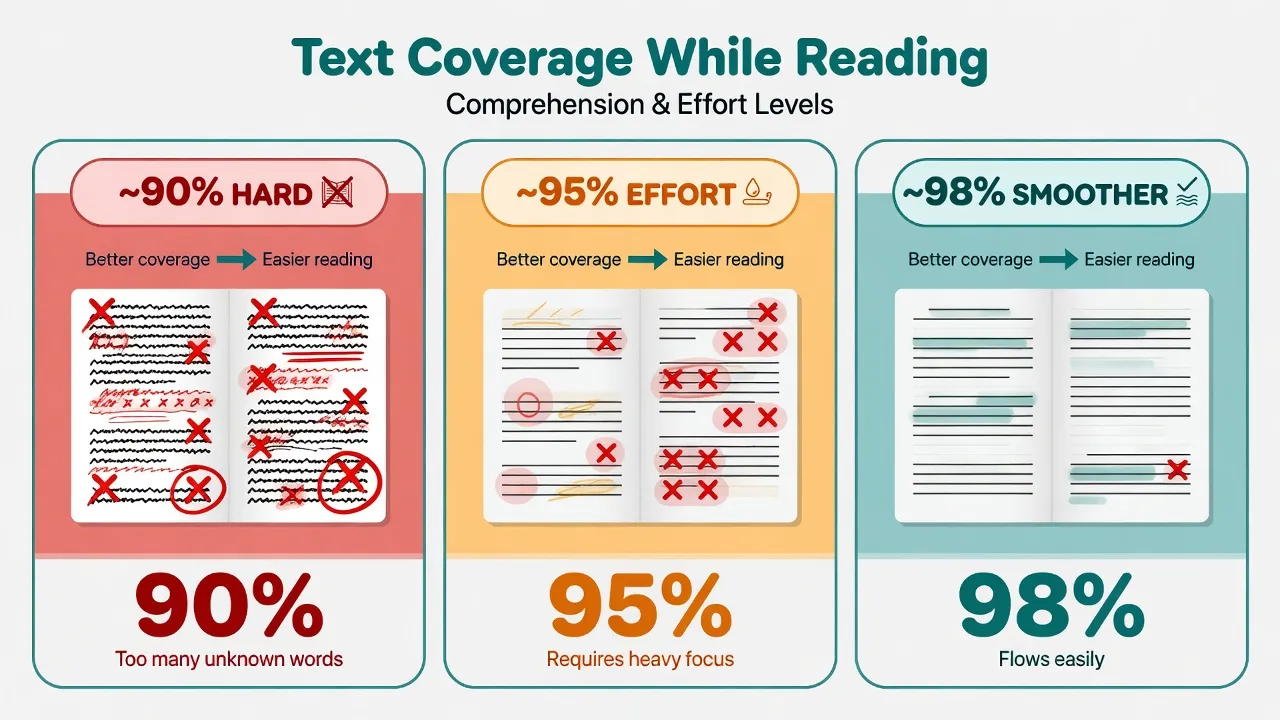
Short version: for reading comprehension, lexical coverage - the share of words on this page you already recognize - matters more than a vanity counter in an app. Research often talks about roughly 95% (still hard) and 98% (usually more comfortable for unassisted reading of tougher text). Treat them as compass ranges, not a magic switch.
This guide is about English and Spanish. Ukrainian here is the article UI language, not "learn Ukrainian as a target" in MovaReader.
Two different scores
| Question | What it measures | What it misses |
|---|---|---|
| "How many words in my app?" | Cards, known flags, your reviews | Genre of this page, multiword units, speed |
| "Can I follow the text?" | How many tokens on the page you already recognize | An "official" CEFR badge by itself |
A private total of "4,200 known" and the feeling "this page is a wall" can both be true. Coverage studies often count word families; apps count lemmas or forms. So numbers rarely match 1:1. More: lemma vs word form, does 5,000 mean C2?.
95% and 98% in plain language
| Coverage (approx.) | Unknowns (order of size) | How it often feels |
|---|---|---|
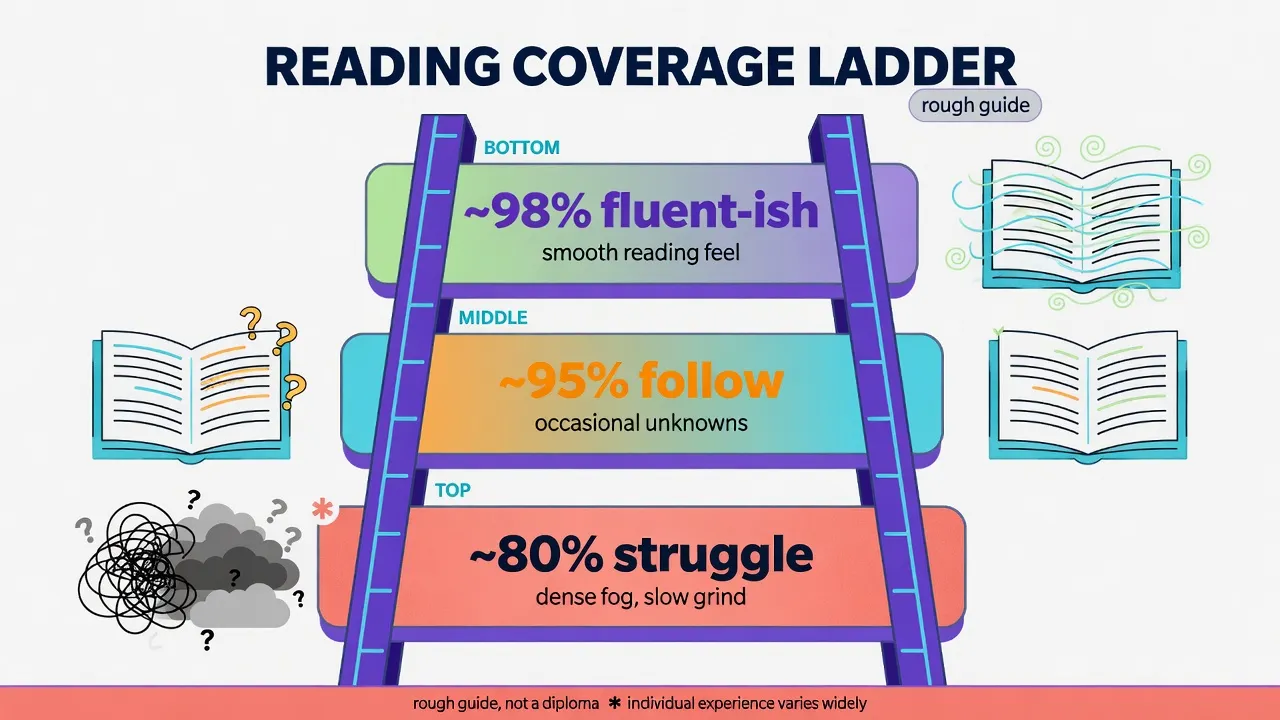
| ~80-90% | 1 unknown per ~5-10 words | Constant decoding, not real reading |
| ~95% | ~1 per 20 | Possible with effort; many people still tire |
| ~98% | ~1 per 50 | Much more comfortable unassisted reading of harder text |
| ~99%+ | rare | Easy extensive reading for this text |
Classic discussion points come from work such as Hu & Nation (2000) and later coverage research (including Schmitt and colleagues; Nation 2006 on size for reading/listening). A summary you will see often:
- about 8,000-9,000 families as an orientation toward ~98% of many written texts (novels and the like);
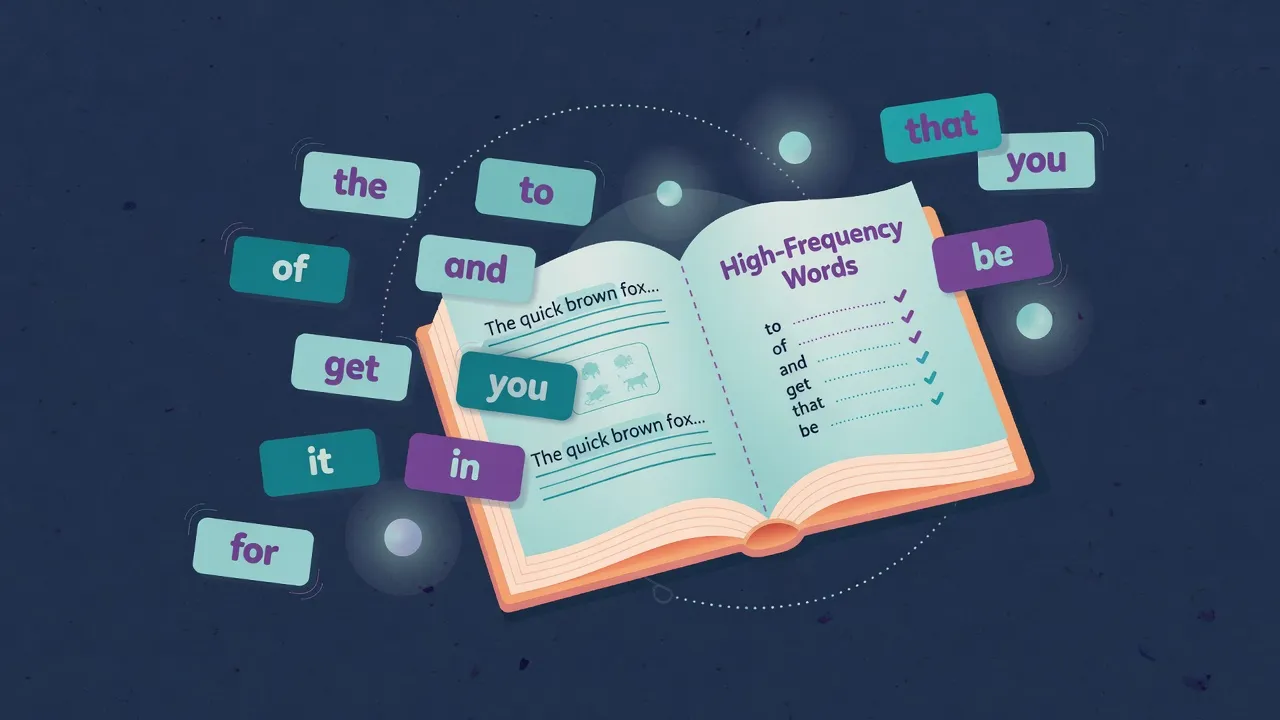
- smaller high-frequency packs toward ~95% on simpler material.
Not a law of nature and not your personal blood test. Genre, topic, proper names, multiword units, and "I know this field" all change the feel. Newer papers also remind us that 95% vs 98% is not identical in every experiment. Keep 95/98 as a compass, not an exam.
How many "families" - and why the CEFR map is different
| Goal (orientation) | What the conversation is about | How not to mix it up |
|---|---|---|
| ~95% on simpler text | Frequency thousands of families + genre | Not = "B1 in every app" |
| ~98% on demanding prose | Often ~8-9k families in EN research talk | Not = a C1 certificate |
| MovaReader CEFR map | Research bands + % on our catalogue | A different system from Nation coverage |
The language map answers: "How am I moving through product level catalogues?"
This article answers: "Why is this page easy or hard right now?"
Both are useful. Neither replaces the other. Map guide: how the map works. CEFR size talk: how many words CEFR.
A practical ladder (EN / ES)
Do not wait for "perfect 98% on everything." Climb steps:
- Graded / adapted texts - lots of known words; the story still moves.
- Simple news, blogs, dialogue - a bit more noise, still manageable.
- Popular fiction / series books - you often need closer to comfortable coverage.
- Academic, legal, dense non-fiction - even a large vocabulary can fail without topic knowledge.
Spanish: Plan Curricular and teaching lists are about what to teach, not one global word quota "for 98% of any novel." See Plan Curricular.
English: frequency lists and families are a handy research language; your app may count differently. Do not compare apples to flashcards.
Try a page (same IDs, /en/ locale):
ES A1 #1127 · ES A2 #1209 · all articles
How to grow without lying to yourself
- Read where the plot or argument still lives, even with unknowns.
- Mark learned after real meetings in text, not green-tapping a list.
- Count phrases too: words vs expressions.
- Mix extensive (volume, pleasure) and intensive (hard passage work).
- Want a catalogue dashboard? Map after sign-in + EN/ES. Tracking: track vocabulary progress.
How MovaReader helps
MovaReader helps you read with in-context translation and build a dictionary. Personal map % needs an account, a learning language (EN/ES), and many marks. The free plan is for trying (about 20 word translations/day as a guide). Practical reading volume is Reader from €1/mo. Full trainers / deeper grammar tree: Pro €5. Pricing · how to use · register.
FAQ
Does 5,000 words mean comfortable novels?
Not automatically. It depends on unit type (form/lemma/family), genre, and this book. See the 5,000 myth.
Is 95% "enough"?
Sometimes yes, sometimes no. Many people still tire hard at 95%. 98% is more often discussed as a safer aim for comfortable unassisted reading of demanding prose - as orientation, not law.
Why do studies say 8-9k families while the CEFR map shows other numbers?
Different questions and different lists. Coverage research ≠ product catalogue ≠ exam.
Will Anki alone fix reading?
Cards build recognition. Page coverage is tested on a page. Best together.
Does Ukrainian count as a learning language?
No. In MovaReader targets are English and Spanish. UI can be Ukrainian.
Next
- Open an easy text and be honest: are you reading or decoding?
- Compare with the map and CEFR ranges.
- Step graded → slightly harder, not a jump into a wall.
- Method: B1 by reading.
Comprehension does not come from a pretty number in a profile. It comes when the next page feels a little less hostile - again and again.
Keep reading with translations inside the text
With a free account, an unknown word translates with one tap, and the words you are learning wait for you in the trainer.
Free account: 7 days of Pro, then 20 word translations a day or a paid plan.