Vocabulary
Most Frequent English Words: a Practical Core With Examples
A small English core does a huge share of daily work. Here is a usable high-frequency set, examples for multipurpose words like get and to, and a reading method that makes them stick.
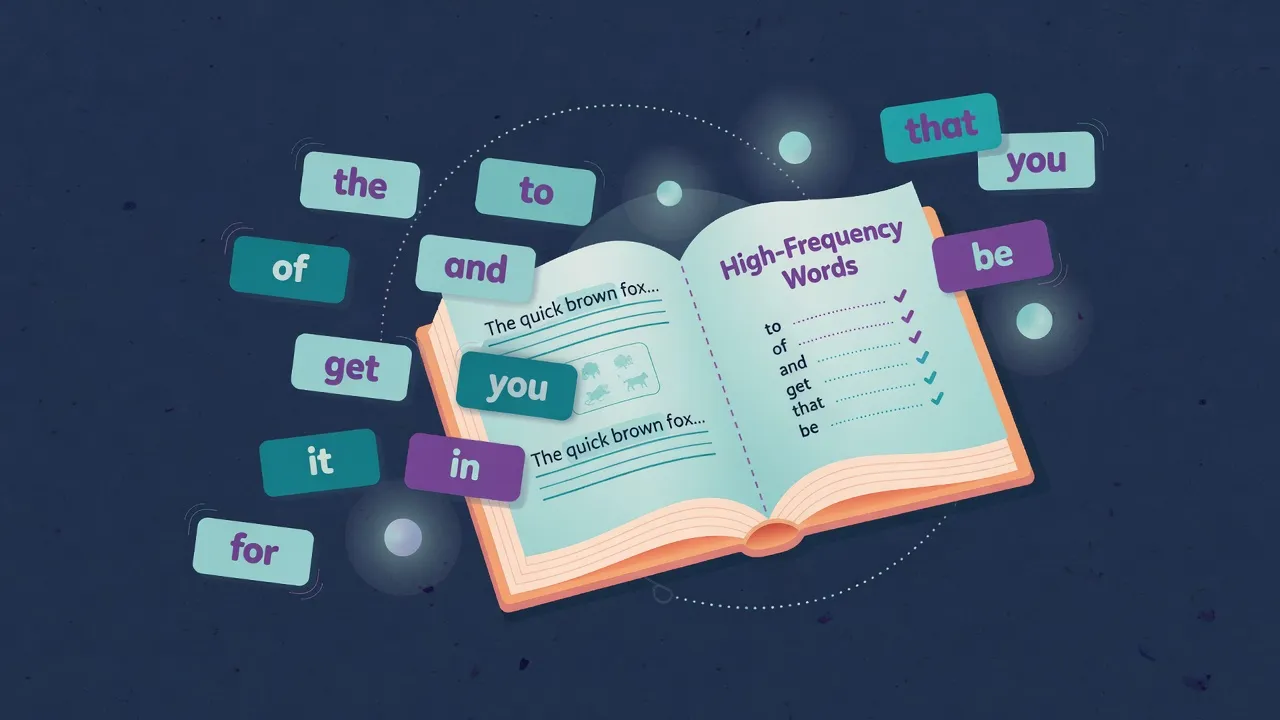
You have probably seen "1000 most common English words" lists that look useful for five minutes and evaporate by Tuesday. Isolated rows are weak memory anchors. Frequency research still helps, though: a small core of English does a huge share of everyday speaking and writing.
Here's the simple version. The most frequent English words are the glue of daily sentences (the, be, to, of, get, that...). A small band covers a large share of running tokens in many corpora. That is not the same as understanding every page or speaking fluently. Learn a practical scaffold of about 50 function words in phrases, meet them in easy reading, and treat "3000 words a month from a list" as marketing, not a plan.
This guide is for English learners in general. Spanish speakers often search this topic hard, but the same scaffold helps anyone building reading and listening at A2-B1 and beyond.
Here is what you get below:
- What "50 words cover a lot" really means (and what it does not mean)
- Why bare lists fail on multipurpose words like get, to, and that
- A practical high-frequency set grouped by function, with short examples
- A four-step method to learn functional words without drowning in glosses
- A 15-minute routine and a note on how MovaReader fits
If you want size orientation later, see how many words by CEFR and the language map.
What "50 words cover a lot of text" really means
Zipf's law and corpus work (frequency bands in the spirit of the General Service List, Oxford 3000, or modern corpus counters) point the same way: a few words show up constantly; a long tail of rarer words carries most of the meanings.
Think rough bands and tokens, not a certificate that these exact 50 equal a fixed percent of every book.
| Band | Coverage idea | What you actually gain |
|---|---|---|
| Top ~10 | Huge token slice | Phrase glue: the, be, to, of, and, a |
| Top ~50 | Skeleton of many simple texts | Structure: you follow the sentence better |
| Top ~1,000 | Much of everyday written English | Independent reading starts to feel possible |
| Top ~3,000 | Solid general base | You still need thousands of content words |
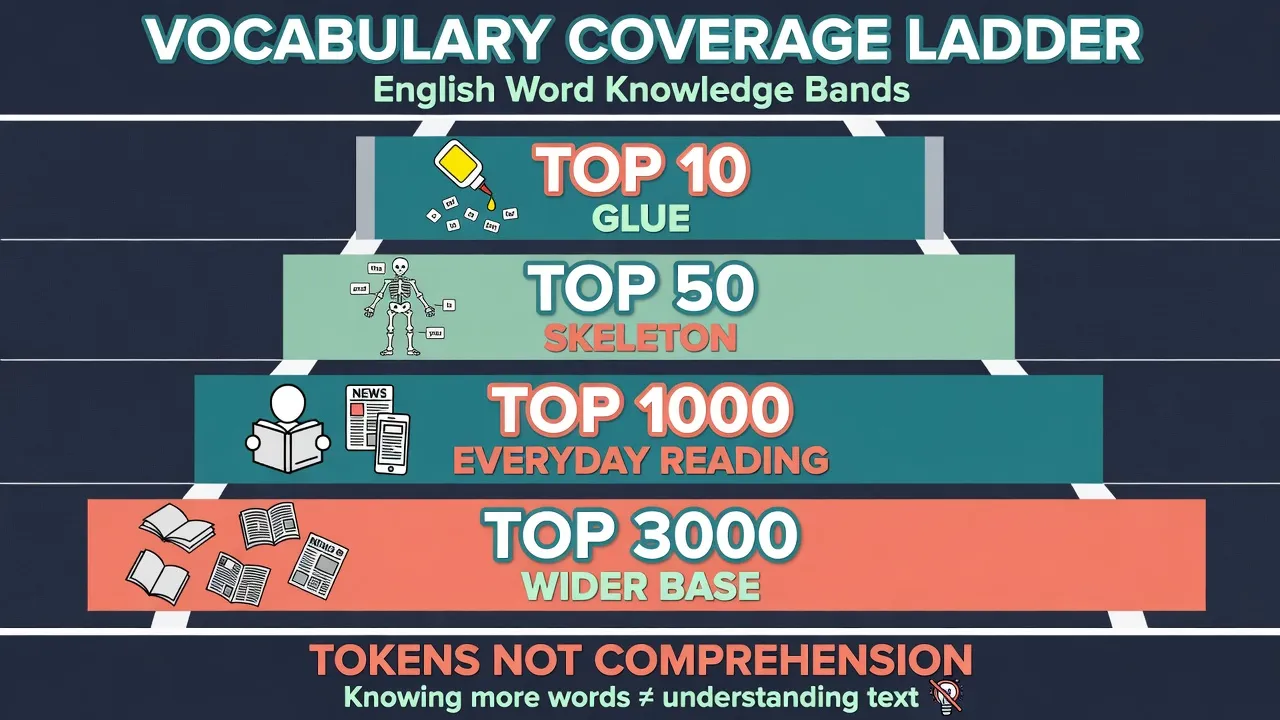
Important caveats:
- Coverage talks about tokens (words that pass by), not "you understand every sentence."
- Many of the top 50 are "small words": the, of, to, it. Knowing a gloss is not the same as using them.
- The rest of a conversation is spread across thousands of content words. The top 50 is foundation, not fluency.
- Nobody stably "installs" 3000 words a month from lists alone. That pace is marketing, not a serious plan for most adults with jobs and lives.
The real goal: automatic recognition of high-frequency patterns in sentences you understand, not memorizing table rows. For more on lemmas vs forms and multiword units, see lemma vs word form and words vs expressions at CEFR.
Why lists alone fail (especially get, to, that)
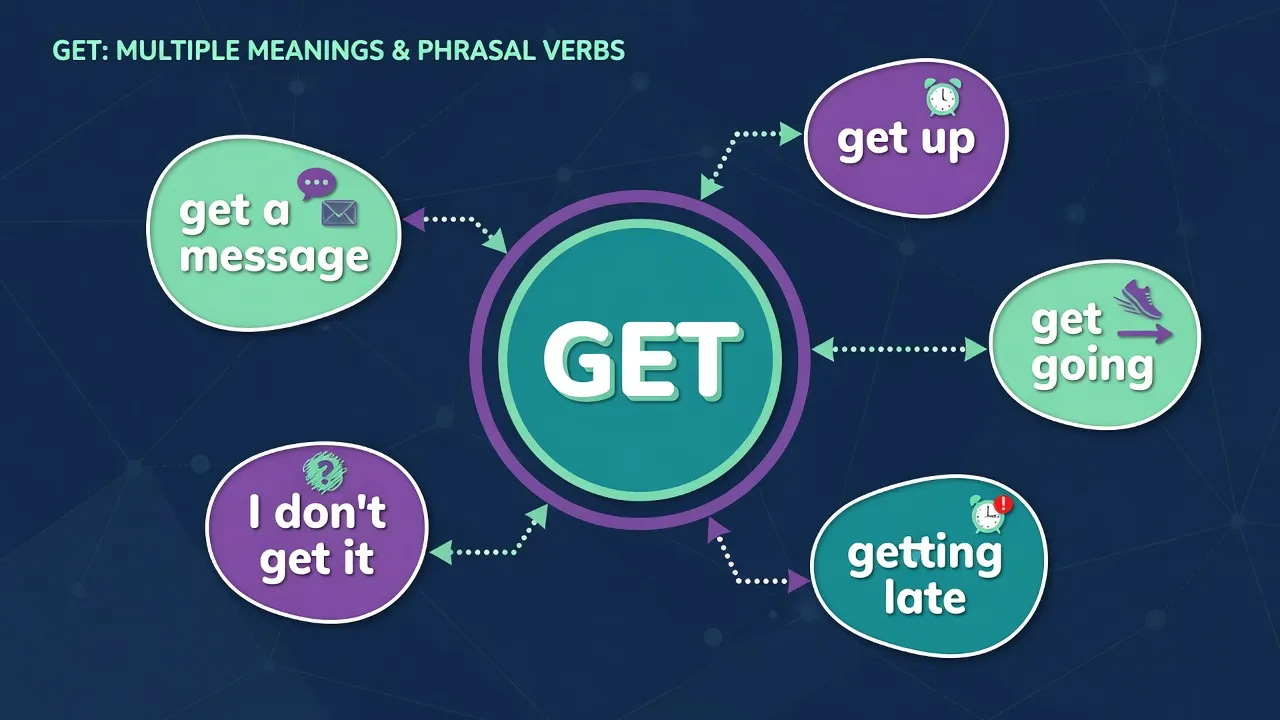
Take get. A list says:
get = obtain / receive
That is true and almost useless by itself. In real English:
- I get up at 7. (wake / rise)
- Did you get my message? (receive)
- It's getting late. (become)
- I don't get it. (understand)
- We have to get going. (start moving)
You only stabilize this by seeing the word do different jobs, many times, in sentences you already understand. Same story for to (infinitive marker vs direction), that (demonstrative vs conjunction vs relative), and have (possession vs perfects vs have to).
These are not "apple = fruit" vocabulary cards. They are grammar habits.
Mini-dialogue: one word, five jobs
A: Did you get my email? B: Yes. I get up early now, so I replied at six. A: It's getting cold. I don't get why the heater is off. B: True. We should get going before the bus leaves.
Save those lines as chunks, not one bare gloss. Spanish speakers (and others) often stall here because the L1 gloss feels "done" while the English jobs keep shifting.
The ~50 high-frequency words (practical set)
Exact rankings change by corpus (spoken vs written, news vs fiction). What follows is a practical high-frequency set for everyday English, not an eternal official ranking.
Articles, demonstratives, and basics
| English | Role | Example |
|---|---|---|
| the | definite article | The coffee is hot. |
| a / an | indefinite article | I need a break. / An apple. |
| this / that | demonstrative | This is easy. / That was hard. |
| these / those | plural demonstrative | These books help. |
| some / any | indefinite quantity | Do you have any time? |
Frequent pronouns and possessives
| English | Role | Example |
|---|---|---|
| I / you / he / she / it | subject | She works here. |
| we / they | plural subject | They live nearby. |
| me / him / her / us / them | object | Call me later. |
| my / your / his / her / our / their | possessive | My phone is dead. |
| it | also dummy / object | It is raining. / I like it. |
Ultra-high-frequency verbs
| English | Role | Example |
|---|---|---|
| be (am/is/are/was/were) | copula / auxiliary | She is ready. / I was tired. |
| have / has / had | possession / perfects / have to | I have two dogs. / I have to go. |
| do / does / did | auxiliary and "perform" | Do you know? / I did it. |
| go / went | move / leave | We go home at 6. |
| get / got | multipurpose | I got a new job. |
| make / made | create / cause | Make a decision. |
| take / took | take / carry / accept | Take a seat. |
| come / came | arrive / approach | Can you come tomorrow? |
| see / saw | see / understand | I see your point. |
| know / knew | know (facts / people) | I know the answer. |
| think / thought | think / believe | I think so. |
| want / need | desire / necessity | I want coffee. / I need help. |
| say / said / tell / told | speak / report | She said yes. / Tell me more. |
| can / could / will / would | common modals | I can help. / We will see. |
Common prepositions and particles
| English | Role | Example |
|---|---|---|
| to | direction / infinitive | Go to school. / I want to learn. |
| of | of / relation | a cup of tea |
| in / on / at | place and time | in Spain / on Monday / at 5 |
| for / with / from | purpose / company / origin | a gift for you |
| about | about / concerning | a book about travel |
| up / out / on (particles) | phrasal verbs | wake up, find out, turn on |
Connectors and discourse glue
| English | Role | Example |
|---|---|---|
| and / or / but | coordination | slow but clear |
| because / so / if | cause / result / condition | I left because it was late. |
| when / while / before / after | time | Call me when you arrive. |
| that / which / who | relative / conjunction | the book that I read |
| not / no | negation | I do not agree. / No problem. |
| there | existence / place | There is a problem. |
| what / where / how / why / who | questions | What do you mean? |
| more / most / very / too | degree | more time / too hard |
| just / only / also / still | common nuance | I'm just asking. |
| yes / well / now / then | spoken discourse | Well, maybe later. |
Do not memorize the whole table in one sitting. Use it as a map: "these pieces show up all the time; I want to see them at work."
How to learn them for real (four steps)
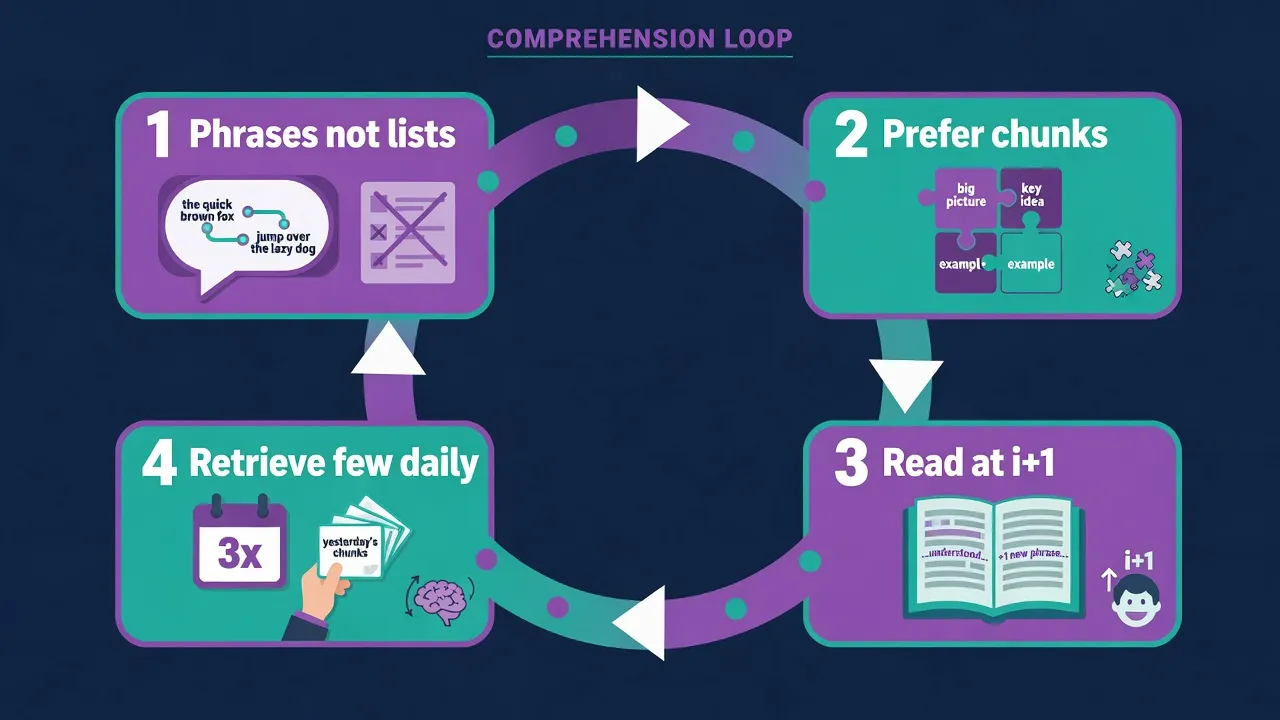
1) Meet them inside sentences, not in rows
For each hard-to-gloss word (get, that, to), write or save 2-3 different real sentences. One gloss is not enough.
2) Prefer chunks
Better:
- a lot of
- have to
- want to
- there is / there are
- as soon as
- in the morning
than a list of 50 lonely words with no neighbors.
3) Meet them in i+1 reading
Open a text you understand at about 80-90%. Each time you see get, make, or that, do not stop to "study the row": notice the job and keep going. Natural repetition does the heavy lifting.
More texts: all articles. For how vocabulary supports reading, see vocabulary for reading comprehension.
4) Retrieve a little every day
Five to ten saved phrases per session. Reuse them out loud or in a trainer. Do not try to "finish the Oxford 3000 this week."
Why "3000 words a month" promises fail
Mass learning from bare lists collides with:
- forgetting (real curves, not marketing slides)
- missing context (you do not know how to use the word)
- fatigue (lists bore you; you quit)
- fake progress (you pass Anki, then freeze in an email)
A healthy pace for many adults is a few new words or phrases well anchored each day, plus lots of input where high-frequency glue repeats on its own. Content words (work, hobbies, travel) should follow your life, not a global ranking.
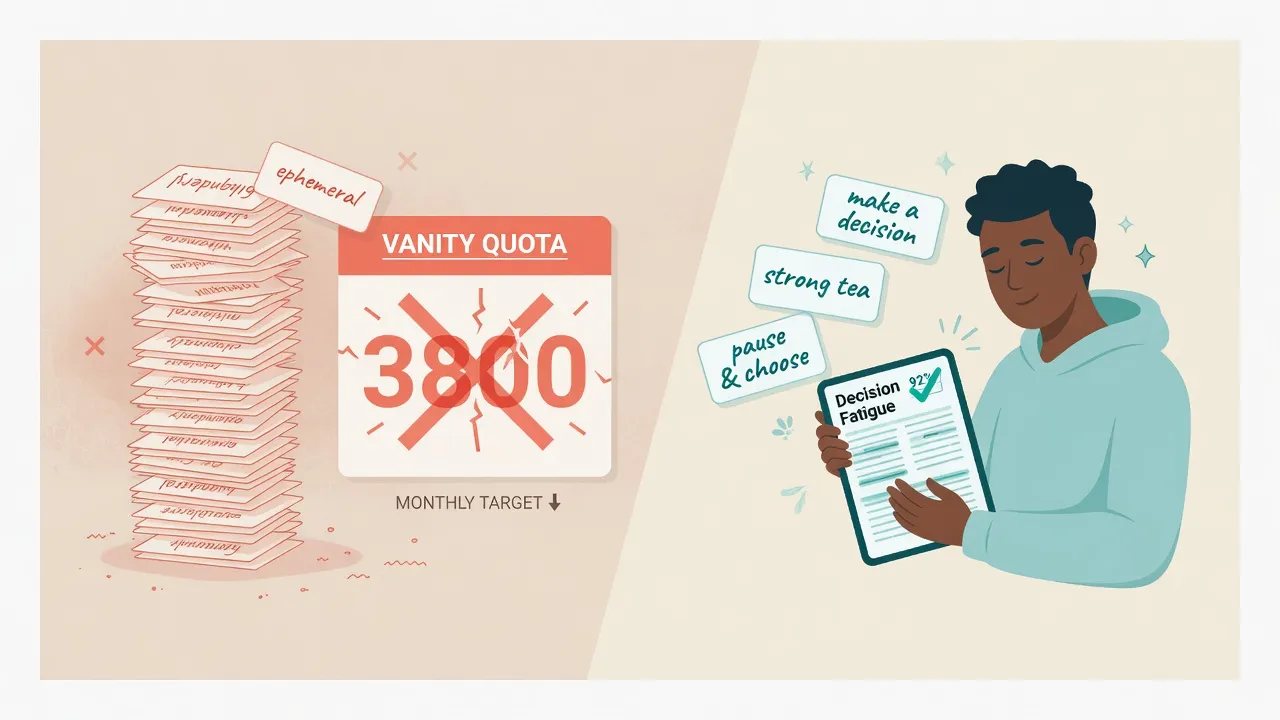
We unpack the vanity-quota math and a reading-first alternative in why a 3000-word monthly quota is a myth.
A 15-minute routine with high-frequency words
- 8 minutes: read an easy text; tap only true blockers.
- 4 minutes: save 3-5 phrases that include top-band words (not 20 rare adjectives).
- 3 minutes: say them out loud or practice in a demo.
Useful demos:
That is enough for a weekday. On a heavier day, re-read yesterday's page once before new material. Repetition in context is the whole point.
How MovaReader fits
High-frequency glue repeats naturally in short, graded stories. You meet get, to, that, and have inside a situation you can picture - not as a dead table row. MovaReader is a reading tool for that habit.
What it does:
- Free graded library with click-to-translate
- Listening that is often unlimited on freemium where audio exists
- Upload of files you own (for example EPUB)
- Phrase practice on demos and trainers after you save useful chunks
A simple free path
- Warm up on graded texts in the library
- Click-to-translate only what blocks sentence meaning
- Save phrases, not whole dictionaries
- When you want orientation ranges, open the language map; setup detail lives on How to use
- Try the word training demo and the phrase training demo
Pricing
Freemium gives about 20 word translations a day, a free graded library, and free listening where audio exists. When daily reading needs more translation volume, Reader is about €1. Pro is about €5/mo if you want the full trainers path - optional, not required to learn this scaffold through reading. Details: Pricing.
FAQ
How many words do I need to read a book in English?
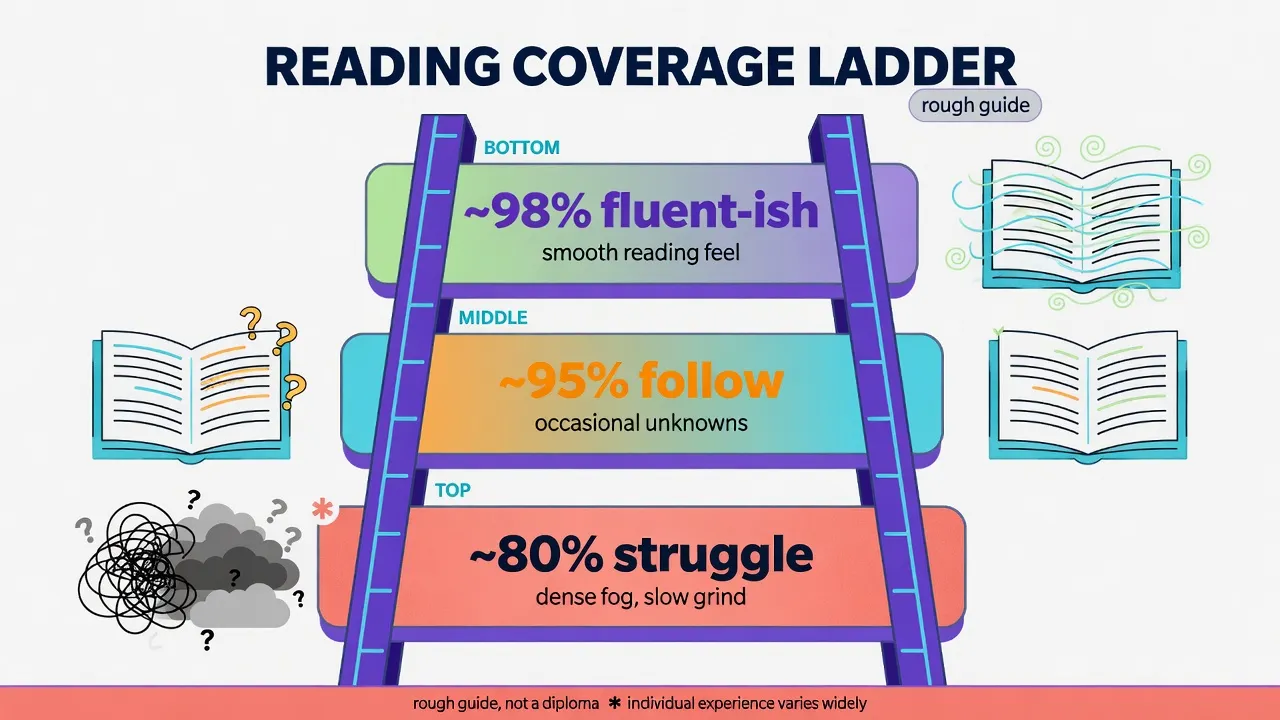
It depends on the book. With about 1,000-2,000 high-frequency words plus support, many graded texts and light YA become viable. Dense novels need more. Coverage percent is not full comprehension. More on size bands: how many words by CEFR and how many words for B2.
Should I Anki the top 50?
Fine if it keeps you motivated. It works better when each card is a phrase and you also read. Bare gloss cards often fail on get and to.
Are the most frequent words the same in US and UK English?
The core glue (the, be, to, of...) is the same. Content vocabulary and some spoken habits differ. For A2-B1 that is rarely the main problem.
What about phrasal verbs?
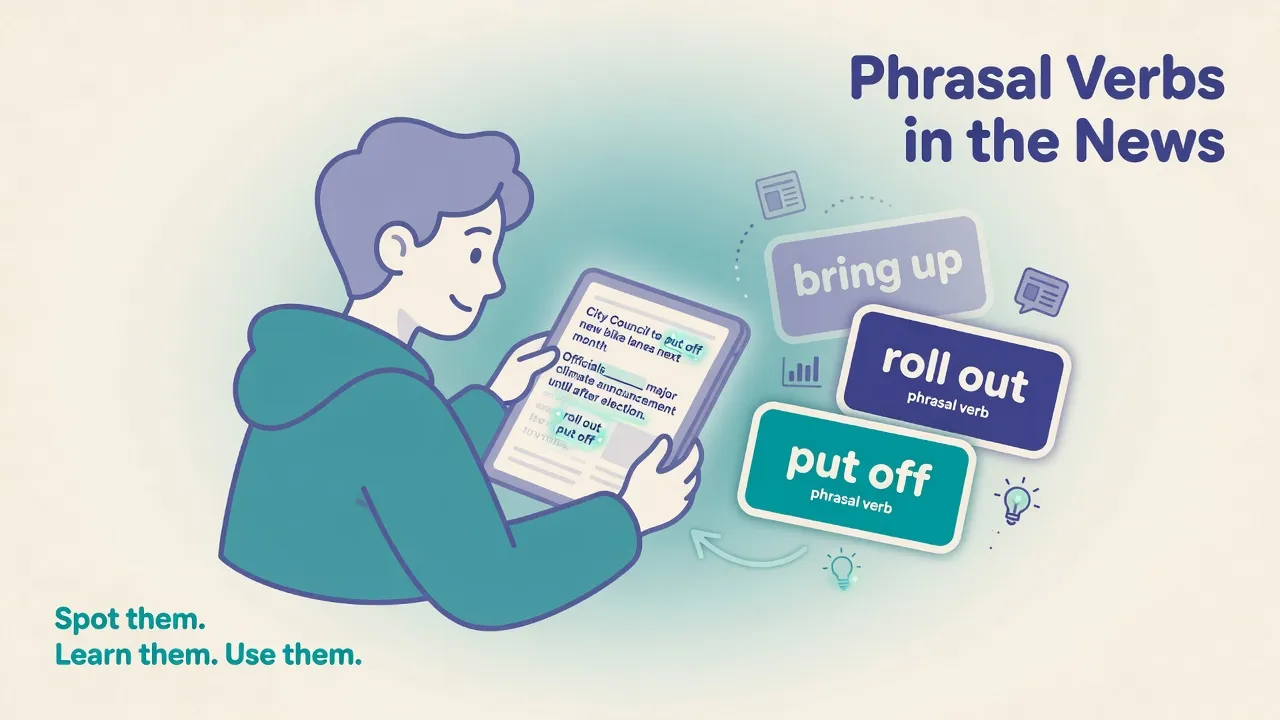
Many use top particles (up, out, on). Learn them as chunks (wake up, find out), not as an infinite day-one list.
Are 50 frequent words enough?
They are enough for a skeleton. Without content words from your life (work, family, hobbies), you will not have real conversations. Combine the core with a personal lexicon.
How long until I "master" them?
There is no single number. With daily comprehensible reading, recognition of sentence glue usually becomes automatic before perfect productive use when speaking.
Is this only for Spanish speakers?
No. The search demand is strong among Spanish speakers, but the scaffold is general English frequency work. Anyone learning English benefits from treating get, to, and that as multipurpose jobs in context.
Closing
The most frequent English words are a foundation, not a magic shortcut and not a "3000 a month" plan.
Learn the core in phrases and texts you understand, save a few chunks a day, and let repetition do its job. Clean start: read for meaning and save five phrases with get, have, that, or to in different jobs.
Learning English?
The English version of MovaReader teaches Spanish and Ukrainian. To read English with a translation for every word, open the reader in Ukrainian or Spanish:
Книги англійськоюЦя стаття українськоюLibros en inglésEste artículo en español