Vocabulary
How Many Words for CEFR A1-C2? Honest Vocabulary Ranges
Everyone wants one number per CEFR level. There is no official quota. Here are research-informed ranges for A1-C2, what a "word" even means, and how a free map helps without faking a certificate.
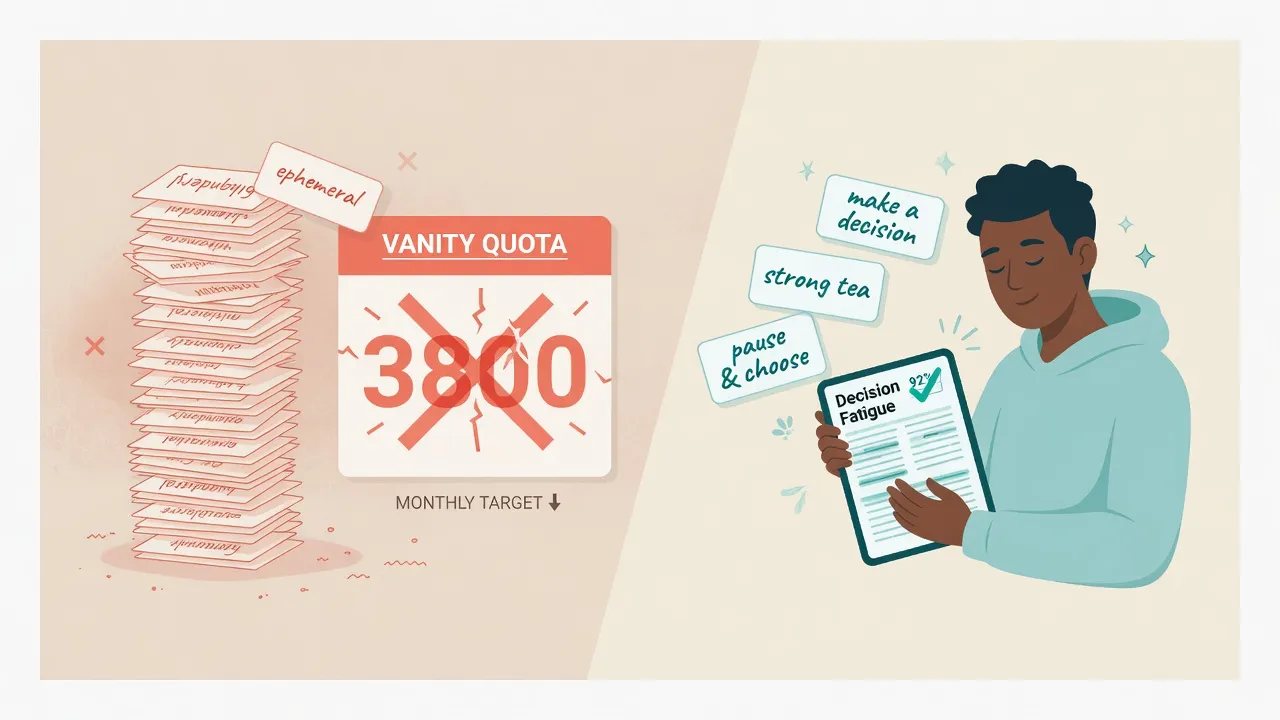
You typed something like "how many words for B2" or "how many words CEFR C1" because one number feels safe. Flashcard apps love tallies. Exam blogs love hard cutoffs. Your brain wants a finish line.
Here is the calm version: CEFR does not publish an official word quota per level. It describes what you can do, not how many dictionary entries you must own.
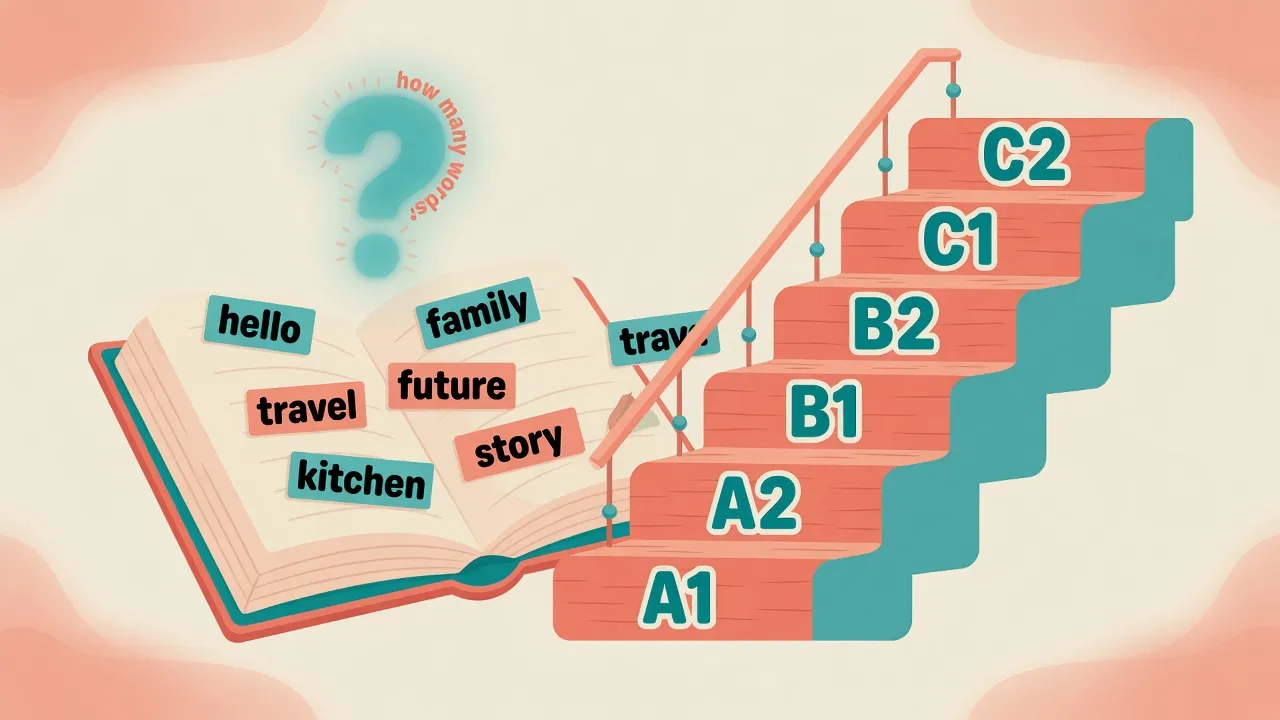
For orientation on frequent lemmas (dictionary headwords), research-informed bands often used for navigation are: A1 up to ~1,500; A2 ~1,500-2,500; B1 ~2,500-3,250; B2 ~3,250-3,750; C1 ~3,750-4,500; C2 ~4,500-5,000+.
Numbers disagree when sites count word forms or word families instead of lemmas. Always ask "what unit?" before comparing your Anki total to a CEFR table. Use these bands as a compass, not a certificate. The free language map uses the same orientation ranges.
Here is the shareable orientation table - same scale as our language map.
| Level | Orientation range (frequent lemmas) | Rough reading feel (approx.) |
|---|---|---|
| A1 | up to ~1,500 | Very short graded texts; heavy support |
| A2 | ~1,500-2,500 | Simple stories and short articles |
| B1 | ~2,500-3,250 | Independent short texts; longer stories with effort |
| B2 | ~3,250-3,750 | Many modern non-literary texts; novels still vary |
| C1 | ~3,750-4,500 | Wide authentic text; remaining style friction |
| C2 | ~4,500-5,000+ | Near-expert discussions; no magic "done" number |
How to read this without lying to yourself:
- Ranges overlap in real life. Strong topic familiarity can make you look "higher" on familiar pages.
- Catalogue sizes inside an app are curated lists. They are not identical to research ranges.
- Hitting a number does not equal passing Cambridge, IELTS, or DELE.
- Productive vocabulary (words you can use) is usually smaller than receptive vocabulary (words you can recognize).
- Treat the table as a compass / road map, not a verdict.
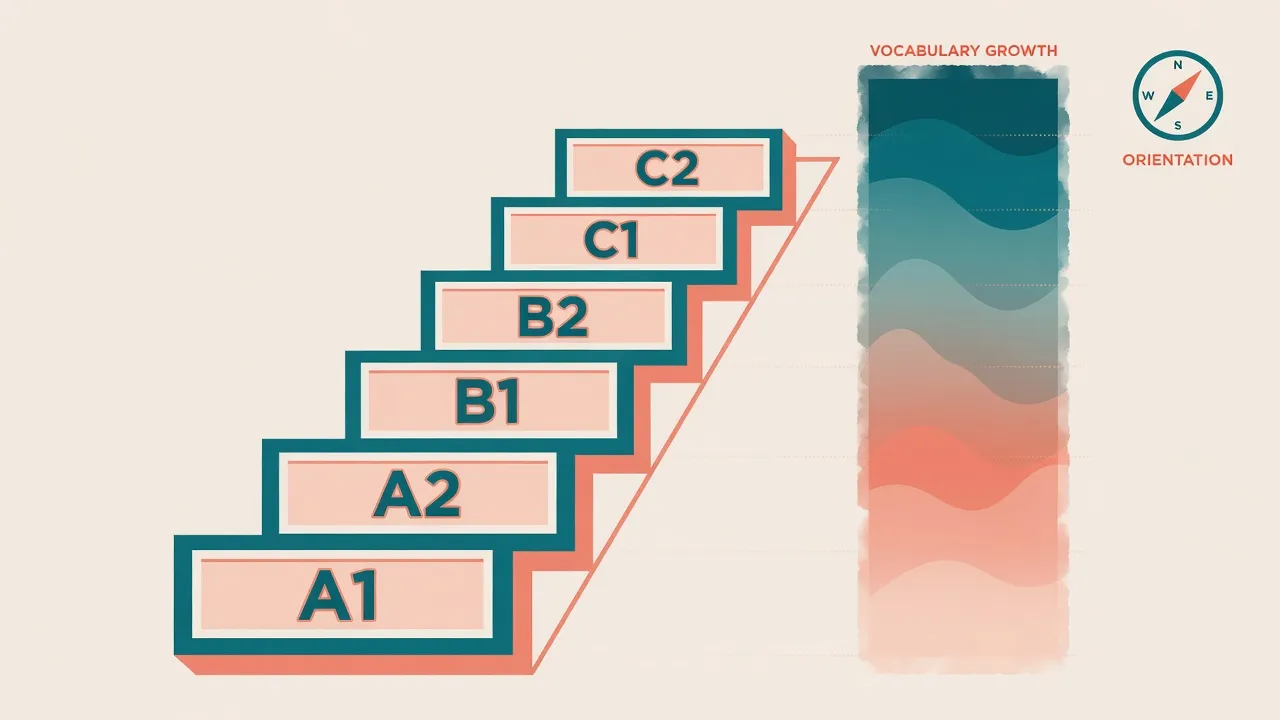
The ladder below is the same idea in one picture: steps from A1 to C2, orientation only.
Why CEFR does not publish an official word count
CEFR (Common European Framework of Reference) is a can-do framework. The Companion Volume updates descriptors: understand main points, argue a view, handle abstract topics. It does not say "B2 equals exactly 3,500 words."
That is not a gap in the paperwork. It is the design.
- Ability is multi-skill: listening, reading, speaking, writing, interaction.
- Vocabulary is necessary but not enough. Grammar, speed, pronunciation, and topic knowledge all matter.
- Languages package meaning differently. Spanish morphology and English phrasal verbs do not line up 1:1.
- Exams test performance on tasks, not a private counter in your head.
So when a blog sells "official CEFR vocabulary size," it is usually selling a teaching convention or a research estimate. Useful sometimes. Not Council of Europe law.
Research orientation ranges for A1-C2
The table above is the shareable spine. Here are the caveats.
Those bands are a navigation aid for frequent lemmas, not a score. Levels blur in real life: you can feel "B2-ish" on a familiar topic and "A2-ish" on dense technical prose. Productive vocabulary usually lags receptive vocabulary.
Public size talk often leans on Milton and Alexiou (X-Lex-style estimates), Nation-style coverage studies, and language-specific curricula. They disagree on units and corpora. App catalogue sizes are curated progressive lists, not the same thing as research ranges.
Keep the A1-C2 table as a road map. Open the free language map for the same scale without turning it into a diploma.
Lemmas, forms, and word families: why numbers disagree
When one site says "B2 needs ~3,500" and another says "B2 needs 8,000," both can be "right" for different counting units.
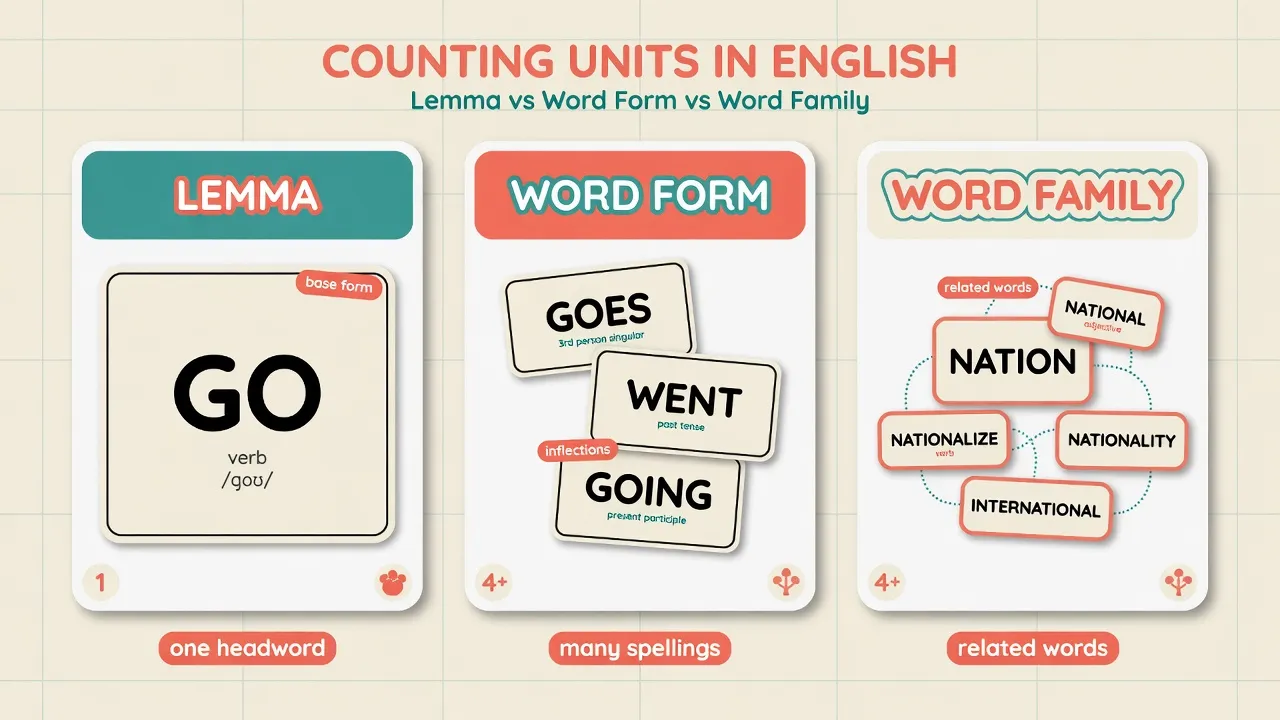
Three ways to count the same learning journey:
Lemma
A lemma is a dictionary headword. Spanish hablar stands for many conjugations in list thinking. English run often covers runs, ran, running in learner counts (researchers still argue the edges). Many CEFR orientation bands and map ranges talk in this unit.
Word form
Every surface spelling can count separately: go, goes, went, gone. Form counts explode fast. If an app treats every inflection as a new word, your "size" looks huge without matching real progress.
Word family
A family groups related derivatives more aggressively (nation, national, nationally, nationalize in the English research tradition). Coverage work on novels often talks in families. That is why "how many words for novels" figures can look larger than frequent-lemma CEFR bands.
Practical rule: always ask "what unit?" before comparing Anki, an app total, or a blog claim to a CEFR table. For a deeper walkthrough, see lemma vs word form.
English research vs Spanish Plan Curricular
This pillar is for people learning English or Spanish. The same compass helps both. The road is not identical.
English
Public vocabulary-size talk is often shaped by English frequency lists and classroom tests (including X-Lex-style tools). High-frequency cores transfer well. Low-frequency academic and literary words dominate hard reading. Phrasal verbs and multiword units are easy to undercount if you only track single lemmas. See also words vs expressions and CEFR.
Spanish
Instituto Cervantes Plan Curricular describes contents and progression for Spanish teaching. It is not a single mandatory word quota per CEFR level. Spanish friction for many learners includes dense verb morphology in narrative pasts, clitics, gender/number agreement that slows parsing even when the lemma is "known," and regional dialogue in real media.
Cognates help some L1 pairs. They do not cancel coverage needs on authentic pages. Deeper dive: Spanish vocabulary and the Plan Curricular.
Bottom line: CEFR can-do for exams and goals; frequency ranges only as a road map.
What "enough words" means for reading (not for a certificate)
"Enough" depends on the job in front of you.
| Goal | What vocabulary size is good for | What it does not prove |
|---|---|---|
| Survive travel A1-A2 | High-frequency core | Fluency in meetings |
| Read graded articles daily | Steady growth through A2-B1 bands | Official B2 |
| Read modern novels with support | Large receptive lexicon + stamina | C2 exam score |
| Pass a formal exam | Exam skills + vocabulary + strategy | A private word counter |
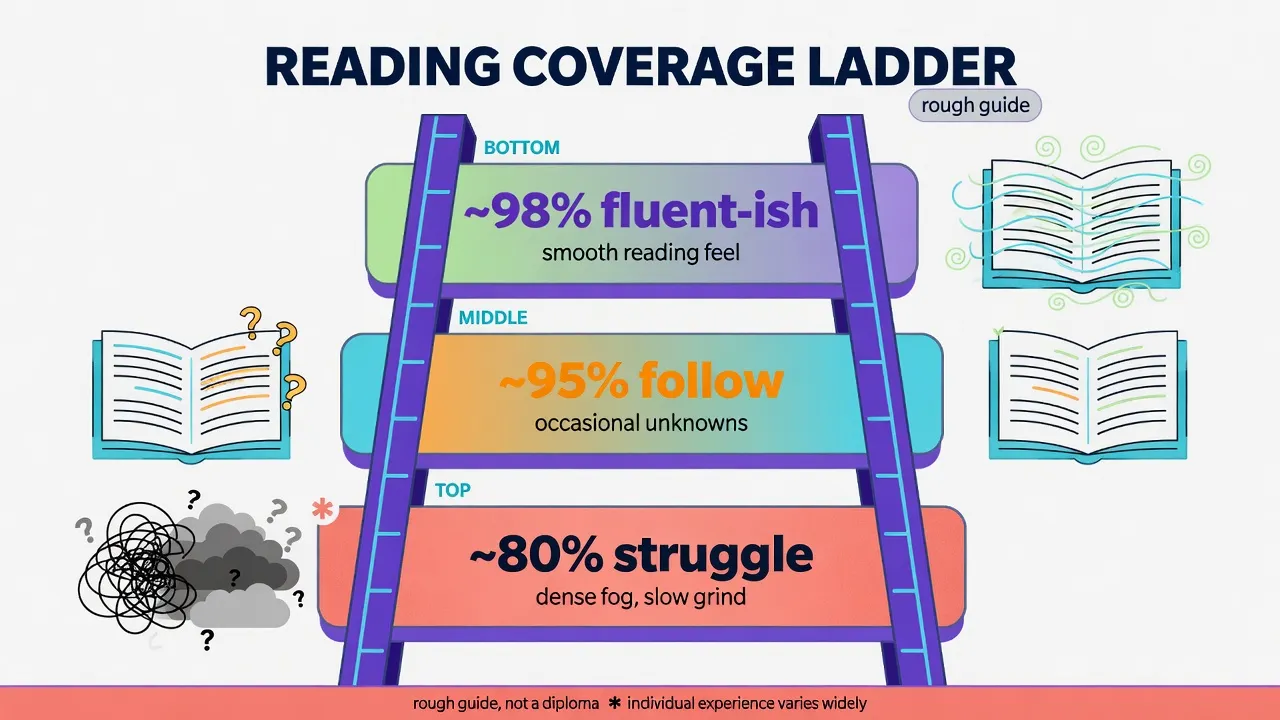
Lexical coverage (share of running words you already know) is often more useful than a trophy total. From reading research (mostly English corpora; use carefully for Spanish and elsewhere): around ~95% can feel effortful but possible; around ~98% is often discussed as more comfortable for independent hard reading. Genre and background knowledge still move the needle.
One line to keep: judge the page by unknown density, not by a universal word trophy.
When reading is the real goal: vocabulary for reading comprehension, build B1 vocabulary by reading, does 5,000 words mean C2?.
How a vocabulary map helps without becoming a fake exam
Here is where a tool can help - if it stays honest.
A good map does three jobs:
- Shows research ranges so A1-C2 is not pure folklore.
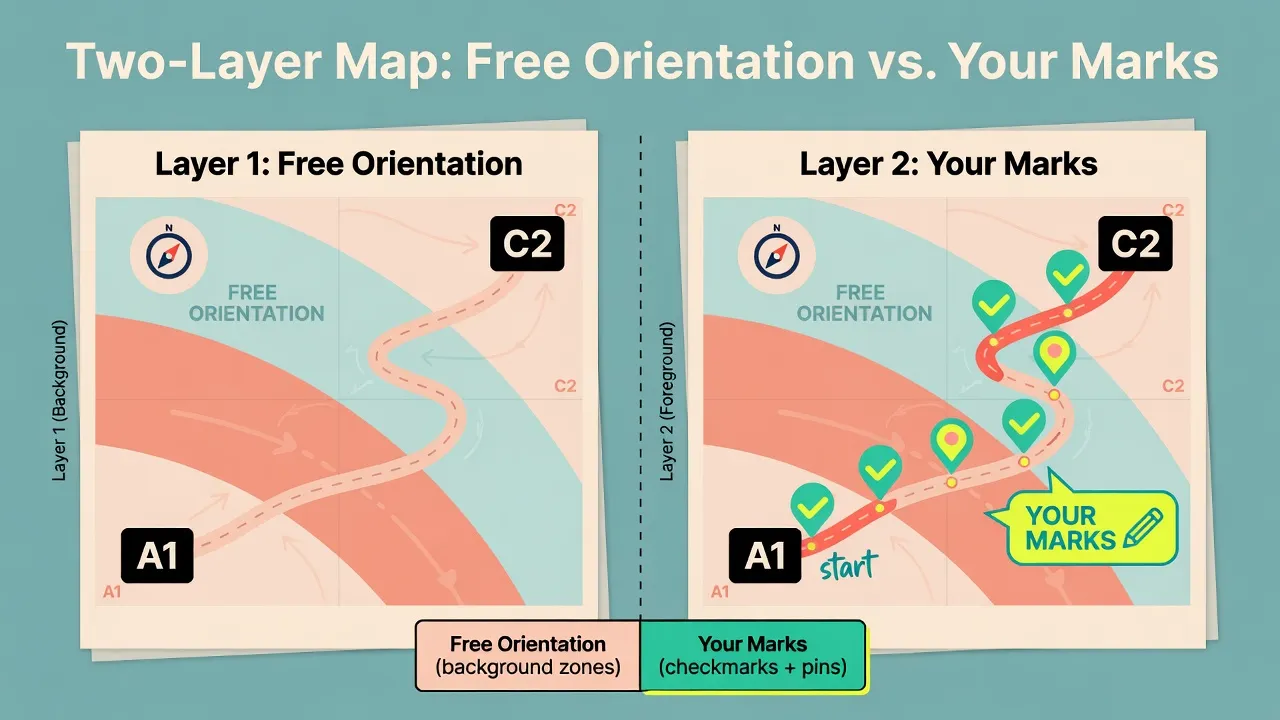
- Separates orientation from personal progress (public ranges vs words you mark as learned).
- Links learning to reading, where words reappear in context.
What a map must not claim: free official certification; exact CEFR level from a 30-second quiz; that app catalogue size equals Council of Europe law; that Ukrainian is a learning target (UI language only; learning targets are English and Spanish).
Two layers on the same idea - free orientation ranges versus your personal marks:
How MovaReader's map fits
The free hub is the language map. Guests can read the same A1-C2 orientation bands without a fake exam badge.
After you sign in and choose English or Spanish as a learning language, level catalogues open (for example A1 vocabulary, B2 vocabulary, C2 vocabulary). Personal % reflects words you mark as learned on curated lists. Catalogue size is a progressive set, not identical to the research ranges above.
Honest volume path:
- Freemium - try the product; about ~20 word translations per day (trial, not unlimited).
- Reader €1/mo - practical unlimited reading translations and dictionary volume when freemium blocks daily reading.
- Pro €5 - optional trainers and full grammar tree path. Not required to understand the map.
This is not a free full CEFR level test and not IELTS, Cambridge, or DELE. Plans: pricing. Workflow: how to use. Soft start: register. Optional: trainers.
Next steps: open the map, then grow words by reading
- Open the free language map and read A1-C2 without panic.
- Pick a realistic band for your current reading (often A2-B1 graded text; B2 for many work texts).
- Read short graded or authentic material daily - sample library: all articles.
- Mark words you truly recognize in context, not words you saw once on a flashcard.
- If freemium (~20 translations/day) blocks volume, consider Reader at €1.
- Optional: register, choose English or Spanish as learning language; Pro trainers only if you want that path.
Common myths
"CEFR officially requires 5,000 words for C2."
No official single quota. ~4,500-5,000+ is an orientation zone for frequent lemmas, not a diploma. See does 5,000 words mean C2?.
"If I hit the B2 number, I am B2."
You might have a strong intermediate lexicon and still struggle in a speaking exam, or pass with exam skills and still feel uneven on open reading. The number is a compass point, not a certificate.
"Spanish and English need the same absolute list."
Frequency cores rhyme. Morphology, multiword units, and culture do not clone 1:1. Plan Curricular is content and progression, not a mandatory word law.
"A free 60-second test can certify my level."
Useful placement quizzes exist. Certificates need more than a shareable widget.
FAQ
How many words do I need for each CEFR level?
There is no official CEFR quota. For orientation on frequent lemmas, research-informed bands often used for navigation are: A1 up to ~1,500; A2 ~1,500-2,500; B1 ~2,500-3,250; B2 ~3,250-3,750; C1 ~3,750-4,500; C2 ~4,500-5,000+. Open the free language map for the same ranges.
How many words for B2?
For frequent lemmas, a common orientation band is ~3,250-3,750. That is a navigation aid, not a Cambridge, IELTS, or DELE pass mark. Deeper dive: how many words for B2. Catalogue path: B2 vocabulary.
Is 5,000 words enough for C2?
Sometimes discussed as a late-range zone on frequent-lemma scales (~4,500-5,000+). It is never a C2 guarantee. C2 is flexible use across contexts, not a private counter. More: does 5,000 words mean C2?.
Lemma or word family - which should I track?
Day to day, track lemmas or headwords you can actually use. Research on reading coverage often uses word families, so those figures look larger. Forms (goes / went) explode counts without matching real progress. Always ask "what unit?" Detail: lemma vs word form.
Do these numbers work the same for Spanish and English?
As a scale, yes - the same A1-C2 orientation bands help both. As destiny, no. Morphology, multiword units, and culture do not clone 1:1. Instituto Cervantes Plan Curricular frames Spanish content and progression; it is not a single mandatory word law. More: Spanish vocabulary and Plan Curricular.
Can MovaReader give me a free full CEFR level test?
No. The free map is orientation (research ranges). Personal progress needs an account, a learning language (English or Spanish only), and words you mark as learned. Freemium is a trial (~20 translations/day). Practical volume for reading translations and dictionary sits on Reader from €1/mo; Pro €5 is optional for trainers and the full grammar-tree path. This is not IELTS, Cambridge, or DELE. Soft links: pricing, how to use, register.
Final takeaway
CEFR tells you what people can do. Research ranges tell you a plausible size of frequent vocabulary for orientation. Your job is not to worship a number. It is to read until the next band feels natural.
Use the free language map as a compass. Grow English or Spanish through reading and honest marks. Choose Reader when freemium volume is not enough. The road map is there so you can keep walking - not so you can frame a certificate that never existed.
Keep reading with translations inside the text
With a free account, an unknown word translates with one tap, and the words you are learning wait for you in the trainer.
Free account: 7 days of Pro, then 20 word translations a day or a paid plan.