Vocabulary
How many Spanish words by CEFR level? What the Plan Curricular says
Wondering if "B2 = 4,000 words" works for Spanish? CEFR is can-do, Plan Curricular is content themes, and map ranges are navigation - not DELE.
You saw a chart that says "B2 = 4,000 words." Then you wondered: does that number work for Spanish? Or is español playing by different rules?
Here is the short version. CEFR (MCER) describes what you can do with Spanish - not a law that fixes how many lemmas you must own. Instituto Cervantes Plan Curricular organises themes and teaching content by level. It is not a mandatory public word quota, so ignore charts that invent "official Cervantes" lemma totals. English frequency tables are a borrowed scale: Spanish morphology, clitics, multiword chunks, and uneven cognates change what "a word" feels like. Use practical A1-C2 orientation ranges as road signs, then grow Spanish with themes, a high-frequency core, and graded-to-authentic reading - not trophy myths.
One line you can keep: for Spanish, treat CEFR as goals, Plan Curricular as a content map, and word counts as navigation - never as a secret Cervantes pass mark.
What you will get below: why every site quotes a different total, what Plan Curricular actually is, why English charts do not paste cleanly, practical A1-C2 ranges, and a growth loop that works. Light related reading if you want depth later: how many words by CEFR, how many for B2, and lemma vs word form.
Why does every site quote a different Spanish word count?
Open five blogs and you get five Spanish "B2 totals." Some say 3,000. Some say 4,000. Some sell a 5,000-word finish line. None of that chaos means Spanish is broken. It means the writers are counting different things - and often borrowing English research without saying so.
What unit are they counting?
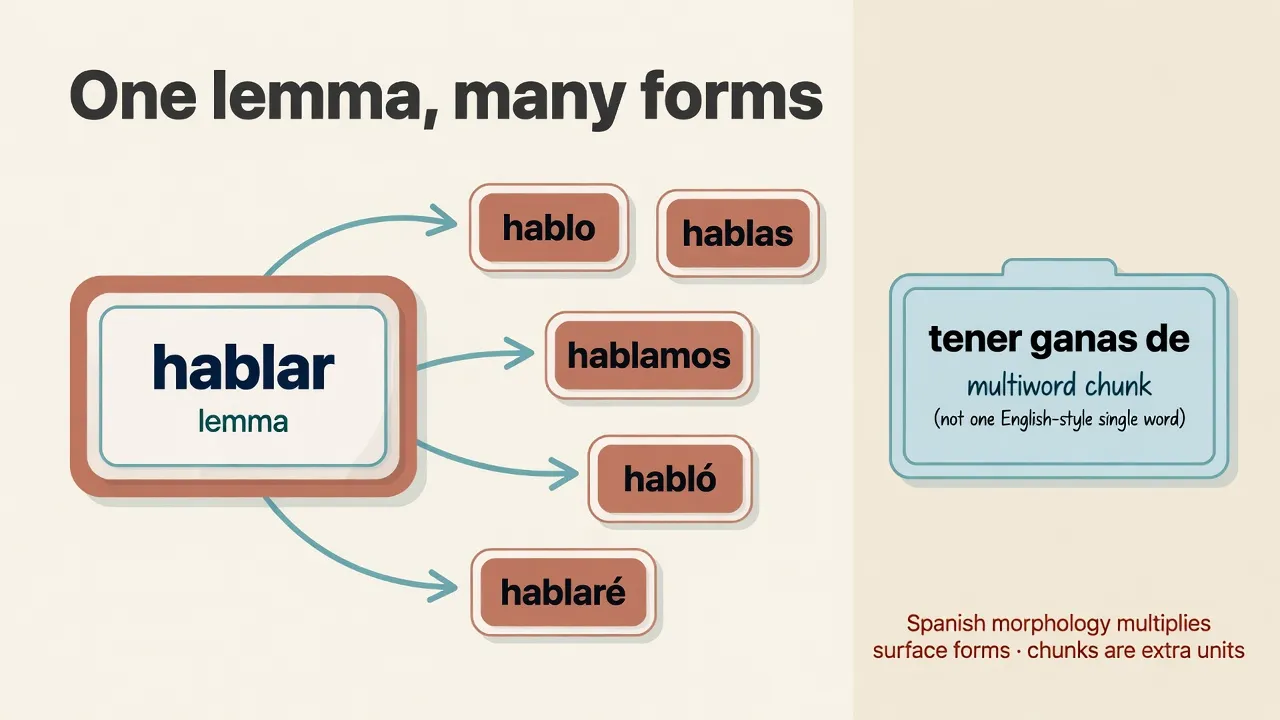
"Word" can mean a surface form (hablo, hablas, habló), a lemma (hablar), or a whole family of related items. Multiword chunks (tener ganas de) sometimes get one slot, sometimes none. Until you know the unit, two charts cannot be compared. For the unit problem in plain language, see lemma vs word form.
Charts sell certainty. For Spanish learners, a useful range beats an invented official total.
Is CEFR (MCER) a Spanish word law?
No. MCER is the Spanish name for CEFR - the Common European Framework of Reference. The framework talks about can-do abilities: what you can understand, say, write, and handle in real situations. It does not say "A2 Spanish = exactly 2,000 headwords" or "B2 = 3,500 lemmas by law."
That matters because exams such as DELE test performance across skills, not your private Anki total. Vocabulary is necessary but not enough. Morphology, listening speed, and register still decide whether a "fluent day" actually happens.
Use CEFR for goals and exam framing. Use word numbers only as orientation - and always ask what unit is being counted.
What is Plan Curricular - and what is it not?
Instituto Cervantes Plan Curricular del Instituto Cervantes is a large reference for teaching Spanish as a foreign language. In plain terms, it organises what content belongs at each level: themes, functions, grammar, and lexis as material for course design. Think curriculum map, not personal size certificate.
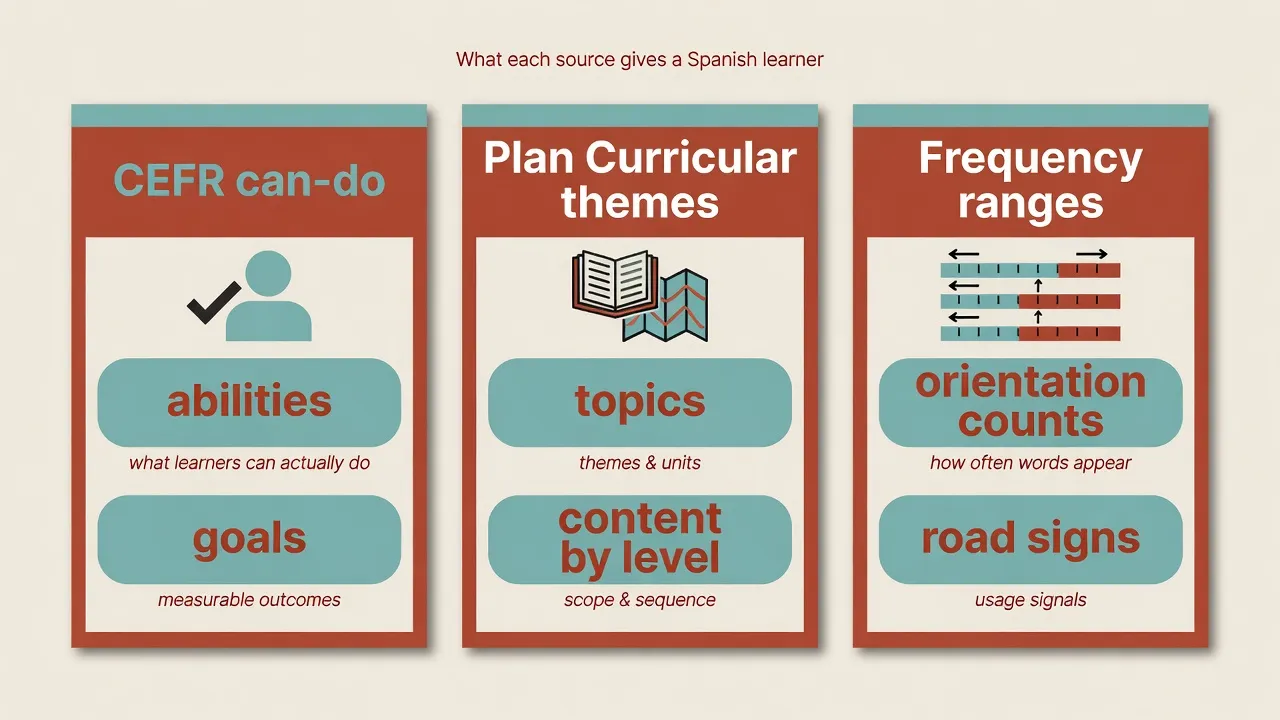
Three sources answer three different questions. Keep them separate:
What it is good for
- Seeing which topics and communicative functions usually appear at A1 vs B1 vs C1.
- Understanding that a level is about range of use (everyday needs, work, abstract topics), not a trophy counter.
- Designing courses and materials around shared expectations instead of pure folklore.
What it is not
Plan Curricular is not a free public "N words = B2" quota. It is not proof of your personal vocabulary size. It is not an English X-Lex chart pasted onto Spanish. And it is not a substitute for DELE if you need an official letter for work or university.
In short, Plan Curricular answers "what should a Spanish curriculum cover at this level?" more than "how many lemmas must I own to be B2?"
Why English CEFR word charts do not paste cleanly onto Spanish
Public "how many words for B2" tables are heavily shaped by English frequency lists and reading-coverage studies. Those tools are useful when English is the learning target. For Spanish they are a borrowed scale, not destiny.
Morphology multiplies surface forms
Spanish packs a lot into verb paradigms. One lemma (hablar, ir, ser) fans out into many forms you meet in stories. If an app counts every surface form as a new "word," your total inflates without true coverage gains. If research counts lemmas, Spanish can look "smaller" while the past tenses of a novel still feel hard.
Agreement and clitics slow recognition
Even when you "know" a lemma, gender and number agreement plus object pronouns can slow parsing. English charts rarely price that friction into a single number.
Cognates help unevenly
Romance and English speakers often get free cognates (hospital, información). Speakers of other first languages may not. Cognates improve early reading comfort; they do not cancel mid-frequency gaps in news or dialogue.
Multiword units and regional speech
Venga, vale, pues, o sea, tener ganas de - natural Spanish is full of chunks that do not map neatly to English phrasal-verb lists. Single-lemma counts undercount what you actually hear and read.
One lemma can fan out into many forms and multiword expressions:
Shared map bands still help as navigation - labeled as research orientation, not Plan Curricular word law.
Source cheat sheet: CEFR vs Plan Curricular vs frequency vs app %
Four tools, four jobs. Do not collapse them into one "official Spanish word law."
| Source type | Mainly gives you | Does not prove |
|---|---|---|
| CEFR/MCER can-do | Abilities, exam framing | Exact lemma totals |
| Plan Curricular | Themes, functions, content design | One mandatory word count |
| English frequency research | Useful frequent-item scale | Perfect Spanish destiny |
| App catalogue % | Progress on that curated list | DELE result |
How many Spanish words per level? Orientation ranges
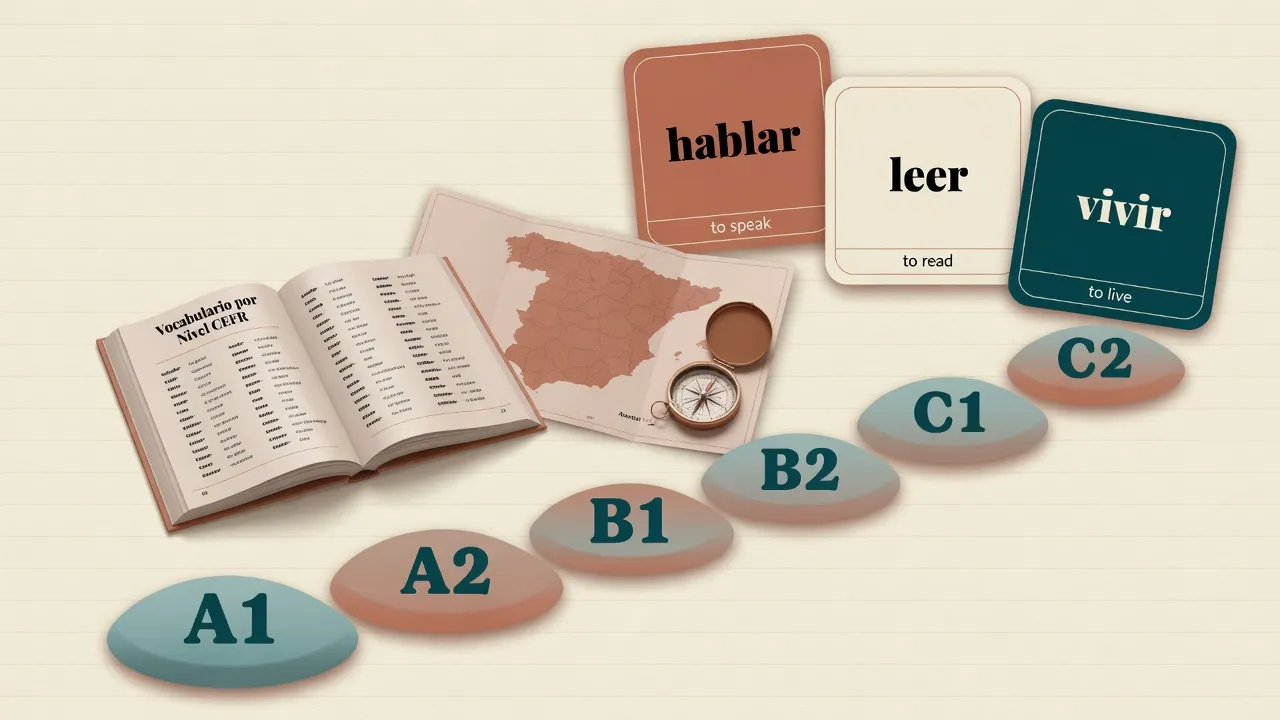
Even without an official Spanish quota, a shared orientation table helps you stop guessing wildly. These bands match the public language map: frequent lemmas, research orientation only. Road signs, not certificates.
| Level | Orientation (frequent lemmas) | Spanish reading feel (approx.) |
|---|---|---|
| A1 | up to ~1,500 | Micro-texts, heavy support |
| A2 | ~1,500-2,500 | Short graded; simple articles with help |
| B1 | ~2,500-3,250 | Longer graded; first authentic pages |
| B2 | ~3,250-3,750 | Many modern non-literary texts; novels vary |
| C1 | ~3,750-4,500 | Wide authentic; style still bites |
| C2 | ~4,500-5,000+ | Near-expert; no magic "finished" number |
How to use the numbers without turning them into stress:
- Treat the number as a road sign, not a DELE pass mark.
- Prefer lemma-consistent tracking over inflated form counts.
- Judge pages by unknown density more than by a trophy total.
- Hitting ~3,500 does not mean "I am C2" - see Does 5,000 words mean C2?.
- Catalogue sizes inside a product are curated lists. They are not identical to research ranges and not a copy-paste of Plan Curricular content.
For the B2 band in more depth: how many words for B2.
How do you grow Spanish vocabulary without only drilling lists?
Plan Curricular thinking is strongest when you combine themes with frequency while you read - not when you only drill a giant alphabetical list.
Theme first, high-frequency core always
If your life needs work email Spanish, prioritise professional themes at your band - but keep growing the general high-frequency core. Rare technical words without a base make reading miserable. Words and multiword expressions both matter; see words vs expressions at CEFR.
Graded input, then authentic
Early bands: short graded Spanish. Easy starts in the library (same article IDs across UI locales): ES sample 1127, ES sample 1209, or browse all articles. Mid bands: longer graded reads plus carefully chosen authentic pages. Upper bands: more news, essays, and fiction with support - not only word lists. Building B1 through pages: build B1 vocabulary by reading. Why reading coverage matters: vocabulary for reading comprehension.
Save less, mark more carefully
Save words that reappear or block meaning. Mark as learned when recognition is stable in context, not after one click. A workable routine: track vocabulary progress.
Let morphology teach itself in context
Seeing dijo / dijo que / se lo dijo in stories beats memorising a conjugation sheet you never read. When structure needs a second look, the grammar tree can help.
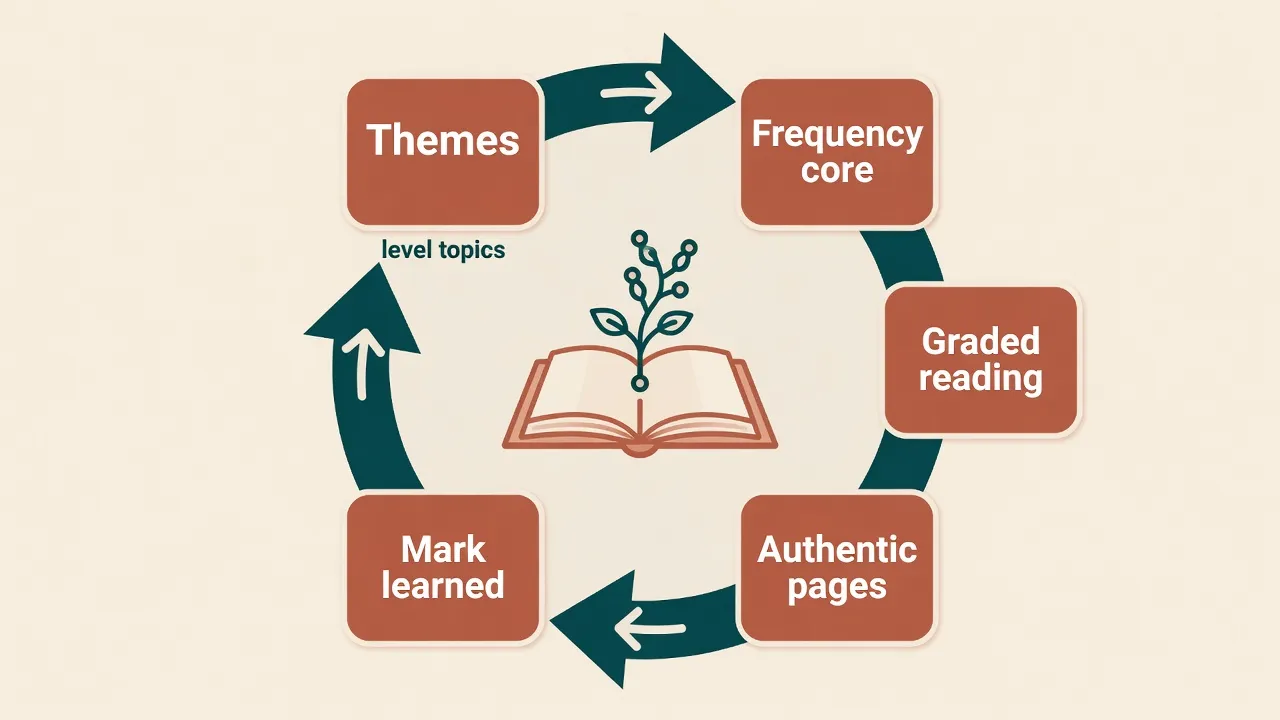
A simple growth loop:
A simple week: read Spanish you can mostly finish, translate blockers, save a small set, mark what you truly own, and glance at map orientation so you stay on a band - not on panic.
How does the language map help when Spanish is your target?
When Spanish is your learning target, the free language map is a compass, not a certificate. Read A1-C2 ranges as navigation only - research-informed orientation, not Plan Curricular word law and not a DELE result.
Free orientation
Open the map. Look at the bands. Use them to pick a realistic reading band, not to claim a diploma.
Personal progress
For personal fill: sign in, choose Spanish as learning language, read with in-context help, and mark what you truly own in level catalogues such as A2 vocabulary, B1 vocabulary, and B2 vocabulary. Progress is coverage of a curated catalogue, not an exam result.
Plans
The free plan gives about 20 word translations a day. Reader is €1/mo when you need real reading volume for translations and dictionary work. Pro is €5/mo for full trainers and a fuller grammar path.
Soft start: How to use · Register · Pricing. Optional review tools: trainers.
Common myths (Spanish edition)
A few stories that keep showing up - and the calmer version.
Plan Curricular lists the exact 5,000 words of C2 Spanish. No. It organises teaching content. It does not hand you a mandatory public quota equal to C2 performance.
English B2 ~3,500 lemmas means Spanish B2 is the same list. The orientation band can navigate similarly; Spanish items, morphology load, and exam tasks still differ.
Cognates mean half the vocabulary. They help recognition. Authentic pages still need mid-frequency Spanish and multiword patterns.
A free 60-second quiz certifies Spanish CEFR. Placement hints exist; certificates need exams. Map progress is learning analytics, not DELE.
Finishing a B2 catalogue means fluent forever. Coverage is useful. Fluency is multi-skill. Keep reading.
FAQ
Does Instituto Cervantes publish an official word count per level?
No. Plan Curricular organises themes, functions, and teaching content by level. It is not best read as one mandatory public lemma total per band. Use it for curriculum-style expectations, then pair it with frequency orientation and real reading - do not invent "official Cervantes" word quotas.
How many Spanish words for B2, then?
For orientation on frequent lemmas, the shared map band is roughly ~3,250-3,750. That is a road sign for navigation, not a DELE pass mark and not a secret Plan Curricular law. Deep dive: How many words for B2. Map: language map.
Should I use Plan Curricular lists or frequency lists?
Both, for different jobs. Plan Curricular thinking helps you cover themes and communicative range at your band. Frequency keeps the high-coverage core that makes everyday text readable. Best growth is themes + frequency + graded-to-authentic reading, not pure alphabetical dumps. If form counts explode, fix the unit: lemma vs word form.
What is the best next step if I am stuck between levels?
Open the language map, pick a comfortable band, and read Spanish you can mostly finish - start from all articles or samples 1127 and 1209. Mark only what you truly recognise in context. When the free plan limits your volume, see pricing.
Why do English and Spanish "words needed" charts disagree?
English charts often count frequent lemmas or families from English research. Spanish multiplies surface forms (verb paradigms), adds clitics and agreement, packs meaning into multiword chunks (tener ganas de), and gives cognates unevenly. Same orientation bands can still help as navigation; the items and feel of "a word" do not paste 1:1.
Final takeaway and next steps
Spanish vocabulary talk fails when people paste English trophy numbers onto Cervantes content guides - or the reverse.
- CEFR/MCER = can-do abilities, not a Spanish word law.
- Plan Curricular = themes and content by level, not one mandatory lemma quota.
- Map ranges = research-informed road signs (frequent lemmas), not DELE.
- Growth = level themes + high-frequency core + graded-to-authentic reading + careful marks.
- MovaReader = free orientation; Reader €1 for real volume; Pro €5 for full trainers.
Next: open the free language map, start Spanish pages you can mostly finish (all articles or samples 1127 and 1209), and choose Reader when the free plan's limits block the volume you need.
Keep reading with translations inside the text
With a free account, an unknown word translates with one tap, and the words you are learning wait for you in the trainer.
Free account: 7 days of Pro, then 20 word translations a day or a paid plan.