Vocabulary
How Many Words to Read Spanish Novels? Coverage First
Apps sell a trophy number. Real research talks coverage and ranges. Here is how many words Spanish novels actually need - and how to test the book in front of you.

You open a Spanish novel you actually want. By page 12 the wall hits. You know "about 3,000 words." Your Anki counter looked serious. Still every paragraph drops another cluster of unknowns, and the plot slips away.
That panic is common. It is also the wrong question framed the wrong way. Apps sell a trophy number. Real reading research talks lexical coverage - how many running words on this page you already know - and realistic ranges, not destiny.
Short answer: there is no single magic word count for Spanish novels. Aim for high coverage on the book in front of you. Research often discusses roughly ~95% (effortful; about 1 unknown in 20 tokens) versus ~98% (more comfortable independent reading). Classic Nation-style work, mostly on English corpora, talks around ~4,000 word families for ~95% of novels/news and ~8,000-9,000 families for ~98%. Use those figures as scale for Spanish, not a vending-machine quota. Then validate with a 10-minute middle-page test and climb graded Spanish to a bridge novel to volume.
In one line: judge the Spanish novel by unknown density on middle pages - not by a trophy Anki total.
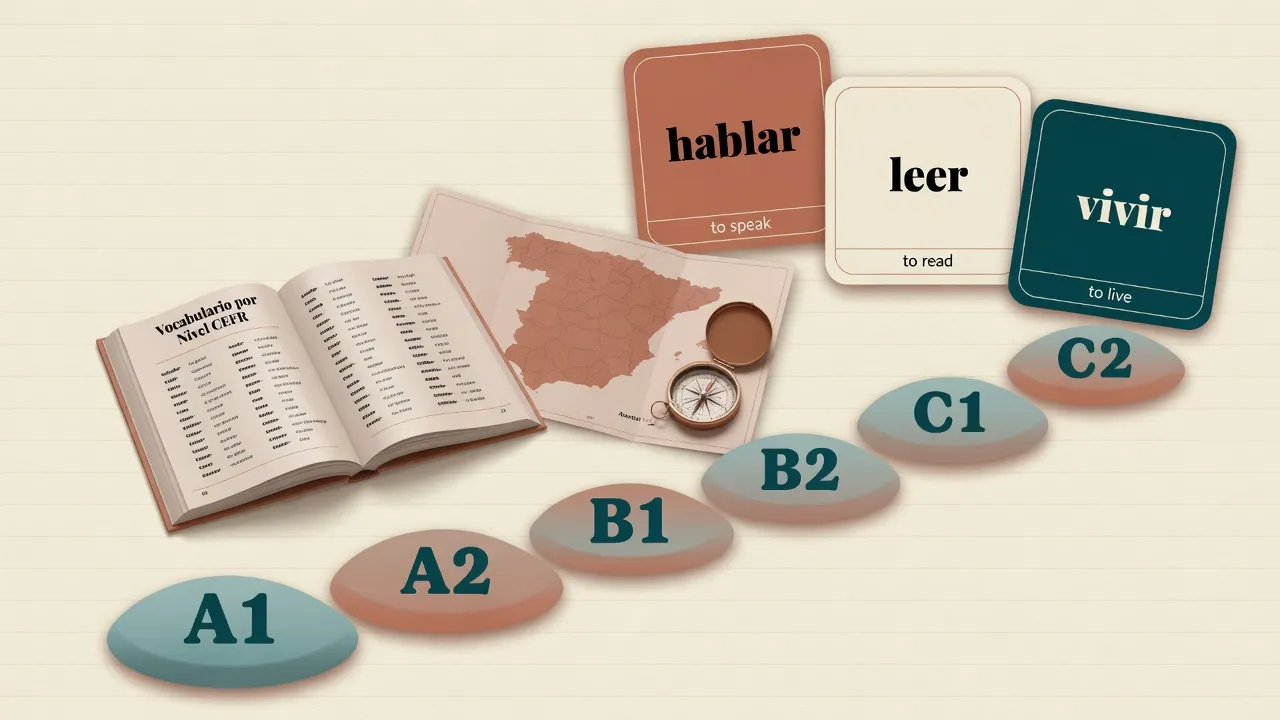
For CEFR-size orientation (a different question than novel coverage), start with how many words for CEFR and the free language map.
What you will get:
- What 95% and 98% coverage feel like on a real page
- Nation-style ranges used carefully as Spanish scale
- Why "I know 3,000 words" still fails on page 12
- A 10-minute middle-page readiness test
- A graded path to your first novel
Coverage first, word counts second
Coverage is the share of running words (tokens) in a text that you already know. It is not your lifetime Anki total. It is how dense the unknowns feel on this page.
Think of unknown density like fog on the road. A little fog, and you still drive. Thick fog every few meters, and you are not reading - you are decoding.
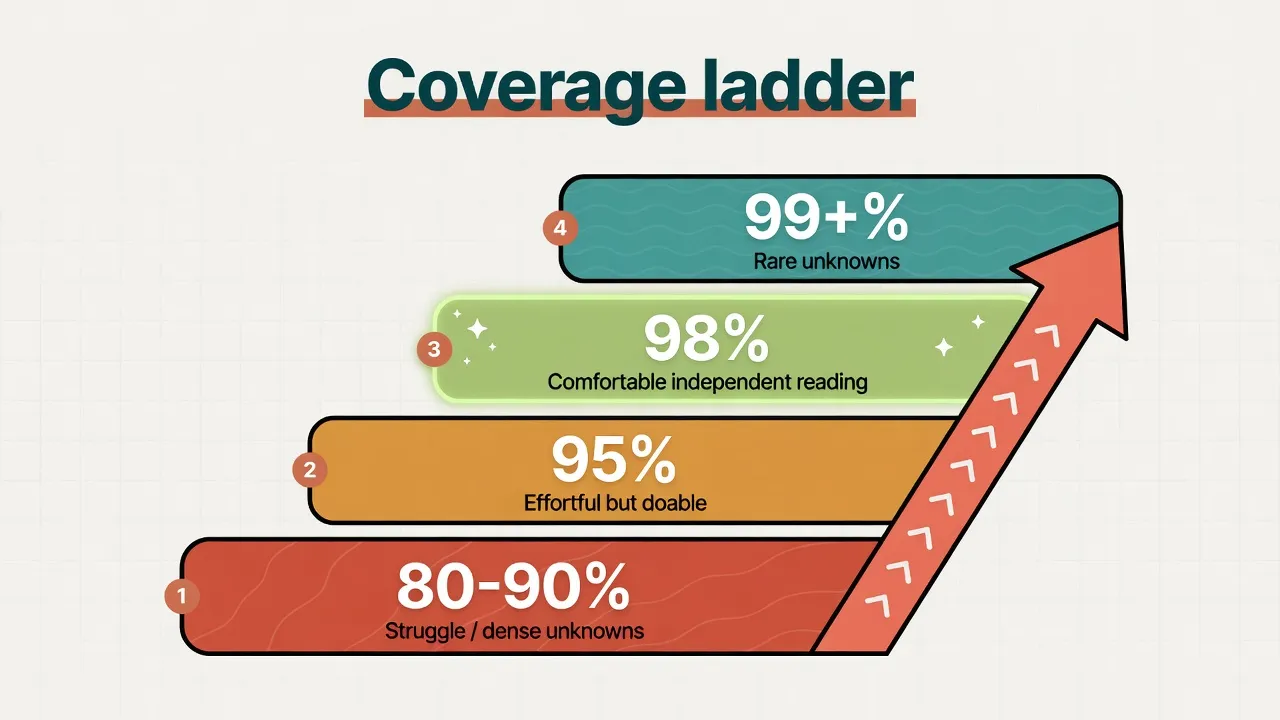
| Coverage (approx.) | Unknown rate | Reading feel (typical) |
|---|---|---|
| ~80-90% | 1 unknown in 5-10 words | Constant decoding; not real reading |
| ~95% | about 1 unknown in 20 | Possible with effort; many still struggle |
| ~98% | about 1 unknown in 50 | Much more comfortable independent reading |
| ~99%+ | rare unknowns | Easy extensive reading for that text |
Hu and Nation (2000) and later work (for example Schmitt and colleagues) support a simple idea: higher coverage usually means better comprehension. Around 98% is often discussed as a safer target for comfortable unassisted reading of hard text. 95% is a common "adequate but still effortful" discussion point. Individuals vary. Genre varies. Your topic knowledge varies.
So if a blog says "exactly 95.000% is the magic switch," ignore the fake precision. Use the feel of the page: can you follow the story, or are you stopping every sentence?
Coverage also explains why vocabulary-for-reading posts matter more than raw counters. For the wider reading angle, see vocabulary for reading comprehension.
What Nation-style numbers actually say (English-corpus ballparks)
Much of the classic quantitative work is on English. Nation (2006)-style analyses get cited everywhere. That does not make them Spanish law. They are ballparks - useful scale, not a destiny number for Cervantes or a contemporary thriller.
| Goal | Rough size discussed (word families) | Notes |
|---|---|---|
| ~95% coverage of several novels/newspapers | often ~4,000 families (+ proper nouns treated as known) | Still ~1 unknown per 20 tokens |
| ~98% coverage of novels/newspapers | often ~8,000-9,000 families (+ proper nouns) | Closer to comfortable independent reading |
| ~95% spoken English | often lower than novels (thousands, not 9k) | Conversation is not literary prose |
| ~98% spoken | still large, but typically below novel 98% figures | Listening has its own profile |
How to use this for Spanish:
- Spanish novels are not English novels, but the coverage principle transfers: you need most running words known.
- Exact Spanish claims like "you need 8,472 lemmas" are usually marketing.
- A modern YA Spanish novel with dialogue can feel easier than a dense literary classic even at the same "vocabulary size."
- Your topic familiarity (detective plots, school stories, romance) can substitute for hundreds of rare words.
If someone waves a Nation number at you as a Spanish exam quota, smile and go back to the page. For the related myth that 5,000 words equals C2, see does 5,000 words mean C2?.
Practical Spanish interpretation (ranges, not guarantees)
Spanish how-to culture often cites something like ~5-8k for "comfortable authentic novels." Treat that as a learner-report band, not an official quota. It still sits under the real rule: coverage on this book.
| Reading target | Rough receptive zone many learners report/need | Coverage goal on that book |
|---|---|---|
| Graded A1-A2 articles | high-frequency core (hundreds to ~1-2k families in use) | high enough to finish pages |
| Easy learner novels / very simple YA | often mid thousands receptive | try for ~95%+ feel |
| Standard modern novels | several thousand families; 98%-ish comfort may need a large lexicon | prefer ~98% feel on sample pages |
| Literary classics, experimental prose | higher still; style beats raw lists | sample before committing |
One more caution: high-frequency lists can claim a large token share and still fail as real novel reading. The top 1,000 words help a lot. They do not make Cien años de soledad readable on their own.
Bottom line: judge this book by unknown density - not by a universal word trophy.
Word families vs forms (why apps and blogs disagree)
Here is why your Anki total and a research "4,000 families" claim almost never match.
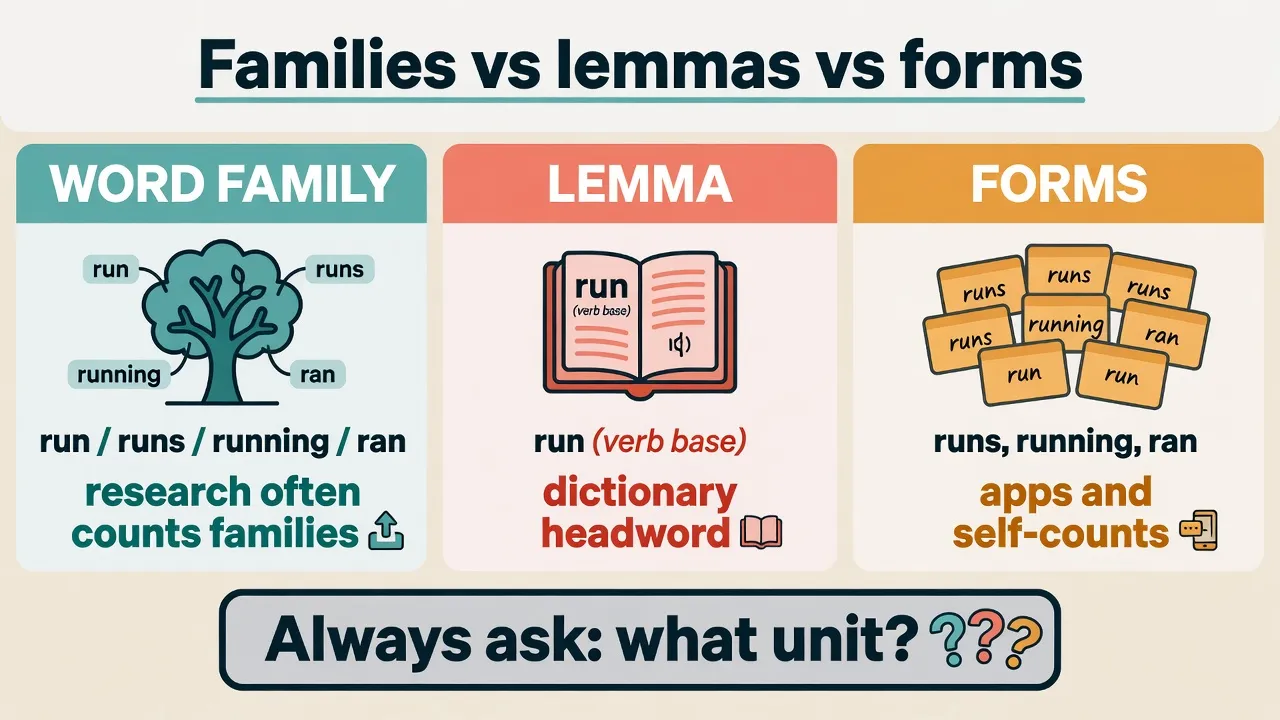
Word family
Research coverage work often counts word families. Spanish correr, corrió, corriendo, corredor can sit under one family for size talk. That unit is wider than a single flashcard.
Lemma / form
Dictionaries and many apps lean on lemmas (base forms) or messier word forms. Learner self-counts are usually the messiest of all:
- Apps count "known words" differently
- Cognates help English speakers learning Spanish unevenly - helpful on some pages, useless on slang and regional dialogue
- Proper nouns can be easy (Madrid) or hard (obscure historical names) depending on the book
| Unit | Who uses it | Why numbers disagree |
|---|---|---|
| Word family | Research coverage counts often | Related forms under one family |
| Lemma | Dictionaries, many apps | Base form; still not every surface spelling |
| Word form / card | Learner Anki / self-counts | Messiest; inflates "I know 3,000" |
Rule: always ask "what unit?" before comparing Anki to a novel claim. Plain unit guide: lemma vs word form. For level orientation: language map explained and the language map itself.
Why "I know 3,000 Spanish words" still fails on page 12
Three common mismatches:
- Recognition vs reading fluency - you "know" a word on a list but not at speed in morphology-heavy Spanish.
- Wrong 3,000 - tourist words are not novel function words, literary verbs, and discourse markers.
- Density clusters - a battle scene or legal subplot can dump 15 unknowns in one paragraph even when the chapter average looked fine.
Spanish-specific friction for many learners:
- past-tense morphology in narrative
- object pronouns and clitic clusters
- regional dialogue
- gender and number agreement that delays parsing
Vocabulary size helps. It is not the whole reading skill. Speed, grammar scaffolding, and world knowledge still decide whether page 12 feels like a story or a wall.
If the wall is real, do not "study harder" with the same book. Run the test below.
A better test than a viral quiz (middle-page test)
Skip any site that promises your exact CEFR from 20 multiple-choice items and a share card. That is entertainment. Novel readiness is simpler to check.
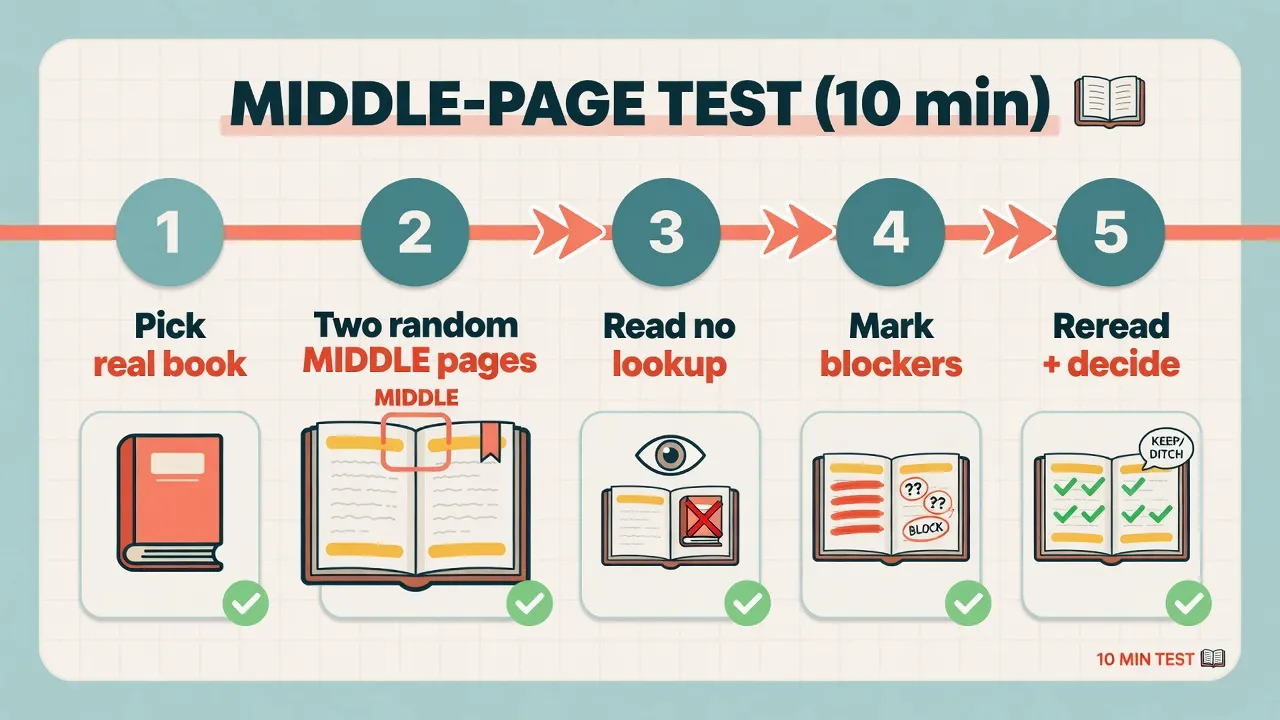
10-minute novel readiness test
- Pick the actual book format you will use (sample EPUB, bookstore preview, library loan).
- Open two random middle pages, not the polished first page.
- Read once without lookup.
- Mark only words or phrases that blocked meaning.
- Reread.
- Repeat on a second candidate book.
| Result | Interpretation | Next step |
|---|---|---|
| Blockers rare; plot clear | Good primary novel | Read daily 15-25 min |
| Plot clear; many lookups | Supported novel (lookups OK) | Limit lookups; keep a graded text on alternate days |
| Plot unclear even after lookup | Stretch project | Drop to easier novel or graded bridge |
| Panic / quit urge | Wrong book for now | No shame - change input |
One book might be possible. The other might be a wall. Ten minutes of honesty beats three months of guilt.
Realistic path to Spanish novels (graded to bridge to volume)
There is no 30-day miracle. There is a ladder.
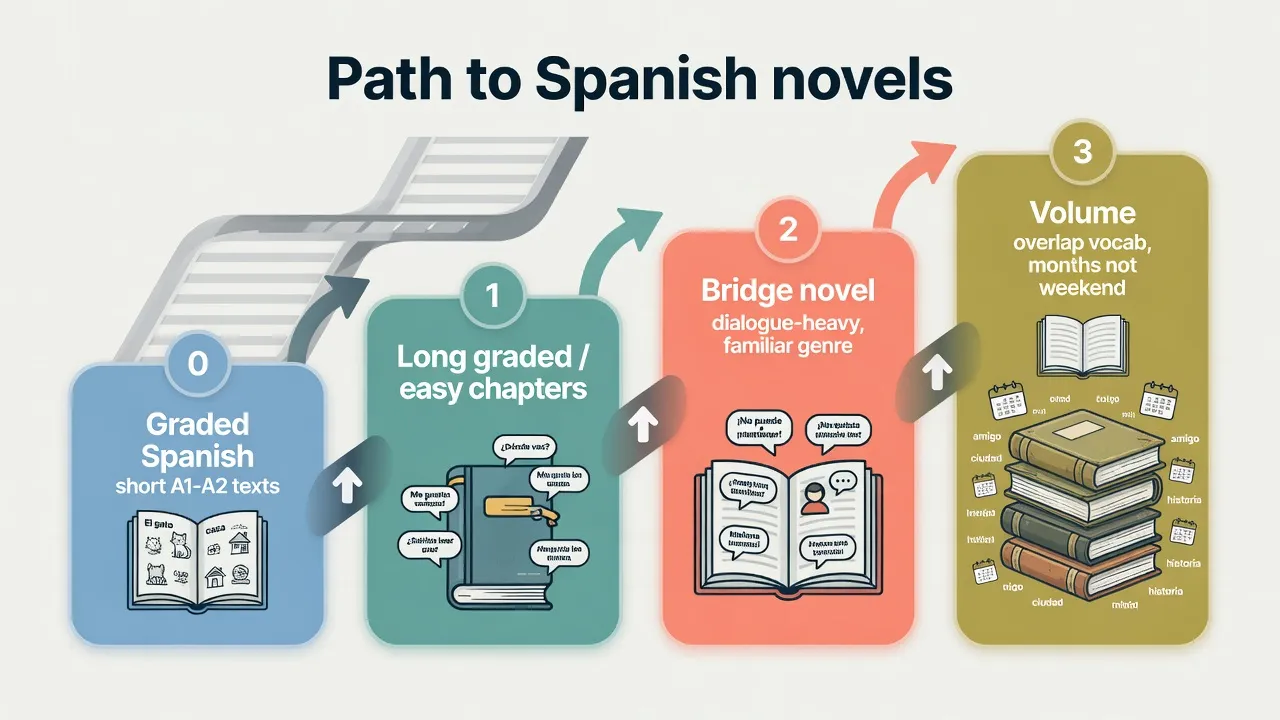
Stage 0 - Short graded Spanish
Goal: finish pages, not decode letters.
- Free leveled articles daily
- Samples: A1 Spanish article, A2 Spanish article
- Browse: All Articles
If you cannot finish short graded pages smoothly, a full novel is not "motivation." It is the wrong input.
Stage 1 - Long graded / easy chapter books
Goal: multi-sitting stories with high coverage.
- Learner novels, diaries, simple YA in Spanish
- Same lookup discipline: blockers only
- Book ideas: easiest Spanish books A2-B1, and the adapted-vs-original take in adapted vs original books for A2 learners
Stage 2 - Bridge novels
Goal: first complete popular novel with support.
- Clear plots, lots of dialogue, familiar genres
- Accept a slower pace
- Optional: upload a legal EPUB you own into a reader with click-translate (see How to use)
Márquez and dense magical realism are stretch goals, not day-one fuel. When you are ready for that conversation: where to start with Márquez in Spanish.
Stage 3 - Volume
Goal: second and third novels get easier because of overlapping vocabulary - not because a counter hit a magic number.
About time: many learners need months of consistent reading, not a weekend challenge, to go from "A2 article" to "comfortable modern novel."
How many words should you learn per week?
Research on extensive reading emphasizes repeated encounters in context more than cramming fifty isolated nouns.
Practical caps that do not kill reading:
- Save 3-10 useful phrases per session
- Prefer chunks (dar por hecho, a pesar de) over orphan lemmas
- Reread yesterday's page before adding new load
If you stop reading to build perfect Anki decks, you optimized the wrong metric. For building size through pages, build B1 vocabulary by reading pairs well with this ladder.
CEFR labels vs coverage on the page
CEFR is a conversation / can-do label. It is not official word law, and it is not a novel-readiness certificate.
| Zone | Reading expectation (very approximate) |
|---|---|
| A2 | Short graded texts; novels usually too heavy as daily drivers |
| B1 | Simple stories and heavy-support novels possible |
| B2 | Many modern novels readable with effort; literary density still varies |
| C1+ | Wide novel range; remaining pain is style, culture, and stamina |
Use CEFR when you talk about level with a teacher or friend. Use coverage on the page when you decide whether to buy or abandon a book.
Related reading:
- How many words for CEFR?
- How many words for B2?
- Spanish vocabulary and Plan Curricular
- Does 5,000 words mean C2?
- Language map · Language map explained
Where tools help (and where they fake it)
Helpful
- Instant lookup so rare words do not end the session
- Saving phrases from real sentences
- Audio after you can already follow the page (unlimited listen is fine for review)
- Graded libraries that raise coverage on purpose
- Owned-file EPUB reading with click-translate at Stage 2
Oversold
- Personal "94.3% novel coverage" as if it were a blood test
- Guarantees that N words produce fluency in N days
- English Nation numbers as exact Spanish lemma destiny
Using MovaReader for this goal
- Build coverage on free graded Spanish: All Articles, A1 sample, A2 sample.
- The free plan gives about 20 translations per day and unlimited listening. When lookups become the bottleneck, Reader is €1 for unlimited translations.
- At Stage 2, upload a novel EPUB you own (How to use).
- Optional Pro at €5/mo for full trainers; keep a small phrase set (3-10 per session). Demo if you want a light practice loop: everyday Spanish phrases practice.
- Use the language map as an orientation compass, not a novel-readiness certificate.
When limits are real, see Pricing. If you need personal marks and progress, register when it helps.
Common myths
"Once I hit 5,000 words, any Spanish novel is fine."
No. Cien años de soledad and a contemporary thriller are different sports. Genre, density, and style matter more than a round trophy number. Unit confusion makes it worse - see does 5,000 words mean C2?.
"If I translate every unknown, I am studying efficiently."
Often you are practicing dictionary use. Prefer finishing scenes. Look up blockers; guess or skip the rest.
"Native speakers know 100% of novel vocabulary."
They do not. They skip, infer, and hold incomplete senses too - with better grammar scaffolding and world knowledge.
"Spanish is easy because of cognates, so Nation numbers do not apply."
Cognates help, especially for English speakers, but coverage still matters. Do not use cognates as permission to start with the hardest classic.
"The 1,000 most common words are almost enough for novels."
Token share is not the same as a readable novel. High-frequency words carry a lot of traffic. They do not carry every battle scene, legal subplot, or regional joke.
FAQ
How many Spanish words to read a novel?
There is no single number. Aim for high coverage on this book (research often discusses ~95-98%). Classic English-corpus Nation-style work associates ~95% novel/news talk with around ~4,000 word families and ~98% with around ~8,000-9,000 families - use as scale for Spanish, not destiny. Validate with a middle-page test.
Is 95% coverage enough?
Sometimes for adequate comprehension with effort (about 1 unknown in 20). Many researchers discuss ~98% as more comfortable for independent hard text. Try both feelings on real middle pages. Fake precision ("exactly 95%") is marketing.
Do I need 98% before I start any novel?
No. Start supported novels earlier if motivation is high. Keep graded input in the mix so you are not only suffering. Coverage on this book beats a diploma threshold.
Is 5,000 words enough for any Spanish novel?
No guarantee. Genre and density vary (Cien años de soledad vs a contemporary thriller). "5,000 words" also depends on unit (forms vs lemmas vs families). See does 5,000 words mean C2? - and use middle pages of the real book.
Word lists or reading - which grows size faster for novels?
For mid and low-frequency novel vocabulary, reading plus selective review usually beats isolated lists. Lists can still seed high-frequency gaps. Prefer 3-10 useful phrases per session and chunks over orphan lemmas.
Can MovaReader tell me my exact vocabulary size or novel coverage %?
No. Use the free plan (about 20 translations/day, unlimited listen), Reader €1 when lookups bottleneck, and upload an EPUB you own at the bridge-novel stage. Progress is marks plus reading habit - not a certificate.
Final takeaway
To read Spanish novels, optimize coverage and habit, not a trophy word count.
- Think 95-98% ranges, not fake exact thresholds.
- Treat Nation-style 4k vs 8-9k family discussions as English-corpus research ballparks, not a Spanish vending machine.
- Test middle pages of the real book.
- Climb graded → bridge novel → volume.
- Use lookups and free libraries to keep sessions alive; pay only when limits are real (Pricing).
Concrete next step: read one free Spanish A2 article, then open two middle pages of a Spanish book you actually want. Let that unknown density - not a viral number - choose your path. For orientation, keep the language map nearby.
Keep reading with translations inside the text
With a free account, an unknown word translates with one tap, and the words you are learning wait for you in the trainer.
Free account: 7 days of Pro, then 20 word translations a day or a paid plan.