Curated Resources
Top 10 Easiest Spanish Books for A2-B1 You Can Actually Finish
Not another prestige pile. Finishable Spanish books from low A2 to high B1, a separate "still too hard" list, graded series names that actually work, and one 80-90% page rule so you stop quitting mid-chapter.
If you are around A2-B1, you do not need another list that dumps Don Quixote or La sombra del viento on you and calls it beginner reading. You need books you can finish without living in a dictionary.
Below: a quick level table, 7 realistically finishable titles (plus controlled graded series like Lola Lago / Juan Fernández / Paco Ardit), a separate stretch list people push too early, and one rule that works - stay when you understand about 80-90% of a random page. Warm up on free graded samples; long commercial novels are copies you own or borrow. MovaReader does not host El Principito or La sombra del viento by default.
Here is what follows:
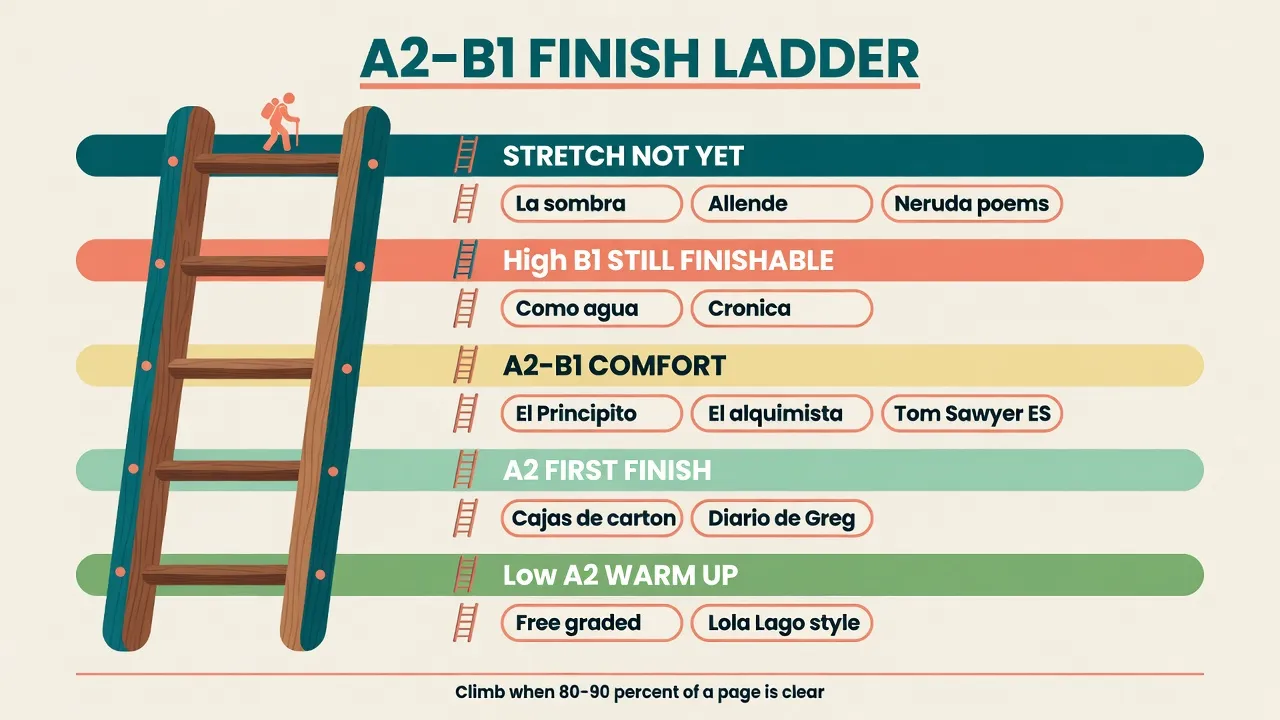
- Quick picks by level
- What "easy" really means at A2-B1
- Controlled graded series worth naming
- Part 1: seven books you can finish
- Part 2: three popular stretch titles (not first)
- A reading method that does not burn you out
- Free vs buy: graded path, library, own EPUB
- How to use MovaReader
- Paths A and B if you feel lost
- FAQ
Quick picks by level
Match the band you can mostly follow - not the prestige book on someone else's shelf.
| Your level now | Start with | Why it works |
|---|---|---|
| Low A2 | Free graded A1-A2 text or short graded series (Lola Lago / Juan Fernández / Paco Ardit style), then Cajas de cartón | Short sentences, concrete vocab, controlled finish |
| Solid A2 | Diario de Greg (Spanish) or El Principito | Familiar story or diary; easy stop and resume |
| A2-B1 | El alquimista or Las aventuras de Tom Sawyer (Spanish) | Clear narrative, plot pull, bridge off pure graded |
| Strong B1 ready to stretch | Como agua para chocolate or Crónica de una muerte anunciada | Popular "next" books; still demanding |
| Not yet | La casa de los espíritus, La sombra del viento, dense poetry as main project | Great books, wrong first "easy A2-B1 finish" |
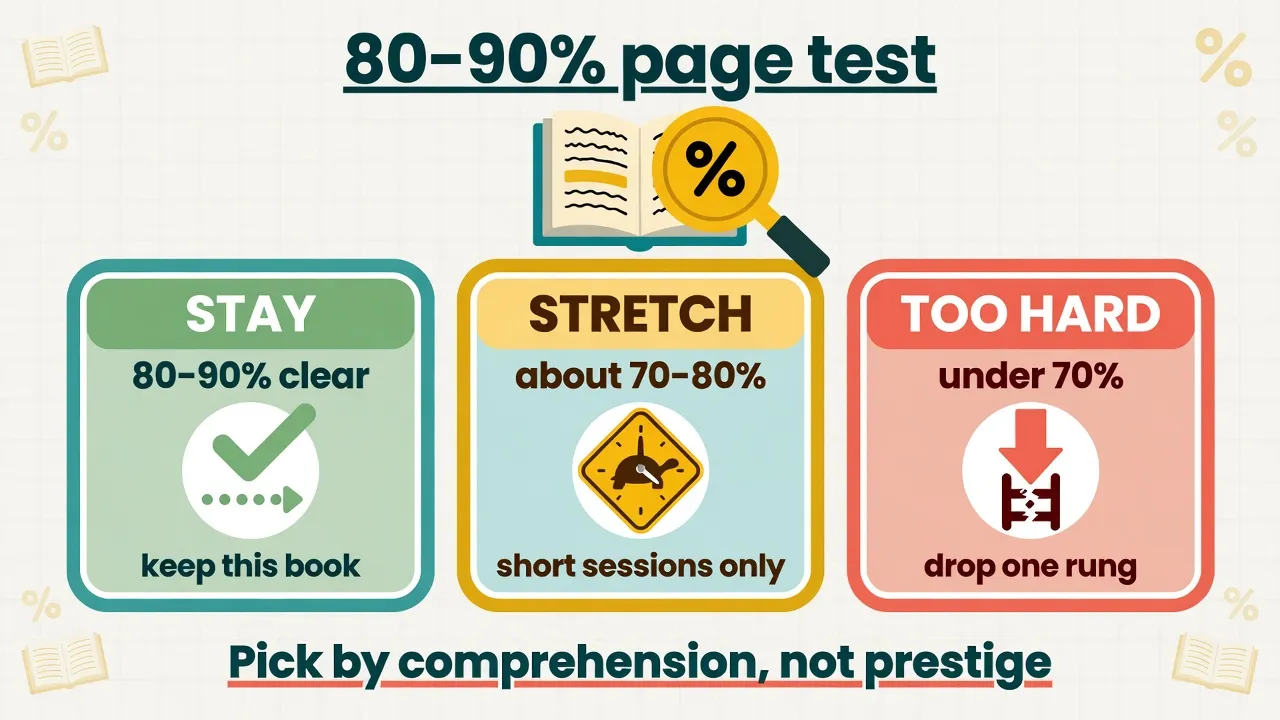
The only rule that matters: open a random page. If you understand about 80-90% without help, keep going. If you understand less than ~70%, the book is a stretch project, not your daily reader.
Try this free sample first (no book purchase needed): Spanish A2 reading: Aprendiendo a reciclar en casa. If that page feels comfortable, you are ready for the easy book list below. Still shaky? Start with the Spanish A1 sample: Mi día en el parque, or browse the free graded library. If you are closer to true A1, use our easy Spanish books for A1 beginners first.
What "easy" really means at A2-B1
At A2-B1, easy usually means:
- short chapters or clear scene breaks
- a lot of dialogue or simple narrative past
- concrete topics (school, family, travel, work, food)
- repeated vocabulary
- a story you already know in another language (optional but helpful)
Easy usually does not mean:
- multi-generation family sagas
- heavy political history without prep
- long gothic mysteries
- poetry full of metaphor as a main project
Many "easy Spanish books" lists mix beginner-friendly titles with prestige novels. That confuses people and causes early quitting. This guide keeps two lists: books you can honestly finish at A2-B1, and popular titles that are better as goals. For the adapted vs original debate at A2, see adapted vs original books for A2.
Controlled A2 finishes: graded series worth naming
Before the "real book" ladder, name the controlled path that many learners finish first. These are learner finishes, not native prestige literature. Short, level-tagged, high finish signal. Buy, borrow, or use free samples elsewhere - the app does not host full commercial ELE series by default.
| Name | Typical band | Best use |
|---|---|---|
| Lola Lago (cousins: Gael, Un día en..., Enigma y misterio, La chica de los zapatos verdes) | True A2 | Classic ELE graded path; buy or borrow |
| Juan Fernández (La profe de español, Año nuevo, vida nueva, etc.) | True A2-B1 | Learner-authored novels; short win |
| Paco Ardit Spanish Novels A2 (and level bundles) | True A2 / pre-int | High finish rate; quality varies by title - still finishable |
| Olly Richards Short Stories (beginner / intermediate) | A2-B1 | Method cousin; plots thin for some - optional |
Need a legal free graded deep-dive? See free graded Spanish readers online and graded Spanish stories by CEFR. Short form only? Try best Spanish short stories by CEFR level.
Optional YA side paths (hedged, not pure A2 starts): Papelucho (Marcela Paz) has an A2-ish journal vibe; Manolito Gafotas is high A2 / solid B1 colloquial Spanish - fun, not a gentle first novel for everyone.
Part 1: books that are realistic for A2-B1
Finishable ladder after free graded warm-up. Per book: soft level, why you can finish, what to watch, and a 3-5 page start test. Soft CEFR labels are orientation for many learners, not certificates.
1. Cajas de cartón - Francisco Jiménez
Realistic level: A2
Why it helps: Clear autobiographical scenes, short sections, everyday vocabulary about family, school, and work.
Watch out for: Emotional intensity. The language is simple; the life story is not light.
Jiménez is widely known for the English-language Circuit stories; Spanish editions such as Cajas de cartón are often used with learners because the style stays concrete and readable. Treat it as a strong A2 memoir-style reader, not as "kids' Spanish only." If pure memoir still feels heavy, start with a Lola Lago or Juan Fernández A2 reader first.
How to start: Read 3-5 pages. If you can follow who is speaking and what happens next, continue.
2. Diario de Greg (Diary of a Wimpy Kid) - Jeff Kinney, Spanish edition
Realistic level: A2-B1
Why it helps: Diary format, short entries, informal school Spanish, humor that keeps you turning pages.
Watch out for: Colloquial lines and jokes that depend on culture. Skip a joke and keep the plot.
This is one of the best "I can finish chapters on a bus ride" options. It will not teach literary Spanish. It will teach useful conversational patterns and the habit of finishing.
3. El Principito - Antoine de Saint-Exupéry (Spanish)
Realistic level: A2-B1
Why it helps: Short chapters, familiar story for many readers, lots of dialogue and simple sentence frames.
Watch out for: Abstract lines about "what is essential." Those sentences are short but not always easy to feel in a second language.
Use it as a confidence book, not as your only source of modern spoken Spanish. Prefer a full edition you own or borrow; adapted school versions can be gentler if the original still freezes you.
4. El alquimista - Paulo Coelho (Spanish edition)
Realistic level: A2-B1
Why it helps: Short chapters, repeated key ideas, clear quest structure.
Watch out for: Repetitive philosophy. Some learners love it; some find it thin. For language practice, repetition is useful.
Good bridge book when graded readers feel too easy but native novels still feel heavy.
5. Las aventuras de Tom Sawyer - Mark Twain (Spanish translation)
Realistic level: A2-B1
Why it helps: Adventure plot, dialogue, and narrative past forms in context.
Watch out for: Older settings and name lists. Keep a simple character map if needed.
Useful for practicing story past tenses in motion, not in isolated grammar drills. When a past form blocks meaning, check it; do not stop for every verb.
6. Como agua para chocolate - Laura Esquivel
Realistic level: high B1 (stretch for many A2 learners)
Why it helps: Strong plot, food vocabulary, chapter structure that mixes recipe and story.
Watch out for: Sensory description and cultural references. If food words pile up, skim the recipe block and return to the plot.
Put this after you can finish one easier book above. It is popular and motivating, but it is not a pure A2 starter.
7. Crónica de una muerte anunciada - Gabriel García Márquez
Realistic level: solid B1 to low B2
Why it helps: Short length, intense plot, repeated events from different angles.
Watch out for: Local references, many character names, and denser sentences than YA fiction.
If you want a first "serious" Spanish novella, this is a better entry than starting with Cien años de soledad. Still: short does not always mean easy. When you outgrow pure "easiest," see Spanish books at B1: what to read.
Comparison table: finishable picks at a glance
One scan of the full spine: graded path, seven finishable titles, three stretch goals.
| # | Title | Author / note | Level (soft) | Finishable at A2-B1? | Watch-out | Start tip |
|---|---|---|---|---|---|---|
| G | Graded series (Lola Lago / Juan Fernández / Paco Ardit) | ELE / learner novels | True A2 | Yes (controlled) | Not free full series in app by default | Buy/borrow or free samples first |
| 1 | Cajas de cartón | Francisco Jiménez | A2 | Yes | Emotional intensity | 3-5 pages; follow speakers |
| 2 | Diario de Greg (ES) | Jeff Kinney | A2-B1 | Yes | Colloquial jokes | Bus-length diary chunks |
| 3 | El Principito | Saint-Exupéry (ES) | A2-B1 | Yes (hedge abstract lines) | Abstract "essential" lines | Confidence book, short chapters |
| 4 | El alquimista | Paulo Coelho (ES) | A2-B1 | Yes | Thin philosophy for some | Bridge off graded |
| 5 | Tom Sawyer (ES) | Twain translation | A2-B1 | Yes | Old setting / name lists | Character map; past forms in motion |
| 6 | Como agua para chocolate | Laura Esquivel | high B1 | Late Part 1 | Recipe sensory pile | After one easier finish |
| 7 | Crónica de una muerte anunciada | García Márquez | solid B1 - low B2 | Late Part 1 | Names + denser prose | First "serious" novella, not Cien años |
| 8 | Veinte poemas de amor... | Neruda | often B2+ comfort | No as main project | Figurative compression | One poem weekly, not finish-this-week |
| 9 | La casa de los espíritus | Isabel Allende | B2+ | No as first easy | Length, timeline, politics, voice | After shorter narrative wins |
| 10 | La sombra del viento | Carlos Ruiz Zafón | B2-C1 | No as first easy | 500+ pages + denser description | Goal book; not habit test |
Part 2: popular books people push too early
These are excellent books. They are simply not the best first "easy A2-B1 finish this month" targets for most learners. Frame them as goal books, not habit killers.
8. Veinte poemas de amor y una canción desesperada - Pablo Neruda
Realistic level for comfortable reading: often B2+
Why people recommend it: Short pieces, famous lines, emotional impact.
Why it is harder than it looks: Poetry compresses meaning. Even common words can be figurative.
Better use case at A2-B1: read one poem slowly, aloud, and keep a few lines - not "finish the book this week."
9. La casa de los espíritus - Isabel Allende
Realistic level: B2+ for most independent readers
Why it is hard early: Length, family timeline, political and historical context, shifts in time and voice.
When to try it: After you can finish shorter narrative books with less lookup.
10. La sombra del viento - Carlos Ruiz Zafón
Realistic level: B2-C1 for comfortable reading
Why people love it: Addictive mystery and atmosphere.
Why it breaks A2-B1 plans: 500+ pages plus denser descriptive style. Motivation helps, but daily lookup load is high.
Keep it as a goal book. Do not use it to test whether "reading in Spanish works."
Also not first "easy" finishes: full Don Quijote (adapted only if you try early), Cien años de soledad (C1 comfort for most), and Harry Potter in Spanish (often B1+/B2 vocab load - fine later if the series already pulls you).
A reading method that does not burn you out
"Can't put down" is not magic willpower. It is the right level plus a small daily loop.
Pick for comprehension, not prestige
If a page needs constant translation, you are studying decoding, not reading. Switch down one level.
Look up less, finish more
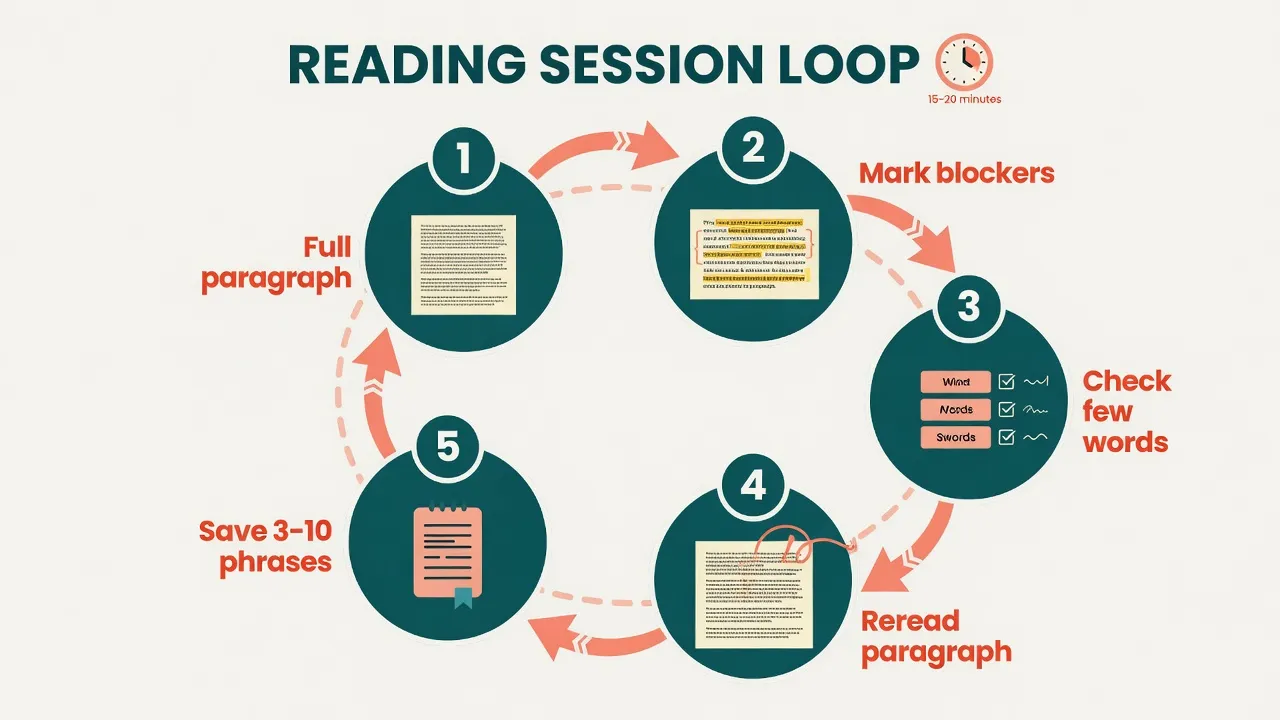
A practical workflow:
- Read a paragraph once without stopping.
- Mark only words that block the meaning of the whole sentence.
- Check those words.
- Reread the paragraph.
- Save 3-10 useful phrases max per session, not 40 isolated words.
Prefer short daily sessions
15-20 minutes daily beats a two-hour weekend guilt session. Stop mid-chapter if needed; stopping is better than quitting the book.
Mix free graded text with one real book
A stable weekly pattern:
- 4 days: free graded Spanish texts in the library
- 2 days: your chosen book (EPUB or paper you own or borrow)
- 1 day: review saved phrases
Start with free samples:
- Spanish A1 sample: Mi día en el parque
- Spanish A2 sample: Aprendiendo a reciclar en casa
- Browse free articles
Need orientation on frequent vocabulary? Peek at the language map, then A2 vocabulary or B1 vocabulary when you want a band, not a guilt score.
Use audio only when it helps
If audio is available for a text, use it after you can follow the written page. Audio on a page you do not understand yet usually adds noise, not magic.
Free vs buy: graded path, library, own EPUB
Where each kind of book comes from, so you do not expect a free full bestseller in the app.
| Path | What you get | Watch-out |
|---|---|---|
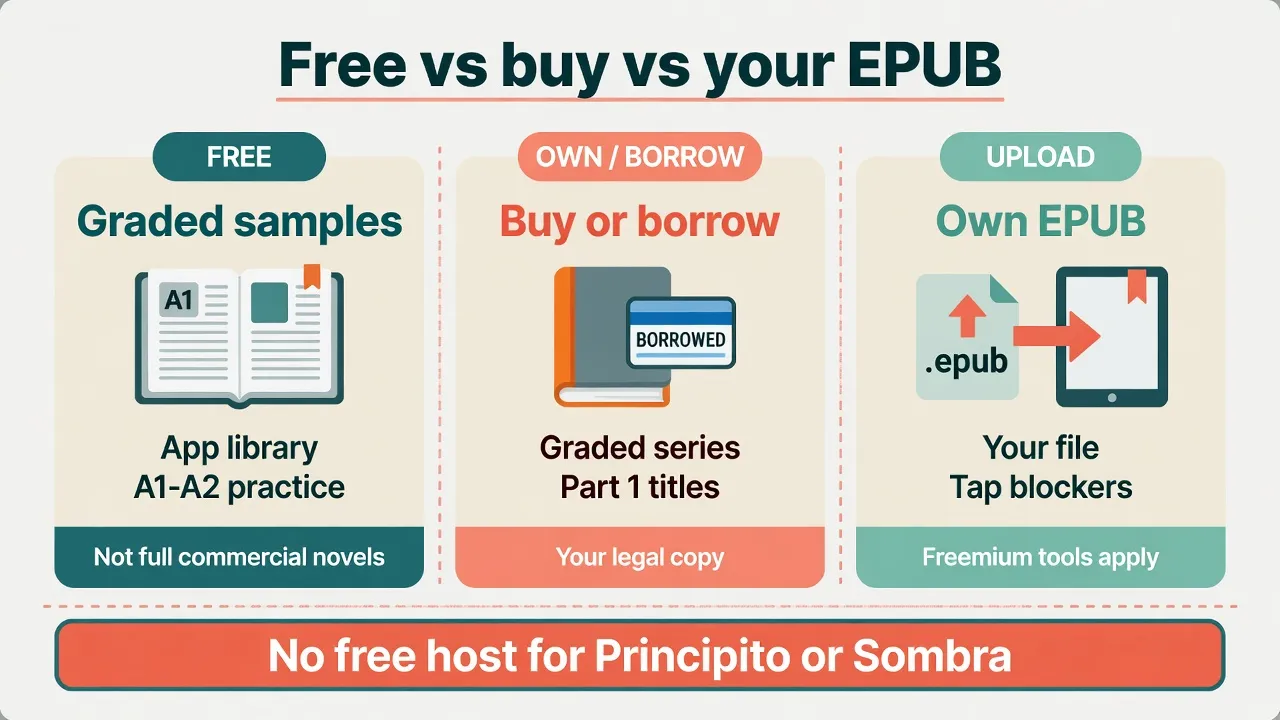
| Free graded in MovaReader | A1-A2 samples + library articles | Not full commercial novels |
| Legal free learner sites / short stories | Extra practice | Quality varies; not always novel-length |
| Buy/borrow ELE graded (Lola Lago, Juan Fernández, Paco Ardit, etc.) | Controlled A2 finishes by design | Paid or library; not "free in app" unless you own the file |
| Buy/borrow commercial titles in Part 1-2 | Motivation + authentic style | Your legal copy |
| Upload own EPUB to MovaReader | Support tools on your file | Freemium limits apply |
No pirate path. No full El Principito or La sombra del viento hosted by default. More free graded options: free graded Spanish readers online. MovaReader does host a small shelf of public-domain classics, for example an A2 adaptation of Lazarillo de Tormes where you tap a word to see its translation: see the Spanish A2 shelf.
How to use MovaReader
MovaReader is useful for this exact problem: reading with support, then turning unknown words into practice. Use it like this:
- Warm up on free graded articles in All Articles so you learn the click-to-translate flow.
- Upload a book file you own (for example EPUB) when you are ready for a longer title. See How to use.
- Tap only blockers, not every unknown adjective.
- Train a small set of phrases in the everyday Spanish phrases practice or full trainers after you save them.
- Respect freemium limits: free use includes listening and a daily word-translation budget (about 20/day). Unlimited reading translations are on Reader (€1/month); full trainers are on Pro (€5/month). Details: Pricing.
What MovaReader does not do:
- It does not legally replace buying or borrowing the commercial books in this list.
- It does not host full El Principito, La sombra del viento, or other commercial list titles by default.
- It does not replace the need to choose the right difficulty.
If you want a free product path today, do this sequence:
- Read Spanish A2 sample
- Try free Spanish vocabulary trainer
- Try phrase training demo
- Only then upload a book you own and start with one realistic title from Part 1 (or a graded series you own)
- Register when you want a full account and progress that sticks
Suggested order if you feel lost
Path A (safer):
- Free A1-A2 articles in MovaReader
- Optional: short graded series title you own or borrow (Lola Lago / Juan Fernández / Paco Ardit A2)
- Cajas de cartón
- Diario de Greg
- El Principito or El alquimista
- Tom Sawyer (Spanish)
- Later: Como agua para chocolate or Crónica de una muerte anunciada
Path B (if you already know the stories in another language):
- Free A2 articles
- El Principito
- Diario de Greg
- El alquimista
- One stretch novella (Crónica...) only after Path B books 2-4 feel manageable
Stay on one path until pages feel green. Jumping to prestige novels early is how "easy Spanish books" lists become quit lists.
FAQ: easy Spanish books for A2-B1
What is the easiest Spanish book for beginners (A2) here?
For many A2 readers: Cajas de cartón or Diario de Greg (Spanish), or a short Lola Lago / Juan Fernández / Paco Ardit A2 reader if you want maximum control. El Principito is common, but abstract lines can slow you down. If even memoir pages feel red, warm up on free graded A1-A2 samples first.
Should A2 learners use graded readers or real books?
Both. Graded texts (free samples + series like Lola Lago style) build speed and confidence. Real books add motivation and natural style. A stable mix: free graded most days + one real book in short sessions (15-20 minutes). Do not force a 500-page novel to prove you are "serious."
How many pages should I read per day?
Start with 2-5 pages or about 15 minutes. Consistency beats volume. Increase only when lookup frequency drops and you can still retell the scene. Stopping mid-chapter is fine; quitting from exhaustion is worse.
What should I do when I do not understand a sentence?
Do not translate every word. Guess from context first. Check only the phrase that blocks meaning. Save useful chunks (3-10 per session), not every unknown adjective. If the page needs constant help, drop one difficulty rung.
Is poetry good for A2-B1?
As a main reading project, usually no. As a short weekly add-on (one poem), yes. Treat Neruda as enrichment, not as your difficulty baseline - figurative lines compress meaning even when words look "short."
Can I read La sombra del viento at B1?
Some motivated B1 readers start it and survive with heavy support. Most enjoy it more at B2+. If the goal is "finish books," choose a shorter win first (Part 1 list or a controlled graded series). Length plus denser description make it a poor first "easy A2-B1" test.
Final takeaway
The best easy Spanish book is the one you can finish this month.
Choose for comprehension, protect your daily habit, and use tools to reduce friction - not to pretend a 500-page novel is beginner material. If you want a clean start today, open a free Spanish A2 text, then pick one realistic title from Part 1 (or a controlled graded series you own). When you are ready to go past pure "easiest," continue with Spanish books at B1.
Keep reading with translations inside the text
With a free account, an unknown word translates with one tap, and the words you are learning wait for you in the trainer.
Free account: 7 days of Pro, then 20 word translations a day or a paid plan.