Grammar in Context
Preterite vs Imperfect Spanish: Photo vs Camera
Stop freezing when Spanish switches past tenses. Photo vs movie-camera logic, four story scenes, then practice in real reading.

You can recite the endings for hablar in pretérito and imperfecto (-é, -aste, -ó... and -aba, -abas...) and still freeze on a real paragraph. The hard part is not the forms. The hard part is why the author chose one past tense instead of the other.
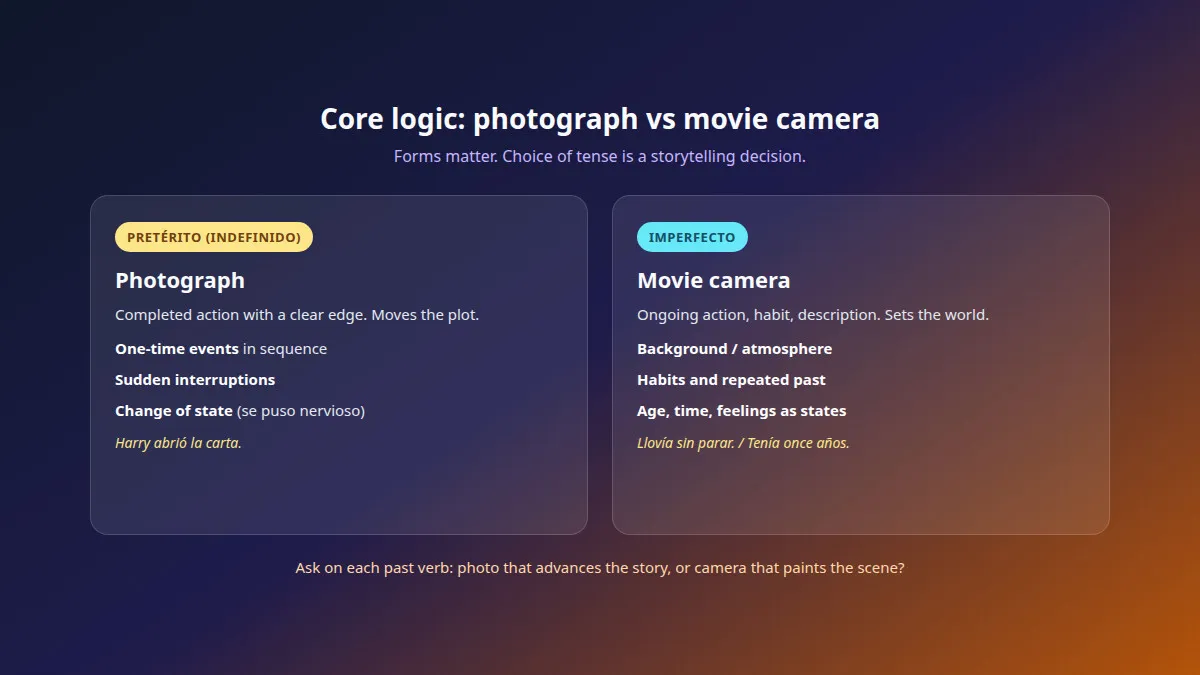
Pretérito indefinido (preterite) is a photograph: one completed plot event with a clear edge (Harry abrió la carta). Pretérito imperfecto (imperfect) is a movie camera: background, habit, description, ongoing state (Llovía sin parar). One line to keep: imperfect sets the stage; preterite moves the story. You can know the endings and still freeze on a real page. The hard skill is why the narrator chose, not the form labels alone.
Rules stick when you see them inside stories. This post uses Harry Potter-style teaching examples as a thinking tool. MovaReader does not host commercial Harry Potter text. If you own a legal EPUB, you can upload it yourself; otherwise start with free graded Spanish articles in the library.
Next: a quick comparison table, photo vs camera in more detail, four story scene patterns, five golden rules, a mini quiz, and a short reading loop you can run today. Comparison and scenes first - not another conjugation encyclopedia.
Quick comparison: preterite vs imperfect
When you freeze mid-sentence, scan this first. The scenes below build the same logic in context.
| Situation | Prefer | Why (one line) |
|---|---|---|
| Completed single event | Preterite | Clear edge; plot move |
| Sequence of finished steps | Preterite | One photo after another |
| Habit / repeated past | Imperfect | Ongoing pattern, no one finish |
| Description / atmosphere | Imperfect | Stage painting |
| Age / clock time as background | Imperfect | State / setting |
| Ongoing action interrupted | Imp + Pret | Camera rolling + sudden photo |
| Two actions ongoing together | Imp + Imp | Simultaneous background |
Tables orient you. Four story patterns train the same decision where it actually lives: inside a paragraph.
The core logic: photograph vs movie camera
Replace textbook labels with one image.
| Tense | Image | What it does | Quick example |
|---|---|---|---|
| Pretérito indefinido (preterite) | Photograph | One completed action with a clear edge; plot move | Harry abrió la carta. (Harry opened the letter.) Click, done. |
| Pretérito imperfecto (imperfect) | Movie camera | Ongoing action, habit, description, atmosphere; no sharp finish | Llovía sin parar. (It was raining non-stop.) |
Imperfect sets the stage. Preterite snaps the photo that changes the scene.
Most learner confusion about when to use preterite or imperfect is this choice, not missing endings. The freeze happens when both appear in one sentence and you have to feel which role each verb plays.
Here is the same model as a simple diagram - photo for plot, camera for background:
Hold that image. Everything below is the same idea in story form.
Scene pattern 1: background, then interruption
A classic narrative dance: atmosphere first, then something snaps. (Harry Potter-style teaching paraphrase only - not text from a hosted book.)
El martes, el señor Dursley llegó al trabajo como siempre. Estaba pensando en todo aquello mientras cruzaba el vestíbulo, pero entonces vio algo que lo hizo olvidarse de todo lo demás.
| Verb | Tense | Why |
|---|---|---|
| llegó | Preterite | Completed arrival |
| estaba pensando | Imperfect | Ongoing mental background |
| cruzaba | Imperfect | Action in progress |
| vio | Preterite | Sudden interrupting event |
| hizo | Preterite | Immediate result that moves the plot |
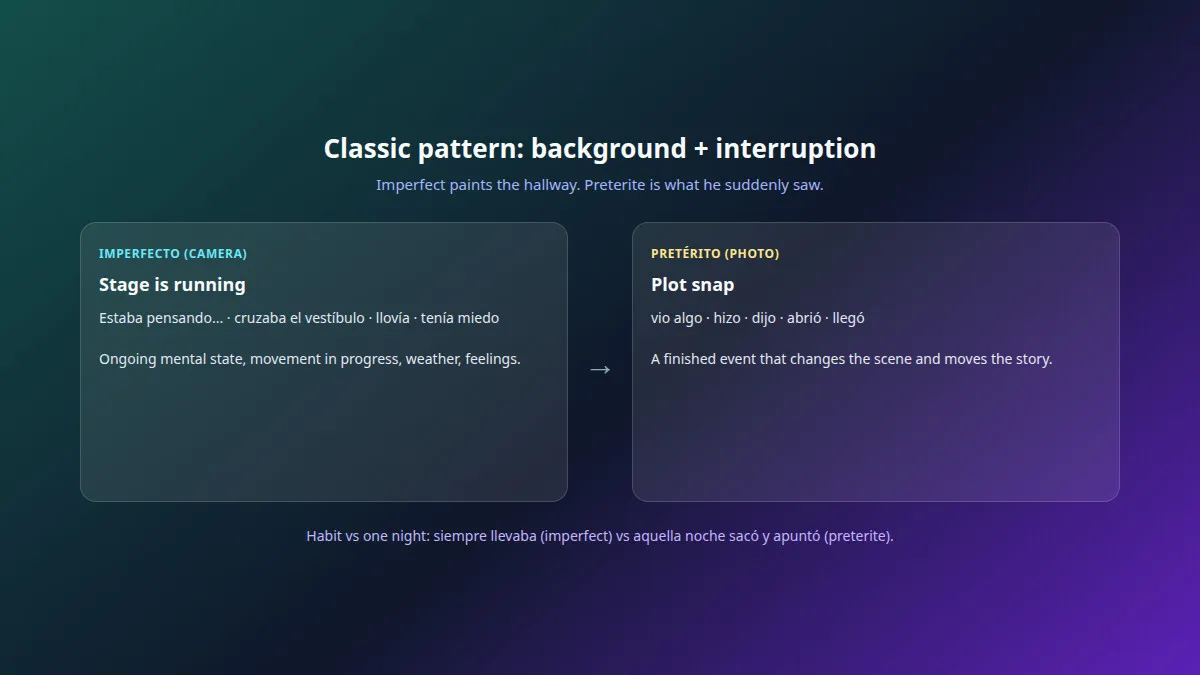
Imperfect sets the stage; preterite snaps the photo. This "background + interruption" pattern appears constantly in fiction.
When you read any Spanish narrative, mark past verbs in a short paragraph and ask: Is this atmosphere, or did something finish and push the story forward?
The interruption pattern in one glance:
Scene pattern 2: habit vs one night's actions
Same character, two time scales: what they always did vs what they did that night.
Hagrid siempre llevaba un paraguas rosado. Aquella noche, sacó el paraguas y apuntó a Dudley.
| Form | Tense | Role |
|---|---|---|
| llevaba | Imperfect | Habit / characteristic (used to carry / always carried) |
| sacó, apuntó | Preterite | Specific sequential actions that night |
Rule of thumb:
- habits, repeated past actions, descriptions → Imperfect
- one-time completed steps in a sequence → Preterite
If the Spanish paints "how life usually was," stay on the camera. If it lists what finished that night, click photo after photo.
Scene pattern 3: feelings and descriptions
Inner weather first; plot moves second.
Harry estaba nervioso. Sentía que el corazón le latía muy rápido. De pronto, la profesora McGonagall dijo su nombre y Harry caminó hacia el taburete.
| Form | Tense | Role |
|---|---|---|
| estaba, sentía, latía | Imperfect | Internal state / description (no exact start/stop) |
| dijo, caminó | Preterite | Plot moves ("what happened next") |
Emotions, physical states, and scene descriptions usually take the imperfect. They answer "What was the world like?" Preterite answers "What happened next?" A change of state often takes a photo (se puso nervioso); ongoing state stays on the camera (estaba nervioso). More under traps.
Scene pattern 4: age and time
Age and clock time are stage setting, not plot punches.
Harry tenía once años cuando recibió la carta.
| Form | Tense | Role |
|---|---|---|
| tenía | Imperfect | Age is a state |
| recibió | Preterite | Completed event |
Clock time in the past also tends to use imperfect as background:
Eran las tres de la mañana cuando Dumbledore apareció.
| Form | Tense | Role |
|---|---|---|
| Eran | Imperfect | Clock time as setting |
| apareció | Preterite | Interrupting / completed arrival |
Age and clock time place the world; the finished event arrives inside it.
Five golden rules you can actually use
Narrative defaults you can actually use - not magic laws.
- Completed, one-time action? → Preterite. Voldemort mató a sus padres.
- Background, description, atmosphere? → Imperfect. La noche era oscura y fría.
- Habit or repeated past action? → Imperfect. Siempre desayunaban en el Gran Comedor.
- Two ongoing actions at once? → Imperfect + Imperfect. Mientras Ron comía, Hermione leía.
- Ongoing action interrupted by a sudden event? → Imperfect + Preterite. Dormía cuando sonó la alarma.
These are narrative patterns, not magic. Authors still make style choices. Your goal is reliable defaults that match most prose.
Why conjugation tables alone fail
A table tells you hablé vs hablaba. It does not tell you which one a narrator needs.
Choosing between preterite and imperfect is a storytelling decision: describe the scene, or advance the plot? You internalize that by seeing the choice dozens of times in context, not by fill-in-the-blank drills alone.
Grammar tests can still help you check forms. They rarely build the instinct that kicks in while you read. Forms matter - they just are not the whole game. Drills check endings; stories train the decision.
Mini quiz: pick the tense
A quick practice check. Choose preterite or imperfect, then peek at the why. Missed items mean you need more context in real reading, not that you "failed grammar forever."
1. Habit vs one-night action
Cada verano, Harry ______ (pasar) las vacaciones con los Dursley.
- Prefer: Imperfect (pasaba)
- Why: repeated past / habit; no single finish edge.
2. Background + interruption
Harry ______ (leer) cuando Hagrid ______ (llamar) a la puerta.
- Prefer: Imperfect (leía) + Preterite (llamó)
- Why: ongoing action interrupted by a sudden event (camera + photo).
3. Age / time + event
Hermione ______ (tener) once años cuando ______ (llegar) a Hogwarts.
- Prefer: Imperfect (tenía) + Preterite (llegó)
- Why: age is state/setting; arrival is a completed plot event.
4. Emotion state vs change of state
Al oír su nombre, Harry ______ (ponerse) nervioso. Antes de eso, ya ______ (estar) tenso todo el día.
- Prefer: Preterite (se puso) + Imperfect (estaba)
- Why: se puso = change of state (photo); estaba = ongoing state (camera).
5. Sequence of plot steps
Aquella noche, sacó el paraguas, apuntó a Dudley y ______ (decir) unas palabras extrañas.
- Prefer: Preterite (dijo)
- Why: one finished step in a sequence of plot actions that night.
6. Simultaneous ongoing
Mientras Ron ______ (comer), Hermione ______ (leer) el libro de hechizos.
- Prefer: Imperfect + Imperfect (comía / leía)
- Why: two actions ongoing together; both are background cameras, not photos.
If two or three felt fuzzy, that is normal. Take those patterns into the next reading session and ask the same question on real lines.
A practical reading method
Use a story you already know in English if you want lower plot load - Harry Potter works as a thinking tool. Or use any Spanish text at a readable level. You still decide: photo or camera?
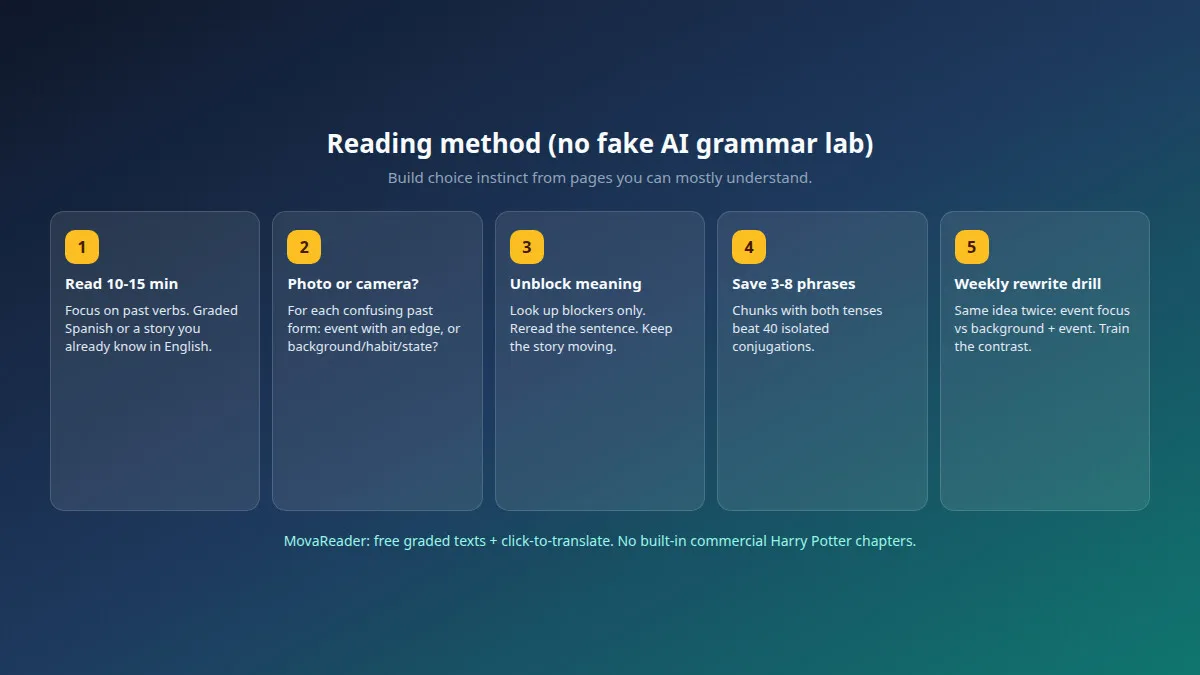
- Read 10-15 minutes focusing on past verbs, not every adjective.
- For each confusing past form, ask: photo or camera? event or background?
- If meaning is blocked, look up the word or form, then reread the sentence.
- Save 3-8 phrases with both tenses mixed, not 40 isolated conjugations.
- Once a week, rewrite 3 short sentences twice: once with preterite focus, once with imperfect background.
Example rewrite drill:
| Focus | Example |
|---|---|
| Event focus | Ayer Harry abrió la carta y gritó. |
| Background + event | Harry estaba nervioso cuando abrió la carta. |
You are training contrast, not inventing perfect literary style.
The loop as a simple diagram:
A short graded paragraph is enough for one freemium session. Warm up on A1: Mi día en el parque, A2: Aprendiendo a reciclar en casa, or All articles. When a past verb blocks meaning, tap for translation if you need it - then you still label photo or camera.
Beyond preterite and imperfect
Once the main pair feels clearer, you will notice other past forms:
| Tense | Example | Role |
|---|---|---|
| Pretérito perfecto | ha llegado | Past linked to the present |
| Pretérito pluscuamperfecto | había llegado | Past before another past |
Same principle: context decides. Build the big pretérito / imperfecto contrast first, then layer the others. Preference for he comido vs comí varies by region (see FAQ).
Common traps
"Was -ing" is not always imperfect
English progressive past often maps to imperfect, but not always. Spanish can use preterite for a bounded past event even when English says "was." Focus on Spanish narrative role, not word-for-word English.
Emotion verbs are not always imperfect
| Spanish | Typical role | Prefer |
|---|---|---|
| Se puso nervioso | Change of state (became nervous) | Preterite (photo) |
| Estaba nervioso | Ongoing feeling / state | Imperfect (camera) |
Change of state = often photo. Ongoing feeling = often camera.
"Suddenly" is a clue, not a law
Words like de pronto, entonces, de repente often mark preterite interruptions. Still read the whole clause - the word is a hint, not a law.
How MovaReader can help
MovaReader supports reading practice so preterite vs imperfect can grow from real Spanish. It does not turn every verb into an automatic private grammar lecture, and it does not ship Harry Potter as a built-in chapter lab.
What is real on site:
- Free graded article library plus click-to-translate
- You can upload EPUB/files you own (with legal rights)
- Freemium: 20 word translations/day, unlimited listening
- Reader (€1) for unlimited translations
- Pro (€5/mo) for full trainers
Suggested workflow:
- Warm up on free Spanish samples: A1: Mi día en el parque, A2: Aprendiendo a reciclar en casa
- Browse more free texts in All articles
- When a past verb blocks meaning, tap for translation; decide yourself: photo or camera?
- Save useful phrases and practice with demos: free Spanish vocabulary trainer, everyday Spanish phrases practice
- Upload a book you own only if you have legal rights to that file. See How to use and Pricing
What MovaReader does not do: host licensed commercial novels by default (including commercial Harry Potter), auto-color every tense role, promise instant grammar mastery, or replace your judgment about narrative meaning.
You still decide pretérito or imperfecto. The app keeps you inside Spanish you can finish.
FAQ
Is pretérito the same as English "simple past"?
Often close for completed events, but Spanish imperfect covers many cases where English uses simple past too (era, tenía, vivía). Map by function (photo vs camera), not by English label alone. If you only match "simple past = pretérito," you will overuse preterite in description and habit scenes.
Should I memorize all conjugations before reading?
Learn high-frequency patterns enough to recognize them, then grow more forms from reading. Waiting for "perfect tables first" delays the only practice that builds choice instinct. Forms still matter - they just are not the whole game. Drills check endings; stories train the decision.
Can beginners use Harry Potter for this?
Only if the Spanish is already roughly readable for you, or you already know the story well and accept heavy lookup. Many A2-B1 learners get better early practice from shorter graded texts, then move to longer fiction. Harry Potter-style scenes in this post are a thinking tool only. MovaReader does not host commercial Harry Potter; train the same patterns on free graded articles or a legal EPUB you own. Start in All articles if full novels still feel heavy.
How long until preterite/imperfect feel automatic?
There is no universal clock. Daily short reading with active "photo vs camera" questions beats rare marathon grammar days. Expect gradual comfort and fewer freezes - not overnight native accuracy.
Do Latin America and Spain use these the same way?
The core pretérito / imperfecto contrast is shared across varieties. Preference for pretérito perfecto (he comido) vs pretérito (comí) for recent or present-linked past varies by region (Spain often leans more on perfecto in speech; many LatAm varieties prefer pretérito more often). For narrative past contrast in stories, the photo vs camera logic still helps.
What should I study after this pair?
Pluscuamperfecto (había llegado) when flashbacks stack (past before another past). Then conditionals and subjunctive when dialogue gets emotional or hypothetical. Keep building the main pair in real reading first; layer the next tenses when you keep meeting them on the page.
Final takeaway
Preterite advances the plot. Imperfect paints the world where the plot happens. Harry Potter-style scenes make that contrast easy to notice because you already know the story frame. Use those examples as a thinking tool, then train the same pattern in any Spanish text you can finish.
Start with a free graded article today - open All articles or the A1 sample - mark five past verbs, and label each one photo or camera. That single habit beats another silent stare at a conjugation grid.
Keep reading with translations inside the text
With a free account, an unknown word translates with one tap, and the words you are learning wait for you in the trainer.
Free account: 7 days of Pro, then 20 word translations a day or a paid plan.