Vocabulary
Polyglot Method: How to Learn Words in Context
Polyglots rarely live in bare word lists. They meet language inside real messages. A practical method with four layers of context and a short daily reading loop.
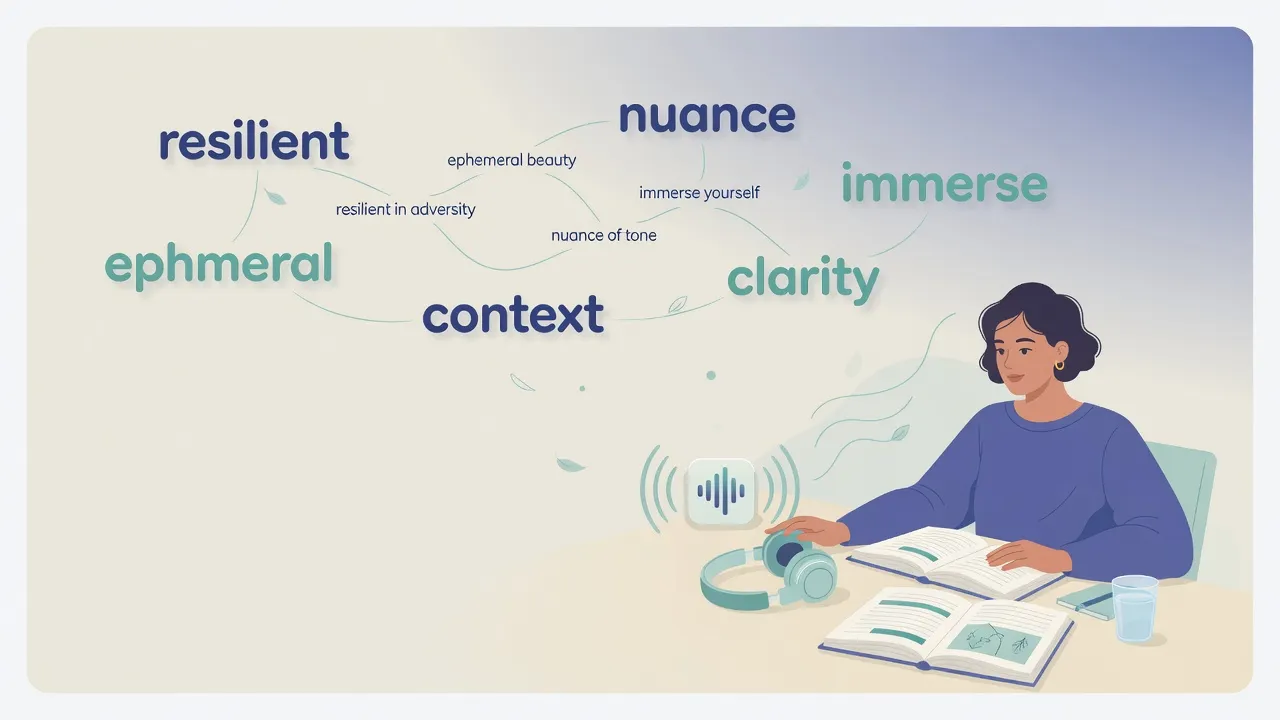
You can know every tense chart and still freeze on a living line with sarcasm or an idiom. Often that is not a "grammar hole." It is a context hole: you learned the word in isolation, but real language arrives with tone, neighbors, and a situation.
People we call polyglots usually do something simple. They meet words and phrases inside real messages - reading, listening, then light reuse of chunks - instead of permanently living in a list of "word = translation."
The method is useful. The internet version often is not: "context makes everyone several times faster," "a lab proved a fixed speed gap," "in 90 days you sound native." Exact universal multipliers in blogs are mostly marketing, not careful science reporting.
Below is the useful core of the method.
Polyglot-style learning is mostly: interesting input near your level → understand the message → notice useful chunks → meet them again → use a little. Context is not a ban on cards or dictionaries. It is a ban on living forever in bare "word = translation" rows with no story. Claims that context makes you several times faster are marketing, not a universal law.
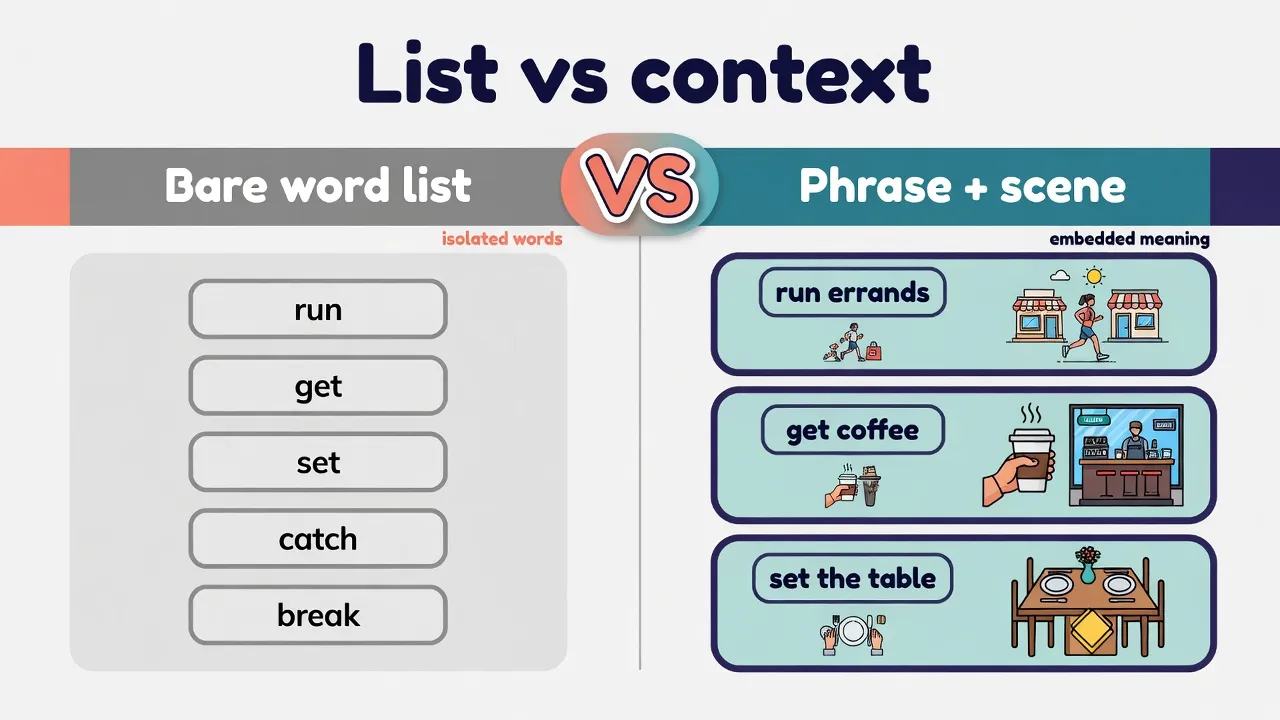
What contextual memory is (and is not)
Here it means:
- the word shows up in a sentence, scene, or dialogue
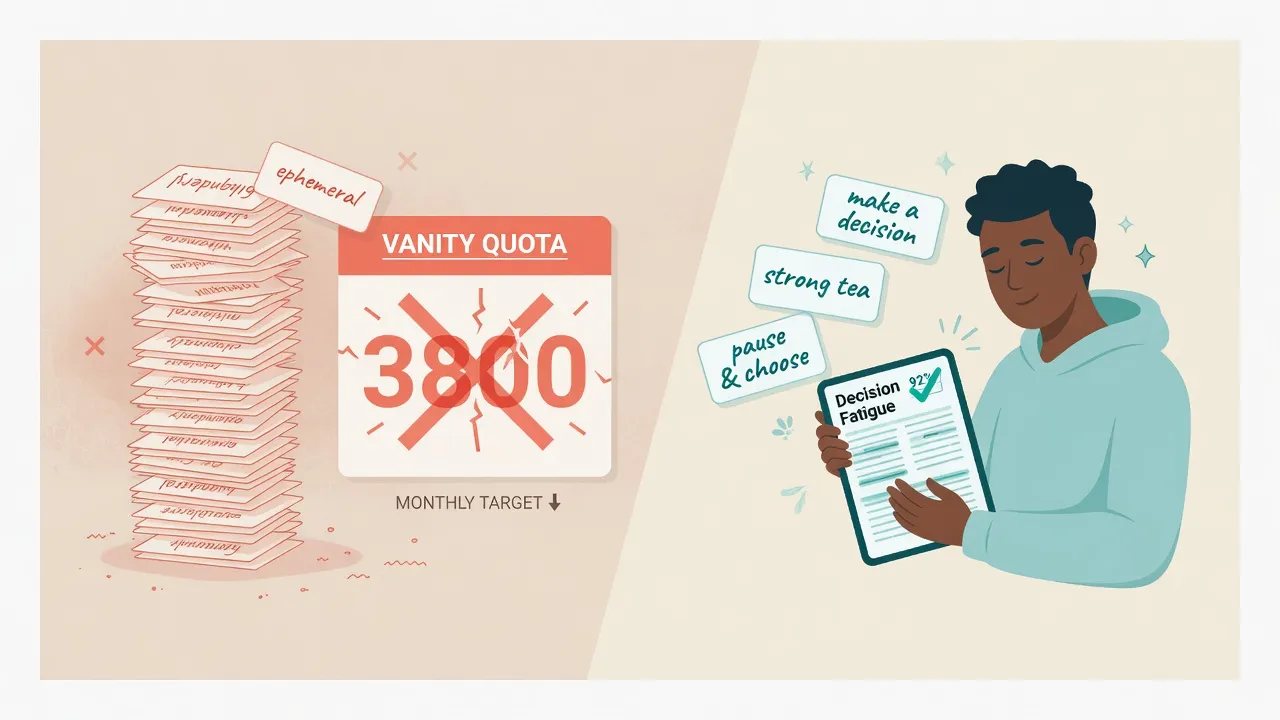
- you see collocations (make a decision, not only decision)
- tone matters (sarcasm, politeness, anger)
- the word reappears on other days and in other texts
It does not mean:
- cards are banned forever (spaced review of phrases from your reading can help)
- dictionaries are evil
- one novel equals fluency
- AI translation automatically turns you into a polyglot
Why bare word lists often sag
Lists are not useless. They are incomplete.
Typical problems:
- Weak memory hooks - a row in a list has almost no story, emotion, or image.
- One gloss hides many senses - English run, Spanish llevar, Ukrainian йти each do a lot of jobs. One translation line covers that up.
- No neighbors - you "know" the noun but not the verb or preposition it walks with.
- Recognition without retrieval - you understand the word when you see it, but you cannot pull it out when speaking.
Polyglot-style practice keeps the link phrase + situation.
Four layers of context worth noticing
No mysticism required. When you meet something new, ask yourself quickly.
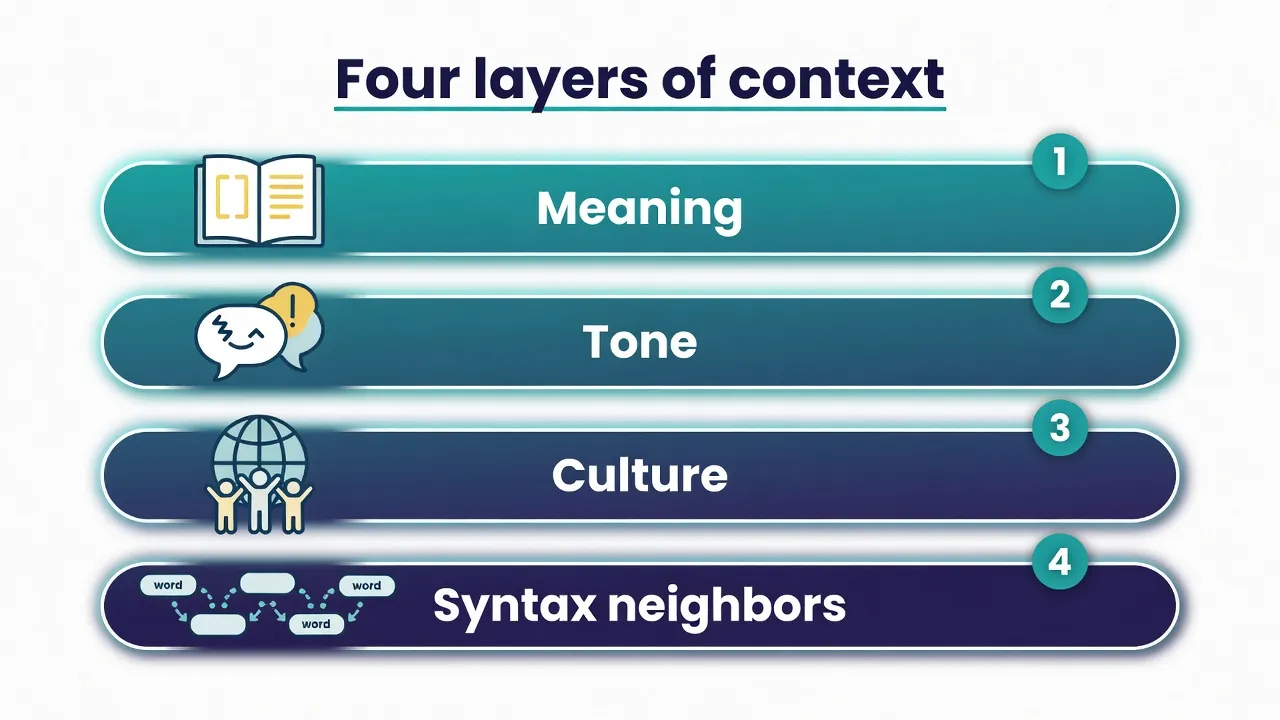
1. Semantics: what does it mean here?
English run:
- She runs a company (manages)
- The colors ran (bled / faded)
- He went for a run (jog)
- A run of bad luck (streak)
Context picks the sense. Your job the first time is to understand this case, not memorize the whole dictionary entry.
2. Pragmatics / emotion: how does it land?
"Oh, great." can be real joy or pure sarcasm. Spanish "¡Qué fuerte!" is often a reaction to shock or intensity, not a compliment at the gym. A bare list skips that.
3. Culture: what social deal sits under the phrase?
Jokes, politeness, "how people do it here" collect better from living texts than from a naked translation table.
4. Syntax: who does the word travel with?
After many examples, patterns become expected: verb + preposition, typical tenses in stories, familiar sentence frames. That is "feeling for the language," even if you do not love Krashen-style labels.
What research roughly supports
A short summary:
- Incidental vocabulary from reading is real: you can pick up words when the focus is meaning, especially with repeated meetings.
- Deeper processing helps: you notice a word, bind it to sense, meet it again - retention is usually better than one shallow glance.
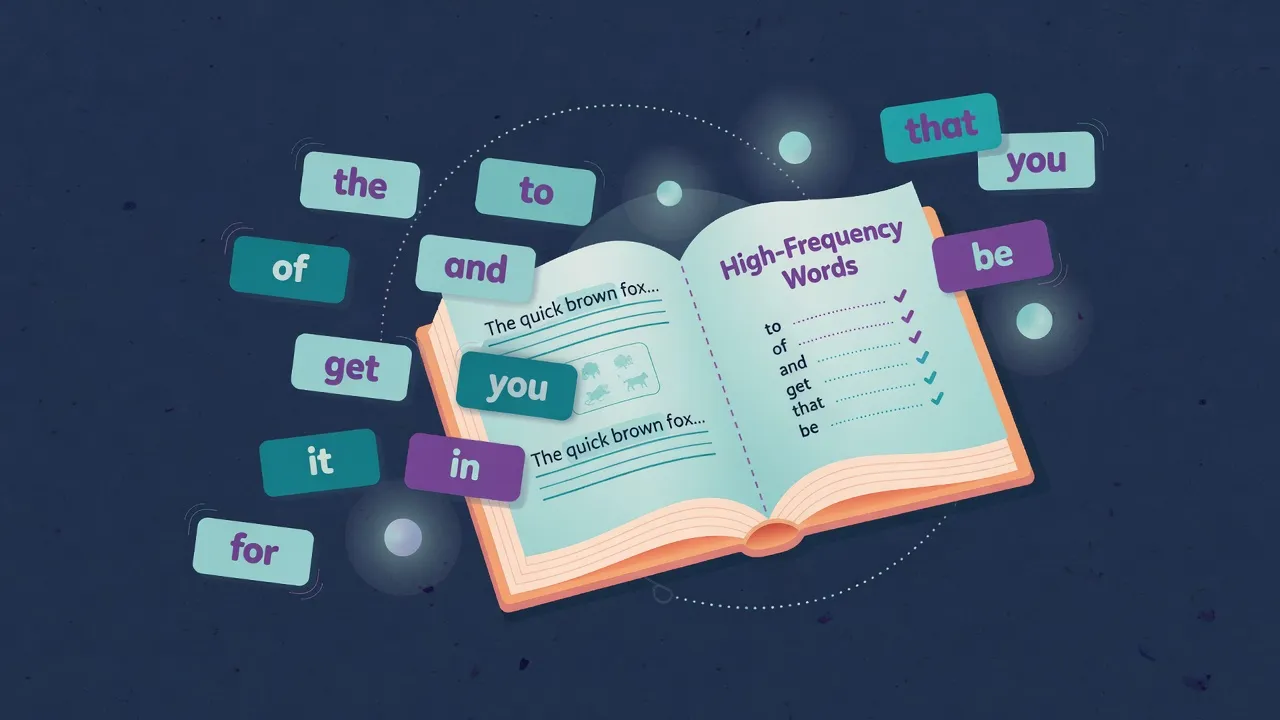
- Lists without context can still work for high-frequency glue with solid spaced review - but transfer into use is better when living examples follow.
- Exact multipliers like "always several times faster for everyone" are not a universal constant. Study designs differ (age, hours, tests, languages, word difficulty). Big round percentages in blogs are a red flag until you can open a real paper and its methods.
Useful traditions as fields: Paul Nation-style work on vocabulary and input; extensive reading; incidental vs intentional vocabulary learning; high-volume listening and reading habits (for example, approaches in the spirit of Steve Kaufmann). Check claims; do not worship people.
If a post hands you a neat package - university name, "group B remembered several times more words," 74% vs 12% - with no path to a source, treat it as content filler until proven otherwise.
Hard limit: context works when you understand enough
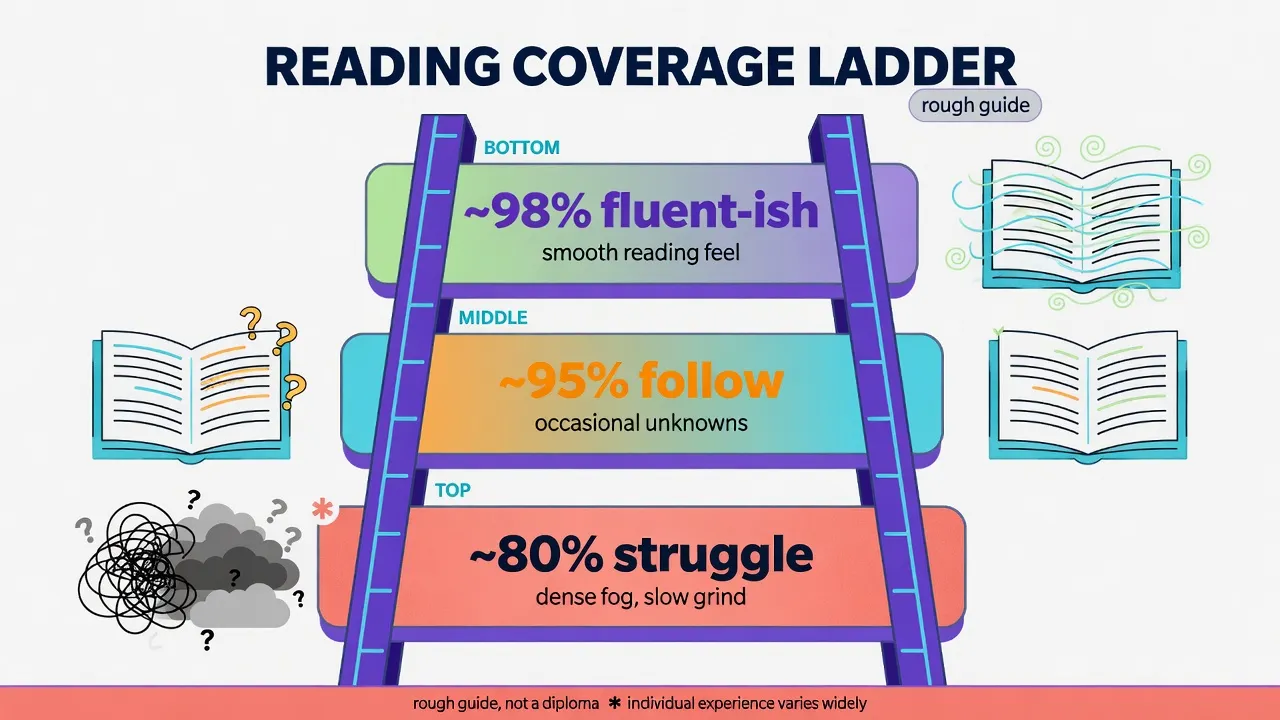
If roughly 40% of a page is unknown, you are not "absorbing rich context." You are drowning.
Practical bands:
| How the page feels | What to do |
|---|---|
| Almost everything clear; rare blockers | Excellent extensive-reading zone |
| You hold the plot with regular helps | Fine with support; save only high-value phrases |
| Walls of unknown | Too hard for daily volume; simplify the text |
Tool traps also matter:
- Paper dictionary on every line kills flow
- Blind machine translation of the whole page trains you to read L1, not the target
- Parallel text as a forever crutch can help at the start, but if you never look at the original, parsing does not grow
- Cards of random words you never met in life - low motivation, weak hooks
A practical polyglot-style protocol
Daily core (15-30 minutes)
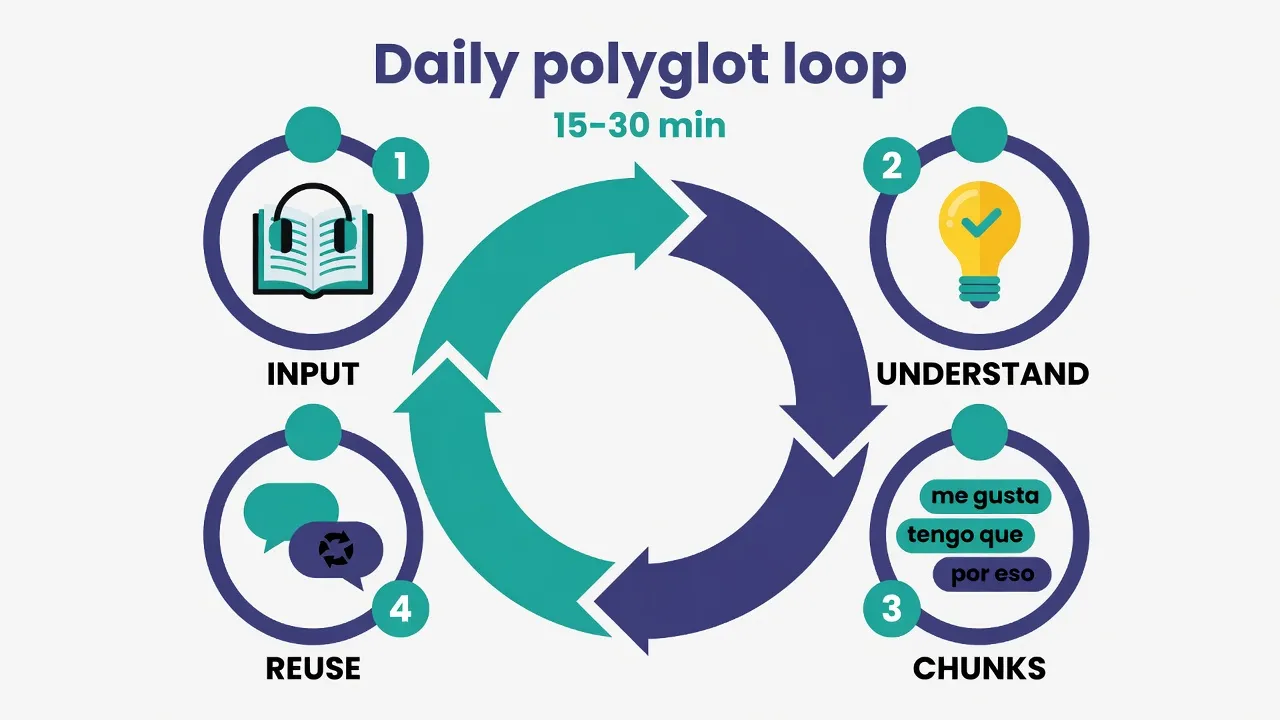
- Pick material that is at least a bit interesting (graded article, news, a book file you own).
- Read for meaning first.
- Check only blockers.
- Save 3-10 phrases max: full chunks, not bare lemmas.
- Stop while you could still continue. Habit beats heroics.
Two or three times a week: light retrieval
- Type or say the saved phrases.
- Write 3-5 new sentences with them.
- Optional: spaced review of those phrases, not a fantasy list of 500 words.
Weekly difficulty check
If lookups drop and pages finish more easily, raise difficulty a little. If dread grows, drop the level for a few days. Polyglots are often ruthless about finishing input, not about looking hardcore.
A simple start on free materials
- Library samples - for example a Spanish A2 sample or other levels in the catalogue
- More texts: All articles
- Phrase reuse: phrase typing demo
- Later: upload your own EPUB via How to use
How MovaReader helps
MovaReader is useful when the bottleneck is friction while reading:
- free graded library + click-to-translate
- upload of files you own
- listening support when available
- later practice of saved language in trainers (full trainers on Pro)
Plans and limits:
- free plan: 20 word translations/day, unlimited listening
- Reader (€1): unlimited translations
- Pro (€5/mo): full trainers
- details: Pricing
A good session: you finish a page, understand the scene, check two blockers, save one useful phrase, move on.
A bad session: you open a prestige novel far above level, tap every adjective, save 60 orphan words, feel productive, and a week later almost nothing sticks.
Context and lists: use both on purpose
| Situation | Better default |
|---|---|
| Reading fluency and "phrase feel" | Context first |
| High-frequency glue that keeps falling out | Short focused review + more input |
| Exam tomorrow on a fixed list | Deliberate list study, then examples in sentences |
| Idioms and sarcasm | Context + the whole chunk |
| Speaking prep | Retrieval out loud, not only rereading |
Polyglots who "hate lists" often still review chunks from content they chose themselves. The enemy is not review. The enemy is review cut off from life.
Related reading: Steve Kaufmann-style input habits, comprehensible input in plain terms, and building B1 vocabulary by reading. Optional navigation: language map.
FAQ
Do polyglots never use cards?
Some yes, some no. Many strong learners mix big input with selective review. The stereotype "zero cards forever" is branding.
Is reading enough to speak well?
Reading strongly helps comprehension, vocabulary, and written patterns. Speaking still needs retrieval under time pressure. Add low-stakes output.
How many new words should I save per day?
Fewer than you think. A small set of useful phrases you will actually reuse beats a cemetery of highlights.
Should I learn the top-1000 words as a list?
A high-frequency base helps. Just do not stop there, and meet those words in living sentences as soon as you can.
What about grammar books?
As a reference when a pattern blocks meaning. Not as a substitute for hours of messages you can understand.
Can AI translation create false confidence?
Yes. If you tap everything and never reread alone, the session feels smooth while independence barely grows. Check blockers, then reread without help when you can.
Closing
A durable "polyglot-style" habit is not a secret percentage. It is a loop:
interesting input near your level → understand the message → notice useful chunks → meet them again → use a little.
Drop invented speed multipliers. Keep the method. If you want a clean start today, open an article, read for meaning, save a handful of phrases, and reuse them in the phrase demo trainer.
Keep reading with translations inside the text
With a free account, an unknown word translates with one tap, and the words you are learning wait for you in the trainer.
Free account: 7 days of Pro, then 20 word translations a day or a paid plan.