Language Learning Psychology
Krashen's Comprehensible Input: What i+1 Really Means (and What It Doesn't)
Comprehensible input is a strong ingredient, not a magic guarantee. A clear guide to Krashen's i+1, its limits, and daily reading habits that help.

You know verb tables. You have a long streak in an app. Then a real conversation starts and your brain freezes.
After that freeze, a loud slogan often appears online: "comprehensible input is the only scientific path, and fluency almost arrives by itself."
That slogan stretches a useful idea past the evidence.
Comprehensible input means language you mostly understand - reading or listening - so the message gets through. Stephen Krashen made the idea famous. Decades of work on reading and vocabulary support lots of understandable contact with a language.
It does not mean input alone always creates full fluency, that grammar never helps, that any app turns any hard novel into perfect i+1, or that progress is automatic if you "trust the process."
Use it as a compass for daily reading, not as a cult slogan. Below is what Krashen actually claimed, where the evidence is strong, where debates continue, and how to use it in your daily reading.
What is comprehensible input in plain words (i+1)
In Krashen's frame, people acquire a lot of language when they understand messages. The informal formula is i+1:
- i - what you already handle
- +1 - a little new language you can still follow with context, prior knowledge, or light help
In practice, good input usually means:
- you keep the main idea without constant dictionary panic
- new words show up often enough to grow, but not so often the text collapses
- the material is interesting enough that you come back
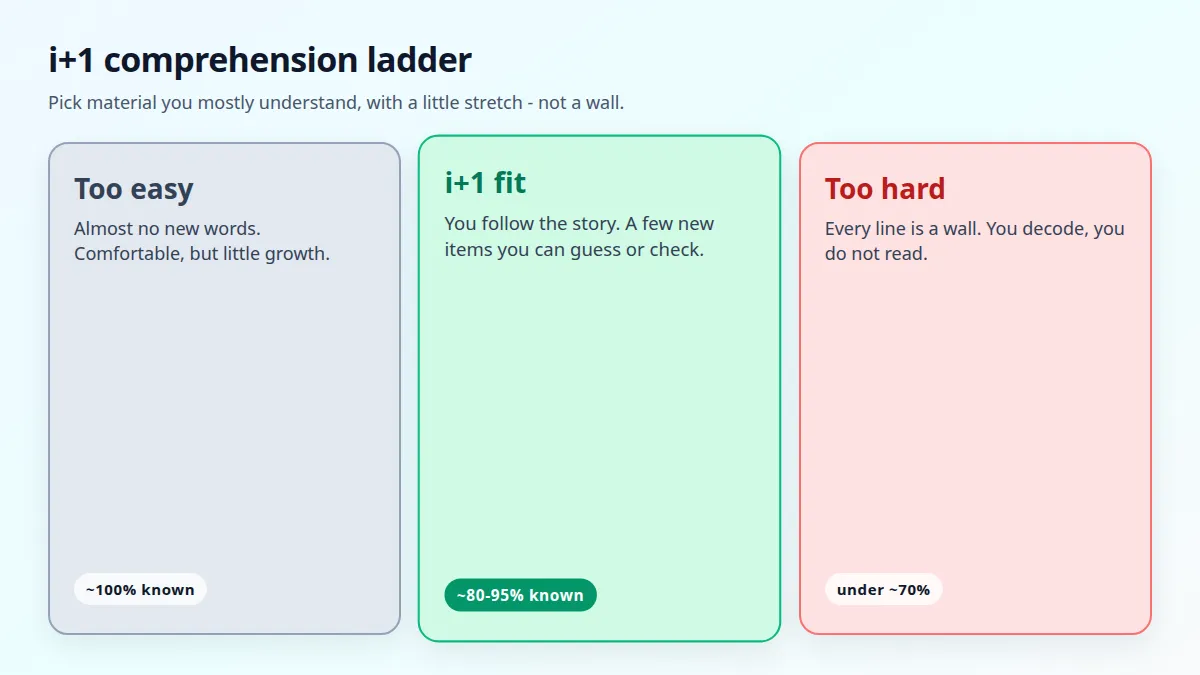
Classroom and extensive-reading practice often aim for understanding most of the page. Many teachers target roughly the high 80-90%+ known-word range for comfortable reading. Those percentages are guides, not physics laws. If every sentence needs a full translation, you are decoding, not reading.
Think of three rungs on a ladder: too easy (little growth), a fit stretch (you follow the story with some support), and too hard (every line is a wall).
Krashen's five hypotheses in plain words
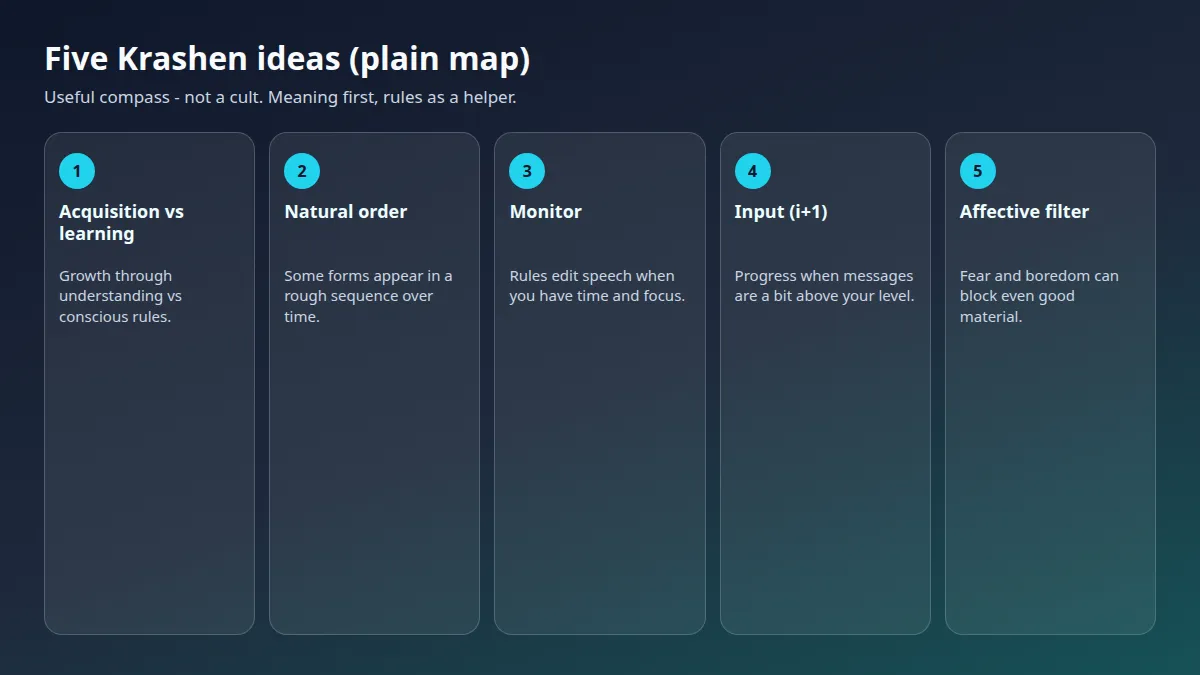
Krashen's Monitor Model is a set of related claims, not one tweetable law. Here is a careful version of the five.
1. Acquisition vs learning
Acquisition is subconscious growth through understandable content and use. Learning is conscious knowledge of rules. Krashen argued that spontaneous ability leans mainly on what was acquired, while learned rules help more when you have time to edit yourself.
Useful takeaway: knowing a rule for a test is not the same as using the form under time pressure. Overreach: "never study grammar." Many people benefit from a short explanation when one pattern keeps blocking meaning.
2. Natural order
Some structures show up in a rough sequence. Textbook order does not fully rewrite that logic. That does not make textbooks useless. It means one chapter rarely "installs" a form forever.
3. Monitor
Conscious rules can check speech when you know the rule, focus on form, and have time. In fast conversation the monitor is weak. That is why some people write carefully but struggle to speak.
4. Input hypothesis (i+1)
Progress comes when you understand messages with material a bit above your current level. Meaning first; form partly follows from repeated successful contact.
5. Affective filter
Stress, boredom, and fear of mistakes can block progress even with decent material. Calm, interesting reading helps. Emotions are not the only variable.
What research supports (and what it doesn't)
Stronger practical claims
From decades of reading and vocabulary work, it is fair to say:
- Extensive reading of mostly understandable texts helps vocabulary, reading speed, and comfort with written language.
- Words that appear many times in different contexts often stick better than one-shot list memorization.
- Anxiety and shame reduce practice time; practice time is a big driver of progress.
- Pure grammar drills without meaningful input often produce "test knowledge" that transfers poorly to real use.
Classic lines include extensive-reading programs (book floods, classroom reading), vocabulary research (including Paul Nation and colleagues), and SLA reviews. Results depend on age, hours, materials, and how progress is measured. Meta-analyses generally find a positive effect of extensive reading on reading outcomes. That is not one magic number for "fluency in N months."
Weaker or marketing claims
Stay skeptical when marketing says:
- "The only scientifically proven path" - SLA has several useful models (interaction, output, usage-based, skill acquisition, and more). Input is central for many researchers. The word "only" is ideology, not a final lab verdict.
- "Fluency almost automatic" - no method locks fluency with a slogan. You need time, quality input, and usually also speaking or writing practice for productive skill.
- "Grammar never helps" - form-focused instruction can improve accuracy on some features, especially when it connects to meaning and practice.
- "Any text becomes perfect i+1 thanks to AI" - tools reduce friction. They do not cancel the need for repetition, sleep, and active use.
Also be careful with "citation theater": pretty study titles and exact "X times faster" claims in blogs are often blurred, twisted, or invented. Prefer principles you can test yourself over dramatic percentages.
Why people still get stuck
Even if you accept that understandable input matters, life puts up blocks:
- Material mismatch - graded texts feel boring; original novels feel too dense.
- Translation friction - paper dictionaries and constant app-switching kill flow.
- Zero interest - "John goes to the airport" dialogues do not build a habit.
- Input only, no retrieval - you recognize words but cannot pull them into speech.
- Irregular minutes - one heroic weekend loses to short daily sessions.
The real goal is not "find perfect i+1 forever." It is to keep a steady cycle of understandable, interesting language, with light support and periodic production practice.
Practical reading method (6 steps)
Respect Krashen. Do not worship him. Six steps that work in real weeks:
Step 1: Interest first, then difficulty
Pick topics you would read in your first language: news, simple stories, hobby blogs, graded articles. Motivation keeps the affective filter lower than the slogan "this is good for you."
Step 2: Comprehension check, not prestige
Open a random page:
- Comfortable - you follow the plot or argument; blockers are rare.
- Stretch - you follow with frequent help, but you finish a short passage.
- Too hard - every line is a wall. Simplify the material or add short support, then look again for an easier level.
Step 3: Translate blockers only, not every unknown word
A working loop:
- Read a paragraph once without stopping.
- Mark only the words without which the sentence meaning collapses.
- Check those.
- Reread.
- Save a few useful phrases (not 40 isolated words).
Step 4: Daily volume beats heroic intensity
Start with 15-20 minutes. Consistency beats "two hours when inspiration hits." Raise time only after the habit holds.
Step 5: Light output later, not instead of input
After reading, use a few phrases: type them, say them aloud, or write three of your own sentences. Input builds the map; output trains navigation. Merrill Swain's output hypothesis is one reason many teachers keep speaking and writing even when they value input.
Step 6: Grammar as a flashlight, not a prison
If one structure keeps blocking you (tense, connector, article), read a short explanation, then return to real text where that form appears. Do not rebuild your whole plan around mountains of drills.
Where MovaReader fits
MovaReader is a reading tool, not a fluency guarantee.
What actually helps:
- a free library of graded articles with tap-to-translate
- upload of EPUB and files you own
- less translation friction so sessions stay on meaning longer
- unlimited listening on the free plan (useful when the written page is already manageable)
- moving saved items into trainers (Pro)
What it does not do:
- host licensed commercial novels free out of the box
- turn B2 prose into "easy as A2" by magic
- replace contact hours and production practice
- claim to be the "only scientifically proven path"
A realistic path in the product:
- Warm up on free samples - for example browse the catalog. If you also study Spanish, graded samples such as A1 and A2 work the same way.
- Open all articles.
- Try demos: word trainer and phrase typing.
- Read how to use if you want to load your own file.
- Check pricing: the free plan includes listening and 20 word translations per day; Reader (€1) unlocks unlimited word translations; Pro (€5/mo) unlocks full trainers.
Tools protect flow. Difficulty decisions stay with you.
Old cycle vs better daily cycle
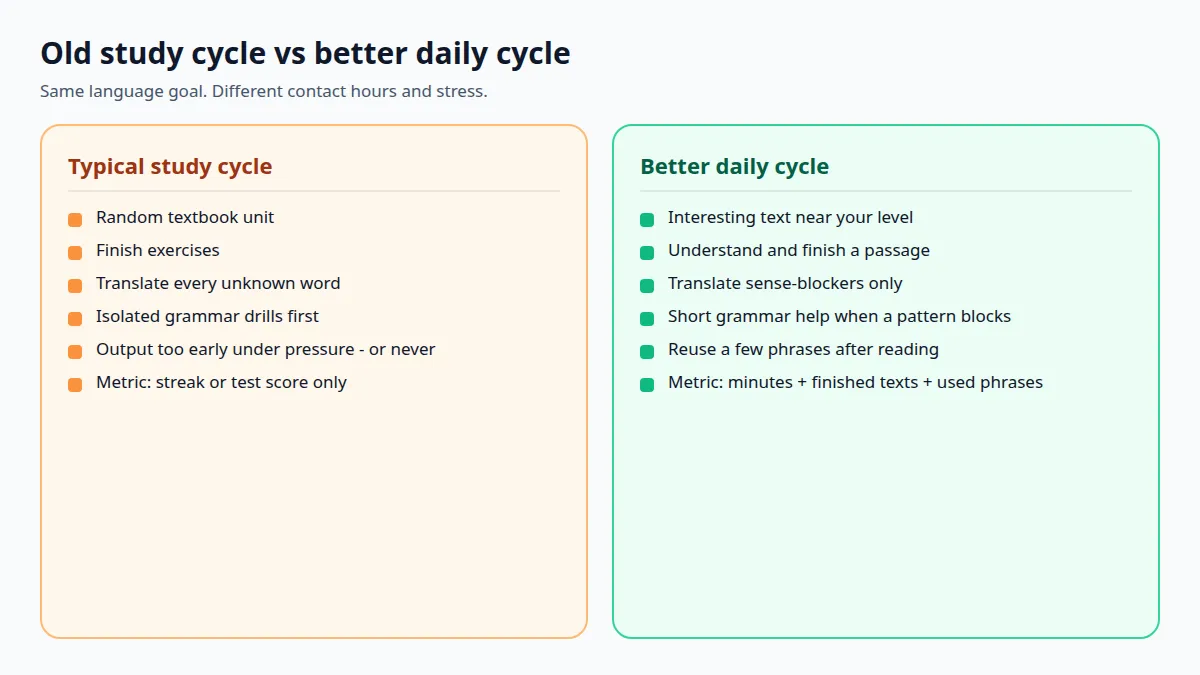
Side by side, the difference is less about slogans and more about what you measure on a normal Tuesday.
| Habit | Typical study cycle | Better daily cycle |
|---|---|---|
| Material | Random textbook unit | Text you find at least mildly interesting |
| Goal | Finish exercises | Understand and finish a passage |
| Translations | Every unknown word | Sense blockers only |
| Grammar | Isolated drills first | Short help when a pattern blocks |
| Output | Too early under pressure, or never | Small phrase reuse after input |
| Emotion | Grade anxiety | Private reading at your pace |
| Metric | Streak or test score only | Minutes + finished texts + used phrases |
Neither column alone "locks in" fluency. The right column usually creates more useful contact hours.
FAQ
Is comprehensible input science or a brand slogan?
It is a real research tradition in second-language acquisition, especially around extensive reading and vocabulary. It is not a single law that cancels every other finding (interaction, output, form-focused instruction, skill acquisition, and more).
Do I still need grammar?
Often a little, used wisely. If rules help you notice patterns in text, keep them short. If rules replace reading for months, rebalance.
Can beginners use comprehensible input?
Yes, with easy materials: graded texts, simple stories, high-frequency words, lots of repetition. Shorter sessions and more support are normal at the start.
Does listening count as input?
Yes. Listening and reading both count when you understand enough. Many people find reading easier to control at first (you can pause and reread).
How long until fluency?
There is no single number. Progress depends on starting level, hours, input quality, speaking and writing practice, and goal (travel chat vs academic reading). Distrust fixed fluency dates.
Should I stay silent until "massive input"?
Not as a hard rule. A quiet period can lower pressure, but gentle speaking practice often helps confidence and retrieval. Keep early speaking low-stakes.
Short summary and next steps
Krashen's practical core still holds: you need a lot of language you understand, in a form you will actually consume.
The dishonest extension is: "this theory alone locks fluency, grammar is dead, and our product makes any text perfect."
Build a simple system: interesting texts near your level, light support for blockers, daily minutes, and a little production. For a clean start in MovaReader, open an article, read for meaning, tap only what blocks you, then reuse a few phrases in a demo trainer.
Keep reading with translations inside the text
With a free account, an unknown word translates with one tap, and the words you are learning wait for you in the trainer.
Free account: 7 days of Pro, then 20 word translations a day or a paid plan.