Language Learning Psychology
The Dopamine Trap: Why Gamified Language Apps Feel Productive but Stall Progress
Long streak, still stuck on a real paragraph? How language-app gamification trains engagement over comprehension - and why wanting to know what happens next in a story is a stronger engine than protecting a flame icon.
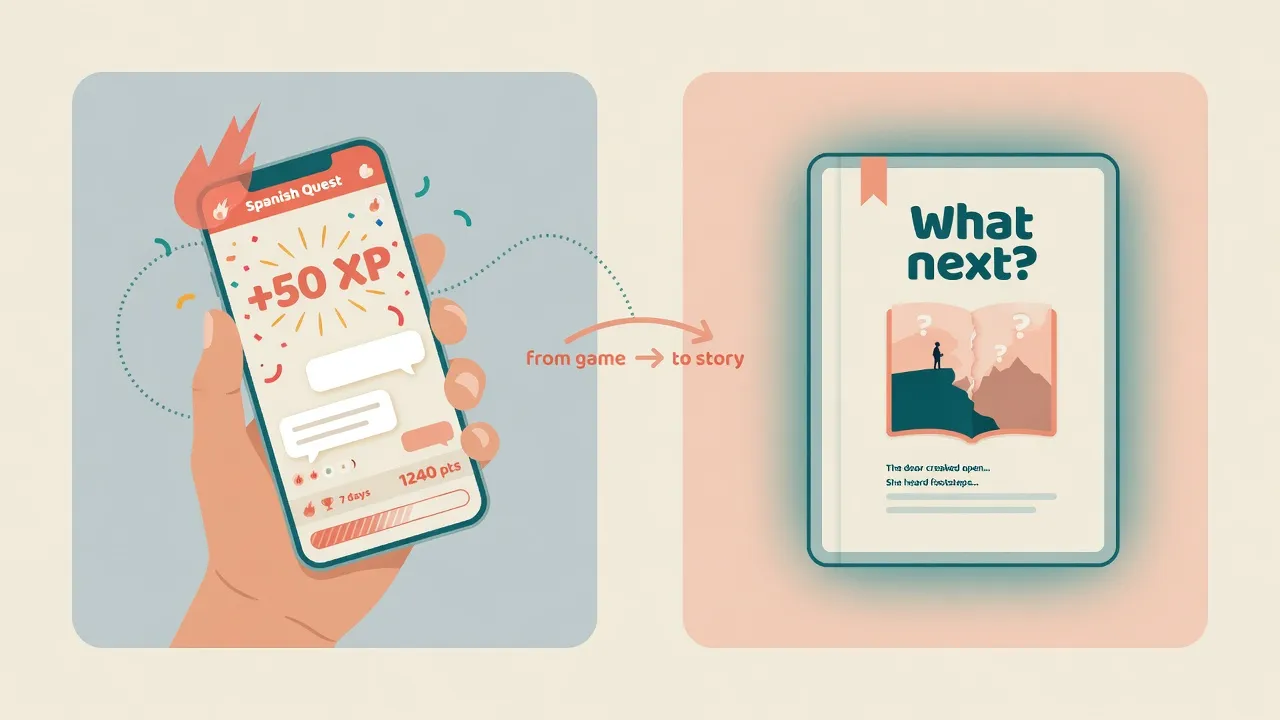
You open the app. The flame is still burning - 180 days, maybe 365. Confetti falls. A cheerful sound tells you that you "won" today. You feel a small lift, the kind you get after a tidy little victory.
Then you open a real article, a short story, or a news piece in English or Spanish. One paragraph in, you stall. Words blur. The sentence will not hold together. The streak looks impressive. The page does not.
That mismatch has a name people reach for: the dopamine trap. It is not a medical diagnosis and it is not a personal failure. It is what happens when engagement design and skill growth get confused.
The short answer: streaks, XP, and notifications reward opening the app and finishing micro-tasks. You get a short win loop that can feel like progress even when understanding real texts barely moves. Gamification is good at engagement. It is weak as a sole path to skill. For many adults, real motivation is simpler: wanting to know what happens next in a story or article you care about - then reading (with light help) beats endless badge farming.
This article is about common game mechanics, not one brand villain. Apps can help as a supplement. They often stall when they are the whole method. Below: how the loops work, five reasons micro-lessons plateau, streak flame vs story cliffhanger, and a practical switch toward reading.
What is the "dopamine trap" in language apps?
In plain words: many language apps optimize for return visits, not for understanding paragraphs, conversations, or books.
Designers are good at keeping you opening the product. Daily flame. Points that go up. A league rank that ticks. A notification that pings at 9 p.m. Those tools are not evil by default. They are excellent at retention. The trap starts when your brain treats those short wins as proof that your language skill is growing at the same speed.
Dopamine, in this article, is a useful everyday frame - not a lab report. Think of it as reward anticipation / wanting: the pull toward a predictable little prize. You look forward to the confetti. You flinch at the idea of losing the flame. That pull can keep habits alive. It can also keep you busy without moving comprehension.
Short game wins can feel good while deeper learning feels slower. Both can coexist. The trap is mistaking one for the other.
Here is the contrast in one picture: the engagement loop on one side, the comprehension loop on the other.
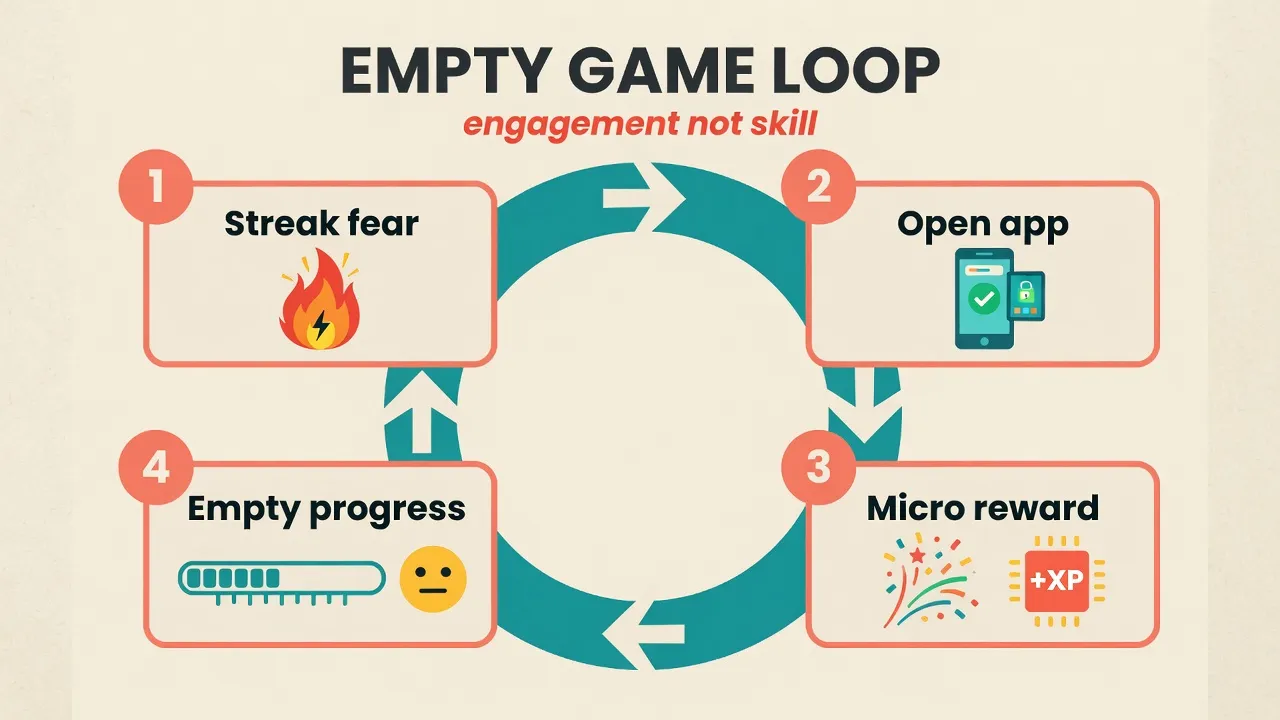
Engagement loop: open app → micro-task → points / streak / confetti → notification → open again.
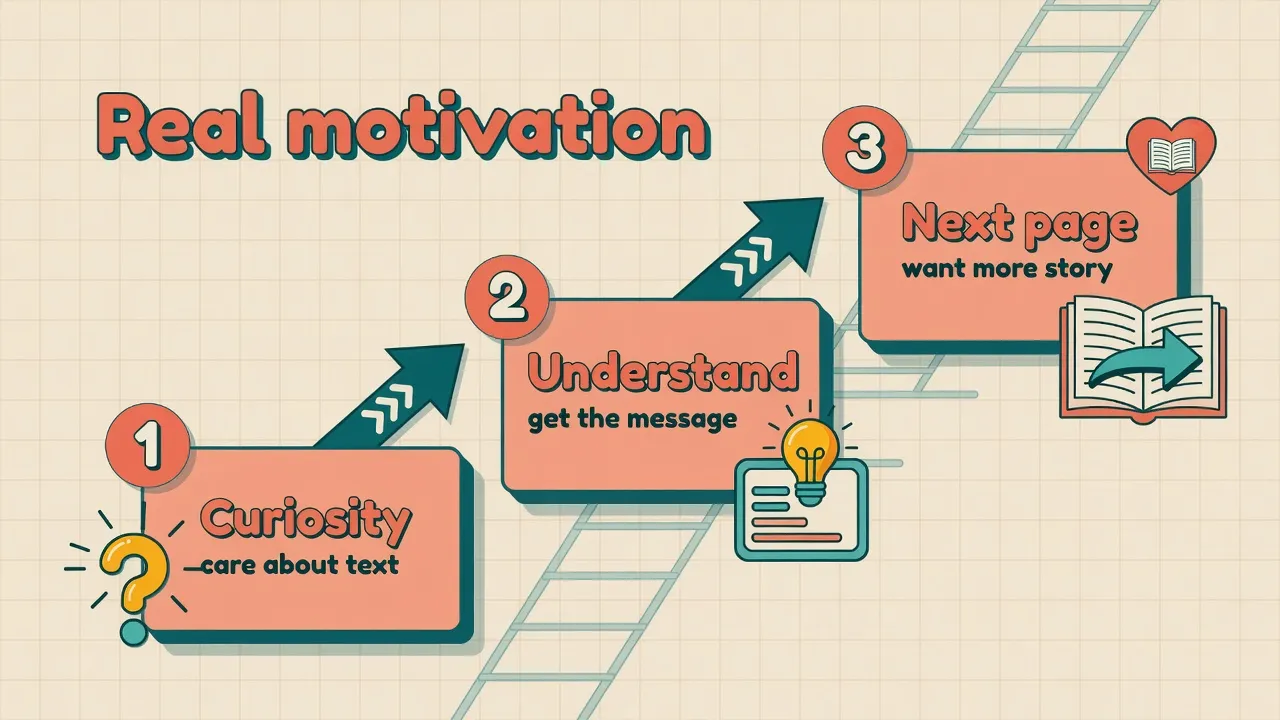
Comprehension loop: open text → curiosity ("what next?") → understand more → want the next page.
One loop measures presence. The other measures whether meaning landed.
How do streaks, XP, leagues, and hearts actually work?
Most big language apps use the same playbook. The question is not "is the owl evil." It is what the loop optimizes for.
| Mechanic | What it pushes | Limit |
|---|---|---|
| Streaks | Open the app daily (loss aversion: protect the flame) | Presence, not performance |
| XP / levels | Countable "progress" on screen | May not map to real language use |
| Leagues / leaderboards | Status vs strangers | Social pressure can replace interest |
| Hearts / lives | Tension, scarcity, re-engagement | Stress is not a skill check |
| Notifications | Re-open prompt | Reminds you to open, not to understand |
These mechanics work for retention. Apps stay open. That is not the same as fluency, reading skill, or natural conversation.
"Why Duolingo doesn't work" is a popular search. Fairer phrasing: when streak apps stall. They often help beginners, light vocab recognition, and a simple daily habit as a supplement. They are a poor sole path if your goal is real articles, books, or natural speech. Many people with long streaks still freeze on a real paragraph. That is a method limit, not proof that any one app "never works for anyone."
Streaks can help start a habit. The problem is when the streak becomes the goal.
5 reasons gamified micro-lessons stall adult progress
Apps are not evil. Here is why, as the main method, many adults plateau - while still feeling busy.
1. Illusion of knowledge
Pick the right translation of a word from four options. That is recognition, not full understanding. In a real sentence, the same word carries tone, collocation, and argument. Multiple choice can pass while a paragraph still feels opaque.
2. Fragmentation
Micro-lessons slice language into isolated items: single words, short drills, grammar outside a living text. Real language arrives as a flow of meaning - grammar, lexis, style, and context together. Fragment practice rarely trains that flow.
3. Artificial ease
Retention-tuned difficulty wants you to keep winning. If tasks get hard, you might leave. So the path can stay just easy enough to confetti. Growth often needs stretch. Endless "wins" without stretch feel productive and stall anyway.
4. Passive taps
Tap the picture. Drag the tile. Press the correct button. Your brain is often in recognition mode, not active meaning-making. Holding a long sentence in mind, guessing from context, revising a hypothesis - those efforts build skill more slowly and more honestly.
5. External rewards crowd out interest
Psychologists talk about overjustification in plain terms: when outside rewards take over, interest can fade. You open the app to save the streak, not because the content is interesting. The flame becomes the content.
If three or more of these hit, you may feel productive while stuck. Common. Not proof you have no talent. Not proof that a year of apps equals zero for everyone. Soft version: many people feel busy and still freeze on real paragraphs.
What does real motivation look like for adults?
Self-Determination Theory (Deci and Ryan) is a useful model, not a miracle law. It points to three needs that feed durable motivation:
| Need | Plain meaning | Fake substitute in many apps | Reading-shaped version |
|---|---|---|---|
| Autonomy | You choose the process | Avatar or skin "choice" | Pick texts you care about (English or Spanish as your study language) |
| Competence | Feel real growth | XP and coins as score | "I understood that page, joke, or argument" |
| Relatedness | Connection that matters | League rank among strangers | Ideas, characters, culture, communities in the content |
Avatar choice is not real autonomy over what you learn. XP is not the same as "I got that paragraph." A stranger's leaderboard is thin relatedness compared to caring about a character or an argument.
The useful wedge: real motivation often equals curiosity about a text. What happens next? What is this writer claiming? Why did that character lie?
Think of a ladder: external badges → habit cue → interest in meaning → story / text pull. Habit tools can sit on a lower rung. They should not block the climb.
If textbook dread or streak guilt has already burned you out, that is a different wound with a similar root - method fatigue. Our note on learning burnout sits next to this topic.
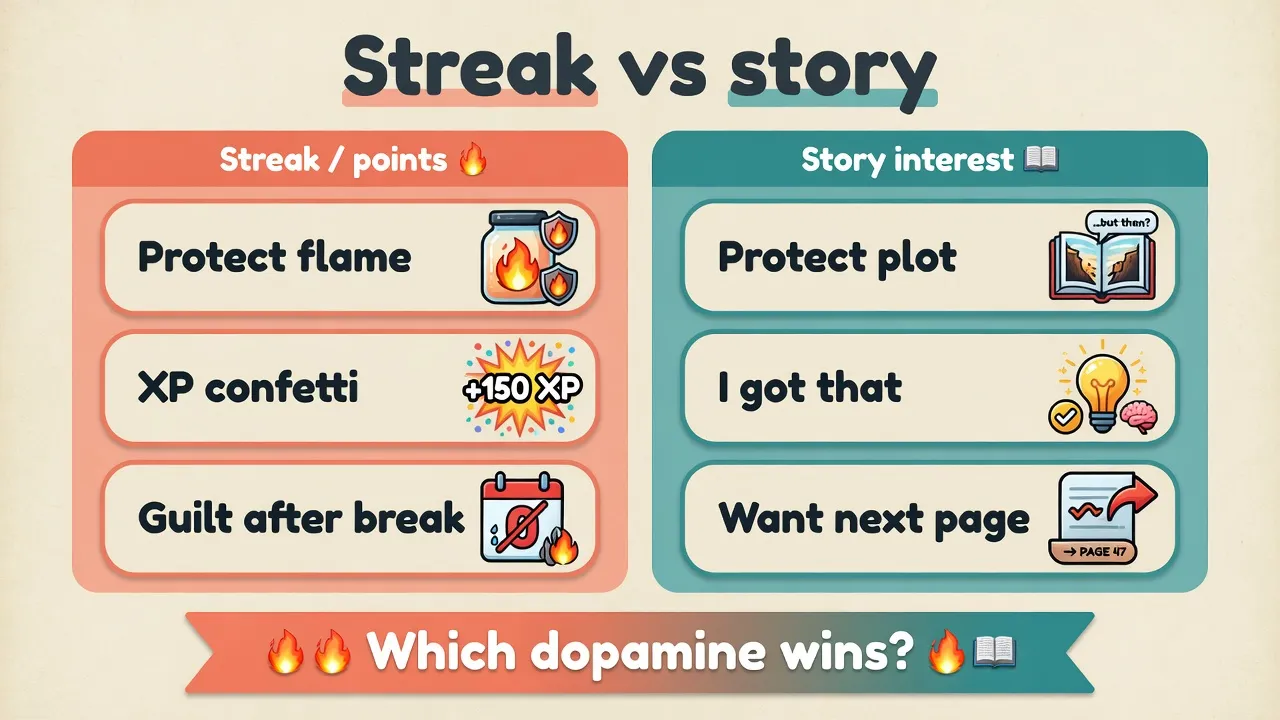
Streak vs story: which dopamine do you want?
Two engines can both feel sticky. One protects a flame icon. The other pulls you to the next page.
| Focus | Streak / app loop | Story / reading loop |
|---|---|---|
| What you protect | Flame / XP | Plot, argument, curiosity |
| Win signal | Daily open + confetti | "I got that paragraph" |
| After a break | Guilt / zero | Pick up the page again |
| Skill proxy | Presence (did the task) | Performance (understood / used language) |
| Motivation type | External schedule | Internal interest |
| Risk | Doing the app without growth | Text too hard without help |
Keep a streak as an optional habit cue if it helps. Change the goal if the flame is the only reason you open anything. After a break, story logic is kinder: reopen the page, not the shame counter.
Why extensive reading beats endless micro-lessons (for many goals)
Stephen Krashen's work on comprehensible input and extensive reading is a useful frame, not a cult. In plain words: large amounts of interesting input you mostly understand help the mind pick up language patterns - vocabulary in context, rhythm, grammar "as it is used" - differently from only rules-plus-quiz.
Acquisition vs learning, lightly: lots of meaningful input you follow for the message, versus only conscious study of rules. Both can have a role. Adults often over-index on the second and under-feed the first.
| Approach | Often helps | Limit |
|---|---|---|
| Gamified micro-lessons alone | Early habit, light vocab recognition | Weak for real paragraphs and conversation depth |
| Extensive / interesting reading | Comprehension, vocabulary in context | Does not guarantee speaking alone |
| Light help on hard spots | Stay in flow | Lookup thrashing if the text is far too hard |
| Active reuse of your phrases | Moves patterns into use | Still not a fluency guarantee |
Reading builds a strong foundation for comprehension and vocabulary. It does not promise speaking fluency by itself. Talk, shadow, courses, friends, work use still matter. For a deeper walk-through of the input idea, see Krashen's comprehensible input hypothesis. If you want titles that are hard to put down at A2-B1 English, try easy English books that hold attention.
Difficulty can be an ally: slightly challenging text with help beats years of too-easy taps.
How to switch: from game loop to real practice
1. A quick self-check
Open a short real text at roughly your level, two or three paragraphs. Notice where you stumble. That is a check of your method, not a verdict on you. If the check makes you want everything to be "perfect", read about fear of mistakes and perfectionism.
2. Pick interest-first content
What would you read in your first language? A news niche, YA, mystery, tech blog, sports, cooking science? Find the same energy in English or Spanish as your learning target. Interest is fuel. Generic lesson paths often run out of it.
3. Make difficulty an ally
If originals feel brutal, start with a graded free library, then step up. Sample warm-ups: Spanish A2-ish article, or step down to Spanish A1-ish. Browse more free graded pieces in all articles. If a page is mostly unknown words, step down - not up with guilt. A language map can help you orient roughly.
4. Active reuse
Pull phrases from your text into light practice - not random textbook lists. When you are ready, trainers and demos like type training or phrase typing exist so practice stays tied to language you actually met.
5. Optional habit tools
If any tool shows stats or streaks (including ours), treat them as optional. Success = pages understood and curiosity still alive, not flame length.
You do not need our product to care about a text. You need a page you want to finish. Graded free texts are one low-pressure start if apps were the only habit you had.
Where MovaReader fits (reading-first)
MovaReader is a reading-first tool: graded texts, in-place help, and optional trainers built from language you meet in real content - not another micro-lesson streak engine as the core story.
What freemium covers: free graded library plus about 20 word translations per day. Enough to try the habit of staying on the page.
If volume grows: Reader at €1/month when you hit translation limits and still want longer reading sessions. Pro at €5/month if you want full trainers after input - not required to quit streak guilt this week.
Upload: bring your own legal EPUB or files. We do not host licensed commercial novels by default. How the flow works: how to use.
Learning targets: English and Spanish. UI can be in several locales; study focus is EN and ES.
Progress: reading-first. If the product shows stats or optional habit tools, treat them as secondary. Progress from real texts you understand - not flame worship. Soft tracking of "what you understand" can help some people; it is not lab proof of a universal comprehension jump.
What it is not: a replacement for conversation partners. Skip the product if paper books and a simple dictionary already work for you. Soft path if you want an account later: register.
FAQ
Is Duolingo (or other streak apps) useless?
No. Streak apps can help beginners, light vocabulary, and a simple daily habit as a supplement. They are weak as the only path if your goal is understanding real articles, books, or natural speech. Many people with long streaks still freeze on a real paragraph - that is a method limit, not proof the app "never works for anyone."
Should I keep my streak or drop it?
Keep it only if it is a gentle habit cue. If the flame is the only reason you open the app - and you feel guilt instead of curiosity - change the goal. Success can mean pages understood or "I wanted to know what happens next," not flame length. You can keep a light habit without worshipping the counter.
Is the "dopamine" science real or hype?
Partly useful framing, partly marketing language. Reward anticipation helps explain why short loops feel sticky: your brain likes predictable little wins. That is not a full neuroscience lecture and not a medical claim. Do not trust precise "receptor" percentages or "hijacked brain" headlines. The practical point: short engagement wins can feel like learning even when comprehension of real language barely moves.
Can complete beginners read if apps felt easier?
Yes - if the text is easy enough. Start with short graded articles or simple interesting pieces, not prestige novels. Tiny sessions are fine. Free graded libraries and light in-place help exist so you are not forced into hard originals on day one. Step down if a page is mostly unknown words. Start from all articles or the samples above.
Will reading alone make me fluent?
No method can guarantee fluency. Lots of interesting input (reading and listening) builds a strong foundation for comprehension and vocabulary. Speaking and writing still need their own practice - talk, shadow, courses, friends, work use. Use reading as a heavy, low-guilt input engine, not as a fluency contract.
How is reading motivation different from XP?
XP and streaks often pull you back with schedule and loss aversion (protect the flame). A story or article you care about pulls you back with curiosity: what happens next, what does this argument say. When external rewards crowd out interest, you may open the app but stop caring about meaning. That overjustification pattern is common - not a moral failure.
Where does MovaReader fit without becoming another guilt app?
Reading-first, optional. Free graded library plus about 20 word translations per day; Reader €1/mo for more translation volume; Pro €5/mo for trainers. Upload your own EPUB; we do not host licensed commercial novels by default. Learning targets: English and Spanish. If the product shows stats or optional habit tools, treat them as secondary - progress from real texts you understand, not flame worship. Details on pricing.
What to do this week
- Pick one short text you care about - English or Spanish - for 10-15 minutes.
- No streak guilt if you miss a day. Reopen the page, not the flame.
- If you need an easy on-ramp, start with free graded pieces in all articles.
- Optional freemium help (~20 translations a day). Pricing only if volume needs it: pricing.
You already know what a flame feels like. Try what a cliffhanger feels like instead - one page you actually want to finish.
Keep reading with translations inside the text
With a free account, an unknown word translates with one tap, and the words you are learning wait for you in the trainer.
Free account: 7 days of Pro, then 20 word translations a day or a paid plan.