Language Learning Psychology
Language Learning Burnout: What to Do When Textbooks Make You Sick
Textbooks feel like duty and every missed day piles on guilt. That is often method burnout, not a lack of talent. Here is how to recognize it and restart with gentle reading of something you actually want to finish.
You open the textbook. Another tense table. Another unit test. Your body answers before your brain does: tight stomach, glassy eyes, a hand that wants to close the book. You think, "Maybe languages are just not for me."
They probably are for you. What often breaks is the method - months of drills and duty with almost no story you care about.
Language learning burnout is when studying stops feeling useful and starts feeling like dread: guilt, boredom, and endless "I'll start Monday" loops. It is usually the system and the pressure, not proof that you lack talent. This week: pause heavy drills, pick a short text or story you actually care about at a comfortable level, and read a little every day without scoring yourself. If tab-hopping to a dictionary kills every paragraph, use easier texts or in-reader lookup; tools like MovaReader are optional help, not the only cure.
Your brain is not broken. Your study loop might be.
Why do textbooks burn adults out?
Most textbooks were built for a classroom. A teacher holds the room, sets the pace, and keeps people moving. Friday night alone with Grammar in Use is a different animal. There is no social fuel - only you, a red pen energy, and the feeling that "real" study means pain.
Here is what usually happens:
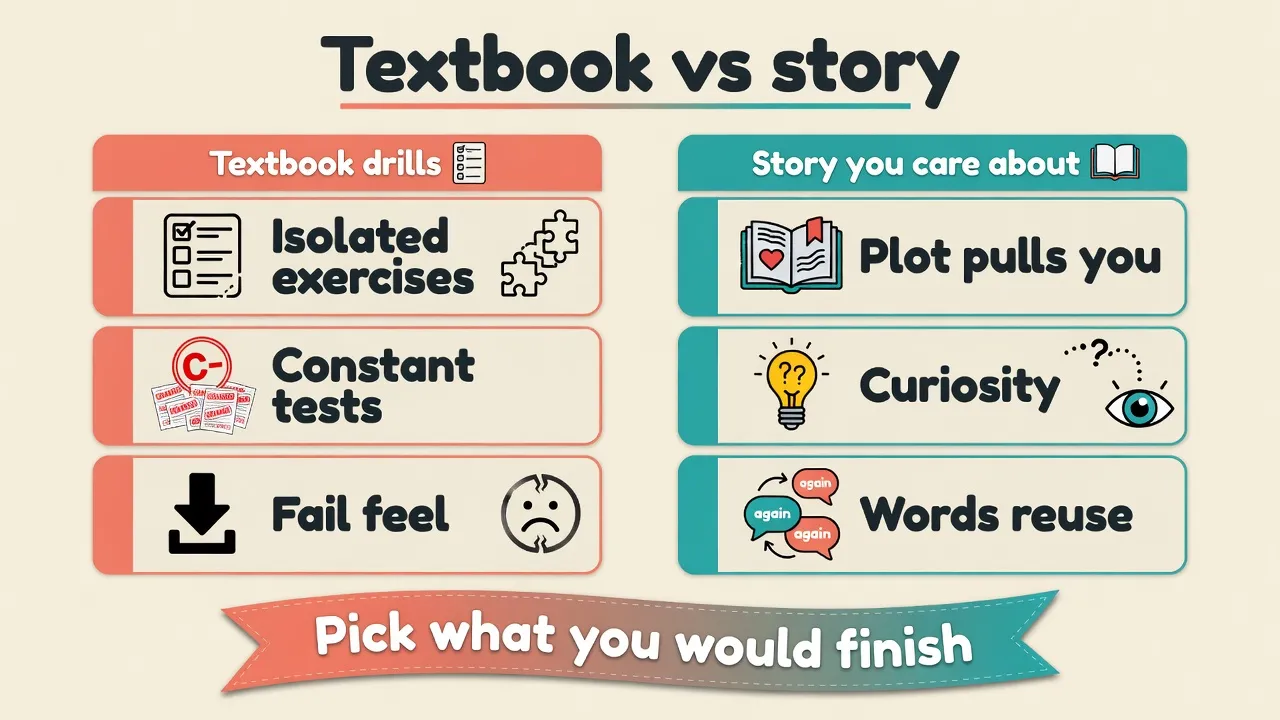
- No story. Your attention wants a plot, a person, a question worth answering. Isolated exercises give none of that. After ten or fifteen minutes, focus drifts because the brain sees little reason to care.
- Artificial lines. "The cat sat on the mat" does almost no emotional work. Flat input is easier to forget than lines tied to surprise, humor, or worry for a character.
- Constant fail-feel. Tests are designed to catch errors. You can end a session thinking "I know nothing," even when your comprehension is fine in real reading.
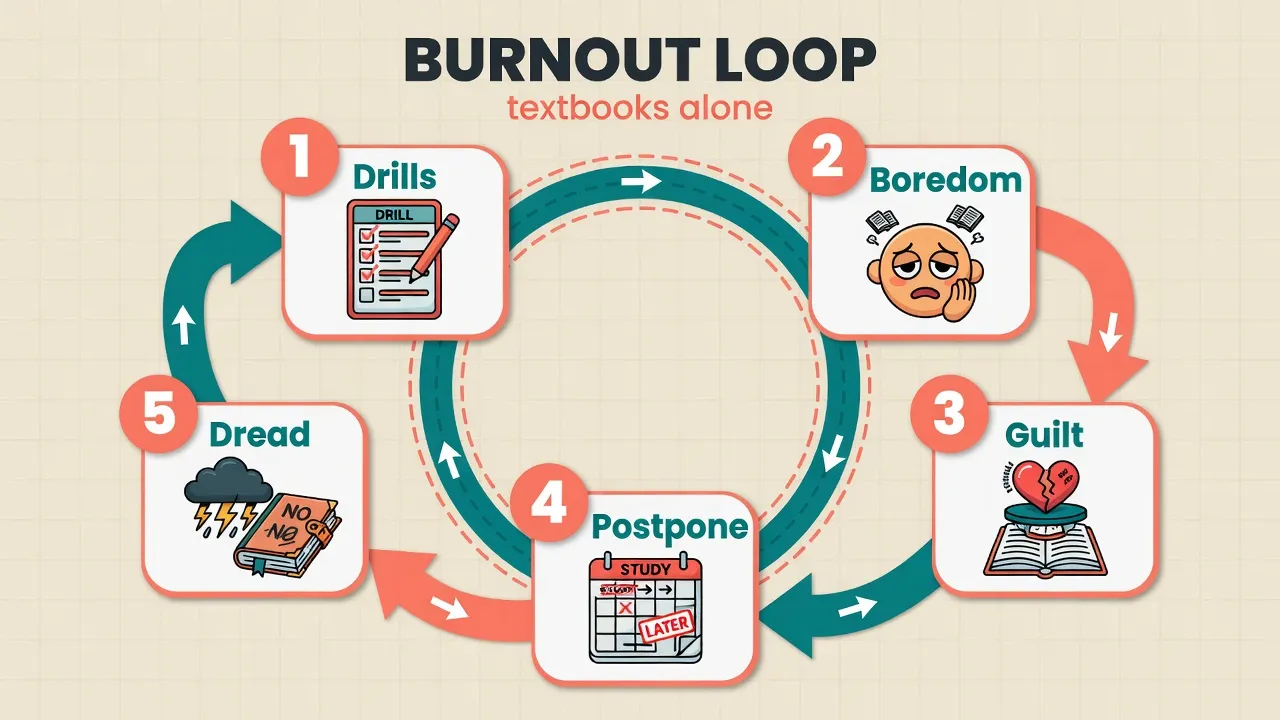
- Guilt loop. You postpone. You feel ashamed. You add more pressure. The next open of the book feels heavier.
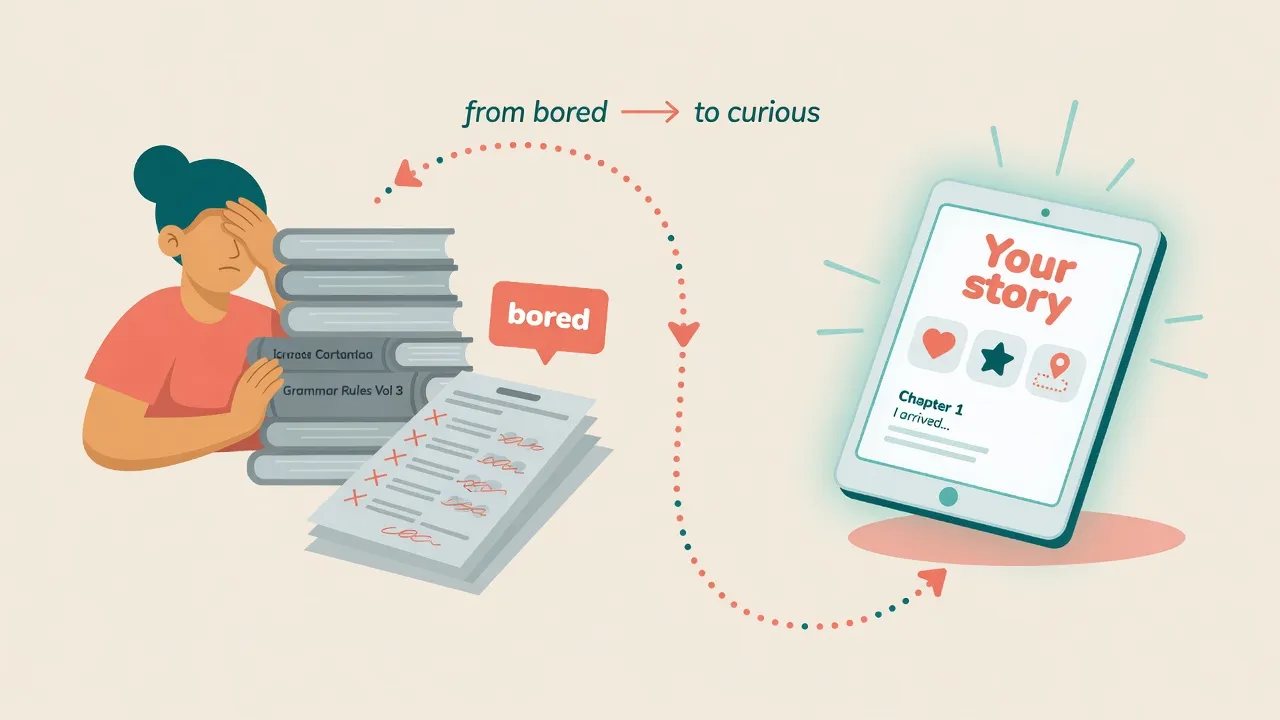
That loop is the quiet engine of adult language burnout: drills lead to boredom or guilt, guilt leads to postponing, postponing leads to more guilt, and soon the book itself feels like a threat.
Here is that burnout loop in one picture - drills in, dread out:
What is language learning burnout (in plain words)?
In everyday talk, language learning burnout means your study habit stopped giving energy and started taking it. You may still want the language. You may still open apps out of duty. But the work feels empty, heavy, or slightly sick-making.
This is not a medical diagnosis. Fatigue from a hard week of life is different from a study method that makes you avoid the subject itself. They can overlap. If rest alone does not help and textbooks still make you sick, treat it as a method problem: change the input, not only the calendar.
Is it laziness or burnout?
Laziness sounds like "I do not care." Burnout often looks like caring too hard with a broken loop: guilt, dread, restart Mondays, and shame after every miss. You can love Spanish or English and still hate the drills. That is pressure plus method - not a character flaw.
5 signs you might have language learning burnout
Check yourself. If about three of five feel true, you are probably in burnout territory - a pattern check, not a label you need forever.
- Daily postpone - endless reasons (fatigue, mood, chores) before you open the book or app.
- Boredom before you start - dread hits at the thought of drills, not only mid-session.
- Method-hopping - app, then textbook, then tutor, then YouTube, then quit, then a shiny new method.
- Guilt after every missed day - self-blame that makes the next session harder, not easier.
- Toxic comparison - "They hit B2 in a year; I am still stuck at A2."
If you recognized yourself, stop for a second. The problem is often the system: solo drills, constant scoring, and no story that pulls you forward.
Why interesting reading helps (without miracle science)
Stephen Krashen and others describe a simple idea: we pick up a lot of language when we understand messages we care about - often called comprehensible input. Free voluntary reading (reading you chose, at a level you can mostly follow) is one practical way adults get that input without turning every page into a test.
What holds up in practice is simple and useful: words tied to plot and emotion often stick better than isolated list items; curiosity keeps you coming back when duty fails; grammar shows up in use instead of only in tables. For a longer walkthrough, read how comprehensible input works.
Reading is not a fluency contract. It is a low-guilt engine for contact with the language - especially when textbooks have made contact feel toxic.
Textbook drills vs a story you care about
Genre does not have to be detective. Mystery works for some people because cliffhangers pull you page to page. Others need romance, YA, sports blogs, travel writing, fantasy, or a niche topic they already love. The test is simple: would you finish this on the couch if it were in your first language?
Detectives are one optional path (repeated lexis, clear stakes) - not the only medicine. If you want title ideas later, try easy English books for A2-B1 or, only if thrills are your thing, detective and thriller vocabulary paths.
Side by side, the two modes feel different:
| Dimension | Textbook drills | Story / text you care about |
|---|---|---|
| Unit of attention | Isolated exercises, lists | Plot, character, topic you chose |
| Motivation fuel | Duty, streak, "should" | Curiosity: what happens next? |
| Emotion | Often flat or fail-feel | Interest, tension, humor, care |
| Word reuse | One-off items in unit tests | Same world, same words return in context |
| Session end feel | Score / incomplete unit | Want one more page (or stop guilt-free) |
| Risk if overdone | Boredom, method-hop, burnout | Text too hard → dictionary thrashing |
| Role | Supplement, review, structure | Enjoyable input when level is comfortable |
Here is the same contrast as a simple board - drills on one side, a story you chose on the other:
You do not need an app to start this shift. You need a text you care about at a level you can mostly follow. Free graded pieces are one low-pressure door: browse the free graded articles, including warm-ups like a Spanish A2-style sample (step down to Spanish A1 if a page feels mostly dark).
Main fear: "I can't read originals - I understand nothing"
This fear is understandable. It is also often about level mismatch plus a broken reading interface, not proof that you will never read.
Typical thrashing loop:
- Open a text that is too hard (or even a good one on a tired day).
- First paragraph: several unknown words.
- Jump to a translator tab for each word.
- Return - and already forgot what the paragraph was about.
- After about fifteen minutes: close the book, open social media.
Flow dies when every sentence is a tab switch. Fixes that actually help:
- Easier text first - graded free library, short articles, not prestige novels on day one.
- Guess from context - look up only sentence-blockers.
- Stay on the page - any in-reader lookup (browser tools, e-reader dictionaries, or a reader app) beats constant tab hopping.
If tab-switching kills every paragraph, pick what keeps you reading. MovaReader is one option: tap a word or phrase for in-place help so the story stays one surface. About 20 word translations per day on freemium, free graded library, optional upload of your own legal EPUB. Learning targets for the product are English and Spanish. We do not host licensed commercial novels by default - you bring books you already own or use free graded texts. Details live on pricing and how to use the reader. Skip the product if paper books and a simple dictionary already feel good.
Unsure whether a text is roughly your zone? The language map is orientation, not an official exam.
A 4-week gentle reading detox plan
No tests. Goal: restore contact and curiosity.
| Week | Focus | Daily practice | Success signal |
|---|---|---|---|
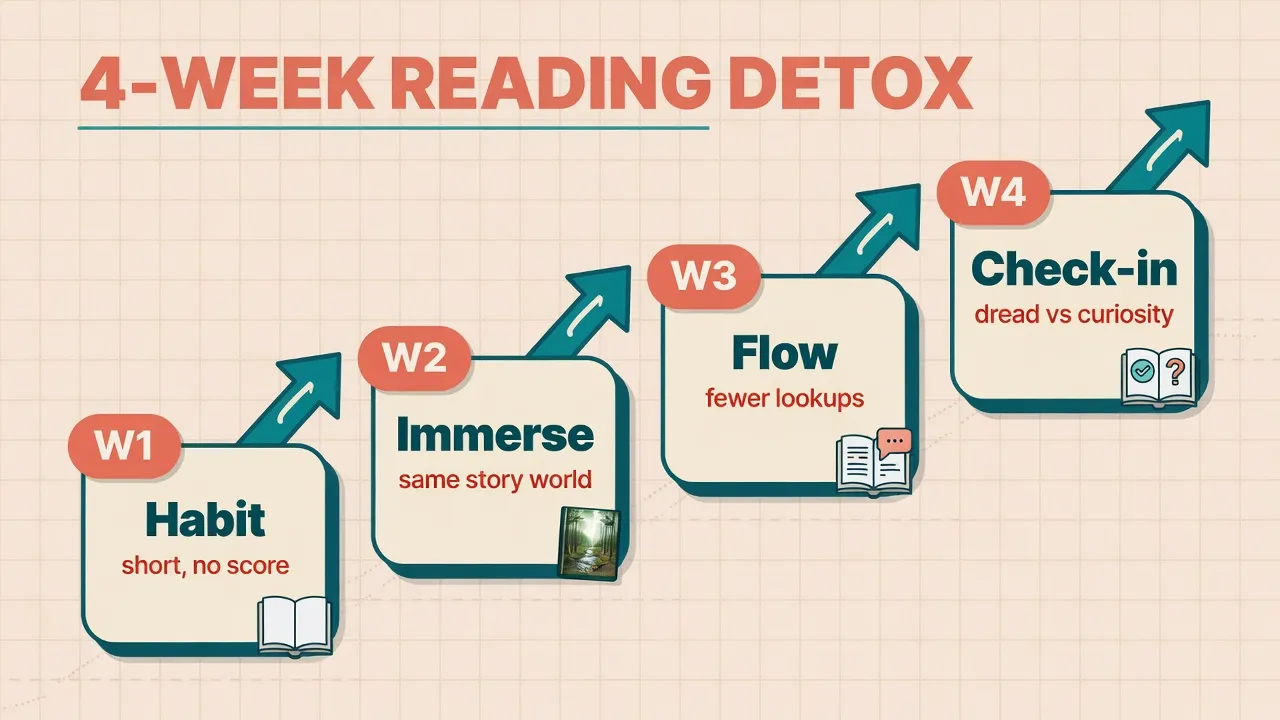
| 1 - Habit / ease | Reattach without score | 10-15 min. Story or graded text you chose. Look up freely; do not force memorization. | You opened the text most days without a fight |
| 2 - Immersion light | Same world a bit longer | About 20-30 min. Stay in one story world or similar topic. Optional light phrase review of words you already met. | Lookups feel a bit rarer; you care what happens next |
| 3 - Flow | Fewer breaks, more pages | Up to about 30-40 min if it feels good - stop when dread returns. Fewer lookups; more guessing. | You forget "I am studying" for stretches of reading |
| 4 - Check-in | Notice dread vs curiosity | Keep reading. Optional light grammar only if curiosity is back - not as punishment. Optional peek at an old textbook exercise (compare feel, not score). | Dread down, curiosity up; choose light structure again or the next story |
Many people find familiar patterns less scary after weeks of interesting input. Individual results vary. Do not expect a miracle score on an old unit test as proof of success.
Here is the four-week ladder in one view - short steps, no miracle outcomes:
Week 1 tip: park the heavy drill stack. Permission, not a forever ban if structure helps you later. Start from all free articles if choosing a book still feels huge.
Weeks 2-3 tip: if curiosity returns and you want light review, optional trainers or demos like type training and phrase typing can reuse words you already met - after reading, not instead of rest.
Week 4 tip: the win is feeling less sick when you think about the language. That is enough for one month.
Where MovaReader fits (optional)
MovaReader is a reading interface meant to keep lookup on the page so stories stay enjoyable. It is optional help for burnout recovery, not the only cure.
- Free graded library - browse
/en/all-articles - Freemium: about 20 word translations per day
- Reader €1/month - more room when you read longer and hit the free cap
- Pro €5/month - full trainers when you want practice after input
- Upload your own legal files; we do not host licensed commercial novels by default
- Product learning focus: English and Spanish
If freemium is enough for short sessions, stay free. If you need more translation volume, Reader is the reading-only step. Pro is for people who want trainers - not required for detox week one. Soft next steps: register only if saving progress matters to you, and pricing when you want the full map of limits.
FAQ
Is language learning burnout the same as laziness?
No. Laziness is "I do not care." Burnout often looks like caring too hard with a broken method: guilt, dread, endless restart Mondays. You may still love the language and hate the drills. That is a method and pressure problem, not a character flaw.
Should I stop studying completely or just change method?
Usually change method first: pause heavy drills and tests for a while, replace them with short daily reading of something interesting at a comfortable level. A full stop can help if you are exhausted - but empty weeks with no language contact often become a permanent quit. Aim for gentle contact, not zero and not hero sessions.
Can beginners read if textbooks already feel impossible?
Yes - if the text is easy enough. Start with short graded articles or very simple stories, not prestige novels. Rule of thumb: you should follow the main idea without translating every word. Free library samples for English and Spanish at A1-A2 exist for warm-up; step down if a page is mostly dark. Try ES A2 sample.
Do I still need grammar if I only read stories?
Reading shows grammar in use and builds a sense of "what sounds right." Light explicit grammar can still help when you want labels for patterns you already notice. Skip grammar as punishment or as the only daily task while you are burned out. Structure is a tool, not a moral duty.
Is "language learning fatigue" different from burnout?
Fatigue often means tired from hard work - rest helps. Burnout here is more about dread, guilt, and loss of interest in the study loop itself. They overlap in real life. If rest alone does not help and textbooks still make you sick, treat it as burnout of method: change the input, not only the schedule.
Will reading alone make me fluent?
No tool or method can guarantee fluency. Lots of interesting input (reading and listening) helps comprehension and vocabulary a lot. Speaking and writing still need their own practice - talk, shadow, courses, friends, work use. Use reading as a heavy, low-guilt input engine, not as a fluency contract.
How does MovaReader help without becoming another guilt app?
It is optional. Free graded library plus about 20 word translations per day on freemium; Reader at €1/month for more translation volume; Pro at €5/month for full trainers. You can upload your own EPUB; we do not host licensed commercial novels by default. Learning targets for the product are English and Spanish. The point of this article is restoring interest, not streak shame. Skip the product if paper books and a simple dictionary already feel good. See pricing for the numbers.
What to do right now
- Close or park the heavy drill stack for a bit - permission, not a forever ban if structure helps later.
- Pick a story or short text you care about at a level you can mostly follow - any genre you would finish on the couch.
- Browse free graded options in the library, or open a sample like Spanish A2.
- Read about 15 minutes today - no score, no guilt for short sessions.
- If lookup thrashing kills flow, use easier text, context guessing, or in-reader tools; freemium limits and paid steps are on pricing.
Language learning burnout is not proof that you are weak. It is often a signal: "Give me something interesting." Textbooks offer rules and red marks. A story you chose offers a reason to turn the page - and that is often enough to restart contact with the language.
Your brain is not broken. Your method might be. Start small today.
Keep reading with translations inside the text
With a free account, an unknown word translates with one tap, and the words you are learning wait for you in the trainer.
Free account: 7 days of Pro, then 20 word translations a day or a paid plan.