Curated Resources
8 Detective and Thriller Books for English Learners (B1-C1)
You stay for the liar, not the flashcard. Eight detective and thriller books with realistic B1-C1 levels, vocabulary that actually repeats, and a way to look up less without losing the plot.
You open a detective novel "for vocabulary" and an hour disappears. You were not drilling flashcards. You wanted to know who is lying. That pull is why detective books for English learners work better than another grammar worksheet: the story holds attention long enough for words to stick.
A few things to know up front:
- not every thriller is easy B1
- not every unknown word needs a lookup
- no app guarantees you will catch every clue on the page
Plain answer. Detective and thriller novels help English learners because the plot pulls you through pages longer than a textbook drill - and crime words like suspect, evidence, witness, alibi, motive, and statement keep repeating. Start with solid B1-B2 titles (Christie, Ware, Foley), not high B2-C1 psychological thrillers sold as "easy." Look up only blockers so you do not kill the twist; warm up on free graded samples, then read a book you own.
Below: a green / yellow / red level test, eight books with realistic B1-C1 levels, a quick-pick table, an intrigue-safe method, and a free graded warm-up path.
Why do detective stories build vocabulary well?
Genre helps when three things line up: you care what happens next, the same cluster of words returns, and the context is rich enough to guess.
Words that keep showing up (free spaced repetition without a deck):
| Word | Plain sense |
|---|---|
| suspect | person who might have done it |
| evidence | facts or objects that support a claim |
| witness | person who saw or heard something |
| alibi | proof you were elsewhere |
| motive | reason someone might act |
| statement | official or formal account of events |
You will also meet fingerprint, murder weapon, investigation, and interrogation in many titles - learn them when they repeat, not on first sight.
Why the genre works in practice:
- Emotional pull keeps sessions longer than "study for 20 minutes" framing.
- Closed settings (island, ship, wedding) recycle the same props and verbs.
- Modern dialogue sits closer to spoken English than dense Victorian prose.
- Strong context: if police lift fingerprints from a murder weapon, half the line is already guessable.
What detective reading does not do alone:
- replace A1 grammar if you still struggle with basic sentences
- turn B1 into C1 in one novel
- work if every sentence becomes a dictionary stop
For a light warm-up before long books, browse all free texts.
How do you pick a real level? (green / yellow / red)
Skip the prestige title for a moment. Test three pages: start, mid-chapter, and another chapter. Then label the book honestly.
| Signal | Meaning | Daily habit? |
|---|---|---|
| Green | You know who does what; you can retell the scene | Yes - ideal main book |
| Yellow | Plot holds; a few blockers per paragraph | Yes if mostly yellow-green |
| Red | Word-by-word; intrigue dies | No - short intensity only, not main habit |
For daily reading, take green or yellow-green. Leave red for a tough short session, not your only track.
Here is that traffic-light test as a card:
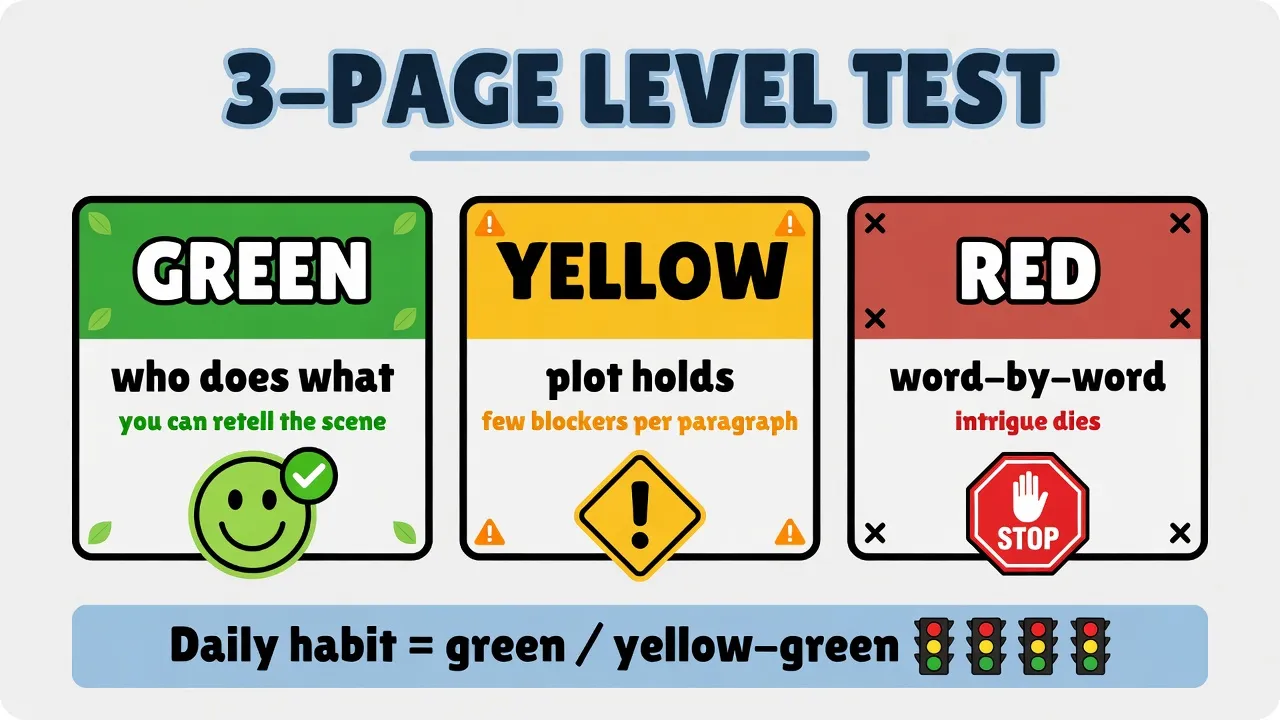
If the page is red, do not hero-suffer. Drop to a graded text, rebuild flow, then try again later. Warm-up link: all free texts.
8 detective and thriller books (realistic levels)
This ladder runs from solid B1-B2 mystery to B2 twists to high B2-C1 voice and atmosphere. Not every thriller is beginner-friendly. Gone Girl and In the Woods sit high on purpose.
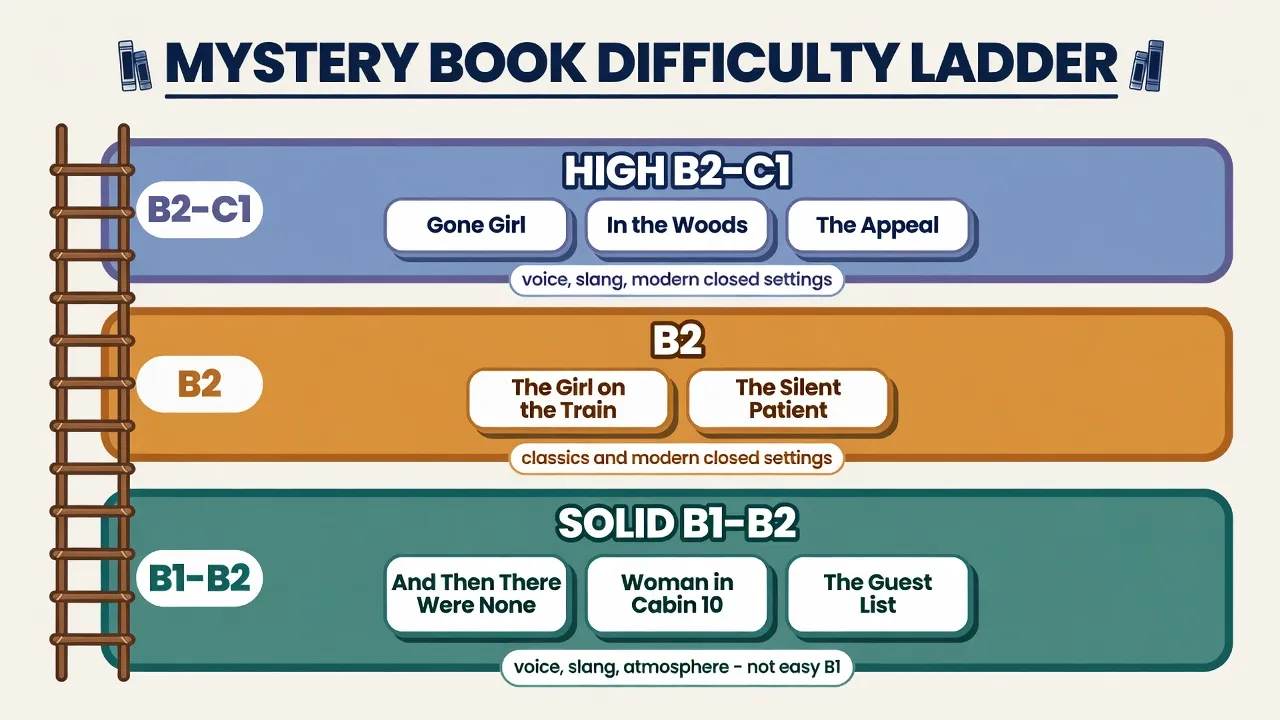
1. Agatha Christie - And Then There Were None
Realistic level: solid B1-B2 (for many, already not a "very easy" start)
Vocab focus: classic British mystery; basic legal-ish words (suspect, alibi, evidence)
Why it works: short sentences, clear "who next" hook, classic closed-island structure
Watch for: older setting; slightly more formal tone than modern thrillers
A strong first "real" mystery after graded texts. Optional graded ELT Christie editions exist as warm-up; they are not the same as the full novel. We never host full commercial Christie for free.
2. Ruth Ware - The Woman in Cabin 10
Realistic level: B1-B2
Vocab focus: cruise and ship words (cabin, deck, hull, starboard); fear and doubt
Why it works: modern closed-setting whodunit; faster pace than many classics
Watch for: atmosphere-heavy stretches - use short sessions if detail slips
A good modern start if Christie feels dated but you still want a locked puzzle.
3. Lucy Foley - The Guest List
Realistic level: B1-B2
Vocab focus: wedding and social English (best man, maid of honour, venue, reception, RSVP)
Why it works: multi-narrator voices; clear closed location; reusable everyday English
Watch for: voice jumps - keep a mini cast map on a sticky note
Useful life vocabulary, not only "murder words." Often the gentlest modern pick for solid B1-B2.
4. Paula Hawkins - The Girl on the Train
Realistic level: B2
Vocab focus: everyday + emotion; alcohol and mental-state language; unreliable narrator
Why it works: many people know the film; modern prose; strong twist energy
Watch for: timeline confusion - mark who / when if you lose the thread
Take this when B1-B2 titles feel easy and you already like unreliable narrators.
5. Alex Michaelides - The Silent Patient
Realistic level: B2
Vocab focus: therapy and psych terms (therapist, delusion, transference); twist structure
Why it works: sharp hook; fairly direct modern prose
Watch for: specialist terms - learn only what repeats and holds the plot
Solid for twist fans at B2 who can handle some clinical vocabulary in context.
6. Gillian Flynn - Gone Girl
Realistic level: high B2-C1
Vocab focus: US informal English; slang; psychology; irony
Why it works: two voices; rich modern informal English; intense plot pull
Watch for: dark themes, slang, cultural references - not an easy B1 thriller
Great when you want harder modern voice. Terrible as a "beginner detective" promise.
7. Tana French - In the Woods
Realistic level: high B2-C1
Vocab focus: descriptive language; Irish English; atmosphere and emotion
Why it works: deep characters; high-quality prose; long reward if you stay
Watch for: slower pace - not easy B1; pure "who did it ASAP" readers may tire
Pick this for atmosphere, not for a light weeknight whodunit.
8. Janice Hallett - The Appeal
Realistic level: B2-C1
Vocab focus: emails, SMS, formal letters; RE:, FYI, ASAP; register switches
Why it works: epistolary format trains real writing genres you need in life
Watch for: you must track the letter chain as evidence - a different reading mode
Ideal if you want writing-register practice more than classic detective prose.
Quick-pick table
Need a fast pick? Match level, pace, and why you are starting this one.
| Book | Realistic level | Pace | Vocab focus | Who starts first |
|---|---|---|---|---|
| And Then There Were None | B1-B2 | moderate | classic detective | first "real" mystery |
| The Woman in Cabin 10 | B1-B2 | fast | cruise, fear | modern whodunit |
| The Guest List | B1-B2 | moderate | social / wedding | gentler modern start |
| The Girl on the Train | B2 | moderate | everyday + emotion | twist + already B2 |
| The Silent Patient | B2 | fast | psych terms | twist fans |
| Gone Girl | high B2-C1 | fast | slang, psychology | harder modern voice |
| In the Woods | high B2-C1 | slow | descriptive | atmosphere readers |
| The Appeal | B2-C1 | moderate | email / formal | writing-style practice |
How do you read without killing the intrigue?
Protect the twist. Translate less. Finish the book this month.
1. Do not translate everything
If you already got the lie, a rare adjective can wait. Reading is following meaning, not building a 100% glossary of the page.
2. Blockers only
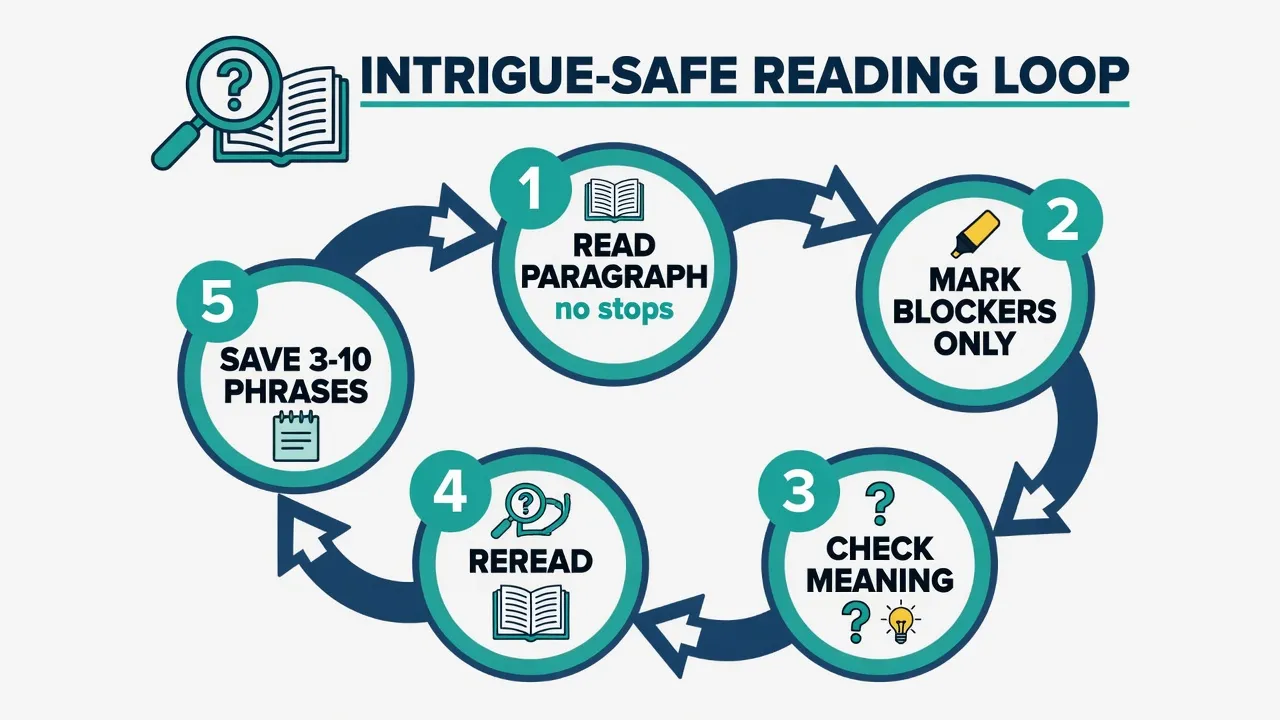
Use this loop each session:
- Read a paragraph without stopping
- Mark only words that break sentence meaning
- Check those words
- Re-read the paragraph
- Save 3-10 phrases per session (not 40 isolated words)
3. Keep a mini case file
One small notebook page (or note) is enough:
- names
- alibis
- 5-10 useful phrases per week
That is your mini case file - not an Anki factory on day one.
4. Mix graded texts and a real book
A stable week:
- 3-4 days: free level texts
- 2-3 days: your detective (EPUB or paper you own)
- 1 day: phrase review
Samples: full free library
5. Prioritize dialogue over landscapes
Lies often sit in speech lines. If time is short, give priority to dialogue and clue sentences; skim long description when the plot still holds.
How to use MovaReader with detective novels
Free graded texts warm you up. Long detective novels stay your EPUB or paper copy. MovaReader helps with lookups and phrase practice on files you already have - it does not host full commercial Christie, Flynn, French, or similar bestsellers as free full-novel chapters inside the app.
A simple loop:
- Warm up on free graded English texts in all articles.
- When ready for a long book, open a file you own (how to use).
- Tap translation only on blockers.
- Train a small phrase set with the phrase typing demo, the word training demo, or full trainers.
Plans (plain):
| Plan | What you get | Fit for thrillers |
|---|---|---|
| Freemium | Free graded library; listening; about 20 word translations/day | Warm-up + short sessions |
| Reader €1/mo | Unlimited reading translations | Long novels without a daily translation wall |
| Pro €5/mo | Full trainers | When review of saved phrases is the bottleneck |
Details: pricing.
What MovaReader does not do:
- replace a legal buy, borrow, or library loan of a commercial novel
- guarantee every plot clue or "fluent from one book"
- auto-level Gone Girl or In the Woods down to B1
Soft start today: demos → then your own EPUB.
FAQ
Which book should I start with at B1?
Safest first picks: The Guest List, The Woman in Cabin 10, or And Then There Were None after a few graded texts. Run the green / yellow / red page test. If the page is red, do not hero-suffer - pick an easier text and come back later.
Is Agatha Christie good for beginners?
Yes as a bridge after graded readers into real mystery novels. No as a promise of "super easy modern spoken English." The original And Then There Were None is solid B1-B2 for many learners, not an A1 freebie. Graded ELT Christie editions exist as optional warm-up; they are not the same as the full novel.
What do I do with slang in Gone Girl?
Do not chase every idiomatic punch. Take patterns that repeat. Skip one-off hits if the plot is still clear. Gone Girl sits at high B2-C1 - it is not an easy B1 thriller.
Do I need legal English before I start?
No. Core words like evidence, witness, alibi, and motive come from context and repetition. Deep legal English is a separate goal, not a ticket to open the book.
How many pages per day?
Start with 15-20 minutes or about 3-8 pages. Daily short sessions beat "100 pages on Sunday and burnout." Protect the habit more than the prestige title.
Can I listen to audio at the same time?
Yes if the page already makes sense by eye. Audio on text you do not understand yet usually adds noise, not magic. Use audio to reinforce a chapter you already follow, not to replace comprehension.
Next steps
The best detective book for English learners is the one you finish this month, not the most Instagram prestige title.
- Choose by plot understanding (green / yellow / red), not by hype.
- Protect a short daily habit; look up blockers only.
- Today: run the three-page test on one real book, then use reader support only for a file you own.
Optional map of levels and vocabulary size: language map.
Tools reduce friction. They do not turn C1 prose into A2 overnight.
Learning English?
The English version of MovaReader teaches Spanish and Ukrainian. To read English with a translation for every word, open the reader in Ukrainian or Spanish:
Книги англійськоюЦя стаття українськоюLibros en inglésEste artículo en español