Curated Resources
Easy English Fiction for Spanish Speakers A2-B1
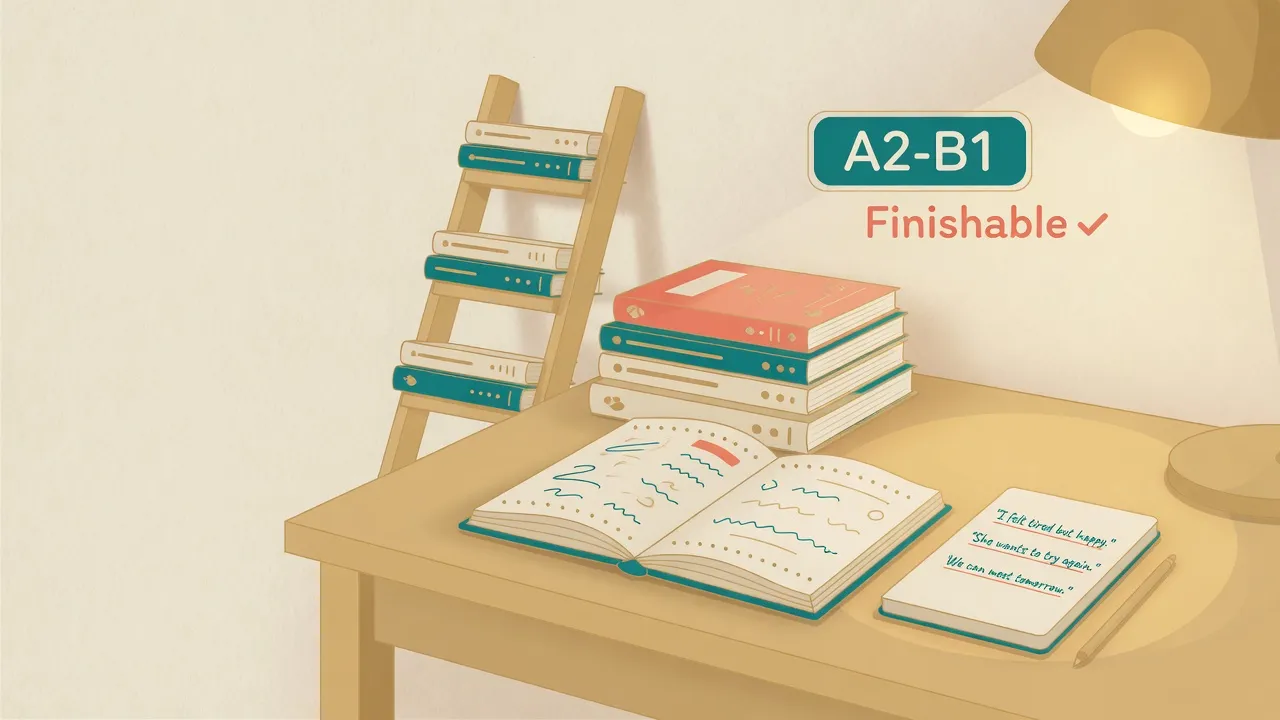
A fiction diet for Spanish speakers at A2-B1: pick a genre lane, run a story-shape test, start one finishable novel, and skip prestige lists sold as beginner.
You open another list of "novelas faciles" and the first title is The Great Gatsby. Or a late Harry Potter tome. Or a BookTok romance sold as beginner English. The list is proud. Your month is not.
You already know those books are good. You also know you will not finish them this month. What you need is a fiction diet: one lane, one shape that works, one book you can keep.
If Spanish is your first language and English is around A2-B1, skip prestige "beginner" novels. Build a fiction diet: pick a genre lane and keep the book only if the story shape works (short chapters, spoken dialogue, a plot question every few pages, concrete nouns). Fail any two and it is stretch, not daily fiction. Starters: dialogue YA Wonder; short mystery Holes; light adventure Fantastic Mr Fox; compact classic The Old Man and the Sea; optional diary Diary of a Wimpy Kid. Warm up on a free A2 text, then one legal novel.
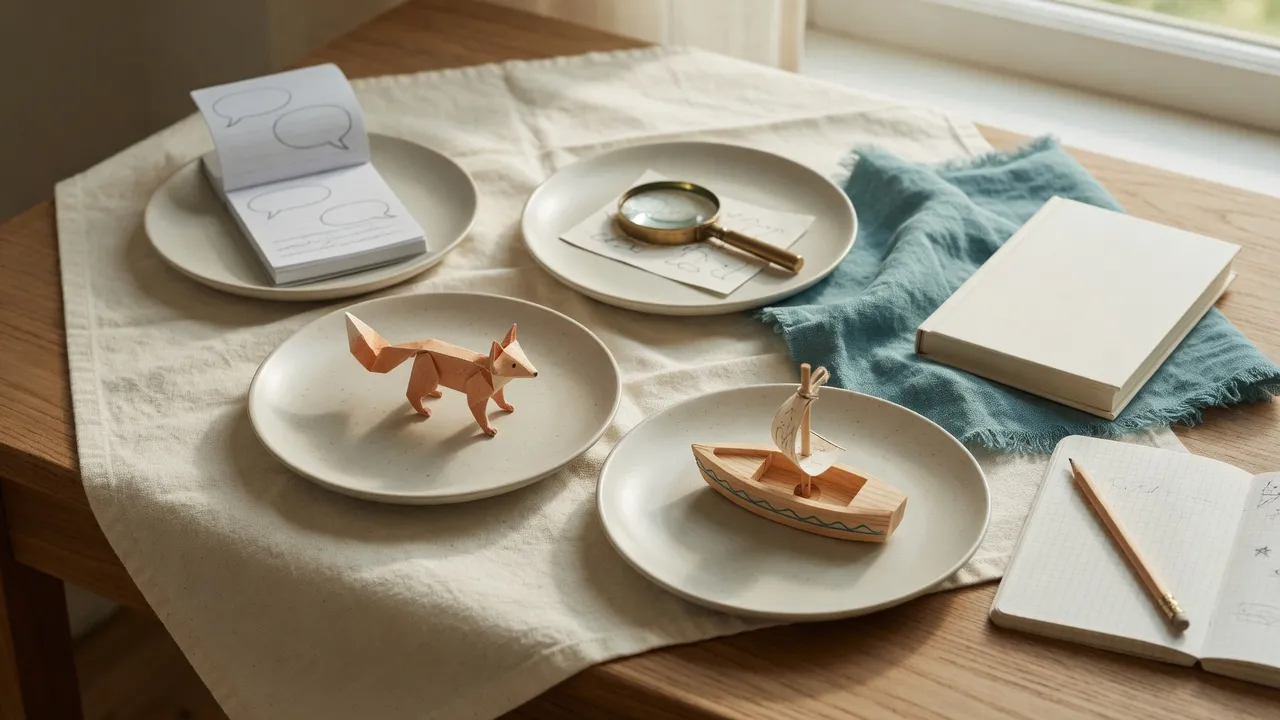
The diet looks like four simple plates, not a prestige stack:
| Lane | Starter |
|---|---|
| Dialogue YA | Wonder |
| Short mystery | Holes |
| Light adventure | Fantastic Mr Fox |
| Compact classic | The Old Man and the Sea |
| Optional diary | Diary of a Wimpy Kid |
Below: why fiction beats a textbook for this job, the story-shape test, four lanes plus an optional diary, a too-early shelf, a weekly diet, a light note on Spanish, and how a reading app fits in. No ranked top ten. One book is enough.
A free English A2 sample is a fair warm-up. The novels themselves are paper or EPUB you own or borrow.
Why does fiction beat textbooks for Spanish speakers?
You already know how a novel works. Chapters. Dialogue. A turn on the next page. A textbook rarely gives you that pull.
Plot is the useful part. You want to know if the fox gets the feast, or why the boy is digging holes. That question keeps the book open after a long day. A unit on the present perfect does not.
Spoken dialogue is the other gift. School talk, family fights, small greetings: you can reuse those chunks. You hear English the way people say it, not the way a grammar box prints it.
Cognates help some pages. Family, important, hospital often feel almost free. That is a footnote, not the thesis. Spanish will not turn a dense metaphor novel into A2 fiction.
Levels here are practical bands, not certificates. A Romance first language does not make a B2 page easy.
How do you test if a novel is A2-B1 finishable?
Before you commit, test the shape, not the cover quote. Open a sample chapter. Tick what is true.
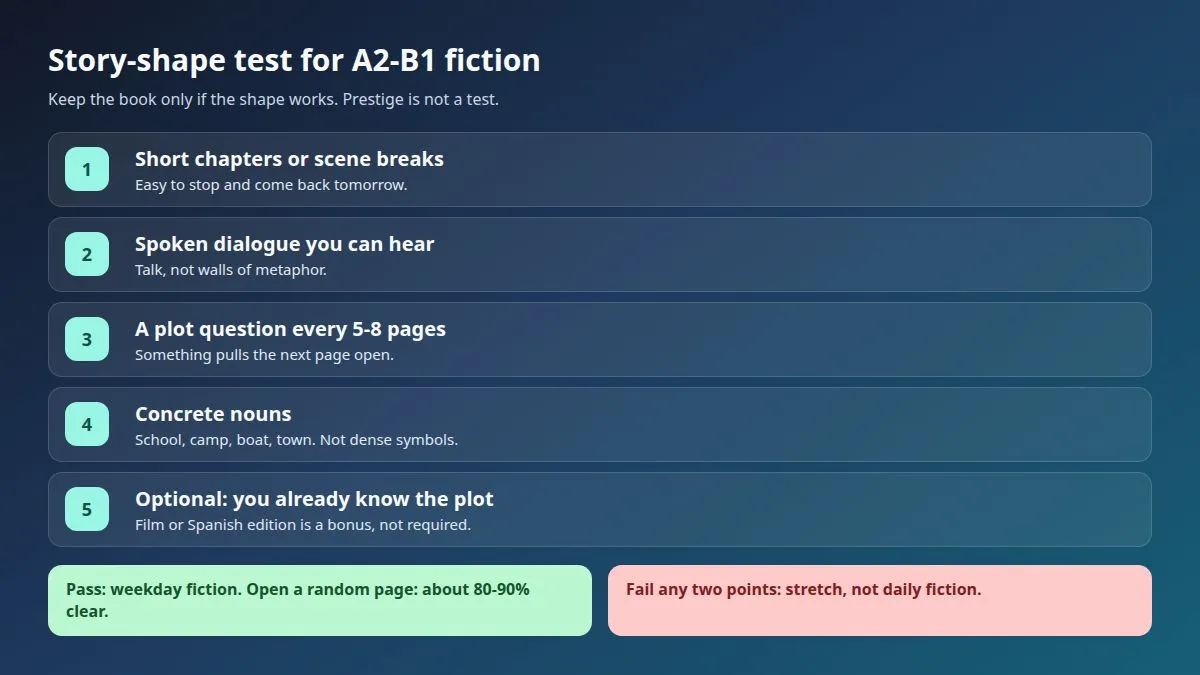
Here is the checklist. Fail two points and the book is stretch, not the weekday plate:
If you want a compass for where your words sit, open the language map. It is a compass, not a certificate.
The five-point story-shape test
- Short chapters or clear scene breaks. You can stop on a commute and come back. Fail: a 20-page wall with no door.
- Spoken dialogue you can hear. Talk, fights, school chat, family scenes. Fail: pages of metaphor with almost no speech.
- A plot question every few pages. You want the next 5-8 pages. Fail: beautiful sentences, no pull.
- Concrete nouns. School, camp, boat, town, fox, hole. Fail: dense abstraction or a lore dump.
- Optional: you already know the plot in Spanish. A film, a translation, or a book you finished as El alquimista. Bonus, not required. A mystery can scaffold itself with the question.
Fail any two and it is stretch, not daily fiction. One miss can be a tax (sea words, US slang). Two misses means weekend ambition, not the weekday novel.
The 80-90% page test
Open a random page. If you understand about 80-90% without a dictionary every line, stay. If you need help every sentence, you are decoding, not eating a diet book. About 70% comprehension is a weekend project, not the weekday novel. That is an adjustment, not a failure.
Which genre lane should you start with?
Pick by mood and story shape, then one book in that lane. Do not collect beginners. If a title also appears on other lists, the reason here is the shape: how the story is built, not a copied "easy to finish" line.
Four plates, plus an optional fifth if you want pictures and short diary stops:
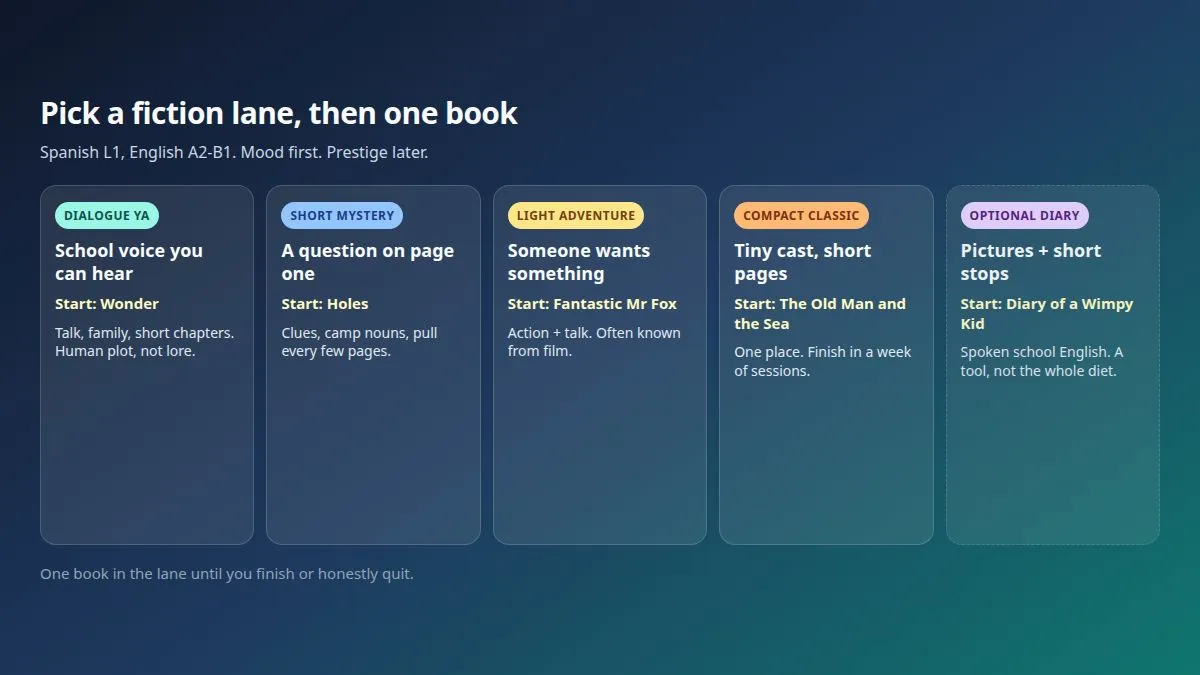
| Lane | Shape in one line | Starter | Stretch |
|---|---|---|---|
| Dialogue YA | Talk-heavy teen voice, clean chapter doors | Wonder | The Giver |
| Short mystery | Question on page one, clues over description | Holes | Curious Incident |
| Light adventure | Want + move + objects | Fantastic Mr Fox | Charlie or Call of the Wild |
| Compact classic | One place, few people, short | The Old Man and the Sea | Animal Farm or Of Mice and Men |
| Optional diary | Pictures + short diary stops | Diary of a Wimpy Kid | stay optional |
Dialogue-heavy YA / school voice
You want a first-person or close teen voice, lots of talk, school and family scenes, and chapters that stop cleanly. That is the dialogue-ratio pick.
Starter: Wonder by R.J. Palacio. You hear spoken English. The plot is human, not lore. A 15-20 minute session has a door. Other lists may sell this book as school vocabulary. Here it stays because of the talk, not because of a cognate lecture.
Watch the emotion and the US school slang. It is longer than Dahl. Some medical and admin words will tax you. School and friendship cognates help (family, important, hospital). Phrasals in speech still sting.
Same-lane stretch: The Giver, after one easier YA finish. The ideas sit denser than the talk.
Short mystery / detective frame
You want a question on page one, short chapters, and clues over description. Do not treat this lane as "easiest book number three." Treat it as a mystery frame.
Starter: Holes by Louis Sachar. A plot question returns every few pages. Camp and action nouns stay concrete. The pull keeps the next scene open. You do not need a known plot in Spanish. The question is the scaffold.
Watch the two timelines and the name map. US slang will appear. If those two taxes stack with weak dialogue days, drop it and come back later.
Same-lane stretch: The Curious Incident of the Dog in the Night-Time. Clear voice, unusual mind. The lists can slow you.
Light adventure / quest with concrete action
Someone wants something. Scenes move. You see objects and places, not essays. That is the quest shape: want, move, concrete nouns.
Starter: Fantastic Mr Fox by Roald Dahl. It is short. Dialogue sits next to action. You can picture the fox, the farm, the hole, the feast. Many readers already know the film or a Spanish Dahl edition. Keep English first; the known plot is only a bonus.
Watch the dark humor. Skip a joke if it blocks the raid. Do not sit on one pun for ten minutes.
Same-lane stretch: Charlie and the Chocolate Factory (invented words) or The Call of the Wild (older adventure prose; a B1+ stretch). A first original novel after graded readers can also wait until this plate feels calm. There is a first-real-novels ladder if you want that frame with no Spanish L1 angle.
Compact classic with a small cast
One place. Few people. A short page count. Not "classic" as a badge.
Starter: The Old Man and the Sea by Ernest Hemingway. Tiny cast. Repeated frames: boat, fish, sea. You can finish in a week of sessions. Other lists may call it a literary bridge. Here it is the small-cast compact plate.
Watch sea words (skiff, harpoon). Short is not the same as easy metaphor. Syntax stays simple and some Latinate words help. The marine list is the tax.
Same-lane stretch: Animal Farm (allegory and politics) or Of Mice and Men (dialect; hard content, no plot spoiler here).
Optional diary / illustrated hybrid
Diary pages or pictures plus short text. Easy bus-ride stops. This lane is a tool, not a personality, and not a fifth required winner.
Starter: Diary of a Wimpy Kid by Jeff Kinney. Informal school English. Pictures carry some of the load. You can finish it in slices.
Watch the US slang. To be clear: it is not literary English. Good spoken-chunk practice. Do not make it the whole diet.
Which popular novels are too early as fiction?
Excellent books. Bad week-one A2-B1 fiction. This is a goal shelf, not a second ranking, and not a test of whether reading in English "works."
Prestige classics sold as "principiante"
- The Great Gatsby: metaphor and jazz-age slang, not A2 dialogue.
- To Kill a Mockingbird: a school setting is not beginner English. Period voice and long scenes fail the door test.
- Lord of the Flies: school-set again. Group chaos plus literary load.
- 1984 or Ulysses as a "novela para principiantes" is a prestige joke. They fail dialogue, chapter doors, and concrete nouns at once.
BookTok and series that feel easy because you saw the film
- Late Harry Potter tomes: length, British school lore, invented names. Motivation is not an A2 chapter shape.
- The Hunger Games: an invented world plus series lock-in.
- The Seven Husbands of Evelyn Hugo and The Housemaid: adult density sold as "empezar a leer en ingles." Thriller heat is not A2-B1 shape.
Early Potter, or a known YA film, can wait until two lane finishes feel calm. Then you have a real sample of your weekday pace.
What does a weekly fiction diet look like?
Not a single winner. Mood pick, one book, graded warm-up. Consistency beats page count.
A week that looks like a diet, not a contest:
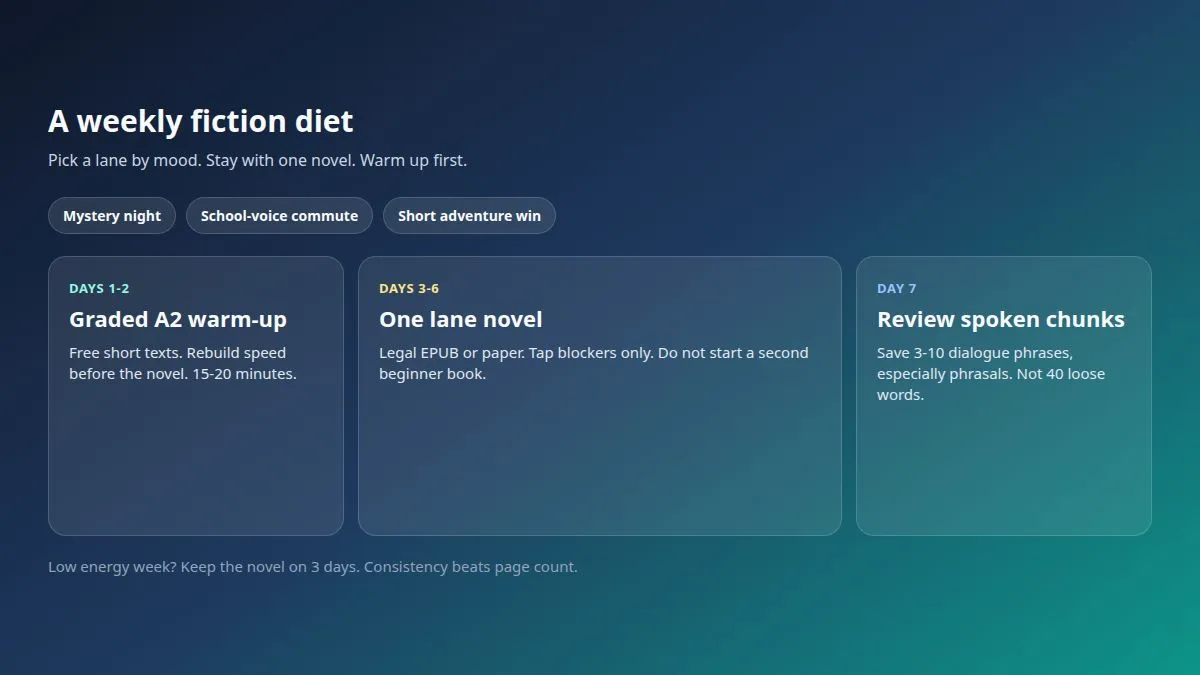
Pick a lane by mood, then stay
Mystery night. School-voice commute. A short adventure win you can close this week. Choose one, then stay.
One book in that lane until you finish or honestly quit. Do not start a second novel to collect beginners.
A simple week
| Day idea | What to read |
|---|---|
| 1-2 | Free A2 graded text (warm-up speed) |
| 3-6 | Chosen lane novel (legal EPUB / paper), 15-20 min |
| 7 | Review 3-10 saved dialogue chunks, not 40 loose words |
Some weeks, three novel days is enough. Pages matter less than finishing the lane book.
Warm up on the free English A2 sample or other free graded texts. Graded days are the side dish. The full warm-up catalogue lives on graded English stories by level.
Look up blockers, not the whole page
- Read a paragraph once without stopping.
- Mark only sentence blockers.
- Check them.
- Reread.
- Save spoken chunks, especially phrasals.
You do not need forty loose adjectives. You need three to ten lines you can say.
Audio only when the page is already mostly clear
Cognates help eyes more than ears. Audio on an opaque page is noise. Use sound after the page is already mostly clear.
What should Spanish speakers do with their first language?
Keep Spanish as a helper, not as a second copy of the book.
Helpful: a known-plot scaffold after you try the English page. A Dahl film. A Spanish edition of a YA you already finished. El alquimista if you already know that story and you are testing the English page, not replacing it.
Helpful: notice dialogue cognates (family, important, hospital) without stopping for every one.
Hurts: a full Spanish reread that you call English practice. Translate every line. Assume a B2 novel is easy because Spanish is Romance.
Phrasals in speech will sting: get up, look after, figure out. Save those chunks.
For the full cognate and false-friend guide, use the cognates and false friends article for Spanish speakers. That page owns the mixed list. This one stays on the fiction diet.
How do you use a reading app with a real novel?
MovaReader helps you warm up on free graded English, then read a legal lane novel you already own or borrow. The app does not host Wonder, Holes, Fantastic Mr Fox, Harry Potter, or other commercial fiction by default. There is no "read chapter 1 in the app" button for those titles.
A simple loop:
- Warm up on a free English A2 sample and other graded texts.
- Buy or borrow the lane novel. Upload an EPUB you own. See how to use.
- Tap blockers only. If you need a compass, not a certificate, open the language map.
- Train a small phrase set with the phrase training demo and the word training demo.
- The free plan includes listening and about 20 word translations a day. Unlimited reading translations are Reader (€1/month). Full trainers are Pro (€5/month). Details sit on pricing.
Tools reduce friction. A hard novel stays hard. Buy or borrow still matters.
FAQ
What is the easiest English novel for Spanish speakers at A2-B1?
There is no single winner. Safest first finishes are usually Fantastic Mr Fox or Diary of a Wimpy Kid. Pick Wonder if you want school dialogue. Pick Holes if you want a mystery pull. A free English A2 sample is the safest warm-up before any novel. The best easy English novel is the lane book you actually finish this month.
Should I start with graded readers or a real novel?
Both, in a diet. Graded days build speed. The novel supplies plot pull. Mix a couple of warm-up sessions, then one lane book. Do not force a 400-page prestige novel to prove you are serious. The graded catalogue lives on the warm-up hub above.
How do I know a novel is too hard as daily fiction?
Fail two story-shape points, or fail the 80-90% page test. Then it is stretch, not the weekday book. Drop a lane or return to graded for a week. About 70% comprehension is a weekend project. That is an adjustment, not a failure.
Can I start with Harry Potter or BookTok bestsellers?
Some motivated B1 readers survive book 1 of Potter with heavy support if they already know the story. Most finish more English if they win two shorter lane books first. Gatsby, Evelyn Hugo, Hunger Games, and late Potter are goal-shelf, not week-one fiction. Motivation is not an A2 chapter shape.
Do cognates make English novels easy?
They make some pages friendlier, especially school and Latin-based words (family, important, hospital). They do not remove phrasals, slang, or metaphor. Test the story shape. Do not trust "Romance language, so B2 novels are easy." The cognate guide is the sibling article linked in the Spanish section above.
How many pages per week?
Start 15-20 minutes a session, four or five sessions on the novel. Pages matter less than finishing the lane book. Some weeks, three novel days is enough.
Start one lane this month
The best easy English novel for a Spanish speaker is the lane book you finish this month. Diet over prestige. Test the shape. One book. Warm up, then a legal copy.
Today: open the free English A2 sample, pick one starter from the board, and stay with it.
If you want a broader Spanish-market hub, not this fiction slice, see easy English books in a wider list. If you want a numbered general ranking with no Spanish L1 frame, there is a ranked general A2-B1 list.
Learning English?
The English version of MovaReader teaches Spanish and Ukrainian. To read English with a translation for every word, open the reader in Ukrainian or Spanish: