Curated Resources
Top 10 Easiest English Books for A2-B1 You Can Actually Finish
Not another prestige pile. Ten finishable English books from soft A2 to solid B1, a separate "still too hard" list, and a simple 80-90% page test so you stop quitting mid-chapter.
You open another "easy English books" list and Moby-Dick is somehow in the mix. Or a 500-page classic with the word "simple" in the blurb. You try chapter one, live in the dictionary, and quit by page twenty. That is not a willpower problem. It is a finish problem.
If you are around A2-B1, you need English books you can actually finish this month - not prestige classics labeled "easy." Below: 10 realistic titles from soft A2 to solid B1, a separate list of popular books that are still a bad first finish, and one rule that works: stay when you understand about 80-90% of a random page. Warm up on free graded samples; long commercial novels are copies you own or borrow - MovaReader does not host Wonder or The Giver by default.
Here is what you will get:
- A quick pick table by level
- Part 1: ten books that are realistic for A2-B1
- A full comparison table of all ten
- Part 2: popular titles that should wait
- A reading method that does not burn you out
- Paths A and B if you do not know where to start
- How to use MovaReader
Quick pick by level
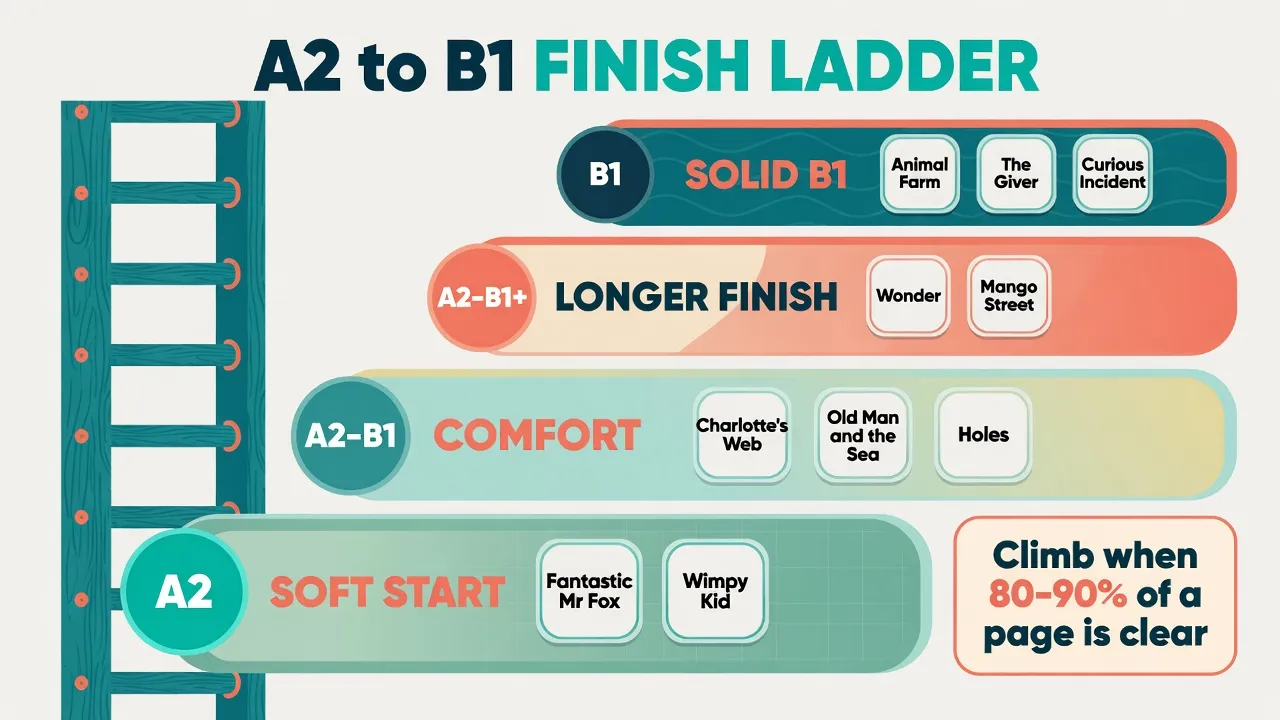
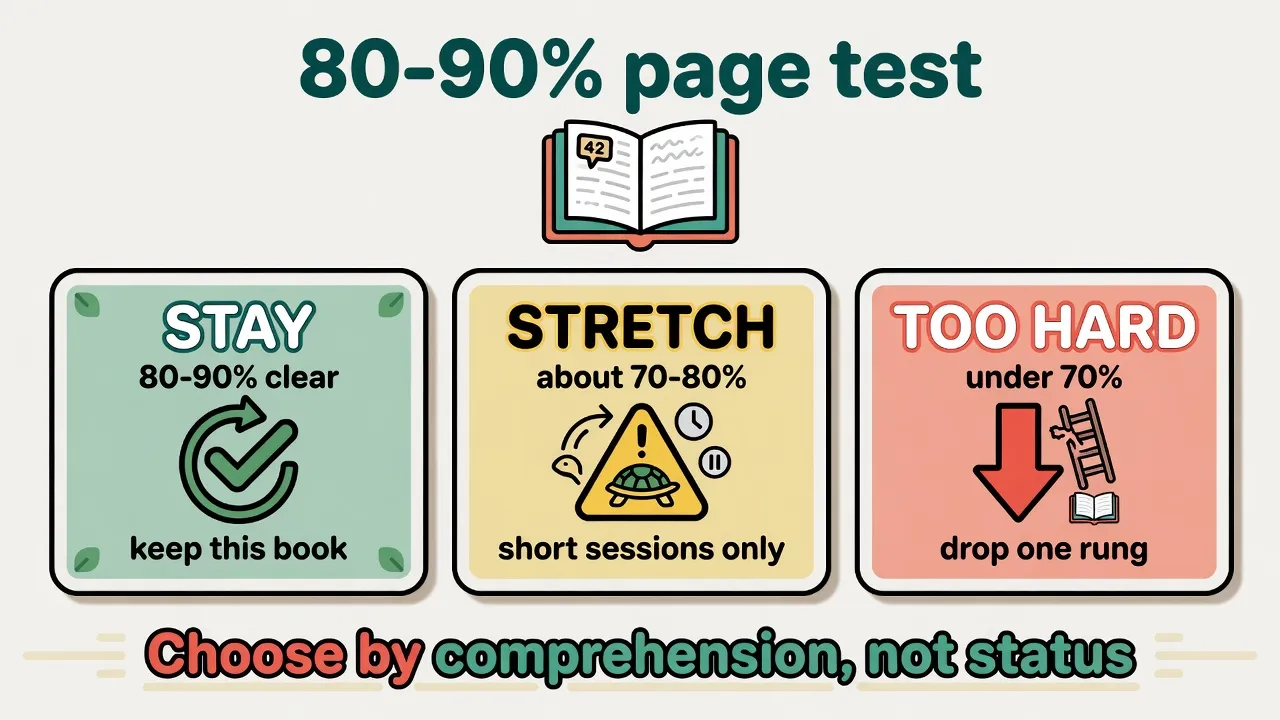
Match your current band, not your prestige wishlist. If a random page is under about 70% clear, drop one rung.
| Your level now | Start with | Why it works |
|---|---|---|
| Low A2 | Fantastic Mr Fox or free graded A1-A2 text | Short sentences, concrete vocab, low frustration |
| Confident A2 | Diary of a Wimpy Kid, Charlotte's Web | Diary chunks or familiar plot; easy stop-and-resume |
| A2-B1 | The Old Man and the Sea, Holes, Wonder | Clear narrative, repeated vocab, strong plot pull |
| Solid B1 (stretch ready) | Animal Farm, The Giver, The Curious Incident... | Shorter literary challenge; needs more attention |
| Still too early as "easy daily" | Dense classics, long fantasy epics, metaphor-heavy poetry | Good books, bad first "easy A2-B1" target |
The one rule that actually works: open a random page. If you understand about 80-90% without help, stay. If under ~70%, treat it as stretch, not daily habit.
Try a free sample first (no purchase needed): free English A2 sample. If that page feels comfortable, the list below is for you. Prefer something lighter? There is also an optional lighter English sample. Or browse the full free graded library.
What "easy" really means at A2-B1
On A2-B1, "easy" usually means:
- short chapters or clear scenes
- lots of dialogue or simple narrative past
- concrete topics (school, family, travel, food, work)
- repeated vocabulary
- optional: a plot you already know in another language
"Easy" usually does not mean:
- multi-generation sagas
- dense politics with zero prep
- long gothic mysteries with heavy style
- metaphor-heavy poetry (beautiful, often harder than plain prose)
Many "easy English books" lists dump late Harry Potter, Hunger Games, or prestige novels into the same bucket as short kids' fiction. That confuses people and causes early quits. This list has two parts: books that are realistic finishes now, and popular books that are better as goals later.
Part 1: books that are realistic for A2-B1
Think of this as a finish ladder from soft A2 to solid B1. For each title: realistic level, why it is finishable, what to watch for, and a short start tip (5-8 pages or one chapter test).
1. Fantastic Mr Fox - Roald Dahl
Realistic level: A2
Why finishable: Short, punchy, full of dialogue and dark humor. Many readers finish it in one or two evenings.
Watch-out: Farmer names and sound jokes. Skip one joke and keep the plot.
Start tip: Read 5-8 pages. If you know who is against whom and what the fox plans, continue.
This is a clean "book win": a complete story without a 400-page marathon.
2. Diary of a Wimpy Kid - Jeff Kinney
Realistic level: A2
Why finishable: Diary format, short entries, informal school English, illustrations. Easy to stop and resume.
Watch-out: Slang and culture jokes. You do not need to "get every meme."
Start tip: Ideal for "finish a section on the bus" habit building.
Note: weak for literary English; strong for spoken patterns and the finishing habit itself.
3. Charlotte's Web - E.B. White
Realistic level: A2-B1
Why finishable: Clean, musical prose; concrete farm scenes; a strong emotional line that pulls you forward.
Watch-out: Animal and farm words. Emotional density can exceed language density.
Start tip: Adults often overestimate how hard it is. Language is simpler than many mid-length "adult" books.
4. The Old Man and the Sea - Ernest Hemingway
Realistic level: A2-B1
Why finishable: Short sentences, limited lexicon, clear conflict. The whole story is short.
Watch-out: Sea vocab (skiff, harpoon, gaff); slow rhythm. "Simple style" is not always easy for modern ears.
Start tip: A good bridge when graded readers bore you but modern novels still crush.
5. Holes - Louis Sachar
Realistic level: A2-B1
Why finishable: Strong plot pull, clear scenes, YA language, constant "what next?" motivation.
Watch-out: Multiple timelines. Keep a short name map if you get lost.
Start tip: Best for readers who quit from boredom more than from grammar.
6. Wonder - R.J. Palacio
Realistic level: A2-B1
Why finishable: First person, conversational English, short chapters, familiar school world.
Watch-out: Longer than Dahl or Hemingway. Themes are often heavier than the language.
Start tip: When short books feel comfortable, this is a "real novel" without dense literary style.
7. The House on Mango Street - Sandra Cisneros
Realistic level: A2-B1
Why finishable: One- to two-page vignettes. One a day is enough.
Watch-out: Poetic images. Sentences are short, but metaphors can be denser than a "simple plot" suggests.
Start tip: Daily mini-portion, not a weekend binge.
8. Animal Farm - George Orwell
Realistic level: solid B1
Why finishable: Short; deliberately clear surface language; repeated ideas; strong plot.
Watch-out: Political allegory. Keep a short history cheat sheet if the context is new.
Start tip: Language is often easier than people expect; irony and subtext are harder.
9. The Giver - Lois Lowry
Realistic level: B1
Why finishable: Short chapters, tension, relatively controlled YA dystopia vocabulary.
Watch-out: Abstract ideas (memory, choice, "ideal society").
Start tip: Not first if Wonder or Holes still need constant dictionary help.
10. The Curious Incident of the Dog in the Night-Time - Mark Haddon
Realistic level: B1
Why finishable: Direct sentences, logical narrator voice, detective frame.
Watch-out: Math inserts, lists, non-linear thoughts. Language is often clear; rhythm sometimes is not.
Start tip: Stretch pick after a few shorter wins.
Comparison table: all 10 at a glance
All ten books from the cards above in one table for a quick scan.
| # | Book | Author | Level | Why finishable | Watch-out | Start tip |
|---|---|---|---|---|---|---|
| 1 | Fantastic Mr Fox | Roald Dahl | A2 | Short; dialogue + humor; 1-2 evenings | Farmer names / sound jokes | 5-8 pages: know the sides + the plan |
| 2 | Diary of a Wimpy Kid | Jeff Kinney | A2 | Diary chunks; informal English; illustrations | Slang / culture jokes | Bus-length sections; skip meme FOMO |
| 3 | Charlotte's Web | E.B. White | A2-B1 | Clean prose; concrete farm scenes | Farm animal words; emotion > language | Adults often overestimate difficulty |
| 4 | The Old Man and the Sea | Ernest Hemingway | A2-B1 | Short sentences; clear conflict | Sea vocab; slow pace | Bridge off graded readers |
| 5 | Holes | Louis Sachar | A2-B1 | Plot pull; YA clarity | Multi-timeline | Name map if confused |
| 6 | Wonder | R.J. Palacio | A2-B1 | 1st person; short chapters | Length; heavy themes | After short wins only |
| 7 | The House on Mango Street | Sandra Cisneros | A2-B1 | 1-2 page vignettes | Poetic density | One vignette/day |
| 8 | Animal Farm | George Orwell | solid B1 | Short; clear surface language | Allegory / history | Cheat sheet for politics |
| 9 | The Giver | Lois Lowry | B1 | Short chapters; controlled YA dystopia | Abstract ideas | Not first if Wonder/Holes hard |
| 10 | The Curious Incident... | Mark Haddon | B1 | Direct voice + detective frame | Math digressions / lists | After 2-3 shorter finishes |
Part 2: popular but not your first easy finish
These are good books. They are simply bad as a first "easy A2-B1, finish this month" target for most people.
- Long fantasy / sci-fi epics (late Harry Potter volumes, The Hobbit for many A2 readers, big series): high motivation and high lookup load.
- Unadapted 19th-century classics (Austen/Dickens-style stacks without graded help): archaisms, long sentences, a different cultural code.
- Dense "must-read" literary prestige: status lists that ignore comprehensible input. Prestige is not finishable input.
- Optimistic YA dumps on the open web: Hunger Games, Percy Jackson, long YA treated as automatic "A2 easy." Often too optimistic for a soft A2 daily habit.
Keep these as goal books, not habit killers. Do not use them to test whether "reading in English works at all." And no: Moby-Dick is not easy English for A2-B1.
Reading method that does not burn you out
A good list fails if your process is "translate every word until you hate books." Use a lighter loop.
Choose by comprehension, not status
If a page needs constant lookup, you are decoding, not reading. Drop one difficulty rung. Your ego can wait; your habit cannot.
Look up less, finish more
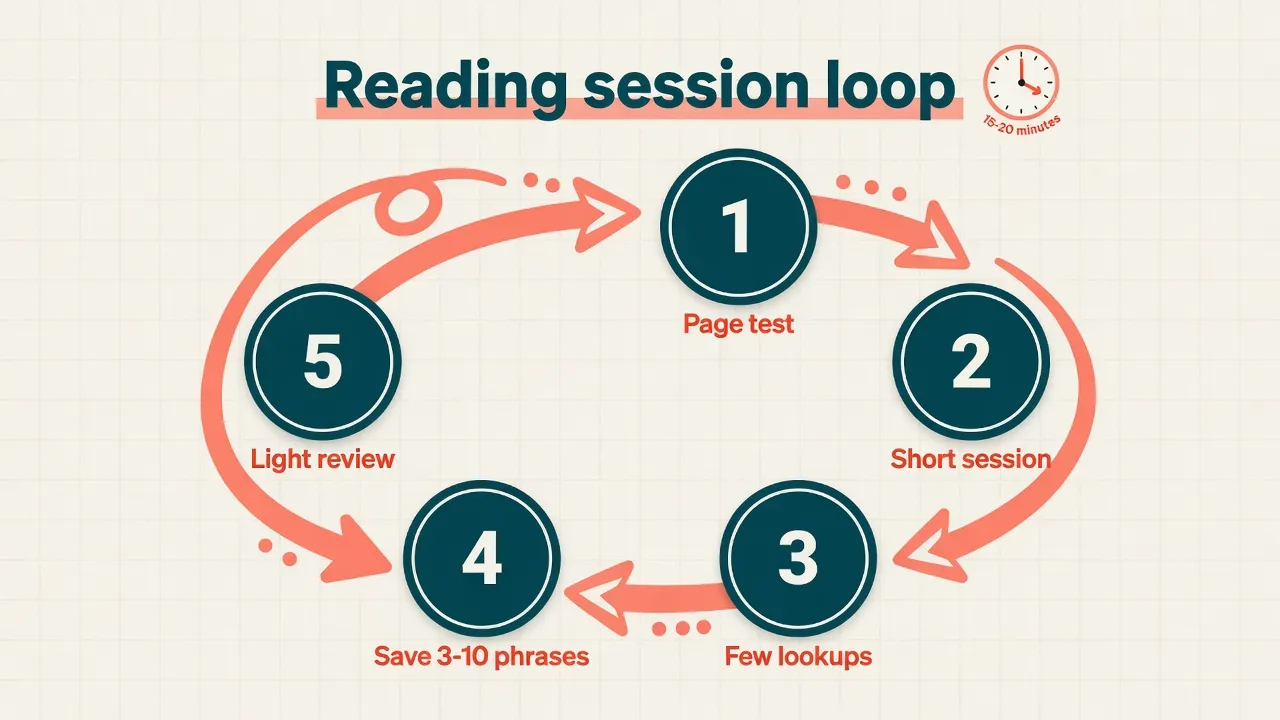
Practical session loop (15-20 minutes beats a Sunday shame marathon):
- Read a paragraph once without stops.
- Mark only words that block the whole sentence.
- Check those blockers.
- Reread the paragraph.
- Save 3-10 useful phrases per session (not 40 isolated words).
Short daily sessions
Fifteen to twenty minutes a day beats a two-hour guilt binge once a week. Stopping mid-chapter is fine. Quitting from exhaustion is worse.
Mix graded text and one real book
A stable week sketch:
- 4 days: free graded texts in the library
- 2 days: your chosen real book (EPUB or paper you own or borrow)
- 1 day: review saved phrases
Warm-up without buying anything:
When vocabulary is the bottleneck, the language map, A2 vocabulary map, and B1 vocabulary map help you see what to build next. For active practice after saving phrases, use the full trainers.
Related reading if you want depth later: build B1 vocabulary by reading, how many words per CEFR level, and vocabulary for reading comprehension.
Audio only when it helps
If a text has audio, turn it on after the page is mostly clear. Audio on an opaque page often adds noise, not magic.
Paths A / B: if you do not know where to start
Pick a path and stay on it until pages feel green. Use the 80-90% page test at every step.
Path A (safer)
- Free A1-A2 articles in MovaReader (all articles)
- Fantastic Mr Fox
- Diary of a Wimpy Kid
- Charlotte's Web or The Old Man and the Sea
- Holes or Wonder
- Later: Animal Farm / The Giver
Path B (if you already know plots in another language)
- Free A2 articles
- Charlotte's Web
- Wonder
- Holes
- One stretch (Animal Farm or The Curious Incident...) only when steps 2-4 read without a constant dictionary
If words keep blocking you, check the A2 vocabulary map or B1 vocabulary map before you jump two rungs.
How to use MovaReader
MovaReader helps you read with support, then turn blockers into practice. Free graded English texts warm you up. Long commercial novels from this list (Wonder, The Giver, and the rest) stay your legal EPUB or paper copy - the app does not host full commercial bestsellers by default.
A simple loop:
- Warm up on free graded texts in All Articles.
- Upload a book file you legally have (for example EPUB) when ready for a longer title - see how to use.
- Tap only blockers, not every unknown adjective.
- Train a small phrase set with the word training demo, phrase training demo, or full trainers.
- Know the free plan limits: listening is free; about 20 word translations per day on the free plan; unlimited reading translations are Reader (€1/month); full trainers are Pro (€5/month) - details on pricing.
Start today: English A2 sample → optional lighter sample → register when you want a full account → your own legal EPUB via how to use.
FAQ: easy English books for A2-B1
What is the easiest English book for beginners here?
For many A2 readers, the easiest finishes are Fantastic Mr Fox or Diary of a Wimpy Kid. Charlotte's Web is often comfortable too, but denser emotionally than the first two. If even Fox feels red, warm up on free graded A1-A2 samples first (free library).
Graded readers or "real" books?
Both. Graded texts build speed and confidence most days. Real books add motivation and natural style. A stable mix: graded on most days + one real book in short sessions (15-20 minutes). Do not force a 400-page novel to prove you are "serious."
How many pages per day?
Start with 2-5 pages or about 15 minutes. Consistency beats volume. Raise the page count only when you look up less and still retell the scene. Stopping mid-chapter is fine; quitting from exhaustion is worse.
What if a sentence is unclear?
Do not translate every word. Guess from context first. Look up only the phrase that blocks the whole meaning. Save useful chunks (3-10 per session), not every unknown adjective. If the page needs constant help, drop one difficulty rung.
Should A2 try Hemingway?
Yes if you mean The Old Man and the Sea and you are ready for sea vocabulary (skiff, harpoon, gaff) and a slow pace. No if you need a quick fun win with humor and dialogue - then Dahl or Wimpy Kid is more reliable. "Simple style" is not always easy for modern ears.
Can I read Harry Potter at B1?
Some motivated B1 readers manage early volumes with support. Most people finish more books if they bank shorter wins first (Part 1 list). Late HP volumes and long series are high motivation and high lookup load - better as a goal book than as proof that "easy A2-B1" works.
Next steps
The best "easy" English book is the one you finish this month - not the one that looks impressive on a shelf.
Choose by comprehension. Protect the daily habit. Tools reduce friction; they do not fake beginner status for a 500-page novel.
Today:
- Open the free English A2 sample and run the 80-90% page test.
- Pick one realistic title from Part 1 (Path A or B).
- Keep sessions to 15-20 minutes and look up blockers only.
- When you need more vocabulary context, use the language map and pricing only if translation limits or trainers are the real wall.
Finish one short book. Then climb the next rung.
Learning English?
The English version of MovaReader teaches Spanish and Ukrainian. To read English with a translation for every word, open the reader in Ukrainian or Spanish:
Книги англійськоюЦя стаття українськоюLibros en inglésEste artículo en español