Curated Resources
Best English Books for B1: 10 Real Novels to Start With
Finished graded readers? Here are ten original English novels to try next, with practical difficulty bands and a clear way to choose your first one.
Best English books for B1: the quick answer
You finish a graded reader, open a normal novel, and suddenly the page looks crowded. The sentences are longer, the jokes are less obvious, and one unknown word seems to invite five more.
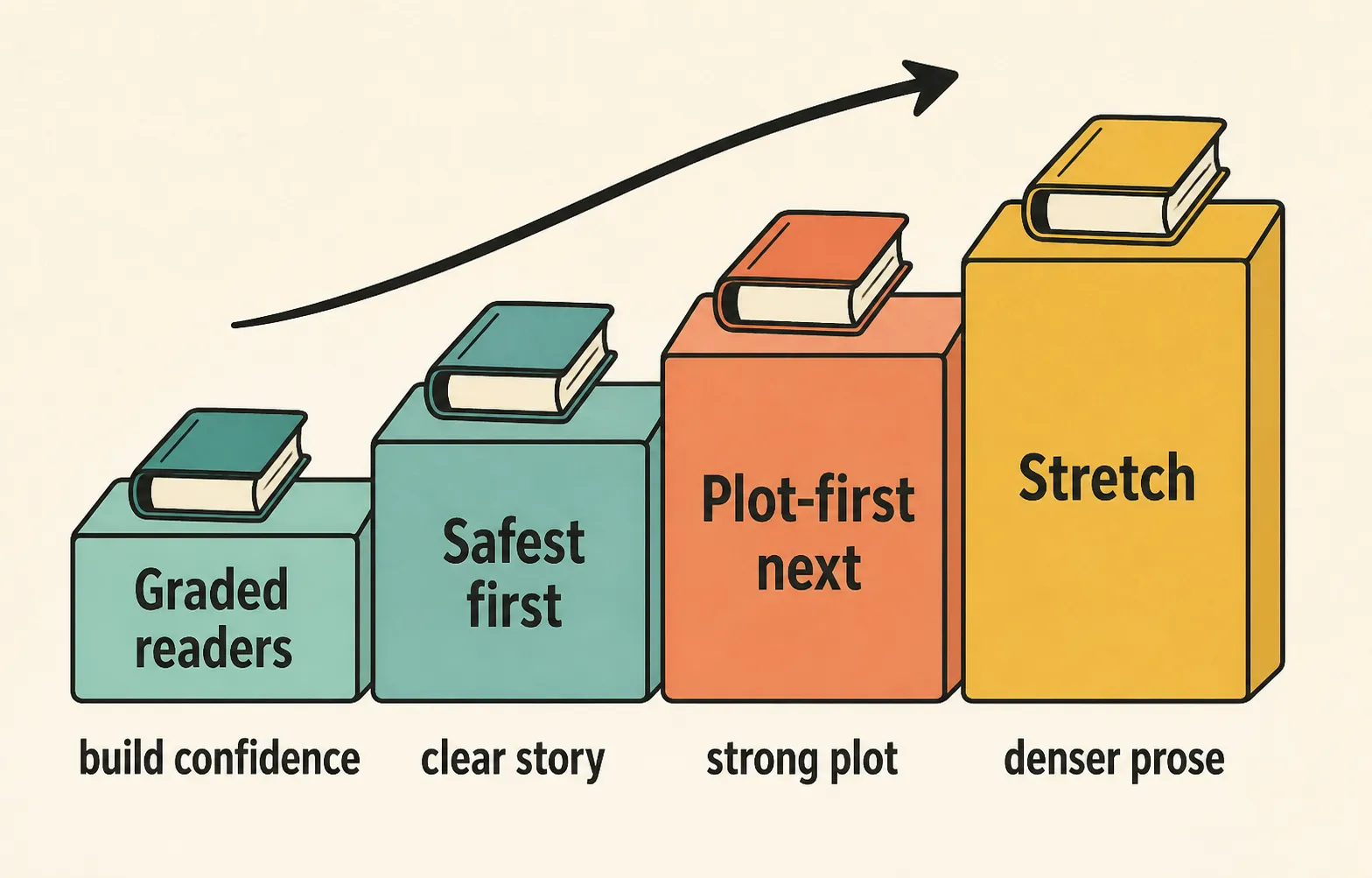
The good news is that you do not need to jump straight into the hardest book on your shelf. For most B1 learners, Matilda, Charlotte's Web, and Charlie and the Chocolate Factory are the safest first choices. Choose Holes or The Giver when you want stronger plot momentum or a bigger central idea. Keep The Curious Incident of the Dog in the Night-Time and The Call of the Wild for a stretch.
These are practical reading bands, not official CEFR certifications. Your first language, the edition, and your reading experience all matter. Start with the clearest story you would genuinely finish, not the title that looks most impressive.
Every title below is original English-language fiction. Some are novels and some are novellas, but none is a graded-reader adaptation.
| If you want... | Start with... | Main friction to expect |
|---|---|---|
| The safest first attempt | Matilda | Playful exaggeration and school vocabulary |
| A gentle classic | Charlotte's Web | Farm words and descriptive passages |
| Short chapters and vivid scenes | Charlie and the Chocolate Factory | Wordplay and invented words |
| A plot that pulls you forward | Holes | Slang, time shifts, and viewpoint changes |
| A very short classic | The Old Man and the Sea | Metaphor and compressed prose |
Are you ready for your first real English novel?
You are probably ready to test one when you can follow the main idea of a graded reader without translating every sentence. Unknown words may slow you down, but they do not erase the scene. You can also retell a short chapter in simple words and keep reading after missing a phrase.
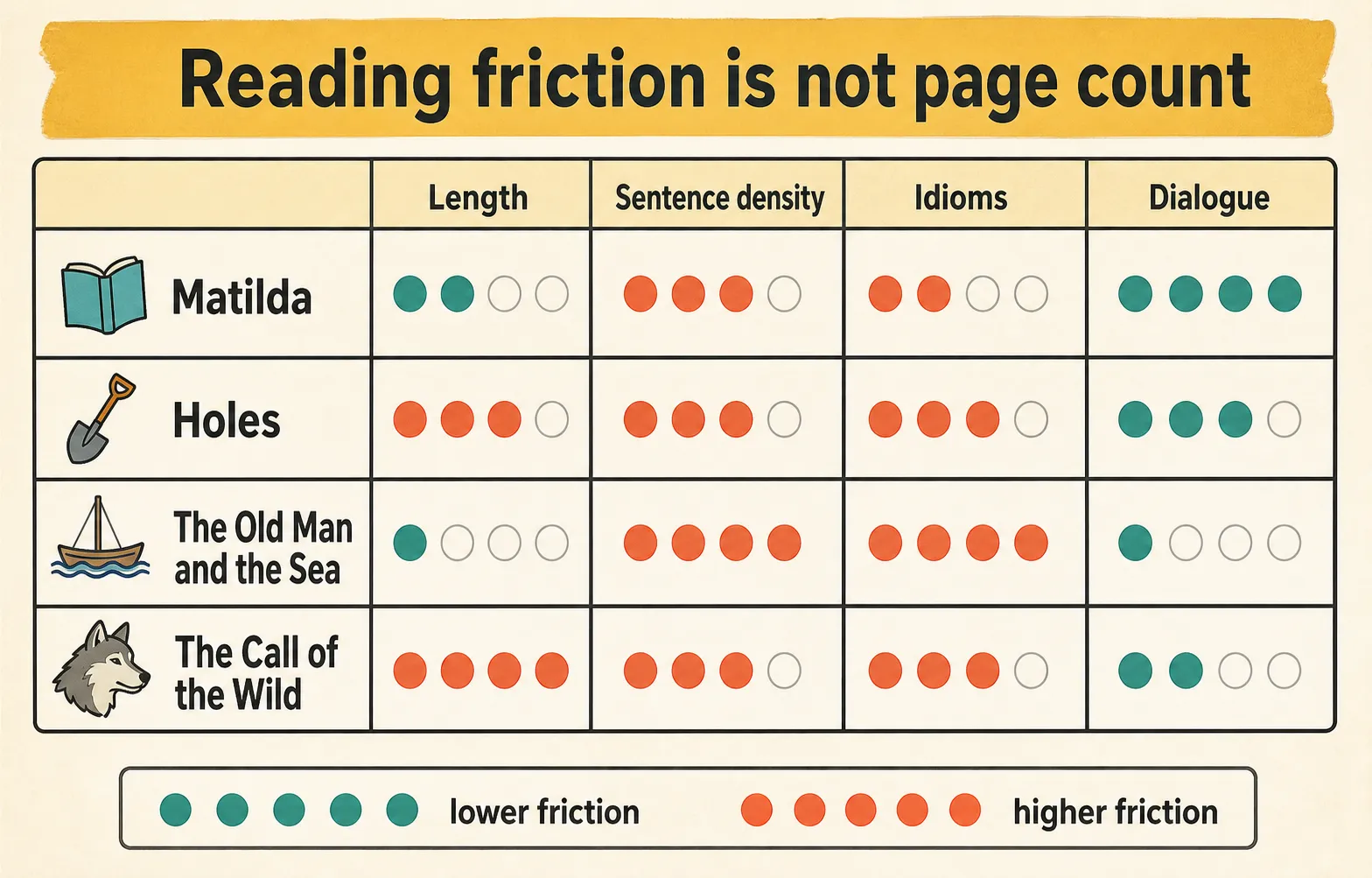
That does not mean the first novel will feel comfortable. Real fiction brings sentence density, idioms, cultural references, dialogue, and changes in viewpoint. A short classic may be harder than a longer modern children's novel because each sentence carries more meaning.
Use this stop rule: if every line needs a dictionary, step down for now. You are decoding the book rather than reading it for meaning. Try a shorter or clearer title, add audio, or return to graded readers for a short cycle. That is a useful adjustment, not a failure.
The ten-title ladder at a glance
The table is a map, not a universal ranking. Interest affects finishability. A reader who loves adventure may find an older book more welcoming than a quiet modern novel. Pick the row whose friction looks manageable and whose story you actually want to enter.
| Title | Practical band | Finishability | Main friction | Best fit |
|---|---|---|---|---|
| Matilda by Roald Dahl | Safest first | Medium and steady | Exaggeration, school vocabulary, cultural references | Clear story and strong momentum |
| Charlotte's Web by E. B. White | Safest first, gentle classic | Medium and steady | Farm and animal words, older expressions | Warm, emotionally clear reading |
| Charlie and the Chocolate Factory by Roald Dahl | Safest first, short | Short and vivid | Wordplay, invented words, descriptions | Quick scenes and playful language |
| Holes by Louis Sachar | Next step, plot-first | Medium and highly finishable | Slang, multiple timelines, viewpoint shifts | Mystery and chapter-level momentum |
| The Giver by Lois Lowry | Next step, idea-first | Short to medium | Abstract vocabulary and implied meaning | Questions and concepts more than action |
| Animal Farm by George Orwell | Next step, short classic | Short and direct | Political vocabulary, allegory, older prose | A compact story with ideas to discuss |
| Of Mice and Men by John Steinbeck | Next step, dialogue-led | Short and compact | Dialect, period language, heavy scenes | Dialogue and a focused storyline |
| The Old Man and the Sea by Ernest Hemingway | Short but literary | Short, with slow reflection | Compressed prose, metaphor, sea vocabulary | A short classic and rereading |
| The Curious Incident of the Dog in the Night-Time by Mark Haddon | Stretch, modern voice | Medium and unusual | Distinctive viewpoint, lists, literal meaning | Mystery and an unconventional narrator |
| The Call of the Wild by Jack London | Stretch, classic adventure | Medium and sustained | Older vocabulary, nature terms, literary voice | Action, animals, and setting |
Ten real novels to try after graded readers
1. Matilda
Practical band: Safest first. Finishability: Medium and steady.
This is a strong first choice because the writing gives you a clear direction from scene to scene. The narrative voice is lively, and memorable moments create enough momentum to carry you through a difficult paragraph. You do not need to understand every joke to know what is happening.
The friction comes from playful exaggeration, school vocabulary, and cultural references. Some descriptions are intentionally over the top, so do not treat every unusual phrase as a serious fact to decode. Choose it if you want a modern-feeling children's novel with a clear progression.
2. Charlotte's Web
Practical band: Safest first, gentle classic. Finishability: Medium and steady.
The narration is mostly accessible, and the emotional direction of each scene is easy to follow. It is a good match for a reader who likes a warm, calm book and does not need constant action to keep going.
Watch for farm and animal vocabulary, descriptive passages, and expressions that feel older than everyday English. The language may be gentle without being completely current. Choose it when you enjoy noticing small details and reading at an unhurried pace.
3. Charlie and the Chocolate Factory
Practical band: Safest first, short. Finishability: Short and vivid.
Short chapters and fast scenes make this one inviting when your main problem is losing momentum. The language is imaginative, but the page usually gives you a strong visual sense of what is happening.
The main friction is wordplay, invented words, and exaggerated descriptions. You can often understand the scene even when one made-up expression is unfamiliar. Pick it if you want a short English book with a playful voice and plenty of reasons to turn the page.
4. Holes
Practical band: Next step, plot-first. Finishability: Medium and highly finishable.
Choose this when a strong question helps you read more than vocabulary confidence does. Short chapters and a clear mystery give each session a useful stopping point. The structure also rewards you for remembering small details.
Slang, multiple timelines, and viewpoint shifts create more friction than the short chapters suggest. If you lose track of when a scene is happening, pause and write one plain sentence about it. This is a good next step for a reader who wants plot to do some of the motivational work.
5. The Giver
Practical band: Next step, idea-first. Finishability: Short to medium.
The prose is controlled, and the central questions keep the reader moving. It suits learners who enjoy thinking about an idea while they read, rather than needing an action-heavy scene on every page.
The difficult part is often abstract vocabulary and meaning that must be inferred. A sentence may be grammatically clear but still require you to think about what it suggests. Choose it if you are comfortable rereading a paragraph and asking what a character understands, not only what they say.
6. Animal Farm
Practical band: Next step, short classic. Finishability: Short and direct.
The direct sentence style and compact length can make this a tempting first classic. It is also useful for a reader who likes having a clear subject to discuss after reading.
Do not confuse short with simple. Political vocabulary, allegory, and older prose add a layer of work. If the ideas interest you, the effort may feel worthwhile. If the language feels dense, choose a more modern title before trying to force your way through it.
7. Of Mice and Men
Practical band: Next step, dialogue-led. Finishability: Short and compact.
Dialogue can make this book feel immediate, especially if you like understanding people through what they say. The focused structure also reduces the amount of narrative description you need to hold in your head at once.
The friction is serious: dialect, period language, and emotionally heavy scenes. Some speech may not look like the English you have studied, and not every phrase should be copied into everyday conversation. Choose it for focused reading and dialogue, with the understanding that the subject matter may require breaks.
8. The Old Man and the Sea
Practical band: Short but literary. Finishability: Short, with slow reflection.
The length is appealing, and repeated language can give you a sense of return as you read. A focused setting also means fewer new places and characters to track.
Still, this is not automatically an easy English book. Compressed prose, metaphor, and sea vocabulary can make a short sentence feel full. Choose it if you are happy to reread and notice how a few words can carry several ideas.
9. The Curious Incident of the Dog in the Night-Time
Practical band: Stretch, modern voice. Finishability: Medium and unusual.
The distinctive narrator and strong question create forward pull for a confident B1 reader. The format can also make the page feel different from a conventional novel, which may help if ordinary narrative is starting to feel repetitive.
The challenge is the viewpoint. Lists or diagrams appear in some editions, and the text can move between literal and implied meaning. Choose it when you like mystery and are ready to ask not only what a sentence says, but how the narrator understands it.
10. The Call of the Wild
Practical band: Stretch, classic adventure. Finishability: Medium and sustained.
Action and a strong setting can make this a satisfying stretch for a reader who enjoys adventure. You have a clear reason to keep reading, even when a paragraph takes more effort.
The main friction is older vocabulary, nature terms, and a literary narrative voice. The book may be easier for an adventure reader than a short literary classic, so use your interest as part of the decision. Expect a longer sustained effort than the shortest choices on this list.
Which B1 novel should you start with?
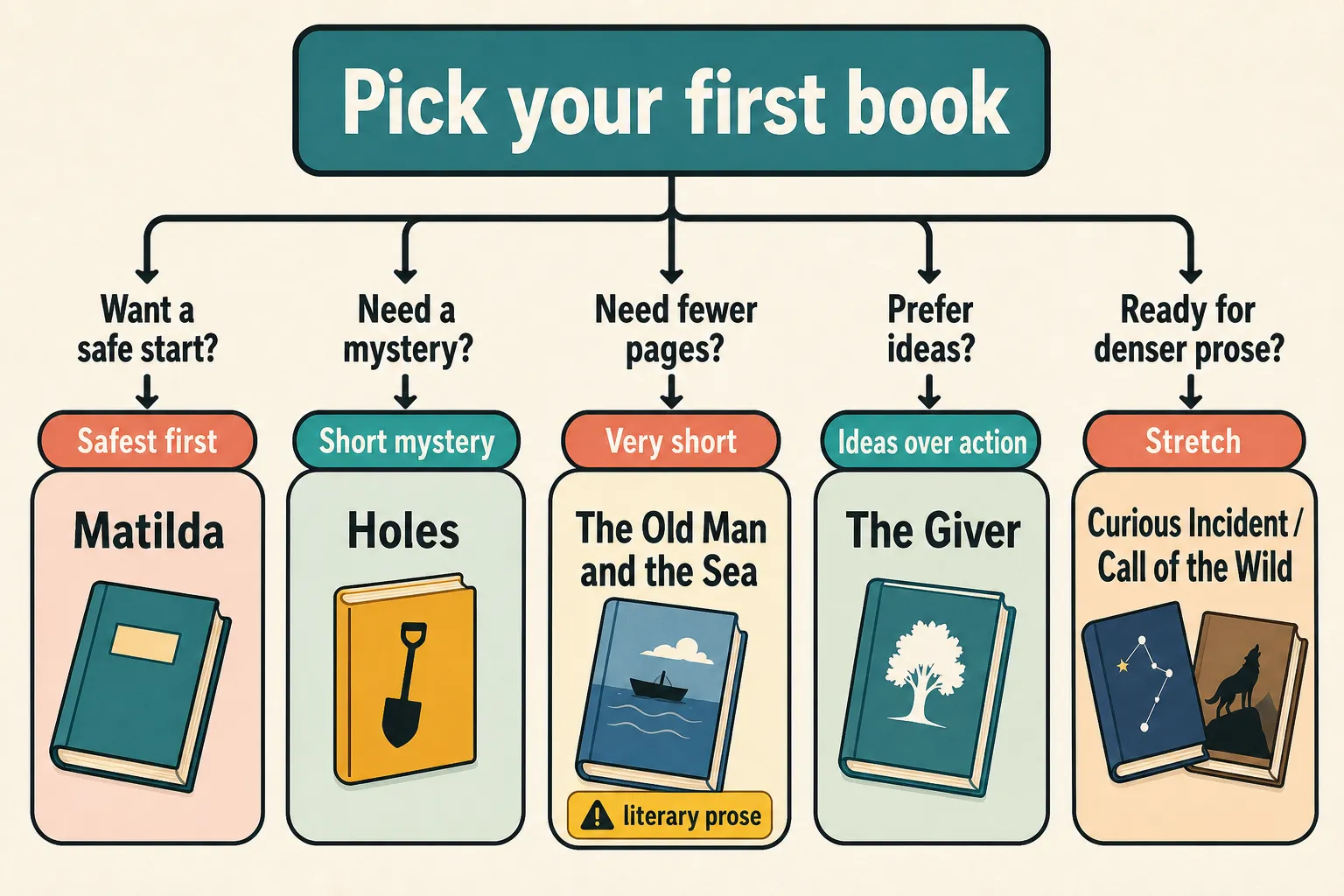
Use this simple guide:
- For the safest first attempt, start with Matilda.
- For short chapters and a mystery, try Holes.
- For vivid scenes and playful language, choose Charlie and the Chocolate Factory.
- For a gentle classic, choose Charlotte's Web.
- For ideas and questions, try The Giver.
- For a short classic, consider The Old Man and the Sea, Animal Farm, or Of Mice and Men, but keep their prose warnings visible.
- For a stretch, choose The Curious Incident of the Dog in the Night-Time for a modern voice, or The Call of the Wild for older adventure prose.
The useful rule is simple: choose the best mix of interest, clear plot, and tolerable friction. Do not choose by page count alone. A short book that makes you stop every few lines can take more energy than a longer book with a story you cannot wait to follow.
How to read a real novel at B1 without translating every line
Read for the scene first. Take a paragraph or a page and ask what changed, who is speaking, or what a character wants. Looking up words before you have a rough picture of the scene often turns reading into a vocabulary test.
Look up blocking words. A blocking word hides the action, the relationship, or the main idea. Find that word. Let a non-blocking word wait if the scene still makes sense.
Save useful language in context. Keep a small set of recurring words or phrases with the sentence that made them memorable. A word tied to a scene is easier to revisit than an isolated list item.
Add audio when the prose feels dense. Audio can support pace, pronunciation, and persistence. It does not turn a difficult book into an easy one, so keep the stop rule available.
If the book stays exhausting after several sessions, pause it and read an easier text. Return when the gap feels smaller. The goal is not to prove that you can suffer through one title. The goal is to build enough reading stamina to enjoy the next one.
Use a level map to choose what to read next
A real novel is one kind of reading practice. If you want a shorter bridge between graded readers and a full book, MovaReader lets you read level-matched English texts and check unfamiliar words in context. You can practise the same reading habits at a manageable pace before returning to your novel.
The level map is a reading guide. It cannot predict exactly how every book will feel. Use it to choose the next useful text, then let your own reading sessions decide when to move up.
Choose one title, read a sample chapter, and apply the stop rule after your first session. If the story is clear enough to keep moving, continue. If every line becomes a translation task, step down briefly and come back with more support.
FAQ
What is the best first real novel for a B1 English learner?
For most readers, Matilda is the safest first try because the story is clear and keeps moving. Charlotte's Web is a gentler classic, while Holes is a strong choice when plot momentum matters most. None of these titles is officially CEFR-certified as B1.
Should I read graded readers before real novels?
Usually, yes. Graded readers build stamina and help you follow a story without stopping for every word. You do not need to wait for a perfect level, though. Try a real novel when you can follow the main idea and let some unknown words pass.
Can I read a novel at B1 without knowing every word?
Yes. You need enough understanding to follow the scene, not complete knowledge of every word. Look up words that hide the action, relationship, or main idea, and leave the rest until context gives you more information.
Which short book should I start with?
Choose Charlie and the Chocolate Factory for fast scenes and playful language. Choose The Old Man and the Sea for a short classic if you can handle metaphor and compressed prose. Animal Farm and Of Mice and Men are also short, but political vocabulary, dialect, and older language can make them feel harder than their length suggests.
What is the difference between a B1 and B2 book?
The difference is usually a mix of sentence density, idioms, cultural references, inference, and sustained length. It is not a fixed property of a title. A short classic can be harder than a longer modern children's novel, so use the friction notes and your own reading experience rather than a label alone.
Learning English?
The English version of MovaReader teaches Spanish and Ukrainian. To read English with a translation for every word, open the reader in Ukrainian or Spanish:
Книги англійськоюЦя стаття українськоюLibros en inglésEste artículo en español