Curated Resources
Easy English Books for Ukrainian Speakers (A2-B1) You Can Actually Finish
A practical A2-B1 book list for Ukrainian speakers learning English: what known plots and loanwords actually help, where articles and false friends tax you, ten titles you can finish, and a too-early list (Harry Potter Book 1 included).

You open another "легкі книги англійською" list. The Very Hungry Caterpillar sits next to The Hobbit. Harry Potter Book 1 is marked A2 because you already know the plot from Ukrainian. You try a page, live in the dictionary, and quit by chapter two.
That is not a talent problem. It is a finish problem.
If Ukrainian is your first language and English is around A2-B1, skip shop lists that call Harry Potter or The Hobbit easy. You need books you can finish this month.
Ukrainian already gives you plots from UA translations, a thin loanword layer, and a school habit of naming tenses. It does not give you articles, phrasal verbs, safe lookalikes, or easy long Latin pages after a Cyrillic day. Stay when you understand about 80-90% of a random page. Warm up on free graded samples. Long commercial novels are copies you own or borrow. MovaReader does not host them by default.
Here is the map: quick CEFR table · UA help vs tax · Part 1 ten books · Part 2 too early · method · paths A/B · how to use MovaReader.
Want a ladder with no first-language angle? There is a general A2-B1 English book list. This one stays with Ukrainian.
Where should a Ukrainian speaker start?
Match your current band, not a shop "легкі" label. If a random page is under about 70% clear, drop one rung. The first Latin-script novel often feels harder than the CEFR sticker, even when the words are fair. That is stamina, not proof you picked the wrong language.
Here is the ladder for Ukrainian speakers:
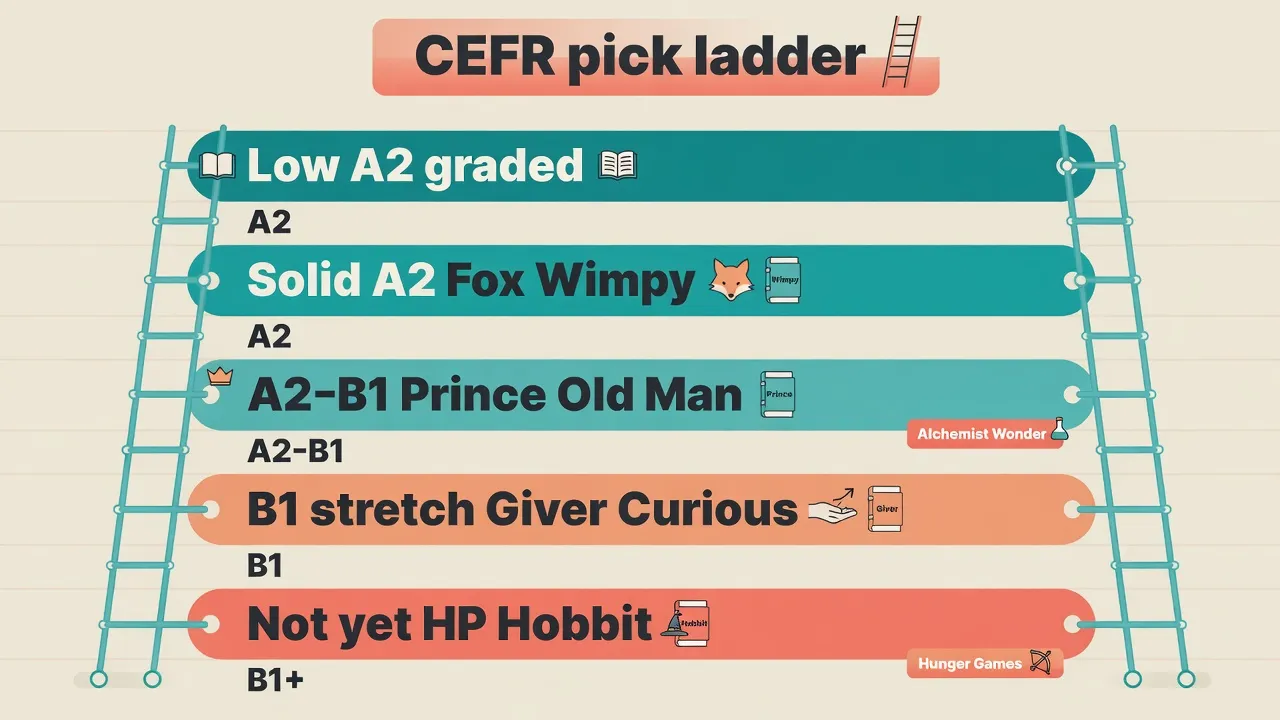
| Your level now | Start with | Why it works for Ukrainian speakers |
|---|---|---|
| Low A2 | Free graded English A2 text, then a short Dahl | Controlled pages; Latin-script stamina first |
| Solid A2 | Wimpy Kid, Fantastic Mr Fox, Charlotte's Web | Short chunks; familiar story shapes; film / UA kids editions often known |
| A2-B1 | The Little Prince, Old Man and the Sea, The Alchemist (EN), Wonder | Plot already known as Маленький принц / Алхімік / Старий і море; short or chaptered |
| Strong B1 (stretch ready) | The Giver, Curious Incident | Readable, but denser ideas / specialist words |
| Not yet | HP Book 1 as a daily book, The Hobbit, Hunger Games / Percy / Midnight Library, Victorian originals | Great later; wrong first finish |
The rule that actually works: open a random page. If you understand about 80-90% without help, stay. Under about 70%, treat it as stretch, not daily habit.
Try a free English A2 sample first. If that page feels comfortable, the list below is for you. More free texts live in All Articles.
What helps Ukrainian speakers, and what is the tax?
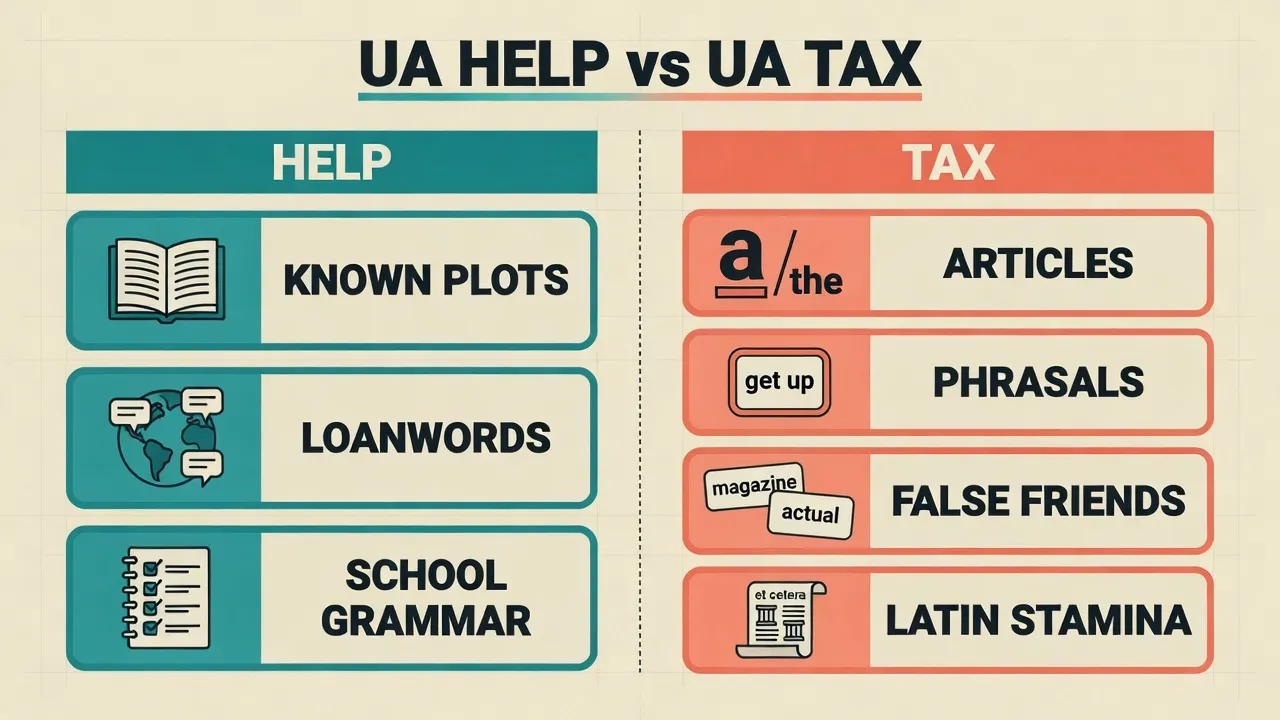
Think of it as UA help vs UA tax. Help is known plots, a thin loanword layer, and a school habit of naming tenses. Tax is articles, phrasal verbs, lookalike words, and lasting twenty pages of Latin type after a Cyrillic day. Spend the help. Budget for the tax.
Real help (use it)
You already know more stories than a typical A2 list admits. Маленький принц, Алхімік, Гаррі Поттер, Старий і море, Павутиння Шарлотти sit on a lot of Ukrainian shelves. Plot memory is a scaffold, not a substitute for English.
You also get a thin loanword layer: hotel, taxi, internet, film, sport, music, computer. Useful. Not a free novel.
Many Ukrainian readers can name tenses. That helps you notice forms on the page. It does not install a / an / the or give up.
Real tax (expect it)
Ukrainian has no articles. a / an / the will keep blinking even when the story is clear. Do not stop the book for every the. Notice them on a reread. The full drill lives in common mistakes Ukrainians make in English, not in a lookup storm.
Phrasal verbs are the other daily tax. Get up, look after, run into, figure out, give up. School lists rarely survive a diary novel.
English also wants subject-verb-object more strictly than Ukrainian. You can feel that as "the sentence is in the wrong order" even when every word looks familiar.
Then come the lookalikes. They feel safe because they echo Ukrainian. They are not free vocabulary.
| English | Ukrainian lookalike | True sense (plain) |
|---|---|---|
| magazine | журнал / магазин | a periodical (sometimes an ammo clip); not a shop |
| accurate | акуратний | precise / correct; not "neat" or "tidy" |
| actual | актуальний | real / existing; not "current" or "topical" |
| sympathetic | симпатичний | showing sympathy; not "nice-looking" or "likeable" |
| fabric | фабрика | cloth / material; not a factory |
One more tax: decoding English words is not the same as lasting twenty pages of Latin type after a Cyrillic workday. Prefer short chapters or diary chunks first. That is stamina, not a diagnosis.
Ukrainian gives you a head start on plot and study habits, not a free pass on any English novel.
When is an English book actually easy?
At A2-B1, easy usually means short chapters or diary chunks, dialogue or simple past, concrete scenes, repeated words, and pages your Latin-script stamina can finish today. A story you already finished in Ukrainian is a bonus, not a requirement.
Easy usually does not mean multi-volume fantasy, dense adult literary prose, or a shop sticker that says "A2-B1" on The Midnight Library or The Hunger Games. That is why this post splits finishable books from later goals, instead of dumping HP, The Hobbit, and Percy into one "легкі" bucket.
Part 1: Ten books you can realistically finish
Ten rungs for Ukrainian speakers. Graded warm-up is #1, not a hidden pre-list. For each book: realistic level, why it helps you, what to watch, and a start tip.
1. Free graded English texts (warm-up before any novel)
Realistic level: A1-A2
Why for Ukrainian speakers: This is the Latin-page gym. Controlled words, short pages, no plot shame if you stop. You build confidence before a commercial novel.
Watch-out: Can feel school-like. Use as warm-up, not forever.
Start tip: Browse All Articles. Stay until a random page is about 80-90% clear.
2. Fantastic Mr Fox - Roald Dahl
Realistic level: A2
Why for Ukrainian speakers: A short funny win this month. Many already know the film or a kids UA edition. Dialogue pulls you forward.
Watch-out: Invented sounds and British farm words. Skip farmer-name jokes that block the plot.
Start tip: Make this your first whole-book finish. If you know who is against whom, keep going.
3. Charlotte's Web - E.B. White
Realistic level: A2
Why for Ukrainian speakers: Clear prose, calm story pull. The Павутиння Шарлотти plot is often already known, so English can carry friendship instead of surprise.
Watch-out: Rural and animal words (trough, manure).
Start tip: Guess farm nouns from context. Keep the friendship thread. Look up only sentence blockers.
4. Diary of a Wimpy Kid - Jeff Kinney
Realistic level: A2-B1
Why for Ukrainian speakers: Diary chunks save Latin-page stamina. You get informal US school English in bites you can finish on a commute.
Watch-out: US school slang. Cartoons can look easier than the idioms under them.
Start tip: One sitting = one diary chunk. This teaches conversational patterns, not literary English, and that is fine.
5. The Little Prince - Antoine de Saint-Exupéry
Realistic level: A2-B1
Why for Ukrainian speakers: Маленький принц is almost always known. The English is short and chaptered. That is not the same as simple.
Watch-out: Philosophical voice, a bit French-in-translation, abstract lines ("matters of consequence"). UA shops call it A2 because everyone knows the plot.
Start tip: Use the known plot; do not vocab-list every aphorism. Under about 70% on a random page, drop to Fox or Wimpy first.
6. The Old Man and the Sea - Ernest Hemingway
Realistic level: A2-B1
Why for Ukrainian speakers: Short book, simple frames, plot over adjectives. Старий і море often sits in school memory, so the fight with the fish is already a picture.
Watch-out: Skiff, harpoon, and sea repetition that still is not "easy modern."
Start tip: Make a tiny sea-word list, then ride the current. Do not restart after every boat noun.
7. The Alchemist - Paulo Coelho (English edition)
Realistic level: A2-B1
Why for Ukrainian speakers: Short chapters, repeated ideas, a clear quest. Knowing Алхімік first is a fair advantage if sessions stay English-first.
Watch-out: Desert / omen / Personal Legend lexicon, plus a spiritual tone some readers find thin. Language practice still works.
Start tip: English on the page; Ukrainian backup only for a blocked chapter. We do not host the commercial novel in the app. Bring a copy you own or borrow.
8. Wonder - R.J. Palacio
Realistic level: A2-B1
Why for Ukrainian speakers: Modern first-person voice, school and friendship vocab, stronger pull than a long adult literary novel at this band.
Watch-out: Length. School social vocab. Themes heavier than the grammar.
Start tip: Let the first-person voice be the friend. Do not restart after every medical word.
9. The Giver - Lois Lowry
Realistic level: high B1 stretch
Why for Ukrainian speakers: Clear YA prose plus a mystery that pulls after one easier finish. Readable sentences, denser ideas.
Watch-out: Abstract community and memory terms.
Start tip: Follow the mystery first; glossary later. Only after you finish one easier book above.
10. The Curious Incident of the Dog in the Night-Time - Mark Haddon
Realistic level: B1 stretch (not A2)
Why for Ukrainian speakers: Short clauses and a detective frame help when long Latin sentences tire you.
Watch-out: Maths digressions, British everyday culture, specialist and autism-related words.
Start tip: Skip a diagram page if the plot is still clear. Do not force every number puzzle.
Later, not a Part 1 swap: Animal Farm if you know Колгосп тварин / Ферма тварин. Short, but allegory plus dated political vocab is a B1 stretch. See the general A2-B1 list or first real novels after graded readers.
Is Harry Potter A2 for Ukrainian speakers?
Excellent books. Not the best first "easy A2-B1 finish" for most Ukrainian-speaking learners. Treat them as later goals, not as a test of whether reading in English works.
Harry Potter and the Philosopher's Stone / Sorcerer's Stone
Comfortable level: often solid B1-B2, even if you already read Гаррі Поттер і філософський камінь.
People recommend it because the Ukrainian edition, the films, and sheer love are huge. Motivation is real. So is the load: invented names, British school culture, longer chapters, descriptive pages, and Latin-page stamina over 200+ pages.
Rule: after two easier finishes plus a short sample chapter. Not the first English experiment.
The Hobbit
Comfortable level: often B2+ for comfortable reading.
Length, description, name lists, and songs stack up. Motivation does not erase the daily lookup load. Keep it as a goal book, not a "does reading in English work?" test.
The Hunger Games, Percy Jackson, The Midnight Library
UA shops sell these as A2-B1. That is optimistic.
Hunger Games and Percy have YA pace, which helps. Names, action verbs, and series lore still pile up. The Midnight Library is modern adult literary plus philosophy. Wrong first finish.
| Book | Realistic band | Why too early as first finish |
|---|---|---|
| Harry Potter (Book 1) | solid B1-B2 | Names, British school culture, 200+ descriptive pages |
| The Hobbit | B2+ | Length + description + name lists + songs |
| The Hunger Games / Percy Jackson | B1-B2 stretch | Action verbs, names, series lore |
| The Midnight Library | adult literary | Philosophy + modern prose; shop "A2-B1" is optimistic |
No shame in wanting them. Just do not start here to prove you can read English.
A reading method that does not burn Ukrainian speakers out
This post stays a book list. The full habit lives in how Ukrainians can start reading in English. The short version is enough to finish Part 1.
Pick for comprehension, not prestige
If a page needs constant translation, you are decoding, not reading. Drop one level.
Use Ukrainian strategically, then leave it alone
Helpful: compare a tough English sentence with the UA edition after you tried English first. Note only repeated false friends and article patterns.
Not helpful: a full Ukrainian reread called English practice. Translating every line in your head is the same trap.
Look up less, finish more
- Read a paragraph once without stopping.
- Mark only words that block the whole sentence.
- Check those blockers.
- Reread the paragraph.
- Save 3-10 useful phrases per session, not 40 isolated words.
For Ukrainian L1, prioritize articles in real noun phrases and phrasal chunks. Skip hotel and internet. You already own those.
Prefer short daily sessions
15-20 minutes daily beats a weekend guilt marathon. Diary and short-chapter books first. Stopping mid-chapter is fine. Latin-page stamina grows with repeats, not with one heroic Saturday.
Mix free graded text with one real book
A stable week looks like this:
- 4 days: free graded English texts
- 2 days: your chosen book (EPUB or paper you own or borrow)
- 1 day: review saved phrases
Start with All Articles. If "where am I?" is the question, open the language map or the A2 vocabulary map.
Audio only when it helps
Use audio after the written page is mostly clear. Loanwords help the eyes more than the ears. Audio on an opaque page is often just noise.
What should I read first?
If you feel lost, pick one path and stay until pages feel mostly green. Path A is safer and English-first. Path B uses a story you already finished in Ukrainian.
Two finish routes, same rule: stay where a random page is about 80-90% clear.
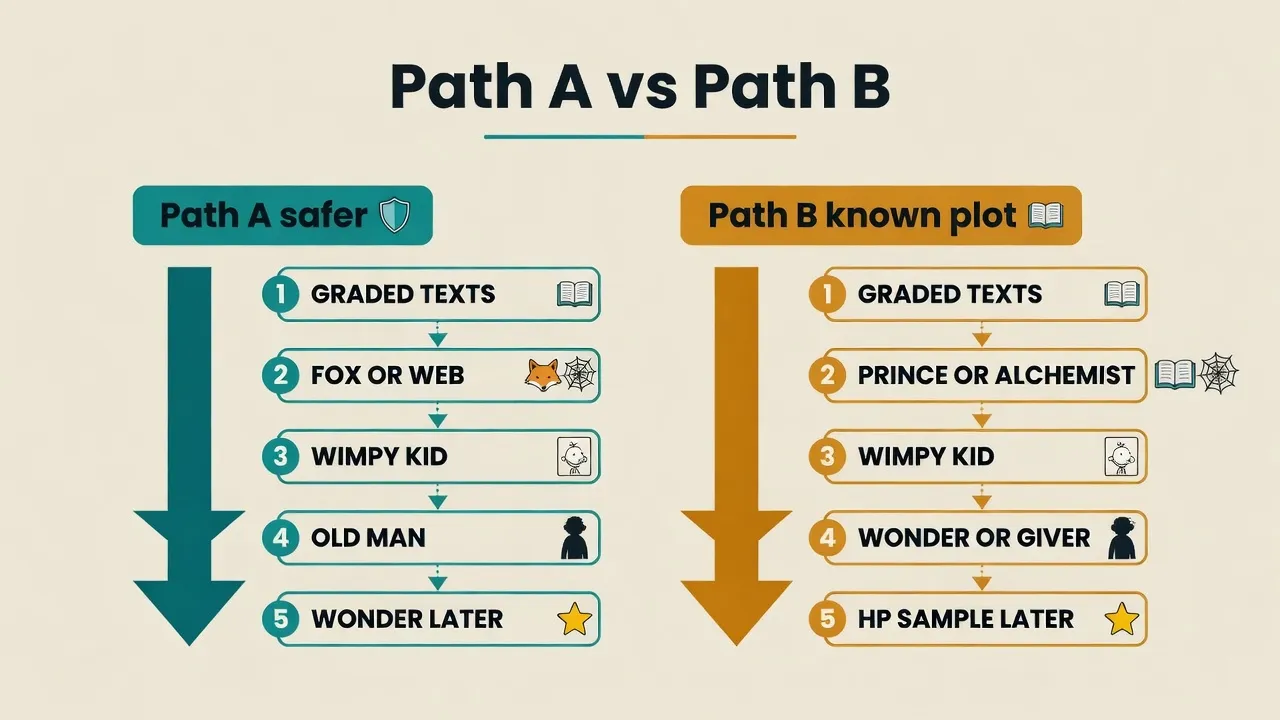
Path A (safer, low A2; English-first):
- Free A1-A2 English articles in All Articles
- Fantastic Mr Fox or Charlotte's Web
- Diary of a Wimpy Kid
- The Old Man and the Sea
- Wonder
- Later: The Giver or Curious Incident, then a sample chapter of a familiar series
Path B (story already finished in Ukrainian):
- Free A2 English articles anyway (still do this; Latin stamina)
- English edition of a story you finished in Ukrainian (Маленький принц or Алхімік - pick the one you actually remember)
- Diary of a Wimpy Kid for modern informal English
- One stretch YA (Wonder or The Giver) only after books 2-3 feel manageable
- Optional: a sample chapter of HP Book 1, not the whole novel as the first test
When denser B1 pages start to work, the B1 vocabulary map is a useful "where am I?" check.
How to use MovaReader
MovaReader helps you read English with support, then turn blockers into practice. Free graded texts warm you up. Long commercial novels from this list stay your legal EPUB or paper copy. We do not host Harry Potter, The Alchemist, or Wonder by default, and we do not send you to unauthorized copies.
- Warm up on free graded texts in All Articles.
- Upload a book file you legally have (for example EPUB) when you want a longer title. See How to use.
- Tap only blockers, not every almost-known loanword (hotel, internet).
- Train a small phrase set in the phrase typing demo, the word training demo, or full trainers.
- The free plan includes listening and about 20 word translations a day. Unlimited reading translations are Reader (€1/month). Full trainers are Pro (€5/month). Details: Pricing.
Tools reduce friction. They do not turn a hard book into beginner material, and Ukrainian does not rewrite CEFR bands.
Free path today: word demo → phrase demo → upload a legal book → one realistic Part 1 title. Register when you want a full account.
FAQ
What is the easiest English book for Ukrainian speakers?
Safest warm-up: free graded A2 texts. First whole-book wins: short Dahl (Fantastic Mr Fox), Charlotte's Web, or Diary of a Wimpy Kid. Маленький принц is known, not automatically easy English. If even those feel hard, stay on graded samples until a random page is about 80-90% clear.
Is Harry Potter A2 if I already read it in Ukrainian?
The plot helps. Comfortable original Book 1 is still often solid B1-B2: invented names, British school culture, longer chapters, Latin-page stamina over 200+ pages. After two easier finishes plus a sample chapter, not as the first experiment.
Should I read the Ukrainian translation first?
Optional for plot anxiety (Алхімік, Маленький принц). Keep sessions English-first. Ukrainian is backup for a blocked chapter only, not the main track. A full Ukrainian reread is not English practice.
How do I handle articles while I read?
Do not stop the story for every the. Notice a / an / the on a reread of a paragraph you already understood. Save a few real noun phrases, not a lookup storm. Deep drill belongs in common mistakes Ukrainians make in English, not in this book list.
How many pages should I read per day?
Start with 2-5 pages or about 15 minutes. Latin-page stamina grows; weekend marathons usually do not. Stopping mid-chapter is fine. Raise the count only when lookups drop and you can still retell the scene.
Graded readers or original books?
Graded first if a random novel page is under about 80%. Then one short original. Both, in a week, beats a purity fight: most days graded for speed; one real book in short sessions for motivation. Do not force a 400-page novel to prove you are serious.
What to do next
The best easy English book for a Ukrainian speaker is the one you finish this month.
Use known plots. Watch the tax. Protect the daily Latin-page habit. Tools cut friction; they do not pretend long fantasy is beginner material.
Today: pick one realistic Part 1 title. When this list feels small, move to first real novels after graded readers. Other first-language lists exist, including easy English books for Spanish speakers; that is a different L1 story, not your main path.
Learning English?
The English version of MovaReader teaches Spanish and Ukrainian. To read English with a translation for every word, open the reader in Ukrainian or Spanish: