Tips & Methods
Common English Mistakes Ukrainian Speakers Make
Your Ukrainian brain is not broken - it is transferring. Here are seven predictable English mistakes, wrong and right forms, and a calm way to retrain them through reading and short drills.
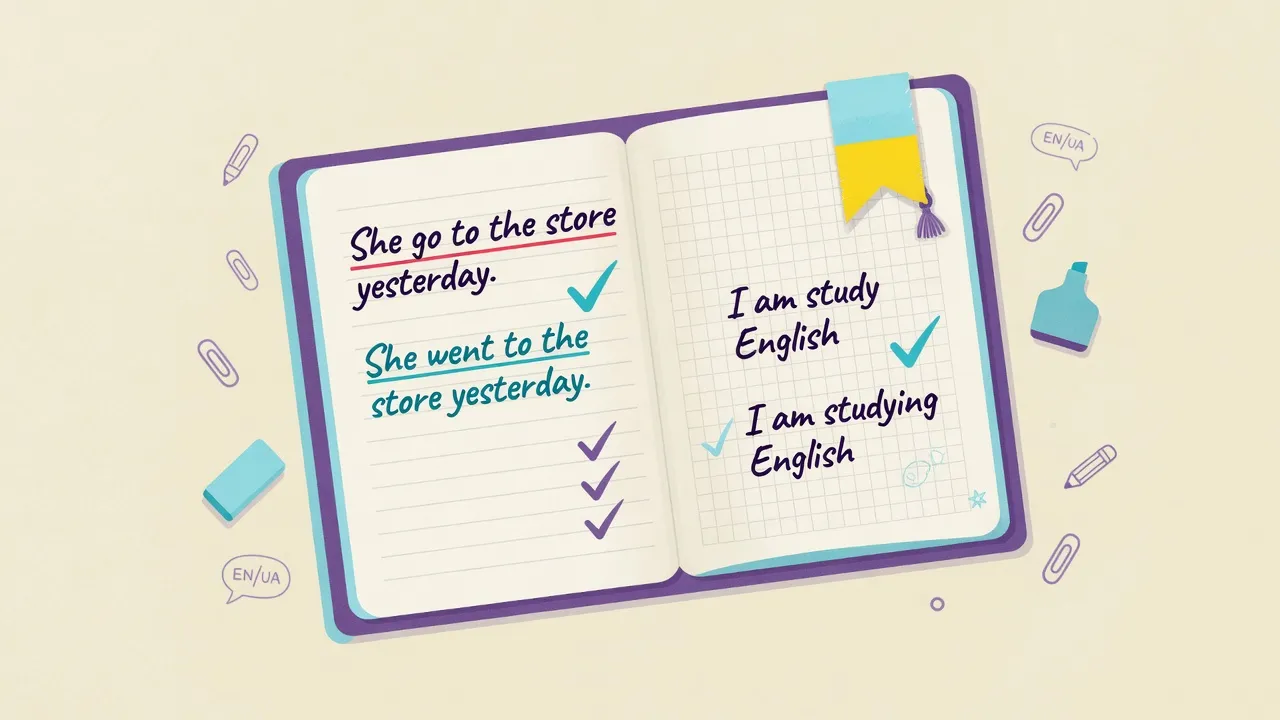
You write He doctor in a chat and freeze. You know is exists. Under pressure your brain reaches for Ukrainian: Він лікар - no link verb needed. The message feels wrong the second you send it.
That is not stupidity. That is language transfer. Ukrainian and English build sentences differently, so your first language hands you patterns English rejects. The same brain that drops to be will skip dummy it, freer word order, calqued prepositions, and false friends that look "almost Ukrainian."
Plain answer. Ukrainian speakers often carry Ukrainian patterns into English: missing to be, missing dummy it, weak or zero articles, free word order where English wants fixed SVO, in/on/at calques, false friends, and set phrases like I am agree or discuss about. These are predictable, not a character flaw. You retrain them by noticing the pattern, meeting correct models in real reading, and short phrase drills. No list erases transfer overnight - and no app makes you fluent in a week.
Below: seven mistakes with wrong/right forms, a soft retrain loop, a 15-minute practice plan, and a simple product path if you want graded text with click-translate.
Why your Ukrainian brain "helps" too much
Ukrainian lets you omit a present-tense link verb (Він лікар), start weather talk without a formal subject (Холодно), shuffle word order for emphasis, and skip articles entirely. English usually needs a verb, often needs a dummy subject, prefers a stable Subject-Verb-Object spine, and tags many noun phrases with a/an/the.
When you think in Ukrainian and write English, the shortcut feels efficient. Listeners may still understand you. Cleaner habits reduce friction, confidence cost, and that post-message shame spiral.
You do not need shame. You need a short map of the traps and enough correct input that the new habit wins under pressure.
Seven common English mistakes for Ukrainian speakers
Use this as a checklist, not a courtroom. Mark which two show up in your last week of chats or homework.
| # | Pattern | Quick fix feel |
|---|---|---|
| 1 | Missing to be | Every statement needs a verb |
| 2 | Missing dummy it | Weather and "hard to..." need It |
| 3 | Articles a/an/the | One of many vs shared vs general |
| 4 | False friends | Sound-alike ≠ same meaning |
| 5 | in / on / at | Learn chunks, not pure logic |
| 6 | Word order | Subject → verb → object first |
| 7 | Collocation calques | agree, discuss, do homework |
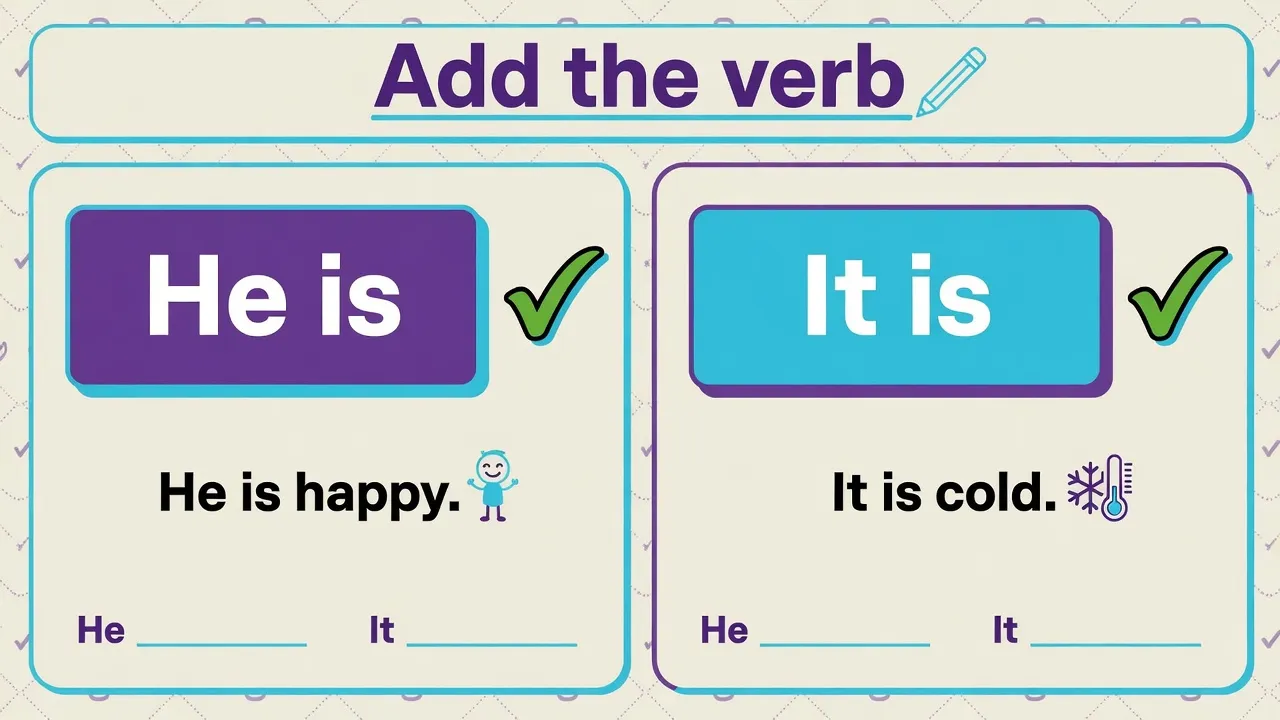
1. Missing to be (He doctor)
Ukrainian present-tense "X is Y" often has no spoken link verb. English statements almost always need one.
- ❌ Wrong: He doctor. / I at home. / They ready.
- ✅ Right: He is a doctor. / I am at home. / They are ready.
Why it happens: L1 transfer, not laziness. Under load, the verb slot is the first thing your brain drops.
Fix tip: When you self-edit, ask: "Where is the verb?" If there is no action verb (read, buy, work), insert am / is / are (or was / were). Train full lines, not isolated words: She is my friend. We are late. It is fine.
2. Missing dummy It (Is cold)
Impersonal Ukrainian lines work without a subject. English still wants one. For weather, time, and many "hard/easy/important to..." frames, that subject is It.
- ❌ Wrong: Is cold today. / Is hard to explain. / Is 5 o'clock.
- ✅ Right: It is cold today. / It is hard to explain. / It is 5 o'clock.
Why it happens: Your meaning is complete in Ukrainian without a dummy. English grammar is not complete without a subject slot.
Fix tip: Collect ten It is... lines from easy reading and say them aloud. Weather reports and graded stories are full of them.
Here is the pair of habits in one board - to be and dummy it as two cards you can pin:
3. Articles a / an / the (often omitted)
Ukrainian has no article system like English. The safe default for many learners is... nothing. That produces I bought book and She is teacher more often than textbooks predict.
- ❌ Wrong: I bought book. / She is teacher. / Open window.
- ✅ Right: I bought a book. / She is a teacher. / Open the window. (the one we both know)
Soft rule of thumb:
- a / an = one of many, not yet shared (I saw a cat)
- the = shared knowledge, unique in the scene (I saw the cat again)
- zero = abstract or a general class (Love is complicated. Dogs bark.)
Do not freeze every sentence over a vs the. Notice patterns while you read. Deeper map: how to use a, an, the.
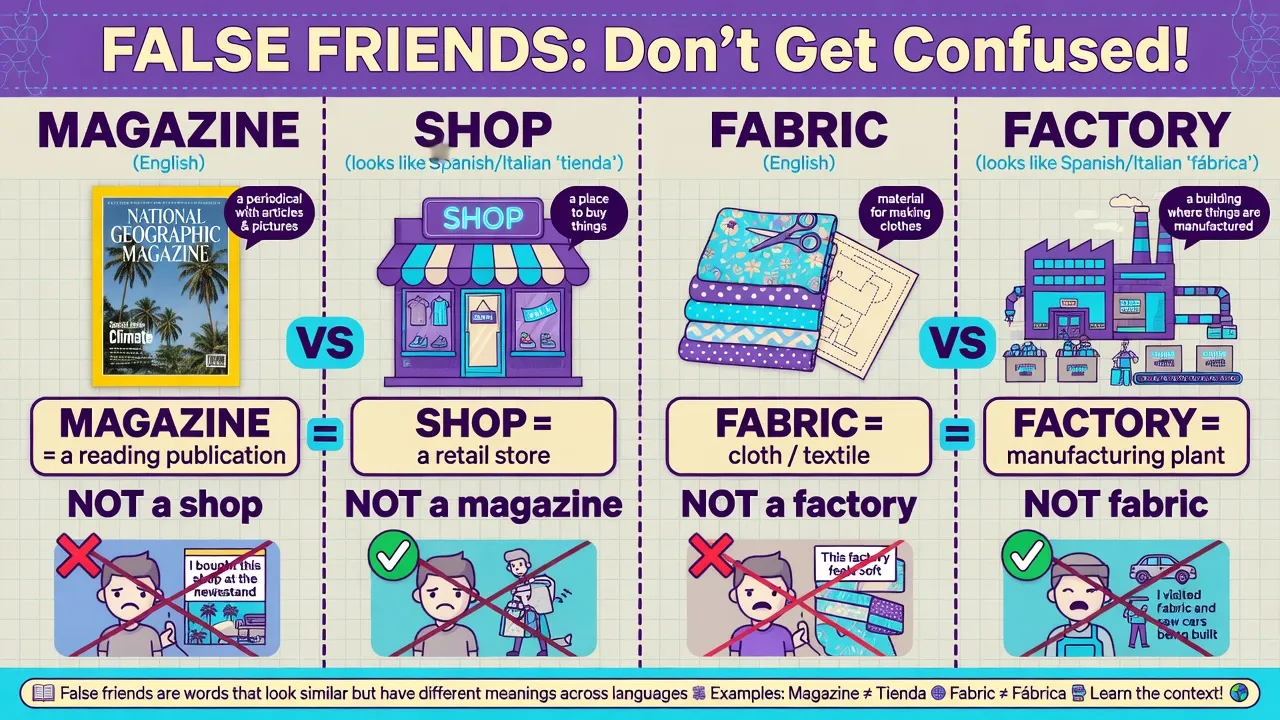
4. False friends (magazine, fabric, accurate, sympathy)
Some English words look or sound like Ukrainian (or shared international roots) but mean something else. Classic trap.
| English word | Not this | Actually means | You often want |
|---|---|---|---|
| magazine | магазин | journal / periodical | shop / store |
| fabric | фабрика | cloth / material | factory |
| sympathy | only "симпатія" | compassion / pity | liking / affection |
| accurate | акуратний | precise / correct | neat / tidy |
| eventual | "optional" feel | final / in the end | finally / in the end |
- ❌ Wrong: I bought milk in the magazine. / She works in a fabric.
- ✅ Right: I bought milk in the shop/store. / She works in a factory.
Fix tip: Learn these words inside full sentences. Context kills the wrong meaning faster than a word list.
5. Prepositions in / on / at
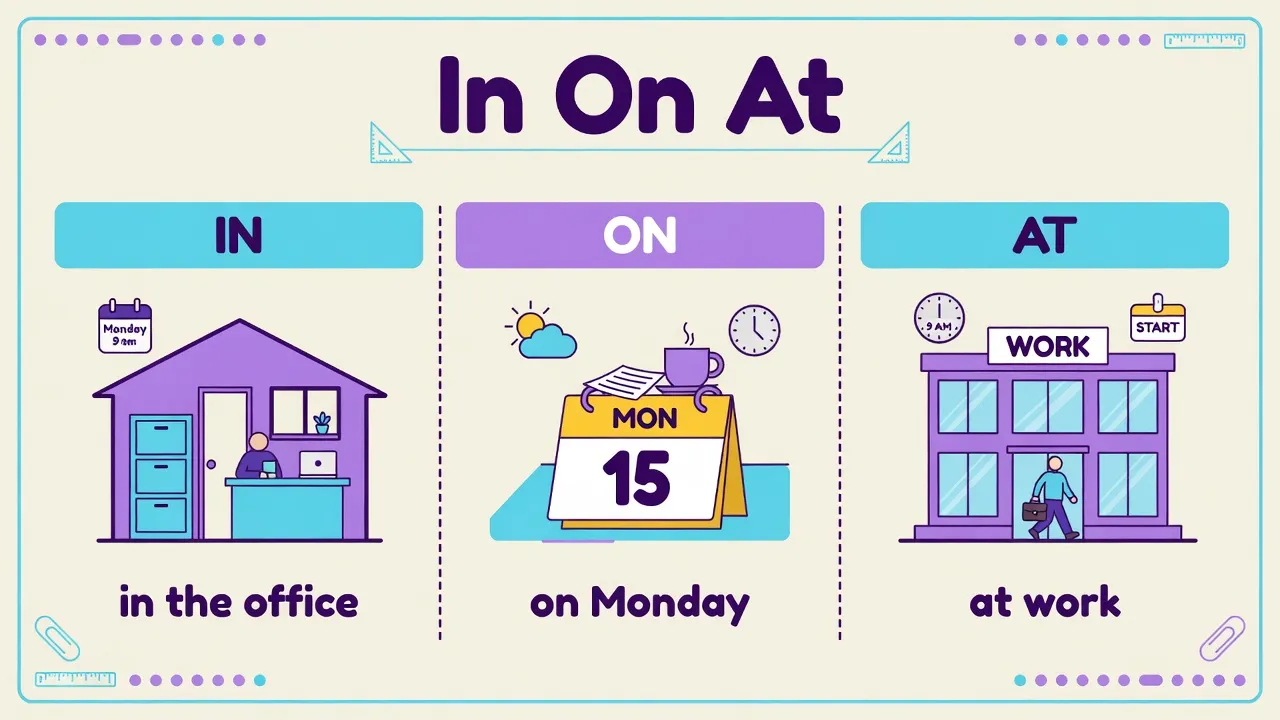
Prepositions rarely map 1:1. Ukrainian на is not always English on. The frequent picture/work traps:
- ❌ Wrong: Who is on the picture? / I am on work. / See you in Monday.
- ✅ Right: Who is in the picture? / I am at work. / See you on Monday.
More useful chunks:
- in the photo / picture / mirror (inside the frame or image)
- at work / school / home (in many fixed place phrases)
- on Monday / on the weekend (days; regional variation exists for weekends)
- in June / in 2020 (months, years)
- at 5 pm (clock time)
Logic will only take you halfway. Chunks plus rereading take you the rest.
6. Word order (fixed SVO)
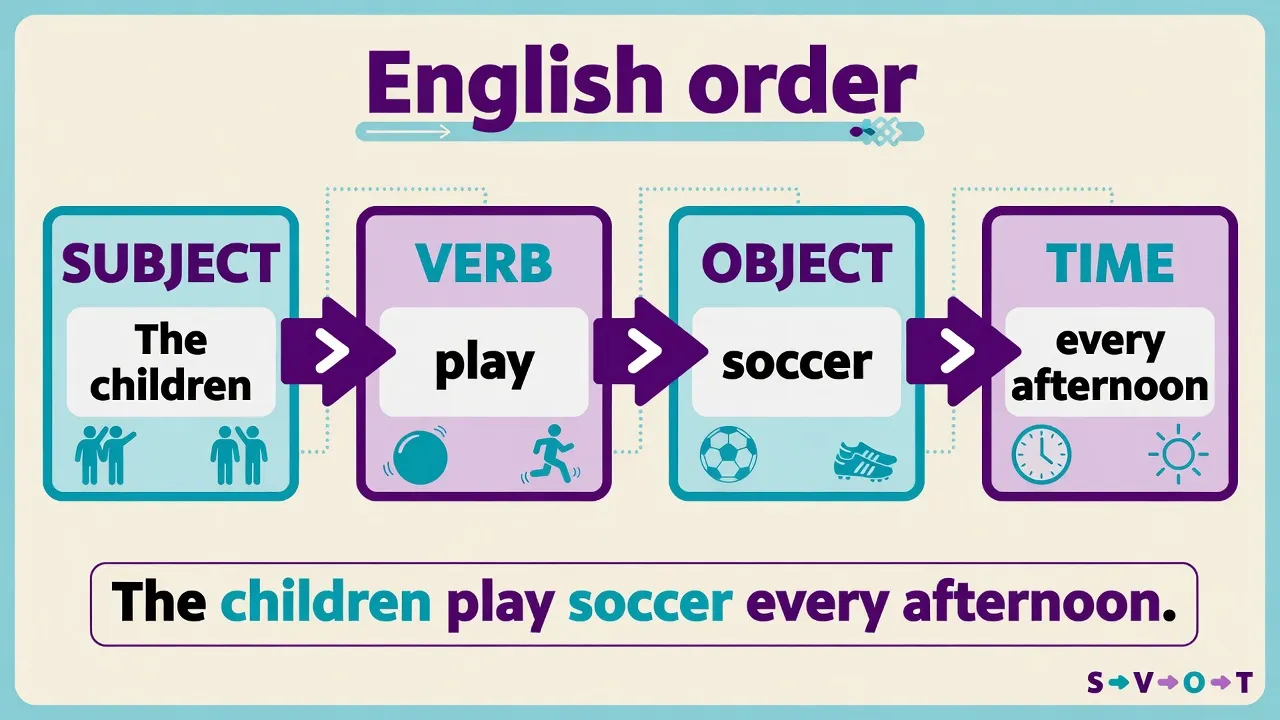
Ukrainian word order is freer. You can front time, object, or place for emphasis and still sound natural. Neutral English likes a stable spine:
Subject → Verb → Object → (place/time often later)
- ❌ Wrong: Yesterday bought I a car. / Very much I like this book.
- ✅ Right: I bought a car yesterday. / I like this book very much.
Time can open the sentence (Yesterday, I bought a car), but the middle still wants clear who → did what → what. Scramble the spine and people may still guess - or flip the story. More structure: English word order guide.
7. Collocation calques (I am agree, discuss about, make homework)
These are word-for-word translations of Ukrainian (or shared Slavic) patterns. Each piece looks English. The combination is not.
- ❌ Wrong: I am agree. / We discuss about the plan. / I make homework. / Explain me the rule.
- ✅ Right: I agree. / We discuss the plan. / I do homework. / Explain the rule to me.
More high-frequency calques:
| Calque | Prefer |
|---|---|
| I am agree | I agree |
| discuss about | discuss |
| make homework | do homework |
| explain me | explain to me |
| depend of | depend on |
| listen music | listen to music |
Fix tip: Save three correct full phrases per week from reading. Retrain the chunk, not a lone verb.
How to retrain (not "once and forever")
Lists help you name the error. Habits change when correct forms show up often enough that your brain stops reaching for the Ukrainian shortcut under stress.
Soft expectations: frequent patterns (is/are, It is, I agree) can feel cleaner in weeks of small notices. Articles and prepositions can take much longer. No list fixes this overnight.
The retrain loop
- Notice the error type after you write or speak (one type per day is enough).
- Read correct models in graded or easy real English - not only rule tables.
- Save 3 full phrases of that pattern (It is cold today. She is a doctor. I agree with you.)
- Type or say them in a short session (2-5 minutes).
- Meet them again in new texts so the form is not a one-off memory.
Grammar books help you label the bug. Reading + short production retrain the muscle. Mix both.
If perfectionism freezes you mid-sentence, that is a separate trap. See fear of mistakes and perfectionism. Silence is not a training plan.
A 15-minute practice plan
Protect a small daily slot. Rare two-hour "grammar weekends" lose to fifteen quiet minutes most days. Related idea: the 15-minute rule for daily vocabulary.
| Minutes | Do this | Goal |
|---|---|---|
| 8 | Read one easy English article or short scene | Meet correct is/are, it is, SVO in context |
| 4 | Highlight 2-3 lines of your weak pattern | Build a personal model set |
| 3 | Type or say those lines slowly | Output without a full grammar exam |
Weekly focus examples:
- Week of to be: mark every am/is/are in a graded text; rewrite three old chat lines with the verb restored.
- Week of dummy it: collect weather and "It is hard/easy..." lines; say them aloud.
- Week of collocations: hunt agree, discuss, do homework, listen to; drop I am agree from your notes.
Start material you can finish: all articles. Still choosing how to begin? How to start reading in English. Later orientation: language map.
How MovaReader helps
Knowing the seven mistakes is step one. Step two is volume of correct English plus a little reuse.
What MovaReader is for:
- free graded library with click-translate on blockers
- about 20 word translations per day on the free plan
- unlimited listening on the free plan for many audio paths
- Reader ~€1 for unlimited translations when volume matters
- Pro ~€5/month for full trainers (phrase typing and deeper reuse)
- upload files you have rights to (legal EPUB and similar) when you outgrow samples
What it is not:
- a promise you will sound like a native speaker
- a one-click cure for all transfer forever
- a host for pirated commercial novels
A simple path that matches this article:
- Open a graded English text in all articles.
- Notice is/are, It is..., SVO, and one collocation per page.
- Save three full phrases to phrases.
- Reuse them in the phrase typing demo or type training demo.
- When the free plan's daily limit blocks your reading volume, check pricing. Interface habits: how to use. Full trainers live on Pro.
Reading builds the models. Short drills protect them. You still do the noticing.
FAQ
Will native speakers still understand me with these mistakes?
Often yes for many of them. He doctor and Is cold still carry meaning. Cleaner grammar reduces friction, repair loops, and your own confidence tax. Aim for clearer habits, not mute perfection.
Should I stop speaking until I am perfect?
No. Speak and notice. Silence freezes progress. Correct after the message when you can. Keep a tiny "repair list" of your top two patterns this month.
Are grammar textbooks enough?
Grammar helps you name the error. Reading + short phrase practice retrain muscle memory. A pure rule diet without input is slow. A pure input diet without any labeling can leave sticky calques untouched. Mix both.
Can I practice for free in MovaReader?
Yes, on the free plan: free graded library, about 20 word translations per day, and unlimited listening. Reader ~€1 unlocks unlimited translations. Pro ~€5/month unlocks full trainers. Phrase typing demos are available to try the reuse feel. Details: pricing.
Do Russian speakers make the same mistakes?
Many patterns overlap (no articles, to be drop, freer order, some calques). Not identical in every collocation or false friend. If you share East Slavic transfer habits, this list still helps - as a transfer map, not a passport test.
How long does it take to retrain?
Frequent patterns can feel cleaner in weeks of small daily notices. Smooth articles and every preposition forever is a multi-year horizon for most adults. Consistency beats intensity.
Next steps
Pick two mistakes from the seven - not all seven at once. Put them on a sticky note. For the next seven days:
- Read 8-15 minutes of easy English.
- Mark every correct model of those two patterns.
- Save three phrases.
- Type or say them once.
Start here if you want support while you read: all articles · phrase typing demo · pricing.
Your Ukrainian brain is trying to help. Teach it a few English defaults, meet them in real text, and let time do the quiet work. No forever cure in one list - just cleaner habits you can keep.
Learning English?
The English version of MovaReader teaches Spanish and Ukrainian. To read English with a translation for every word, open the reader in Ukrainian or Spanish:
Книги англійськоюЦя стаття українськоюLibros en inglésEste artículo en español