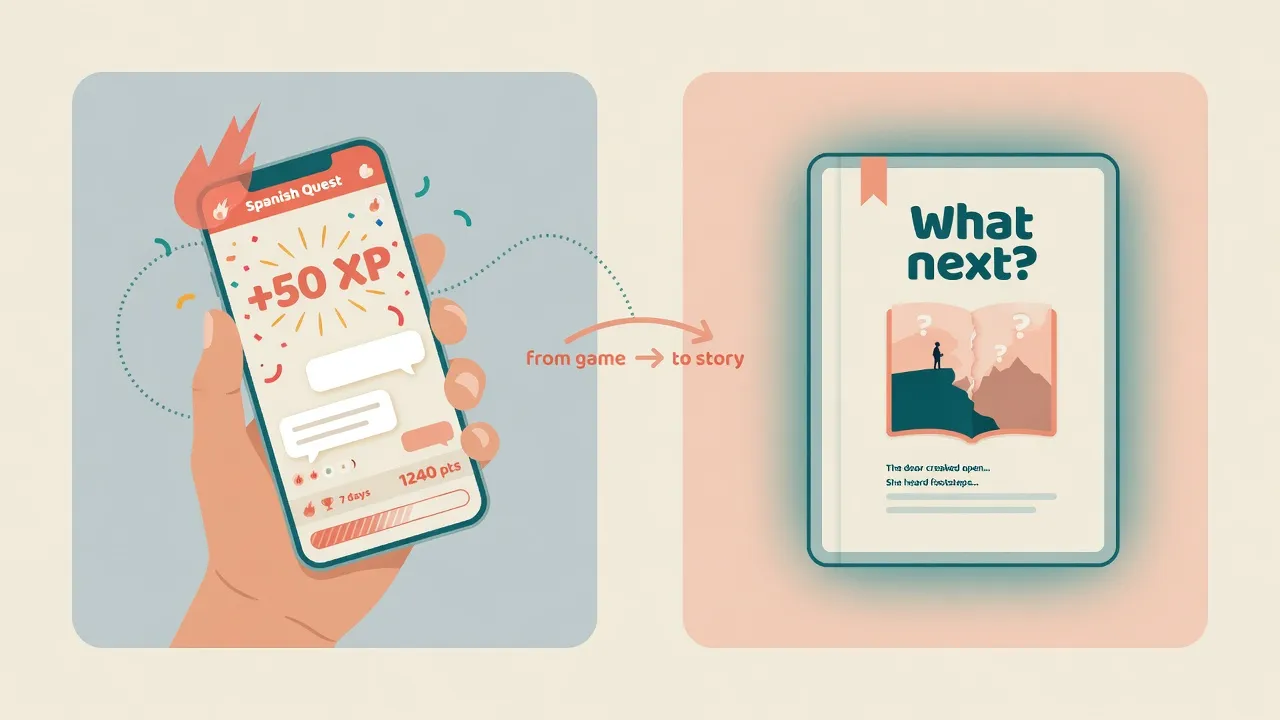
Language Learning Psychology
Fear of Mistakes in Language Learning: Why Perfectionism Freezes Speech
Fear of mistakes is often school conditioning, not low skill. Why the internal editor freezes speech, how reading builds patterns at low stress, and five practical steps.

You know this moment. You are standing in front of someone who speaks English or Spanish better than you do. The sentence is ready in your head. Then the freeze hits. What if the tense is wrong? What if the article is wrong? What if they think you sound foolish?
Seconds stretch. The moment slips. Out comes "Yes, good" instead of the thought you actually had.
That is not only a "language barrier." That is fear of the mistake - and for many adult learners it is the real brake on speaking.
Fear of mistakes in language learning is often perfectionism, not weak grammar: an internal editor tries to polish every sentence before you speak, and working memory freezes. School red-pen habits train that freeze. Calm reading at the right difficulty builds correct patterns with low social risk, so later speech feels less scary - but reading still does not replace real speaking practice.
Below: where the red pen comes from, why more grammar drills can make speech worse, how a calm reading habit shrinks the fear, five practical steps, a short comparison table, and where a reading tool fits.
What is language-learning perfectionism?
Language-learning perfectionism is the quiet rule that every sentence must be "perfect" before you dare say it. Your skill can be fine. The use of that skill is blocked.
If several of these sound familiar, the blocker is often fear of the red pen, not a missing tense chart:
- You translate every sentence in your head before speaking
- You avoid hard structures even when you "know" them
- You ruminate on errors for hours after a chat
- You delay speaking until "more grammar" is done
- Your body stresses (flush, sweat, freeze) at the thought of a mistake
Three or more hits is a pattern, not a personality verdict. High standards help when you edit a draft or prep for an exam. They hurt when zero-error rules freeze conversation. Carol Dweck's growth-mindset idea is useful here in plain form: a slip can be data for the next try, or "proof" you are not good enough. Conversation needs the first frame.
Why does school "red pen" train fear of mistakes?
For many people the root is not a bad ear for languages. It is school.
In class, a written error often meant a public mark, a lower grade, sometimes shame in front of the room. Error became pain, not feedback. Years later, in a cafe or on a call, the adult brain still waits for the invisible red pen.
So you play safe. Short answers. Safe phrases. Silence when the real thought needs a messy sentence.
Here is the loop in one line: fear of mistakes → silence → less practice → more fear next time.
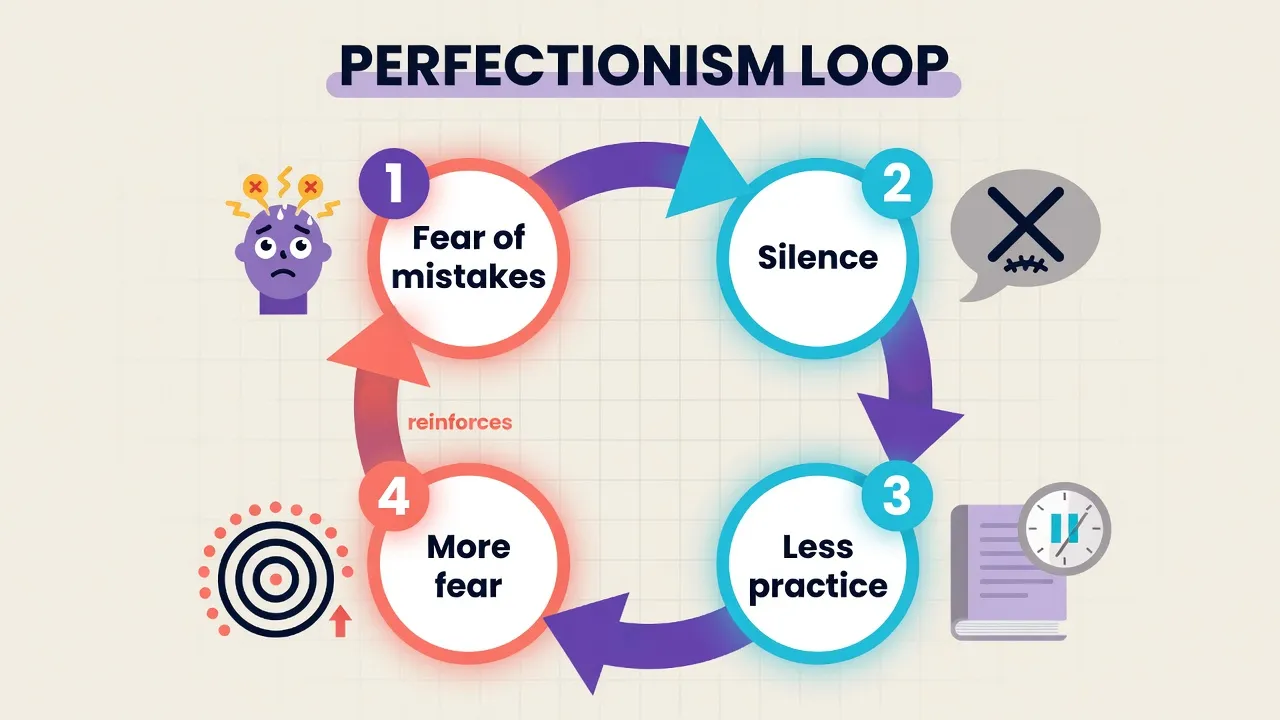
Silence feels safe once. It costs practice. Less practice "proves" the freeze was right.
A spoken slip is not a failing report card. It is one more sample of what your ear and tongue still need. Some people also feel strong foreign-language anxiety (teaching blogs sometimes call it xenoglossophobia). That is a plain-language label for a real feeling, not a diagnosis and not a reason to wait forever for perfect grammar.
Why does perfect grammar practice make speaking worse?
This sounds backwards until you look at working memory.
Live speech already juggles meaning, words, syntax, sound, and the other person's face. There is little free space left for a full grammar audit mid-sentence. When you run that audit anyway, attention leaves the message. Speech slows. You stumble. Words you "know" vanish.
Stephen Krashen's distinction helps here: acquisition (picking up language from comprehensible input) versus learning (conscious rule study). Rule stockpiling alone does not free speech. Acquisition needs mass correct examples you understand. We unpack that idea more in our note on Krashen's comprehensible input.
What do listeners usually hear when you mess up an article or a past form? Effort and meaning first. A missing "the" rarely kills the message. Confident imperfect speech often lands better than perfect frozen speech with five restarts.
Drill still has a place for writing and exams. As the only pre-speaking diet, it trains the internal editor more than the mouth.
How do receptive skills (calm reading) shrink the fear?
Most advice says "just speak more." That is fair eventually - and brutal as day-one medicine when the red pen still owns your nervous system.
The useful wedge is low-stakes pattern building. Calm reading at a comfortable level puts thousands of correct structures in front of your eyes with no judge waiting for your turn.
A simple loop:
- Pick text at the right difficulty (comfortable, not panic density)
- Calm read - no judge, no timer for "perfect"
- Tap or look up blockers only
- Notice "got it" / wow moments (patterns that clicked)
- Optional: shadow short audio after a page
- Later: low-stakes speak + phrase chunks
Paul Nation's extensive-reading idea is close: volume plus comfort helps uptake. You are not memorizing a rule table. You are filling memory with how English or Spanish actually strings ideas together.
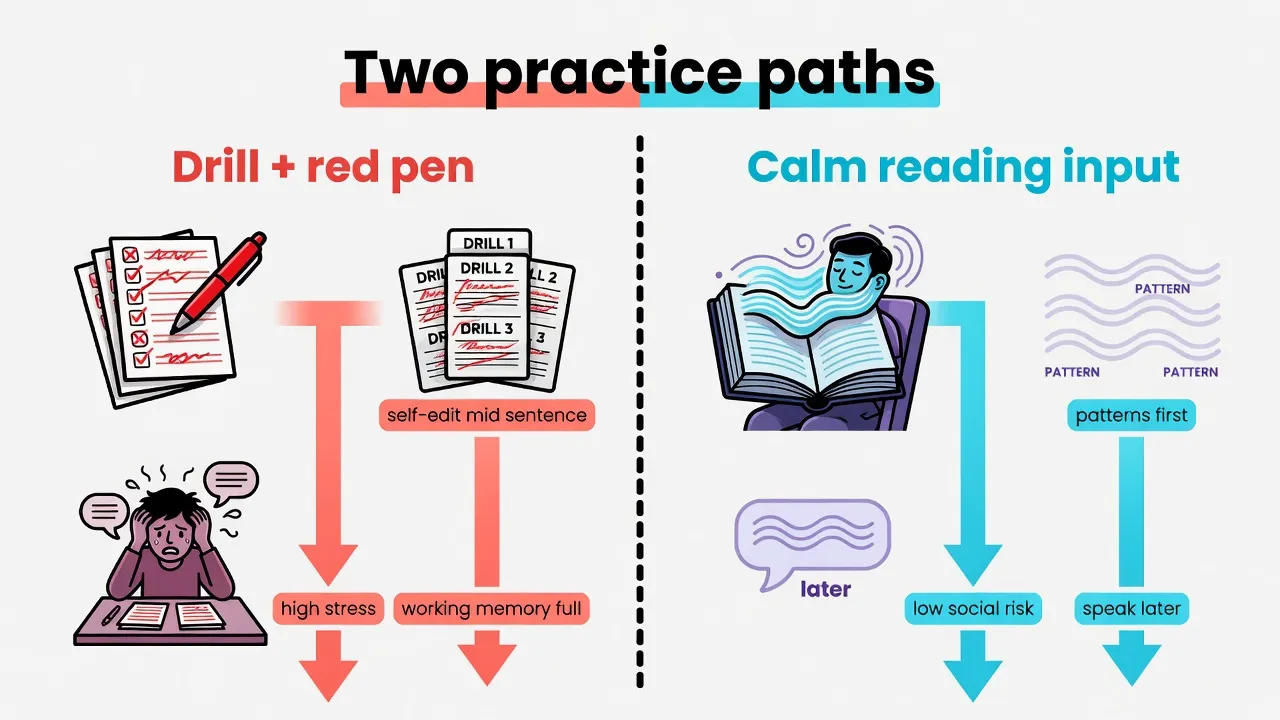
Tools that keep flow (tap-to-translate blockers, optional audio) reduce friction.
Reading builds foundation and confidence. It does not replace live speaking, real-time listening, or social practice.
Start the habit with graded pieces in the article library when you want texts that match a calmer level.
5 practical steps to unfreeze with reading
Small swaps, not a personality transplant.
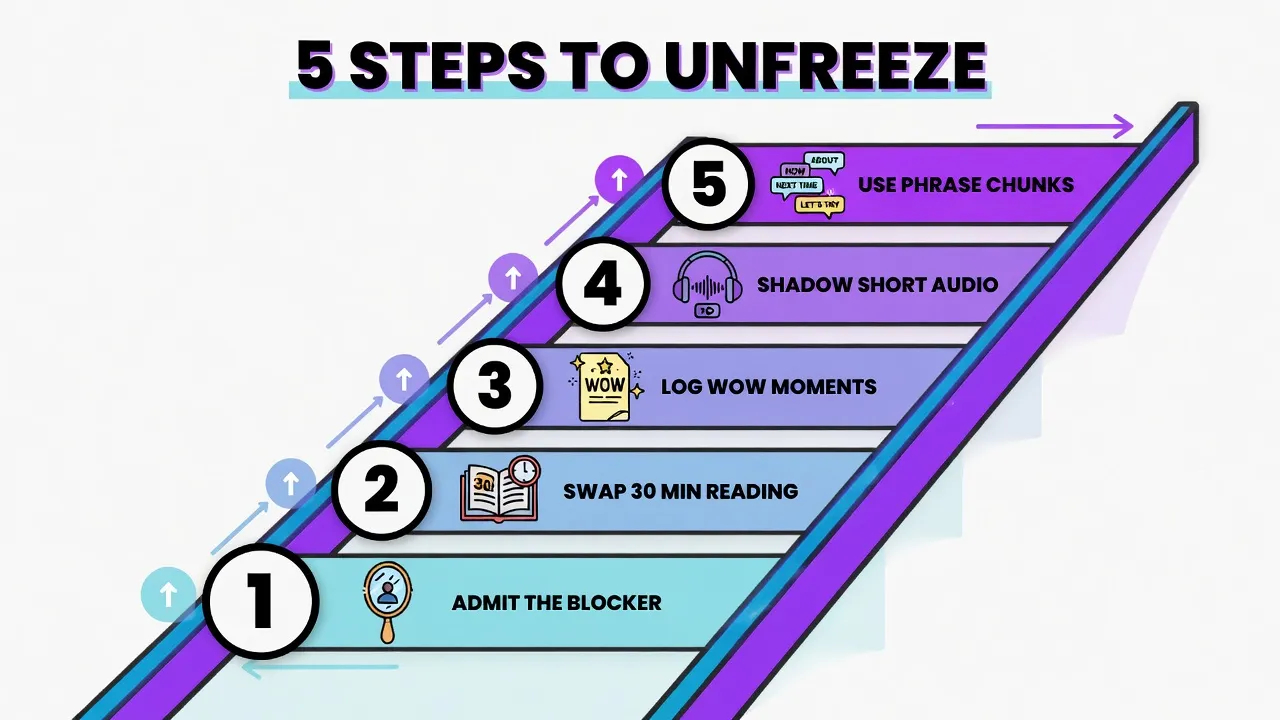
1. Admit perfectionism is the blocker
"I need more grammar before I speak" is often sabotage, not a plan. You will never feel "ready enough" by perfectionist standards. Name the freeze. That is progress.
2. Swap 30 minutes of grammar drill for 30 minutes of reading
Same time budget, different input. Choose a topic you actually want to finish - sport, food, tech, a short story - and stay near a comfortable level. A good place to browse graded texts is the all-articles library.
3. Log "got it" / wow moments, not only errors
Celebrate sentences you understood cleanly. Error journals alone feed the red pen. One sticky note: "I got this structure without translating" is enough.
4. Shadow short audio after a page
Copy rhythm and chunks without social eyes. Do not run a grammar courtroom mid-repeat. Finish the stretch, then optionally check one form you noticed.
5. Start with phrase chunks, not isolated rules
Reuse ready blocks from the texts you read. When you want active practice, try phrase typing or type training - and only then decide if trainers are worth a paid step.
Maria: from freeze to usable speech
Maria (composite) had strong grammar scores and a cafe freeze. On paper she "knew" past forms. In front of a traveler asking for a recommendation, her mind ran a full edit and her mouth offered "Yes, nice."
She did not throw out all study. She swapped half her drill time for daily calm reading at a level she could enjoy. She marked "got it" moments, shadowed a short audio stretch a few times a week, and later sent low-stakes voice notes to a language partner.
After some months the freezes still happened - less often. She still practices real conversation. Nothing in her story is a native-in-a-month miracle. The win is usable speech with lower shame, not perfect speech without humans.
How do polyglots treat imperfect speech?
Briefly: progress beats polish. People who use many languages treat mistakes as tuition, not as a final grade. They keep input high, speak when the moment needs it, and fix patterns over time instead of waiting for a silent perfect debut.
You do not need twenty languages for that attitude. You need fewer silent weeks and more correct examples in your ear and eye before each brave line.
Perfectionist vs reader: comparison
Same goal - better language - two different operating systems.
| Focus | Perfectionist path | Reader / input path |
|---|---|---|
| Goal | Zero errors before speech | Understand + use patterns |
| Practice | Drill, rewrite, silence | Daily calm pages + later speak |
| Error meaning | Shame / red pen | Data / next try |
| Working memory | Full editor on | Meaning first |
| Anxiety trend | Fear loop grows | Fear shrinks with familiarity |
| Speaking | Delayed forever | Low-stakes after patterns |
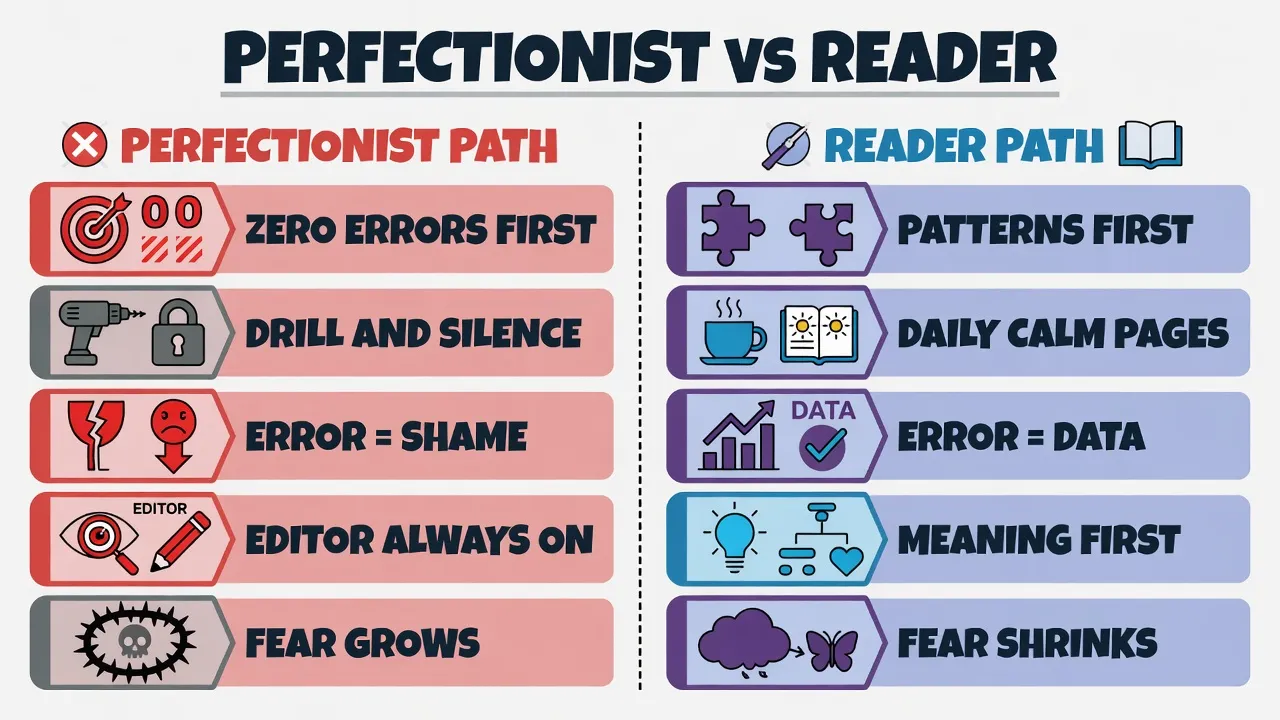
The reader path does not mean "ignore grammar forever." It means acquire grammar through mass correct examples first, then speak with lower freeze - still with real conversation later.
How to use MovaReader for this habit
MovaReader is built for calm reading that builds patterns: workable difficulty, tap-to-translate blockers without app-hopping, optional audio for shadowing, and later phrase/type trainers when you want active use.
Fit the tool to the bottleneck. You do not need every paid feature on day one.
| Need | Realistic plan |
|---|---|
| Test calm reading without commitment | Freemium (~20 word translations/day; listening often unlimited on free) |
| Daily page volume + dictionary without flow breaks | Reader €1/mo |
| Phrase / type trainers for active chunk practice | Pro €5/mo |
Freemium is enough to start the habit and learn the loop. Move to Reader on pricing when translation limits stop real pages. Use Pro when trainers - not more theory - are the bottleneck. Demos for phrase typing and type training show the active side.
Path in short: open all articles → read with sparse translates → optional how to use if the tap/audio loop is unclear → trainers when ready → still add one low-stakes spoken line with a human. Optional: language map for vocab orientation, not as a cure for freeze.
FAQ
Why am I afraid to speak even if my grammar tests are fine?
Tests reward careful editing. Live speech does not. Fear of mistakes is often school-style red-pen conditioning plus an internal editor that tries to polish every sentence in working memory - so skill sits unused. Some people also feel strong foreign-language anxiety; that is a feeling, not proof you lack talent. The fix starts with lower-stakes input and meaning-first practice, not another pure grammar course.
Is language-learning perfectionism always bad?
High standards help writing drafts and exam prep. Perfectionism is harmful when zero-error rules freeze speech, delay practice, and turn every slip into shame. In conversation, good enough meaning plus recovery beats silent polish. Treat spoken errors as data for the next try, not a failing report card.
Does reading really help speaking confidence or reduce anxiety?
Calm reading at the right difficulty builds correct patterns without a judge watching. Over time, familiar chunks and structures reduce the "blank" feeling when you speak. It helps foundation and confidence. It does not replace live speaking, listening in real time, or social practice - and it does not guarantee fluent speech by itself. Browse calm graded reading if you want a low-stress place to start.
Should I stop correcting myself mid-sentence?
Mid-sentence full grammar audits usually make freeze worse. Prefer finishing the thought, then optionally repair one clear mistake. Save deep correction for writing or a short review after the talk. Shadowing and phrase chunks train form without running a courtroom in your head while someone is waiting.
How much reading before I practice real conversation?
There is no magic hour count. A practical pattern: daily calm pages (often 20-30 minutes) until common patterns feel familiar, plus early low-stakes speaking (messages, short lines, friendly partners) so fear does not grow in silence. Reading first lowers risk; it is not a forever excuse to avoid speech. If you only read for months with zero speaking, the freeze can stay social even when input is strong.
Can I start this habit on the free MovaReader tier?
Yes for the habit itself. Freemium supports calm graded/library reading within limits: about ~20 word translations/day, and listening is often unlimited on free. Stay on free while you test the loop. Real daily page volume usually wants Reader at €1/mo. Pro at €5/mo is for phrase/type trainers when you move patterns into active use - not required to start reading. See current options on pricing. Reading still does not replace speaking with humans.
Next steps
Today: 20-30 minutes of calm reading at a green or yellow difficulty; one "got it" note; no mid-sentence grammar trial in your head during that block. Start from the article library if you need a simple entry point.
This week: one shadow pass after a page; one low-stakes message or line out loud to a person or a voice note.
Tools reduce friction. They do not remove the need to speak with humans later.
Stop polishing the unsaid sentence. Fill your ear and eye with good patterns first - then let imperfect speech do its job in the real world.
Keep reading with translations inside the text
With a free account, an unknown word translates with one tap, and the words you are learning wait for you in the trainer.
Free account: 7 days of Pro, then 20 word translations a day or a paid plan.