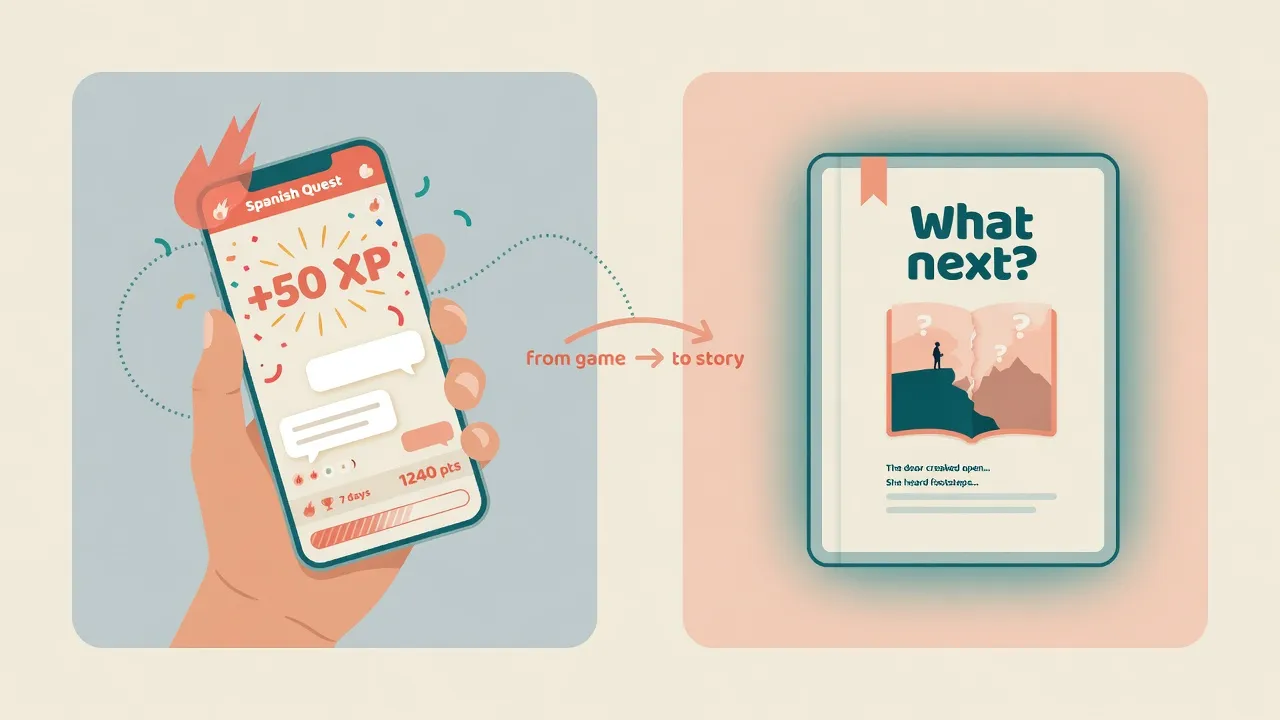
Language Learning Psychology
B1-B2 Language Plateau: Why You Stall and How Reading Helps
The B1-B2 plateau usually comes from comfortable input and low weekly volume, not a lack of talent. Five signs you are stuck and reading strategies that help.

You can order coffee. You can write a work email. You can follow a series with subtitles. By most social measures you "know" the language. And still the level feels stuck between B1 and B2 - for a year, two years, sometimes longer.
That is the B1-B2 language plateau: time and effort keep going, but the feeling of progress almost disappears. You are not broken. At intermediate, the easy weekly wins fade, and the language starts asking for far more contact hours before anything shifts.
The B1-B2 language plateau is usually not a talent problem. You keep practicing at comfort level (same graded texts, same shows, low weekly hours of harder input), so progress feels invisible. Break-through means more reading you understand at about 70-90%, thematic immersion, and making vocab gains visible - plus speaking practice elsewhere. Reading builds the path.
Below: five signs you are on an intermediate language plateau, why courses and cards often stall, how right-level reading works as the engine, five practical strategies, a first 7-day plan, and an FAQ.
Why does the plateau hit hardest at B1-B2?
At A1-A2, every new frequent word expands the map fast. You learn food, work, yesterday - and daily life suddenly opens. Intermediate is different. You hit the long tail: thousands of less frequent words and structures that live in articles, books, podcasts, and fast talk, not in textbook dialogs. If you care how large that bank can feel toward B2, see how many words for B2 and why 5,000 words is not C2.
Three mechanisms keep people stuck at B1:
- Illusion of sufficiency. You already "survive" in the language, so the brain stops screaming "study now."
- Comfort zone. Same series, same roughly 800 words, endless graded-only text that never bruises you.
- Invisible progress. Shifts get smaller: fewer panics per page, not "I learned Present Perfect this weekend."
Krashen's i+1 idea (input a little above your level) is useful here as practice, not religion. Too easy = no fuel. Too hard without support = you quit. The plateau is often stuck-easy or bruised by naked hard text. More on that frame in Krashen and comprehensible input.
Here is the loop most intermediate learners fall into:
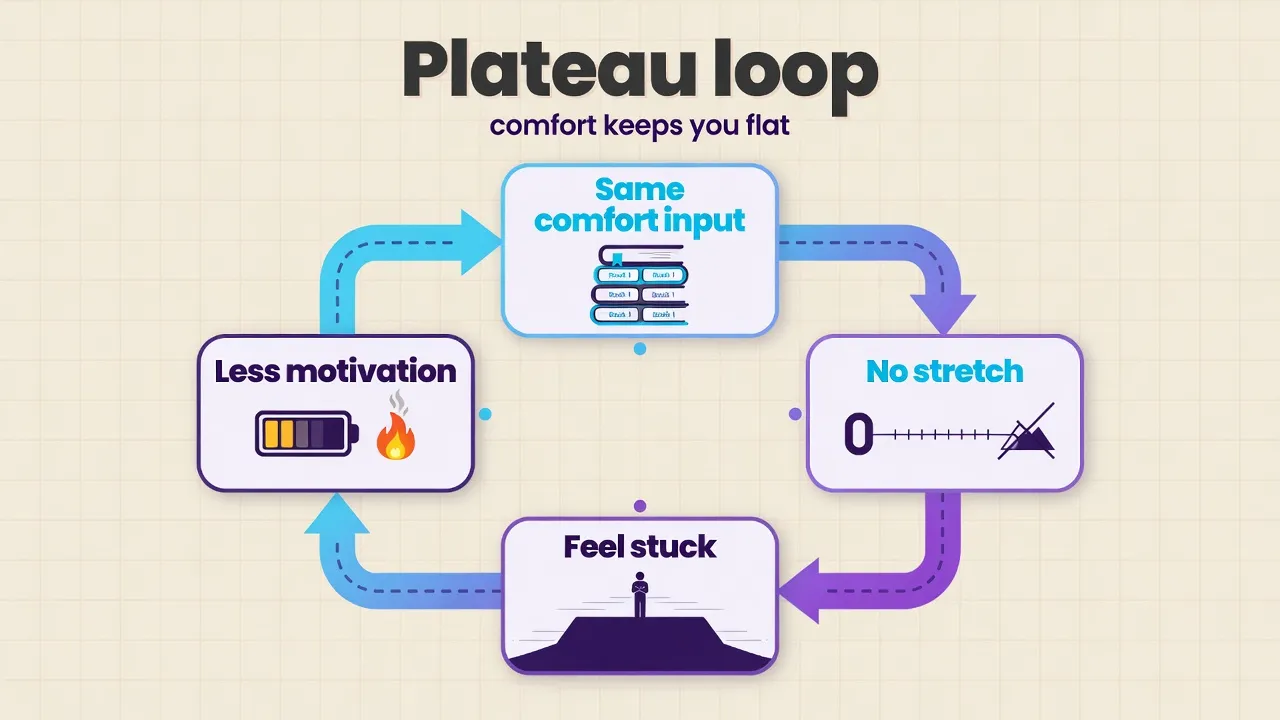
Comfort input leads to low stretch. Low stretch flattens how progress feels. Flat progress kills motivation. Lower motivation sends you back to the same safe series and graded pages. The fog on the plateau thickens - not because you lack talent, but because the loop never climbs.
5 signs you are on a plateau
If three or more of these ring true, change the system, not yourself.
- Same safe adjectives forever. You still default to good / bad / interesting (and their L2 twins) instead of sharper words the page keeps offering.
- Graded is fine; native is fog. Adapted readers feel smooth. News, denser articles, or real blogs feel like walking into mist.
- Same errors for years. Fossilization: I am agree, wrong prepositions, the same tense slip - you "know" the rule and still produce the old form.
- Grammar known in drills, late in real use. Tables feel familiar. In a live paragraph or chat, the form arrives late or not at all.
- Motivation dropped because "nothing moves." You open an app out of duty. The streak may be green. The sense of growth is not.
Three hits is a pattern. First move is volume and difficulty, not a talent autopsy.
Why the traditional stack often fails at B1+
The stack that got you to solid B1 often stalls when the real job becomes hours of denser input. Here is where common methods still help - and where they break:
| Method | What it gives | Where it breaks at B1+ |
|---|---|---|
| Courses 2×/week | structure, feedback | too few input hours/week |
| Cards without context | isolated words | weak transfer into paragraphs |
| Tutor without home volume | conversation | 60 min ≠ tens of thousands of text words |
| Series "as it comes" | ear, motivation | passive = little new vocabulary |
| Graded readers forever only | confidence | under-delivers B2 density eventually |
Cambridge-style talk of "hundreds of hours" is a direction, not a stopwatch for your life. Two lessons a week alone can stretch into years if almost nothing harder enters your week. There is no universal hours-to-B2 number that fits every start point and language pair.
Massive reading as the main engine (not a religion)
Reading is not the only path. For most adults it is the highest-volume meaningful input they can actually control.
Why it breaks plateaus:
- Thirty minutes puts thousands of word forms through you in context
- Grammar appears in action, not only in tables
- You pick the topic, so the habit sticks
- You control the pace - pause, re-read, skip a boring paragraph
There is a real barrier. Open a naked native paragraph at B1 without support and it can feel like dictionary hell:
The ramifications of the geopolitical upheaval have permeated every facet...
Ten minutes of lookup later, the plot of the paragraph is gone. The fix is not "never read originals." It is support + right difficulty + regularity.
The sweet band is roughly 70-90% understanding: the story holds, a few words sting, you keep turning pages. Always 98% and bored? Stretch. Below about 70% and the plot collapses? Simplify or add support.
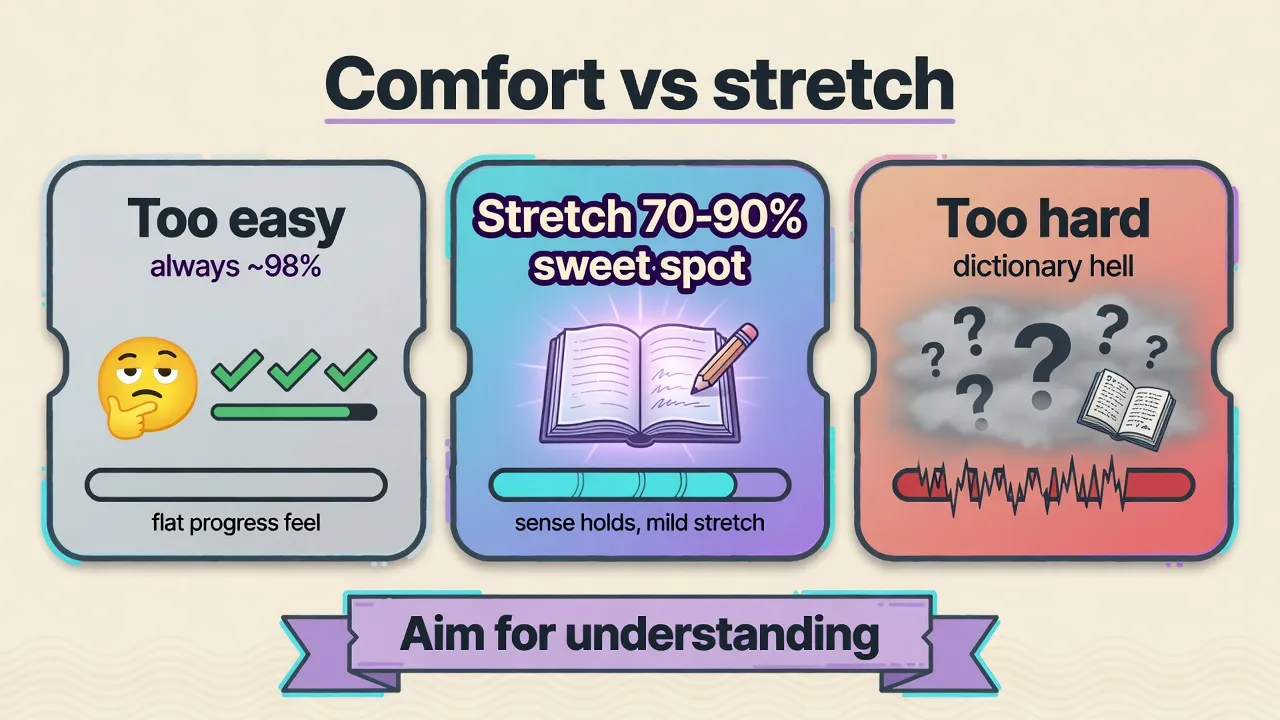
Click-to-translate in a reader, plus your own EPUB when you are ready, cuts the friction of that barrier. For now, the engine is pages at the right difficulty - browse the free path in all articles, and see building B1 vocabulary by reading if you want a softer ladder first.
How MovaReader helps
MovaReader is a reader UI for right-level volume: free graded library path, click-to-translate for blockers, save phrases, and upload your EPUB or file when ready. Tools cut friction. They do not replace the pages.
A practical path:
- Read from all articles at a comfortable-but-stretch level.
- Tap only sense-breakers - words that break the plot.
- Save about 5-12 phrases per session (habit, not a law).
- Train saved chunks in demos when ready: phrase typing, type training.
- Own book when ready - how to use.
- Make progress visible on the language map so gains are not only a "vibe."
Plans on pricing - fit the plan to the bottleneck:
| Need | Realistic plan |
|---|---|
| Test the habit / free graded path | Freemium (~20 word translations/day) |
| Daily page volume without a translation wall | Reader €1/mo |
| Full trainers for phrase practice | Pro €5/mo |
Freemium is enough to learn the loop. The free graded library has limits; it is not designed as an unlimited high-volume engine. Reader at €1/month unlocks unlimited translations so daily pages do not die mid-session. Pro at €5/month is for when full trainers are the bottleneck for moving saved phrases into active use. Serious map marks at real reading scale usually need an account and enough translation volume for daily work.
What it does not do:
- host licensed bestsellers as a free built-in warehouse
- replace spoken practice
You do not need Pro to start the reading habit. You do need pages.
5 breakthrough strategies
System tweaks, not a personality transplant. One ladder:
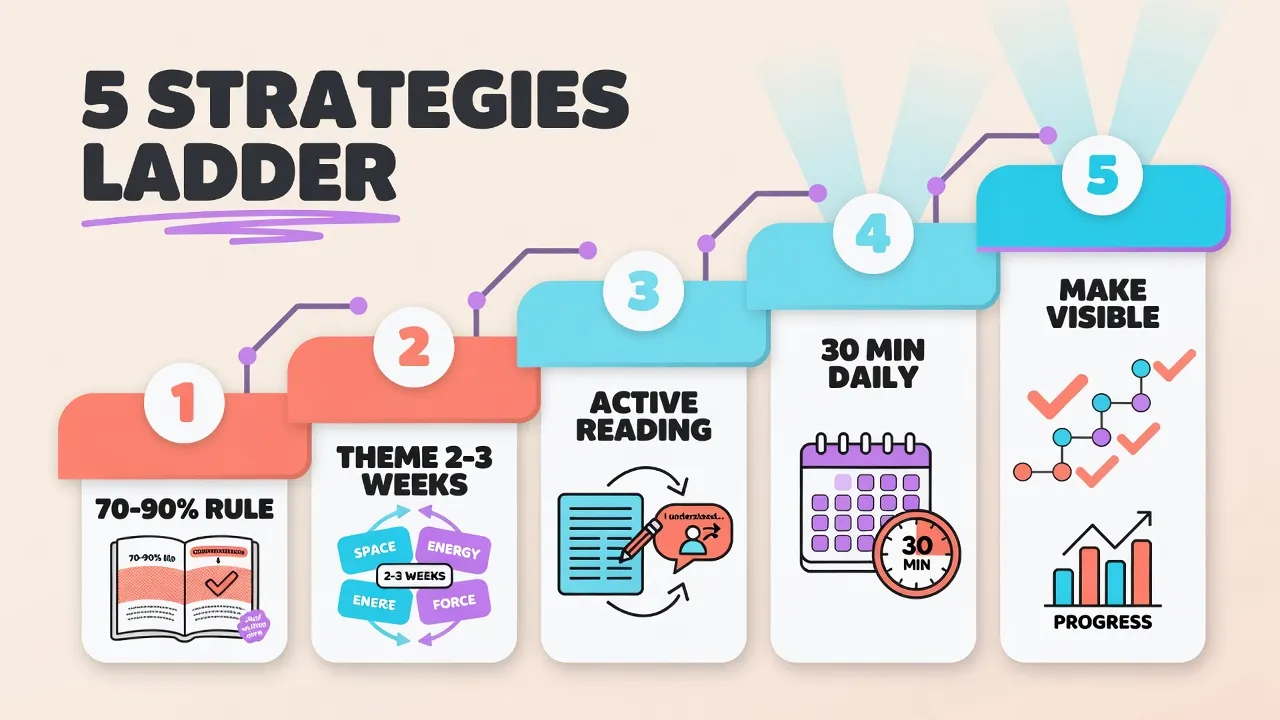
1. The ~70-90% understanding rule
Pick texts where the overall sense holds. Below roughly 70%, simplify. Always 98% and bored? Stretch. Start with easier library filters, try a graded sample such as this A2-ish Spanish text, then move toward denser pieces with support. The article library is the practical menu.
2. Thematic immersion for 2-3 weeks
Do not hop randomly across fifty topics. Two weeks on AI, two on sport, two on your work field - lexis recycles and "lands" faster than chaos browsing. Same characters, same jargon, same verbs. The fog on one theme clears before you open a new ridge.
3. Active but economical reading
- First pass: one paragraph without taps
- Then: only blockers
- After a section: two or three sentences retold in your own words
Do not tap every unknown word "for stats." That returns you to dictionary hell and kills the story.
4. About 30 minutes almost daily
Thirty minutes times seven beats one three-hour Sunday. Over roughly twelve weeks of that habit you bank real contact hours - ranges, not a magic month. A working scheme: morning article + evening own file or book.
5. Make progress visible
Once a month:
- Re-read the same "hard" piece from week one
- Roughly count blockers per page
- Record a one-minute oral retell on the same topic
- Glance at the language map and any marks you set
Micro-progress is invisible until you measure it. Related depth: track vocabulary progress.
Impostor syndrome on the plateau
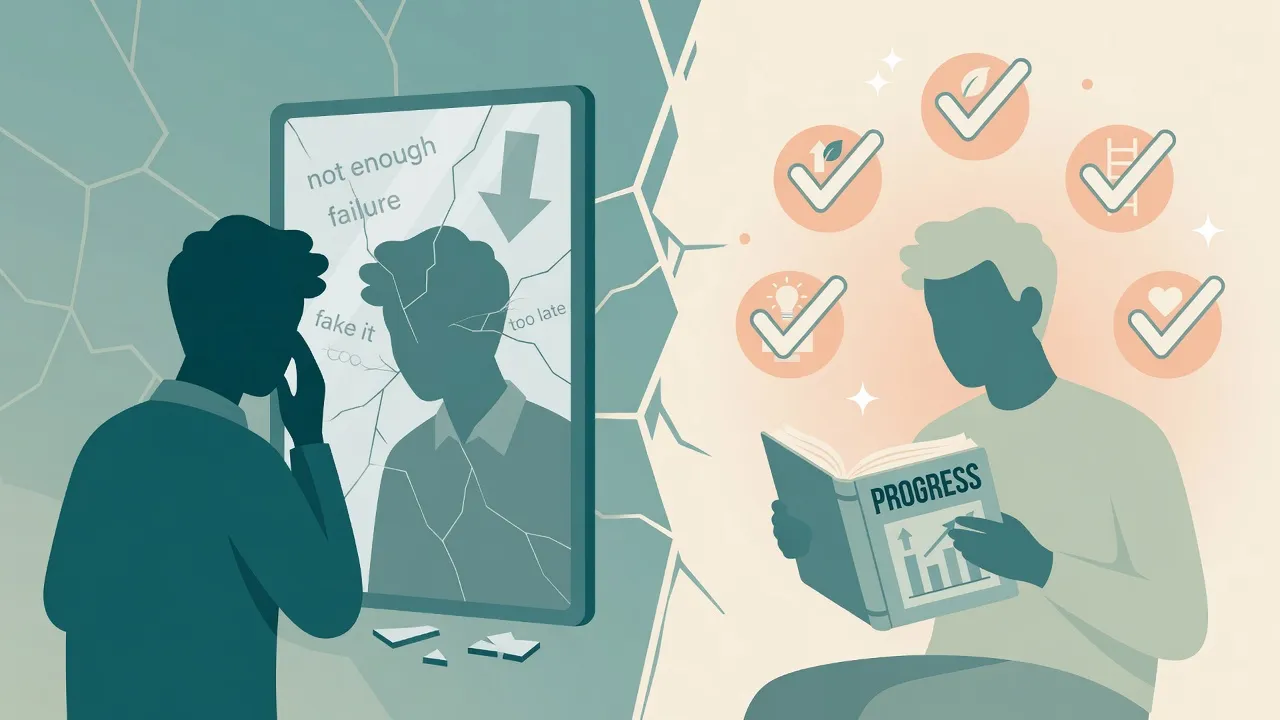
"I'm faking knowing the language" is a common companion on the intermediate plateau. You compare your inner chaos to someone else's outer calm.
People who sound freer usually have more contact hours (and often more speaking) - not more talent. Small proofs help: a finished article, a known word showing up in a new text, fewer subtitles on a familiar show. If this spiral is loud for you, our notes on impostor syndrome and real level and fear of mistakes go deeper without pretending the feeling is unique.
Math without fairy tales
Weekly "word exposure" orders of magnitude are useful. They are never guarantees.
| Activity | What it gives | Limit |
|---|---|---|
| 2 lessons/week | feedback | low volume |
| Cards only | point memory | weak context |
| Series 3 h/week | listening | easy to stay passive |
| Reading ~30 min/day | large input | needs level + support |
Reading does not "guarantee B2 in 6-12 months for everyone." It is how you bank the hours B2 almost never happens without. Ranges only. No universal hours-to-B2 fact. For size of the vocab job, again: how many words for B2.
First 7 days
One week to install the habit.
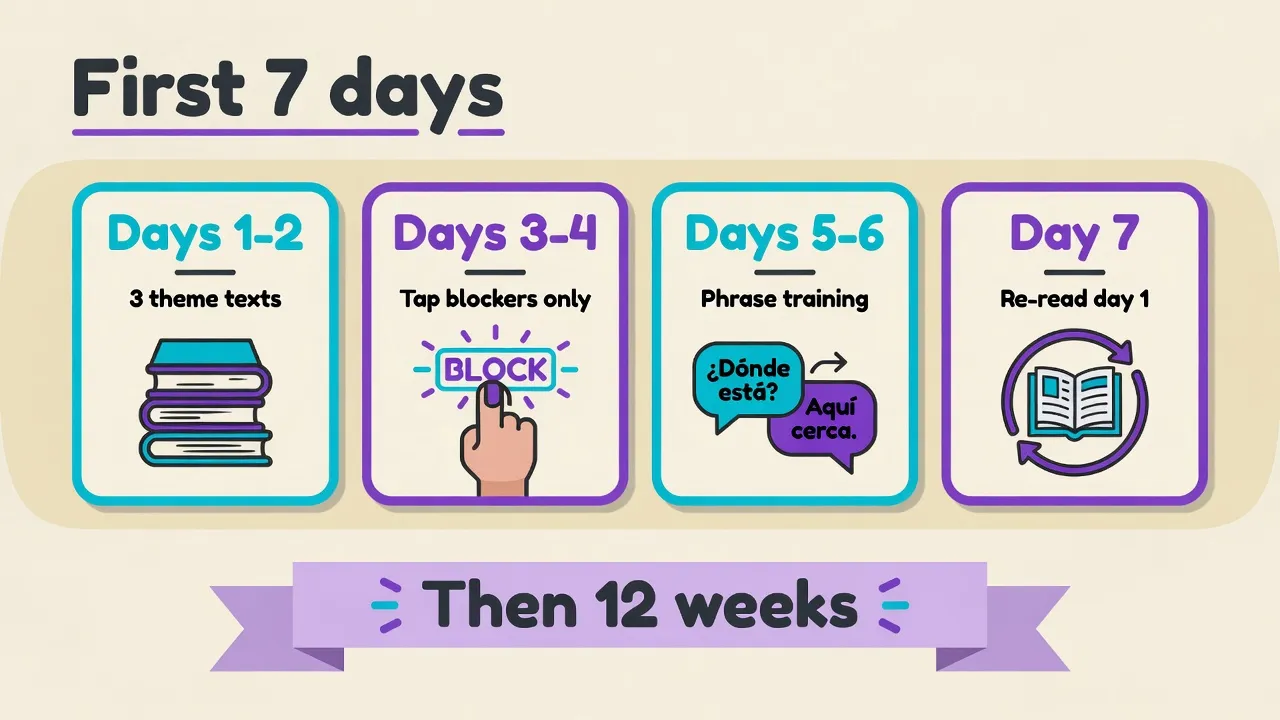
- Days 1-2. Three library texts on one interesting theme. About 20 minutes. Start in all articles.
- Days 3-4. Twenty to thirty minutes. Tap blockers only. Save 5-10 phrases.
- Days 5-6. Short phrase training - demos or Pro trainers when you need them (phrase typing).
- Day 7. Re-read the day-1 text. Notice what got easier. That is your first ridge edge out of the fog.
Then: about twelve weeks of the same logic, slowly raising difficulty. Same theme immersion, same 70-90% band, same visible checks. A system that keeps climbing.
FAQ
How long does it take to go from B1 to B2?
It depends on your start point, language pair, weekly hours, and how much speaking and output you do. Ignore hard ad guarantees ("B2 in N weeks"). Reading volume is how most people bank the contact hours B2 almost never happens without - but there is no universal hours-to-B2 number that fits everyone. See also how many words for B2.
Should I quit my tutor?
No, not required. A better split is often: tutor for speaking and error feedback, plus self-driven massive reading for volume. One weekly hour of conversation alone rarely replaces tens of thousands of words of text input.
Graded readers or original texts?
Both. Graded for speed, confidence, and finishing pages. Denser originals (or harder news and articles) for B2-level density when you have support - tap-to-translate, dictionary in context. Forever-only graded can stall density later. Forever naked originals can kill the habit.
Is it OK to look up or translate words while reading?
Yes, selectively. Look up blockers - words that break the plot. Bad pattern: translate everything and lose the story. Aim for sense first, a handful of taps per page in the ~70-90% band, then save only high-value phrases (about 5-12 per session is a solid habit, not a law).
What about grammar on a plateau?
Patch the patterns that keep tripping you in real texts and speech. Do not restart "all grammar from zero" for the fifth time instead of reading. Grammar in action (mass correct examples) plus short targeted fixes beats another full syllabus restart.
I don't like reading. Is there a way out?
Yes. Short hobby articles, target-language subtitles plus transcripts, comics, or any mass meaningful input you will actually finish. The principle is volume of understandable input, not only classic novels. Optional freemium start: free library sessions within about 20 word translations/day; Reader at €1 if daily volume needs unlimited taps. Speaking practice still matters elsewhere.
What to do next
The B1-B2 plateau is rarely fixed by a new streak app. It moves with pages at the right difficulty, week after week, with low friction.
Today: twenty to thirty minutes in the free library, a few phrases saved, a glance at the language map so progress is not only mood. Stay freemium while you test; move to Reader (€1) on pricing when ~20 translations a day stop real pages. Own-file path is in how to use.
The tool lowers pain. You still take the steps - one readable ridge at a time, out of the fog.
Keep reading with translations inside the text
With a free account, an unknown word translates with one tap, and the words you are learning wait for you in the trainer.
Free account: 7 days of Pro, then 20 word translations a day or a paid plan.