Vocabulary
How Many Words Do You Need for B2?
For B2, research often points to about 3,250-3,750 frequent lemmas. Here is what that range covers, why estimates differ, and how to grow your vocabulary by reading.
You finished most of your B1 material. An app shows something like 3,000 cards. A friend says "you need 8,000 for B2." And you still ask the same question: how many words do you need for B2?
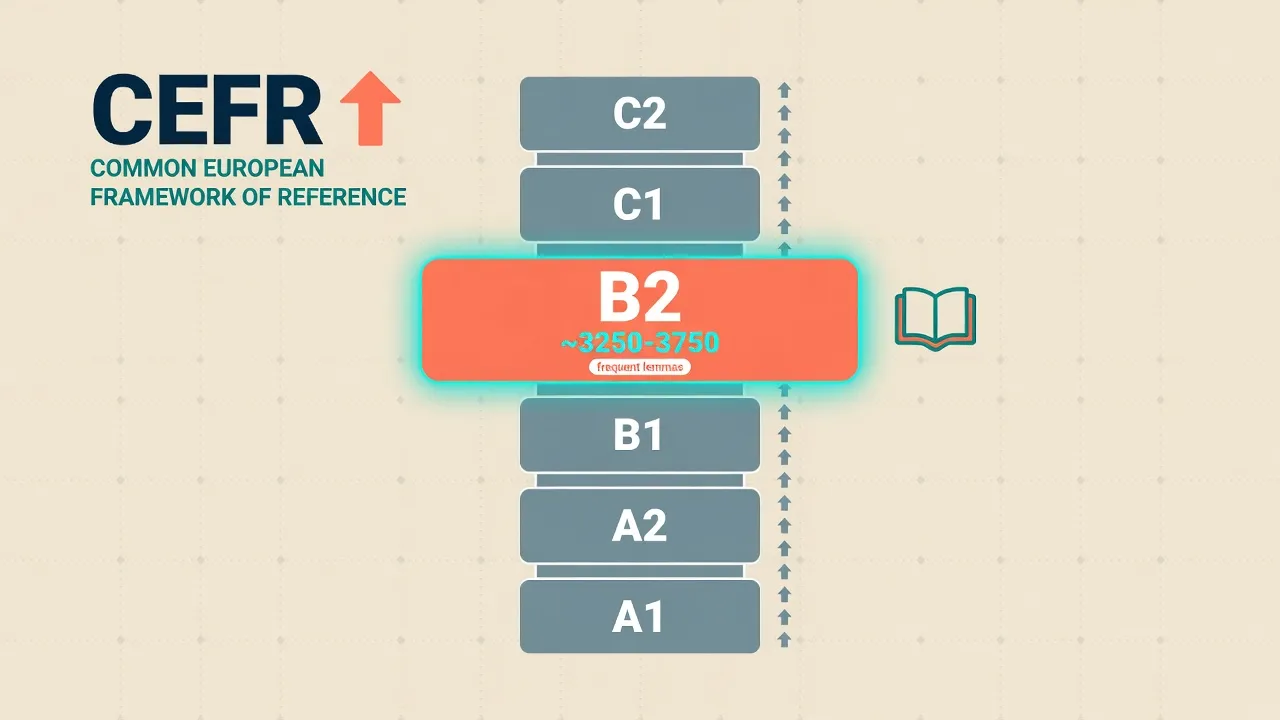
Here is the plain answer. For orientation, research-informed tools (and MovaReader's public language map) often put B2 around ~3,250-3,750 frequent lemmas. Same band as the free map. Treat it as a road sign for common headwords, not as a diploma you print after a counter ticks over.
That number helps you plan a high-frequency base and compare B1 / B2 / C1 without folklore. It is not an official CEFR word quota or a DELE / IELTS / Cambridge pass mark by itself. CEFR talks about what you can do; vocabulary supports those outcomes, it does not replace them.
This deep-dive sits under the full A1-C2 picture in How many words for CEFR A1-C2?. Below: the ladder, real can-do language, why B2 still feels stuck, why blogs say 3k or 8k, reading coverage, English vs Spanish friction, a practical plan, and how to use the map.
Short answer: the B2 orientation band
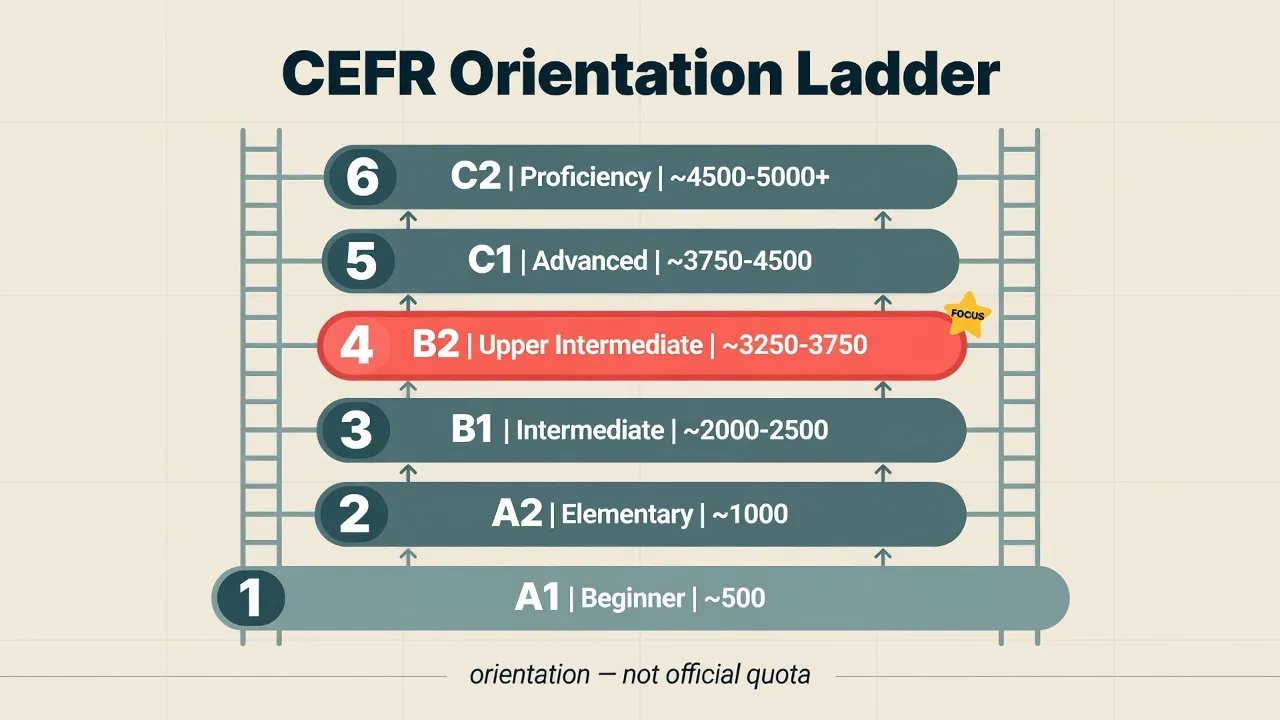
The full ladder puts B2 in the middle of a simple frequent-lemma scale. Numbers are orientation ranges, not Council of Europe law.
| Level | Orientation (frequent lemmas) | Where it sits |
|---|---|---|
| A1 | up to ~1,500 | Early core |
| A2 | ~1,500-2,500 | Survival + simple stories |
| B1 | ~2,500-3,250 | Independent short texts |
| B2 | ~3,250-3,750 | Upper-intermediate map band |
| C1 | ~3,750-4,500 | Wider authentic range |
| C2 | ~4,500-5,000+ | Late-range discussions |
The ladder with B2 highlighted:
How to use the band without lying to yourself:
- Count frequent lemmas (dictionary headwords like run or hablar), not every surface form.
- App catalogue sizes are curated lists. They are not identical to research ranges.
- Hitting ~3,500 does not mean "I passed B2 speaking."
- Productive vocabulary (words you can use) is usually smaller than receptive vocabulary (words you can recognize).
Sources often cited for scale include X-Lex-style frequency work (Milton & Alexiou tradition for English estimates) and Nation-style coverage studies for reading. They disagree on units and corpora. Road sign, not diploma. In one line: B2 orientation ≈ 3,250-3,750 frequent lemmas - a map band for common vocabulary, not fluency forever on every page.
What B2 can-do descriptions actually say
CEFR (and the Companion Volume) describes what you can do, not how many headwords you own.
At B2-ish ability, descriptors typically talk about things like:
- understanding the main ideas of complex text on concrete and abstract topics
- interacting with enough fluency and spontaneity that regular conversation with native speakers is possible without strain for either party (still not "perfect")
- producing clear, detailed text on a wide range of subjects and explaining a viewpoint
None of those lines say "exactly 3,500 lemmas." Vocabulary supports those outcomes. Listening speed, grammar control, topic knowledge, and exam strategy still matter.
So when people search "how many words for B2," the useful answer is:
- A plausible size of frequent vocabulary for orientation.
- A reminder that B2 performance is multi-skill.
- A practical path to grow words in context (reading), not a viral quiz.
If you are building upward from B1 with books, see Build B1 vocabulary by reading. Chunks and fixed expressions matter too: Words vs expressions at CEFR levels.
Why B2 feels stuck even with thousands of words
The plateau is real, and a bit boring for a reason.
You already know the "easy" high-frequency words
By late B1 / early B2, many learners have a decent core. New gains come from mid-frequency items, multiword units, and topic vocabulary. Flashcard totals grow slowly while the feeling of "I still don't understand this page" stays.
Productive vs receptive gap
You may recognize 3,500 lemmas on a list and still freeze when speaking. Recognition is cheaper than retrieval under time pressure. A map of marked words can overstate speaking readiness if you only mark passive recognition. Habits for honest tracking: Track vocabulary progress.
Text difficulty is not uniform
Work emails, news explainers, and modern non-fiction often sit near "possible with effort" at B2 orientation. Literary novels, dense legal text, or fast slangy dialogue can still feel like a wall. B2 is not a free pass into every genre.
Exams train exams
You can pass a formal B2 exam with exam-shaped skills and still struggle with open reading, or the reverse. A private word counter is not Cambridge, IELTS, or DELE.
Practical takeaway: if you feel stuck at "almost B2," check unknown density on real pages, not only your Anki total. Peek at neighboring bands for context, not panic: B1 vocabulary and C1 vocabulary.
Why blogs disagree: lemmas, forms, families
When Site A says "B2 needs 3,000" and Site B says "8,000," both can be "right" for different units.
Three units that change the headline number:
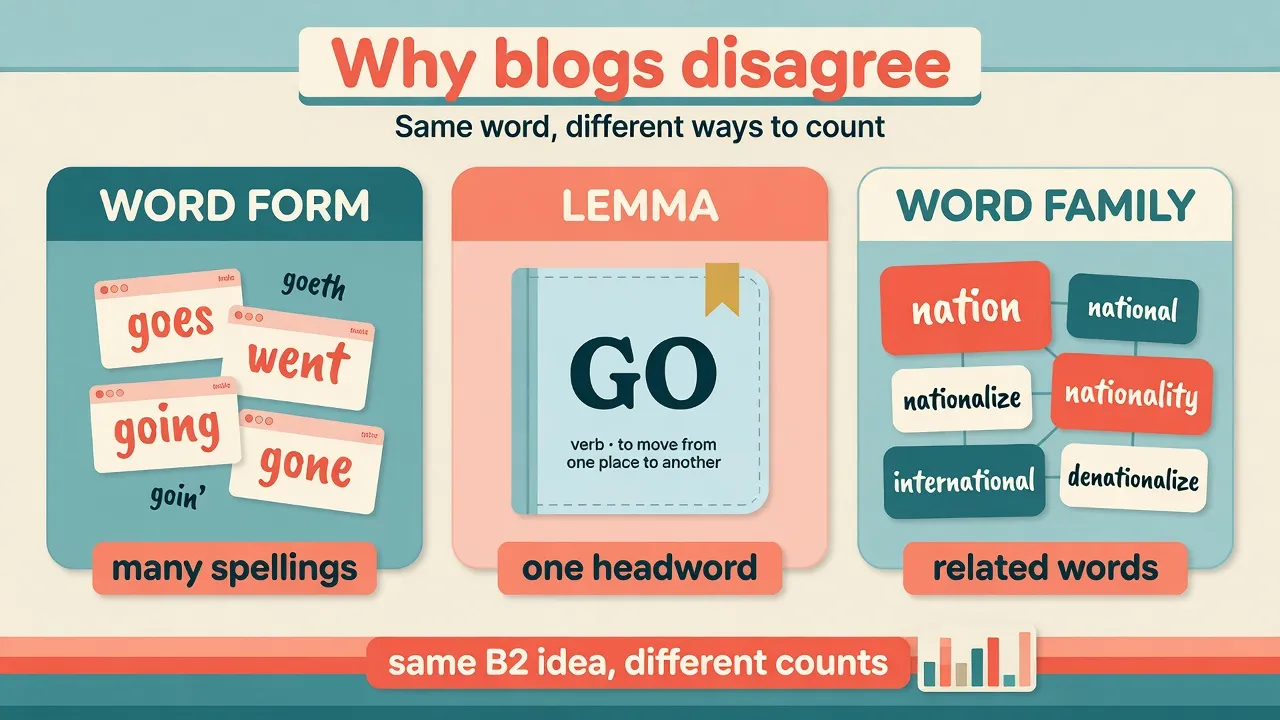
| Unit | What it counts | How B2 numbers look |
|---|---|---|
| Lemma | Dictionary headword (run, hablar) | Closer to the ~3,250-3,750 orientation band |
| Word form | Each spelling/inflection (runs, ran, running) | Totals inflate fast |
| Word family | Related set (nation, national, nationally...) | Reading-research figures often look larger |
Practical rule: before you compare your deck to a CEFR table, ask "what unit?" If an app counts every conjugation as a new word, your size looks huge without real progress.
Full unit deep-dive: Lemma vs word form. Full A1-C2 ranges: How many words for CEFR?.
Reading coverage vs the B2 trophy number
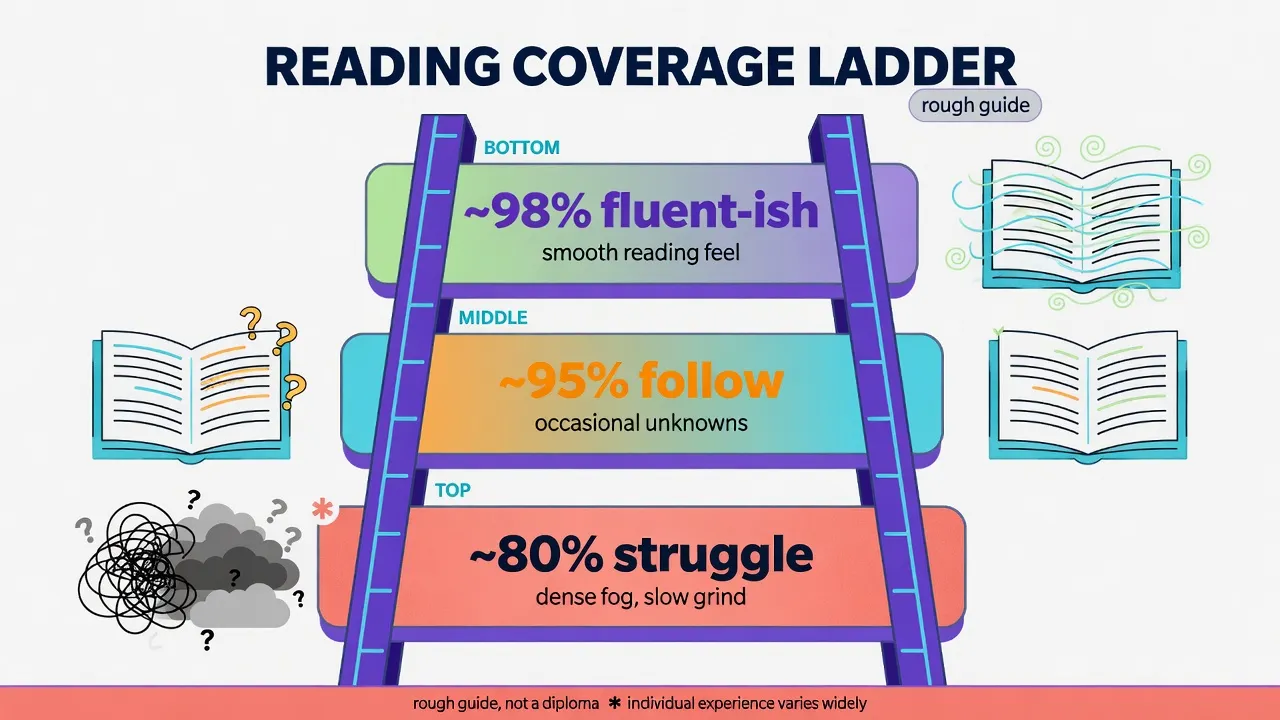
Nation-style reading research often cares less about a trophy total and more about lexical coverage: what share of running words on the page you already know.
Rough discussion points from that tradition (mostly English corpora; use carefully for other languages):
| Coverage of running words | Typical feel |
|---|---|
| ~95% | Effortful but possible; many look-ups |
| ~98% | Often discussed as more comfortable for independent hard reading |
What 95% vs 98% feels like on the page:
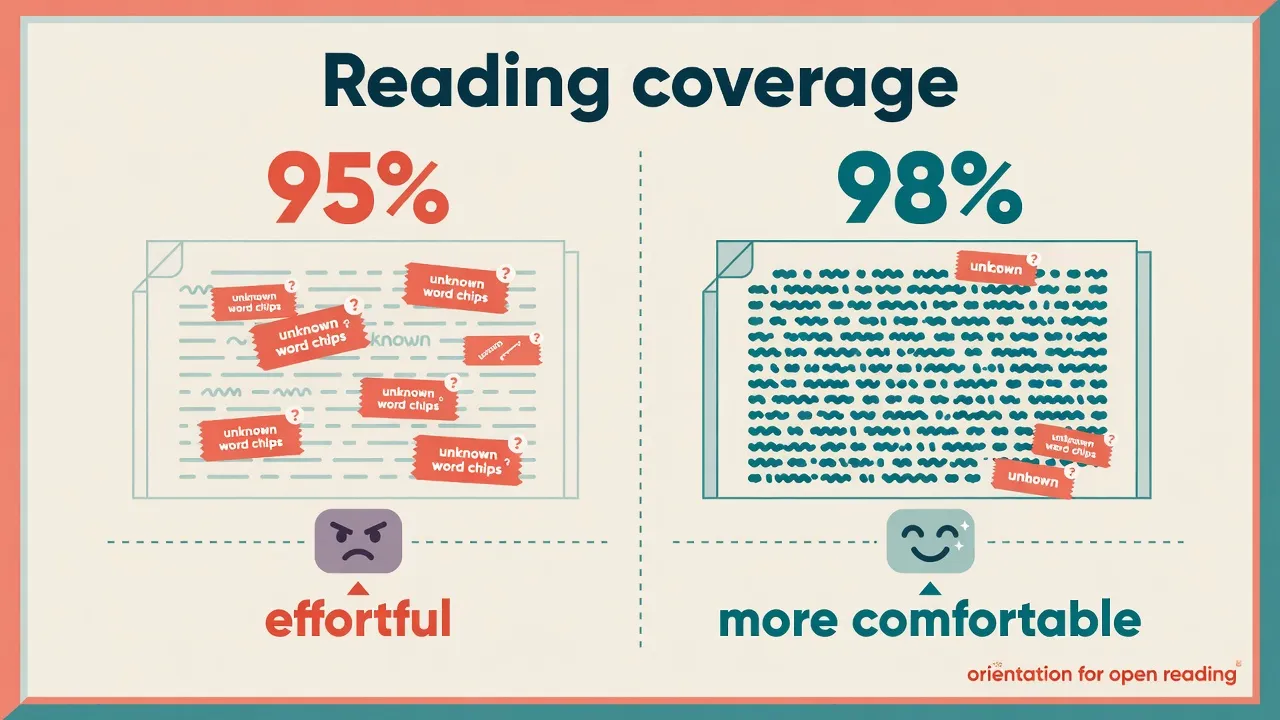
Genre and background knowledge still move the needle. For novels and technical text, the receptive lexicon you need can sit above a frequent-lemma B2 orientation band, especially if you count in families rather than lemmas.
So:
- B2 orientation (~3,250-3,750 frequent lemmas) helps you plan a high-frequency base.
- Comfortable open reading still needs more exposure, multiword units, and topic depth.
- B2 is a strong intermediate station, not "I finished vocabulary forever."
Judge the page in front of you by unknown density, not only by a universal word trophy. Larger "5,000 words" headlines often mix units or goals: Does 5,000 words mean C2?.
English vs Spanish: same band, different friction
English as learning target
Public vocabulary-size talk is heavily shaped by English frequency lists and classroom tools (including X-Lex-style estimates). Useful notes:
- High-frequency cores transfer well across many texts.
- Phrasal verbs and multiword chunks are easy to undercount if you only track single lemmas.
- Academic and literary low-frequency items dominate hard reading long after a B2 map band.
Spanish as learning target
Instituto Cervantes Plan Curricular describes contents and progression for Spanish teaching. It is not a single mandatory word quota for B2. Spanish-specific friction often includes:
- dense verb morphology in narrative past tenses
- clitics and object pronouns
- gender/number agreement that slows parsing even when the lemma is "known"
- regional dialogue in real media
Cognates help some L1 pairs more than others. Cognates do not cancel coverage needs on authentic pages. Deeper Spanish content framing: Spanish vocabulary and Plan Curricular.
Bottom line: use the same orientation scale for English and Spanish on the map, but expect different stuck points. Plan Curricular frames Spanish content; it does not replace research ranges with one legal word count. MovaReader learning targets are English and Spanish only.
A practical plan: high-frequency base + contextual reading
- Accept the orientation band. Open the free language map and read B2 as ~3,250-3,750 frequent lemmas, not as a certificate.
- Protect the high-frequency core. Unknowns in the top thousands hurt every page.
- Read daily material you can finish. Graded or lightly supported texts beat heroic novels you abandon. Sample library: All articles.
- Mark words you truly recognize in context, not words you saw once on a flashcard. Level catalogue after sign-in: B2 vocabulary.
- Separate recognition from production. Speaking and writing still need retrieval practice; lists alone do not finish B2 can-do.
- Volume has a soft price wall. The free plan is a trial (20 word translations a day). If you need unlimited translations and dictionary volume to grow marks honestly, Reader at €1/mo is the practical path. Trainers are optional deeper practice.
Soft tracking path: register, choose English or Spanish, read, mark, revisit. No 60-second free certification. Setup notes: How to use.
How to use the B2 level on the language map
A good map does three jobs:
- Shows research ranges so B2 is not pure folklore.
- Separates orientation (public bands) from personal progress (your learned marks).
- Links growth to reading, where words reappear in context.
What it should not claim:
- free official certification
- exact CEFR level from a shareable 30-second quiz
- that catalogue size equals Council of Europe law
- that Ukrainian is a learning target in MovaReader (UI language only; learning targets are English and Spanish)
MovaReader paths
- Public hub: Language map
- B2 catalogue (after sign-in): B2 vocabulary
- Neighbors: B1, C1
- Pillar table A1-C2: How many words for CEFR
- Product: How to use, Pricing, optional trainers
The free map shows orientation ranges. Your personal fill only appears after you sign in, pick English or Spanish, and mark words you actually know. The free plan is enough to try (20 translations a day). If you need real reading volume with translations and a personal dictionary, Reader starts at €1/mo.
Personal % / stage reflects words you mark as learned against curated lists. Meaningful fill usually needs real reading volume.
Common myths about words for B2
"CEFR officially requires 3,500 words for B2."
No official single quota. ~3,250-3,750 is a research orientation discussion for frequent lemmas, not law.
"If I hit the B2 number, I am B2."
You might have a strong intermediate lexicon and still fail a speaking exam, or pass an exam with uneven open reading.
"B2 means I can read any novel comfortably."
Many modern non-literary texts become workable; novels and technical text still vary a lot. Coverage research is harsher than trophy totals.
"Spanish and English need the same absolute list."
Frequency cores rhyme; morphology, multiword units, and culture do not clone 1:1.
"A free 60-second test can certify my B2."
Placement quizzes can be useful. Certificates and full level diagnosis need more than a shareable widget. MovaReader does not sell a free full CEFR level test.
FAQ
How many words do I need for B2?
There is no official CEFR word quota. For orientation on frequent lemmas, many tools (including MovaReader's language map) discuss roughly ~3,250-3,750. See the full ladder in How many words for CEFR A1-C2?.
Is 3,000 words enough for B2?
It may sit near the lower edge of some discussions, but units matter (lemma vs form vs family), and ability is multi-skill. Treat ~3,000 as "possible late B1 / early B2 orientation," not a pass.
Is 4,000 or 5,000 words B2 or higher?
On the frequent-lemma map bands used here, ~3,250-3,750 is B2 orientation; ~3,750-4,500 is C1 discussion; ~4,500-5,000+ is late-range / C2 discussion - not a special B2 rule. Larger family-based reading figures are a different unit. See Does 5,000 words mean C2?.
Why do some sites say 8,000+ for B2?
Usually different units (forms or families), different goals (comfortable novel coverage vs frequent core), or mixed app "known words." Ask what they count before you panic. Unit guide: Lemma vs word form.
Do these numbers work for Spanish the same as English?
As map scale, yes. As exact destiny, no. Plan Curricular frames Spanish content; it does not replace orientation ranges with one mandatory B2 word quota. English phrasals and Spanish morphology create different friction.
Can MovaReader give me a free full B2 level test?
No. The free map is orientation. Personal progress needs an account, a learning language (English or Spanish), and learned marks. Practical volume for translations and dictionary sits on paid plans from Reader €1. It is not IELTS, Cambridge, or DELE.
What should I do after this article?
Open the map, check the B2 band next to B1 and C1, then grow high-frequency vocabulary in context with reading you can finish. Paths: language map, B2 vocabulary after sign-in, How to use, Pricing.
Final takeaway
- Short answer: B2 orientation ~3,250-3,750 frequent lemmas
- Not a certificate: CEFR can-do is multi-skill; exams are separate
- Count units carefully: lemma vs form vs family explains blog wars
- Reading still needs coverage: B2 is not "fluent forever" on every page
- English and Spanish: same map scale; different friction (Plan Curricular is content, not one legal quota)
- The map: free ranges; personal progress via marks; Reader €1 for meaningful translation and dictionary volume
Use the free language map, open B2 vocabulary when you want catalogue tracking after sign-in, and keep the full picture at How many words for CEFR.
Keep reading with translations inside the text
With a free account, an unknown word translates with one tap, and the words you are learning wait for you in the trainer.
Free account: 7 days of Pro, then 20 word translations a day or a paid plan.