Vocabulary
Does 5,000 Words Mean You Are at C2?
Your Anki or dashboard hits 5,000 and the brain whispers "C2 done?" Not quite. Here is where that number comes from, why other sites say 10k or 16k, and what to aim for instead.
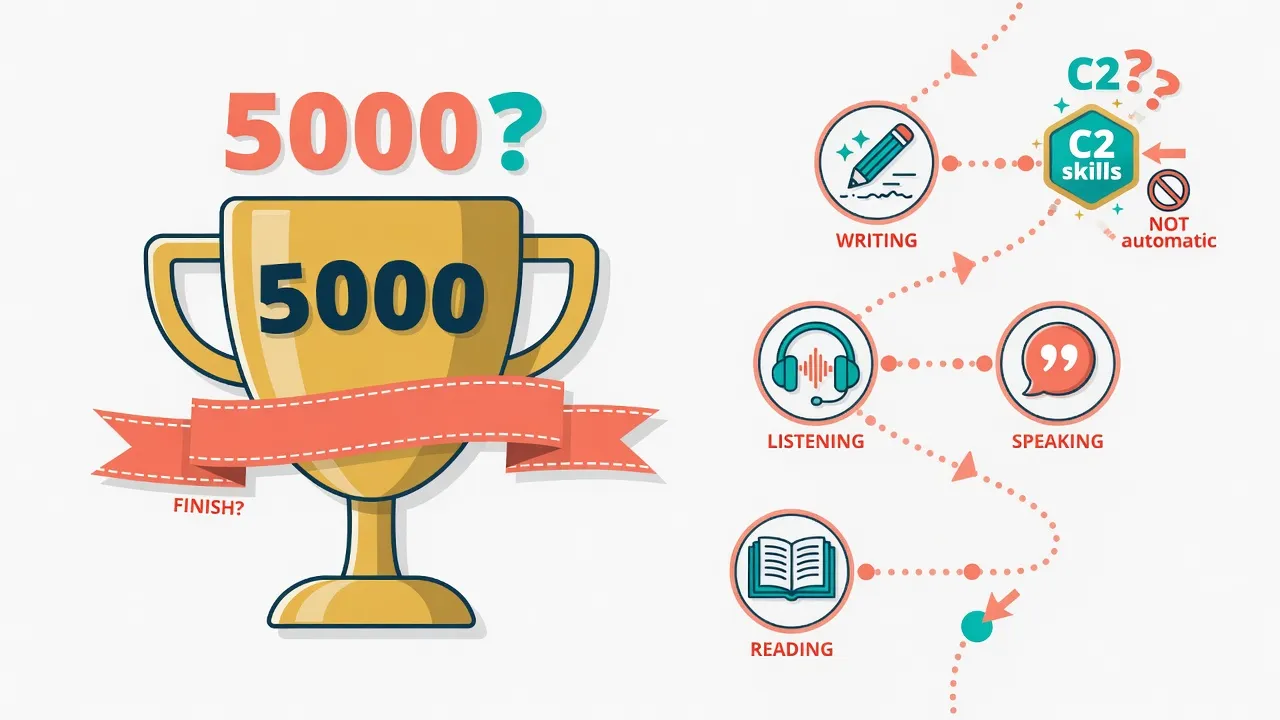
You open Anki, a vocab app, or a learning dashboard. The counter finally ticks past 5,000. For a second the brain writes the rest of the story for you: that is C2, right? I am done.
No. Seeing, saving, or even "knowing" about 5,000 words does not mean you are at C2. It is not a diploma. It is not fluent forever. It will not replace DELE, IELTS, Cambridge, or real use under pressure.
Where the number does come from is calmer and more useful. Some frequency-based learner scales (X-Lex-style discussions for English) treat roughly 4,500-5,000+ frequent lemmas as a late zone near the top of the checklist. MovaReader's free language map uses that same band as navigation, not as a certificate. Keep scrolling if you want the three competing internet numbers explained, why novels still hurt at 5k, and a healthier weekly loop than chasing a magic integer.
If you want the full A1-C2 table first: How many words for CEFR?. Units that break comparisons: Lemma vs word form. Tracking progress: Track vocabulary progress.
Where "5,000" comes from
The myth usually glues three different claims into one finish line:
| What people hear | What it often really means | What it does not mean |
|---|---|---|
| "C2 needs 5,000 words" | Late band on a frequent-lemma orientation scale | Official Council of Europe quota |
| "I know 5,000 words" | Some mix of flashcards, forms, and guesses | Measured C2 performance |
| "5,000 = fluent" | Marketing shorthand | Listening speed, register, grammar control, exam skill |
X-Lex-style scales and frequent lemmas
Classroom and research tools in the X-Lex / Milton & Alexiou tradition often estimate size against high-frequency lists. In that world, totals around the high thousands of frequent lemmas sit near the upper end of the scale for many learners. Blogs then collapse the idea into a neat slogan: "5,000 = C2."
A few caveats matter here:
- The unit is closer to lemmas / checklist items, not every surface form you ever saw.
- The lists prioritise high-frequency vocabulary. They are not a full educated native lexicon.
- A strong frequency score is not the same as flexible C2 use across topics, accents, and genres.
- Different tools, corpora, and scoring rules move the number.
So "5k on a frequency scale" can mean: you are strong on common vocabulary relative to many learners. It does not mean: you perform like a C2 exam candidate.
How the map frames C2
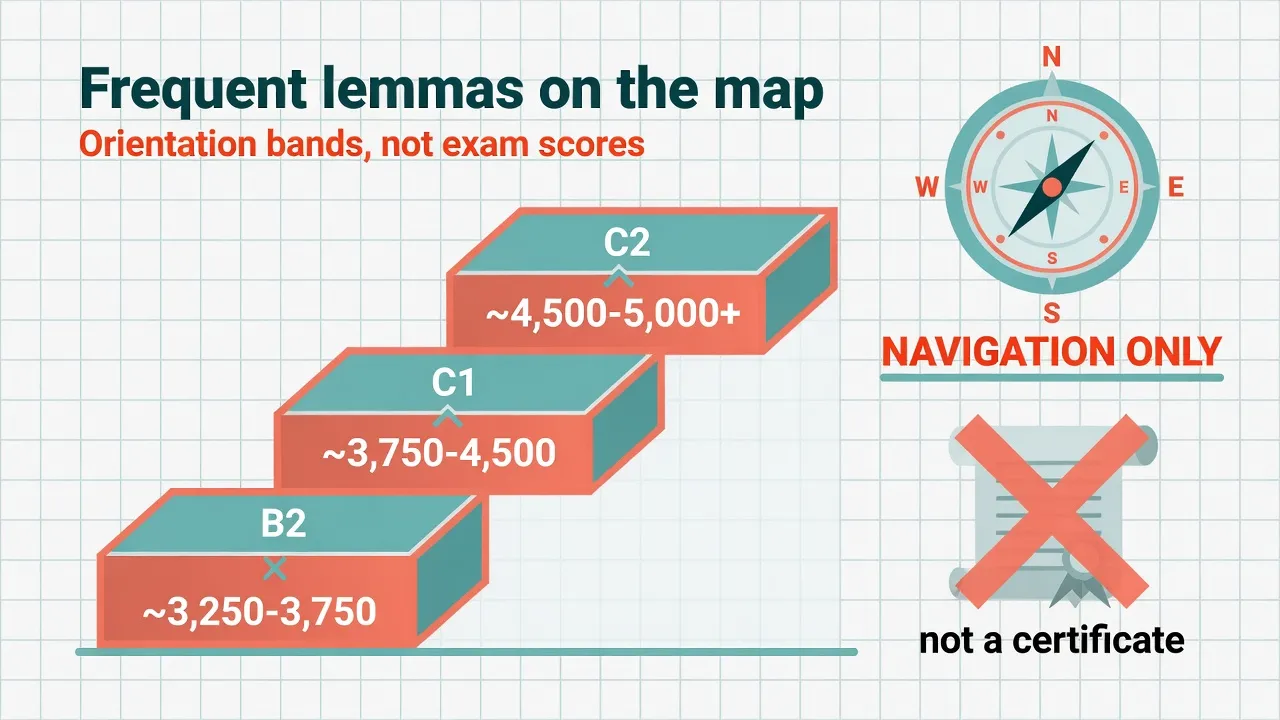
On the language map, the orientation band for C2 is ~4,500-5,000+ frequent lemmas. The neighbours look like this:
| Level | Orientation (frequent lemmas) |
|---|---|
| B2 | ~3,250-3,750 |
| C1 | ~3,750-4,500 |
| C2 | ~4,500-5,000+ |
Think of those bands as a compass, not a trophy shelf. For the B2 story in more detail: How many words for B2?. Catalogue pages such as C1 vocabulary and C2 vocabulary are curated progressive lists after sign-in. They are not identical to research ranges and not exam boards.
Why other sites say 10,000+ or 16,000
Here is the part most "5k = C2" posts skip. The internet is not lying in three different ways by accident. It is often talking about different jobs with different units.
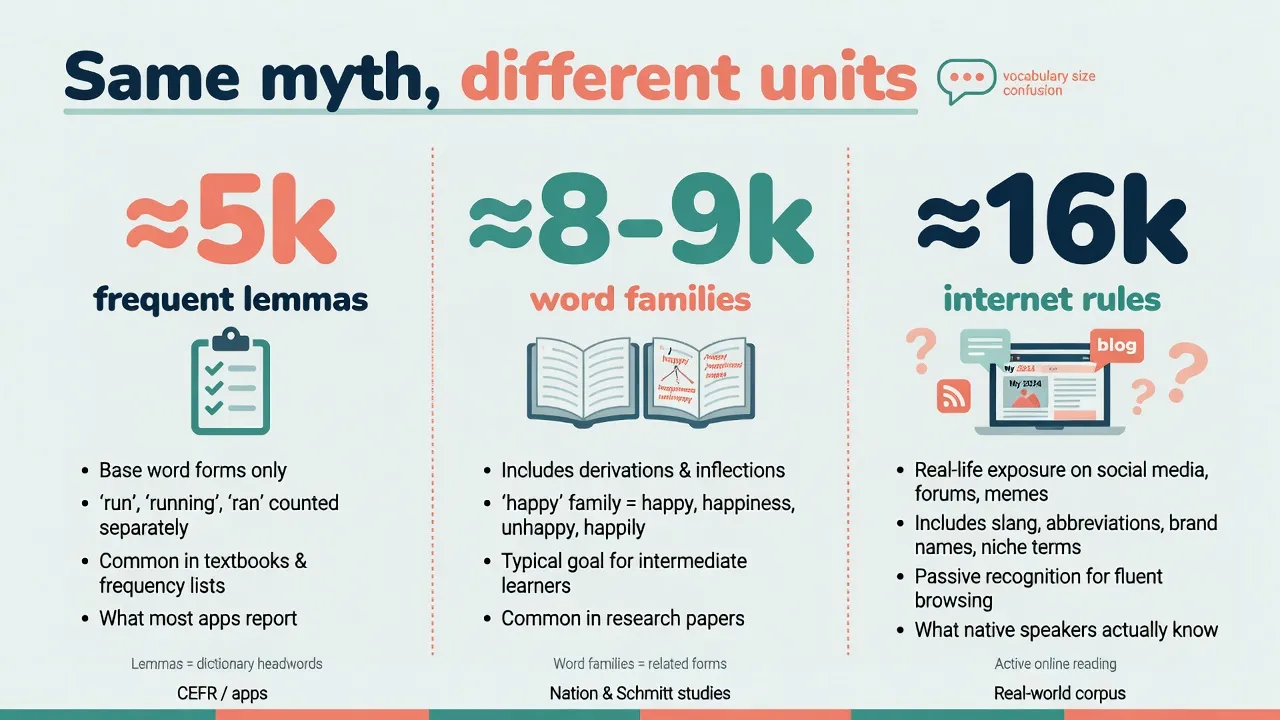
| Number you see online | Typical unit / tradition | What it really measures |
|---|---|---|
| ~4,500-5,000+ | Frequent lemmas (X-Lex-style upper learner scale) | Late common vocabulary orientation |
| ~8,000-9,000 | Word families (Nation-style coverage talk for authentic text) | Comfortable independent reading discussion |
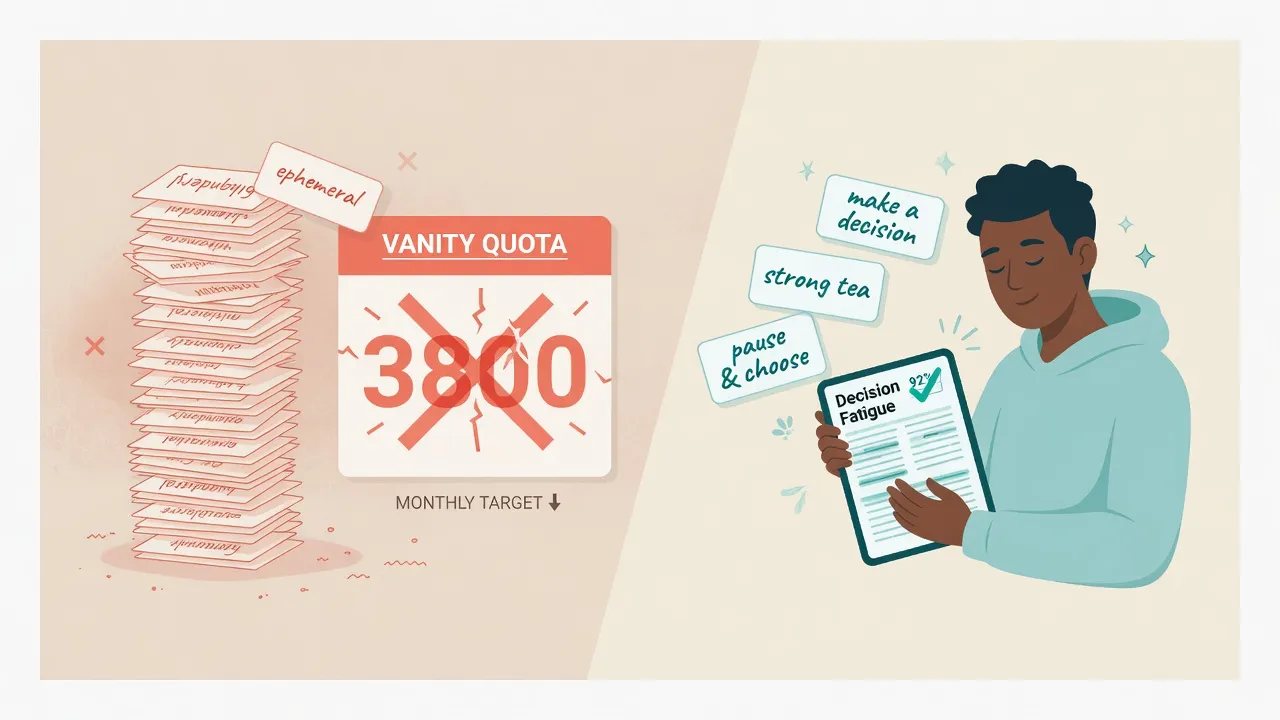
| ~10,000-16,000 | Blog "Rule of 2" / mixed passive-size guesses | Memorable milestones; not official CEFR law |
None of these is "official CEFR law." The Council of Europe describes what you can do, not a legal word quota.
Units matter more than the integer:
- Word forms count go / went / gone as three hits. Counters balloon.
- Lemmas group related forms under one headword. Maps and many checklists prefer this.
- Word families go wider still (related derivatives under one family in coverage research).
Goals matter too. A classroom frequency checklist asks: "How strong is your common core?" A novel-coverage discussion asks: "How many running words on a hard page do you already know?" Those questions produce different "enough" numbers even when both writers are careful.
That is why Site A can say C2-ish size is around 5k and Site B can wave at 10k or 16k without either inventing CEFR policy from thin air. For unit confusion in plain language, keep Lemma vs word form vs word family open in another tab.
Nation, coverage, and authentic texts
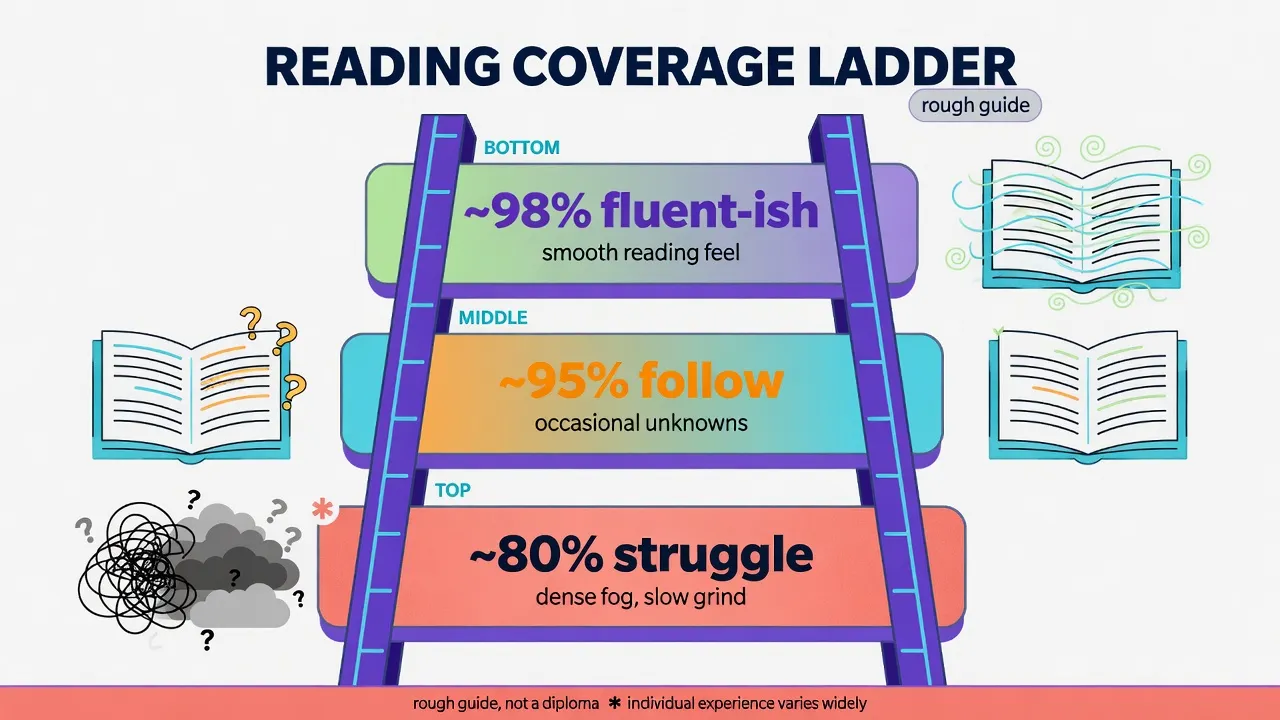
If your real goal is reading real pages, a single trophy total is the wrong hero metric. Reading research in the Nation tradition talks more about lexical coverage: what share of the running words on the page you already know.
| Coverage of running words | Typical feel for independent reading |
|---|---|
| ~95% | Possible but effortful; many look-ups or guesses |
| ~98% | Often discussed as more comfortable for hard independent reading |
To push coverage on authentic novels, newspapers, and academic-ish text, researchers often discuss needing on the order of 8,000-9,000 word families (not the same unit as "5,000 frequent lemmas"). That is one reason "I have 5,000 in Anki" and "I still drown in novels" can both be true.
Translation for learners:
- Frequent lemmas ~5k on a map = late orientation for common vocabulary.
- Comfortable coverage of authentic text often needs a larger, messier lexicon plus background knowledge.
- Genre matters. A sports blog and a legal opinion do not share one magic total.
- Unknown density on the page in front of you is more reliable than a global counter.
When blogs say "5,000 is enough to read anything," they usually ignore families vs lemmas, multiword units, names, slang, and topic vocabulary.
Skills beyond vocabulary still decide C2
CEFR (and the Companion Volume) describes what you can do, not how many headwords you own. C2-ish ability is about flexible, precise, almost effortless use across contexts. Vocabulary is necessary. It is not sufficient.
Even with a large lexicon, you can still struggle with:
| Skill area | Why a word count fails |
|---|---|
| Grammar control | Dense clause stacking, aspect, modality, agreement under time pressure |
| Listening fluency | Reduced speech, accents, speed, noise |
| Speaking fluency | Retrieval speed, repair strategies, turn-taking |
| Register and pragmatics | Formal vs informal, hedging, irony, professional tone |
| Writing organisation | Cohesion, argumentation, genre conventions |
| Exam strategy | Timing, task types, scoring criteria (IELTS, Cambridge, DELE) |
You can reverse the story too: someone exam-trained can pass a high-level paper with uneven open reading or narrow topics. A private word counter does not capture either case.
When vocabulary is not the only bottleneck inside MovaReader, optional companions include the grammar tree (full reading path more on Pro) and trainers (full unlimited more on Pro). Reading still remains the main loop for growing words in context: All articles.
English vs Spanish: counting caveats
MovaReader learning targets are English and Spanish only. The same "5,000" myth shows up for both, but the counting friction differs.
English
- Frequency lists and X-Lex-style talk shaped a lot of public "size" discourse.
- Phrasal verbs and multiword units (look after, put up with) are easy to undercount on single-lemma dashboards.
- Irregular forms (go / went / gone) inflate form counters without new meanings.
- Academic and literary tails are long; common-word strength does not equal novel comfort.
Spanish
- Instituto Cervantes Plan Curricular defines content and progression, not one legal word quota per CEFR level. See also Spanish vocabulary and Plan Curricular when you want that angle.
- Verb morphology makes form counts explode (hablar paradigms) while lemma maps stay calmer.
- Clitics, object pronouns, and gender/number agreement slow parsing even when the lemma feels "known."
- Regional dialogue and media slang add layers that a tidy 5k checklist never lists.
Bottom line for both languages: treat ~4,500-5,000+ as a late frequent-lemma zone on a map, not as "native-like forever" and not as automatic exam success.
Healthier goals than a magic number
Replace "I need exactly 5,000" with goals you can actually observe:
- Unknown density. Can you finish a short authentic article with look-ups that still feel productive?
- Receptive vs productive. Recognition always runs ahead of free use; plan for both.
- Coverage by genre. News, fiction, work email, and exams are different jobs.
- Stable high-frequency core. Missing common words hurts more than missing rare gems.
- Skills practice. Speaking, listening, and writing sessions that force retrieval.
- Consistent tracking. One consistent catalogue beats three incompatible app totals.
A practical weekly loop looks less like a finish-line party and more like this:
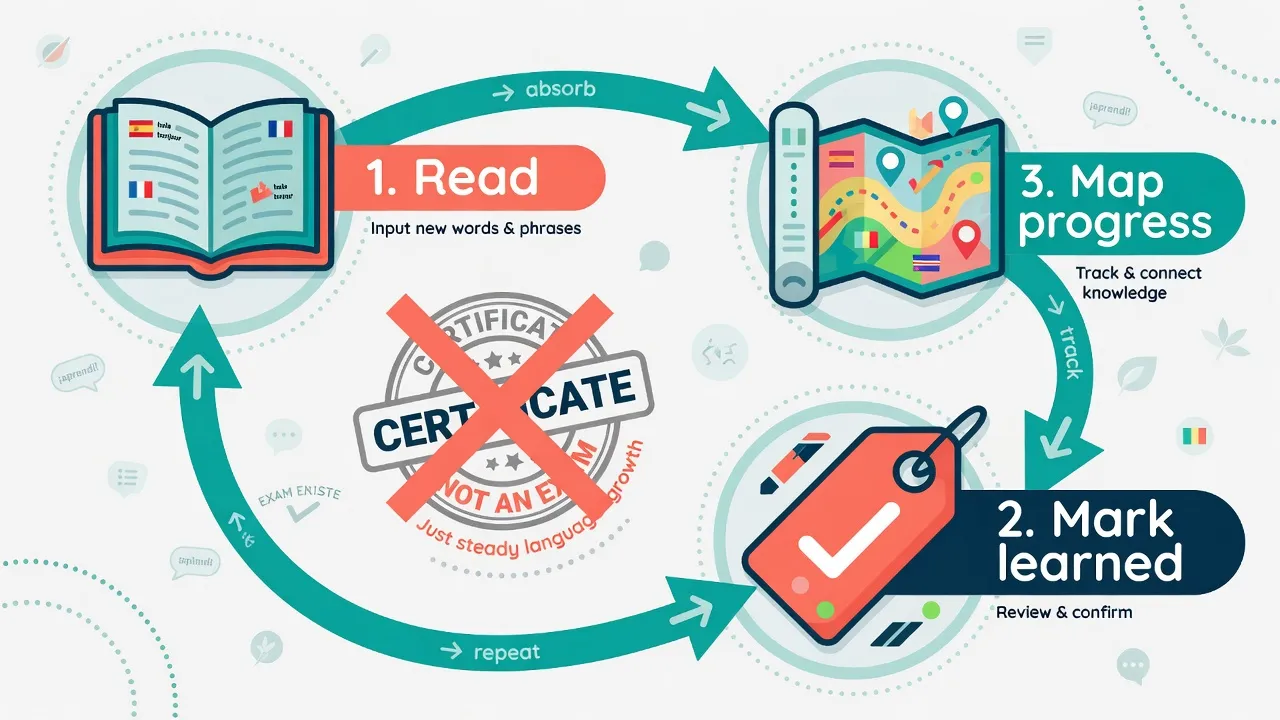
- Read material slightly above comfort (graded or supported authentic).
- Save and mark learned only what you truly recognise in context.
- Review a sustainable set (optional trainers on Pro if volume helps).
- Check orientation on the free map; do not treat personal % as a certificate.
More on useful metrics: How to track vocabulary progress. Product workflow: How to use.
Use C1/C2 map bands as navigation only
Late bands are a compass, not a trophy shelf.
Do:
- Open the free language map and read C1/C2 as orientation.
- After sign-in, browse C1 and C2 catalogues as progressive lists.
- Grow marks through reading volume; use Reader from €1 when freemium's 20 translations/day blocks real volume.
- Confirm high-stakes goals with real exams or trusted tutors, not a map percentage.
Do not:
- Treat 5,000 as automatic C2.
- Compare raw Anki form counts to lemma orientation bands.
- Expect a free full CEFR level diagnosis from the map.
- Confuse UI language (including Ukrainian on the site) with a learning-target language; targets are English and Spanish.
What personal map progress actually is
| Map surface | What it is | What it is not |
|---|---|---|
| Public research ranges | Orientation for frequent lemmas | Official CEFR law |
| Personal % / stage | Learned marks vs curated catalogue size | DELE / IELTS / Cambridge score |
| Level vocabulary pages | Progressive teaching lists | Native lexicon inventory |
Soft path if you want tracking: register, choose English or Spanish, read, mark, and ignore vanity totals. Freemium can try the product (20 word translations/day). Practical volume of reading translations and personal dictionary use sits on paid plans from €1/mo (Reader). There is no free full CEFR level test.
FAQ
Does 5,000 words mean C2?
No. About 4,500-5,000+ frequent lemmas is a late orientation zone on some research-informed scales and on the language map. C2 is multi-skill performance, not a private counter.
Is 5,000 words enough for fluency?
"Fluency" is vague. Strong common vocabulary helps, but fluency also needs speed, listening, grammar under pressure, and topic range. Five thousand checklist items do not guarantee any of that.
Why do some sites say C2 needs 5,000 and others say 10,000+?
Different units (forms, lemmas, families), different corpora, and different goals (classroom frequency vs novel coverage). X-Lex-style talk sits near ~4.5-5k frequent lemmas. Nation-style coverage discussions often sit higher when the unit is word families for authentic text. Blog "Rule of 2" tables may climb toward 10k-16k as memorable milestones. See lemma vs word form.
Is 5,000 enough to read novels?
Sometimes for lighter modern prose with support; often not for dense literary or specialised text. Watch unknown density on the page. Coverage research suggests many learners need a larger, broader lexicon than a 5k frequent core for comfortable independent reading.
Does the same number work for Spanish and English?
As a rough map band, yes. As exact destiny, no. Spanish morphology and Plan Curricular content framing change the feel; English multiword verbs change counting. Neither language has a single official CEFR word quota.
Can MovaReader certify my C2 for free?
No. The free map is orientation. Personal catalogue progress needs an account, English or Spanish as learning language, and learned marks. Practical translation and dictionary volume for filling that progress sits on paid plans from Reader €1. The product does not replace official exams and does not offer a free full CEFR level test.
What should I aim for instead of "hit 5,000"?
Aim for readable pages in your real genres, a solid high-frequency base, growing productive use, and skills practice. Use the map as navigation; use reading as the engine.
Final takeaway
5,000 words is a late frequent-lemma discussion zone, not a C2 badge.
X-Lex-style scales explain why "5k" feels like a finish line. Nation-style coverage explains why authentic text still hurts. Grammar, fluency, register, and exams sit outside any private total. English and Spanish share the myth and not the exact counting pain. The map is a compass for catalogue learning, not certification; Reader from €1 supports the reading volume that feeds honest marks.
Next step: open the language map, skim C1/C2 as orientation only, then grow words in context rather than chasing a magic integer.
Keep reading with translations inside the text
With a free account, an unknown word translates with one tap, and the words you are learning wait for you in the trainer.
Free account: 7 days of Pro, then 20 word translations a day or a paid plan.