Vocabulary
How to Check Your English Vocabulary Size for B2
You can score high on flashcards and still freeze on a real article. How to check your English vocabulary size on a page you care about, with a practical 15-minute loop.
Your Anki deck is green. Duolingo says you are on a roll. Then you open a short New York Times piece or a Netflix scene without subtitles, and the fog rolls in. Half the words feel familiar in isolation. The sentence still does not land.
That gap has a plain name: the blind zone. You can pass an isolated list and still struggle with the same items inside running meaning. The problem is not only "how many words do I have?" It is how you check.
Here is the simple version. You check vocabulary size reliably by measuring comfort on a real page, not by collecting a viral badge. Pick a short text near your goal, mark only words you would defend next week, and estimate known-word coverage (dense fog vs occasional unknowns). If you want a number, a careful research-style size test (yes/no or Nation-style) can estimate receptive knowledge in a named unit - often word families. That number is still not a CEFR diploma. Soft B2 orientation sits near ~3,250-3,750 frequent lemmas on our map; full counts live on the sibling post. Fifteen minutes of read → mark unknowns → compare comfort beats a 1-minute "true size" quiz.
Below we unpack the blind zone, clear units for "size", a soft B2 band (with links to the full numbers), why multiple-choice and fast quizzes mislead, a finishable 15-minute protocol, coverage caveats, and a free language map as a compass. Learning targets in the product path are English and Spanish only.
If you mainly need counts, go to How many words for B2?. Full A1-C2 ladder: How many words for CEFR?. Ongoing metrics and streaks: Track vocabulary progress. This post covers how to check in one sitting.
The blind zone: you "know" the word - until the page
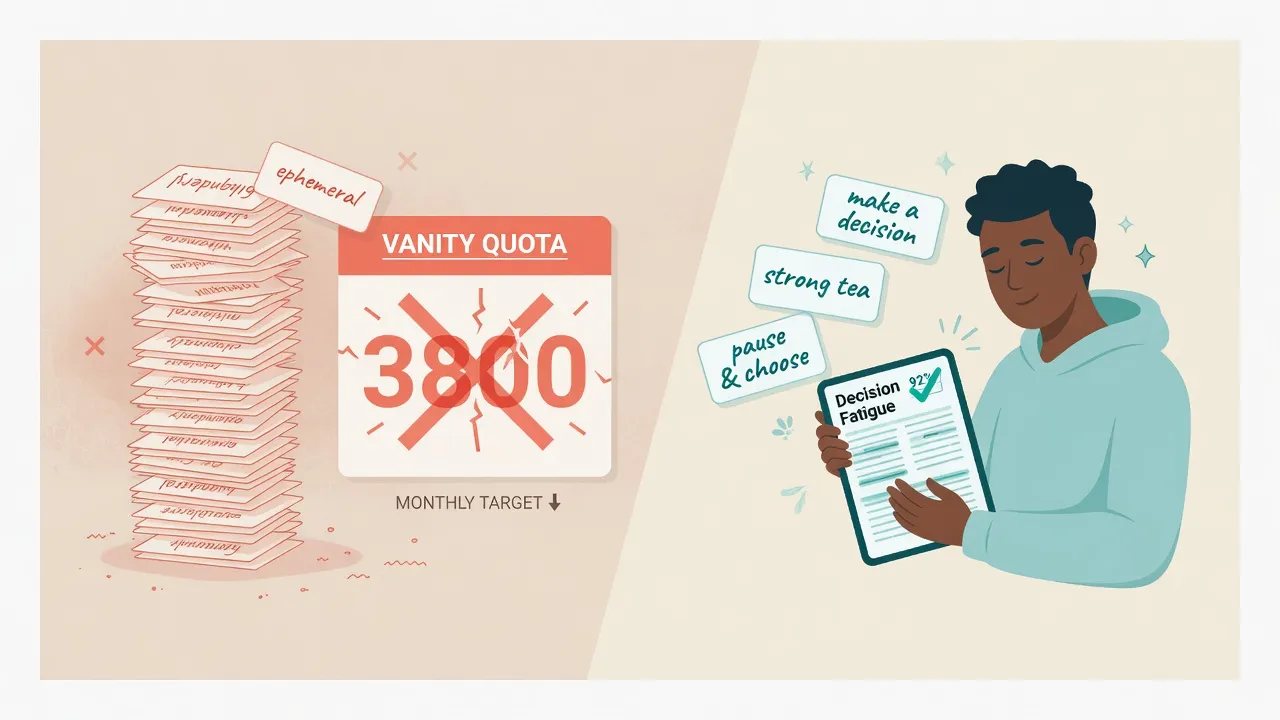
Flashcards and app drills often test isolated recognition: the word sits alone, maybe with one translation or a short clue. That can feel strong. Real reading and dialogue test in-context recognition: the same item has to fire while meaning is moving.
A learner voice many of us know: "Every word looked familiar; the sentence still didn't."
That is the blind zone in one line. Your passive list can look huge while authentic text still stalls. A size number alone does not close the gap. The method of checking has to include a real page, or you will keep optimizing for green streaks and foggy articles.
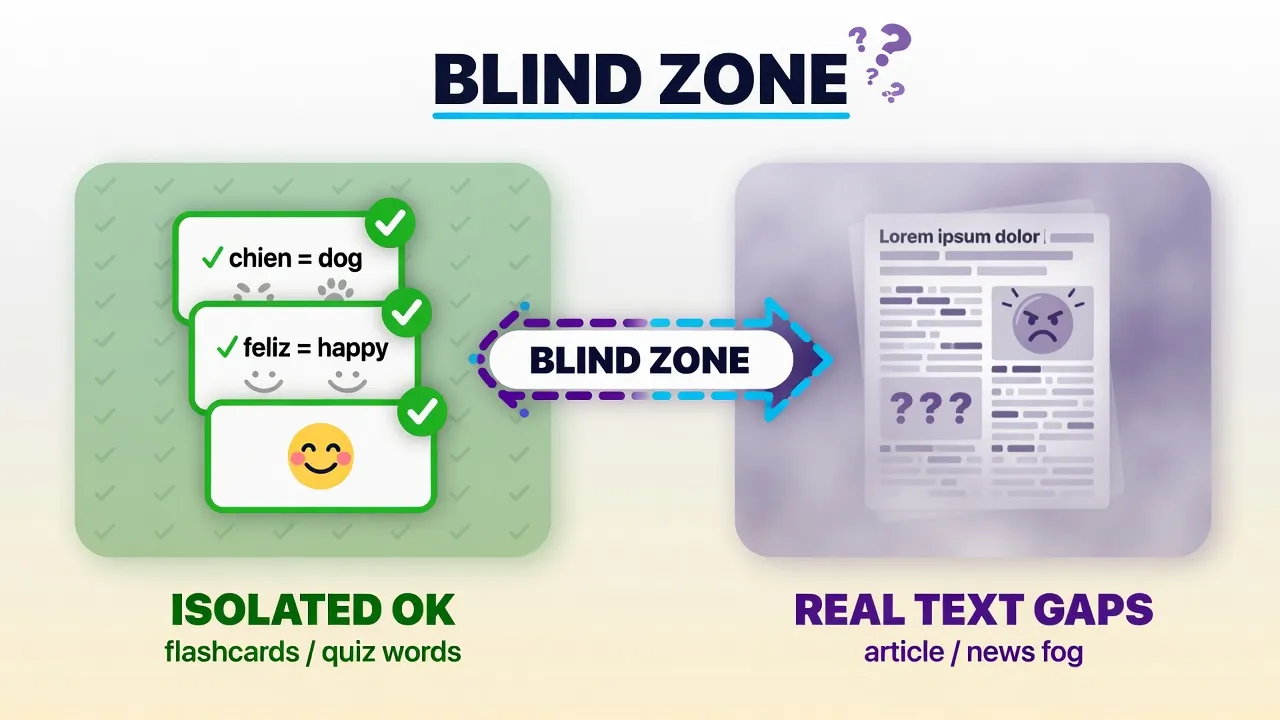
Same word list, two different checks.
So when you ask "how do I check my English vocabulary size?", answer with two layers: a careful size sample if you want a range, and a coverage feel on text you actually care about. The second layer is what viral quizzes almost always skip.
What "vocabulary size" actually means
Before any number, name the unit. Otherwise you will compare apples to bus tickets.
| Unit | What it is | Where you see it |
|---|---|---|
| Word form | Spelling on the page (runs, running) | Running text; raw counters |
| Lemma | Dictionary head (run) | Frequency lists; map spine (frequent lemmas) |
| Word family | Related derivatives under one family | Nation-style VST; many research size tests |
Reader rule: never equate "4,000 families" with map "~3,500 lemmas" or with "you are B2."
A few more points to keep in mind:
- Most size quizzes estimate receptive recognition (you understand it when you see it).
- Productive use (you can retrieve and say or write it under pressure) is usually smaller.
- Multi-sense words need context. Knowing run as "jog" does not automatically unlock Who runs this company?
When two tools disagree, fix the unit first. A deeper walk-through lives at Lemma vs word form. For this article, the gate is simpler: no unit label, no trust in the number.
Soft B2 band (and where the full numbers live)
If your goal is roughly B2, you still need an orientation band - a road sign, not a diploma.
Research-informed tools and MovaReader's public language map often put B2 near ~3,250-3,750 frequent lemmas. Same soft band as our map spine. Treat it as a sense of scale for common headwords, not as a certificate you unlock when a counter ticks over.
CEFR has no official word quota. Multi-skill B2 still needs listening, grammar control, topics, and performance under real conditions. Vocabulary supports those outcomes; it does not replace them.
Deep counts, unit wars, and can-do context belong to How many words for B2?. The full A1-C2 ladder lives in How many words for CEFR?. Skip folklore like "4,000-5,000 word families = B2 law." Soft band, then back to methods.
Why multiple-choice (and fast) tests mislead
Online "vocabulary tests" are not all equal. Some are useful receptive samples. Many are entertainment with a confidence hangover.
Multiple choice invites guessing. You can pick a synonym without ever using the word. Multi-sense items get reduced to one neat option. High scores feel like level stamps; they are not.
Yes/no ("do you know this word?") is fast and honest-looking, but people overclaim. "I have seen it" becomes "I know it." Without a page or a production check, the total inflates.
Adaptive two-minute tools can be useful as a receptive size estimate when they name the unit (often families). Still not a multi-skill CEFR certificate. Still not proof you will finish tomorrow's article comfortably.
Viral entertainment quizzes optimize for shareability. Treat them as games, not size science.
Research traditions in the Nation VST family and careful adaptive samples are different from a "free B2 stamp in 60 seconds." If you want a number, treat it as a range with a unit label. Then still run the reading check in the next section. A fast sample alone will not show your blind zone.
A 15-minute real-text check protocol
Here is the practical core of this article: one finishable self-check. It is a way to answer "where am I on a page I care about?" without waiting for a perfect lab score.
- Pick a page you care about near your goal. A graded free sample or a short authentic extract works. Skip the hardest novel on day one. Prefer something you can finish in one sitting. Free library paths: all articles. How the product reading loop works: how to use.
- Read for meaning. Do not trophy-dictionary every rare name or one-off proper noun. Stay with the story or argument.
- Mark unknowns honestly. Only words and phrases you would not bet on recognizing next week. No ego marks. No "I almost knew it" for the leaderboard in your head.
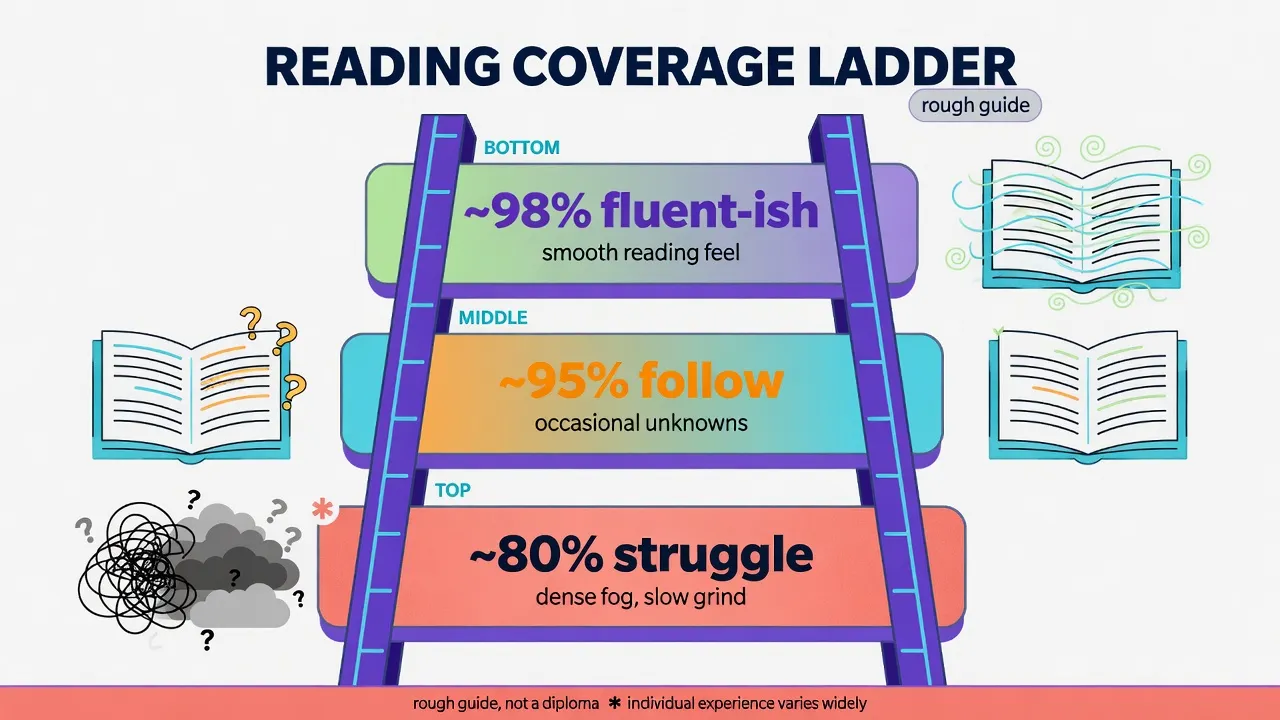
- Estimate coverage feel - roughly: every sentence stuck / frequent fog / occasional unknowns / almost clear. That feel is not a CEFR letter. It is a practical sensor. The next section explains the famous 95% / 98% discussion with caveats.
- Optional: one careful receptive size sample (yes/no or research-style). Label the unit (families vs lemmas). Write "estimate, not diploma" next to the number.
- Map orientation. Open free public ranges on the language map. Personal fill comes later after careful marks - more on that in the product section.
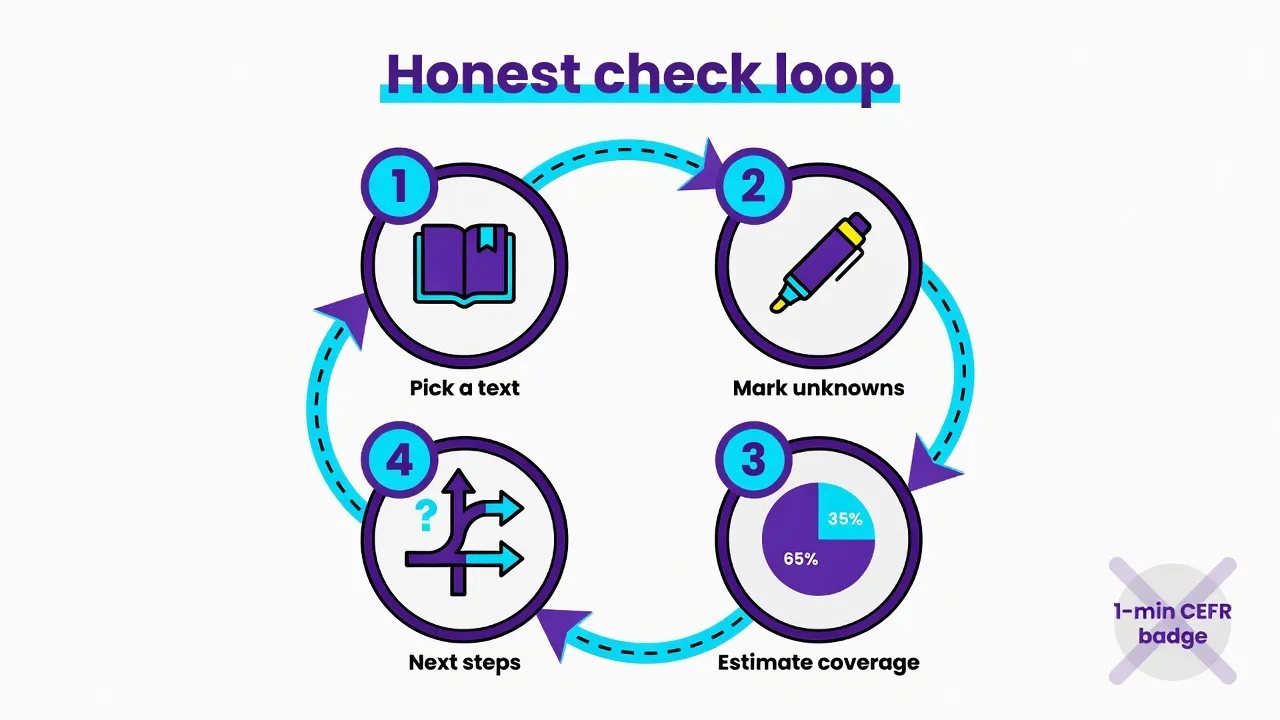
Fifteen minutes on a real page tell you more than a 1-minute quiz.
Ground rules under the list:
- No trophy marks
- Productive skill is separate from receptive recognition
- One language path at a time for learning (English or Spanish)
- Re-run on a new page next month rather than chasing one magic integer forever
If the page is constant fog, the text may be above your current comfort - even if a viral quiz once said "C1 vibes." That is useful information, not failure. Drop difficulty, finish more pages, mark carefully, and check again later.
Coverage 95% / 98%: useful caveats (not a CEFR score)
Reading research often discusses lexical coverage: what share of the running words on a page you already know.
Rough discussion points you will see in the literature tradition (Hu & Nation, Schmitt, Laufer-style discussions):
- Knowing about ~95% of running words is often framed as more effortful / a minimal zone for many texts.
- Knowing about ~98% is often framed as more comfortable independent hard reading.
Those are discussion points about page coverage, not CEFR letters and not a B2 pass mark.
A few caveats worth keeping in mind. Those bands are not a diploma and not "exactly 98% or you fail B2." They do not guarantee full comprehension - background knowledge, grammar, speed, and genre still matter. They mostly come from an English reading corpus tradition, so do not paste them as universal law for every Spanish page or for listening. In practice, judge unknown density on the page in front of you more than a global magic percentage.
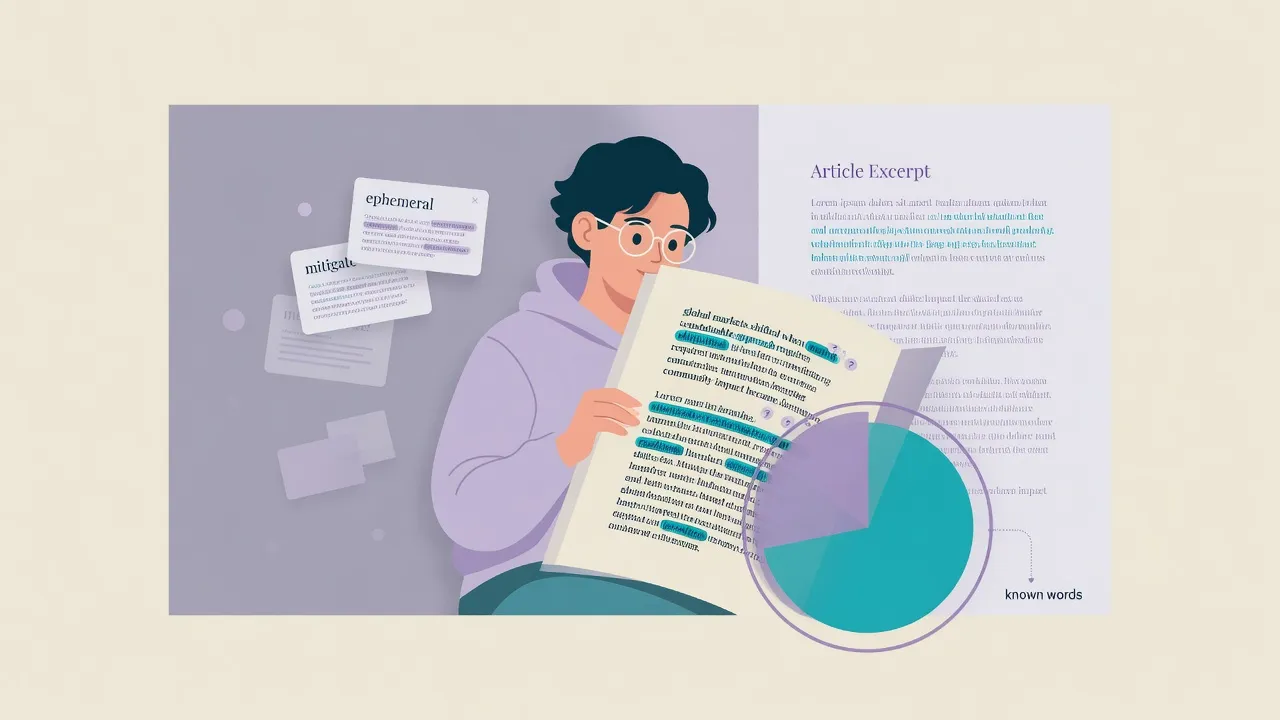
Discussion points, not a diploma.
In the 15-minute protocol, you do not need a lab counter for every token. You need a rough feel: dense fog, frequent friction, occasional unknowns, or almost clear. That is enough to choose the next text and the next month's plan. For more on vocabulary that serves reading, see Vocabulary for reading comprehension when you want a sibling on that angle.
After the check: language map first
After the check, you need a compass more than a trophy.
Open the free language map. Guests see research-style orientation ranges (including the soft B2 band near ~3,250-3,750 frequent lemmas). That is navigation, not "you just passed an exam."
Two layers on the same idea:
- Public orientation - free ranges for guests. Road signs.
- Personal progress - approximate coverage of catalogue items you marked learned for English or Spanish. Needs an account, a learning path, and many careful marks. Empty personal % for guests or unmarked accounts is by design, not "you know nothing" and not a broken free test.
What actually helps after the check: graded free library plus your own EPUB, tap-translate in context, save blockers, and mark what you would still defend next week. Freemium is enough to try: about 20 word translations per day. When real pages need more dictionary volume, Reader starts at €1/mo. Unlimited trainers and deeper practice paths are more Pro (€5/mo) - optional. Details: pricing. Sign-up if you want personal fill: register. Mechanics tour if you like: Language map explained.
To be clear: the map is not a CEFR level test or certificate, and MovaReader is not DELE, IELTS or Cambridge. Learning targets are English and Spanish.
This article is a one-shot methods guide. For multi-month metrics, streaks, and why a map can sit at 0%, continue with Track vocabulary progress.
FAQ
How do I check my English vocabulary size?
Use a real page near your goal. Read for meaning, mark only words you would not bet on recognizing next week, and estimate known-word comfort (dense fog vs occasional unknowns). Optional research-style size tests can add a receptive range if you name the unit (often word families). That whole loop fits in about 15 minutes. It is a self-check, not an official exam.
Can a 1-2 minute test give my real CEFR level?
No. Fast quizzes and adaptive size samples can estimate receptive recognition in a named unit. They do not certify multi-skill B2 (listening, grammar, topics, performance under exam rules). Treat any letter or "level" from a short vocab quiz as soft orientation at best - then run a real-text check.
How many words for B2?
Soft orientation on our map sits near ~3,250-3,750 frequent lemmas - a road sign, not a diploma. CEFR has no official word quota. For deep counts, unit wars, and can-do context, read How many words for B2?; full ladder: How many words for CEFR?. This post covers how to check.
What is lexical coverage 95% / 98%?
Research on reading often discusses knowing about ~95% of running words as more effortful for many texts, and ~98% as more comfortable for independent hard reading. Those are discussion points about page coverage, not CEFR letters and not guaranteed full comprehension. Background knowledge, grammar, speed, and genre still matter. Judge unknown density on the page in front of you more than a global magic percentage.
Word family vs lemma - which does my test use?
Name the unit before you trust the number. Many Nation-style and research size tools report word families. Frequency lists and MovaReader's public map spine use frequent lemmas. A form is the spelling on the page. Never equate "4,000 families" with "~3,500 lemmas" or with "I am B2." Deeper units: Lemma vs word form.
Does MovaReader give a free full CEFR exam?
No. The free language map is an orientation compass (research-style ranges). Personal % is marks on catalogue after you sign in and choose English or Spanish - learning analytics, not DELE / IELTS / Cambridge / a free full CEFR certificate. Freemium is enough to try (~20 word translations/day); Reader from €1 when reading volume bites.
Why do flashcards look C1 while news still fails?
That is the blind zone: isolated recognition vs in-context recognition. A list can look green while running text still stalls. Fix the check method - add a real-page coverage loop - not only a bigger isolated deck.
Next steps
- Run the 15-minute check today on one real page from all articles.
- Soft-read the B2 band if you need numbers: How many words for B2? and the ladder How many words for CEFR?.
- Open the free language map for orientation ranges (soft B2 included).
- Register if you want personal fill: choose English or Spanish, then mark carefully from real reading.
- Stay on freemium while testing; step to Reader from €1 on pricing when translation volume bites. Onboarding: how to use. For ongoing metrics later: Track vocabulary progress.
A good check ends with a page you finished and a compass you trust - not a badge that expires the moment the next article starts.
Learning English?
The English version of MovaReader teaches Spanish and Ukrainian. To read English with a translation for every word, open the reader in Ukrainian or Spanish:
Книги англійськоюЦя стаття українськоюLibros en inglésEste artículo en español